
Medical Injection Molding Machine Market Size and Share
Market Overview
| Study Period | 2021 - 2031 |
|---|---|
| Market Size (2026) | USD 2.28 Billion |
| Market Size (2031) | USD 2.97 Billion |
| Growth Rate (2026 - 2031) | 5.45 % |
| Fastest Growing Market | Asia-Pacific |
| Largest Market | Asia-Pacific |
| Market Concentration | Low |
Major Players *Disclaimer: Major Players sorted in no particular order Image © Mordor Intelligence. Reuse requires attribution under CC BY 4.0. | |
Medical Injection Molding Machine Market Analysis by Mordor Intelligence
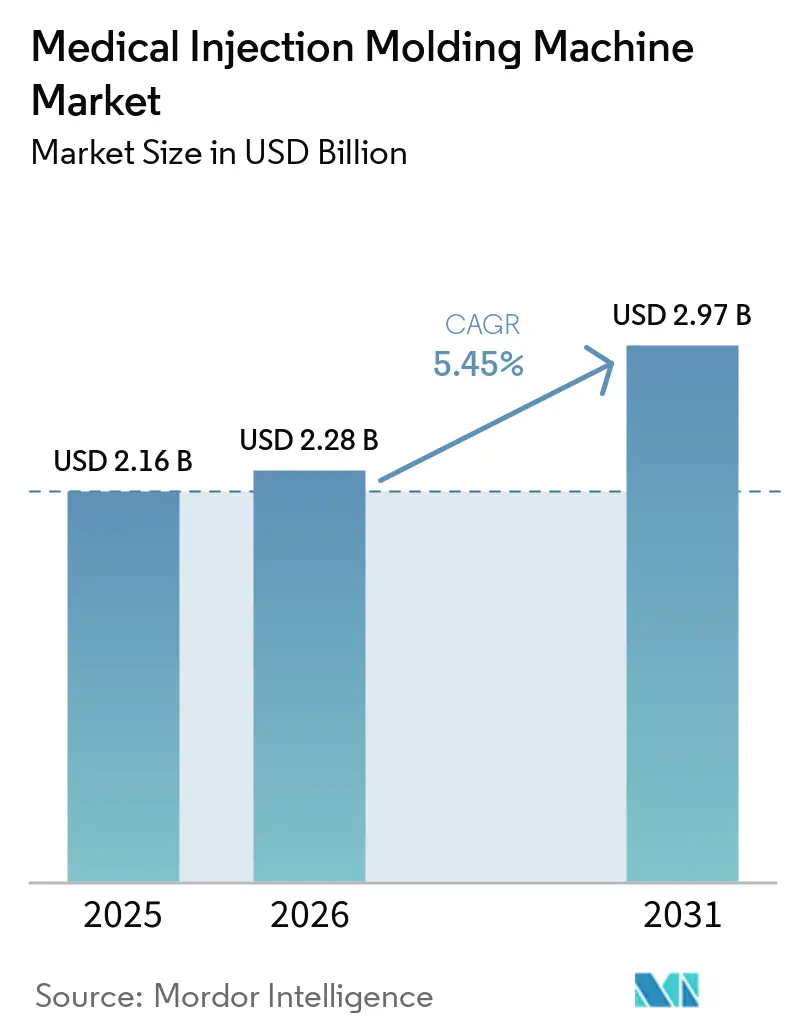
The Medical Injection Molding Machine Market size was valued at USD 2.16 billion in 2025 and is estimated to grow from USD 2.28 billion in 2026 to reach USD 2.97 billion by 2031, at a CAGR of 5.45% during the forecast period (2026-2031). Demand is supported by rising output of single-use devices, injectable drug-delivery systems, and diagnostic components. The U.S. Food and Drug Administration Quality Management System Regulation took effect on February 2, 2026, and incorporated ISO 13485:2016 by reference into 21 Code of Federal Regulations (CFR) Part 820, which raises the importance of documented process consistency in finished-device production. This change can prompt equipment audits and replacement decisions among molders using older platforms. Production capacity is also expanding across Asia-Pacific, while North America and Europe continue to support demand for high-value, integrated production cells. The medical injection molding machine market is, therefore, shaped by compliance requirements, device manufacturing investment, and suppliers that can support validation work alongside machine delivery.
Key Report Takeaways
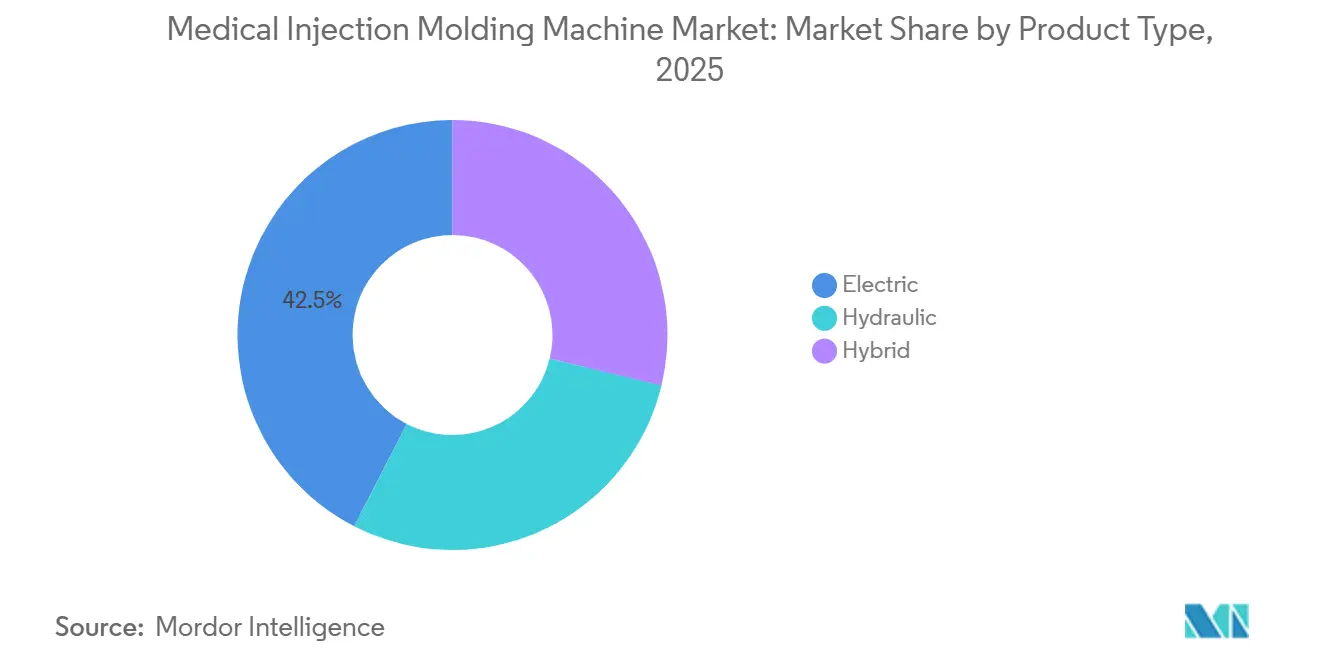
- By product type, electric held 42.45% of the medical injection molding machine market share in 2025, while hybrid is projected to advance at a 6.06% CAGR through 2031.
- By system type, hot runner held 58.11% of the medical injection molding machine market share in 2025 and is projected to advance at a 6.23% CAGR through 2031.
- By material, plastics held 80.26% of the medical injection molding machine market share in 2025, while metals are projected to advance at a 6.42% CAGR through 2031.
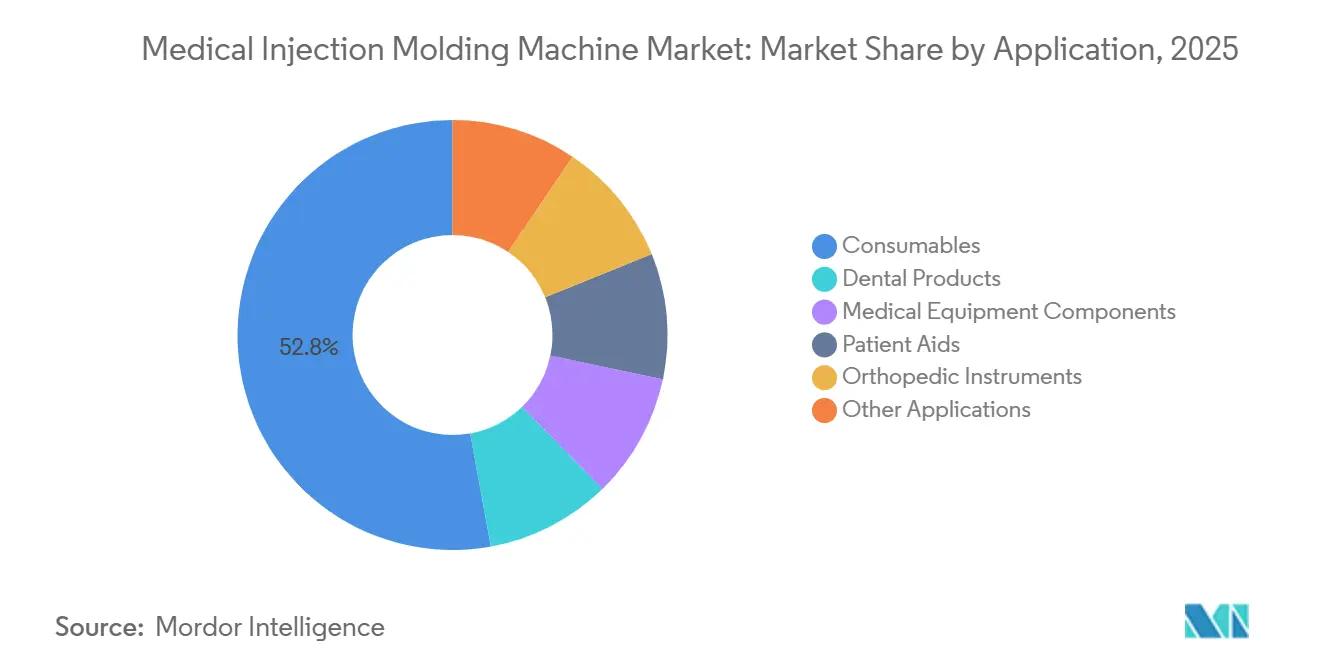
- By application, consumables held 52.84% of the medical injection molding machine market share in 2025, while medical equipment components are projected to advance at a 6.55% CAGR through 2031.
- By geography, Asia-Pacific held 30.72% of the medical injection molding machine market share in 2025 and is projected to advance at a 6.37% CAGR through 2031.
Note: Market size and forecast figures in this report are generated using Mordor Intelligence’s proprietary estimation framework, updated with the latest available data and insights as of January 2026.
Global Medical Injection Molding Machine Market Trends and Insights
Drivers Impact Analysis*
| Driver | (~) % Impact on CAGR Forecast | Geographic Relevance | Impact Timeline |
|---|---|---|---|
| Demand for Single-Use and Minimally Invasive Devices | +1.5% | Global, concentrated in Asia-Pacific and North America | Short term (≤ 2 years) |
| Precision Production of Diagnostic and Drug-Delivery Components | +1.2% | Global, with early gains in North America, Europe, and China | Medium term (2–4 years) |
| Shift Toward Electric, Cleanroom-Compatible Presses | +1.0% | Global; compliance factors concentrated in North America and EU | Medium term (2–4 years) |
| Expansion of Medical-Device Manufacturing in Asia-Pacific | +0.8% | APAC core, spillover to MEA | Long term (≥ 4 years) |
| Cavity-Level Digital Control for Faster Validation | +0.6% | Global; early adoption in North America, Germany, and Japan | Long term (≥ 4 years) |
| Source: Mordor Intelligence | |||
Demand for Single-Use and Minimally Invasive Devices
Single-use medical products are supporting sustained purchases of high cavity machines for syringes, intravenous connectors, catheter assemblies, and pen injector components. Infection control needs, immunization programs, and injectable biologic therapies support this production base. Pen injector manufacturers are expanding molding capacity on shorter schedules as demand for glucagon-like peptide-1 delivery devices grows. Jiangsu Wanhai Medical Instruments Co., Ltd. began construction of a CNY 390 million investment (approximately USD 54 million) pen injector facility in Changzhou in July 2025, with annual capacity targeted at 310 million units, including autoinjectors. The company is also pursuing U.S. Food and Drug Administration 510(k) clearance for its next-generation systems. Within the medical injection molding machine market, ISO 10993 biocompatibility needs and material traceability requirements favor electric presses because they eliminate hydraulic oil from classified production areas.
Precision Production of Diagnostic and Drug-Delivery Components
Microfluidic chips, prefillable syringe barrels, and drug-delivery pen bodies require tight dimensional control. Servo-driven electric and hybrid machines can provide consistent injection velocity, while oil-temperature variation can affect hydraulic production runs. A 2026 Journal of Process Control study reported that model-predictive cavity-pressure control kept part-mass deviation within 0.21% when manufacturers switched between virgin and recycled polymer batches. Per-cavity data logging is becoming more important in regulated programs because manufacturers must document process performance. Wearable drug-delivery products and point-of-care diagnostic devices are also reducing shot weights below 0.1 g. These applications require dedicated micro-injection units and can require new capital equipment in the medical injection molding machine market, even when an existing molding fleet remains operational.
Shift Toward Electric, Cleanroom-Compatible Presses
Electric injection molding machines remove hydraulic oil from the production environment and improve repeatability through servo-driven axes. This combination supports tighter process control in cleanroom production. Sumitomo (SHI) Demag Plastics Machinery GmbH announced that it would phase out hydraulic press production in Europe during 2025. ENGEL presented its all-electric e-motion 280 WP in October 2025 for diagnostic well plate and lid production in a compact cleanroom cell. ENGEL reported a 25% improvement in overall production efficiency compared with conventional equipment for that application. Energy-efficiency requirements in Europe add another reason for facilities in the medical injection molding machine market to consider replacing hydraulic equipment.
Expansion of Medical-Device Manufacturing in Asia-Pacific
Asia-Pacific combines industrial policy, cost-competitive production, and growing domestic healthcare demand. These factors are supporting machine purchases for standard consumables and complex device components. India’s Production Linked Incentive Scheme for medical devices covers 4 dedicated medical device parks in Andhra Pradesh, Telangana, Tamil Nadu, and Himachal Pradesh[1]Ministry of Commerce and Industry, Government of India, “Production Linked Incentive Scheme for Medical Devices,” Invest India, investindia.gov.in. The program supports local supply-chain development by domestic original equipment manufacturers and international contract manufacturers. Lubrizol and Polyhose India opened an ISO 13485-certified medical tubing facility in Chennai in 2025. Such upstream investment can create a broader base of regulated production activity and associated demand in the medical injection molding machine market.
Restraints Impact Analysis*
| Restraint | (~) % Impact on CAGR Forecast | Geographic Relevance | Impact Timeline |
|---|---|---|---|
| High Capital and Total Cost of Ownership | -0.7% | Global; most acute for smaller contract manufacturers in South America and MEA | Short term (≤ 2 years) |
| Validation and Qualification Burden | -0.5% | Global; regulatory influence concentrated in North America, EU, and Japan | Medium term (2–4 years) |
| Shortage of Specialized Tooling and Process Engineers | -0.3% | Global; most acute in North America and Europe | Long term (≥ 4 years) |
| Source: Mordor Intelligence | |||
High Capital and Total Cost of Ownership
All-electric medical injection molding equipment with cleanroom features can carry a 30%-50% price premium over comparable hydraulic equipment. The acquisition decision also includes cleanroom infrastructure, temperature-control units, material drying and conveying systems, automation, and preventive maintenance. These annual operating requirements can add 15%-20% of the machine purchase cost. Smaller contract manufacturers face greater difficulty when volumes are uncertain or production runs are short. The challenge is particularly relevant in South America and Middle East and Africa, where cost recovery can take longer. Longer delivery times from European and Japanese suppliers can further increase financing exposure for medical injection molding machine market buyers when device programs face regulatory delays.
Validation and Qualification Burden
The Quality Management System Regulation requires manufacturers to align with ISO 13485:2016 requirements incorporated into 21 CFR Part 820[2]U.S. Food and Drug Administration, “Quality Management System Regulation,” U.S. Food and Drug Administration, fda.gov. Medical injection molding processes require installation qualification, operational qualification, and performance qualification documentation. Each validation cycle can cost USD 15,000 to USD 30,000 and take 4 to 6 weeks for each mold-material combination. The work can add 15% to device program timelines and budgets. Replacing an existing validated machine can require requalification, which slows upgrades to newer equipment. Suppliers in the medical injection molding machine market that provide parameter databases, cavity-pressure qualification templates, and digital simulation tools can help reduce this burden for contract molders.
*Our forecasts treat driver/restraint impacts as directional, not additive. The impact forecasts reflect baseline growth, mix effects, and variable interactions.
Segment Analysis
By Product Type: Electric Leads Demand, While Hybrid Capitalizes on the Mid-Range
Electric held 42.45% of the medical injection molding machine market size in 2025. Its cleanroom compatibility and repeatable output support use in validated production for North American and European device programs. Hydraulic machines remain relevant for orthopedic component housings and structural device parts that require high clamping force. Their position is declining across the medical injection molding machine market as cleanroom mandates expand across more applications. ARBURG GmbH + Co KG presented its NextGen Medical Solution with Sanofi in October 2025, using an all-electric ALLROUNDER 570 A and an 8-cavity mold for injector pen caps.
Hybrid is projected to advance at a 6.06% CAGR through 2031. It combines electric cleanliness with the force needed for thicker-wall and higher-pressure medical parts. Haitian Plastics Machinery launched the MA5/Ultra at CHINAPLAS 2026 for multi-cavity precision and medical applications. ARBURG GmbH + Co KG began worldwide sales of the ALLROUNDER 475 V in January 2026 for medical insert molding, with energy use up to 60% lower than conventional hydraulic vertical presses.



By System Type: Hot Runner Sets the Benchmark for Precision Multi-Cavity Medical Molding
Hot runner held 58.11% of the medical injection molding machine market size in 2025 and is projected to advance at a 6.23% CAGR through 2031. It eliminates cold runner scrap that cannot be reused in many single-use medical applications. The technology also helps preserve cavity-to-cavity balance in high-cavity molds. Top Clean Packaging Group reported that its shut-off hot runner system for medical-grade polyether ether ketone molding eliminated sprues and improved project profitability. Needle-valve gating is used where a low gate vestige is required for patient-contact parts.
Cold runner systems continue to suit multi-material, insert-molded, and lower-volume development programs. They can be appropriate where heated-manifold investment is not supported by production economics. Sumitomo (SHI) Demag Plastics Machinery GmbH demonstrated its PAC-E 420 clean-toggle press at K 2025 with a 48-cavity hot runner mold, a 3-second cycle time, and an annual output of 432 million medical cup components. Japanese suppliers have historically used hot runner integration to differentiate precision platforms in the medical injection molding machine market.
By Material: Plastics Anchor Revenue, While Metals Claim Fastest Growth in Precision Hardware
Plastics held 80.26% of the market share in 2025. Polypropylene syringes, polycarbonate diagnostic housings, and cyclic olefin copolymer microfluidic substrates support this demand. Cyclic olefin copolymer is used in prefillable syringe barrels and diagnostics because of its transparency, low extractables profile, and moisture resistance. These requirements can increase demand for precise temperature control during molding. Hongke Plastic Mold invested USD 2.5 million in all-electric machines and ISO Class 7 cleanroom suites for polyether ether ketone and polysulfone components in 2024.
Metals are projected to advance at a 6.42% CAGR through 2031. Metal injection molding is used for surgical instruments, laparoscopic end-effectors, orthodontic brackets, and spinal fixation components. It can produce complex shapes in 316L stainless steel, 17-4PH, and titanium alloys, where machining becomes less economical above 5,000 to 10,000 units annually. Surgical robotics supports this demand in the medical injection molding machine market because its small parts can require internal channels and articulated features that are difficult to machine.
By Application: Consumables Sustain Market Revenue, While Medical Equipment Components Lead Growth
Consumables held 52.84% of the market share in 2025. Syringes, intravenous connectors, catheter assemblies, and diagnostic cartridges require continuous high-throughput output. Their scale supports steady equipment demand across many healthcare delivery settings. Shanghai Kohope Medical Devices Co., Ltd. announced a 40% expansion of syringe production capacity in December 2025. The company also opened a Shanghai distribution center serving the United States and more than 50 other countries, broadening its downstream customer base within the medical injection molding machine market.
Medical equipment components are projected to advance at a 6.55% CAGR through 2031. The category includes imaging-device enclosures, monitoring housings, diagnostic structures, and surgical device parts. ENGEL demonstrated an all-electric diagnostic cell in October 2025 with a reported 25% efficiency improvement. Milacron Holdings, LLC showcased the Roboshot ALPHA-S110iB with a 28 mm liquid silicone rubber package for cleanroom membrane production in February 2026.
Geography Analysis
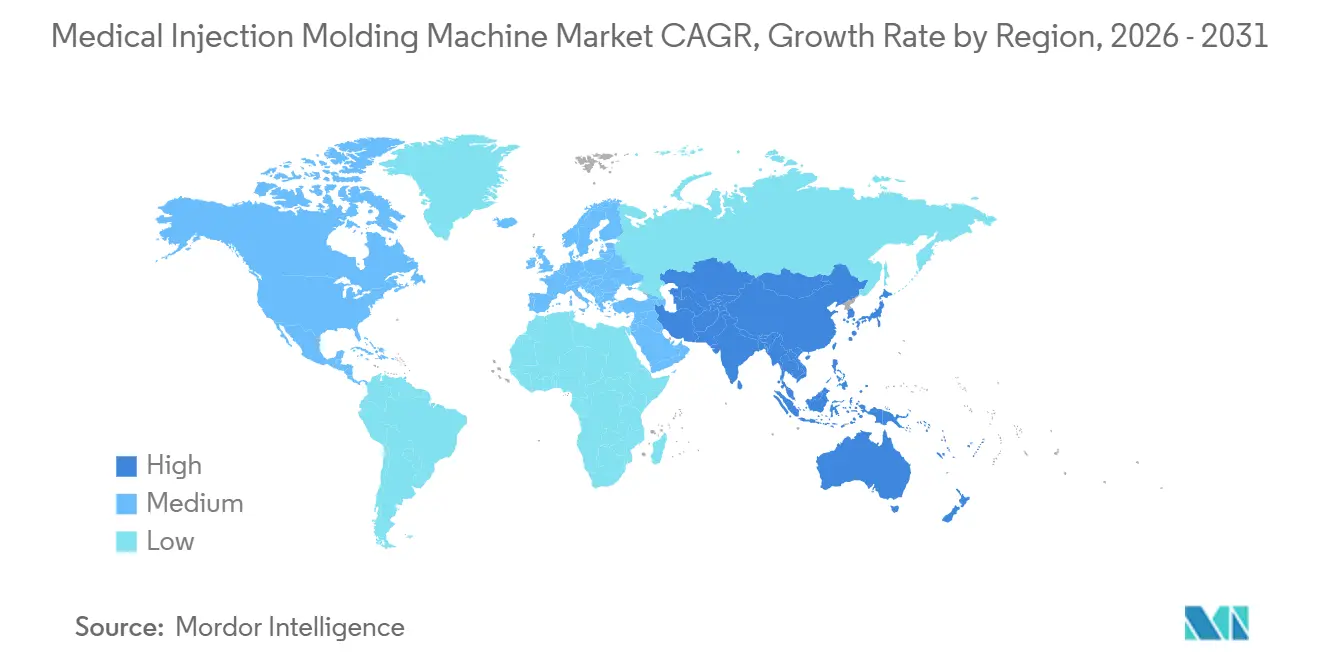
Asia-Pacific held 30.72% of the market share in 2025 and is projected to advance at a 6.37% CAGR through 2031. Domestic contract development and manufacturing organizations and original equipment manufacturers are updating electric and hybrid fleets for export programs. India’s Production Linked Incentive Scheme for medical devices covers 4 dedicated medical device parks. Lubrizol and Polyhose India opened an ISO 13485-certified medical tubing facility in Chennai in 2025.
Japan retains substantial precision manufacturing capability through NISSEI PLASTIC INDUSTRIAL CO., LTD., TOYO INNOVEX Co., Ltd., Shibaura Machine, FANUC Corporation, and The Japan Steel Works, LTD. NISSEI PLASTIC INDUSTRIAL CO., LTD. and TOYO INNOVEX Co., Ltd. completed their business integration under GMS Group Co., Ltd. on April 1, 2026. South Korea, Thailand, Vietnam, and Malaysia are attracting activity from device companies diversifying supply chains. North America concentrates on Class II and Class III device production. The Quality Management System Regulation is prompting equipment audits among molders serving U.S.-regulated programs.
Europe has sophisticated demand across Germany, the United Kingdom, France, Italy, and the Nordic countries. Regulatory documentation needs and energy-efficiency requirements support electric equipment in the region. South America and Middle East and Africa have smaller demand bases tied to healthcare investment and import substitution. Brazil, Argentina, Saudi Arabia, and South Africa support targeted activity, while currency volatility and limited technical support can favor accessible hybrid and servo-hydraulic platforms. The medical injection molding machine market offers suppliers distinct opportunities across high-specification and cost-sensitive geographies.

Competitive Landscape
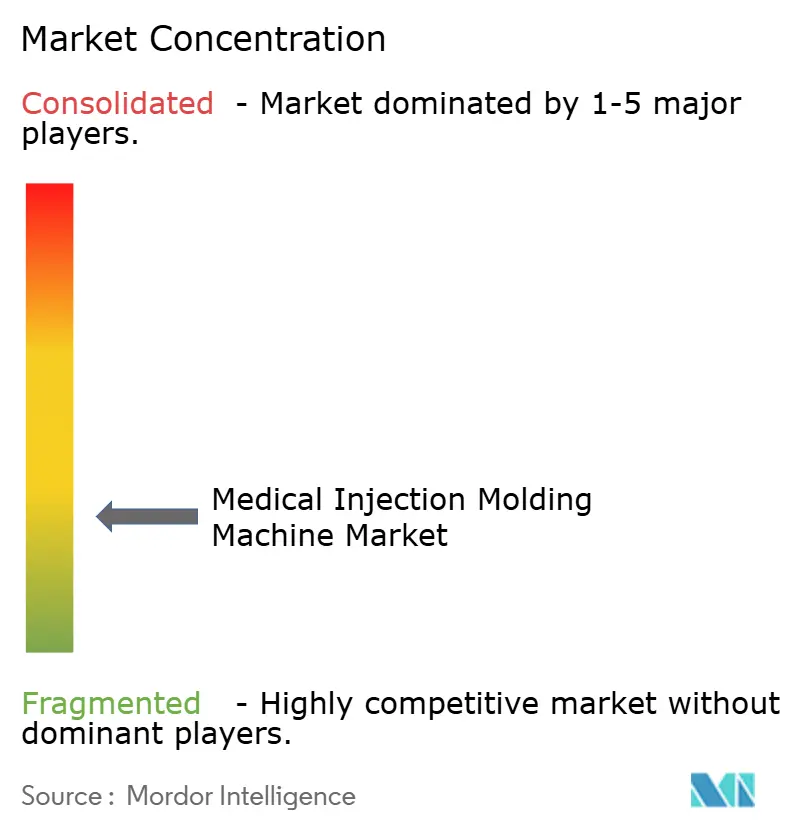
The medical injection molding machine market is highly fragmented, with the top five players including ENGEL, ARBURG GmbH + Co KG, Sumitomo (SHI) Demag Plastics Machinery GmbH, Haitian Plastics Machinery, and Milacron Holdings, LLC. Haitian Plastics Machinery introduced X-Injection at CHINAPLAS 2026 for automated process optimization in medical, optical, and electronics molding. The system had been deployed at manufacturing customers since 2025.
NISSEI PLASTIC INDUSTRIAL CO., LTD. and TOYO INNOVEX Co., Ltd. combined under GMS Group Co., Ltd. during April 2026 to strengthen their competitive position. The transaction shows that scale has become more important in precision machine manufacturing. The medical injection molding machine market increasingly rewards suppliers that provide validated production packages. ARBURG GmbH + Co KG worked with Sanofi on a medical cell for injector pen cap manufacturing. ENGEL’s diagnostic cell combined molding, automation, and validated packaging in a compact cleanroom layout.
Sumitomo (SHI) Demag Plastics Machinery GmbH and MAPAG Maschinen AG demonstrated the IntElect S 100 with Kistler sensing for insulin cap production in January 2026. WITTMANN Technology GmbH, Husky Technologies, and UBE Machinery Inc. serve specialized needs in automation, packaging cells, and high-tonnage presses. Toolmaker partnerships can help medical injection molding machine market suppliers qualify complex molds and achieve stable output. The medical injection molding machine industry is becoming more competitive as integrated technical support gains weight in purchasing decisions.
Medical Injection Molding Machine Industry Leaders
ENGEL
ARBURG GmbH + Co KG
Sumitomo (SHI) Demag Plastics Machinery GmbH
Haitian Plastics Machinery
Milacron Holdings, LLC
- *Disclaimer: Major Players sorted in no particular order

Recent Industry Developments
- August 2026: Hammarplast Medical invested in a new all-electric Sumitomo (SHI) Demag IntElect 75-110 injection molding machine to expand production capacity for medical devices. The investment strengthened precision, flexibility, and production efficiency for medical injection molding applications.
- April 2026: ENGEL showcased its all-electric e-mac 200 injection molding machine for medical technology, producing 32-cavity auto-injector components with cycle times below 10 seconds. The system combines precision process control, real-time weight monitoring, and low energy consumption, supporting demand for high-speed and reliable injection molding equipment for medical devices.


Global Medical Injection Molding Machine Market Report Scope
Medical injection molding machines are manufacturing systems used to produce precision medical components by injecting molten materials into molds under controlled conditions. They support consistent production of components with complex geometries, tight tolerances, and repeatable dimensions.
The Medical Injection Molding Machine Market is segmented by product type, system type, material, application, and geography. By product type, the market is segmented into electric, hydraulic, and hybrid. By system type, the market is segmented into hot runner and cold runner. By material, the market is segmented into plastics, metals, and other materials. By application, the market is segmented into consumables, medical equipment components, patient aids, orthopedic instruments, dental products, and other applications. The report also covers the market size and forecasts for medical injection molding machines in 15 countries across major regions. For each segment, the market sizing and forecasts have been done on the basis of value (USD).
| Electric |
| Hydraulic |
| Hybrid |
| Hot Runner |
| Cold Runner |
| Plastics |
| Metals |
| Other Materials |
| Consumables |
| Medical Equipment Components |
| Patient Aids |
| Orthopedic Instruments |
| Dental Products |
| Other Applications |
| Asia-Pacific | China |
| India | |
| Japan | |
| South Korea | |
| ASEAN Countries | |
| Rest of Asia-Pacific | |
| North America | United States |
| Canada | |
| Mexico | |
| Europe | Germany |
| United Kingdom | |
| France | |
| Italy | |
| NORDIC Countries | |
| Rest of Europe | |
| South America | Brazil |
| Argentina | |
| Rest of South America | |
| Middle East and Africa | Saudi Arabia |
| South Africa | |
| Rest of Middle East and Africa |
| By Product Type | Electric | |
| Hydraulic | ||
| Hybrid | ||
| By System Type | Hot Runner | |
| Cold Runner | ||
| By Material | Plastics | |
| Metals | ||
| Other Materials | ||
| By Application | Consumables | |
| Medical Equipment Components | ||
| Patient Aids | ||
| Orthopedic Instruments | ||
| Dental Products | ||
| Other Applications | ||
| By Geography | Asia-Pacific | China |
| India | ||
| Japan | ||
| South Korea | ||
| ASEAN Countries | ||
| Rest of Asia-Pacific | ||
| North America | United States | |
| Canada | ||
| Mexico | ||
| Europe | Germany | |
| United Kingdom | ||
| France | ||
| Italy | ||
| NORDIC Countries | ||
| Rest of Europe | ||
| South America | Brazil | |
| Argentina | ||
| Rest of South America | ||
| Middle East and Africa | Saudi Arabia | |
| South Africa | ||
| Rest of Middle East and Africa | ||


Key Questions Answered in the Report
What is the size of the medical injection molding machine market?
The medical injection molding machine market stands at USD 2.28 billion in 2026 and is projected to reach USD 2.97 billion by 2031.
What is driving demand for medical injection molding machines?
Single-use devices, drug-delivery systems, diagnostic components, and updated validation requirements support demand.
Which product type held the largest share in 2025?
Electric machines held a 42.45% share in 2025.
Which system type is expected to grow fastest through 2031?
Hot runner is projected to advance at a 6.23% CAGR through 2031.
Page last updated on:





