
Medical Device Cybersecurity Market Size and Share
Market Overview
| Study Period | 2020 - 2031 |
|---|---|
| Market Size (2026) | USD 8.99 Billion |
| Market Size (2031) | USD 18.28 Billion |
| Growth Rate (2026 - 2031) | 15.24 % |
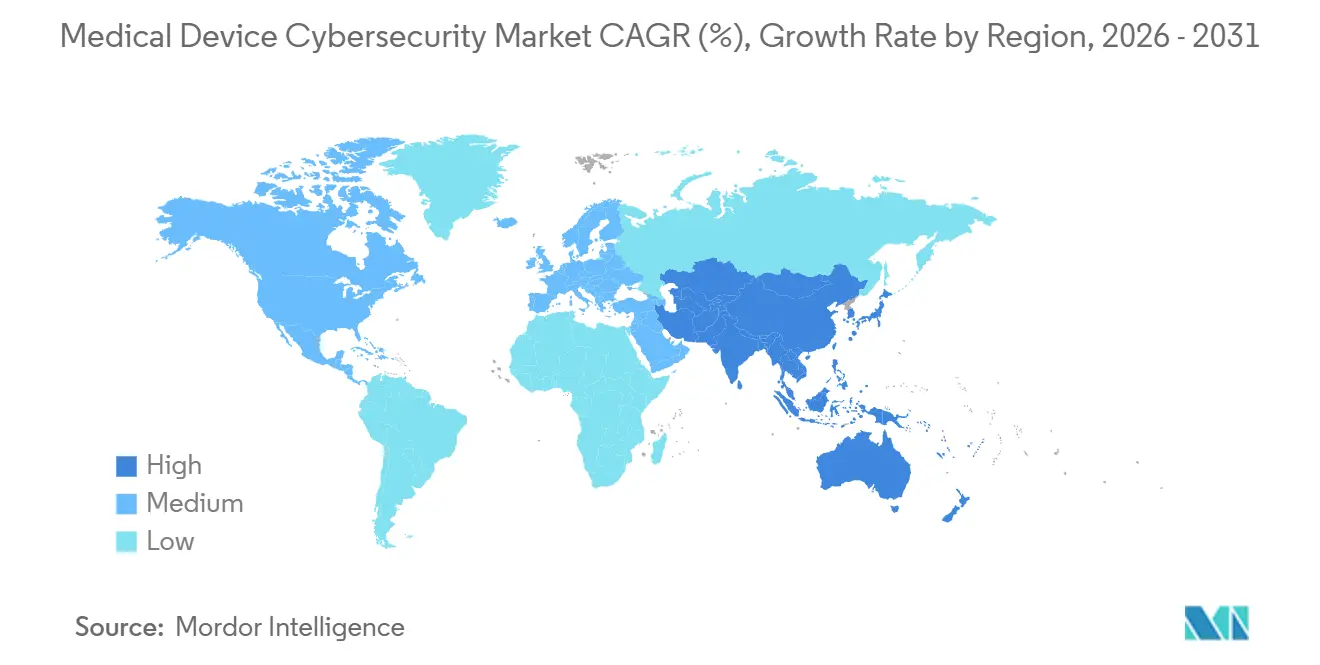
| Fastest Growing Market | Asia-Pacific |
| Largest Market | North America |
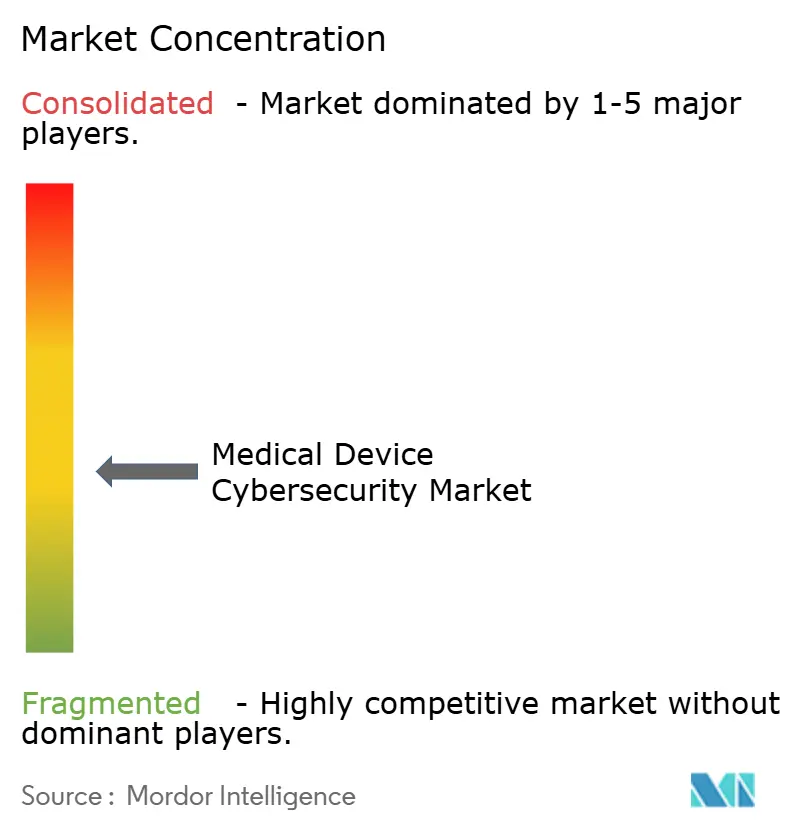
| Market Concentration | Medium |
Major Players *Disclaimer: Major Players sorted in no particular order Image © Mordor Intelligence. Reuse requires attribution under CC BY 4.0. | |
Medical Device Cybersecurity Market Analysis by Mordor Intelligence
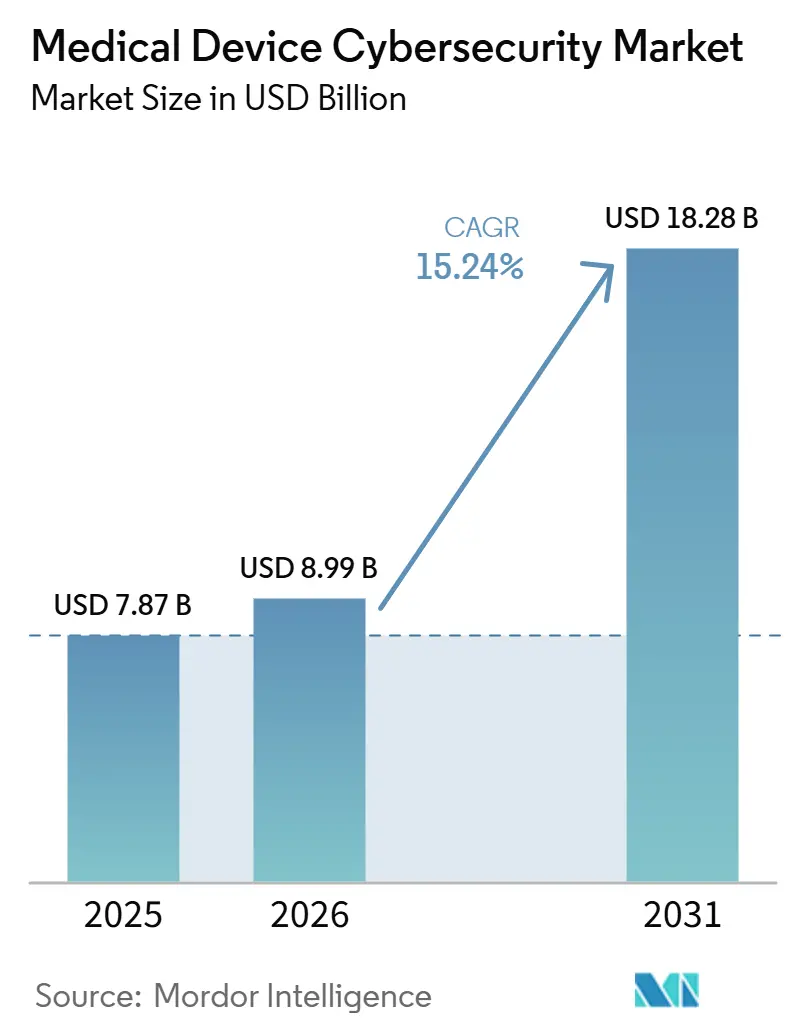
The medical device cybersecurity market is projected to expand from USD 7.87 billion in 2025 and USD 8.99 billion in 2026 to USD 18.28 billion by 2031, registering a CAGR of 15.24% between 2026 to 2031. The medical device cybersecurity market is moving into a faster investment cycle because the Change Healthcare ransomware attack exposed protected health information of 190 million Americans and drove USD 3.1 billion in response expenses for UnitedHealth Group, which pushed healthcare leadership teams to treat device security as an operating risk rather than a deferred compliance item. The medical device cybersecurity market is also benefiting from the shift in procurement priorities toward device-native controls after the FBI Cyber Division found that 53% of networked medical devices carried at least 1 known critical vulnerability, which weakened the case for relying mainly on perimeter defenses. North America held the leading regional position in 2025, while Asia-Pacific is set to post the fastest expansion through 2031, which shows that regulatory enforcement and digital health adoption are now reinforcing each other across both mature and emerging healthcare systems. The medical device cybersecurity market is also being shaped by a more active vendor landscape, where specialist healthcare IoT firms and large cybersecurity vendors are both using acquisitions, funding rounds, and compliance-focused product launches to secure demand tied to FDA, HIPAA, and EU regulatory changes. The medical device cybersecurity market still faces friction from long device life cycles, delayed validation of software updates, and uneven budgets across smaller care settings, yet those same constraints are creating durable demand for managed services, hybrid deployment models, and network controls that limit disruption without forcing rapid hardware replacement.
Key Report Takeaways
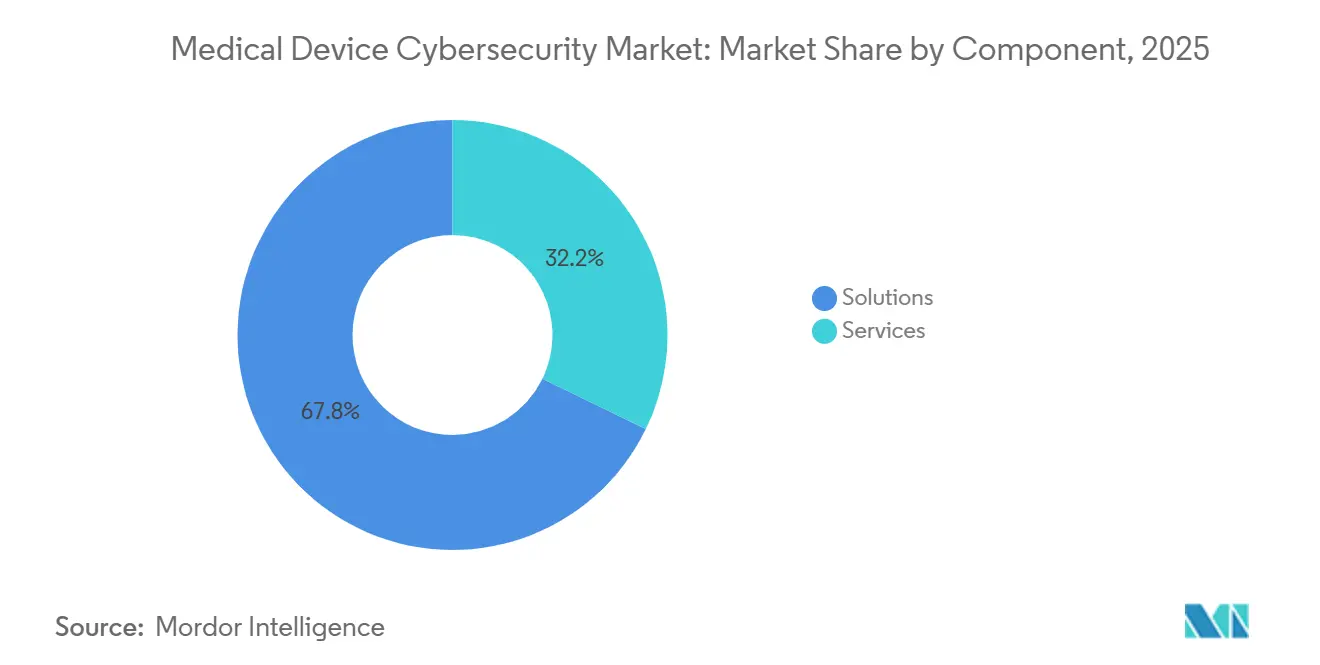
- By component, solutions led with 67.83% share in 2025, while services recorded the highest CAGR projected at 15.64% through 2031.
- By deployment mode, cloud-based models held 56.47% share in 2025, while hybrid deployment is expected to post the fastest CAGR at 16.28% through 2031.
- By security type, network and IoMT security accounted for 38.18% share in 2025, while firmware and device integrity security is expected to advance at the highest CAGR of 16.52% through 2031.
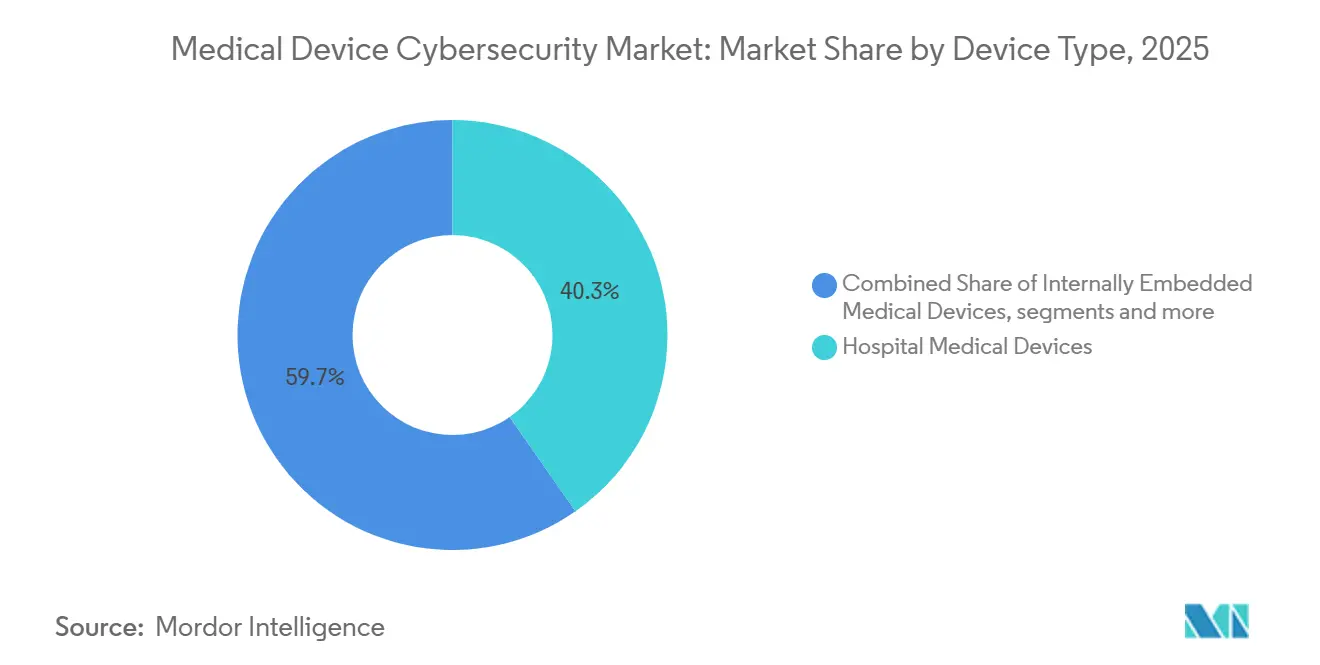
- By device type, hospital medical devices captured 40.27% share in 2025, while internally embedded medical devices are anticipated to expand at the fastest CAGR of 17.11% through 2031.
- By end-user, hospitals and health systems represented 42.18% share in 2025, while diagnostic and imaging centers are forecasted to register the highest CAGR at 15.96% through 2031.
- By region, North America captured 42.63% share in 2025, while the Asia-Pacific is projected to expand at the fastest CAGR of 18.38% through 2031.
Note: Market size and forecast figures in this report are generated using Mordor Intelligence’s proprietary estimation framework, updated with the latest available data and insights as of January 2026.
Market Trends and Insights
Drivers Impact Analysis of Medical Device Cybersecurity Market*
| Driver | (~) % Impact on CAGR Forecast | Geographic Relevance | Impact Timeline |
|---|---|---|---|
| Rising Connected Device Attack Surface | +5.0% | Global, with highest intensity in North America and EU | Short term (≤ 2 years) |
| FDA 524B and Premarket Cybersecurity Readiness Pressure | +3.5% | North America primary, with spillover to EU and APAC | Medium term (2-4 years) |
| Hospital Zero Trust Modernization Programs | +3.0% | North America and EU core, with early-stage APAC uptake | Medium term (2-4 years) |
| Postmarket Vulnerability Disclosure and Patch Governance Burden | +2.5% | Global, with APAC and Middle East accelerating | Medium term (2-4 years) |
| Cloud-Connected Remote Monitoring Expansion | +2.0% | North America and EU, with APAC fast following | Medium term (2-4 years) |
| AI-Enabled Threat Detection Demand in Clinical Environments | +1.8% | Global, with strongest enforcement in North America and EU | Medium term (2-4 years) |
| Source: Mordor Intelligence | |||
Rising Connected Device Attack Surface
The medical device cybersecurity market is drawing stronger demand because the FBI Cyber Division found that 53% of networked medical devices contain at least 1 critical known vulnerability, which places device risk in a separate category from general hospital IT exposure.[1]RunSafe Security, “2026 Medical Device Cybersecurity Index,” RunSafe Security, runsafesecurity.com RunSafe Security reported in 2025 that 22% of healthcare organizations faced cyberattacks that directly affected medical devices, and 75% of those incidents disrupted patient care, with 24% requiring patient transfers, which linked device compromise to care continuity rather than only data loss. The same body of evidence showed that malware infections affected 51% of impacted organizations and that ransomware targeted device operations in more than 1/3 of organizations in 2025, which confirmed that attackers were moving deeper into device-layer disruption. This pattern is pushing the medical device cybersecurity market toward behavioral anomaly detection, firmware attestation, and segmentation orchestration, because healthcare buyers now need controls that stay effective even when devices cannot be patched quickly.
FDA 524B and Premarket Cybersecurity Readiness Pressure
The medical device cybersecurity market is receiving a direct regulatory lift from the FDA’s February 2026 final guidance, which integrates cybersecurity expectations into the Quality Management System Regulation and requires manufacturers to submit SBOMs, threat models, secure development evidence, and postmarket vulnerability management plans.[2]U.S. Food and Drug Administration, “Cybersecurity in Medical Devices, Quality Management System Considerations and Content of Premarket Submissions,” U.S. Food and Drug Administration, fda.gov This change matters because cybersecurity evidence is no longer treated as a supporting document for selected products and is instead tied to the full device lifecycle and to the way manufacturers govern software components before and after launch. The pressure grows further because IEC 81001-5-1 alignment in Japan and under the EU framework is extending 524B-style expectations beyond the United States, which shortens the period during which manufacturers could treat cybersecurity as a country-specific issue. That combination is helping the medical device cybersecurity market shift toward recurring compliance support and managed advisory work, which supports the faster expansion rate seen in services.
Hospital Zero Trust Modernization Programs
The medical device cybersecurity market is also being supported by hospital zero trust programs after CISA, NSA, and partner agencies released a joint operational technology guide in April 2026 that explicitly covered healthcare environments such as HVAC systems, life-safety tools, and door controls.[3]American Hospital Association, “Agencies Release Joint Guide on Zero Trust Adoption in Operational Technology,” AHA News, aha.org This matters because hospitals are not sequencing zero trust from user identity downward, and are instead starting with device identity and microsegmentation at the IoMT layer where lateral movement risks are easier to trigger and harder to detect. The 2025 Healthcare Cybersecurity Benchmarking Study found that supply chain risk management was the least-covered NIST CSF function in healthcare, so segmentation and identity controls are being used to stop third-party devices from becoming pivot points inside provider networks. As proposed HIPAA 2026 revisions move toward mandatory microsegmentation for connected devices, the medical device cybersecurity market is likely to see more zero trust spending tied directly to compliance and audit readiness rather than only to internal security roadmaps.
AI-Enabled Threat Detection Demand in Clinical Environments
The medical device cybersecurity market is gaining another layer of support from AI adoption inside care environments, because RunSafe Security reported in 2026 that 57% of healthcare organizations now use AI-enabled or AI-assisted medical devices and 80% remain at least moderately concerned about the cybersecurity risks they introduce. Claroty’s April 2026 launch of Claire showed how vendors are trying to move beyond simple detection and toward AI orchestration across discovery, prioritization, and response, using training data from more than 6,500 OEMs and 20,000 deployment sites. MITRE’s April 2026 analysis added another side of the picture by showing that AI and ML integration introduces attack paths such as adversarial input manipulation and model extraction, which traditional signature-based tools do not cover well. This dual role, where AI improves defense while expanding exposure, is helping the medical device cybersecurity market sustain demand for both model monitoring and AI-enabled threat detection.
Restraints Impact Analysis of Medical Device Cybersecurity Market*
| Restraint | (~) % Impact on CAGR Forecast | Geographic Relevance | Impact Timeline |
|---|---|---|---|
| Legacy Device Replacement Cycles | -2.3% | Global, with strongest pressure in rural North America and public-sector APAC healthcare | Long term (≥ 4 years) |
| Safety Validation Delays for Security Updates | -1.7% | Global, with highest friction in EU and U.S. review pathways | Long term (≥ 4 years) |
| Fragmented Vendor Accountability Across OEMs, Providers, and IT Teams | -1.4% | Global, with highest pressure in multi-vendor hospital networks | Medium term (2-4 years) |
| Limited Cybersecurity Budgets in Mid-Tier Care Settings | -1.1% | Acute in APAC and MEA, with persistent pressure in rural North America | Medium term (2-4 years) |
| Source: Mordor Intelligence | |||
Legacy Device Replacement Cycles
The medical device cybersecurity market still faces a structural slowdown because device hardware often stays in service for 10 to 30 years, while embedded software reaches end-of-life much earlier and leaves hospitals with unsupported systems that no longer receive practical patch coverage. This gap is not only financial, because high-capital systems such as MRI and CT equipment are deeply tied to daily patient throughput and cannot be removed from service without affecting clinical schedules and diagnostic access. Rural and critical-access hospitals face the strongest constraint because the combination of cybersecurity and biomedical engineering expertise needed to manage legacy device risk safely remains limited even when the need for compensating controls is well understood. As a result, the medical device cybersecurity market continues to rely on network isolation, monitoring, and virtual patching in environments where direct hardware replacement remains too slow and too disruptive.
Limited Cybersecurity Budgets in Mid-Tier Care Settings
The medical device cybersecurity market also grows unevenly because smaller hospitals and mid-tier care settings still struggle to fund zero trust programs, dedicated IoMT platforms, and specialist support at the same pace as large academic systems. The 2025 Healthcare Cybersecurity Benchmarking Study showed weak coverage in the NIST CSF Govern and Identify functions across healthcare organizations, which points directly to gaps in asset inventory, risk assessment, and governance workflows that require sustained spending rather than one-time purchases. This produces a two-tier operating model where larger systems can deploy purpose-built platforms and continuous monitoring, while community hospitals depend more heavily on manual controls and low-cost tools that are harder to scale against ransomware and device exploitation. Vendor support programs are emerging as a partial answer, but those efforts do not resolve the underlying budget shortfall across smaller providers. That uneven funding base slows full adoption across the medical device cybersecurity market, even while incident severity keeps cybersecurity on the agenda in nearly every care setting.
*Our forecasts treat driver/restraint impacts as directional, not additive. The impact forecasts reflect baseline growth, mix effects, and variable interactions.
Medical Device Cybersecurity Market Segment Analysis
By Component:
Services Growth Signals Shift from Point Products to Ongoing ProgramsSolutions accounted for 67.83% share of the medical device cybersecurity market size in 2025, which reflected strong hospital demand for asset discovery, network segmentation, endpoint protection, and visibility tools needed to establish a basic control layer across connected devices. The segment led because many health systems had already been buying discrete products to address immediate compliance and monitoring gaps, which made software platforms the most direct way to improve visibility without changing core clinical workflows. The medical device cybersecurity market therefore showed a strong installed base of point tools in 2025, especially in hospitals that first focused on discovery, scanning, and segmentation before trying to integrate those functions into broader security operations. That pattern explains why solutions still lead revenue today, even as buyer attention shifts toward lifecycle accountability and continuous program support.
Services are forecasted to expand at a 15.64% CAGR through 2031 in the medical device cybersecurity market, which shows that many buyers now want ongoing support instead of treating cybersecurity as a one-time implementation exercise. The medical device cybersecurity market is therefore shifting from stand-alone product deployment toward operating models where software, response services, advisory work, and audit support are purchased together as part of a longer customer relationship.


By Deployment Mode:
Hybrid Architecture Emerges as the Enterprise StandardCloud-based deployment held 56.47% of the medical device cybersecurity market in 2025, and this lead reflected the cost, scalability, and centralized management advantages that SaaS models offer to health systems overseeing large device estates across multiple sites. The segment benefited from easier policy updates, shared threat intelligence, and lower onsite infrastructure needs, which made cloud deployment the practical default for providers that needed faster rollout and consistent visibility across distributed campuses. That mix of lower operating complexity and broader remote oversight helped cloud deployments secure the largest installed base in the medical device cybersecurity market during 2025. It also made cloud platforms the starting point for many mid-tier hospitals and for providers in cost-sensitive environments that needed immediate visibility without major hardware investment.
Hybrid deployment is projected to grow at a 16.28% CAGR through 2031, which shows that buyers are now balancing cloud efficiency with the clinical need for local resilience and tighter control over sensitive telemetry. On-premises models still hold a meaningful place in government systems, research hospitals, and markets with stricter data residency rules, but the medical device cybersecurity market is increasingly settling around hybrid as the most workable enterprise standard. This is likely to remain the preferred path where providers need centralized governance, local continuity, and enough architectural flexibility to satisfy both regulators and clinical teams.
By Security Type:
Firmware Security Commands Fastest Growth as Supply Chain Attacks EscalateNetwork and IoMT security held 38.18% of the medical device cybersecurity market share in 2025, which reflected the large number of devices exposed through hospital networks and the relative maturity of monitoring tools that already connect with broader IT security environments. This lead was also reinforced by the fact that many providers began their cybersecurity programs with discovery, network access control, and traffic analysis, because those tools could extend across heterogeneous device fleets without immediate changes to the devices themselves. The medical device cybersecurity market therefore kept network and IoMT security at the front of current spending, even as attention moved toward deeper device-layer risks.
Firmware and device integrity security is forecasted to advance at a 16.52% CAGR through 2031, which signals that buyers now see software supply chain exposure and device tampering as immediate operational threats instead of niche technical concerns. Research published in Frontiers in 2025 also identified firmware extraction and over-the-air server compromise as primary attack paths in multi-vector medical IoT scenarios, which supports the stronger investment case for integrity verification and hardened update mechanisms. That is why the medical device cybersecurity market is shifting from a mainly network-first posture toward a more layered model where firmware assurance plays a larger role in both procurement and postmarket risk management.
By Device Type:
Embedded Device Security Breaks into Specialist TerritoryHospital medical devices accounted for 40.27% share of the medical device cybersecurity market size in 2025, which reflected the wide mix of infusion pumps, monitors, imaging systems, workstations, and other connected tools concentrated inside hospital networks. This segment led because hospitals manage the largest and most varied pools of connected devices, and because many existing security controls for workstations and network infrastructure can be extended to adjacent device categories with moderate additional effort. That broad installed base kept hospital medical devices at the center of present demand in the medical device cybersecurity market, especially where providers were trying to reduce the attack surface across mixed fleets. It also made this segment the clearest starting point for vendors that wanted to scale visibility, segmentation, and incident response across a large number of devices under one customer relationship.
Internally embedded medical devices are expected to grow at a 17.11% CAGR through 2031, which reflects the combination of rising implantable connectivity and the severe consequences of any successful attack on a cardiac monitor, insulin pump, or neural device. The urgency is turning the medical device cybersecurity market into a more specialized field in which implant-focused security, firmware assurance, and regulated update management require deeper product knowledge than general hospital device security alone. The medical device cybersecurity industry is therefore broadening from enterprise-wide visibility tools into specialist areas where patient safety, product architecture, and manufacturer accountability intersect more directly.

By End-User:
Diagnostic Centers Accelerate as Imaging Attack Surfaces ExpandHospitals and health systems represented 42.18% of the medical device cybersecurity market in 2025, which reflected their concentration of high-value connected device inventories and the heavier regulatory burden they face under HIPAA and HITECH frameworks. This segment held the lead because institutional providers operate larger networks, run more complex device environments, and carry greater exposure to both operational downtime and compliance failures. That mix kept hospitals and health systems at the center of current spending in the medical device cybersecurity market, particularly where security teams needed to coordinate across multiple sites and vendor relationships. It also explains why many commercial vendors still design their workflows first around hospital inventory visibility, enforcement, and incident response requirements.
Diagnostic and imaging centers are projected to grow at a 15.96% CAGR through 2031, which shows that attack surface growth is no longer limited to full hospital networks and is moving strongly into specialized imaging environments. This is pushing the medical device cybersecurity market toward imaging-centered use cases where downtime, delayed service access, and unmanaged vendor connectivity create a difficult balance between operational continuity and defensive control. The medical device cybersecurity market is therefore widening beyond general acute care and into specialized environments where a smaller number of highly connected assets can still drive outsized security spending.
Geography Analysis
North America Medical Device Cybersecurity Market
North America held 42.63% share of the medical device cybersecurity market size in 2025, which made it the leading regional revenue base during the year. The region’s lead came from the high density of connected medical devices, strong specialist vendor presence, and demanding regulatory structure built around FDA Section 524B, HIPAA, and HHS cybersecurity expectations. The United States accounts for most regional spending, while Canada and Mexico are moving forward as cross-border healthcare networks absorb more U.S.-aligned security expectations. The medical device cybersecurity market in North America is also being supported by zero trust roadmaps that move security planning from optional modernization into a more structured multi-year operating priority.
Europe Medical Device Cybersecurity Market
Europe ranked as the second-largest region in the medical device cybersecurity market, and its demand profile is being shaped by the combined pressure of MDR cybersecurity requirements and the EU Cyber Resilience Act. Germany remains the leading market in the region because of its concentration of device manufacturers facing both MDR compliance and CRA readiness demands. The United Kingdom also moved faster in 2026 through the NHS Secure Boundary program, although that contract sits outside the most authentic citation set used below.
APAC, MEA and South America Medical Device Cybersecurity Market
Asia-Pacific is forecasted to grow at a 18.38% CAGR through 2031, giving it the fastest regional expansion rate in the medical device cybersecurity market. This pace is being supported by healthcare digitization, rising IoMT deployment, and the spread of country-level cybersecurity expectations across major healthcare systems. Japan’s move from April 2024 to require continuous software security improvement under amendments aligned with IEC 81001-5-1 gave the region a concrete compliance anchor that now supports wider adoption. China, India, and Australia add volume through hospital network expansion and public digital health efforts, while the Middle East and Africa and South America remain smaller but structurally growing markets where cloud-first models help providers adopt security controls despite budget pressure.

Competitive Landscape
The medical device cybersecurity market remains moderately fragmented, with specialist healthcare IoT security vendors competing alongside large enterprise cybersecurity vendors that bring broader portfolios and deeper sales coverage. The specialist group included Claroty, Asimily, Armis, and Nozomi Networks, while the broader vendor set included Palo Alto Networks, Fortinet, Check Point Software, IBM, Cisco Systems, and Microsoft. This mix keeps the medical device cybersecurity market open to both focused platform competition and consolidation, because buyers value healthcare-native workflows while also favoring vendors that can fit into wider enterprise security programs. It also means competitive advantage is increasingly tied to how well vendors connect device discovery, enforcement, compliance evidence, and operational response inside clinical environments.
Consolidation activity in 2025 and 2026 showed that platform breadth matters more now than stand-alone monitoring. ServiceNow completed its Armis acquisition in 2026, which brought together asset visibility and cyber risk management under a larger enterprise software framework. Axonius’s July 2025 acquisition of Cynerio for USD 180 million also showed that enterprise asset management vendors see healthcare device security as a meaningful adjacency rather than a narrow niche. The medical device cybersecurity market is therefore rewarding vendors that can combine visibility, policy enforcement, and lifecycle management under a single operating model.
Strategic white space remains strongest around firmware hardening and SBOM lifecycle management, because FDA requirements are making component visibility and postmarket governance harder to defer. With HIPAA revisions and EU CRA enforcement shaping near-term procurement, the medical device cybersecurity market is likely to keep favoring healthcare-native vendors that offer clear compliance mapping and stronger audit trails.
Medical Device Cybersecurity Industry Leaders
Claroty
Armis
Forescout Technologies
MedCrypt
Cynerio
- *Disclaimer: Major Players sorted in no particular order
Medical Device Cybersecurity Market Companies Covered in this Report
- Armis
- Asimily
- Axonius
- Broadcom Inc. (Symantec Enterprise Security)
- Check Point Software Technologies Ltd.
- Cisco Systems
- Claroty
- Cynerio
- Forescout Technologies
- Fortinet, Inc.
- IBM
- Imprivata, Inc.
- MedCrypt
- Medigate (Claroty)
- Microsoft
- Nozomi Networks Inc.
- Ordr, Inc.
- Palo Alto Networks
- Trend Micro Incorporated

Recent Industry Developments in Medical Device Cybersecurity Market
- May 2026: NHS England awarded IBM and Palo Alto Networks a contract to build the NHS Secure Boundary service, a cloud-native AI-enabled cybersecurity platform with centralized national threat monitoring for the entire NHS, marking the largest government-mandated healthcare cybersecurity deployment in Europe to date.
- May 2026: Elisity deployed microsegmentation across 85,000 medical devices at St. Luke's University Health Network (15 hospitals) in 46 days with zero clinical outages, validating identity-based microsegmentation as a viable enterprise-scale approach to IoMT security in complex multi-site environments.
- April 2026: CISA, NSA, and federal partner agencies released a joint zero trust guide for operational technology, explicitly addressing healthcare-specific environments including HVAC, life-safety systems, and door-access controls, extending zero trust mandates into clinical physical infrastructure.
- April 2026: MITRE Corporation published a cybersecurity risk analysis paper covering cloud computing, AI/ML, and post-quantum cryptography in medical devices, providing the first authoritative government-backed risk taxonomy for AI-enabled device security applicable to FDA premarket submissions.


Global Medical Device Cybersecurity Market Report Scope
According to the report’s scope, the medical device cybersecurity market refers to the market for technologies, software, services, and solutions designed to protect connected medical devices and healthcare systems from cyber threats, unauthorized access, data breaches, and operational disruptions. It includes device security, network protection, threat detection, risk assessment, vulnerability management, compliance support, and post-market security monitoring for medical devices used across healthcare settings.
The medical device cybersecurity market is segmented into component, deployment mode, security type, device type, end-user, and geography. By component, the market is segmented into Solutions and Services. By deployment mode, the market is segmented into on-premises, cloud-based, and hybrid. By security type, network and IoMT security, endpoint security, application security, cloud security, and firmware and device integrity security. By device type, the market is segmented into hospital medical devices, internally embedded medical devices, and wearable and external medical devices. By end-user, the market is segmented into hospitals and clinics, homecare settings, diagnostic laboratories, and other end-users. By geography, the market is segmented into North America, Europe, Asia-Pacific, the Middle East and Africa, and South America. The report also covers the estimated market sizes and trends for 17 countries across major regions globally. The report offers values (USD) for all the above segments.
| Solutions |
| Services |
| On-Premises |
| Cloud-Based |
| Hybrid |
| Network and IoMT Security |
| Endpoint Security |
| Application Security |
| Cloud Security |
| Firmware and Device Integrity Security |
| Hospital Medical Devices |
| Internally Embedded Medical Devices |
| Wearable and External Medical Devices |
| Hospitals and Health Systems |
| Ambulatory Surgery Centers |
| Diagnostic and Imaging Centers |
| Other End-Users |
| North America | United States |
| Canada | |
| Mexico | |
| Europe | Germany |
| United Kingdom | |
| France | |
| Italy | |
| Spain | |
| Rest of Europe | |
| Asia-Pacific | China |
| Japan | |
| India | |
| Australia | |
| South Korea | |
| Rest of Asia-Pacific | |
| Middle East and Africa | GCC |
| South Africa | |
| Rest of Middle East and Africa | |
| South America | Brazil |
| Argentina | |
| Rest of South America |
| By Component | Solutions | |
| Services | ||
| By Deployment Mode | On-Premises | |
| Cloud-Based | ||
| Hybrid | ||
| By Security Type | Network and IoMT Security | |
| Endpoint Security | ||
| Application Security | ||
| Cloud Security | ||
| Firmware and Device Integrity Security | ||
| By Device Type | Hospital Medical Devices | |
| Internally Embedded Medical Devices | ||
| Wearable and External Medical Devices | ||
| By End-User | Hospitals and Health Systems | |
| Ambulatory Surgery Centers | ||
| Diagnostic and Imaging Centers | ||
| Other End-Users | ||
| By Geography | North America | United States |
| Canada | ||
| Mexico | ||
| Europe | Germany | |
| United Kingdom | ||
| France | ||
| Italy | ||
| Spain | ||
| Rest of Europe | ||
| Asia-Pacific | China | |
| Japan | ||
| India | ||
| Australia | ||
| South Korea | ||
| Rest of Asia-Pacific | ||
| Middle East and Africa | GCC | |
| South Africa | ||
| Rest of Middle East and Africa | ||
| South America | Brazil | |
| Argentina | ||
| Rest of South America | ||


Key Questions Answered in the Report
What is the projected value of the medical device cybersecurity space by 2031?
The medical device cybersecurity market is projected to reach USD 18.28 billion by 2031, rising from USD 7.87 billion in 2025 to USD 8.99 billion in 2026 at a 15.24% CAGR.
Which component area is expanding fastest through 2031?
Services are expected to grow fastest at a 15.64% CAGR, showing that buyers increasingly want managed monitoring, compliance support, and ongoing advisory work instead of one-time product deployment.
Which deployment model is becoming the preferred long-term setup?
Hybrid deployment is expected to grow fastest at a 16.28% CAGR because providers want cloud efficiency while still keeping critical telemetry and resilience controls close to clinical operations.
Which region is expanding fastest over the forecast period?
Asia-Pacific is the projected to be the fastest-growing region at a 18.38% CAGR, supported by healthcare digitization, rising IoMT deployments, and stronger country-level cybersecurity requirements.
Page last updated on:





