
Medical Device Companion Software Market Size and Share
Market Overview
| Study Period | 2020 - 2031 |
|---|---|
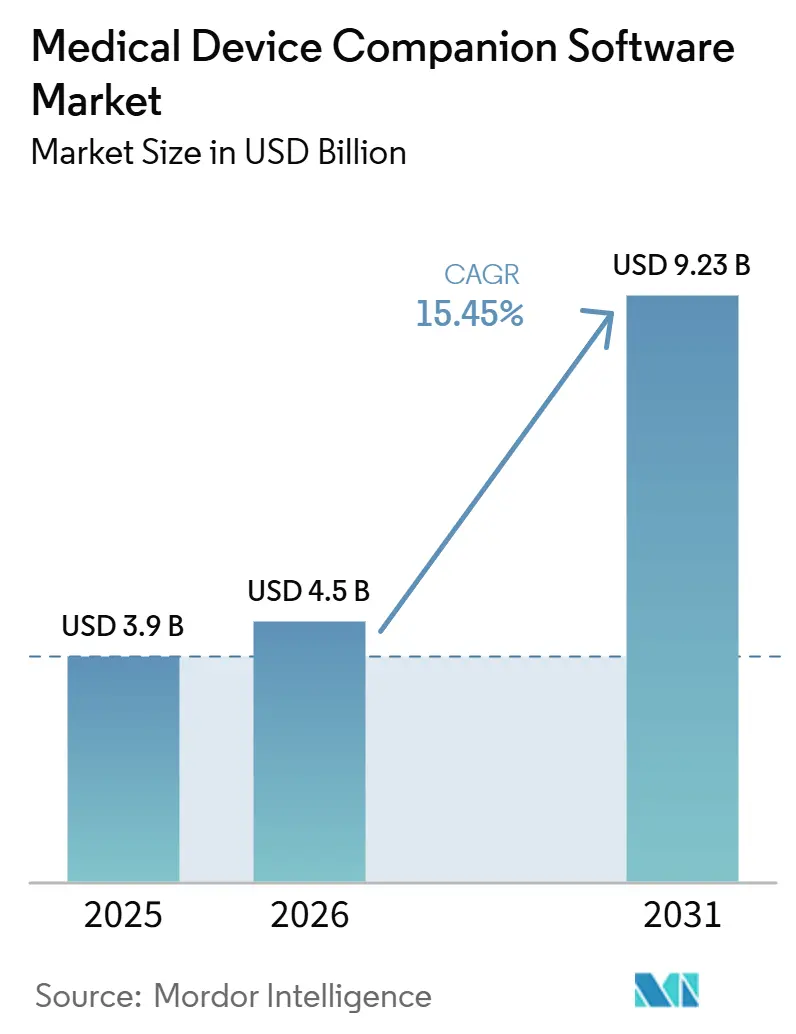
| Market Size (2026) | USD 4.5 Billion |
| Market Size (2031) | USD 9.23 Billion |
| Growth Rate (2026 - 2031) | 15.45 % |
| Fastest Growing Market | Asia-Pacific |
| Largest Market | North America |
| Market Concentration | Medium |
Major Players *Disclaimer: Major Players sorted in no particular order Image © Mordor Intelligence. Reuse requires attribution under CC BY 4.0. | |
Medical Device Companion Software Market Analysis by Mordor Intelligence
The Medical Device Companion Software Market size was valued at USD 3.9 billion in 2025 and is estimated to grow from USD 4.5 billion in 2026 to reach USD 9.23 billion by 2031, at a CAGR of 15.45% during the forecast period 2026-2031.
Growth reflects the shift of care into home settings, where connected devices require reliable software for data capture and clinical review. The medical device companion software market is also benefiting from cloud-connected devices and reimbursement models that recognize remote monitoring as a billable service. In the 2026 Physician Fee Schedule, CMS introduced CPT 99445 and CPT 99470, reducing the transmission threshold from 16 days to 2 days within a reporting period. This change expands patient eligibility for remote monitoring programs, while device manufacturers use companion applications to build recurring service revenue and extend the value of established hardware portfolios.
Key Report Takeaways
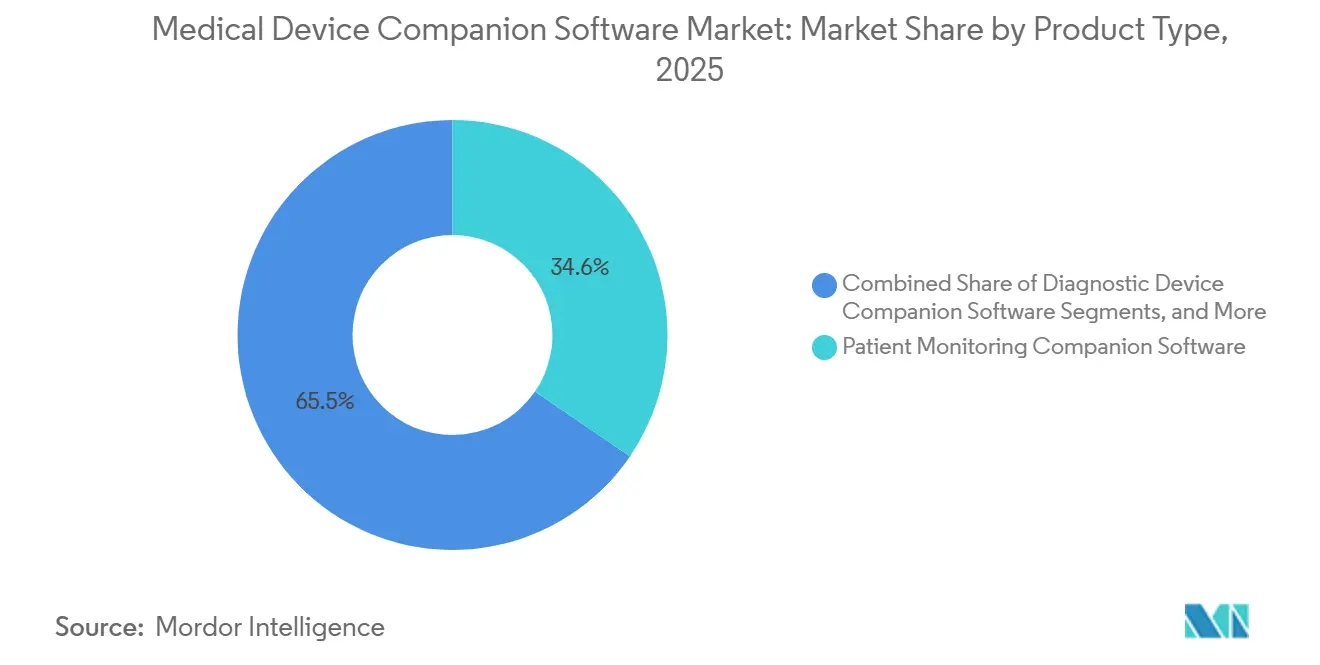
- By product type, patient monitoring companion software held 34.55% of the medical device companion software market share in 2025, while diagnostic device companion software is projected to grow at a 15.93% CAGR through 2031.
- By form factor, cloud-based web platforms held 33.56% of revenue in 2025, while responsive web applications are projected to grow at a 17.67% CAGR through 2031.
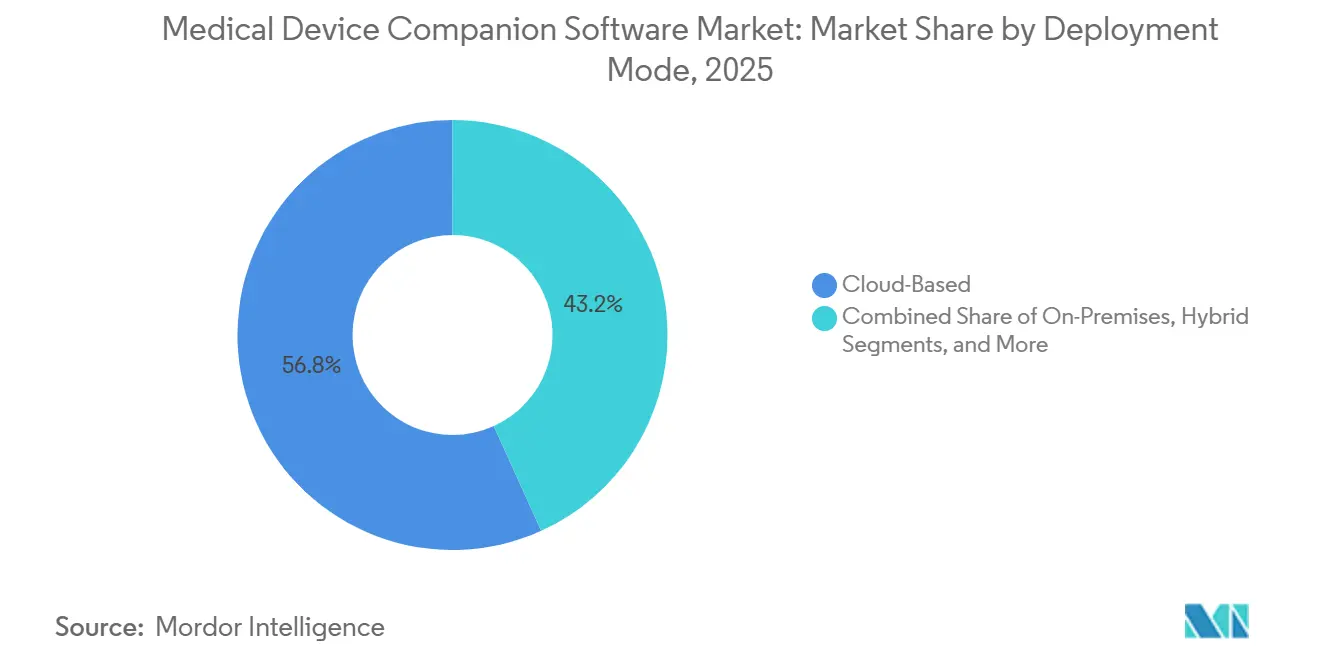
- By deployment mode, cloud-based deployment held 56.77% of revenue in 2025, while hybrid deployment is projected to grow at a 16.35% CAGR through 2031.
- By device category, continuous glucose monitoring systems held 32.88% of revenue in 2025, while medical imaging devices are projected to grow at a 17.45% CAGR through 2031.
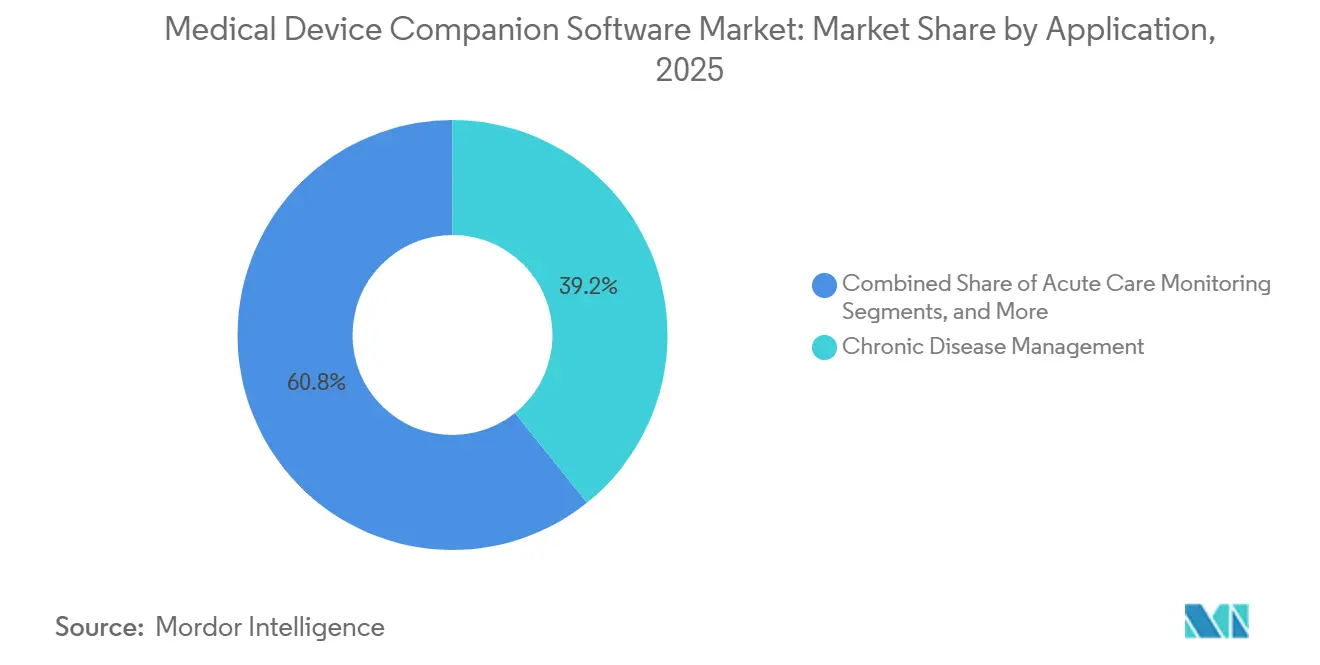
- By application, chronic disease management held 39.24% of revenue in 2025, while diagnosis and clinical assessment is projected to grow at an 18.22% CAGR through 2031.
- By geography, North America held 42.45% of revenue in 2025, while Asia-Pacific is projected to grow at an 18.56% CAGR through 2031.
Note: Market size and forecast figures in this report are generated using Mordor Intelligence’s proprietary estimation framework, updated with the latest available data and insights as of January 2026.
Global Medical Device Companion Software Market Trends and Insights
Drivers Impact Analysis*
| DRIVER | (~) % IMPACT ON CAGR FORECAST | GEOGRAPHIC RELEVANCE | IMPACT TIMELINE |
|---|---|---|---|
| Expansion of home-based and remote care | +3.8% | Global, highest in North America and Western Europe | Short term (≤ 2 years) |
| Clinical value of continuous device data | +2.7% | Global, core in North America and emerging in Asia-Pacific | Medium term (2-4 years) |
| Interoperability and open api adoption | +1.9% | North America and Europe, with spillover to Asia-Pacific | Medium term (2-4 years) |
| Remote physiologic and therapeutic monitoring reimbursement | +2.4% | North America, driven by CMS, with Europe following | Short term (≤ 2 years) |
| Device-embedded personalization and closed-loop therapy | +1.6% | Global, highest in diabetes-prevalent countries | Medium term (2-4 years) |
| Software-led differentiation of mature device portfolios | +1.1% | North America, Europe, and Japan | Long term (≥ 4 years) |
| Source: Mordor Intelligence | |||
Expansion of Home-Based and Remote Care
Home-based care is expanding connected-device use in settings where clinicians rely on remote data capture. As a result, the medical device companion software market depends on applications that collect, transmit, and present data without an in-person visit. CMS introduced CPT 99445 for 2 to 15 days of transmitted data and CPT 99470 for 10 to 19 minutes of treatment management in 2026. This change removed the former 16-day threshold that excluded patients with intermittent device use. Manufacturers that record transmission compliance through their applications can help provider customers support clearer billing, while the combination of remote patient monitoring and Chronic Care Management increases the role of companion applications in value-based care agreements.
Rising Clinical Value of Continuous Device-Generated Data
Companion applications increasingly support clinical decisions rather than only displaying readings. This shift raises the value of the medical device companion software market for providers that need timely and actionable patient information. Dexcom became the first participant in the FDA Technology-Enabled Meaningful Patient Outcomes Pilot on July 22, 2026. The pilot combined G7 and Stelo data with nutrition, activity, and related inputs in an AI-powered glucose health program. It created a real-world evidence pathway that may reduce reliance on the traditional premarket authorization process for qualifying programs and encourages investment in clinical-grade analytics for treatment decisions and payer discussions.
Interoperability and Open API Adoption
Interoperability is reducing a long-standing barrier to hospital adoption of companion applications. The medical device companion software market has often required separate proprietary integration work for each health system. The HL7 Device Interoperability FHIR Accelerator brings together IEEE, ISO, IHE, and medical technology participants to advance common implementation work. Broader use of FHIR R5 and IHE SDPi profiles can provide developers with more standardized access to patient records, reduce deployment time, lower the cost of entering hospital workflows, and weaken the advantage established suppliers gained from expensive proprietary interfaces.
Reimbursement for Remote Physiologic and Therapeutic Monitoring
Remote monitoring reimbursement is changing how hospitals evaluate medical devices and related software. CMS set the 2026 Physician Fee Schedule conversion factor at USD 33.40 per RVU, compared with USD 32.35 in 2025. New CPT codes and Chronic Care Management stacking raised monthly RPM revenue potential to USD 300 to USD 500 per patient in the supplied framework. Providers increasingly assess whether a companion application supports applicable billing codes before selecting a device. Abbott CGM devices that qualify under CPT 99445 show how reimbursement can shape software feature priorities, while real-time interactive communication requirements set a functional threshold for validated software.
Restraints Impact Analysis*
| RESTRAINT | (~) % IMPACT ON CAGR FORECAST | GEOGRAPHIC RELEVANCE | IMPACT TIMELINE |
|---|---|---|---|
| Cybersecurity, privacy, and software liability exposure | -1.5% | Global, most acute in North America and Europe | Short term (≤ 2 years) |
| Fragmented regulatory and data-residency requirements | -1.2% | Asia-Pacific, Europe, and global markets | Medium term (2-4 years) |
| Low patient engagement and digital health literacy | -0.9% | Emerging markets and elderly populations globally | Long term (≥ 4 years) |
| Device-software validation across long lifecycles | -0.8% | Global, highest in European and U.S. jurisdictions | Long term (≥ 4 years) |
| Source: Mordor Intelligence | |||
Cybersecurity, Privacy, and Software Liability Exposure
Cybersecurity requirements continue to increase costs and operational workloads for application developers. FDA final guidance published on June 27, 2025, requires Software Bills of Materials, interface disclosures, and lifecycle malware prevention plans for applicable cyber devices under Section 524B of the FD&C Act. Companion applications may include third-party libraries, cloud services, and device interfaces that require lifecycle monitoring. This ongoing compliance burden is significant for mid-sized developers with smaller quality and cybersecurity teams and favors established suppliers with mature processes and larger support budgets.
Fragmented Global Regulatory and Data-Residency Requirements
International expansion remains challenging because medical software rules differ across major markets. China published revised YY/T 1406-2026 in March 2026, and the standard takes effect in March 2027. The standard sets lifecycle risk-management requirements that differ from the FDA approach and the European Union framework. Applications cleared as US Class II devices may require a new classification process under the EU Medical Device Regulation and a separate technical file in China, increasing regulatory costs for one product.
*Our forecasts treat driver/restraint impacts as directional, not additive. The impact forecasts reflect baseline growth, mix effects, and variable interactions.
Segment Analysis
By Product Type: Patient Monitoring Supports Revenue While Diagnostics Leads Growth
Patient Monitoring Companion Software held 34.55% of product-type revenue in 2025. This category supports implantable cardiac monitors, ambulatory ECG patches, connected oximeters, and continuous glucose monitoring systems. These devices generate regular readings that providers must transmit, review, and act on within care plans. Established reimbursement pathways for several monitoring applications support their commercial role.
Diagnostic Device Companion Software is forecast to grow at a CAGR of 15.93% through 2031, supported by AI imaging and pathology tools that improve triage and findings correlation within clinical workflows. Drug Delivery Device Companion Software is also advancing as pharmaceutical companies integrate applications into drug-device combinations for adherence monitoring. Aptar Digital Health’s connected inhaler ecosystem reflects this use of software alongside drug delivery devices. Therapeutic and Surgical Device Software occupies mid-range growth positions, while Implantable Device Companion Software grows more slowly due to longer hardware replacement cycles.



By Form Factor: Cloud Platforms Lead While Responsive Web Applications Grow Fastest
Cloud-Based Web Platforms held 33.56% of form-factor revenue in 2025. Their position reflects health system demand for multi-user tools that do not require installation on each workstation. The medical device companion software market size for this form factor benefits when EHR workflow access is built into a browser-based experience. GE HealthCare received FDA 510(k) clearance for its View diagnostic viewer in March 2026.
The browser-based design allows radiologists to access diagnostic imaging tools without local software installation. Responsive Web Applications are forecast to grow at a 17.67% CAGR through 2031. Clinicians value access across devices, while health systems can reduce app-store and desktop deployment friction. Native Mobile Applications remain important for patient-facing uses that depend on Bluetooth pairing with CGMs and cardiac monitors.
By Deployment Mode: Cloud Retains Scale While Hybrid Addresses Regulatory Needs
Cloud-Based deployment held 56.77% of revenue in 2025, supported by provider demand for scalable software-as-a-service delivery that is less dependent on device replacement cycles. A cloud platform allows a supplier to release updates, support multiple users, and maintain consistent service across a distributed device base. Hybrid deployment is forecast to grow at a 16.35% CAGR through 2031 as health systems combine cloud collaboration with local processing or storage. This approach is relevant where GDPR, Chinese data-residency requirements, and Indian regulatory conditions complicate an entirely cloud-based model.
Edge-Based deployment is gaining use in intensive care units and surgical suites that may need millisecond-level processing for immediate alerts. On-Premises deployment is declining but remains necessary in government and military facilities with air-gapped networks. Philips launched the cloud-enabled IntelliSite Pathology Solution on HealthSuite in 2026, demonstrating a model in which cloud collaboration is layered over on-premise image acquisition. Hybrid architecture can address local storage obligations without abandoning cloud-based coordination, while deployment choices are becoming a practical part of product differentiation in the medical device companion software market.
By Device Category: Continuous Glucose Monitoring Leads While Imaging Advances Fastest
Continuous Glucose Monitoring Systems held 32.88% of device-category revenue in 2025. Dexcom received FDA clearance in July 2026 for the updated Stelo application and separately for pediatric use of the Stelo sensor. The revised application brings nutrition, sleep, and activity data into metabolic health management. Medical Imaging Devices are forecast to grow at a 17.45% CAGR through 2031, supported by AI-enabled tools and expanding use in oncology and cardiovascular workflows.
GE HealthCare received FDA 510(k) clearance for MIM Contour ProtégéAI+ 2.0 in June 2026 for radiation oncology treatment planning. Siemens Healthineers introduced AI-powered coronary analysis software at RSNA 2025. Insulet rolled out an enhanced Omnipod 5 algorithm in June 2026, including a 100 mg/dL target glucose, Automated Delivery Restriction improvements, and Abbott FreeStyle Libre 3 Plus compatibility in the United States through an over-the-air application update. iRhythm received a USPTO patent grant for ECG machine-learning architectures in April 2026, and ResMed’s myAir received FDA 510(k) clearance as a standalone Class II device in April 2026.
By Application: Chronic Disease Management Leads While Diagnostic Use Grows Fastest
Chronic Disease Management held 39.24% of application revenue in 2025. It serves large patient groups with diabetes, cardiovascular disease, and respiratory conditions that need regular monitoring. Daily engagement supports a continuing role for companion software in these care pathways. Diagnosis and Clinical Assessment is forecast to grow at an 18.22% CAGR through 2031, supported by AI imaging tools that help clinicians prioritize findings and support diagnosis in settings with limited specialist capacity.
Aidoc filed a breakthrough FDA submission for a foundation model that covers double-digit conditions, and the company reported that its aiOS platform had analyzed more than 100 million patient cases. Acute Care Monitoring, Screening and Early Detection, Post-Acute Care, and Medication Adherence remain mid-growth applications supported by expanding remote monitoring, payer interest in preventive data, and expanded RPM codes. Treatment Planning and Therapy Optimization can produce clinical value when software improves closed-loop therapy, while Recovery and Rehabilitation applications are emerging through wearable movement analytics in orthopedic care pathways.
Geography Analysis
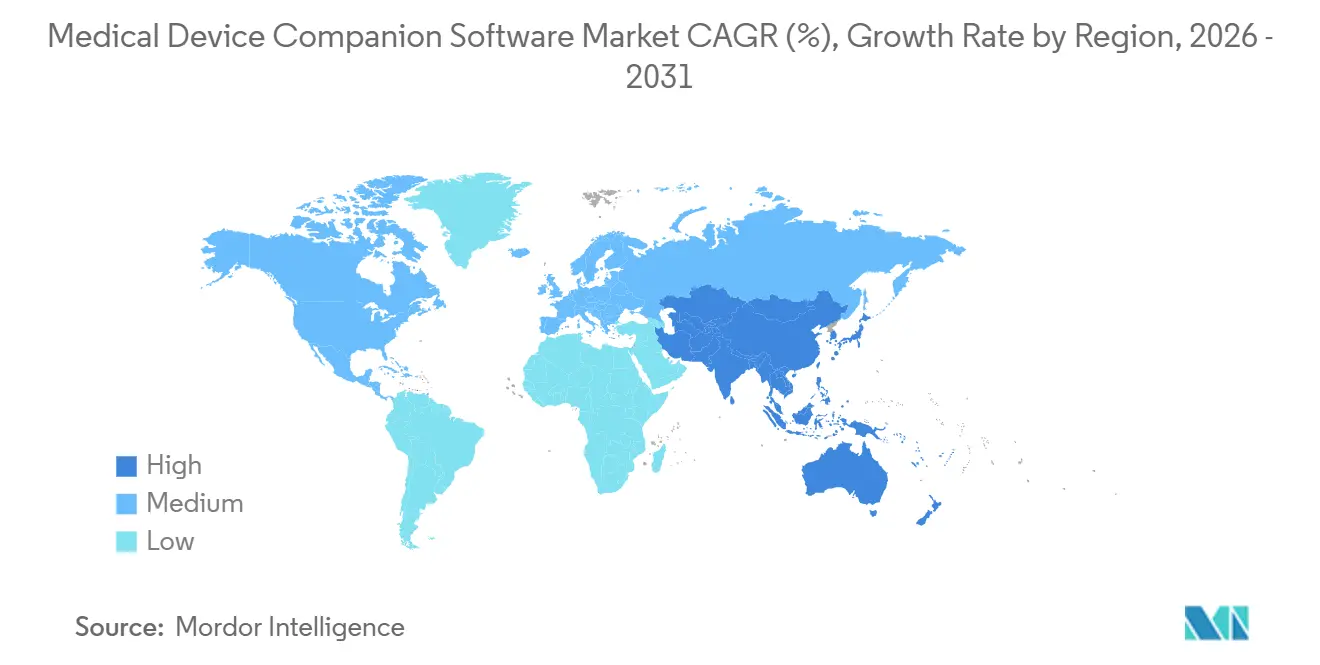
North America held 42.45% of the medical device companion software market share in 2025, supported by established RPM reimbursement infrastructure and a large installed base of connected devices. CMS added CPT 99445 and CPT 99470 in 2026 and set the conversion factor at USD 33.40 per RVU, expanding the billable patient pool by removing the 16-day minimum for data transmission. The FDA also broadened enforcement discretion for certain lower-risk clinical decision support functions in January 2026. Canada and Mexico are adopting digital health procurement approaches that increasingly align with U.S. payer models, while U.S. provider organizations are expected to make RPM and Chronic Care Management billing combinations more routine through 2027.
Europe holds the second-largest regional position in the supplied analysis. Germany’s DiGA framework and the United Kingdom’s NICE Evidence Standards Framework provide structured pathways for software that meets clinical evidence requirements. EU Medical Device Regulation reclassification work since 2024 created a competitive filter among developers, with validated companies gaining evidence packages for expansion and others facing pressure to consolidate or seek acquisition. Siemens Healthineers and Philips disclosed AI imaging companion investments at RSNA 2025, while the European Health Data Space targets implementation in 2027 with FHIR-based health data portability requirements.
Asia-Pacific is forecast to grow at a CAGR of 18.56% through 2031, the fastest regional rate in the medical device companion software market. Government action in Japan, hospital digitalization in China, and private hospital investment in India support demand. China published YY/T 1406-2026 in March 2026 to establish software lifecycle risk management requirements, and the Gates Foundation provided Qure.ai with a USD 8 million grant in January 2026 for AI-driven tuberculosis and pneumonia ultrasound diagnosis. Opportunities in the Middle East and Africa include Saudi Arabia’s Vision 2030 digital health investments and Huma Therapeutics’ cardiac health program with Bayer, while South America offers a longer-term opening as Brazil advances digital health regulation.

Competitive Landscape
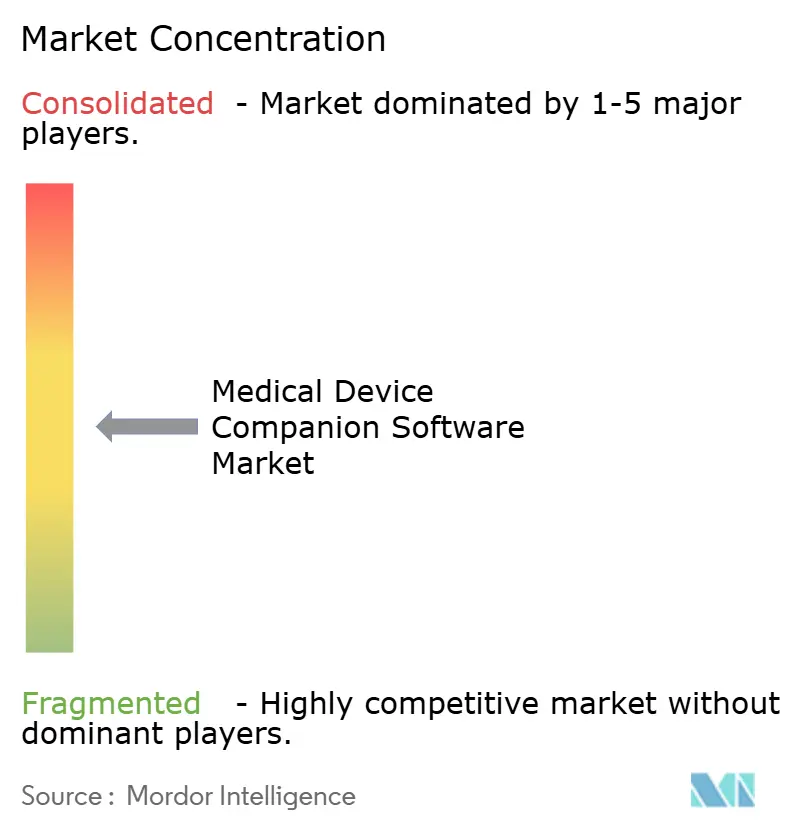
The medical device companion software market has moderate concentration. Medtronic, Abbott, Dexcom, ResMed, and Philips have hardware-software integration advantages that can create multi-year switching costs by linking applications directly to device portfolios and patient data flows. ResMed’s myAir received FDA clearance as a standalone Class II device in April 2026, showing how companion applications can support recurring revenue within a device ecosystem. Subscription delivery also helps OEMs maintain customer engagement after the initial hardware sale.
AI-focused companies are challenging established suppliers in selected clinical areas. Aidoc’s aiOS platform has analyzed more than 100 million cases, according to the company’s supplied disclosure. GE HealthCare and Siemens Healthineers are integrating third-party algorithm marketplaces into Genesis Radiology Workspace and Syngo.via, positioning external algorithms as complementary offerings rather than only direct competitors. iRhythm’s April 2026 patent grant for ECG machine-learning architectures strengthened the intellectual property position behind MyZio, while Dexcom’s July 2026 selection for the FDA TEMPO Pilot gave its glucose data platform another route to demonstrate clinical value.
Post-acute rehabilitation monitoring, neurostimulation applications, and multi-condition chronic disease platforms remain less developed areas. Large OEMs are acquiring software-focused companies to close capability gaps, while private-equity-backed consolidators are building broader platforms from niche applications. Cybersecurity obligations under the FDA’s 2025 guidance are also becoming a market-access filter. Companies with strong quality systems can manage documentation and maintenance requirements more effectively, keeping partnerships, acquisitions, and platform integration relevant.
Medical Device Companion Software Industry Leaders
Abbott Laboratories
GE HealthCare Technologies Inc.
Koninklijke Philips N.V.
Medtronic plc
Siemens Healthineers AG
- *Disclaimer: Major Players sorted in no particular order

Recent Industry Developments
- July 2026: Dexcom was selected for the FDA’s Technology-Enabled Meaningful Patient Outcomes Pilot to deploy an AI-powered glucose health program integrating G7 and Stelo data with nutrition, sleep, and activity inputs for prediabetes screening.
- July 2026: Dexcom launched the redesigned Stelo OTC CGM companion application after FDA clearance, with international expansion planned in the United Kingdom, Australia, New Zealand, and South Korea later in 2026.
- June 2026: Insulet Corporation rolled out the enhanced Omnipod 5 algorithm with a 100 mg/dL target glucose, Automated Delivery Restriction improvements, and Abbott FreeStyle Libre 3 Plus sensor compatibility in the United States.
- June 2026: GE HealthCare received FDA 510(k) clearance for MIM Contour ProtégéAI+ 2.0, an AI-enabled auto-contouring companion software for radiation oncology treatment planning.
- March 2026: GE HealthCare received FDA 510(k) clearance for View, a zero-footprint diagnostic viewer within Genesis Radiology Workspace that enabled browser-based access to diagnostic imaging.


Global Medical Device Companion Software Market Report Scope
As per the scope of the report, Medical device companion software is a type of Software as a Medical Device (SaMD) that runs on general-purpose platforms like smartphones or computers to support, configure, or extend the medical purpose of a physical hardware device. Key aspects include companion apps, data visualization dashboards, and remote monitoring tools.
The medical device companion software market is segmented by product type, form factor, deployment mode, device category, application, and geography. By product type, the market includes patient monitoring companion software, diagnostic device companion software, therapeutic device companion software, drug delivery device companion software, surgical and interventional device companion software, rehabilitation and assistive device companion software, implantable device companion software, and home-use medical device companion software. By form factor, the market is segmented into native mobile application, responsive web application, desktop application, embedded device software, cloud-based web platform, hybrid application, and conversational and voice interface. By deployment mode, the market is categorized into cloud-based, on-premises, hybrid, and edge-based. By device category, the market includes continuous glucose monitoring systems, insulin pumps and automated insulin delivery systems, connected blood glucose meters, connected blood pressure monitors, connected pulse oximeters, connected weight scales, connected spirometers and respiratory devices, connected inhalers, sleep apnea and ventilation devices, ambulatory cardiac monitoring devices, implantable cardiac devices, patient monitoring systems, medical imaging devices, surgical robotics and navigation systems, neurostimulation devices, orthopedic and rehabilitation devices, and home diagnostic devices. By application, the market is segmented into chronic disease management, acute care monitoring, post-acute care, medication administration and adherence, screening and early detection, diagnosis and clinical assessment, treatment planning, therapy optimization, recovery and rehabilitation, and patient safety and risk reduction. By geography, the market is analyzed across North America, Europe, Asia-Pacific, the Middle East and Africa, and South America. The report also covers the estimated market sizes and trends for 17 countries across major regions globally. The report offers the market sizes and forecasts in terms of value (USD) for the above segments.
| Patient Monitoring Companion Software |
| Diagnostic Device Companion Software |
| Therapeutic Device Companion Software |
| Drug Delivery Device Companion Software |
| Surgical and Interventional Device Companion Software |
| Rehabilitation and Assistive Device Companion Software |
| Implantable Device Companion Software |
| Home-Use Medical Device Companion Software |
| Native Mobile Application |
| Responsive Web Application |
| Desktop Application |
| Embedded Device Software |
| Cloud-Based Web Platform |
| Hybrid Application |
| Conversational and Voice Interface |
| Cloud-Based |
| On-Premises |
| Hybrid |
| Edge-Based |
| Continuous Glucose Monitoring Systems |
| Insulin Pumps and Automated Insulin Delivery Systems |
| Connected Blood Glucose Meters |
| Connected Blood Pressure Monitors |
| Connected Pulse Oximeters |
| Connected Weight Scales |
| Connected Spirometers and Respiratory Devices |
| Connected Inhalers |
| Sleep Apnea and Ventilation Devices |
| Ambulatory Cardiac Monitoring Devices |
| Implantable Cardiac Devices |
| Patient Monitoring Systems |
| Medical Imaging Devices |
| Surgical Robotics and Navigation Systems |
| Neurostimulation Devices |
| Orthopedic and Rehabilitation Devices |
| Home Diagnostic Devices |
| Chronic Disease Management |
| Acute Care Monitoring |
| Post-Acute Care |
| Medication Administration and Adherence |
| Screening and Early Detection |
| Diagnosis and Clinical Assessment |
| Treatment Planning |
| Therapy Optimization |
| Recovery and Rehabilitation |
| Patient Safety and Risk Reduction |
| North America | United States |
| Canada | |
| Mexico | |
| Europe | Germany |
| United Kingdom | |
| France | |
| Italy | |
| Spain | |
| Rest of Europe | |
| Asia-Pacific | China |
| India | |
| Japan | |
| Australia | |
| South Korea | |
| Rest of Asia-Pacific | |
| Middle East and Africa | GCC |
| South Africa | |
| Rest of Middle East and Africa | |
| South America | Brazil |
| Argentina | |
| Rest of South America |
| By Product Type | Patient Monitoring Companion Software | |
| Diagnostic Device Companion Software | ||
| Therapeutic Device Companion Software | ||
| Drug Delivery Device Companion Software | ||
| Surgical and Interventional Device Companion Software | ||
| Rehabilitation and Assistive Device Companion Software | ||
| Implantable Device Companion Software | ||
| Home-Use Medical Device Companion Software | ||
| By Form Factor | Native Mobile Application | |
| Responsive Web Application | ||
| Desktop Application | ||
| Embedded Device Software | ||
| Cloud-Based Web Platform | ||
| Hybrid Application | ||
| Conversational and Voice Interface | ||
| By Deployment Mode | Cloud-Based | |
| On-Premises | ||
| Hybrid | ||
| Edge-Based | ||
| By Device Category | Continuous Glucose Monitoring Systems | |
| Insulin Pumps and Automated Insulin Delivery Systems | ||
| Connected Blood Glucose Meters | ||
| Connected Blood Pressure Monitors | ||
| Connected Pulse Oximeters | ||
| Connected Weight Scales | ||
| Connected Spirometers and Respiratory Devices | ||
| Connected Inhalers | ||
| Sleep Apnea and Ventilation Devices | ||
| Ambulatory Cardiac Monitoring Devices | ||
| Implantable Cardiac Devices | ||
| Patient Monitoring Systems | ||
| Medical Imaging Devices | ||
| Surgical Robotics and Navigation Systems | ||
| Neurostimulation Devices | ||
| Orthopedic and Rehabilitation Devices | ||
| Home Diagnostic Devices | ||
| By Application | Chronic Disease Management | |
| Acute Care Monitoring | ||
| Post-Acute Care | ||
| Medication Administration and Adherence | ||
| Screening and Early Detection | ||
| Diagnosis and Clinical Assessment | ||
| Treatment Planning | ||
| Therapy Optimization | ||
| Recovery and Rehabilitation | ||
| Patient Safety and Risk Reduction | ||
| By Geography | North America | United States |
| Canada | ||
| Mexico | ||
| Europe | Germany | |
| United Kingdom | ||
| France | ||
| Italy | ||
| Spain | ||
| Rest of Europe | ||
| Asia-Pacific | China | |
| India | ||
| Japan | ||
| Australia | ||
| South Korea | ||
| Rest of Asia-Pacific | ||
| Middle East and Africa | GCC | |
| South Africa | ||
| Rest of Middle East and Africa | ||
| South America | Brazil | |
| Argentina | ||
| Rest of South America | ||


Key Questions Answered in the Report
What is the projected value of medical device companion software in 2031?
The medical device companion software market is forecast to reach USD 9.23 billion by 2031, from USD 4.50 billion in 2026, at a 14.45% CAGR. The projection reflects stronger use of remote monitoring, connected devices, and reimbursable software services.
Which product category has the largest revenue position?
Patient Monitoring Companion Software held 34.55% of product-type revenue in 2025. Its position is supported by frequent data transmission across connected cardiac, oximetry, and glucose-monitoring devices.
Which application is expected to grow fastest through 2031?
Diagnosis and Clinical Assessment is forecast to grow at an 18.22% CAGR through 2031. AI imaging tools support the use of these applications within established clinical workflows.
Which region is growing fastest?
Asia-Pacific is forecast to grow at an 18.56% CAGR through 2031. Digital health programs, hospital investment, and clinical staffing needs support demand across the region.
Why is hybrid deployment gaining adoption?
Hybrid deployment is forecast to grow at a 16.35% CAGR because it combines cloud collaboration with local processing and storage. This approach helps health systems address regulatory and network requirements.
How do CMS changes affect remote monitoring software?
CPT 99445 and CPT 99470 introduced in 2026 reduced the data transmission threshold from 16 days to 2 days. This expands eligibility for remote monitoring programs and helps providers consider more patients for software-supported device monitoring. The codes also reinforce the need for applications that document transmitted data and support interactive clinical communication.
Page last updated on:





