
Media Planning Market Size and Share
Market Overview
| Study Period | 2020 - 2031 |
|---|---|
| Market Size (2026) | USD 6.64 Billion |
| Market Size (2031) | USD 11.35 Billion |
| Growth Rate (2026 - 2031) | 11.32 % |
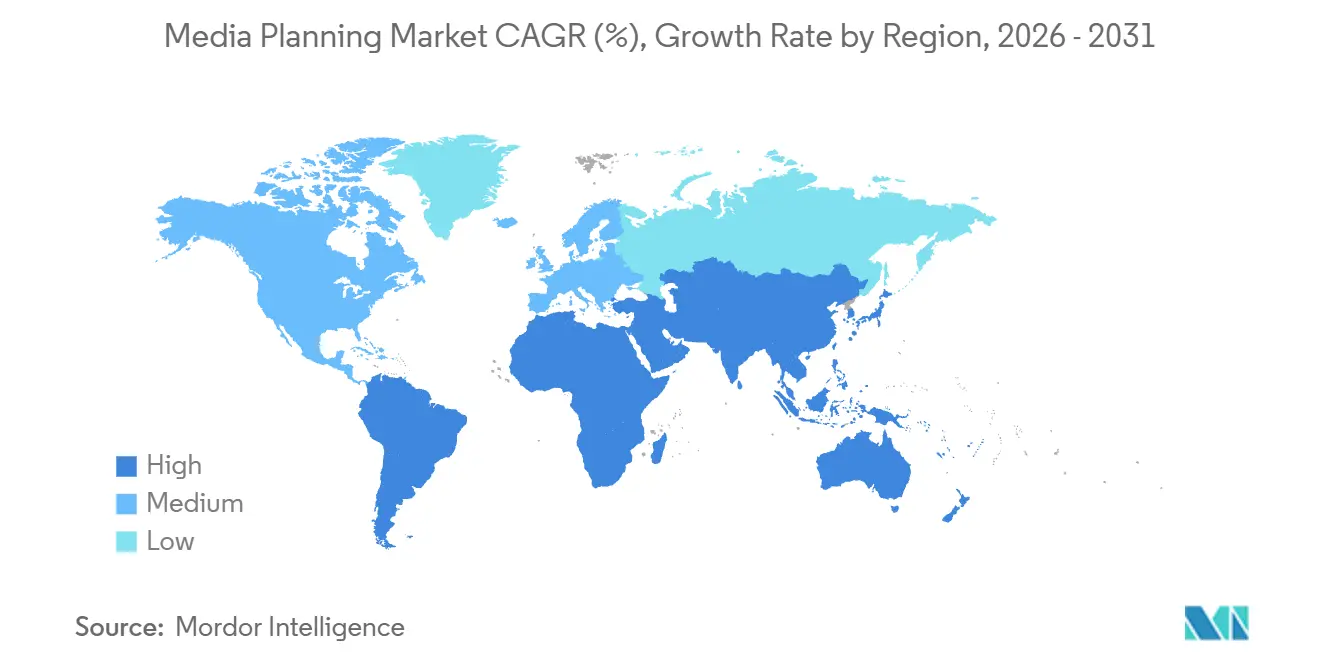
| Fastest Growing Market | Middle East |
| Largest Market | North America |
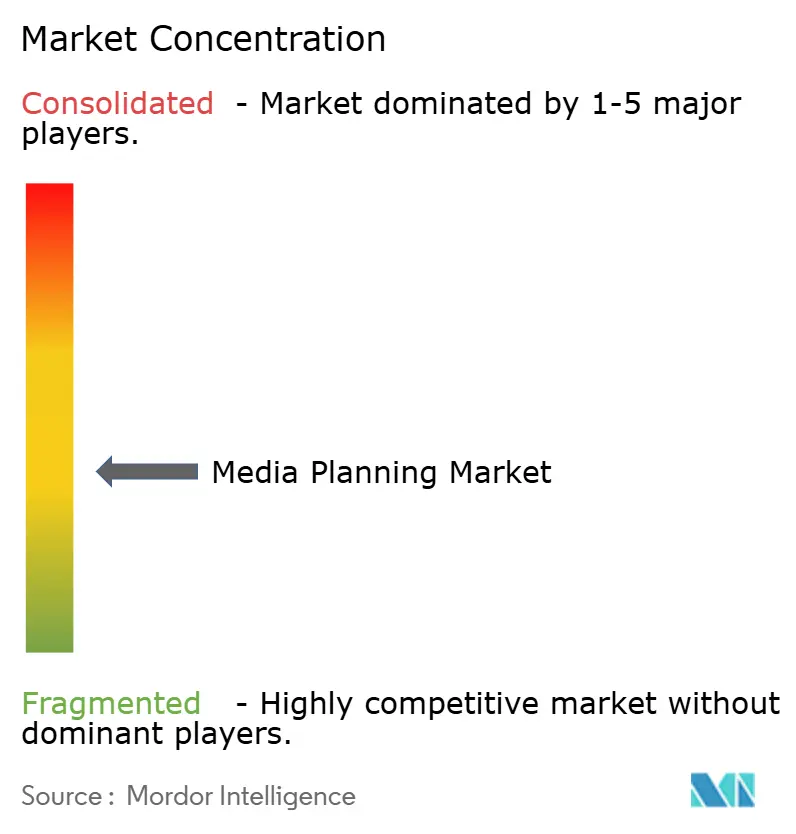
| Market Concentration | Medium |
Major Players *Disclaimer: Major Players sorted in no particular order Image © Mordor Intelligence. Reuse requires attribution under CC BY 4.0. | |
Media Planning Market Analysis by Mordor Intelligence
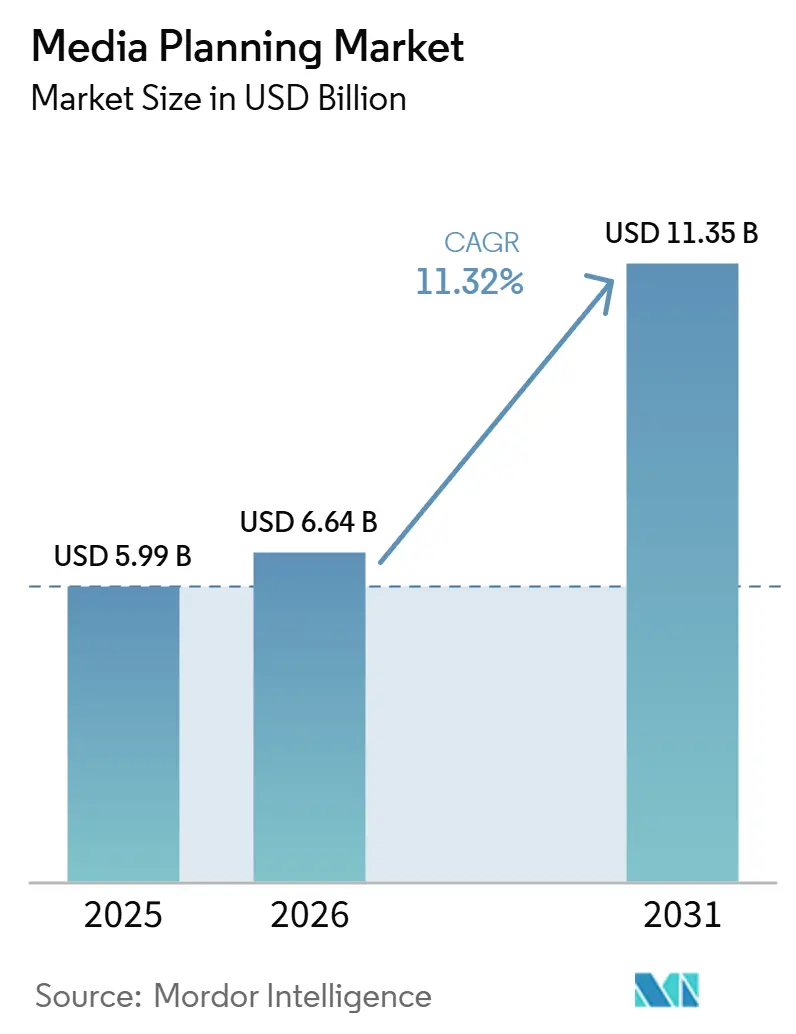
The Media Planning Market size was valued at USD 5.99 billion in 2025 and is estimated to grow from USD 6.64 billion in 2026 to reach USD 11.35 billion by 2031, at a CAGR of 11.32% during the forecast period 2026-2031. The Media Planning Market is being shaped by the broader adoption of AI in campaign planning, the growth of addressable inventory, and stronger demand for proof that spending drove incremental outcomes. These changes are moving planning work away from manual schedule building and toward systems that use data to allocate budgets and evaluate inventory. Large agency groups are responding by building integrated data and AI platforms, while independent technology providers are targeting gaps in planning, measurement, and activation. Privacy rules and signal loss remain material constraints because they reduce the accuracy of audience-matching and frequency models. The Media Planning Market also has an opening in tools that unite reach, frequency, and scenario planning across connected TV, audio, social, retail media, and other digital channels.b
Key Report Takeaways
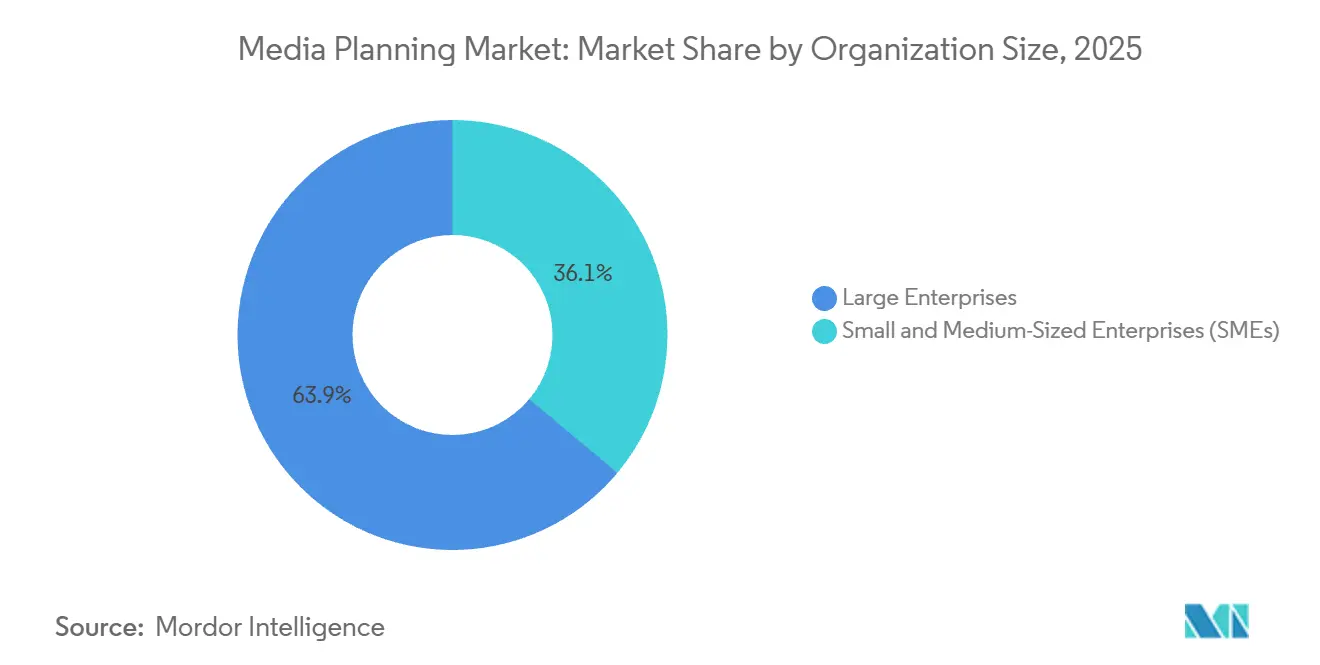
- By organization size, large enterprises accounted for 63.92% of revenue in the Media Planning Market 2025, while small and medium-sized enterprises are projected to expand at a 12.41% CAGR through 2031.
- By planning objective, audience planning accounted for 30.12% of revenue in 2025, while budget allocation and scenario planning are expected to expand at a 14.23% CAGR through 2031.
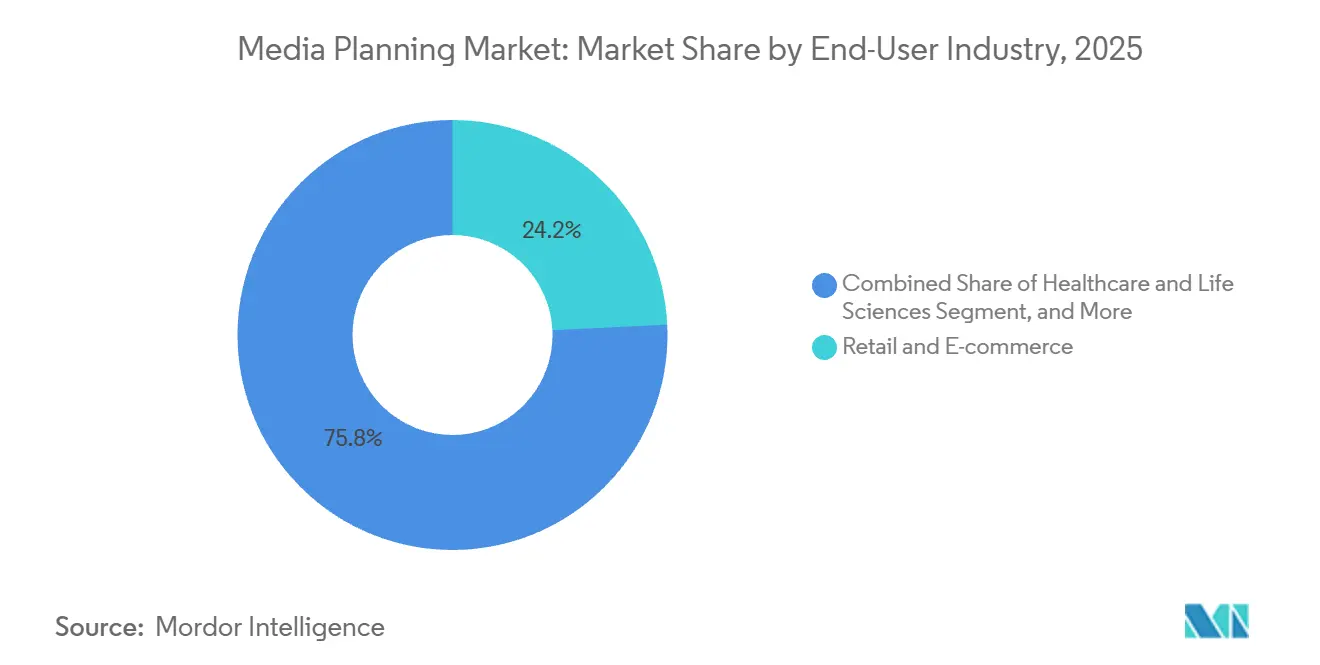
- By end-user industry, retail and e-commerce accounted for 24.23% of revenue in the Media Planning Market 2025, while healthcare and life sciences are projected to grow at a 13.91% CAGR through 2031.
- By geography, North America accounted for 36.38% of revenue in the Media Planning Market 2025, while the Middle East is expected to expand at a 12.12% CAGR through 2031.
Note: Market size and forecast figures in this report are generated using Mordor Intelligence’s proprietary estimation framework, updated with the latest available data and insights as of January 2026.
Global Media Planning Market Trends and Insights
Drivers Impact Analysis*
| Driver | (~) % Impact on CAGR Forecast | Geographic Relevance | Impact Timeline |
|---|---|---|---|
| Shift Toward Algorithmic and Programmatic Planning | +3.2% | Global, with concentrated gains in North America, Western Europe, and Asia-Pacific core markets | Short term (≤ 2 years) |
| Expansion of Retail Media and Commerce Media Inventories | +2.5% | North America and Europe, with spillover to Asia-Pacific and the Middle East | Short term (≤ 2 years) |
| Fragmentation Across Connected TV, Audio, and Creator Channels | +1.8% | North America, Western Europe, and Australia | Medium term (2-4 years) |
| Need for Unified Reach and Frequency Across Cross-Platform Campaigns | +1.3% | Global | Medium term (2-4 years) |
| Media Brief Compression From Generative AI Copilots | +1.0% | Global, with early gains in North America and Western Europe | Short term (≤ 2 years) |
| Budget Reforecasting Pressure From Tariff-Driven Demand Volatility | +0.7% | North America and trade-exposed Asia-Pacific markets | Short term (≤ 2 years) |
| Source: Mordor Intelligence | |||
Shift Toward Algorithmic and Programmatic Planning
Algorithmic decision-making has become a central part of media planning rather than a limited trial capability. The IAB reported that AI-related priorities accounted for 5 of the 6 leading areas of focus for advertisers and agencies in 2026, including systems that can plan, activate, and optimize campaigns with limited human intervention.[1]Interactive Advertising Bureau, “IAB 2026 Outlook Study,” Interactive Advertising Bureau, iab.com The change shifts planners toward reviewing model outputs, assessing data quality, and setting inventory and attribution rules. This is important for the Media Planning Market because the value of planning software increasingly depends on its governance rather than just its ability to automate tasks. Agency groups are increasingly combining planning, strategy, and audience development within centralized technology architectures. Companies that can make automated decisions understandable and controllable should be better positioned as media buyers rely more heavily on agent-based workflows.
Expansion of Retail Media and Commerce Media Inventories
Retail media has become a planning requirement because it combines consumer data, advertising inventory, and purchase signals. Its expansion has moved retail media beyond a narrow channel-diversification role and into routine planning decisions. The growing use of off-site inventory requires planners to consider retail media across connected TV, social media, and programmatic channels. Planners in the Media Planning Market, therefore, need to consider retail media as a full-funnel channel rather than just a search activity on a retailer's website. Industry efforts to distinguish measurable retail and commerce media from traditional trade spending provide a clearer basis for measurement and reporting. The growing number of networks also requires more careful evaluation of inventory quality, audience access, and the ability to compare results across platforms.
Fragmentation Across Connected TV, Audio, and Creator Channels
The expansion of connected TV, digital audio, and creator distribution has increased the number of channels within a typical plan. CIMM identified fragmented supply paths, different identity systems, and siloed measurement as persistent barriers to planning, buying, and measuring connected TV campaigns.[2]Coalition for Innovative Media Measurement, “Best Practices for Planning, Buying and Measuring CTV Ad Campaigns,” Coalition for Innovative Media Measurement, cimm-us.org The result is greater demand for tools that prevent repeated exposure and show which channels drive new reach. Comscore reported that adding digital audio to a connected TV plan produced an average 10% lift in incremental reach in initial testing with The Trade Desk. Creator content distributed through TV environments adds another inventory category that many existing planning workflows do not yet handle well. The Media Planning Market benefits when planners need a more coordinated way to manage these overlapping formats.[3]Comscore, “Comscore Launches Audio Targeting and Measurement Capabilities With The Trade Desk,” Comscore, comscore.com
Need for Unified Reach and Frequency Across Cross-Platform Campaigns
Cross-platform measurement has become a business issue because advertisers need confidence that budget allocation reflects real reach and outcomes. CIMM and the 4As found that advertisers have extensive analytical access but less confidence in cross-channel results because systems use different measurement and attribution methods. This gap makes unified identity resolution and reach deduplication more important at the planning stage, before budgets are committed. Nielsen and Mediaocean announced a June 2026 integration to provide advanced audience reporting for data-driven linear national TV campaigns through the Prisma platform. Such integrations show that planning tools are increasingly expected to connect measurement with the workflow where budget choices are made. This strengthens demand within the Media Planning Market for systems that bring reporting and planning closer together.[4]Nielsen, “Nielsen and Mediaocean Announce New Integration to Power the Next Phase of Data-Driven Linear Advanced Audience Measurement,” Nielsen, nielsen.com
Restraints Impact Analysis*
| Restraint | (~) % Impact on CAGR Forecast | Geographic Relevance | Impact Timeline |
|---|---|---|---|
| Signal Loss From Privacy Regulation and Cookie Deprecation | -1.5% | Global, most acute in Europe and the United States | Short term (≤ 2 years) |
| Measurement Fragmentation Across Walled Gardens | -1.2% | Global | Medium term (2-4 years) |
| Planning Talent Shortage in Agentic and Incrementality-Based Workflows | -0.9% | North America and Western Europe | Medium term (2-4 years) |
| Inventory Quality Risk Across Retail Media and Creator Marketplaces | -0.7% | North America and Asia-Pacific | Medium term (2-4 years) |
| Source: Mordor Intelligence | |||
Signal Loss From Privacy Regulation and Cookie Deprecation
Privacy requirements continue to limit the data available for targeting, measurement, and frequency management. The impact is most visible where consent requirements limit audience matching and the use of data across platforms. For Media Planning Market participants, lower match rates can make audience estimates less certain and make frequency controls less precise. Investment in first-party data and consent systems can also compete with working media budgets. These issues can delay platform investments until buyers establish durable data rights and operating rules. The restraint is especially relevant for businesses that need to compare campaigns across several regulated environments.
Measurement Fragmentation Across Walled Gardens
Large advertising platforms continue to measure performance under their own definitions, making direct comparisons difficult. Separate conversion windows and attribution methods can lead platforms to claim credit for the same purchase event. This can favor environments that report more aggressively and can lead planners to place too much emphasis on immediate conversion signals. Media Planning Market buyers are using media mix modeling, incrementality testing, and data clean rooms to address this problem, but matching rates and data access vary by partnership. The shortage of planning talent with expertise in agent-based systems and incrementality methods adds another operational constraint. Inventory quality concerns across retail and creator environments further underscore the need for reliable verification, brand safety, and measurement controls.
*Our forecasts treat driver/restraint impacts as directional, not additive. The impact forecasts reflect baseline growth, mix effects, and variable interactions.
Segment Analysis
By Organization Size: Enterprise Demand Leads Revenue While SMEs Expand Access
Large enterprises held 63.92% of the Media Planning Market share in 2025. Their scale supports investment in enterprise planning systems, advanced measurement suites, and custom AI integrations. These buyers often operate through global agency networks or mature in-house teams that manage extensive omnichannel budgets. This concentration sustains demand for systems that integrate data, planning, activation, and measurement. Omnicom introduced its next-generation Omni platform in January 2026 to integrate data, identity, AI, media planning, commerce activation, and measurement.
Small and medium-sized enterprises are projected to record the highest growth at a 12.41% CAGR from 2026 to 2031. Self-service programmatic tools and AI-supported planning services reduce the need for an agency intermediary for routine campaign construction. This makes structured planning more accessible to smaller advertisers that previously relied on separate channel tools. Software that turns a brief into a draft plan and offers accessible pricing supports this Media Planning Market buyer group. Providers that combine clear workflows with self-service access can address this broader buyer base without requiring the cost structure of an enterprise implementation.


By Planning Objective: Audience Planning Leads While Scenario Planning Gains Pace
Audience planning accounted for 30.12% of revenue in 2025. This leading position reflects the importance of defining an addressable audience before allocating budget across channels. First-party and contextual targeting have made audience definition more central as access to third-party signals becomes less dependable. Reach and frequency planning, customer journey planning, and share-of-voice planning remain important because they support campaign delivery and competitive assessment. Large advertisers use these Media Planning Market functions to manage brand activity across linear and digital media.
Budget allocation and scenario planning are projected to grow at a 14.23% CAGR from 2026 to 2031. Demand volatility has increased the need for frequent reforecasting and more responsive budget allocation. AI-based scenario engines can model several budget outcomes quickly and allow teams to revise plans as conditions change. Mediaocean introduced NIVO AI in June 2026 to convert briefs, emails, and spreadsheets into ready-to-run campaign execution workflows. The Media Planning Market is likely to favor platforms that offer real-time reforecasting and scenario modeling, rather than treating budget allocation as a periodic, manual exercise.
By End-User Industry: Retail Supports Scale While Healthcare Requires Specialized Workflows
Retail and e-commerce accounted for 24.23% of revenue in 2025. This segment relies on specialized planning workflows for on-site and off-site retail media inventory. The shift toward off-site inventory means that retail planners must coordinate conversion-oriented activity with broader awareness campaigns. BFSI, education, automotive, IT, and telecom also need Media Planning Market tools that can reflect their audience, data, and compliance needs. Media and entertainment, travel and hospitality, and consumer goods continue to require unified reach planning across linear and digital audiences.
The healthcare and life sciences industry is projected to grow at a 13.91% CAGR from 2026 to 2031. The sector is shifting advertising activity toward digital formats and requires platforms that can incorporate sector-specific controls. Compliance requirements under HIPAA and FDA rules push advertisers toward purpose-built systems. OptimizeRx launched programmatic access to authenticated EHR advertising inventory in May 2026, connecting its network with demand-side platforms. The Media Planning Market has a clear opportunity to develop software that combines planning functions with these safeguards, rather than offering only general campaign tools.

Geography Analysis
North America held 36.38% of the Media Planning Market share in 2025. The region has a mature programmatic ecosystem and a high concentration of global media holding companies. The November 2025 Omnicom acquisition of Interpublic concentrated media investment planning within a smaller number of larger organizations. Canada and Mexico are adding to regional demand through expanding digital advertising activity, though currency and tariff-related uncertainty make scenario planning more relevant. Continuing investment in data, AI, and connected-TV measurement strengthens the Media Planning Market's role in the region.
Europe is a stable but complex region because consent requirements affect data availability, and joint industry measurement bodies remain important. France and Germany are adopting AI-supported planning infrastructure. MiQ deployed its Sigma AI tool in France in February 2026 for planning across linear TV, streaming TV, YouTube, and social media. Local Media Planning Market systems must combine precision with GDPR-compliant data practices. South America, led by Brazil, is seeing wider adoption of programmatic planning as digital advertising measurement becomes more formalized and global agency platforms expand locally.
The Middle East is projected to grow at a 12.12% CAGR from 2026 to 2031. The MENA digital advertising sector reached USD 8.185 billion in 2025, rising 17.8% year over year, according to IAB MENA. Retail media grew by as much as 40.5% in 2025, while connected TV grew 31%, raising the need for planning tools that support more than social-led campaigns. Saudi Arabia and the UAE are supporting demand as economic diversification expands the advertiser base outside oil-related activity. Asia-Pacific presents a major opportunity, with China, Japan, India, South Korea, and Australia each having distinct advertiser needs.

Competitive Landscape
The Media Planning Market is moderately fragmented at the enterprise level, with Omnicom, Publicis Groupe, WPP, Dentsu, and Havas handling much of the planning for large advertisers. The underlying technology layer remains more fragmented, with independent advertising technology vendors, measurement specialists, and data providers serving different parts of the workflow. Omnicom completed its USD 9 billion acquisition of Interpublic in November 2025, creating a larger media investment organization and raising the scale needed for investment in AI platforms. This approach reflects a broader move from manually assembled plans toward AI-supported processes. The competitive advantage of the largest groups increasingly depends on their data assets, technology systems, and ability to connect planning with activation and measurement.
Publicis expanded its partnership with Microsoft in 2026, taking on Microsoft’s global media account while deepening cooperation on cloud and agentic AI capabilities. The agreement illustrates how agency mandates can now be linked with technology and data infrastructure. WPP retired the GroupM brand and introduced WPP Media in May 2025, consolidating media investment operations within a single AI-enabled structure. WPP invested GBP 300 million (USD 381 million) annually in AI and technology through its WPP Open platform. These actions show that large networks are using platform investment to strengthen client retention and operating efficiency.
Independent platforms are seeking opportunities where holding-company systems can be expensive or difficult to adapt. Basis launched Compass in April 2026 to transform campaign briefs into omnichannel strategies and activate plans across programmatic, direct, paid search, and paid social media. The Trade Desk announced Audience Unlimited and Koa Adaptive Trading Modes in September 2025, giving advertisers greater algorithmic control over campaign strategy and data use. Specialists such as Keen Decision Systems and GWI serve adjacent needs in marketing-mix optimization and audience intelligence. The Media Planning Market supports different approaches to technology deployment for enterprise and middle-market advertisers.
Media Planning Industry Leaders
Omnicom Group Inc.
WPP plc
Publicis Groupe S.A.
Dentsu Group Inc.
Havas N.V.
- *Disclaimer: Major Players sorted in no particular order

Recent Industry Developments
- July 2026: Nielsen launched Ad Intel AI on July 27, 2026, the company’s first AI-powered platform tracking competitive ad spending, creative strategies, and market dynamics across 5.5 million brands and 4.6 million advertisers in more than 90 markets. The platform marked a move from reporting tools toward real-time decision support through the Model Context Protocol.
- June 2026: Mediaocean introduced NIVO AI on June 11, 2026. The system used Innovid agents and delivered workflow efficiency gains of up to 90% versus manual campaign setup during pilots with FanDuel, Paddy Power, and Canvas, enabling campaigns to go live from raw brief input within minutes.
- June 2026: Nielsen and Mediaocean announced a data integration on June 4, 2026, to bring advanced audience reporting for data-driven linear national TV campaigns into Mediaocean’s Prisma platform. The integration is scheduled to launch in September 2026 before the fall TV season.
- May 2026: OptimizeRx launched programmatic access to its authenticated EHR advertising network on May 11, 2026. The launch enabled demand-side platforms to integrate proprietary point-of-care inventory into existing media buying workflows and opened OptimizeRx to programmatic advertising.


Global Media Planning Market Report Scope
The media planning market refers to the strategic processes and professional services involved in determining the optimal channels, timing, and frequency for delivering advertising messages to a target audience. This market encompasses various planning objectives, including reach and frequency optimization, budget allocation and scenario modeling, audience targeting, customer journey mapping, and share of voice (SOV) planning. Catering to organizations of all sizes across industries such as retail, media, healthcare, and consumer goods, media planning bridges the gap between broad marketing strategy and tactical media execution. By leveraging data-driven insights and cross-channel analytics, these services enable advertisers to optimize their spending, ensure cohesive messaging across diverse traditional and digital touchpoints, and maximize overall campaign effectiveness and return on investment.
The Media Planning Market Report is Segmented by Organization Size (Large Enterprises, and Small and Medium-Sized Enterprises), Planning Objective (Reach and Frequency Planning, Budget Allocation and Scenario Planning, Audience Planning, Customer Journey Planning, and Share of Voice (SOV) Planning), End-User Industry (Retail and E-commerce, Media and Entertainment, Healthcare and Life Sciences, Travel and Hospitality, Consumer Goods, and Other End-User Industries (BFSI, Education, Automotive and IT and Telecom amongst Others)), and Geography (North America, South America, Europe, Asia-Pacific, Middle East, and Africa). The Market Forecasts are Provided in Terms of Value (USD).). The Market Forecasts are Provided in Terms of Value (USD).
| Large Enterprises |
| Small and Medium-Sized Enterprises |
| Reach and Frequency Planning |
| Budget Allocation and Scenario Planning |
| Audience Planning |
| Customer Journey Planning |
| Share of Voice (SOV) Planning |
| Retail and E-commerce |
| Media and Entertainment |
| Healthcare and Life Sciences |
| Travel and Hospitality |
| Consumer Goods |
| Other End-User Industries (BFSI, Education, Automotive and IT and Telecom amongst Others) |
| North America | United States |
| Canada | |
| Mexico | |
| South America | Brazil |
| Argentina | |
| Chile | |
| Rest of South America | |
| Europe | Germany |
| United Kingdom | |
| France | |
| Italy | |
| Spain | |
| Rest of Europe | |
| Asia-Pacific | China |
| Japan | |
| India | |
| South Korea | |
| Australia | |
| Rest of Asia-Pacific | |
| Middle East | United Arab Emirates |
| Saudi Arabia | |
| Qatar | |
| Rest of Middle East | |
| Africa | South Africa |
| Egypt | |
| Nigeria | |
| Rest of Africa |
| By Organization Size | Large Enterprises | |
| Small and Medium-Sized Enterprises | ||
| By Planning Objective | Reach and Frequency Planning | |
| Budget Allocation and Scenario Planning | ||
| Audience Planning | ||
| Customer Journey Planning | ||
| Share of Voice (SOV) Planning | ||
| By End-User Industry | Retail and E-commerce | |
| Media and Entertainment | ||
| Healthcare and Life Sciences | ||
| Travel and Hospitality | ||
| Consumer Goods | ||
| Other End-User Industries (BFSI, Education, Automotive and IT and Telecom amongst Others) | ||
| By Geography | North America | United States |
| Canada | ||
| Mexico | ||
| South America | Brazil | |
| Argentina | ||
| Chile | ||
| Rest of South America | ||
| Europe | Germany | |
| United Kingdom | ||
| France | ||
| Italy | ||
| Spain | ||
| Rest of Europe | ||
| Asia-Pacific | China | |
| Japan | ||
| India | ||
| South Korea | ||
| Australia | ||
| Rest of Asia-Pacific | ||
| Middle East | United Arab Emirates | |
| Saudi Arabia | ||
| Qatar | ||
| Rest of Middle East | ||
| Africa | South Africa | |
| Egypt | ||
| Nigeria | ||
| Rest of Africa | ||


Key Questions Answered in the Report
What is the size of the Media Planning Market?
The Media Planning Market is estimated at USD 6.64 billion in 2026 and is forecast to reach USD 11.35 billion by 2031, at an 11.32% CAGR.
What is driving growth in media planning services and software?
AI-supported planning, programmatic buying, retail media growth, and demand for unified cross-platform reach and frequency management are supporting demand.
Which organization size leads spending on media planning?
Large enterprises led with 63.92% of revenue in 2025 because they manage complex omnichannel budgets and invest in custom data and AI systems.
Which planning objective is growing fastest?
Budget allocation and scenario planning is projected to expand at a 14.23% CAGR through 2031 as advertisers need more frequent budget revisions.
Which end-user sector is expected to grow fastest?
Healthcare and life sciences is projected to grow at a 13.91% CAGR through 2031, supported by growing digital spending and specialized compliance needs.
Which region is expected to grow fastest?
The Middle East is projected to expand at a 12.12% CAGR through 2031 as retail media and connected TV activity increase.
Page last updated on:


 Your data is secure and never sold or shared.


