
Mashed Potatoes Market Size and Share
Market Overview
| Study Period | 2022 - 2032 |
|---|---|
| Market Size (2027) | USD 4.42 Billion |
| Market Size (2032) | USD 5.72 Billion |
| Growth Rate (2027 - 2032) | 5.29 % |
| Fastest Growing Market | Asia-Pacific |
| Largest Market | North America |
| Market Concentration | Low |
Major Players *Disclaimer: Major Players sorted in no particular order Image © Mordor Intelligence. Reuse requires attribution under CC BY 4.0. | |
Mashed Potatoes Market Analysis by Mordor Intelligence
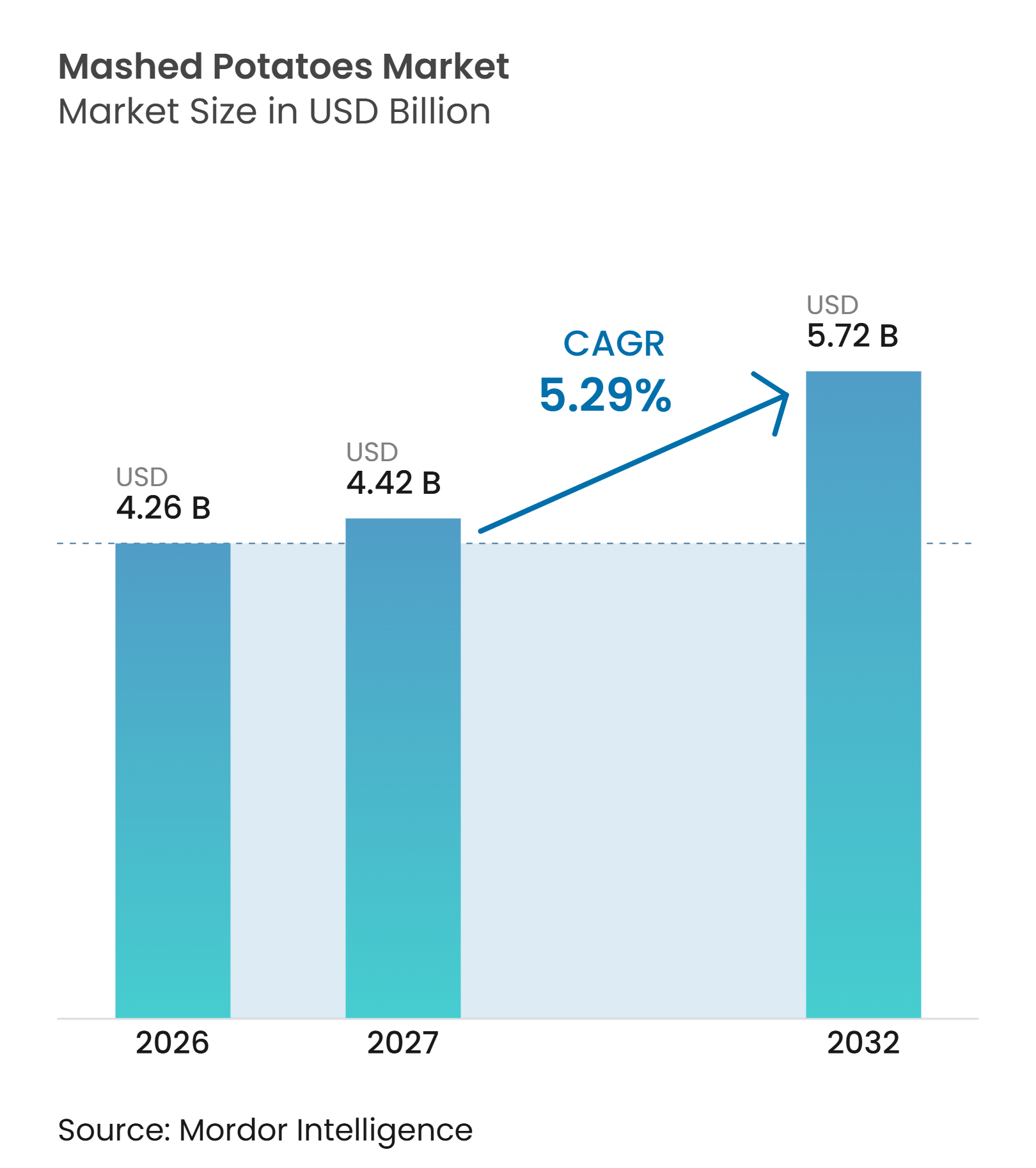
The mashed potatoes market size is expected to grow from USD 4.26 billion in 2026 to USD 4.42 billion in 2027 and is forecast to reach USD 5.72 billion by 2032 at a 5.29% CAGR over 2027-2032. The market is supported by growing demand for convenient meal solutions, wider adoption of ready-to-prepare food products, and the increasing use of standardized potato preparations across household and commercial foodservice applications. Changing consumption patterns, demand for comfort foods, and the need for efficient food preparation are encouraging product innovation and broader application across foodservice and retail settings. Improvements in processing, preservation, packaging, and preparation technologies are further supporting product accessibility and consistency. Increasing interest in ingredient transparency, nutritional value, and diverse product offerings is also encouraging manufacturers to expand their portfolios. Continued investment in production capabilities, product development, and distribution networks is expected to support the market's development over the forecast period.
Key Report Takeaways
-
By product form, fresh/refrigerated products held 35.73% of the mashed potatoes market share in 2026, while dehydrated products are forecast to grow at a 6.75% CAGR during 2027-2032.
-
By nature, conventional products held 83.61% of the mashed potatoes market share in 2026, while organic products are forecast to grow at a 7.15% CAGR during 2027-2032.
-
By distribution channel, retail held a 62.48% share in 2026, while HoReCa is forecast to grow at a 6.79% CAGR from 2027 to 2032.
-
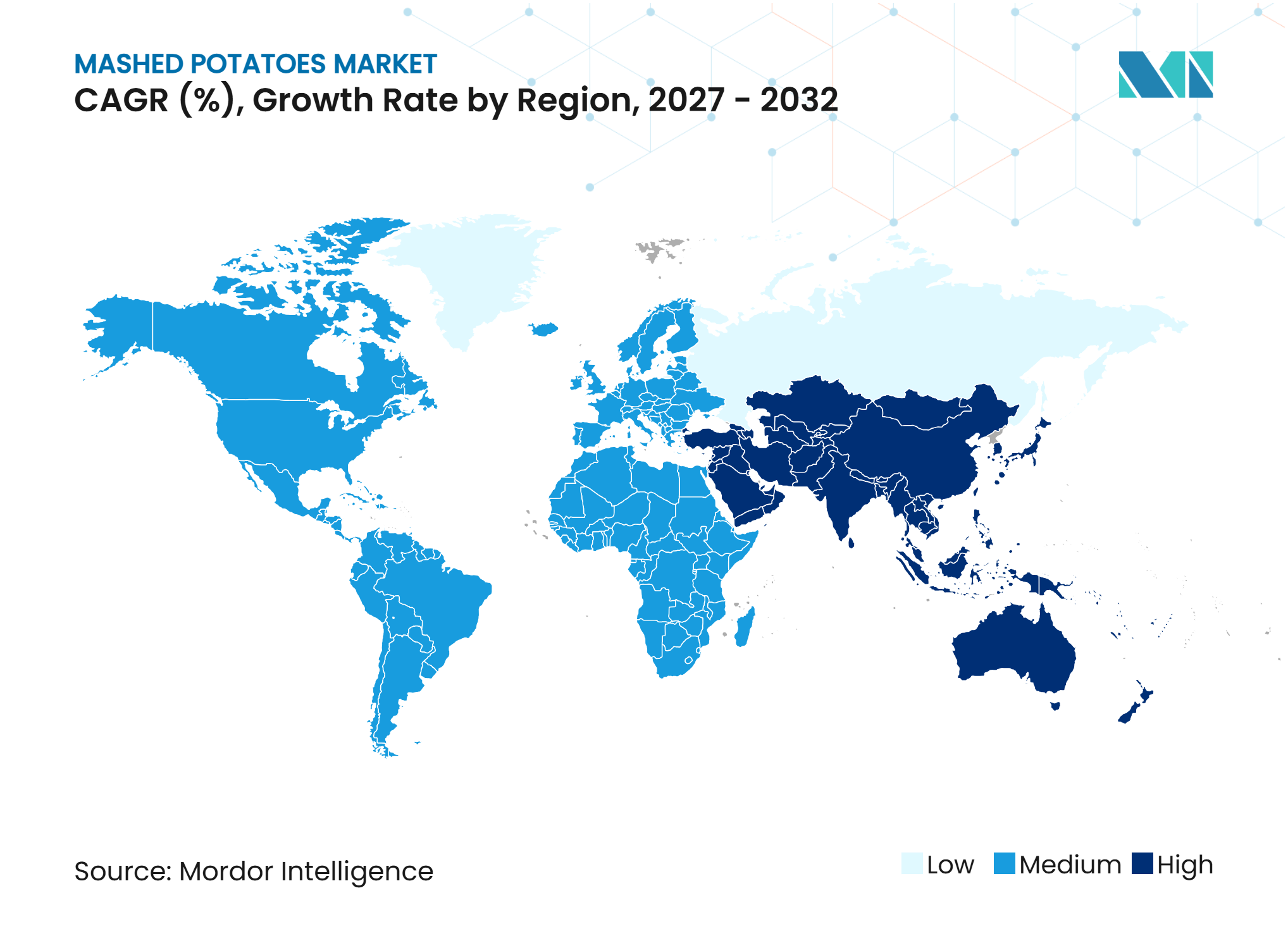
By geography, North America held a 35.44% share in 2026, while Asia-Pacific is forecast to grow at a 6.85% CAGR during 2027-2032.
Note: Market numbers in this report are based on Mordor Intelligence's proprietary estimation framework, which combines nine months of actuals with Q4 projections for base year 2026.
Market Trends and Insights
Drivers Impact Analysis of Mashed Potatoes Market*
| Driver | (~) % Impact on CAGR Forecast | Geographic Relevance | Impact Timeline |
|---|---|---|---|
| Growing demand for convenient home meal preparation | +1.1% | Global; highest in North America and Western Europe | Short term (≤ 2 years) |
| Growing foodservice demand for operational efficiency and preparation convenience | +0.9% | Global; most pronounced in North America, Asia-Pacific | Medium term (2–4 years) |
| Increasing consumption of processed and frozen potato products | +0.8% | Global; Asia-Pacific core, spill-over to the Middle East and Africa and South America | Medium term (2–4 years) |
| Growing preference for frozen foods to reduce food waste | +0.5% | Europe | Short term (≤ 2 years) |
| Population aging and demand for texture-modified meals | +0.5% | North America, Europe, Japan, South Korea | Long term (≥ 4 years) |
| Expansion of restaurant and foodservice consumption | +0.7% | Asia-Pacific, South America, Middle East and Africa | Medium term (2–4 years) |
| Source: Mordor Intelligence | |||
Growing Demand for Convenient Home Meal Preparation
Increasing preference for convenient home meal preparation is supporting demand for mashed potatoes as an easy-to-prepare food option. According to the International Food Information Council's (IFIC) 2026 Food & Health Survey, convenience influenced food and beverage purchasing decisions for 61% of American consumers, surpassing healthfulness at 56% for the first time in the survey's 21-year history [1]. This growing emphasis on convenience reflects shifting household meal-preparation priorities, with consumers increasingly valuing products that simplify cooking and reduce the time required to prepare meals. Mashed potatoes fit these requirements through their relatively straightforward preparation and suitability as an accompaniment to a variety of meals. The preference for convenient meal solutions is therefore expected to support their adoption across household consumption occasions.
Growing Foodservice Demand for Operational Efficiency and Preparation Convenience
The need to maintain kitchen productivity amid staffing constraints is supporting the adoption of convenient, easy-to-prepare food products across foodservice establishments. According to the National Restaurant Association's 2026 State of the Restaurant Industry report, 1 in 5 restaurants were understaffed in 2025, highlighting the importance of streamlining kitchen operations and reducing preparation requirements. Additionally, 47% of restaurant operators reported having job openings that were difficult to fill in 2025, while 45% were actively seeking kitchen support staff[2]. These staffing challenges are encouraging foodservice operators to incorporate products that reduce manual preparation steps, simplify kitchen workflows and support consistent food preparation. Ready-to-prepare mashed potato products address these requirements by reducing the time and labor involved in conventional potato cooking and mashing, supporting their adoption across restaurants, catering establishments and institutional kitchens.
Increasing Consumption of Processed and Frozen Potato Products
Growing consumption of processed and frozen potato products is supporting demand for value-added potato preparations across household and foodservice applications. According to the United States Department of Agriculture's (USDA) Economic Research Service, processing accounted for 70% of total potato sales volume over the three most recent marketing seasons, highlighting the significant role of processed formats in the potato industry [3]. This established demand for processed potato products reflects consumer and commercial preference for convenient food formats that simplify preparation and offer versatility across meal applications. Mashed potatoes benefit from the broader adoption of processed potato products, as they offer a convenient alternative to traditional potato cooking and mashing. Continued integration of processed potato products into household meal planning and commercial food preparation is expected to support market demand.
Growing Preference for Frozen Foods to Reduce Food Waste
A growing preference for frozen foods is driving demand for products that offer greater storage flexibility and help reduce household and foodservice food waste. Freezing allows food products to be stored for extended periods while preserving their usability, enabling consumers and commercial kitchens to use ingredients according to meal requirements rather than immediate consumption needs. Frozen potato preparations also offer greater flexibility in inventory management, as users can prepare the required quantities while retaining the remainder for later use. This supports more efficient food purchasing, storage, and portion planning in both household and commercial settings. As consumers and foodservice operators increasingly prioritize efficient food utilization and waste reduction, frozen mashed potato products are positioned to benefit from these preferences.
Restraints Impact Analysis of Mashed Potatoes Market*
| Restraint | (~) % Impact on CAGR Forecast | Geographic Relevance | Impact Timeline |
|---|---|---|---|
| Raw potato supply fluctuations and procurement price volatility | -0.6% | Global; most acute in Europe and North America | Short term (≤ 2 years) |
| Nutritional concerns surrounding sodium, saturated fat, and processed formulations | -0.5% | North America, Europe, Singapore, Australia | Medium term (2–4 years) |
| High energy and infrastructure costs associated with cold-chain distribution | -0.4% | North America, Europe, Asia-Pacific | Medium term (2–4 years) |
| Raw potato quality variability and processing consistency challenges | -0.3% | Global; most acute in developing processing regions | Long term (≥ 4 years) |
| Source: Mordor Intelligence | |||
Raw Potato Supply Fluctuations and Procurement Price Volatility
Dependence on agricultural raw materials exposes mashed potato manufacturers to fluctuations in potato availability, quality, and procurement costs. Variations in weather conditions, seasonal production cycles, crop yields, and harvesting patterns can influence the volume and consistency of raw potato supplies. These fluctuations can affect procurement planning, production scheduling, and input cost management, particularly for manufacturers that require consistent raw material volumes throughout the year. Changes in potato prices can also influence processing costs and overall manufacturing economics, as potatoes represent a key input in mashed potato production. Consequently, maintaining reliable sourcing arrangements, managing supplier relationships, and diversifying procurement channels remain important considerations for manufacturers operating in the market.
Nutritional Concerns Surrounding Sodium, Saturated Fat, and Processed Formulations
Increasing consumer awareness of dietary composition and nutritional quality may influence purchasing preferences for mashed potato products, particularly those containing added sodium, saturated fats, and multiple processing ingredients. Certain prepared formulations incorporate butter, cream, cheese, salt, and other additives to achieve desired taste, texture, and consistency, which can increase their overall sodium and saturated fat content. Growing attention to nutritional labeling and healthier eating habits is encouraging consumers to examine ingredient lists and compare the nutritional profiles of packaged food products. This may influence preferences towards formulations with simpler ingredient compositions and more balanced nutritional profiles. Manufacturers consequently face increasing pressure to consider sodium reduction, fat composition, and ingredient selection while maintaining the taste, texture, and preparation characteristics expected from mashed potato products.
*Our forecasts treat driver/restraint impacts as directional, not additive. The impact forecasts reflect baseline growth, mix effects, and variable interactions.
Mashed Potatoes Market Segment Analysis
By Product Form:
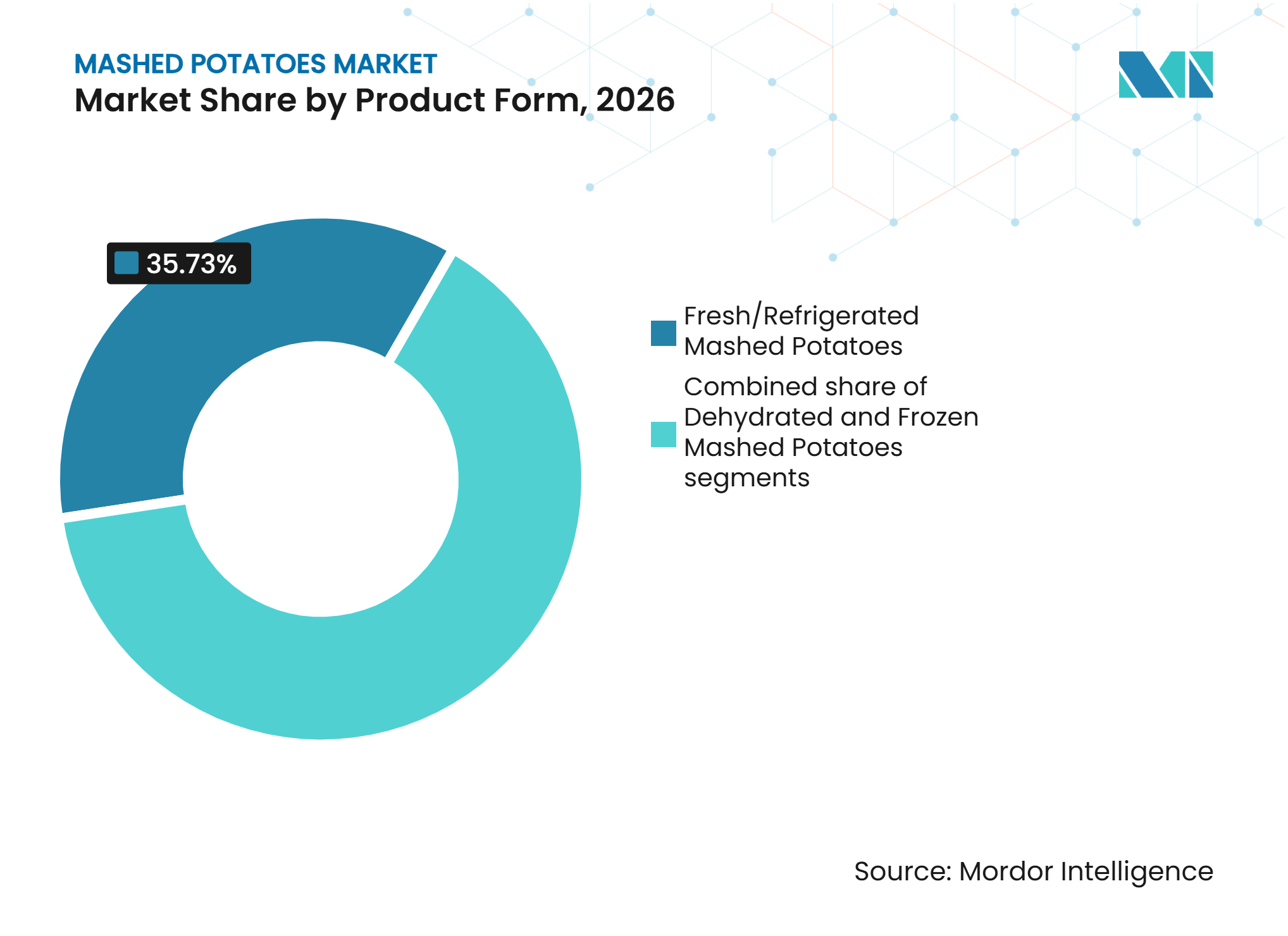
Dehydrated Formats Scaling Fast on Foodservice TailwindsFresh/refrigerated mashed potatoes account for the largest market share, at 35.73% in 2026. Their leading position is supported by established consumer familiarity, ready-to-heat convenience, and suitability for household meal preparation and foodservice applications. These products offer an alternative to making mashed potatoes from scratch while retaining the characteristics of freshly prepared meals. Their availability through established chilled food distribution channels and suitability for different meal occasions further support their adoption. Continued demand for convenient, prepared food options is expected to sustain the segment's leading position.
Dehydrated mashed potatoes represent the fastest-growing product form, registering a CAGR of 6.75% over 2027–2032. Their growth is supported by extended shelf life, ambient storage requirements, ease of transportation, and convenient reconstitution, making them suitable for both household consumption and commercial food preparation. The format also enables foodservice operators to standardize preparation processes and manage inventory more efficiently. Its versatility across catering, institutional kitchens and packaged food applications further supports adoption. Increasing demand for shelf-stable food products and preparation-efficient ingredients is expected to drive growth in the segment over the forecast period.



By Nature:
Organic Gains Share but Structural Supply Constraints PersistConventional mashed potato products account for the largest market share, at 83.61% in 2026. Their leading position is supported by established consumer acceptance, broad product availability, and suitability for household and foodservice applications. These products benefit from established sourcing and manufacturing practices, supporting their availability across different price points and distribution channels. Their use in standardized food preparation and established purchasing patterns further reinforces their market position. Continued demand across retail and commercial applications is expected to sustain the segment's leading share.
Organic mashed potato products represent the fastest-growing segment, registering a CAGR of 7.15% over 2027–2032. Growth is supported by increasing consumer interest in organic food products, ingredient transparency, and production practices aligned with organic certification standards. However, the availability of certified raw materials and the requirements associated with organic sourcing and processing can constrain wider adoption. The segment's expansion is also influenced by manufacturers' ability to develop products that meet organic standards while maintaining the taste, texture, and preparation characteristics consumers expect. Increasing interest in organic and clean-label food choices is expected to support the segment's growth over the forecast period.
By Distribution Channel:
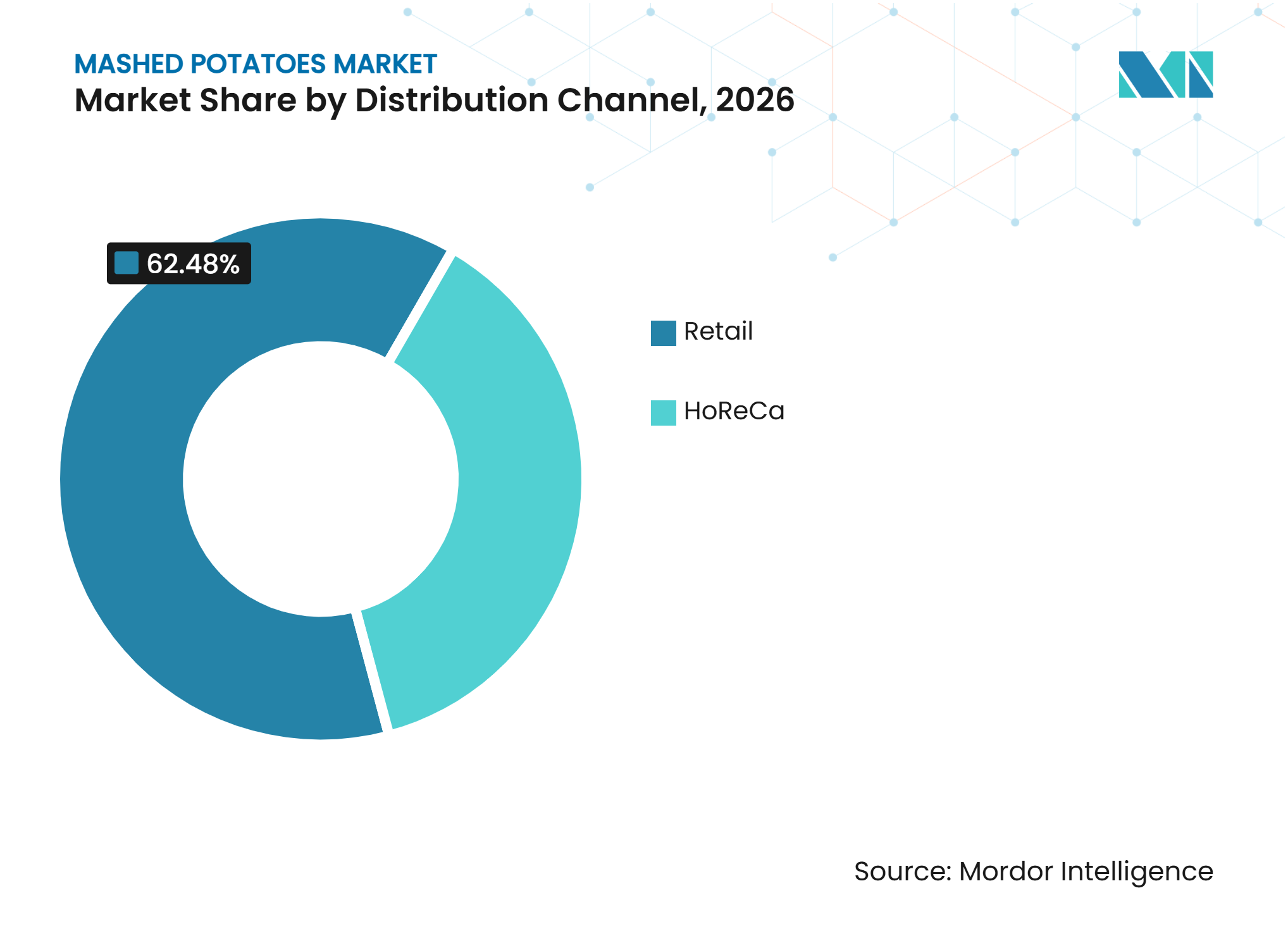
HoReCa Accelerating While Retail Remains the Revenue AnchorRetail distribution accounts for the largest market share, representing 62.48% of market revenue in 2026. Its leading position is supported by broad consumer access through established retail outlets and the availability of mashed potato products across branded and private-label offerings. Supermarkets and hypermarkets represent the largest sub-channel within retail, benefiting from their extensive product assortments and established grocery purchasing patterns. Convenience stores, independent grocers, and online retail further extend product accessibility across different shopping formats. Seasonal purchasing associated with major holidays and family meal occasions also contributes to retail demand. These factors are expected to sustain the channel's leading position over the forecast period.
HoReCa represents the fastest-growing distribution channel, registering a CAGR of 6.79% over 2027–2032. Growth is supported by demand from restaurants, hotels, catering businesses, and other commercial foodservice establishments for products that simplify preparation and reduce kitchen workload. Mashed potato products offer operational convenience across high-volume foodservice applications, including institutional kitchens and healthcare facilities. Demand from healthcare and elder-care settings is also supported by the use of texture-modified meals for individuals with swallowing difficulties, including puréed foods prepared to meet International Dysphagia Diet Standardization Initiative (IDDSI) Level 4 requirements. The suitability of mashed potato formulations for these applications, along with their use in conventional foodservice operations, is expected to support the channel's growth.

Geography Analysis
North America
North America accounts for the largest share of the mashed potatoes market, representing 35.44% in 2026. The region's leading position is supported by established consumption patterns, widespread acceptance of convenient potato preparations, and the availability of mashed potato products across retail and foodservice channels. Demand is supported by the use of both refrigerated and dehydrated formats for household meal preparation and commercial foodservice applications. A well-established potato-processing industry and domestic raw-material supply further support regional production capabilities. Continued demand for convenient prepared foods and established distribution networks are expected to sustain North America's leading market position.
Asia-Pacific
Asia-Pacific is the fastest-growing regional market, registering a projected CAGR of 6.85% over 2027–2032. Growth is supported by expanding food-processing capabilities, increasing consumption of convenience foods, and developing organized foodservice channels across the region. Rising demand from quick-service restaurants, catering establishments, and institutional kitchens is supporting the adoption of prepared potato products that simplify food preparation. Growing applications for potato flakes and other dehydrated formats in packaged foods and commercial meal preparation are also contributing to regional demand. Increasing investment in potato processing infrastructure and the expansion of foodservice operations are expected to support market growth.
Europe, South America, and Middle East and Africa
Europe, South America, and the Middle East and Africa represent emerging regional markets, with demand shaped by differences in food consumption patterns, processing capabilities, and foodservice development. In Europe, established demand for refrigerated and dehydrated mashed potato products is supported by developed retail distribution networks and consumer familiarity with prepared potato foods. South America offers growth opportunities through expanding potato processing capacity and increasing regional demand for processed potato products across foodservice and retail applications. In the Middle East and Africa, demand is supported by the expansion of quick-service restaurants, hotels and institutional foodservice establishments, particularly in markets with established commercial catering sectors.
Competitive Landscape
Market Concentration
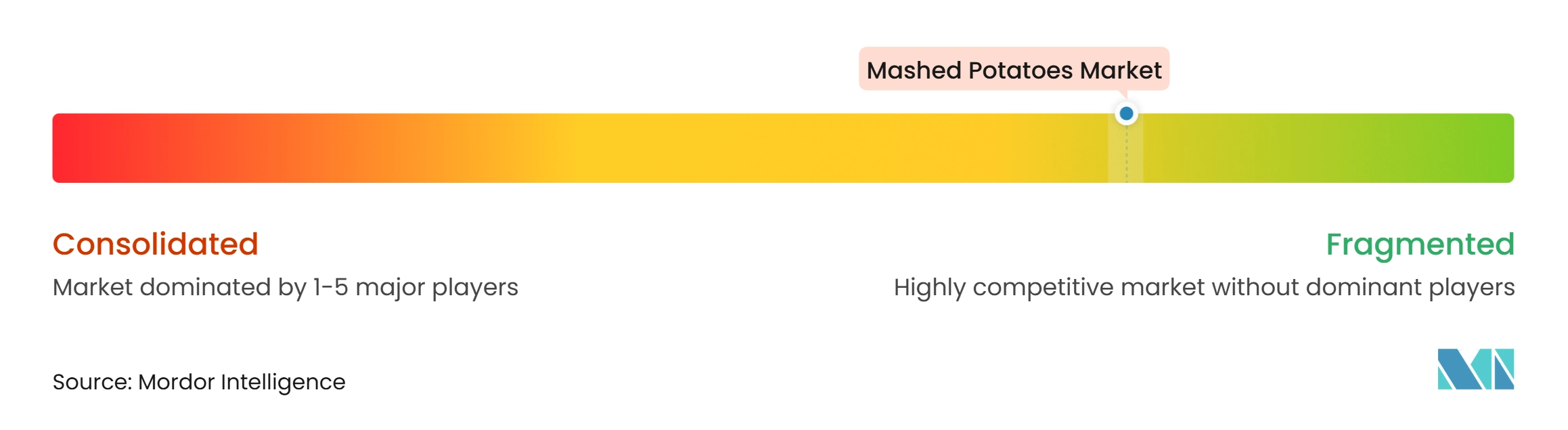
The mashed potatoes market is fragmented, with competition among multinational food manufacturers, specialized potato processors, and regional prepared-food producers. McCain Foods Limited, Idahoan, Lamb Weston, Inc., Nestlé S.A., and Simplot Global Food, LLC are among the key market participants, supported by established product portfolios, manufacturing capabilities, and distribution networks. These companies compete across different product formats and customer channels, with no single player holding a dominant position across the entire market.
Leading companies are collectively focusing on expanding their product portfolios, strengthening manufacturing and processing capabilities, and broadening their presence across retail and foodservice channels. Product development is increasingly driven by convenience, flavor variety, nutritional differentiation, and shifting ingredient preferences. Companies are also emphasizing supply chain efficiency, raw material sourcing, product quality, and packaging improvements to strengthen their competitive positions and respond to evolving customer requirements.
Emerging and regional players are contributing to market competition through specialized product offerings, localized distribution networks and differentiated positioning. Their strategies commonly include catering to specific consumer preferences, supplying private-label and foodservice customers, and developing products aligned with demand for clean-label, organic, and other specialized formulations. These companies also compete through flexibility in product development and customer-specific solutions, allowing them to address opportunities that may be less central to the strategies of larger multinational manufacturers.
Mashed Potatoes Industry Leaders
-
McCain Foods Limited
-
Idahoan
-
Lamb Weston, Inc.
-
Nestlé S.A.
-
Simplot Global Food, LLC
- *Disclaimer: Major Players sorted in no particular order
Mashed Potatoes Market Companies Covered in this Report
- McCain Foods Limited
- Idahoan
- Lamb Weston, Inc.
- Nestlé S.A.
- Simplot Global Food, LLC
- Basic American Foods
- Reser’s Fine Foods, Inc.
- Hormel Foods Corporation
- Unilever PLC
- Simply Potatoes (Michael Foods, Inc.)
- Emsland Group
- Aviko B.V.
- Farm Frites International B.V.
- Bob Evans Farms, Inc.
- Pineland Farms Potato Company, Inc.
- Agristo N.V.
- Peka Kroef B.V.
- Idaho Pacific Holdings, Inc.
- Pizzoli S.p.A.
- Mash Direct Ltd.
Recent Industry Developments in Mashed Potatoes Market
- October 2026: Idahoan launched Cheddar Broccoli Mashed Potatoes in the United States market. The product combines mashed potatoes with cheddar cheese and broccoli and was introduced as an addition to the company's packaged mashed potato portfolio.
- September 2026: Idahoan introduced its Ultimate Mashed Potatoes range, comprising Garlic Butter and Loaded Baked varieties. The products are made from Idaho potatoes and are supplied as instant mashed potatoes.
- June 2026: Hungritos introduced a mashed potato premix range at Snackex 2026 in Lisbon, marking its first presentation to international markets. The range comprises seven variants, including Classic, Buttery Home Style, Butter & Herbs, Cheddar Cheese & Sour Cream, and Four Cheese Mix.
Global Mashed Potatoes Market Report Scope
The mashed potatoes market covers processed potato products prepared by cooking and mashing potatoes, available in dehydrated, frozen, and fresh or refrigerated forms for household and commercial foodservice applications. The market is segmented by product form into dehydrated, frozen, and fresh or refrigerated mashed potatoes; by nature into conventional and organic; by distribution channel into HoReCa and retail; and by geography into North America, Europe, Asia-Pacific, South America, and the Middle East and Africa. The market forecasts are provided in USD value and metric tons.
Segmentation Overview
| Dehydrated Mashed Potatoes |
| Frozen Mashed Potatoes |
| Fresh/Refrigerated Mashed Potatoes |
| Conventional |
| Organic |
| HoReCa | |
| Retail | Supermarkets/Hypermarkets |
| Convenience Stores/Independent Grocers | |
| Online Retail | |
| Other Distribution Channel |
| North America | United States |
| Canada | |
| Mexico | |
| Rest of North America | |
| Europe | Germany |
| United Kingdom | |
| Italy | |
| France | |
| Spain | |
| Netherlands | |
| Poland | |
| Belgium | |
| Sweden | |
| Rest of Europe | |
| Asia-Pacific | China |
| India | |
| Japan | |
| Australia | |
| Indonesia | |
| South Korea | |
| Thailand | |
| Singapore | |
| Rest of Asia-Pacific | |
| South America | Brazil |
| Argentina | |
| Colombia | |
| Chile | |
| Peru | |
| Rest of South America | |
| Middle East and Africa | South Africa |
| Saudi Arabia | |
| United Arab Emirates | |
| Nigeria | |
| Egypt | |
| Morocco | |
| Turkey | |
| Rest of Middle East and Africa |
| By Product Form | Dehydrated Mashed Potatoes | |
| Frozen Mashed Potatoes | ||
| Fresh/Refrigerated Mashed Potatoes | ||
| By Nature | Conventional | |
| Organic | ||
| By Distribution Channel | HoReCa | |
| Retail | Supermarkets/Hypermarkets | |
| Convenience Stores/Independent Grocers | ||
| Online Retail | ||
| Other Distribution Channel | ||
| By Geography | North America | United States |
| Canada | ||
| Mexico | ||
| Rest of North America | ||
| Europe | Germany | |
| United Kingdom | ||
| Italy | ||
| France | ||
| Spain | ||
| Netherlands | ||
| Poland | ||
| Belgium | ||
| Sweden | ||
| Rest of Europe | ||
| Asia-Pacific | China | |
| India | ||
| Japan | ||
| Australia | ||
| Indonesia | ||
| South Korea | ||
| Thailand | ||
| Singapore | ||
| Rest of Asia-Pacific | ||
| South America | Brazil | |
| Argentina | ||
| Colombia | ||
| Chile | ||
| Peru | ||
| Rest of South America | ||
| Middle East and Africa | South Africa | |
| Saudi Arabia | ||
| United Arab Emirates | ||
| Nigeria | ||
| Egypt | ||
| Morocco | ||
| Turkey | ||
| Rest of Middle East and Africa | ||
Key Questions Answered in the Report
What is the forecast growth rate for mashed potatoes through 2032?
The market is forecast to grow at a 5.29% CAGR from 2027 to 2032, reaching USD 5.72 billion in 2032.
Which product form has the largest share of mashed potatoes?
Fresh/refrigerated products held the largest share at 35.73% in 2026, while dehydrated products are expected to grow faster at a 6.75% CAGR through 2032.
Which sales channel is growing fastest for mashed potatoes?
HoReCa is forecast to expand at a 6.79% CAGR from 2027 to 2032, supported by restaurant, healthcare, education, and travel demand.
Which region has the strongest growth outlook for mashed potatoes?
Asia-Pacific is forecast to grow at a 6.85% CAGR from 2027 to 2032.