
Managed PKI Services Market Size and Share
Market Overview
| Study Period | 2021 - 2032 |
|---|---|
| Market Size (2027) | USD 3.36 Billion |
| Market Size (2032) | USD 6.18 Billion |
| Growth Rate (2027 - 2032) | 12.97 % |
| Fastest Growing Market | Asia-Pacific |
| Largest Market | North America |
| Market Concentration | Medium |
Major Players *Disclaimer: Major Players sorted in no particular order Image © Mordor Intelligence. Reuse requires attribution under CC BY 4.0. | |
Managed PKI Services Market Analysis by Mordor Intelligence
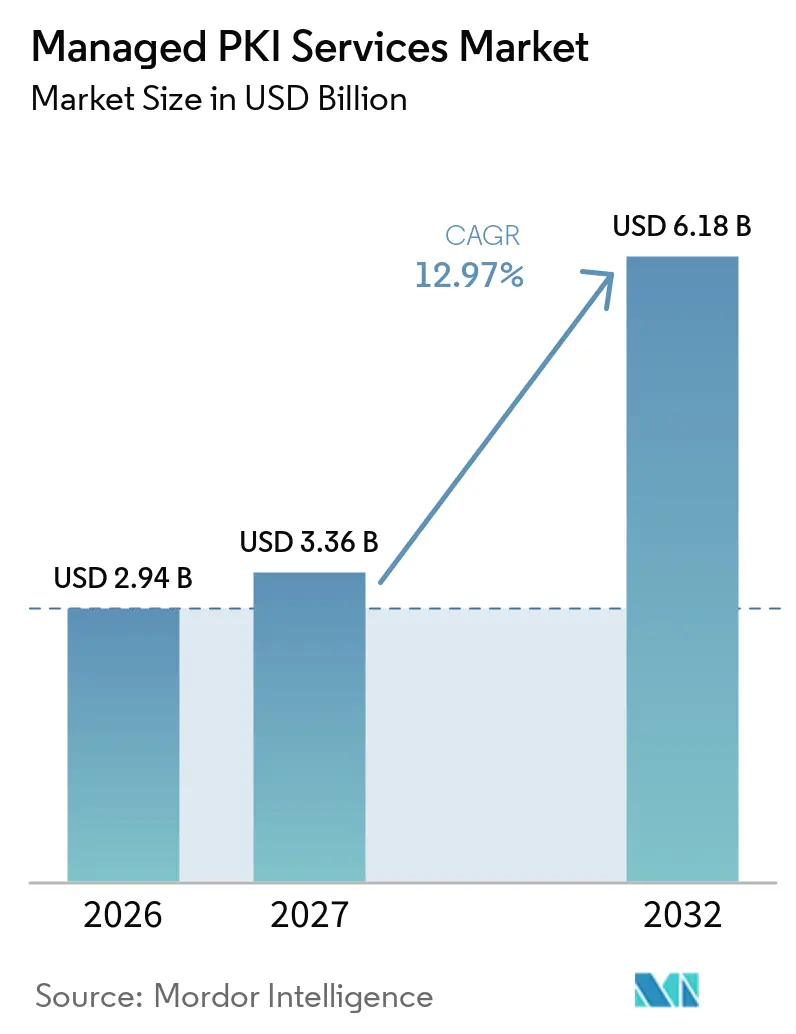
The Managed PKI Services Market size is projected to expand from USD 2.94 billion in 2026 and USD 3.36 billion in 2027 to USD 6.18 billion by 2032, registering a CAGR of 12.97% between 2027 and 2032. The managed PKI services market is being reshaped by the rising number of certificates needed for cloud workloads, container platforms, and connected devices. Shorter TLS certificate validity periods make automated renewal a necessary operating capability for many enterprises. Post-quantum cryptography requirements also move certificate operations from a cost issue toward a governance priority. Providers that combine lifecycle automation, support for multiple certificate authorities, and local deployment options are positioned to address the broadest set of requirements. The shortage of experienced PKI staff and country-specific key custody rules can extend implementation timelines, even as they strengthen the case for managed delivery.
Key Report Takeaways
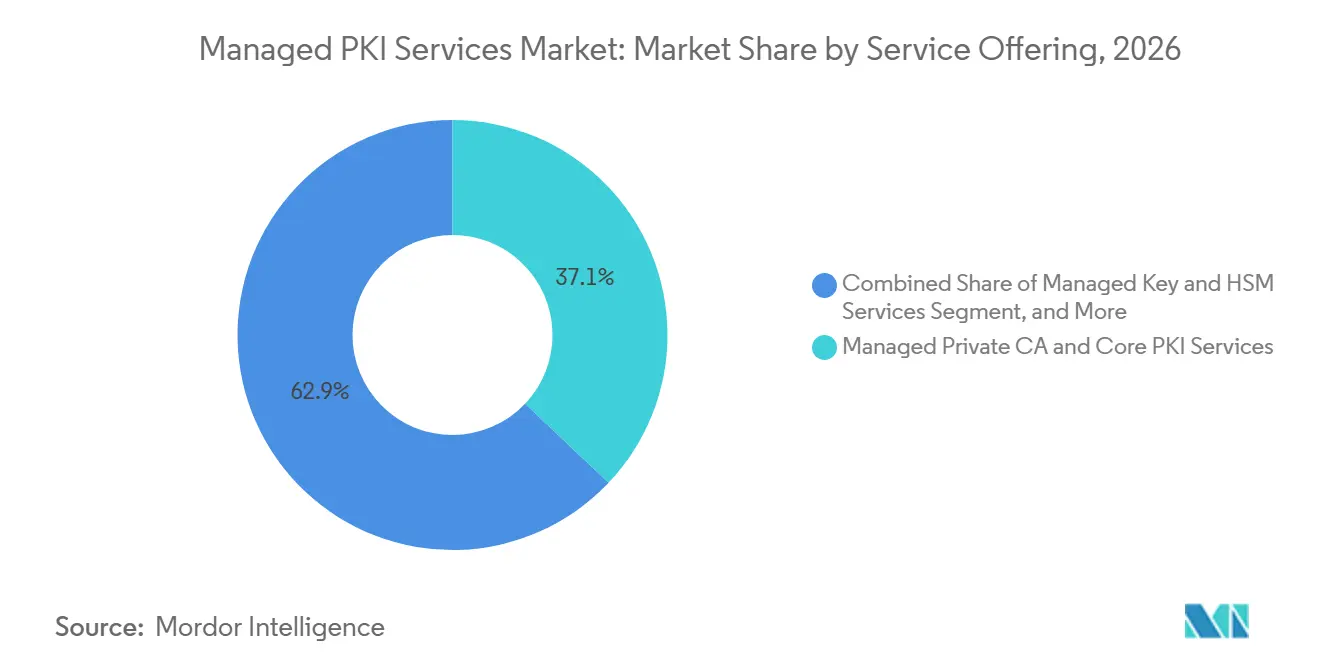
- By service offering, Managed Private CA and Core PKI Services held 37.07% of the share of the managed PKI services market in 2026, while Certificate Lifecycle Automation and Management Services is projected to expand at a 13.77% CAGR through 2032.
- By deployment mode, cloud accounted for 56.80% of the Managed PKI Services Market in 2026 and is expected to expand at a 13.56% CAGR through 2032.
- By organization size, large enterprises accounted for 77.21% of the managed PKI services market in 2026, while small and medium-sized enterprises are projected to grow at a 13.38% CAGR through 2032.
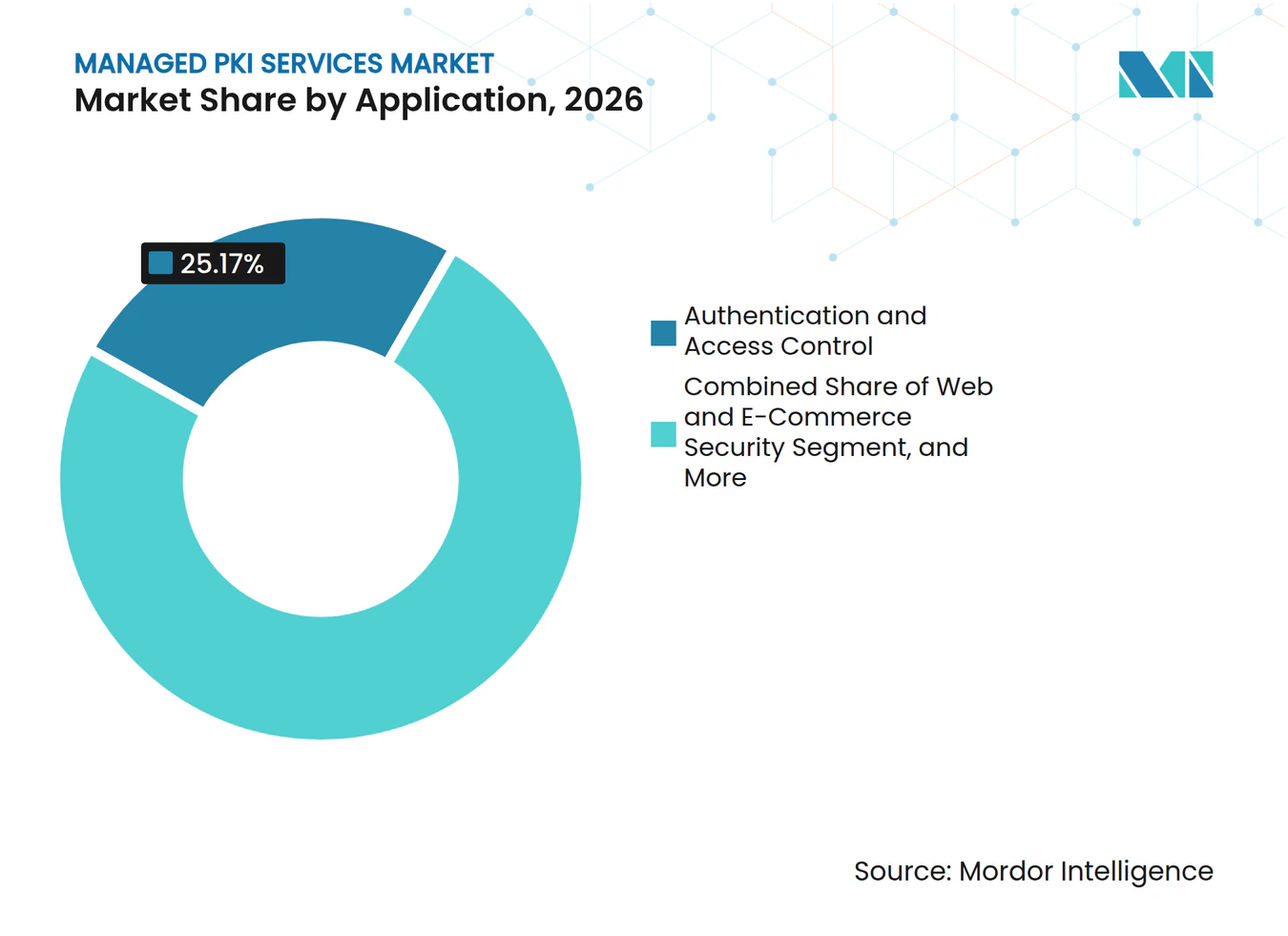
- By application, Authentication and Access Control accounted for 25.17% of the share of the managed PKI services market in 2026, while IoT Device Identity Management is forecast to expand at a 14.32% CAGR through 2032.
- By end-user industry, BFSI held 23.81% of the share of the managed PKI services market in 2026, while IT and Telecom are expected to expand at a 14.28% CAGR through 2032.
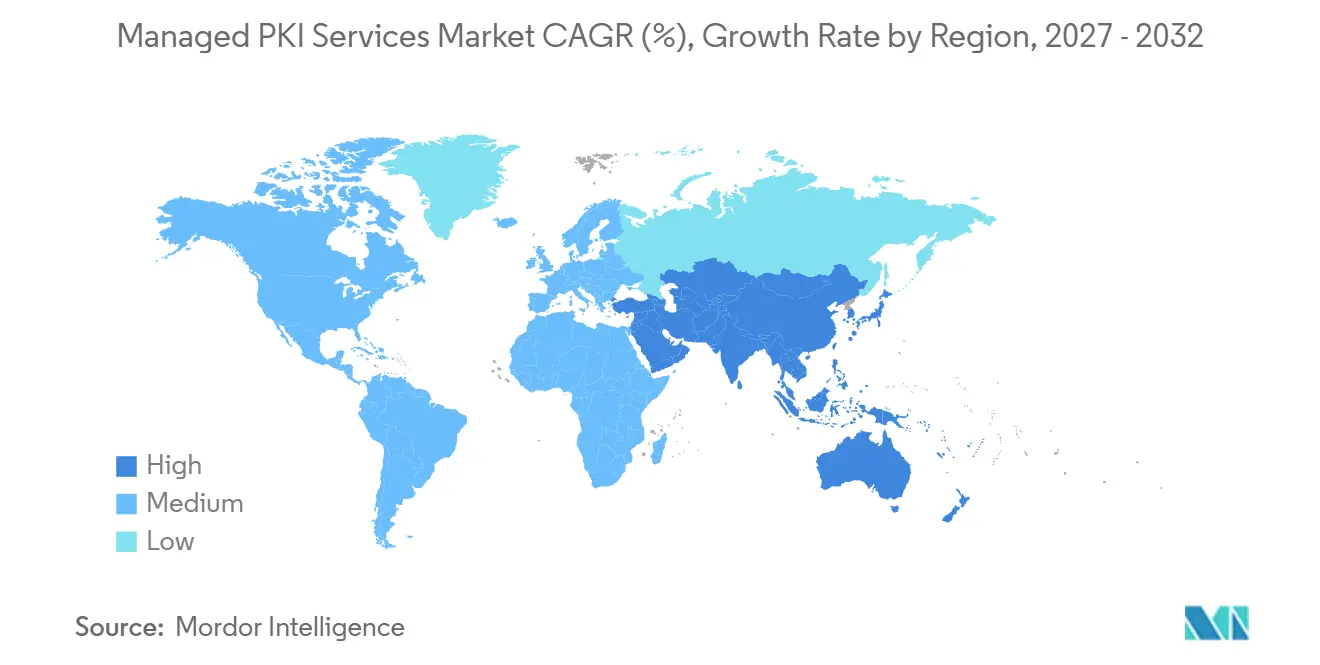
- By geography, North America held 40.14% of the share of the managed PKI services market in 2026, while Asia-Pacific is projected to advance at a 13.92% CAGR through 2032.
Note: Market numbers in this report are based on Mordor Intelligence's proprietary estimation framework, which combines nine months of actuals with Q4 projections for base year 2026.
Market Trends and Insights
Drivers Impact Analysis of Managed PKI Services Market*
| Driver | (~) % Impact on CAGR Forecast | Geographic Relevance | Impact Timeline |
|---|---|---|---|
| Expansion of Machine and Workload Identities | +3.8% | Global | Short term (≤ 2 years) |
| Zero Trust and Mutual TLS Adoption | +2.7% | North America and Europe, with spillover to Asia-Pacific | Medium term (2-4 years) |
| Shorter Certificate Lifecycles and Continuous Renewal | +2.3% | Global | Short term (≤ 2 years) |
| Regulatory Requirements for Cryptographic Governance | +1.6% | North America, Europe, and Asia-Pacific | Long term (≥ 4 years) |
| Cloud, Hybrid Cloud, and Kubernetes Adoption | +1.2% | Global | Short term (≤ 2 years) |
| Connected Product and Industrial Device Identity | +0.9% | Asia-Pacific, Europe, and North America | Medium term (2-4 years) |
| Source: Mordor Intelligence | |||
Expansion of Machine and Workload Identities Redefines PKI Operating Scale
Machine identities are changing the scale at which enterprises must issue, renew, and revoke certificates. Palo Alto Networks reported that machines outnumber human identities by 109 to 1, and 99 out of 100 surveyed organizations had adopted AI agents that require cryptographic identities. Kubernetes scheduling and serverless deployment create issuance needs that traditional certificate authority teams cannot reliably handle through manual processes. CyberArk also reported that 56% of organizations had experienced service disruption related to unmanaged PKI infrastructure. The managed PKI services market, therefore, benefits when organizations shift certificate work to shared automated platforms that can support high issuance volumes.
Zero Trust and Mutual TLS Adoption Creates Persistent PKI Demand
Zero-trust programs turn certificate issuance into a recurring part of application security operations. Zscaler reported that 96% of surveyed organizations favored zero trust, and 81% planned to implement a zero trust strategy within 12 months. Mutual TLS is central to many of these deployments because services need to authenticate each other across distributed environments. DXC Technology and Microsoft found that 83% of organizations that adopted zero trust had reduced security incidents. Each additional protected workload adds certificate lifecycle work, which supports continued demand in the managed PKI services market.
Shorter Certificate Lifecycles Force Automation at Enterprise Scale
The CA/Browser Forum has reduced the maximum TLS certificate validity period to 200 days, effective March 15, 2026. It will reduce the period to 100 days from March 2027 and 47 days from March 2029.[1] Organizations with large certificate inventories cannot depend on manual renewal activity at these intervals. Sectigo found that 95% of organizations remained at least partly dependent on manual certificate management. This change gives the managed PKI services market a durable reason to adopt automated discovery, renewal, and policy enforcement tools.
Regulatory Requirements for Cryptographic Governance Shape Enterprise Procurement
Post-quantum cryptography is raising the importance of complete cryptographic inventories and flexible certificate policies. NIST published FIPS 203, FIPS 204, and FIPS 205 in August 2024, establishing standards for ML-KEM, ML-DSA, and SLH-DSA. In 2025, NIST also published migration mappings to help organizations connect post-quantum work with risk management processes. Microsoft launched a post-quantum authentication pilot program for certificate ecosystems in October 2026. The managed PKI services market can support this transition by giving organizations centralized control over certificate profiles, algorithms, and issuance policies.
Restraints Impact Analysis of Managed PKI Services Market*
| Restraint | (~) % Impact on CAGR Forecast | Geographic Relevance | Impact Timeline |
|---|---|---|---|
| Shortage of PKI and Cryptographic Operations Expertise | -1.8% | Global | Short term (≤ 2 years) |
| Key Custody and Data Sovereignty Requirements | -1.2% | Europe, Asia-Pacific, and Middle East | Medium term (2-4 years) |
| Fragmented Ownership of Ephemeral Workload Identities | -0.7% | Global | Medium term (2-4 years) |
| CA Policy Portability and Vendor Lock-In Risk | -0.5% | North America and Europe | Long term (≥ 4 years) |
| Source: Mordor Intelligence | |||
Shortage of PKI and Cryptographic Operations Expertise Constrains Deployment Velocity
A shortage of specialized security staff can slow the selection, design, and governance of managed PKI programs. ISACA reported that 55% of cybersecurity teams were understaffed and 65% reported unfilled positions in 2025.[2] The shortage increases demand for outsourcing because providers can supply operational expertise that many enterprises cannot build internally. It can also delay projects because internal teams still need enough knowledge to evaluate a service, define certificate policies, and manage vendor relationships. The managed PKI services market must therefore make onboarding, policy templates, and advisory support easier for customers with limited in-house capability.
Key Custody and Data Sovereignty Requirements Create Structural Deployment Barriers
Data localization rules can prevent a standardized cloud PKI service from being deployed without local changes. eIDAS 2.0 requires qualified trust service providers to meet strict protection and audit requirements for qualified signatures. DigiCert launched a locally hosted DigiCert ONE deployment in India in January 2026 to support requirements associated with RBI, SEBI, IRDAI, and CERT-In. Local infrastructure can add cost and lengthen implementation schedules for providers. The managed PKI services market must balance globally consistent automation with country-specific controls on key custody and data residency.
*Our forecasts treat driver/restraint impacts as directional, not additive. The impact forecasts reflect baseline growth, mix effects, and variable interactions.
Managed PKI Services Market Segment Analysis
By Service Offering:
Certificate Lifecycle Automation Outpaces Legacy CA ServicesManaged Private CA and Core PKI Services held 37.07% market share in the managed PKI services market in 2026. The segment remains central because root key ceremonies, certificate policy administration, and certificate authority hierarchy design require specialist controls and audit capability. Large organizations also need services that can support several public and private certificate authorities without weakening governance. Certificate Lifecycle Automation and Management Services is projected to expand at a 13.77% CAGR through 2032, the highest rate among service offerings. The managed PKI services market size for lifecycle automation benefits directly from shorter TLS validity periods and the need to discover certificates across dispersed environments.
Managed Cryptographic Key and HSM Services are relevant for organizations that need secure key generation, storage, and policy administration. These services are especially important when an enterprise maintains root or issuing certificate authority keys in controlled hardware environments. Professional, Migration, and Integration Services continue to support cryptographic inventory work, policy redesign, and movement toward post-quantum readiness. Providers increasingly bundle lifecycle automation with private certificate authority services, which reduces the separation between the two offerings. This pattern encourages customers to procure a broader managed PKI services market platform rather than isolated certificate tools.



By Deployment Mode:
Cloud PKI Captures the Majority of Enterprise SpendingCloud deployment accounted for 56.80% of the managed PKI services market in 2026 and is forecast to expand at a 13.56% CAGR through 2032. Cloud services allow customers to use automated enrollment protocols such as ACME, EST, and SCEP without operating all certificate authority infrastructure themselves. This model can lower the operational burden of certificate discovery, issuance, renewal, and revocation across hybrid work environments. Keyfactor re-architected Keyfactor Command SaaS during 2025 with containerized infrastructure and automated multi-tenant workflows. These capabilities align with the demand for scalable automation in the managed PKI services market.
On-premises deployments remain necessary in air-gapped systems, classified networks, and environments that require direct control over keys and hardware. Some financial institutions and public agencies also retain local certificate authority infrastructure to meet specific custody requirements. Hybrid deployment combines this local control with cloud-based automation for public-facing certificates and distributed applications. The 47-day validity period increases the need for automated interfaces when enterprises retain Active Directory Certificate Services for internal use. This maintains a place for hybrid architectures even as cloud services account for most spending in the managed PKI services market.
By Organization Size:
Large Enterprises Anchor Demand, SMEs AccelerateLarge enterprises accounted for 77.21% of the managed PKI services market in 2026. Their certificate estates often span business units, regions, clouds, internal certificate authorities, and public certificate providers. Audit obligations and complex integration work also make specialist services attractive to this group. A January 2025 financial services survey found that 44% of institutions used a service provider or cloud provider-managed private PKI. The managed PKI services market continues to depend on these large environments because they have the most complex operating requirements.
Small and medium-sized enterprises are forecast to expand at a 13.38% CAGR through 2032. Their adoption is supported by managed service providers and cloud marketplaces that package lifecycle automation with simpler procurement and support. Sectigo joined the Pax8 Marketplace in May 2025, giving nearly 40,000 managed service providers access to certificate lifecycle management capabilities. Shorter renewal cycles make it more difficult for small teams to maintain internally managed certificates. This supports the managed PKI services market by simplifying deployment and pricing for smaller customers.
By Application:
IoT Device Identity Emerges as the Fastest-Growing Use CaseAuthentication and Access Control accounted for 25.17% of the managed PKI services market in 2026. Certificate-based authentication supports virtual private networks, 802.1X wireless access, and zero-trust access models across enterprise networks. These uses remain important because they protect users, devices, and services through established certificate standards. IoT Device Identity Management is projected to expand at a 14.32% CAGR through 2032. The managed PKI services market size for this application is increasing as manufacturers need unique device identities at the point of production.
Manufacturers need certificate lifecycle processes that can provision, rotate, and revoke device credentials at high volume. NIST described a reference approach for trusted IoT device onboarding and lifecycle management that uses PKI for network-layer controls. Code Signing and Software Integrity also gain support from DevSecOps workflows that require software to be verified during delivery. Secure Email and Document Signing, Web and E-Commerce Security, and Payment Processing and Mobile Wallets provide stable demand across regulated and customer-facing operations. These applications broaden the addressable market for managed PKI services beyond traditional website certificate management.

By End-User Industry:
BFSI Leads While IT and Telecom Outpaces the FieldBFSI held 23.81% of the managed PKI services market in 2026. Financial institutions need certificate controls for payment security, open banking application programming interfaces, and regulated communications. DigiCert was selected by ASC X9 in February 2025 to provide managed PKI infrastructure for financial services use cases. ASC X9 and DigiCert activated the X9 Financial PKI production environment through a formal key ceremony in June 2025.
IT and Telecom is forecast to expand at a 14.28% CAGR through 2032. Service mesh deployments and 5G network slicing require certificate-based service authentication at scale, which favors managed automation. Government and Defense maintain demand through federal zero-trust requirements and controlled identity systems. Healthcare and Life Sciences also need automated certificate operations as networks connect many sites and clinical systems. CyberArk reported in May 2025 that PDS Health expanded its deployment to automate certificate lifecycle management across more than 1,000 dental and primary care practices in the United States.
Geography Analysis
North America Managed PKI Services Market
North America accounted for 40.14% of the managed PKI services market in 2026. The region brings together global technology vendors, major financial institutions, and federal agencies that are adopting zero-trust controls. U.S. public-sector demand is supported by policy direction that treats zero trust as a standard procurement requirement. The US Government Accountability Office found in 2025 that departments needed to fully implement key cybersecurity workforce practices.[3] This staffing pressure strengthens the rationale for managed cryptographic operations.
North America and APAC Managed PKI Services Market
Canada adds demand through healthcare digitization and financial-sector compliance requirements. Mexico contributes early demand as digital payments and connected service platforms expand. Asia-Pacific is projected to advance at a 13.92% CAGR through 2032, the fastest regional rate in the managed PKI services market. India, China, Japan, and South Korea are important because of digital identity programs, manufacturing activity, and high volumes of online transactions. DigiCert’s locally hosted India deployment demonstrates that international suppliers are adapting their operating models to meet regional data sovereignty requirements.
EMEA and South America Managed PKI Services Market
Europe is the second-largest region in the managed PKI services market. eIDAS 2.0 shapes procurement by requiring qualified trust service providers to meet high standards for auditability and key protection. Eviden signed a contract with France Titers in July 2025 to manage PKI infrastructure for French biometric passports, electronic national identity cards, and digital identities for government agents. Deutsche Telekom launched Magenta Security Sign in October 2026 as an eIDAS-compliant service integrated with Germany’s federal PKI. South America, the Middle East, and Africa remain early-stage markets, with demand driven by national digital identity programs, financial digitization, and public infrastructure investment.
Competitive Landscape
Market Concentration
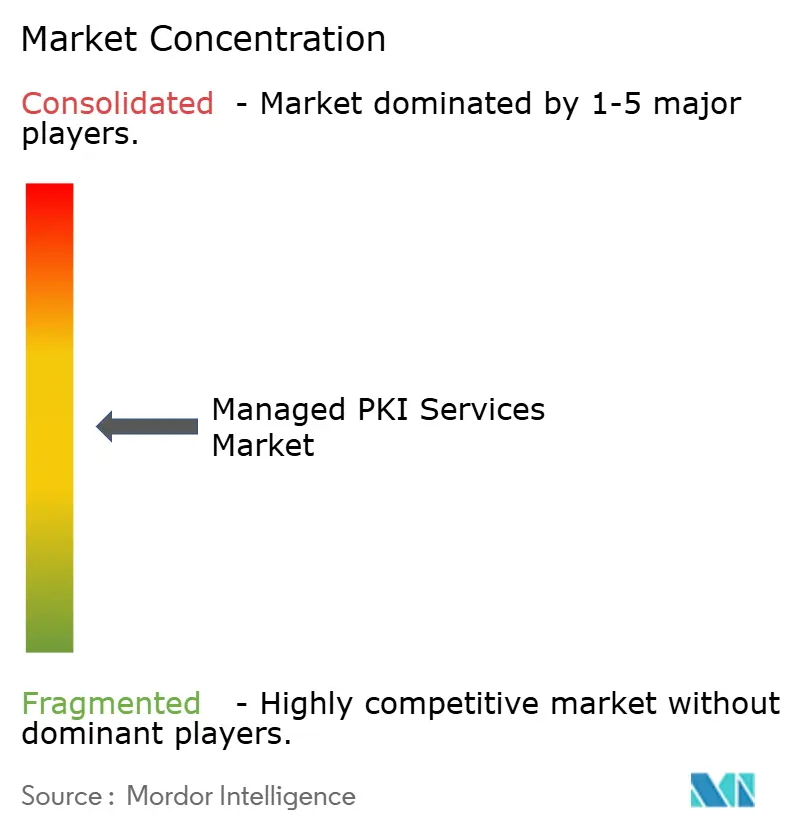
The managed PKI services market is moderately consolidated in the large enterprise tier, while regional and mid-market competition remains broad. DigiCert, Entrust, and Keyfactor address complex enterprise and public-sector requirements across certificate authority operations, automation, and cryptographic governance. DigiCert’s DigiCert ONE brings public trust PKI, enterprise PKI, DNS management, and certificate automation into one platform. Keyfactor strengthened its portfolio in May 2025 through the acquisitions of InfoSec Global and CipherInsights, adding capabilities in cryptographic posture management and asset discovery.
Suppliers compete on multi-certificate authority interoperability, automation depth, local deployment, and readiness for post-quantum cryptography. AppViewX acquired Eos in March 2026 to combine certificate lifecycle management with AI-agent identity controls. Keyfactor announced its intent to acquire Cofide in July 2026 to extend verified identity capabilities to cloud workloads and AI agents. These moves show that providers are expanding beyond certificates toward machine identity governance. The managed PKI services market also includes smaller suppliers that compete through focused integrations, specialized compliance expertise, and alternative commercial models.
WebTrust audits, ETSI certification, and FedRAMP authorization serve as barriers for providers seeking to serve regulated customers. These qualifications can limit the pool of firms that can serve government, financial services, and qualified trust use cases. Sectigo completed the migration of Entrust’s public certificate business in September 2025, moving more than 500,000 certificates to the Sectigo Certificate Manager platform. Newfold Digital selected DigiCert in September 2026 to modernize its certificate infrastructure across its Network Solutions Group and Bluehost Group brands, which serve 6 million customers.
Managed PKI Services Industry Leaders
-
DigiCert, Inc.
-
Entrust Corporation
-
GMO GlobalSign Holdings K.K.
-
Sectigo Limited
-
Keyfactor, Inc.
- *Disclaimer: Major Players sorted in no particular order
Managed PKI Services Market Companies Covered in this Report
- DigiCert, Inc.
- Entrust Corporation
- GMO GlobalSign Holdings K.K.
- Sectigo Limited
- Keyfactor, Inc.
- CyberArk Software Ltd.
- AppViewX, Inc.
- Ascertia Limited
- eMudhra Limited
- SSL.com, Inc.
- WISeKey International Group AG
- SwissSign AG
- SECOM Trust Systems Co., Ltd.
- Actalis S.p.A.
- IdenTrust Services, LLC
- Garantir Technologies SAS
- EverTrust SAS
- Smallstep Labs, Inc.
- SECARDEO GmbH
- SecureMetric Technology Sdn Bhd
- Trustwave Holdings, Inc.
- CFCA, Inc.
Recent Industry Developments in Managed PKI Services Market
- October 2026: Keyfactor announced a USD 1 billion-plus growth investment led by Summit Partners, with former CyberArk CEO Matt Cohen appointed to the board of directors. The round accelerates Keyfactor's expansion beyond USD 200 million in annual recurring revenue and is positioned to fund its next phase of scale across the AI and post-quantum PKI era.
- October 2026: SAIC completed its acquisition of Information Security Corp. (ISC), absorbing more than three decades of PKI, encryption, and credential management software purpose-built for federal agencies and regulated enterprises. The deal strengthens SAIC's cryptographic identity stack for federal zero trust deployments, following its USD 205 million acquisition of SilverEdge Government Solutions earlier in 2025.
- October 2026: Deutsche Telekom launched Magenta Security Sign, an eIDAS-compliant eSignature platform integrated with Germany's federal public key infrastructure (Verwaltungs-PKI) and operating exclusively within German infrastructure in the Open Telekom Cloud. The platform supports all electronic signature classes mandated for German public administrations.
- September 2026: Newfold Digital, serving approximately 6 million customers globally, selected DigiCert to modernize SSL/TLS certificate infrastructure across its Network Solutions Group and Bluehost Group brands, consolidating certificate management onto the DigiCert ONE platform.
Global Managed PKI Services Market Report Scope
The Managed PKI Services Market refers to the global market for outsourced, third-party services that enable organizations to establish, operate, secure, and maintain Public Key Infrastructure (PKI) environments without managing the underlying infrastructure and operational processes internally. These services include managed private Certificate Authority (CA) and core PKI operations, certificate lifecycle automation and management, cryptographic key management and Hardware Security Module (HSM) services, as well as professional, migration, and integration services. Managed PKI service providers support the issuance, renewal, revocation, and monitoring of digital certificates; cryptographic key protection; identity verification; and the enforcement of certificate-based security policies across enterprise IT environments.
The Managed PKI Services Market Report is Segmented by Service Offering (Managed Private CA and Core PKI Services, Certificate Lifecycle Automation and Management Services, Managed Cryptographic Key and HSM Services, and Professional, Migration, and Integration Services), Deployment Mode (Cloud, On-Premises, and Hybrid), Organization Size (Large Enterprises and Small and Medium-Sized Enterprises), Application (Authentication and Access Control, Secure Email and Document Signing, Web and E-Commerce Security, IoT Device Identity Management, Code Signing and Software Integrity, and Payment Processing and Mobile Wallets), End-User Industry (BFSI, Government and Defense, IT and Telecom, Healthcare and Life Sciences, Manufacturing and Industrial, Retail and E-Commerce, and Other End-User Industries), and Geography (North America, South America, Europe, Asia-Pacific, Middle East, and Africa). The Market Forecasts are Provided in Terms of Value (USD).
Segmentation Overview
| Managed Private CA and Core PKI Services |
| Certificate Lifecycle Automation and Management Services |
| Managed Cryptographic Key and HSM Services |
| Professional, Migration, and Integration Services |
| Cloud |
| On-Premises |
| Hybrid |
| Large Enterprises |
| Small and Medium-Sized Enterprises |
| Authentication and Access Control |
| Secure Email and Document Signing |
| Web and E-Commerce Security |
| IoT Device Identity Management |
| Code Signing and Software Integrity |
| Payment Processing and Mobile Wallets |
| BFSI |
| Government and Defense |
| IT and Telecom |
| Healthcare and Life Sciences |
| Manufacturing and Industrial |
| Retail and E-Commerce |
| Other End-User Id=ndustries |
| North America | United States |
| Canada | |
| Mexico | |
| South America | Brazil |
| Argentina | |
| Rest of South America | |
| Europe | Germany |
| United Kingdom | |
| France | |
| Italy | |
| Spain | |
| Rest of Europe | |
| Asia-Pacific | China |
| Japan | |
| India | |
| South Korea | |
| Australia | |
| Rest of Asia-Pacific | |
| Middle East | Saudi Arabia |
| United Arab Emirates | |
| Turkey | |
| Rest of Middle East | |
| Africa | South Africa |
| Nigeria | |
| Egypt | |
| Rest of Africa |
| By Service Offering | Managed Private CA and Core PKI Services | |
| Certificate Lifecycle Automation and Management Services | ||
| Managed Cryptographic Key and HSM Services | ||
| Professional, Migration, and Integration Services | ||
| By Deployment Mode | Cloud | |
| On-Premises | ||
| Hybrid | ||
| By Organization Size | Large Enterprises | |
| Small and Medium-Sized Enterprises | ||
| By Application | Authentication and Access Control | |
| Secure Email and Document Signing | ||
| Web and E-Commerce Security | ||
| IoT Device Identity Management | ||
| Code Signing and Software Integrity | ||
| Payment Processing and Mobile Wallets | ||
| By End-User Industry | BFSI | |
| Government and Defense | ||
| IT and Telecom | ||
| Healthcare and Life Sciences | ||
| Manufacturing and Industrial | ||
| Retail and E-Commerce | ||
| Other End-User Id=ndustries | ||
| By Geography | North America | United States |
| Canada | ||
| Mexico | ||
| South America | Brazil | |
| Argentina | ||
| Rest of South America | ||
| Europe | Germany | |
| United Kingdom | ||
| France | ||
| Italy | ||
| Spain | ||
| Rest of Europe | ||
| Asia-Pacific | China | |
| Japan | ||
| India | ||
| South Korea | ||
| Australia | ||
| Rest of Asia-Pacific | ||
| Middle East | Saudi Arabia | |
| United Arab Emirates | ||
| Turkey | ||
| Rest of Middle East | ||
| Africa | South Africa | |
| Nigeria | ||
| Egypt | ||
| Rest of Africa | ||
Key Questions Answered in the Report
What is the size of the Managed PKI Services Market?
The Managed PKI Services Market is valued at USD 2.94 billion in 2026 and is projected to reach USD 6.18 billion by 2032, at a 12.97% CAGR from 2027 to 2032.
Why are enterprises adopting managed PKI services?
Shorter TLS certificate validity periods, zero trust implementation, and the rising number of machine identities make automated certificate management more important.
Which deployment model leads managed PKI adoption?
Cloud deployment leads with a 56.80% share in 2026 and is expected to expand at a 13.56% CAGR through 2032.
Which application is expanding the fastest?
IoT Device Identity Management is projected to expand at a 14.32% CAGR through 2032, supported by device identity and lifecycle requirements.
Which customer sector accounts for the largest share?
BFSI leads end-user demand with a 23.81% share in 2026 because of payment security, open banking, and compliance requirements.
Which region is expected to expand the fastest?
Asia-Pacific is projected to advance at a 13.92% CAGR through 2032, supported by digital identity programs and data sovereignty needs.