
Managed Mobile Identity and Access Services Market Size and Share
Market Overview
| Study Period | 2021 - 2032 |
|---|---|
| Market Size (2027) | USD 9.66 Billion |
| Market Size (2032) | USD 17.39 Billion |
| Growth Rate (2027 - 2032) | 12.48 % |
| Fastest Growing Market | Asia-Pacific |
| Largest Market | North America |
| Market Concentration | Medium |
Major Players *Disclaimer: Major Players sorted in no particular order Image © Mordor Intelligence. Reuse requires attribution under CC BY 4.0. | |
Managed Mobile Identity and Access Services Market Analysis by Mordor Intelligence
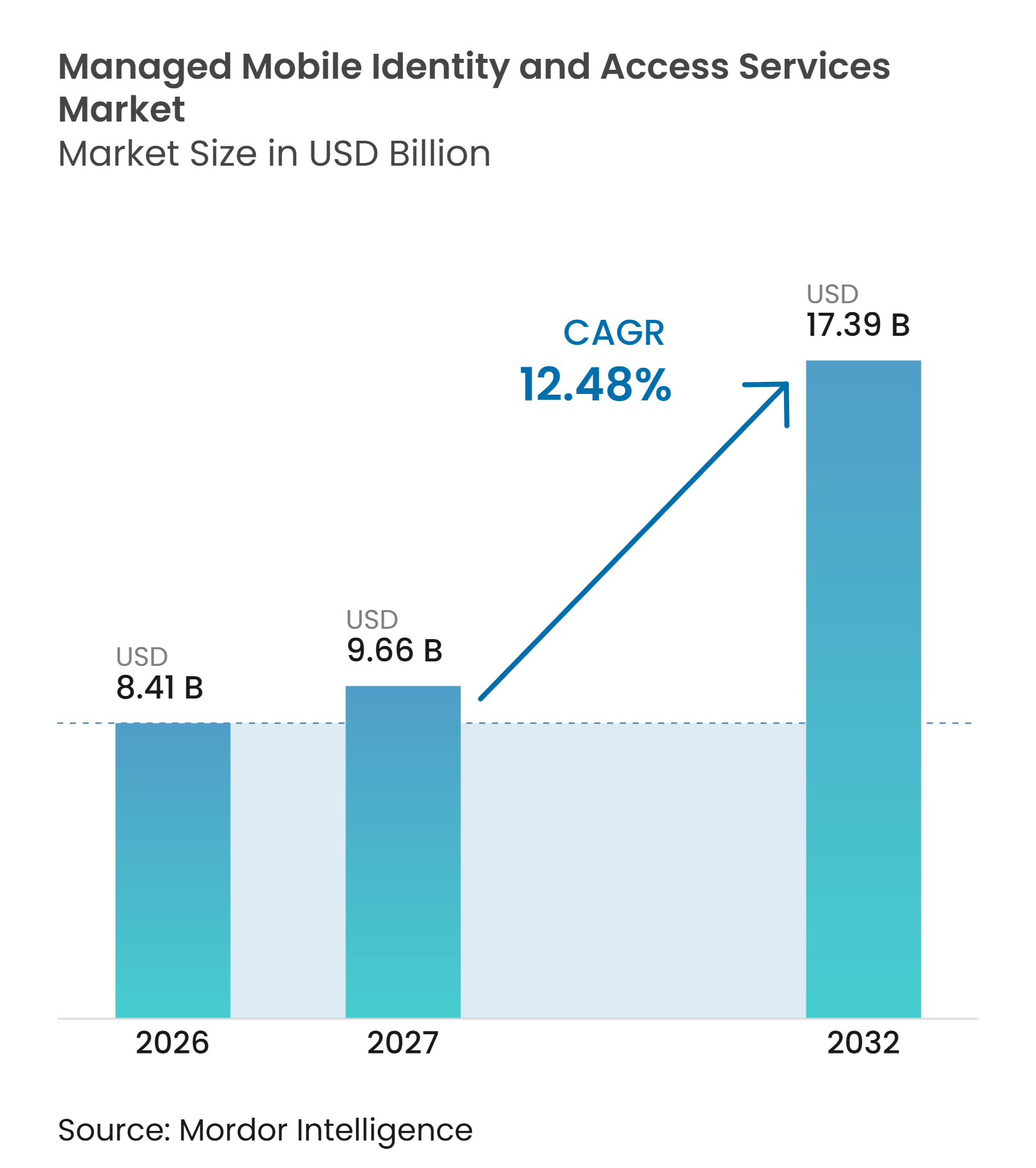
The managed mobile identity and access services market size is projected to expand from USD 8.41 billion in 2026 and USD 9.66 billion in 2027 to USD 17.39 billion by 2032, registering a CAGR of 12.48% between 2027 to 2032. The managed mobile identity and access services market is being shaped by enterprise mobility, rising credential theft, and the move from internal identity operations to managed subscriptions. Cloud delivery is becoming the practical default because authentication demand can rise sharply during banking, e-commerce, and public service peaks. The managed mobile identity and access services market is supported by this need for flexible capacity. Providers are also extending their offers from authentication into identity lifecycle controls, device trust, and fraud monitoring. The managed mobile identity and access services market offers a stronger opening for providers that combine privacy controls with operational support, particularly where carrier identity signals must meet consent and data-residency rules.
Key Report Takeaways
- By offering solutions, it held 62.12% of the managed mobile identity and access services market share in 2026, while the market is projected to expand at a 12.88% CAGR through 2032.
- By deployment, cloud-based delivery accounted for 79.02% of 2026 revenue and is projected to grow at a 12.91% CAGR through 2032.
- By organization size, large enterprises held 77.64% of 2026 revenue, while SMEs are projected to expand at a 13.07% CAGR through 2032.
- By end user, enterprises held 64.39% of 2026 revenue, while mobile network operators and mobile virtual network operators are projected to expand at a 13.24% CAGR through 2032.
- By industry vertical, BFSI accounted for 26.03% of 2026 revenue, while retail and e-commerce are projected to expand at a 13.83% CAGR through 2032.
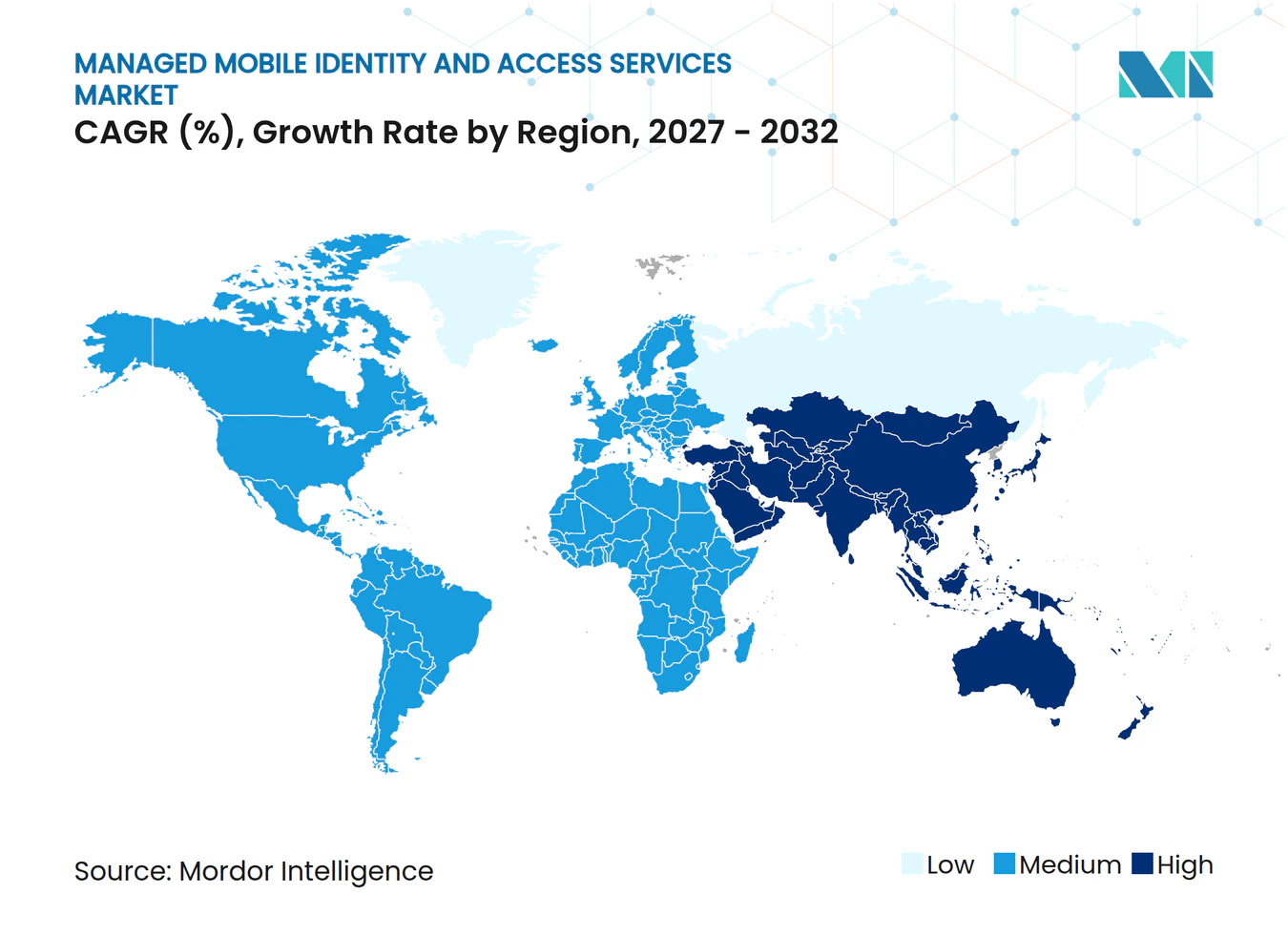
- By geography, North America held 38.98% of 2026 revenue, while Asia-Pacific is projected to expand at a 13.46% CAGR through 2032.
Note: Market numbers in this report are based on Mordor Intelligence's proprietary estimation framework, which combines nine months of actuals with Q4 projections for base year 2026.
Market Trends and Insights
Drivers Impact Analysis of Managed Mobile Identity and Access Services Market*
| Driver | (~) % Impact on CAGR Forecast | Geographic Relevance | Impact Timeline |
|---|---|---|---|
| Mobile-First Workforce and BYOD Expansion | +2.8% | Global, concentrated in North America, Europe, and Asia-Pacific core markets | Medium term (2-4 years) |
| Escalating Mobile Credential Theft and Account Takeover | +2.5% | Global, strongest in North America, Asia-Pacific fintech hubs, and Southeast Asia | Short term (≤ 2 years) |
| Passwordless and Phishing-Resistant Authentication Adoption | +2.2% | North America and Western Europe, with early adoption in Japan and South Korea | Medium term (2-4 years) |
| Cloud Migration and Zero-Trust Access Modernization | +1.9% | Global, including Middle East and Africa government sectors and Asia-Pacific cloud adopters | Medium term (2-4 years) |
| Government Digital Identity and Network API Expansion | +1.3% | Asia-Pacific and the Middle East and North Africa, including Malaysia, Vietnam, India, and UAE | Long term (≥ 4 years) |
| Managed-Service Demand From Identity Skills Shortages | +1.0% | Global, particularly North America and European SMEs | Short term (≤ 2 years) |
| Source: Mordor Intelligence | |||
Mobile-First Workforce and BYOD Expansion
Mobile use for work has moved identity decisions away from the office network and onto devices that may not be owned or managed by the employer. This shift makes access policy, device posture, and continuous monitoring more important in the managed mobile identity and access services market. Palo Alto Networks reported that 98% of surveyed organizations experienced BYOD policy violations, indicating that enforcement remains difficult even when policies are established. Managed providers can address this gap through ongoing device assessment and access controls that internal teams may not be able to operate consistently. The managed mobile identity and access services market benefits when this operational work is delivered as a continuing service. The opportunity is particularly relevant for SMEs, which can use cloud-delivered identity tools without the capital commitment previously associated with enterprise IAM programs. Contracts that align BYOD controls with NIST SP 800-63, and ISO/IEC 27001 requirements can also give providers a clearer path through security reviews and procurement processes.
Escalating Mobile Credential Theft and Account Takeover
Credential theft has heightened the urgency of managed identity services, as a compromised mobile account can affect payments, employee access, and customer transactions. Kaspersky reported that mobile banker attacks increased 1.5 times year over year and that more than 1 million banking accounts at the 100 largest banks were compromised through infostealers.[1] TransUnion found that global digital account takeover volume rose 21% between the first half of 2024 and the first half of 2025. The managed mobile identity and access services market benefits when buyers require specialist monitoring covering account recovery, password resets, and service-desk verification. These recovery processes can become weak points when they rely on limited identity checks or reusable credentials. The managed mobile identity and access services market is, therefore, affected by how well providers secure recovery channels. Providers that pair authentication with lifecycle governance and behavior monitoring are therefore better positioned to address the full operating problem.
Passwordless and Phishing-Resistant Authentication Adoption
Passwordless authentication is moving beyond trials as organizations seek controls that are harder to phish and easier for employees to use. The FIDO Alliance found that 87% of surveyed US and UK organizations with more than 500 employees had deployed or were deploying passkeys. Okta reported a 63% increase in adoption of phishing-resistant authenticators during 2025, while FastPass use rose from 6.7% to 13.3% of users. T-Mobile deployed 200,000 phishing-resistant YubiKeys across employees, vendors, and authorized retail partners in January 2025. Such rollouts require enrollment, recovery, exception handling, and user support, which expands the operational role for managed providers. The managed mobile identity and access services market is likely to favor providers that can deliver FIDO2-compatible deployments and maintain supporting processes post-implementation.
Cloud Migration and Zero-Trust Access Modernization
Cloud migration makes identity the consistent policy layer across users, applications, and locations. Legacy directories and on-premises certificate systems can be difficult to adapt at the pace of cloud adoption, creating demand for managed support. Zscaler stated in April 2025 that T-Mobile was progressing toward retiring traditional VPN access through its Zero Trust Exchange deployment. Kyndryl launched SASE services with Palo Alto Networks in February 2025 for enterprises moving from on-premises security infrastructure. The managed mobile identity and access services market is supported by these projects because mobile access policy, network security, and identity orchestration are being bought together more often. The pending retirement of SAP Identity Management before 2027 also creates a time-bound migration requirement for many large, ERP-dependent organizations.
Restraints Impact Analysis of Managed Mobile Identity and Access Services Market*
| Restraint | (~) % Impact on CAGR Forecast | Geographic Relevance | Impact Timeline |
|---|---|---|---|
| Mobile Operating-System and Device Fragmentation | -1.1% | Global, especially Asia-Pacific markets with varied Android versions and SMEs with limited MDM investment | Short term (≤ 2 years) |
| Privacy Restrictions on Centralized Subscriber and Device Signals | -0.8% | Europe, Southeast Asia, South America, and markets adopting national data policies | Medium term (2-4 years) |
| Legacy IAM and MDM Integration Complexity | -0.6% | North America and Europe, especially large enterprises with extensive on-premises IAM systems | Medium term (2-4 years) |
| Cross-Border Identity, KYC, and Data-Residency Inconsistency | -0.5% | Global, with material friction for multinational enterprises and government users across Asia-Pacific and the Middle East and Africa | Long term (≥ 4 years) |
| Source: Mordor Intelligence | |||
Mobile Operating-System and Device Fragmentation
Mobile operating systems and device hardware do not offer a uniform technical base for managed identity delivery. Android variants can use different update schedules and security controls, while iOS and Android expose different forms of device telemetry. TechTarget noted that manufacturer customization and uneven update cycles can delay adoption of newer Android security versions. This variation can lengthen deployments and force providers to maintain separate policy approaches. It can also reduce the consistency of device-posture checks, particularly where organizations have not invested in mobile device management. Privacy obligations under ISO 27001-aligned programs and GDPR can further limit the device data a provider can collect in European deployments.
Privacy Restrictions on Centralized Subscriber and Device Signals
SIM swap detection, number verification, and device location signals can strengthen mobile identity decisions, but their use is constrained by consent and data-residency rules. GDPR and similar Southeast Asian privacy regimes require that purposes for collecting and sharing telecom subscriber data be defined. These requirements limit the ability to deploy the same carrier authentication model across multiple countries without local adaptation. GSMA reported in July 2025 that BTS handled more than 6 million daily API requests for SIM Swap, Number Verification, and KYC use cases, and described the operational work required to commercialize these services.[2] Providers in the managed mobile identity and access services market need consent management, tokenization, and privacy-preserving design to sustain differentiated carrier-based offers. Regulatory delays in sovereign digital identity systems can also postpone related integration work for service providers.
*Our forecasts treat driver/restraint impacts as directional, not additive. The impact forecasts reflect baseline growth, mix effects, and variable interactions.
Managed Mobile Identity and Access Services Market Segment Analysis
By Offering:
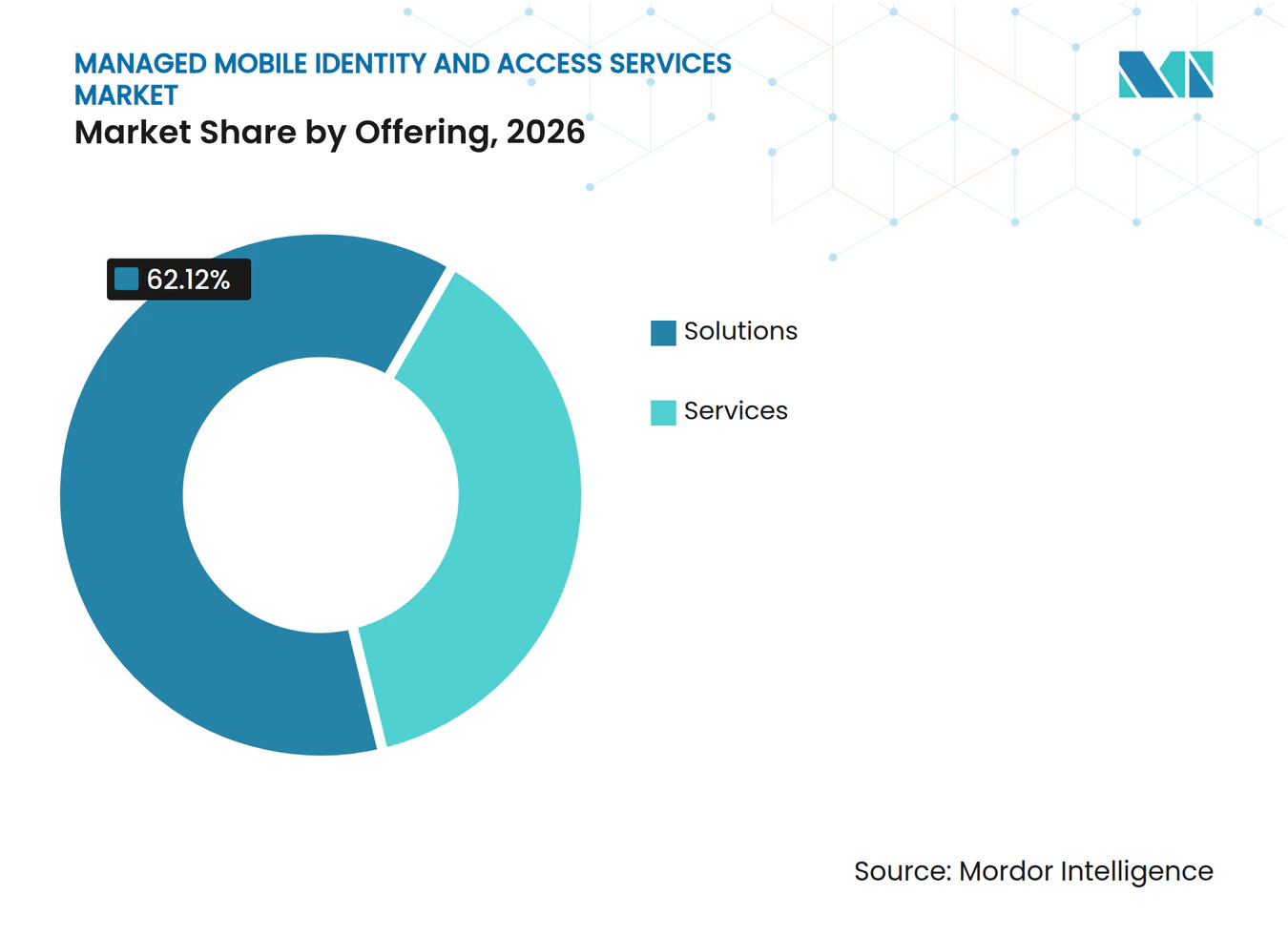
Solutions Maintain Revenue Leadership as Services ExpandSolutions captured 62.12% of the managed mobile identity and access services market share in 2026 because buyers still need authentication platforms, access policy engines, lifecycle automation, and privileged access controls. These tools form the core technical environment in which service teams must operate. ENISA reported that 34% of EU organizations identified IAM capability gaps in 2025. That gap supports demand for help with configuration, monitoring, access review, and identity governance. Services are projected to expand at a 12.88% CAGR through 2032 as organizations seek continuous operational delivery. The service proposition is increasingly focused on outcomes rather than implementation effort alone.
IBM launched AskIAM in May 2026 as an agentic identity operations service spanning IBM Verify, Microsoft Entra, Saviynt, CyberArk, and SailPoint environments. The launch shows how providers are using automation to support complex identity environments without relying only on labor-intensive consulting. This approach can reduce dependence on scarce identity specialists and support more regular control checks. It can also help customers operate mixed environments while they retire older platforms. The managed mobile identity and access services industry has room for providers capable of integrating platform operations with mobile access and recovery workflows. Outcome-based contracts may become more common when buyers can measure access governance, remediation speed, and policy compliance.


By Deployment:
Cloud-Based Delivery Leads the Shift From On-Premises SystemsCloud-based delivery accounted for 79.02% of 2026 revenue and is projected to grow at a 12.91% CAGR through 2032. Authentication demand can change quickly during peak banking, e-commerce, and government service activity. Cloud platforms provide capacity that can be adjusted without maintaining large, fixed infrastructure. This matters when user access spans mobile devices, remote workers, applications, and external partners. The largest deployment type is also the fastest expanding because many on-premises and hybrid environments still need modernization. The managed mobile identity and access services market, therefore, retains a substantial migration opportunity rather than depending only on new greenfield deployments.
On-premises systems remain relevant where governments and regulated financial entities require local credential stores. Several Asia-Pacific jurisdictions and public-sector users in the Russian and Middle Eastern markets continue to apply these requirements. SailPoint released IdentityIQ 9.0 in October 2026 alongside its cloud Human Fabric platform for customers managing hybrid and on-premises estates. The dual approach reflects the need to modernize without forcing a complete move to public cloud services. Managed providers can support these customers through integration, policy alignment, and operational monitoring. The managed mobile identity and access services market can retain these customers even when full cloud migration is not feasible. Hybrid delivery remains important where data rules prevent a full cloud transition, but identity complexity still exceeds internal capacity.
By Organization Size:
Large Enterprises Lead While SMEs Build AdoptionLarge enterprises held 77.64% of 2026 revenue because their mobile identity programs manage large numbers of devices, privileged accounts, and customer authentication flows. These organizations often operate in several countries and use long-term managed service contracts. Their requirements can include detailed access governance, recovery controls, and integration with several security platforms. The scale of these environments gives established service providers an advantage in procurement processes. SMEs are projected to expand at a 13.07% CAGR through 2032 as cloud delivery reduces the initial infrastructure commitment. The managed mobile identity and access services market presents a growing SME opportunity, as subscription pricing can align identity spending with operating budgets.
JumpCloud found that 23% of surveyed UK SMEs planned to invest in identity and access management over the next 6 months in 2025. Insurers, customers, and supply-chain partners are also raising expectations for basic security controls. ISO 27001 certification and security guidance can turn informal identity practices into more structured obligations. Managed services help SMEs access specialist support without building extensive in-house teams. This makes continuous monitoring and access review more attainable for organizations with limited technical staff. The managed mobile identity and access services industry can capture this demand when service packages remain understandable, affordable, and aligned with common compliance needs.
By End User:
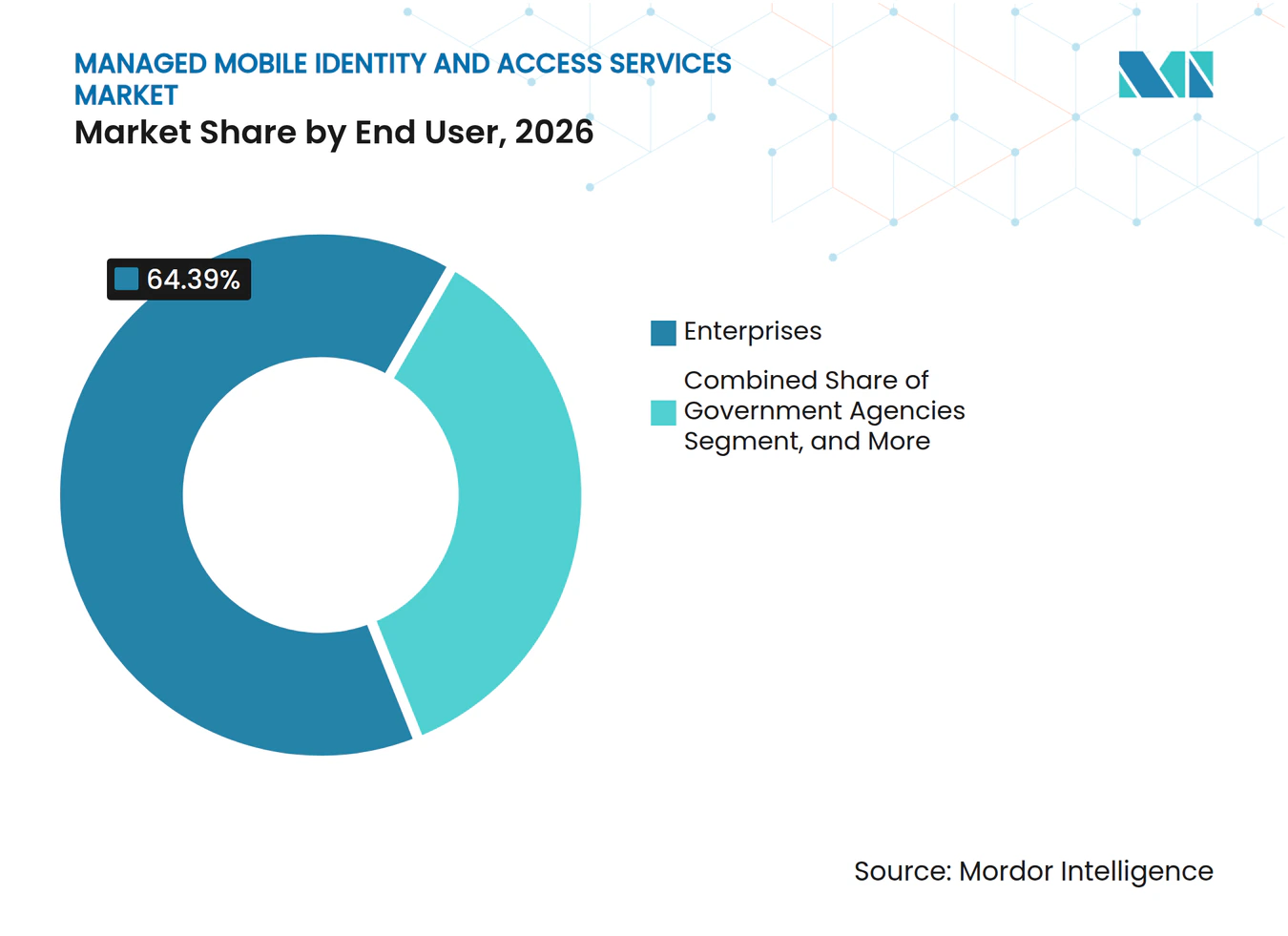
Enterprises Lead as MNOs and MVNOs Build Network Identity ServicesEnterprises accounted for 64.39% of 2026 revenue because they use managed mobile identity services for workforce authentication, privileged access, and customer identity across digital channels. Their spending is centered on a consistent access policy for employees, contractors, partners, and customers. Mobile Network Operators and Mobile Virtual Network Operators are projected to expand at a 13.24% CAGR through 2032. This reflects the increasing commercial use of carrier data for number verification, fraud prevention, and identity checks. The GSMA Open Gateway initiative covered 79 operator groups, 291 networks, and nearly 80% of global mobile connections by September 2025. The managed mobile identity and access services market can benefit as enterprises seek help integrating these standardized network APIs.
Malaysia’s 5 major mobile operators announced a federated Number Verification API in September 2025 through GSMA Open Gateway. Vietnam’s MobiFone, Viettel, and VNPT also signed a GSMA Open Gateway memorandum in April 2025 to support authentication, fraud prevention, location, and device-verification services. These moves show how network operators are becoming identity-enabling partners rather than just connectivity providers. OTT providers use similar services to protect customer accounts and simplify verification. Government agencies also represent a long-cycle customer group, as national digital identity programs require integration and operational support. Providers that can translate telecom APIs into usable services for banks, merchants, and public agencies have a defined opportunity.


By Industry Vertical:
BFSI Leads as Retail and E-Commerce AccelerateBFSI accounted for 26.03% of 2026 revenue because the sector faces high fraud exposure, stringent compliance requirements, and a large base of mobile banking customers. Institutions need secure onboarding that does not create unnecessary friction for customers. European PSD2 requirements, RBI digital identity guidance, and FFIEC authentication guidance shape many identity control decisions. Garanti BBVA Romania launched a fully digital mobile onboarding in May 2025, using biometric validation, document scanning, liveness detection, and qualified electronic signatures. These deployments position identity controls inside customer acquisition journeys, not only in security operations. The managed mobile identity and access services market is relevant where institutions need to operate these connected controls at scale.
Retail and e-commerce are projected to expand at a 13.83% CAGR through 2032 because secure checkout and sign-in can affect customer completion rates. Dashlane found that e-commerce platforms accounted for 45% of passkey authentications globally in 2025, while Amazon had already made passkeys its default mobile sign-in option in 2024. IT and telecom, healthcare, government, and manufacturing also contribute to demand. Healthcare providers need reliable patient identity verification for telehealth services. Manufacturers increasingly require controlled mobile access for field personnel using operational technology environments. These use cases broaden the managed mobile identity and access services market beyond traditional workforce access programs.
Geography Analysis
North America Managed Mobile Identity and Access Services Market
North America accounted for 38.98% of 2026 revenue in the managed mobile identity and access services market, supported by high enterprise IAM investment, a large managed services base, and active federal modernization efforts. The United States is the principal contributor because enterprises and government agencies have mature identity programs and established zero-trust procurement practices. Federal modernization programs in the United States continue to support demand for mobile-credential-compatible and API-first identity architectures. The program supports an API-first architecture for mobile, passwordless, and derived credentials. Canada is driving demand in financial services and public institutions, while Mexico is emerging as an opportunity in digital identity verification. Alignment with CISA and NIST guidance can favor providers that have established compliance capabilities.
APAC Managed Mobile Identity and Access Services Market
Asia-Pacific is projected to expand at a 13.46% CAGR through 2032, the fastest regional rate in the managed mobile identity and access services market. Mobile-first consumers, government digital identity programs, and carrier API deployments provide the core demand base. India combines digital public infrastructure with requirements for stronger identity governance when organizations process citizen data. UPI and Aadhaar-based authentication create integration requirements for providers serving banking and fintech customers. The Philippine Identification System stated that GCash used its National ID authentication service for more than 56% of new account verifications by mid-2025.[3] Japan, South Korea, and Australia are more advanced adoption environments, while Vietnam, Indonesia, the Philippines, and Malaysia are building momentum through public identity and mobile payment infrastructure.
EMEA and South America Managed Mobile Identity and Access Services Market
Europe was the second-largest regional area, with the United Kingdom and Germany as key revenue contributors. GDPR, the NIS2 Directive, and the EU Digital Identity Wallet program shape technical and operating requirements across the region. The UK government reported that employment in its digital identity sector increased at an average annual rate of 11.7% from 2020 to 2024, with financial services as the leading demand vertical. South America is led by Brazil, Argentina, and Chile, where digital banking and privacy regulation are raising demand for trusted identity services. The Middle East and Africa remain at an earlier stage of adoption, although government programs in the UAE and Saudi Arabia are supporting opportunities in sovereign digital services. Nigeria’s national identity authentication effort also provides a foundation for mobile identity use cases, while infrastructure constraints continue to limit near-term uptake in parts of Africa.
Competitive Landscape
Market Concentration
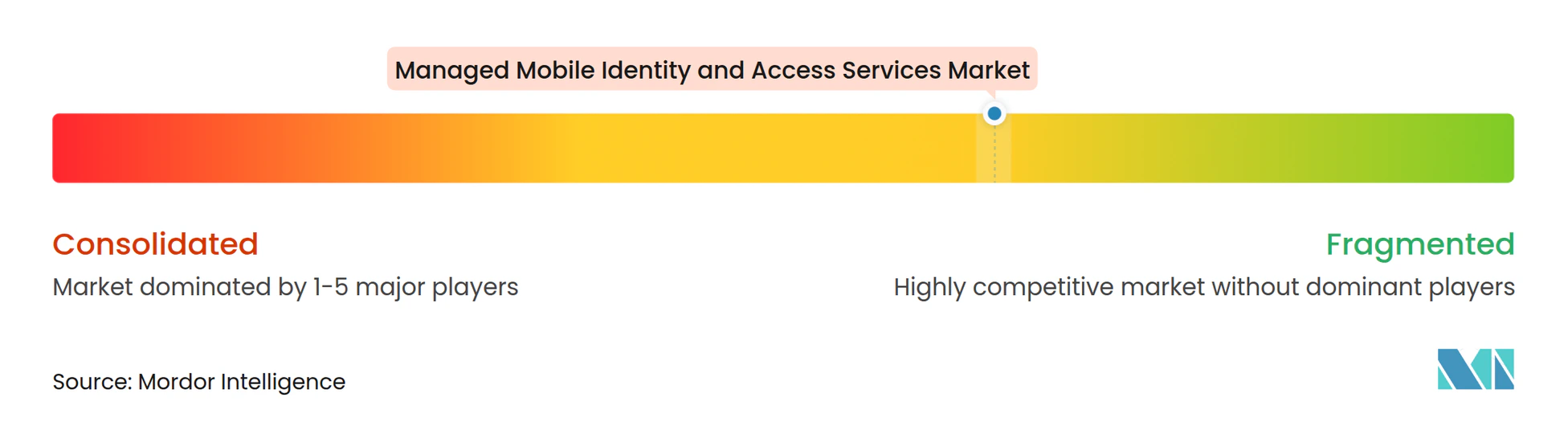
The managed mobile identity and access services market is moderately fragmented among broad IAM platforms and highly fragmented among specialist managed service providers. Okta, SailPoint, and CyberArk compete through product breadth, partner ecosystems, and established enterprise contracts. Specialists such as 1Kosmos, Prove Identity, Trulioo, and Tru.ID competes through mobile verification, device-bound authentication, and carrier-related identity capabilities. The central competitive difference is between general IAM vendors expanding managed operations and specialists using network signals that software platforms cannot duplicate easily. FIDO2 and WebAuthn provide a common technical floor for credible providers. They also affect qualification requirements for providers serving network operator use cases and large organizations.
Saviynt raised USD 700 million in a KKR-led financing round in December 2025 and reported annual recurring revenue above USD 300 million. It also introduced Zuma for governing human, non-human, and AI agent identities. This move reflects the widening scope of identity management for managed providers as AI agents initiate transactions and access enterprise systems. Veza launched Access AuthZ in November 2025 to automate access grants and revocation across enterprise systems through open authorization APIs. Okta introduced its Identity Security Fabric in September 2025, including capabilities for AI agents, posture management, and the planned introduction of verifiable digital credentials. These investments show that providers are seeking to connect mobile identity, non-human identity, and access governance in a single operating model.
The clearest opening lies in managed network API integration for mid-market customers who lack the resources to build carrier connections on their own. A related opening is identity governance for organizations using AI agents across mobile and cloud workflows. Providers also compete by helping customers replace SMS-based one-time passwords with device-bound, phishing-resistant methods. Privacy-by-design architecture can be a decisive factor when carrier and subscriber data is used across borders. The managed mobile identity and access services market depends on this discipline as network identity services expand. The managed mobile identity and access services industry remains open to specialists because procurement decisions often depend on local telecom integrations and specific regulatory needs.
Managed Mobile Identity and Access Services Industry Leaders
-
Okta, Inc.
-
Ping Identity Corporation
-
SailPoint Technologies, Inc.
-
Entrust Corporation
-
Palo Alto Networks
- *Disclaimer: Major Players sorted in no particular order
Managed Mobile Identity and Access Services Market Companies Covered in this Report
- Okta, Inc.
- Ping Identity Corporation
- SailPoint Technologies, Inc.
- Saviynt, Inc.
- Palo Alto Networks
- One Identity LLC
- JumpCloud, Inc.
- Entrust Corporation
- RSA Security LLC
- SecureAuth Corporation
- Beyond Identity, Inc.
- FusionAuth, Inc.
- 1Kosmos Inc.
- Prove Identity, Inc.
- Trulioo Information Services Inc.
- Callsign, Inc.
- LoginRadius Inc.
- Simeio Solutions, LLC
- Radiant Logic, Inc.
- OpenIAM, LLC
- Oleria, Inc.
- Veza Technologies, Inc.
- Aembit, Inc.
- Authlete, Inc.
- Tru.ID Limited
Recent Industry Developments in Managed Mobile Identity and Access Services Market
- October 2026: SailPoint announced enterprise-scale Human Fabric capabilities at its Navigate conference, including a re-platformed access certification engine designed to handle unlimited access reviews, proactive Separation of Duties enforcement blocking toxic access combinations at the moment of request, and AI-powered conversational access requests from chat tools. Simultaneously, SailPoint released IdentityIQ 9.0 for hybrid and on-premises customers, including an automated upgrade tool that scans and migrates existing environments, removing the primary technical barrier that had stalled on-premises upgrades across large regulated enterprises.
- July 2026: FusionAuth released version 1.68 featuring Intelligent MFA with a 10-signal, deterministic risk engine that evaluates every login against signals including unrecognized device, blocklisted IP, impossible travel, and dormant account status, challenging high-risk sessions while avoiding friction for trusted sessions. The company reported 201% quarter-over-quarter bookings expansion in the quarter ending April 30, 2026, its strongest commercial result to date, indicating accelerating demand for customer-controlled, auditable authentication infrastructure.
- May 2026: IBM launched AskIAM, an agentic identity operations service spanning IBM Verify, Microsoft Entra, Saviynt, CyberArk, and SailPoint environments. The service illustrates how identity providers are applying AI orchestration to managed operations across mixed identity environments.
- April 2026: Prove Identity announced a USD 5 million investment and creation of 50 jobs in Ireland, expanding its European operations for phone number-based digital identity verification as demand from EMEA financial institutions and e-commerce platforms accelerated.
Global Managed Mobile Identity and Access Services Market Report Scope
The Managed Mobile Identity and Access Services Market refers to the market for solutions and services that enable organizations to securely manage, authenticate, authorize, and monitor user identities and access to mobile devices, applications, networks, and enterprise resources. These services help protect sensitive data, enforce access control policies, and ensure secure mobile connectivity through technologies such as multi-factor authentication, single sign-on, identity federation, mobile device authentication, and identity and access management (IAM) platforms.
The Managed Mobile Identity and Access Services Market Report is Segmented by Offering (Solutions and Services), Deployment (Cloud-Based, On-Premises, and Hybrid), Organization Size (Large Enterprises and Small and Medium-Sized Enterprises), End User (Enterprises, Mobile Network Operators and MVNOs, OTT Providers, and Government Agencies), Industry Vertical (BFSI, IT and Telecom, Retail and E-Commerce, Healthcare and Life Sciences, Government and Public Sector, Manufacturing, and Other Industry Verticals), and Geography (North America, Europe, Asia-Pacific, South America, Middle East, and Africa). The Market Forecasts are Provided in Terms of Value (USD).
Segmentation Overview
| Solutions |
| Services |
| Cloud-Based |
| On-Premises |
| Hybrid |
| Large Enterprises |
| Small and Medium-Sized Enterprises |
| Enterprises |
| Mobile Network Operators and MVNOs |
| OTT Service Providers |
| Government Agencies |
| BFSI |
| IT and Telecom |
| Retail and E-Commerce |
| Healthcare and Life Sciences |
| Government and Public Sector |
| Manufacturing |
| Other Industry Verticals |
| North America | United States |
| Canada | |
| Mexico | |
| South America | Brazil |
| Argentina | |
| Chile | |
| Rest of South America | |
| Europe | United Kingdom |
| Germany | |
| France | |
| Italy | |
| Spain | |
| Russia | |
| Rest of Europe | |
| Asia-Pacific | China |
| Japan | |
| India | |
| South Korea | |
| Australia | |
| Rest of Asia-Pacific | |
| Middle East | United Arab Emirates |
| Saudi Arabia | |
| Qatar | |
| Turkey | |
| Rest of Middle East | |
| Africa | South Africa |
| Egypt | |
| Nigeria | |
| Rest of Africa |
| By Offering | Solutions | |
| Services | ||
| By Deployment | Cloud-Based | |
| On-Premises | ||
| Hybrid | ||
| By Organization Size | Large Enterprises | |
| Small and Medium-Sized Enterprises | ||
| By End User | Enterprises | |
| Mobile Network Operators and MVNOs | ||
| OTT Service Providers | ||
| Government Agencies | ||
| By Industry Vertical | BFSI | |
| IT and Telecom | ||
| Retail and E-Commerce | ||
| Healthcare and Life Sciences | ||
| Government and Public Sector | ||
| Manufacturing | ||
| Other Industry Verticals | ||
| By Geography | North America | United States |
| Canada | ||
| Mexico | ||
| South America | Brazil | |
| Argentina | ||
| Chile | ||
| Rest of South America | ||
| Europe | United Kingdom | |
| Germany | ||
| France | ||
| Italy | ||
| Spain | ||
| Russia | ||
| Rest of Europe | ||
| Asia-Pacific | China | |
| Japan | ||
| India | ||
| South Korea | ||
| Australia | ||
| Rest of Asia-Pacific | ||
| Middle East | United Arab Emirates | |
| Saudi Arabia | ||
| Qatar | ||
| Turkey | ||
| Rest of Middle East | ||
| Africa | South Africa | |
| Egypt | ||
| Nigeria | ||
| Rest of Africa | ||
Key Questions Answered in the Report
What is the managed mobile identity and access services market size?
The market is projected to reach USD 17.39 billion by 2032, from USD 9.66 billion in 2027, at a 12.48% CAGR.
What is driving demand for managed mobile identity services?
Enterprise mobility, credential theft, passkey deployment, cloud migration, and the need for continuous identity operations are central demand factors.
Which deployment model leads managed mobile identity services?
Cloud-based delivery held 79.02% of 2026 revenue and is projected to expand at a 12.91% CAGR through 2032.
Which customer group is expanding fastest?
Mobile Network Operators and Mobile Virtual Network Operators are projected to expand at a 13.24% CAGR through 2032 as network identity APIs gain adoption.
Which industry vertical is the largest user of managed mobile identity services?
BFSI held 26.03% of 2026 revenue because it needs secure mobile onboarding, fraud controls, and compliant customer authentication.
Which region offers the fastest expansion?
Asia-Pacific is projected to expand at a 13.46% CAGR through 2032, supported by digital identity program