
Managed Mobile Help Desk Services Market Size and Share
Market Overview
| Study Period | 2021 - 2032 |
|---|---|
| Market Size (2027) | USD 3.64 Billion |
| Market Size (2032) | USD 6.18 Billion |
| Growth Rate (2027 - 2032) | 11.17 % |
| Fastest Growing Market | Asia-Pacific |
| Largest Market | North America |
| Market Concentration | Medium |
Major Players *Disclaimer: Major Players sorted in no particular order Image © Mordor Intelligence. Reuse requires attribution under CC BY 4.0. | |
Managed Mobile Help Desk Services Market Analysis by Mordor Intelligence
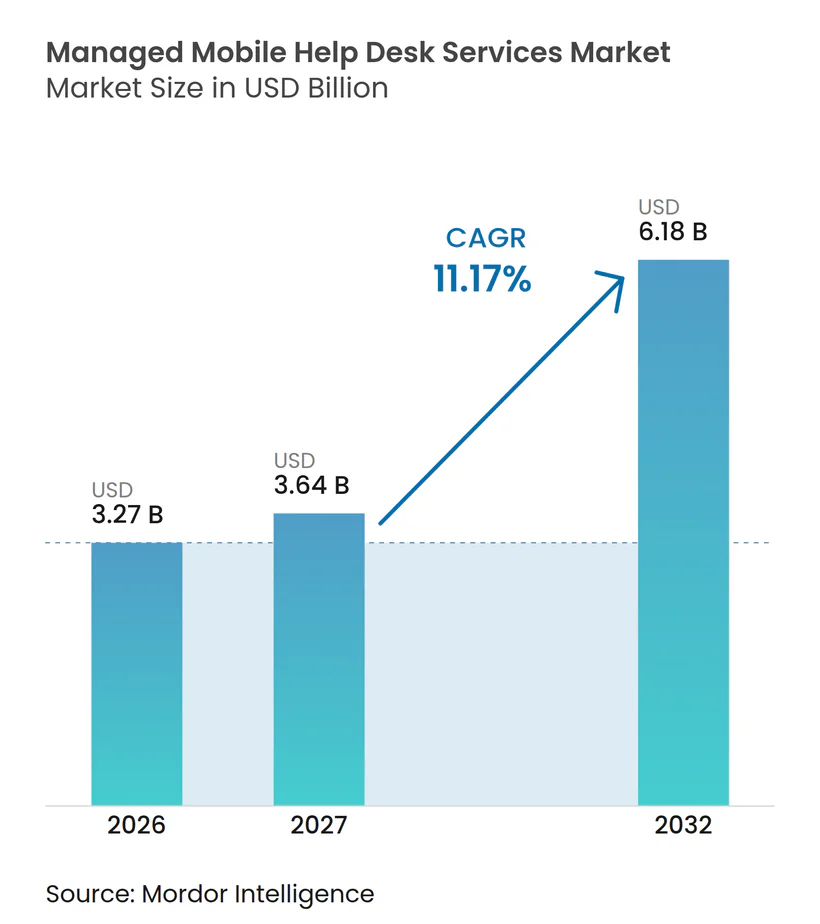
The managed mobile help desk services market size is projected to expand from USD 3.27 billion in 2026 to USD 3.64 billion in 2027, and to USD 6.18 billion by 2032, registering a CAGR of 11.17% from 2027 to 2032. Permanent hybrid work is increasing the number and variety of endpoints that employers need to support, including smartphones, shared rugged devices, employee-owned tablets, and devices used by frontline employees across multiple work settings. This is moving more organizations toward specialized providers that can handle device activation, account access, connectivity issues, application support, carrier coordination, and lifecycle tasks within a single service model. Security and compliance are becoming core contract requirements rather than optional additions, especially when mobile devices handle regulated data, access internal networks, or are shared by multiple employees. Providers are responding with cloud-based endpoint management, automation, stronger carrier and platform partnerships, and support processes designed to identify common issues before they lead to longer service interruptions.
Key Report Takeaways
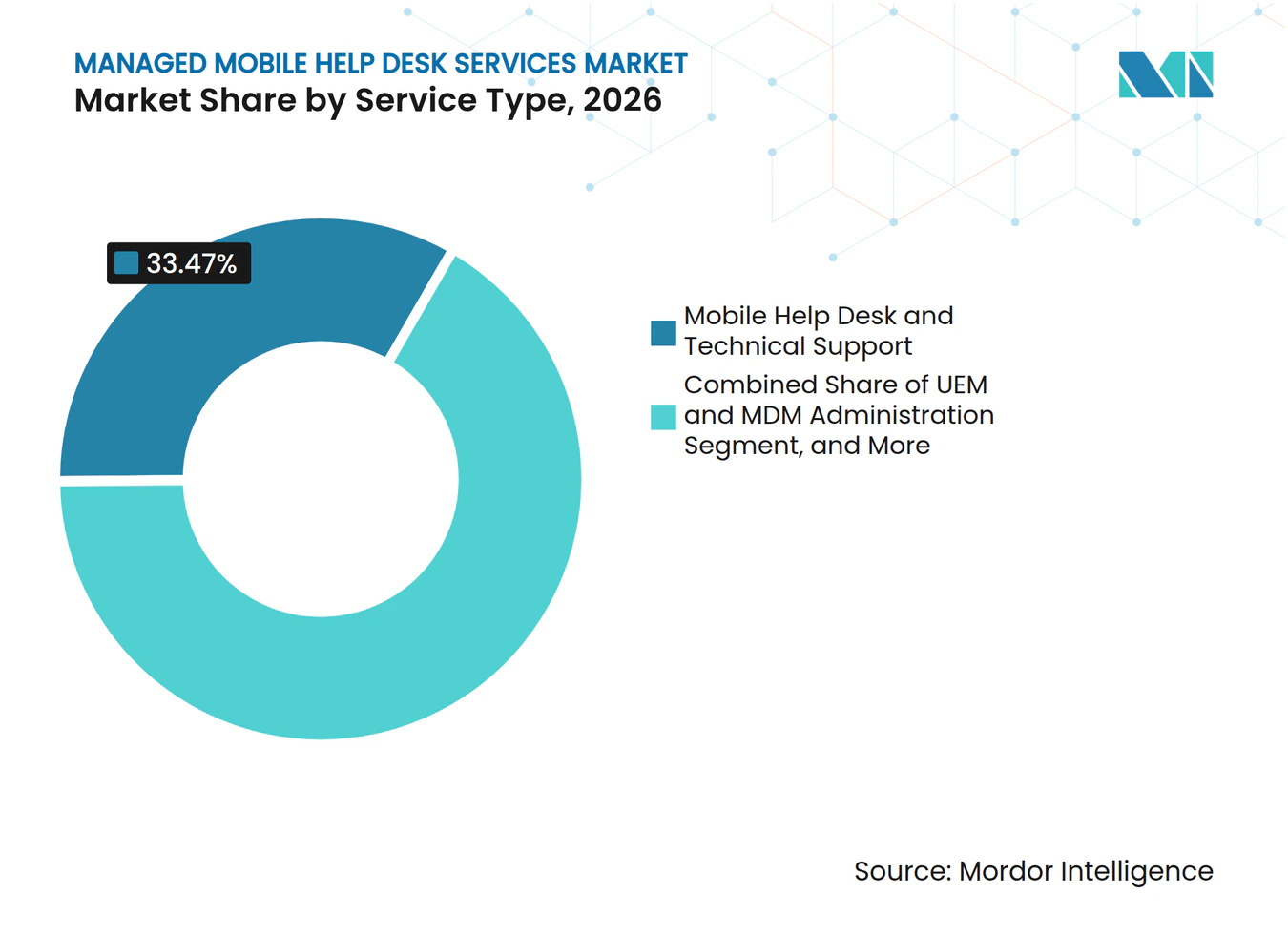
- By service type, Mobile Help Desk and Technical Support held 33.47% of the managed mobile help desk services market share in 2026, while Security, Compliance, and Content Management is projected to expand at a 12.63% CAGR through 2032.
- By enterprise size, Large Enterprises held 67.83% of revenue in 2026, while Small and Medium Enterprises are projected to expand at a 12.27% CAGR through 2032.
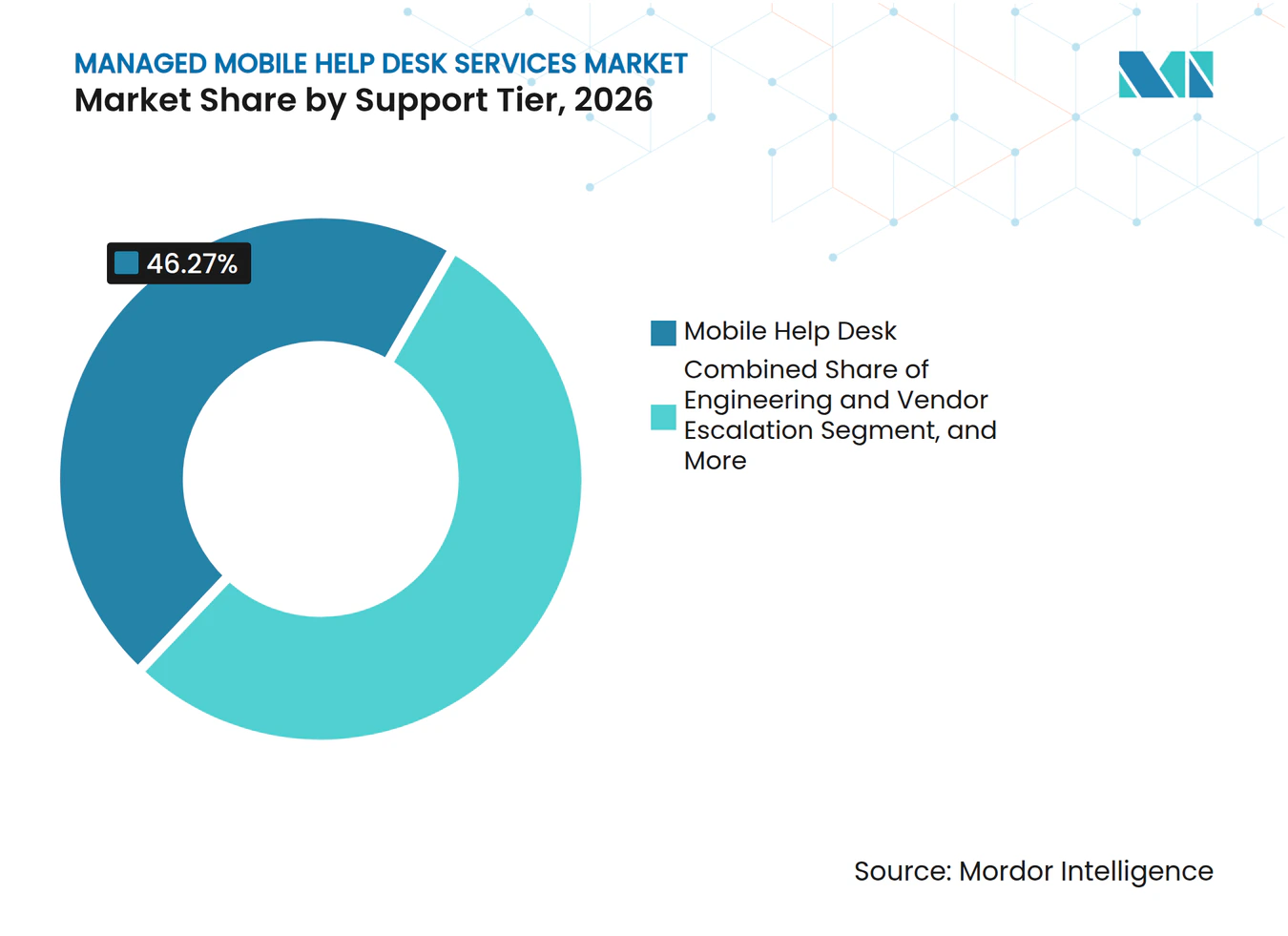
- By support tier, Mobile Help Desk held 46.27% of revenue in 2026, while Mobility Specialist Support is projected to expand at an 11.83% CAGR through 2032.
- By end-user industry, Information Technology and Telecommunications held 23.67% of revenue in 2026, while Healthcare is projected to expand at an 11.67% CAGR through 2032.
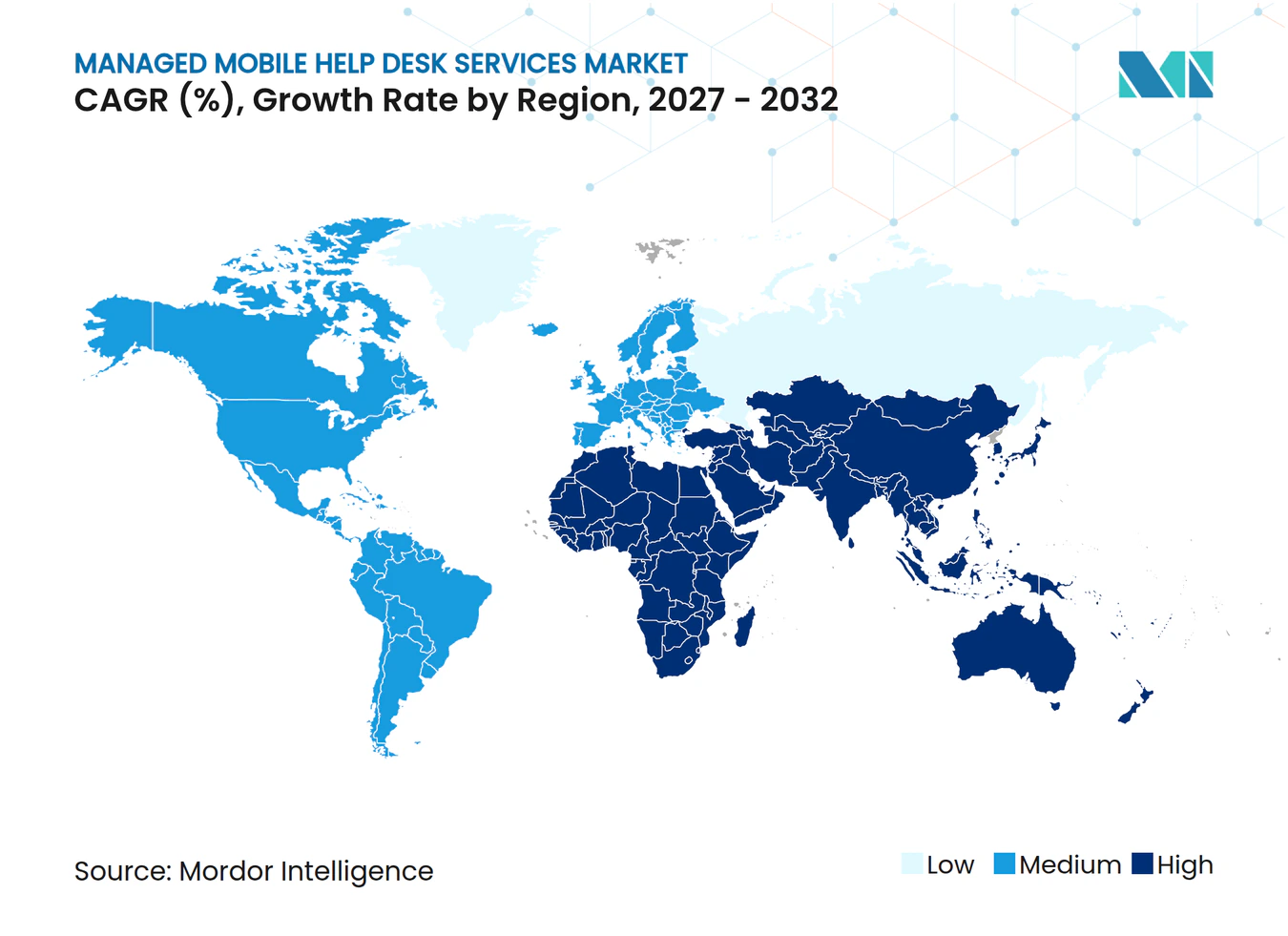
- By geography, North America held 38.37% of revenue in 2026, while Asia-Pacific is projected to expand at an 11.84% CAGR through 2032.
Note: Market numbers in this report are based on Mordor Intelligence's proprietary estimation framework, which combines nine months of actuals with Q4 projections for base year 2026.
Market Trends and Insights
Drivers Impact Analysis of Managed Mobile Help Desk Services Market*
| Driver | (~) % Impact on CAGR Forecast | Geographic Relevance | Impact Timeline |
|---|---|---|---|
| Rising Mobile Security and Compliance Requirements | +2.4% | Global, with heightened impact in North America and Europe | Medium term (2-4 years) |
| Hybrid Work and Distributed Mobile Workforce Expansion | +2.1% | Global | Short term (≤ 2 years) |
| Outsourcing Mobility Lifecycle Management to Reduce Total Cost of Ownership | +1.8% | Global, concentrated in North America and Asia-Pacific | Medium term (2-4 years) |
| Cloud-Based UEM Adoption and Centralized Policy Administration | +1.4% | North America and Europe, expanding to Asia-Pacific | Medium term (2-4 years) |
| Growth of Connected and Ruggedized Device Fleets | +1.0% | Asia-Pacific and North America | Long term (≥ 4 years) |
| AI-Enabled Predictive Support and Automated Ticket Resolution | +0.8% | Global, with early leaders in North America | Medium term (2-4 years) |
| Source: Mordor Intelligence | |||
Rising Mobile Security and Compliance Requirements
Mobile protection has become a central concern for enterprise technology teams, particularly when devices hold business applications, credentials, and regulated information outside company premises. In the second quarter of 2025, 1 million enterprise employees faced mobile phishing incidents, while executives were 23% more likely to be targeted by AI-personalized attacks. National Institute of Standards and Technology guidance identifies policy enforcement, remote wipe functions, and operating-system compliance checks as important controls for enterprise mobile devices. Organizations without dedicated mobility specialists often seek managed support for patch governance, compliance monitoring, security reviews, and content controls that must be applied consistently across a varied device fleet. Healthcare, banking, financial services, and government buyers also favor providers that can demonstrate recognized security and privacy credentials. This requirement can narrow the supplier field because generalist providers may not meet every control or reporting expectation, creating an advantage for qualified providers in the managed mobile help desk services market.
Hybrid Work and Distributed Mobile Workforce Expansion
Hybrid work requires support teams to resolve issues across home broadband, corporate Wi-Fi, cellular networks, changing locations, and different levels of employee technical confidence. Cisco reported in April 2025 that 72% of surveyed organizations required office attendance on set days while continuing to offer flexible work options.[1] This arrangement increases the range of connectivity, application-permission, re-enrollment, and authentication issues that users experience outside traditional offices. Employees also use several device types, which adds to the operating load of internal teams originally designed around fixed locations and standard work hours. The managed mobile help desk services market benefits when providers offer 24x7 support, multiple language options, and several contact channels that are available when a mobile user needs help. These capabilities help clients maintain service continuity without expanding internal staffing in line with every new endpoint.
Outsourcing Mobility Lifecycle Management to Reduce Total Cost of Ownership
Organizations are seeking predictable support costs for procurement, repairs, carrier billing, device refreshes, replacements, and retirement. Managed subscriptions convert these uneven expenses into recurring service fees that finance teams can plan more easily and compare across user groups. Tangoe reported that telecom invoice errors can account for 15-20% of enterprise telecom spending, creating a clear recovery opportunity for providers that automate billing reconciliation. Providers can also prepare devices before delivery, verify required applications, and arrange replacement logistics, which shortens the time before a new employee can work. This benefit matters in retail, logistics, and field services, where employee turnover and distributed workforces place recurring pressure on device operations. The managed mobile help desk services market, therefore, has room to grow where clients want a broader lifecycle scope rather than incident handling alone.
Cloud-Based UEM Adoption and Centralized Policy Administration
Cloud-delivered unified endpoint management gives organizations a central way to govern device identity, applications, security posture, and routine policy changes across distributed fleets. Cloud agents can reach devices across locations without dedicated on-premises gateway infrastructure, which can simplify rollout and reduce local maintenance work. Providers gain timely visibility into device health, policy compliance, application update status, and common support patterns when they work through these platforms. This information supports proactive remediation before a user creates a ticket and allows support teams to use the same policy data when responding to an incident. Buyers who standardize on a UEM platform often prefer service providers with proven skills, formal training, and operational experience on that platform. That preference can support contract renewals for incumbent providers and increase the importance of vendor certifications in the managed mobile help desk services market.
Restraints Impact Analysis of Managed Mobile Help Desk Services Market*
| Restraint | (~) % Impact on CAGR Forecast | Geographic Relevance | Impact Timeline |
|---|---|---|---|
| Legacy ITSM, UEM, Carrier, and Identity Integration Complexity | -1.2% | Global, particularly North America and Europe | Medium term (2-4 years) |
| Perceived Loss of Operational Control and Cost Visibility | -0.9% | Global | Short term (≤ 2 years) |
| SLA Exposure from High-Variance Mobile Incidents | -0.5% | Global, concentrated in regulated industries | Medium term (2-4 years) |
| Shortage of Mobile-Platform and Telecom Support Specialists | -0.4% | Global | Long term (≥ 4 years) |
| Source: Mordor Intelligence | |||
Legacy ITSM, UEM, Carrier, and Identity Integration Complexity
Many enterprises start with 3-5 carrier relationships, 2-3 IT service-management platforms, and at least 2 identity providers, each with separate contacts and operational procedures. These systems have different interfaces, data models, access requirements, and escalation processes that can make a consistent support experience harder to deliver. Connecting them is an ongoing engineering task rather than a single setup exercise, especially when carrier portals or identity tools are updated. Carrier contracts can run for 24-36 months, so providers may need to maintain links with legacy portals and billing systems for long periods. Organizations migrating from VMware Workspace ONE to Microsoft Intune can face further disruption because both management environments may need support during the transition. Buyers should clarify whether integration work is included in the recurring fee or charged separately, since that choice can materially alter contract cost and slow implementation in the managed mobile help desk services market.
Perceived Loss of Operational Control and Cost Visibility
Technology and finance leaders can hesitate when they believe outsourcing will limit visibility into mobile spend, device location, service quality, or ticket status. Pooled service models can make detailed reporting harder to obtain without a premium service tier, particularly when clients want device-level detail across carriers and business units. Providers are addressing this issue with experience-level agreements that track user outcomes, including first-call resolution, resolution time for priority incidents, and employee satisfaction. These measures can make accountability more practical than infrastructure availability measures alone, but they depend on shared definitions and reliable reporting. However, clients need internal measurement practices and named service owners to use outcome-based agreements well. Dedicated customer portals with device inventories, usage data, and ticket dashboards can reduce this concern without changing the provider’s underlying delivery model or requiring a separate management layer, which can support adoption in the managed mobile help desk services market.
*Our forecasts treat driver/restraint impacts as directional, not additive. The impact forecasts reflect baseline growth, mix effects, and variable interactions.
Managed Mobile Help Desk Services Market Segment Analysis
By Service Type:
Security and Lifecycle Complexity Reshape the Service PortfolioMobile Help Desk and Technical Support held 33.47% of the service-type segment in 2026. The segment covers device onboarding, password recovery, connectivity triage, application-access support, and the routine account tasks that occur when employees change devices or plans. These high-volume requests remain the operational base of most enterprise mobility programs because they affect users every day and require quick, consistent responses. Security, Compliance, and Content Management is projected to grow at a 12.63% CAGR through 2032. Enterprises need this service for patch validation, application review, data-loss prevention, policy enforcement, and audit preparation across corporate and personally owned devices.
UEM and MDM Administration manages enrollment, policy configuration, and operating-system compliance between support incidents, which helps clients keep fleets ready for internal review. Mobile Application Support and Maintenance is more relevant where organizations run custom warehouse, point-of-sale, or clinical applications that have specific permissions, release schedules, and user-support needs. Device Lifecycle and Logistics Support brings procurement coordination, preconfiguration, delivery, repairs, replacement, and end-of-life recycling into the contract. Telecom Expense and Mobility Service Management also helps clients identify billing errors, validate inventories, and reconcile carrier invoices. Together, these activities allow the managed mobile help desk services market to serve clients who need ongoing mobility operations rather than a narrow incident-response service. ServiceNow introduced its AI-native Flow service desk in October 2026, showing how conversational automation is becoming part of managed support portfolios.[2]



By Enterprise Size:
SME Growth Reshapes the Demand BaseLarge Enterprises held 67.83% of the enterprise-size segment in 2026. Their larger device fleets, multicarrier environments, and geographically dispersed workforces create a substantial need for structured service agreements. Many operate with corporate-liable devices, employee-owned devices, and shared-device pools at the same time, often across several countries. Each ownership model requires different enrollment rules, support processes, replacement policies, and levels of access to company information. This scale helps explain why large organizations remain the main revenue base for the managed mobile help desk services market.
Small and Medium Enterprises are projected to grow at a 12.27% CAGR through 2032. Per-device subscriptions remove the earlier capital spending needed to build and operate a dedicated mobile-device-management environment. Cloud endpoint management can combine policy controls, remote wipe functions, application management, and compliance reporting with managed help desk coverage. Smaller organizations can adopt these capabilities without running separate procurement processes for every technical function. Specialist providers are responding with lower minimum commitments and shorter terms than traditional large-enterprise contracts. This makes the managed mobile help desk services industry more accessible to firms with fewer than 500 employees.
By Support Tier:
First-Line Volume Anchors Revenue as Specialist Roles AccelerateMobile Help Desk held 46.27% of support-tier revenue in 2026. This tier handles device activations, SIM replacements, basic troubleshooting, carrier-plan administration, and the first review of access or connectivity requests. Its scale reflects the high frequency of routine issues across large mobile fleets, where simple problems can affect productivity if they are not resolved quickly. A 5,000-person enterprise can receive thousands of mobile support contacts each month across phones, tablets, rugged handhelds, and other connected devices. Current device configurations, documented procedures, and carrier access help providers resolve many of these requests without escalation.
Engineering and Vendor Escalation covers hardware defects, operating-system issues, carrier-network problems, and other cases that require an original equipment manufacturer or carrier response. This tier provides a safeguard that separates broad managed contracts from basic help desk services and gives clients a defined route for complex incidents. Mobility Specialist Support is projected to expand at an 11.83% CAGR through 2032. It addresses UEM architecture, application containerization, identity federation, security incident response, and other tasks that demand deeper technical judgment. AI-assisted ticket routing and pattern detection can support specialists by identifying recurring issues before users submit a request, increasing the value of these skills within the managed mobile help desk services market.

By End-User Industry:
Healthcare Mobility Elevates Support ComplexityInformation Technology and Telecommunications held 23.67% of end-user revenue in 2026. Organizations in this sector often have large device footprints, complex application environments, and mature governance for managed service agreements. Banking, financial services, and insurance also need mobile support that can verify encryption, application sandboxing, remote wipe controls, and documented access practices. Retail and e-commerce depend on rugged devices for point-of-sale and inventory work, while manufacturing uses connected devices on factory floors. Government and defense buyers can require security-cleared support staff in some locations and more formal escalation processes.
Healthcare is projected to grow at an 11.67% CAGR through 2032. A 2026 survey of 400 healthcare delivery organization leaders found that 87% of clinicians frequently contacted the help desk for lockouts, while 81% used personal devices when institutional devices were unavailable. Organizations that used centralized shared-device programs reported average annual savings of USD 1.1 million and a 92% improved return on investment for mobile device programs. Healthcare buyers need reliable reprovisioning between patients, stable access controls, and documented audit trails. HIPAA requirements and HITRUST CSF expectations make specialized mobile-device management a procurement requirement. This need gives the managed mobile help desk services market a clear opening in clinical mobility programs.
Geography Analysis
North America held 38.37% of the managed mobile help desk services market share in 2026. The region combines a large enterprise customer base, established outsourcing practices, early use of cloud UEM platforms, and buyers that often require formal service levels, detailed reporting, and support across several device types. The United States drives demand through hybrid work, mobile security programs, and increasing attention to zero-trust controls, while Canada provides additional demand through shared clinical device programs in healthcare and government. Mexico is supported by nearshore delivery expansion and mobile workforce programs connected with manufacturing growth, which creates a need for services that coordinate users, devices, carriers, and logistics across locations.
Asia-Pacific is projected to grow at an 11.84% CAGR through 2032, giving the managed mobile help desk services market an important expansion area. GSMA reported that the regional mobile ecosystem generated USD 1 trillion in economic value in 2025 and is expected to reach USD 1.4 trillion by 2030. The region supported nearly 2.7 billion mobile connections in 2025.[3] China, India, Japan, South Korea, and Australia are the largest enterprise demand centers because they combine substantial business device use with mature technology buyers. Southeast Asian countries are expanding faster from smaller starting positions, where local language support, carrier relationships, and flexible commercial models can influence provider selection.
Europe is anchored by Germany, the United Kingdom, and France, where buyers expect documented security controls and evidence that providers can manage privacy, policy, and audit requirements. South American demand is concentrated in Brazil and Argentina, especially among multinationals with shared-service centers that want consistent mobile support for hybrid workforces. The Middle East is shaped by digital government programs in Saudi Arabia and the United Arab Emirates, while Africa remains at an earlier stage, with South Africa, Egypt, and Nigeria as primary commercial centers. French-language support can be a differentiator in West African markets, where managed providers need to match regional service requirements rather than apply one global model. These local conditions create opportunities in the managed mobile help desk services market for providers with regional delivery capacity, language capability, security credentials, and appropriate carrier coverage.
Competitive Landscape
Market Concentration
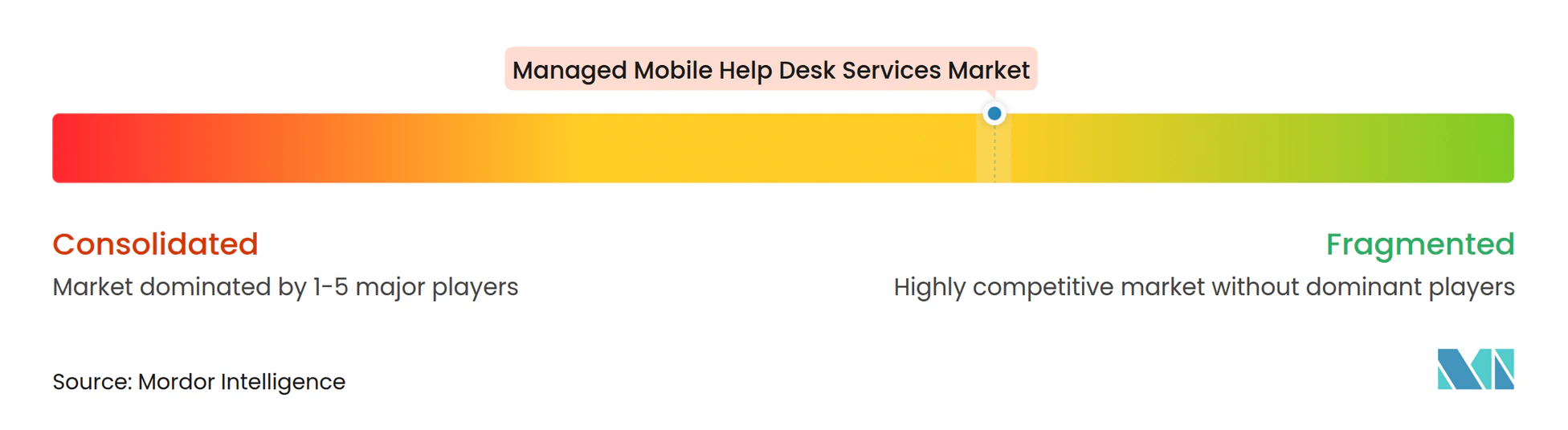
The managed mobile help desk services market is moderately fragmented. Global integrators, consulting-led providers, telecom operators, mobility specialists, and telecom-expense platforms all compete for contracts, with each group bringing a different combination of scale, platform skills, and carrier knowledge. Larger firms use broad delivery networks, long carrier relationships, and investments in AI-enabled service management to compete on scale and to support clients operating across several countries. Specialists compete through device lifecycle knowledge, faster provisioning, close carrier relationships, and support models designed around mobility rather than general information technology operations. Buyers are increasingly looking for a provider that can connect support with endpoint management and security operations while still giving internal teams clear visibility into service results.
Strategic acquisitions have expanded provider capabilities in the managed mobile help desk services market. Kyndryl agreed to acquire Solvinity in November 2025 to add secure private and hybrid sovereign cloud services to its managed-services portfolio. Stratix acquired Mobility CG in November 2025 to strengthen carrier partnerships and lifecycle-management capacity. Tangoe introduced Multi-SIM Management in 2026 to automate links between mobile lines and multi-SIM devices. These moves show that providers are adding specialist capabilities through both product development and consolidation, rather than relying only on internal expansion.
SOTI expanded its platform in June 2026 with shared-device security, cross-platform IT service-management integrations, automated Android compliance actions, and Windows issue detection.[4] ServiceNow launched Flow in October 2026 as a conversational AI-native service desk designed for rapid deployment. Providers are also focusing on multi-carrier eSIM support and automation for routine tier-1 incidents, where faster resolution can reduce the work passed to scarce specialists. These capabilities allow staff to focus on security, complex escalations, lifecycle planning, and client-specific process improvements. The competitive field remains broad because clients use different carriers, UEM platforms, and deployment models, so differentiation in the managed mobile help desk services market rests on integration capability, service visibility, and depth in specific verticals.
Managed Mobile Help Desk Services Industry Leaders
-
Accenture plc
-
Kyndryl Holdings, Inc.
-
IBM Corporation
-
Tata Consultancy Services Limited
-
Wipro Limited
- *Disclaimer: Major Players sorted in no particular order
Managed Mobile Help Desk Services Market Companies Covered in this Report
- Accenture plc
- International Business Machines Corporation
- Kyndryl Holdings, Inc.
- Wipro Limited
- Tata Consultancy Services Limited
- DXC Technology Company
- Fujitsu Limited
- NTT DATA Group Corporation
- Cognizant Technology Solutions Corporation
- Infosys Limited
- HCL Technologies Limited
- Capgemini SE
- Tech Mahindra Limited
- Unisys Corporation
- Digital Management, LLC
- Stratix Corporation
- Tangoe, Inc.
- AT&T Inc.
- Verizon Communications Inc.
- Vodafone Group Plc
- Orange S.A.
- SOTI Inc.
- Brightfin, LLC
Recent Industry Developments in Managed Mobile Help Desk Services Market
- October 2026: Stratix Corporation opened its South Central Service Center in Dallas, its sixth facility in the continental United States, extending enterprise managed mobility lifecycle services and pickup-and-delivery capabilities across Texas and the south-central US and enabling broader coverage for education, retail, healthcare, and logistics clients in the region.
- October 2026: ServiceNow launched Flow, a standalone conversational AI-native service desk for ITSM, deployable in a single day without implementation infrastructure. Flow enables teams to automate IT workflows through natural-language chat in Slack and Microsoft Teams. ServiceNow stated its L1 IT Service Desk AI Specialist resolves assigned cases 99% faster than human agents within the company's own help desk, positioning agentic AI as a performance benchmark for the managed help desk industry.
- June 2026: Stratix and Jeppesen ForeFlight launched Manage My EFB, a Device-as-a-Service solution for commercial aviation operators that bundles Electronic Flight Bag devices, ForeFlight software, Stratix lifecycle services, and SmartSIM connectivity into a single per-device monthly subscription. The launch marked Stratix's entry into the aviation mobility market and introduced a subscription-based delivery model for a sector historically reliant on capital expenditure device programs.
- June 2026: SOTI released its 2026.1 platform update for the SOTI ONE Platform, introducing shared-device lockout security with multi-factor authentication options, cross-platform ITSM API integrations for live troubleshooting, automated Android compliance policy actions, and real-time Windows issue detection with Microsoft Defender for Endpoint integration, directly enabling managed providers to reduce frontline device downtime.
Global Managed Mobile Help Desk Services Market Report Scope
The Managed Mobile Help Desk Services Market covers outsourced services that provide technical assistance, administration, troubleshooting, and ongoing support for enterprise mobile devices, applications, and mobility environments. These services include mobile help desk and technical support, unified endpoint management (UEM) and mobile device management (MDM) administration, mobile application support and maintenance, device lifecycle and logistics support, telecom expense and mobility service management, and security, compliance, and content management. Providers support device configuration, connectivity issues, application access, mobile operating system problems, endpoint policies, device provisioning, and escalation of complex mobility incidents across enterprise mobile environments.
The Managed Mobile Help Desk Services Market Report is Segmented by Service Type (Mobile Help Desk and Technical Support, UEM and MDM Administration, Mobile Application Support and Maintenance, Device Lifecycle and Logistics Support, Telecom Expense and Mobility Service Management, and Security, Compliance, and Content Management), Enterprise Size (Large Enterprises, and Small and Medium Enterprises), Support Tier (Mobile Help Desk, Mobility Specialist Support, and Engineering and Vendor Escalation), End-User Industry (Information Technology and Telecommunications, BFSI, Healthcare, Retail and E-Commerce, Manufacturing, Government and Defense, and Other End-User Industries), and Geography (North America, South America, Europe, Asia-Pacific, Middle East, and Africa). The Market Forecasts are Provided in Terms of Value (USD).
Segmentation Overview
| Mobile Help Desk and Technical Support |
| UEM and MDM Administration |
| Mobile Application Support and Maintenance |
| Device Lifecycle and Logistics Support |
| Telecom Expense and Mobility Service Management |
| Security, Compliance, and Content Management |
| Large Enterprises |
| Small and Medium Enterprises |
| Mobile Help Desk |
| Mobility Specialist Support |
| Engineering and Vendor Escalation |
| Information Technology and Telecommunications |
| BFSI |
| Healthcare |
| Retail and E-Commerce |
| Manufacturing |
| Government and Defense |
| Other End-User Industries |
| North America | United States |
| Canada | |
| Mexico | |
| South America | Brazil |
| Argentina | |
| Rest of South America | |
| Europe | Germany |
| United Kingdom | |
| France | |
| Italy | |
| Spain | |
| Russia | |
| Rest of Europe | |
| Asia-Pacific | China |
| India | |
| Japan | |
| South Korea | |
| Australia | |
| Rest of Asia-Pacific | |
| Middle East | Saudi Arabia |
| United Arab Emirates | |
| Turkey | |
| Rest of Middle East | |
| Africa | South Africa |
| Egypt | |
| Nigeria | |
| Rest of Africa |
| By Service Type | Mobile Help Desk and Technical Support | |
| UEM and MDM Administration | ||
| Mobile Application Support and Maintenance | ||
| Device Lifecycle and Logistics Support | ||
| Telecom Expense and Mobility Service Management | ||
| Security, Compliance, and Content Management | ||
| By Enterprise Size | Large Enterprises | |
| Small and Medium Enterprises | ||
| By Support Tier | Mobile Help Desk | |
| Mobility Specialist Support | ||
| Engineering and Vendor Escalation | ||
| By End-User Industry | Information Technology and Telecommunications | |
| BFSI | ||
| Healthcare | ||
| Retail and E-Commerce | ||
| Manufacturing | ||
| Government and Defense | ||
| Other End-User Industries | ||
| By Geography | North America | United States |
| Canada | ||
| Mexico | ||
| South America | Brazil | |
| Argentina | ||
| Rest of South America | ||
| Europe | Germany | |
| United Kingdom | ||
| France | ||
| Italy | ||
| Spain | ||
| Russia | ||
| Rest of Europe | ||
| Asia-Pacific | China | |
| India | ||
| Japan | ||
| South Korea | ||
| Australia | ||
| Rest of Asia-Pacific | ||
| Middle East | Saudi Arabia | |
| United Arab Emirates | ||
| Turkey | ||
| Rest of Middle East | ||
| Africa | South Africa | |
| Egypt | ||
| Nigeria | ||
| Rest of Africa | ||
Key Questions Answered in the Report
What is the managed mobile help desk services market size?
The managed mobile help desk services market is projected to grow from USD 3.64 billion in 2027 to USD 6.18 billion by 2032 at an 11.17% CAGR. The forecast reflects a broader role for providers that can combine everyday user support with endpoint controls, device logistics, carrier administration, compliance reporting, and support for workforces that operate across offices, homes, field locations, and clinical settings.
What is driving demand for managed mobile help desk services?
Hybrid work, mobile security requirements, cloud endpoint management, and outsourcing of device lifecycle work are increasing demand. Organizations also want predictable service costs and a single provider that can coordinate device support, carrier administration, policy enforcement, inventory records, replacement logistics, and repair workflows across a dispersed workforce.
Which service type leads managed mobile help desk services?
Mobile Help Desk and Technical Support led the service-type segment with 33.47% share in 2026. The service handles the frequent activities that employees encounter, including activation, password recovery, application access, connectivity support, initial troubleshooting, and guidance when a replacement device or new SIM must be configured.
Which customer group is expanding fastest?
Small and Medium Enterprises are projected to expand at a 12.27% CAGR through 2032 as subscription models lower adoption barriers. Cloud-based tools allow these organizations to use remote wipe, policy management, compliance reporting, application administration, and managed support without building their own dedicated device-management team or signing separate contracts for each capability.
Why is healthcare a fast-growing user sector?
Healthcare is projected to grow at an 11.67% CAGR because clinical devices require secure access, shared-device management, and reliable reprovisioning. The need to protect patient information, maintain auditable access practices, and prevent access delays makes mobility support a continuing operational requirement for healthcare delivery organizations with clinical staff working across departments and locations.
Which region is expected to grow fastest?
Asia-Pacific is projected to expand at an 11.84% CAGR through 2032, supported by a large and growing mobile ecosystem. China, India, Japan, South Korea, Australia, and Southeast Asian countries offer demand opportunities for the managed mobile help desk services market as enterprises expand mobile workforces, digitize frontline operations, and seek partners that can manage regional carrier and language requirements.