
Managed IT Energy Management Services Market Size and Share
Market Overview
| Study Period | 2021 - 2032 |
|---|---|
| Market Size (2027) | USD 15.15 Billion |
| Market Size (2032) | USD 28.51 Billion |
| Growth Rate (2027 - 2032) | 13.48 % |
| Fastest Growing Market | Asia-Pacific |
| Largest Market | North America |
| Market Concentration | Medium |
Major Players *Disclaimer: Major Players sorted in no particular order Image © Mordor Intelligence. Reuse requires attribution under CC BY 4.0. | |
Managed IT Energy Management Services Market Analysis by Mordor Intelligence
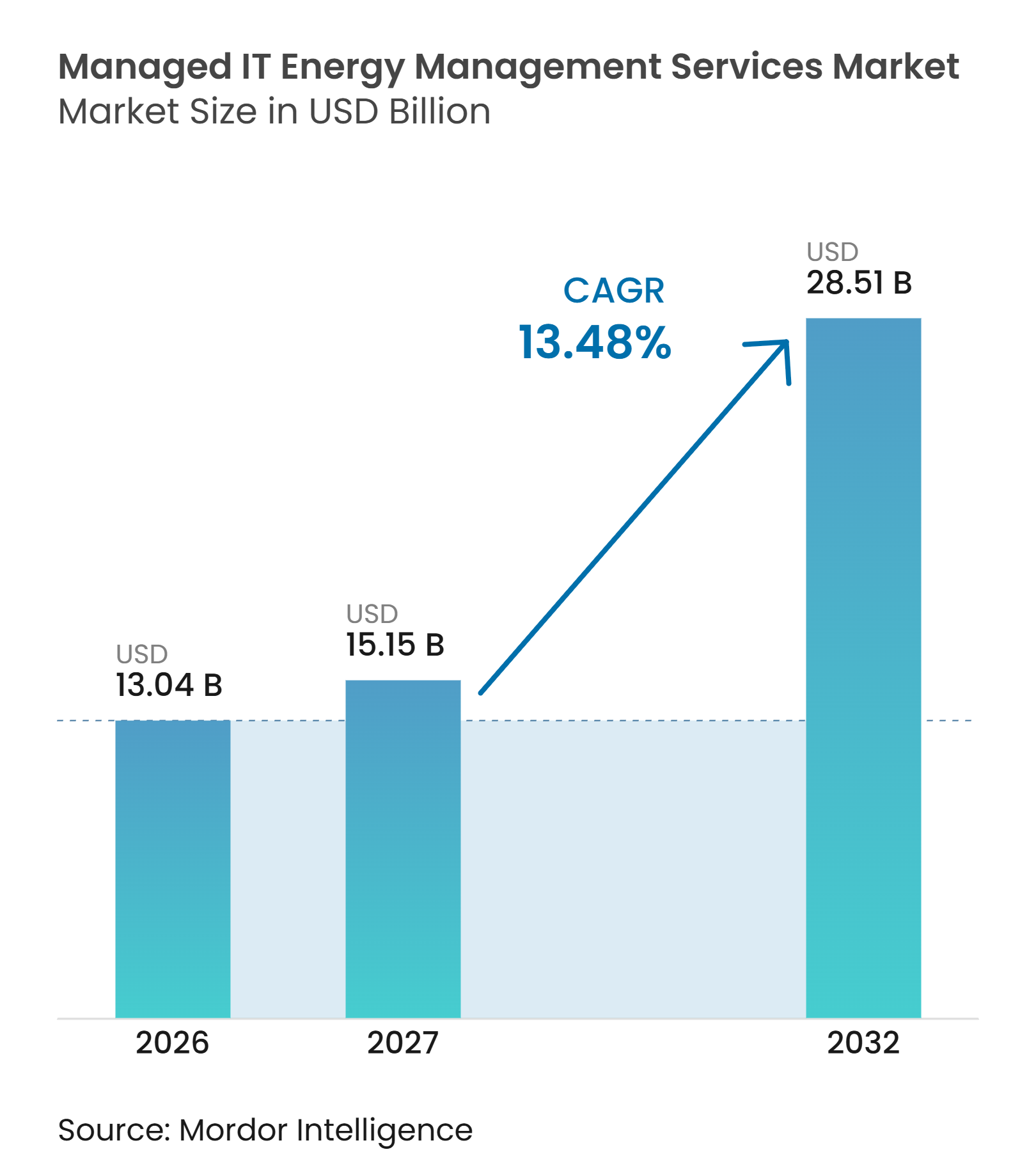
The Managed IT Energy Management Services Market size is projected to expand from USD 13.04 billion in 2026 and USD 15.15 billion in 2027 to USD 28.51 billion by 2032, registering a CAGR of 13.48% between 2027 to 2032. Electricity use in data centers is making energy management a board-level issue for IT organizations as AI workloads raise power and cooling requirements. The Managed IT Energy Management Services Market is being shaped by pressure to measure energy use across data centers, network sites, and cloud estates. Reporting rules in Europe, California, and several Asia-Pacific countries are moving energy management closer to a compliance requirement. Providers in the Managed IT Energy Management Services Market are responding by combining monitoring, optimization, digital twins, and carbon-aware operations within long-term service contracts. The opportunity is strongest where customers need verified operating savings, regulator-ready reporting, and better control of high-density computing environments.
Key Report Takeaways
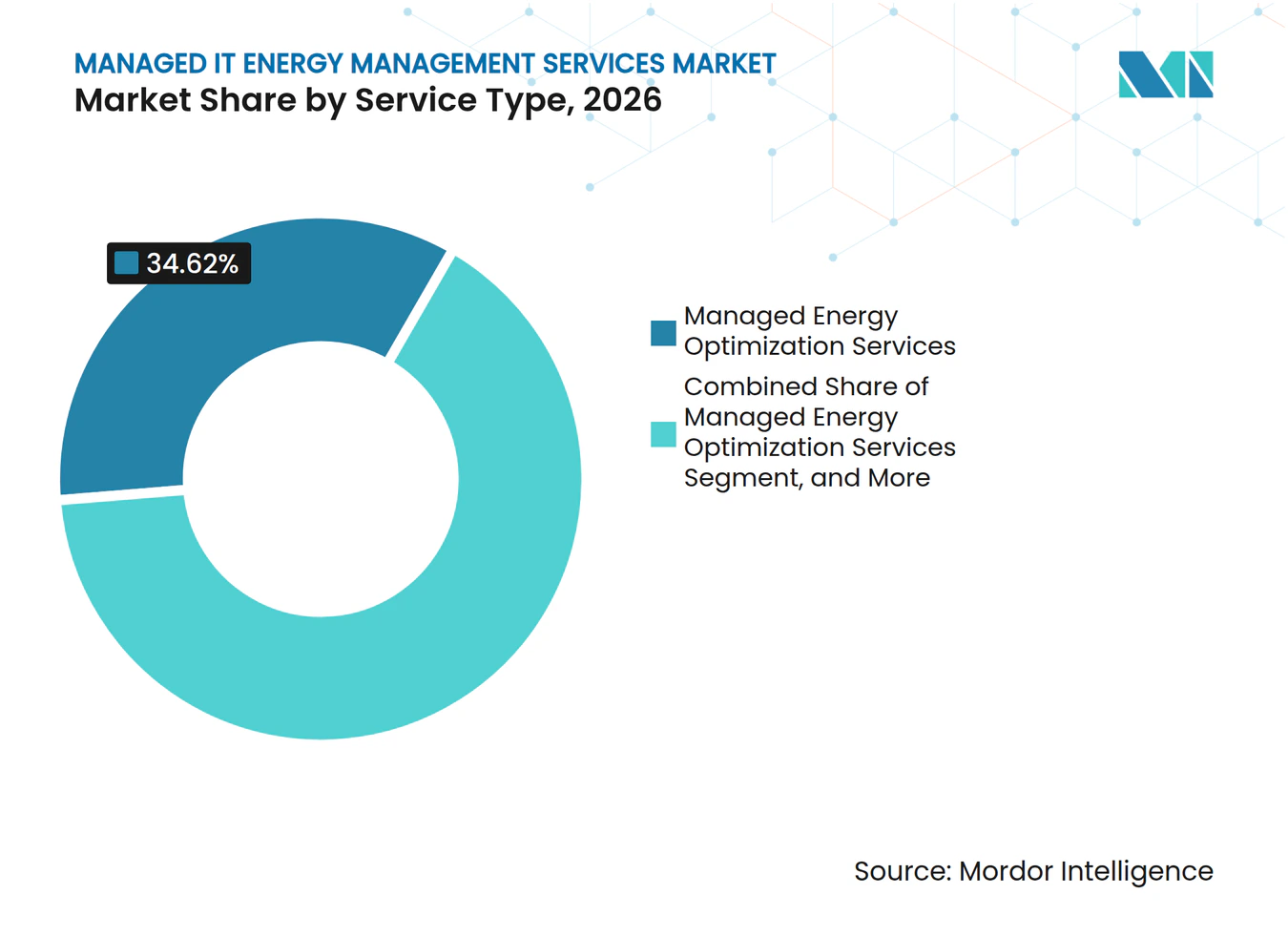
- By service type, Managed Energy Optimization Services held 34.62% of the Managed IT Energy Management Services Market share in 2026 and are projected to expand at a 14.57% CAGR through 2032.
- By deployment model, cloud-based deployment held 48.71% of revenue in 2026 and is projected to expand at a 14.78% CAGR through 2032.
- By service area, Data Center and Cloud Sustainability Management held 46.23% of the Managed IT Energy Management Services Market share in 2026, while IT Asset Lifecycle and Circularity Management is projected to expand at a 15.21% CAGR through 2032.
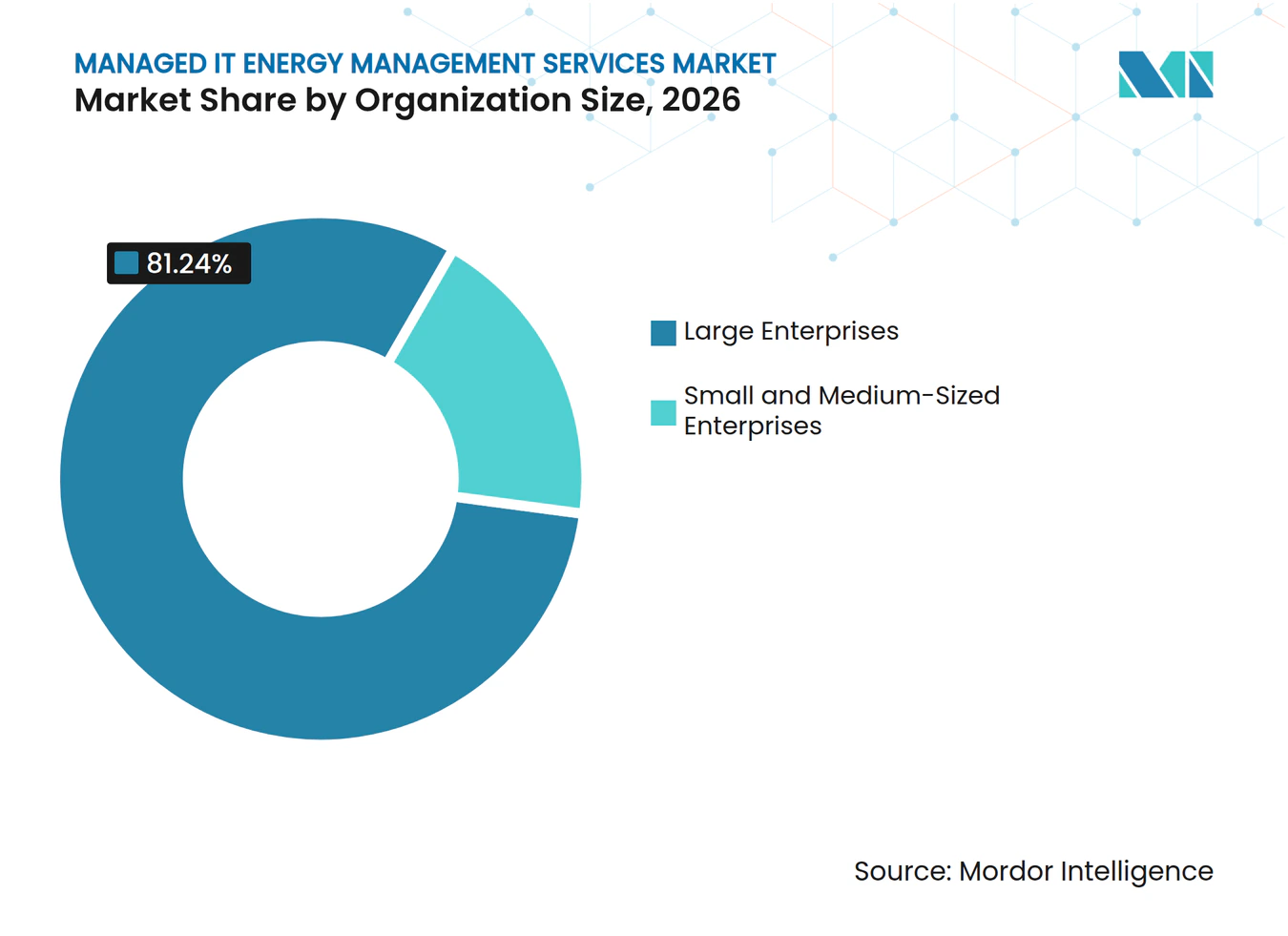
- By organization size, large enterprises held 81.24% of revenue in 2026, while SMEs are projected to expand at a 15.25% CAGR through 2032.
- By end-user industry, IT and Telecommunications held 37.51% of the Managed IT Energy Management Services Market share in 2026 and are projected to expand at a 14.87% CAGR through 2032.
- By geography, North America held 35.67% of revenue in 2026, while Asia-Pacific is projected to expand at a 15.74% CAGR through 2032.
Note: Market numbers in this report are based on Mordor Intelligence's proprietary estimation framework, which combines nine months of actuals with Q4 projections for base year 2026.
Market Trends and Insights
Drivers Impact Analysis of Managed IT Energy Management Services Market*
| Driver | (~) % Impact on CAGR Forecast | Geographic Relevance | Impact Timeline |
|---|---|---|---|
| AI Workload Growth and High-Density Rack Expansion | +2.8% | Global, concentrated in North America and Asia-Pacific | Short term (≤ 2 years) |
| Rising Electricity Costs and Demand for Measurable Savings | +2.3% | Global, most acute in Europe and North America | Short term (≤ 2 years) |
| Mandatory Energy and Emissions Reporting | +2.0% | EU, North America, and Asia-Pacific | Medium term (2-4 years) |
| Real-Time Digital Twin Optimization Across Power and Cooling Systems | +1.6% | North America and Europe, with early adoption in Asia-Pacific | Medium term (2-4 years) |
| Sustainability-Linked Service-Level Agreements | +1.4% | North America and Europe | Medium term (2-4 years) |
| Renewable-Aware Workload Placement and Carbon-Intelligent Operations | +1.0% | Global, with strongest adoption in the EU and North America | Long term (≥ 4 years) |
| Source: Mordor Intelligence | |||
AI Workload Growth and High-Density Rack Expansion
The Managed IT Energy Management Services Market is gaining demand as higher rack densities expose the limits of static facility operations. The International Energy Agency reported that AI-server power density increased 11 times between 2020 and 2025, and it expects another 4-fold increase by 2027. A single advanced rack could then have peak demand equal to 65 households. These loads change quickly and create cooling demands that conventional contracts cannot manage effectively. Customers in the Managed IT Energy Management Services Market, therefore, need continuous telemetry, predictive cooling adjustments, and load balancing rather than periodic energy reviews. Providers in the Managed IT Energy Management Services Market that are able to support these functions can pursue multi-year agreements that tie service quality to measurable operating outcomes.
Rising Electricity Costs and Demand for Measurable Savings
Higher electricity costs are prompting enterprises to examine the energy intensity of AI and data workloads. The energy challenge is not limited to the data center because dispersed network equipment and cloud services also influence the customer’s overall operating cost. The Managed IT Energy Management Services Market benefits when buyers can assess energy use at the equipment, facility, and workload levels through a single managed platform. Contracts are increasingly centered on cost-per-watt or verified savings commitments instead of time-based advisory work. This shift favors providers that can collect reliable metering data and document savings against defined baselines. It also raises the value of monitoring systems that allow customers to test and validate the performance commitments contained in service-level agreements.
Mandatory Energy and Emissions Reporting
Mandatory reporting is turning energy data collection into an operational requirement for many large IT operators. The European Commission requires relevant data centers to report annual performance information under Article 12 of the Energy Efficiency Directive. Sweden’s reporting framework under Act 2025:570 took effect in July 2025 and supports this reporting process. The requirements cover measures such as power usage effectiveness, renewable energy factors, and other information used to evaluate data center performance. California SB 253 also requires qualifying companies to disclose Scope 1, Scope 2, and Scope 3 greenhouse gas emissions. Managed providers can reduce the burden by supplying preconfigured reporting workflows and records that are ready for audit and regulatory review.
Real-Time Digital Twin Optimization Across Power and Cooling Systems
Digital twins are moving into operational use for data center cooling and power management. A 2026 study of liquid-cooling infrastructure at the Frontier exascale system recorded 30.1% total energy savings from jointly optimizing supply temperature and flow rates through a validated digital twin.[1] Research from Penn State found that physics-informed reinforcement learning within a digital twin could reduce cooling energy use by 25% in a representative U.S. data center. The Open Compute Project states that digital twins can simulate thermal flows and energy use, allowing data center operators to improve decisions between scheduled audits. The Managed IT Energy Management Services Market can use this capability to shift from monitoring energy use to continuously improving it. For customers subject to annual disclosures, the technology also creates a clearer record of performance changes over time.
Restraints Impact Analysis of Managed IT Energy Management Services Market*
| Restraint | (~) % Impact on CAGR Forecast | Geographic Relevance | Impact Timeline |
|---|---|---|---|
| High Upfront Integration Cost in Brownfield IT Estates | -2.2% | Global, most acute in North America and Europe where aging infrastructure is prevalent | Short term (≤ 2 years) |
| Legacy OT and IT Interoperability Gaps | -1.7% | Global, most severe in manufacturing-heavy economies | Medium term (2-4 years) |
| Cybersecurity and Critical-Infrastructure Liability | -1.1% | Global, with the highest regulatory burden in North America and the EU | Medium term (2-4 years) |
| Limited Availability of Energy-Optimization Specialists | -0.7% | Global, most acute in the Middle East, North Africa, and emerging Asia-Pacific countries | Long term (≥ 4 years) |
| Source: Mordor Intelligence | |||
High Upfront Integration Cost in Brownfield IT Estates
Brownfield facilities often need substantial investment before they can support modern energy management tools. Schneider Electric stated in July 2025 that strategic brownfield modernization can reduce facility capital spending by up to 30% compared with greenfield development.[2] Yet conversion for GPU-intensive racks can require upgrades to transformers, switchgear, power distribution units, and cabling. The reported cost is USD 500,000 to USD 1 million per megawatt of capacity. The resulting work can lengthen procurement cycles by 12-18 months, especially where changes must be completed without disrupting live production systems. Providers in the Managed IT Energy Management Services Market can ease this constraint by starting with a monitoring overlay and then moving to closed-loop optimization after the customer has a reliable performance baseline.
Legacy OT and IT Interoperability Gaps
Legacy operational technology can delay energy management deployments because many facility systems were not designed to exchange data with IT platforms. Building management systems, SCADA controllers, and cooling controls may rely on Profibus, Modbus, or RS-232. Fraunhofer FIT describes these environments as single-purpose, proprietary, and siloed, which limits data exchange between operational and information systems. Providers in the Managed IT Energy Management Services Market may need custom adapters to connect power and cooling systems with modern analytics platforms. This increases the cost of each deployment and can leave smaller providers unable to pursue technically complex accounts. Cybersecurity requirements add another consideration because providers must protect connections to critical infrastructure systems.
*Our forecasts treat driver/restraint impacts as directional, not additive. The impact forecasts reflect baseline growth, mix effects, and variable interactions.
Managed IT Energy Management Services Market Segment Analysis
By Service Type:
Optimization Contracts Set the Commercial StandardManaged Energy Optimization Services held 34.62% of the Managed IT Energy Management Services Market share in 2026 and are projected to expand at a 14.57% CAGR through 2032. This is the only segmentation type where the largest and fastest-expanding category is the same. The result indicates that customers increasingly value outcomes such as lower power use, better cooling performance, and documented savings. Managed Energy Monitoring and Reporting Services remain a practical entry point for organizations beginning structured energy management. These services also support organizations that need to meet mandatory reporting obligations. The Managed IT Energy Management Services Market size for optimization work is supported by the shift from periodic reports to continuous action on energy data.
Managed Power and Cooling Operations are becoming more important in AI-dense sites where reactive cooling cannot manage GPU thermal loads. Managed Carbon and Sustainability Services are also gaining relevance as Scope 2 and Scope 3 targets become part of annual disclosures. Under this model, providers connect operational data with reporting needs and action plans. ISO 50001 certification is increasingly included within optimization contracts. The certification increases compliance value for customers and can raise switching costs after a provider becomes embedded in a client’s management system. The managed IT energy management services industry therefore benefits from contracts that join technical optimization with governance and reporting responsibilities.



By Deployment Model:
Cloud Leads on Share and Growth SimultaneouslyCloud-based deployment held 48.71% of revenue in 2026 and is projected to expand at a 14.78% CAGR through 2032. Customers in the Managed IT Energy Management Services Market use cloud delivery to bring telemetry from dispersed IT assets into a central view. This model supports real-time dashboards, standardized reporting, and faster changes to analytic functions. The cloud format is especially useful when an organization manages several data centers, branch locations, or network sites. It can also make managed energy tools accessible without a large initial software installation. These capabilities explain why cloud delivery leads both the current revenue position and the forecast rate of expansion.
On-premises deployment retains a place in defense, financial services, and critical infrastructure settings. In these environments, data sovereignty requirements or air-gapped policies can limit cloud connectivity. Hybrid deployment offers an alternative because it processes sensitive telemetry locally while using cloud analytics and reporting functions. The managed IT energy management services industry can therefore address security and locality concerns without abandoning centralized analytics. Privacy requirements under the General Data Protection Regulation and national data localization rules influence the final architecture. Providers in the Managed IT Energy Management Services Market that support all 3 deployment models can address a wider mix of technical and regulatory conditions.
By Service Area:
Data Center Demand Remains Central While Circularity Broadens the ScopeData Center and Cloud Sustainability Management held 46.23% of revenue in 2026. The segment within the Managed IT Energy Management Services Market benefits from the concentration of power demand in hyperscale and campus data centers, where power usage effectiveness improvements can produce visible returns. The Managed IT Energy Management Services Market is also supported by the need to manage cooling, power distribution, and workload conditions as a connected operating system. IT Infrastructure and Network Energy Management is gaining attention because distributed network nodes can create a large energy footprint that traditional facility reporting does not capture. Providers in the Managed IT Energy Management Services Market can extend managed services from central data centers to these connected assets. This widens the operating scope of energy management beyond one building or one computing site.
IT Asset Lifecycle and Circularity Management is projected to expand at a 15.21% CAGR through 2032. The category responds to requirements to document asset provenance, data erasure, and end-of-life disposition. The EU Waste Electrical and Electronic Equipment framework establishes obligations that support the proper treatment and recovery of electrical and electronic equipment.[3] Managed services can combine reverse logistics, certified data destruction, and sustainability reporting in one operating model. AI-supported asset grading and traceable provenance records can assist clients that operate across several jurisdictions. This service area creates a connection between energy goals, hardware lifecycle management, and audit readiness.
By Organization Size:
Large Enterprises Lead While SMEs Expand AccessLarge enterprises held 81.24% of revenue in 2026. Their multi-site IT estates are large enough to support bespoke contracts that cover data centers, workplace technology, network sites, and reporting systems. Compliance responsibilities under the Corporate Sustainability Reporting Directive and California SB 253 create a direct procurement trigger for many larger organizations. Their scale also allows them to invest in dedicated meters, integration work, and advanced optimization services. The Managed IT Energy Management Services Market is consequently centered on customers that need enterprise-wide visibility and can commit to long-term contracts. These buyers also place strong emphasis on reliability, security, and auditable operating data.
SMEs are projected to expand at a 15.25% CAGR through 2032. SaaS dashboards and consumption-based pricing allow smaller organizations to adopt services without building a large internal energy management function. Energy monitoring is increasingly included within broader managed cloud packages, which makes adoption easier for customers already using external IT services. Sustainability requests from large customers can also require suppliers to provide Scope 3 information. This creates a secondary source of demand among firms that do not face the same direct reporting thresholds as large enterprises. Providers in the Managed IT Energy Management Services Market that offer standardized packages can address this segment while keeping delivery costs manageable.

By End-User Industry:
Telecommunications Provides the Largest Current BaseIT and Telecommunications held 37.51% of revenue in 2026 and are projected to expand at a 14.87% CAGR through 2032. Telecom operators manage a broad power footprint across radio access networks, data centers, and distributed network nodes. The expansion of 5G infrastructure adds to the importance of controlling this energy use. Providers in the Managed IT Energy Management Services Market can help operators coordinate power, cooling, and equipment use across a large geographic network. This makes telecommunications the leading end-user base and the fastest-expanding end-user category in the forecast period. The category also favors managed services that can be applied consistently across thousands of sites.
BFSI is the second-largest vertical because financial firms prioritize operational resilience as well as lower operating costs. Government and defense customers adopt these services more gradually because procurement cycles and data sovereignty requirements are demanding. Healthcare creates an opportunity as medical AI workloads raise the energy requirements of hospital data centers. Manufacturing is more fragmented because energy management is often part of wider OT and IT integration programs. Energy and utilities customers require strong cybersecurity and operational controls before extending managed access into critical systems. The Managed IT Energy Management Services Market can respond to these different needs through sector-specific delivery models rather than a standard contract alone.
Geography Analysis
North America Managed IT Energy Management Services Market
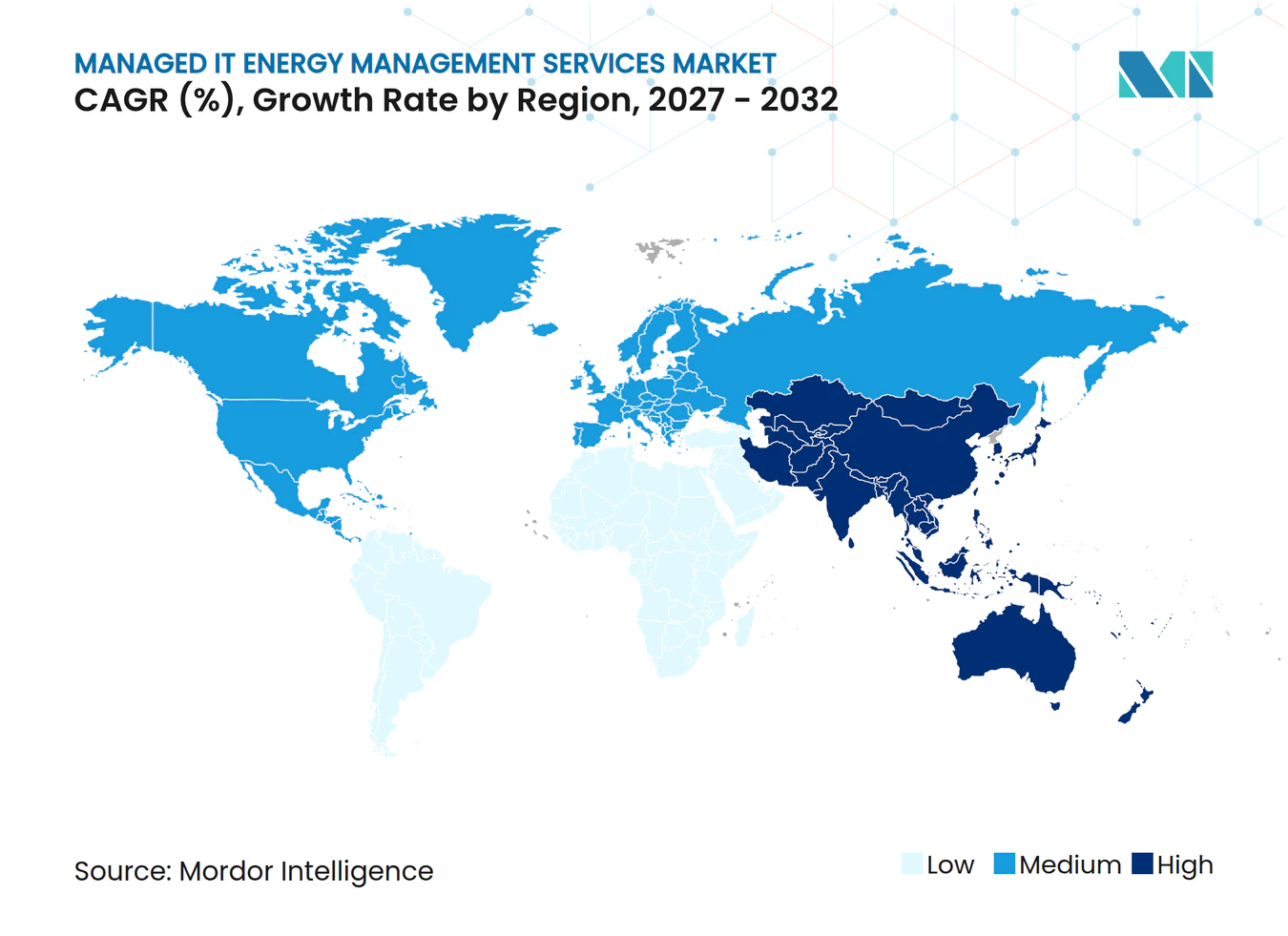
North America held 35.67% of revenue in 2026. The United States has the largest concentration of hyperscale and enterprise data center capacity. The U.S. Department of Energy reported that data centers used 4.4% of U.S. electricity in 2023 and could reach 6.7%-12% by 2028.[4] This demand makes energy use a strategic concern for technology companies, financial institutions, and healthcare organizations. California’s emissions disclosure requirements add a compliance consideration for qualifying companies. Federal Energy Regulatory Commission Order No. 918 approved Reliability Standard CIP-003-11 in March 2026, reinforcing cybersecurity requirements for relevant critical infrastructure systems.
APAC Managed IT Energy Management Services Market
Asia-Pacific is projected to expand at a 15.74% CAGR through 2032. China’s Eastern Data, Western Computing program includes efficiency targets for participating facilities, creating demand for facility-level measurement and optimization. India is the fastest-expanding country opportunity because data localization requirements are encouraging hyperscalers to establish domestic campuses. Japan’s AI infrastructure program and high electricity costs support demand for premium power usage effectiveness services. Singapore’s land constraints increase interest in liquid cooling and circularity services. South Korea offers a specialized opportunity because its semiconductor and electronics data center footprint requires detailed technical support.
EMEA and South America Managed IT Energy Management Services Market
Europe holds a major position because its regulatory setting is among the most extensive for data center sustainability. Data centers above the applicable threshold must provide annual reporting under Article 12 of the Energy Efficiency Directive. Germany also requires reporting on energy efficiency and water consumption under its Energy Efficiency Act. These requirements support demand for managed monitoring and reporting services even when customers delay discretionary sustainability spending. South America remains at an earlier stage, with Brazil’s data center expansion creating demand for cloud-delivered monitoring. The Middle East is emerging as hyperscale construction in the UAE and Saudi Arabia raises cooling needs in arid climates. Africa is also early in development, though mobile operators are beginning to use managed sustainability services.
Competitive Landscape
Market Concentration
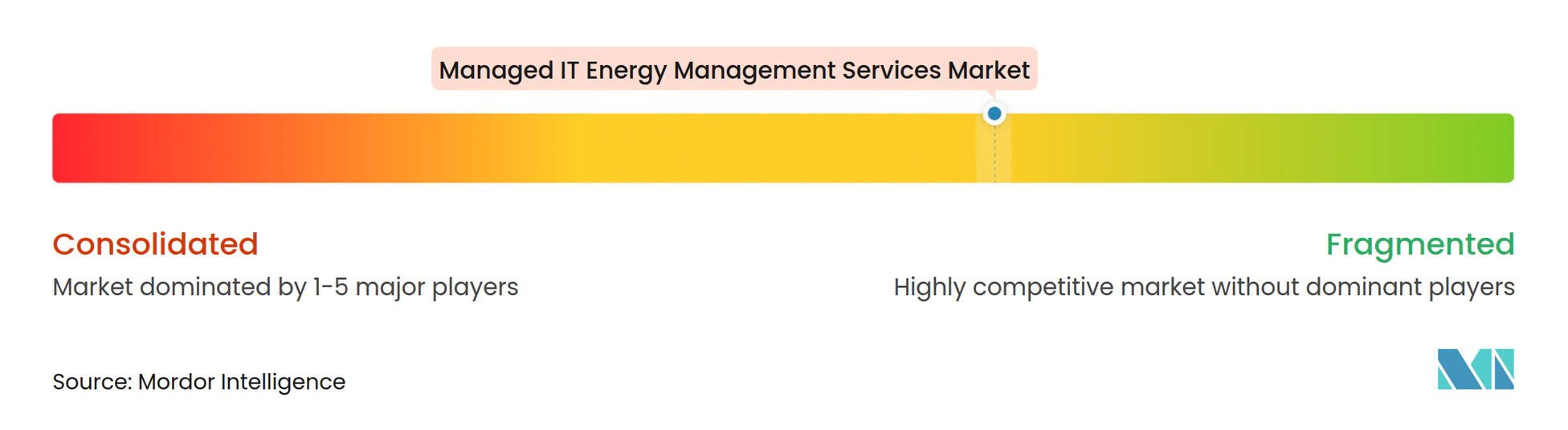
The Managed IT Energy Management Services Market has a moderately fragmented, 2-tier structure. Global IT services providers such as Accenture, IBM, Kyndryl, TCS, Infosys, Wipro, and Capgemini compete through broad portfolios, global delivery capacity, AI capabilities, and digital twin expertise. Infrastructure specialists including Schneider Electric, Vertiv, Siemens, ABB, and Eaton compete from their installed position in power, cooling, and automation systems. The first group aims to combine energy services with wider IT transformation work. The second group can link managed services directly to physical infrastructure equipment. These positions are converging as infrastructure suppliers add software and analytics while IT service providers build data center engineering capabilities.
Accenture’s acquisition of a majority stake in DLB Associates closed in January 2026 and added data center design, construction, and commissioning capabilities to its data center portfolio. Schneider Electric introduced a unified asset performance management model in November 2025 for U.S. customers, bringing its critical infrastructure portfolio under one accountable partnership structure. Vertiv and Caterpillar announced a November 2025 collaboration that combines power distribution, cooling, natural gas turbines, and combined cooling, heat, and power systems for AI data centers. These examples show how suppliers are broadening their offers around integrated power, cooling, analytics, and service delivery. Cybersecurity requirements under CSRD, NIS2, and NERC CIP also create an additional evaluation factor for managed contracts.
Competition also centers on carbon-aware workload scheduling and the ability to connect it to enterprise IT contracts. Research presented at an ACM conference found that carbon-aware spatial workload shifting could reduce carbon dioxide emissions by 38.4% compared with performance-first baselines. Providers in the Managed IT Energy Management Services Market that build proprietary datasets from managed-estate telemetry or develop renewable-aware scheduling methods can create a defensible position. Smaller firms are targeting focused opportunities such as telecom tower energy management in Africa and circularity services for semiconductor manufacturers in Asia-Pacific. These businesses can compete where local response times and knowledge of regional rules matter more than global delivery scale. The Managed IT Energy Management Services Market remains open to specialists, but large providers retain an advantage in complex, multi-country accounts.
Managed IT Energy Management Services Industry Leaders
-
Accenture plc
-
Atos SE
-
Capgemini SE
-
Cisco Systems, Inc.
-
Fujitsu Limited
- *Disclaimer: Major Players sorted in no particular order
Managed IT Energy Management Services Market Companies Covered in this Report
- Accenture plc
- Atos SE
- Capgemini SE
- Cisco Systems, Inc.
- Cognizant Technology Solutions Corporation
- Dell Technologies Inc.
- Fujitsu Limited
- Hewlett Packard Enterprise Company
- IBM Corporation
- Infosys Limited
- Johnson Controls International plc
- Kyndryl Holdings, Inc.
- NTT DATA Corporation
- Eaton Corporation
- Schneider Electric SE
- Siemens AG
- Tata Consultancy Services Limited
- Vertiv Holdings Co
- Wipro Limited
- ABB Ltd.
Recent Industry Developments in Managed IT Energy Management Services Market
- October 2026: Accenture and Dell Technologies announced the formation of the Accenture Dell Business Group, expanding a 20-year collaboration to help enterprises scale private AI and modernize infrastructure. Accenture committed to training more than 3,000 practitioners across the Dell portfolio, targeting energy-efficient on-premises AI factory deployments for regulated industries.
- September 2026: Wipro Limited renewed its multi-year Digital Workplace Services contract with ABB, delivering AI-powered endpoint lifecycle management, predictive workplace services, and sustainable device operations across ABB's global estate to support its digital transformation and sustainability commitments.
- July 2026: TCS and ABB signed a multi-million, multi-year deal to transform ABB's global network operations through an integrated network-as-a-service model, scaling TCS's role from infrastructure management to end-to-end global network delivery as part of ABB's Future Network Model program.
- February 2026: CGI and Schneider Electric expanded their strategic partnership to support energy suppliers in the DACH region with end-to-end sustainable digital solutions, combining CGI's managed services capabilities with Schneider Electric's Advanced Distribution Management Systems for grid operations and planning.
Global Managed IT Energy Management Services Market Report Scope
Managed IT Energy Management Services are outsourced, data-driven operational solutions where a third-party managed service provider (MSP) assumes full responsibility for monitoring, analyzing, and optimizing the energy consumption and carbon footprint of an enterprise’s information technology infrastructure.
The Managed IT Energy Management Services Market Report is Segmented by Service Type (Managed Energy Monitoring and Reporting Services, Managed Energy Optimization Services, Managed Power and Cooling Operations, Managed Power and Cooling Operations, and Other Service Types), Deployment Model (Cloud-Based, On-Premises, and Hybrid), Service Area (Data Center and Cloud Sustainability Management, IT Infrastructure and Network Energy Management, End-User Computing and Workplace Sustainability Services, IT Asset Lifecycle and Circularity Management, and Other Service Areas), Organization Size (Large Enterprises and Small and Medium-Sized Enterprises), End-User Industry (IT and Telecommunications, BFSI, Government and Defense, Healthcare and Life Sciences, Manufacturing, Energy and Utilities, and Other End-User Industries), and Geography (North America, South America, Europe, Asia-Pacific, Middle East, and Africa). The Market Forecasts are Provided in Terms of Value (USD).
Segmentation Overview
| Managed Energy Monitoring and Reporting Services |
| Managed Energy Optimization Services |
| Managed Power and Cooling Operations |
| Managed Power and Cooling Operations |
| Other Service Type |
| Cloud-Based |
| On-Premises |
| Hybrid |
| Data Center and Cloud Sustainability Management |
| IT Infrastructure and Network Energy Management |
| End-User Computing and Workplace Sustainability Services |
| IT Asset Lifecycle and Circularity Management |
| Other Service Areas |
| Large Enterprises |
| Small and Medium-Sized Enterprises |
| IT and Telecommunications |
| BFSI |
| Government and Defense |
| Healthcare and Life Sciences |
| Manufacturing |
| Energy and Utilities |
| Other End-user Industries |
| North America | United States |
| Canada | |
| Mexico | |
| South America | Brazil |
| Argentina | |
| Rest of South America | |
| Europe | Germany |
| United Kingdom | |
| France | |
| Italy | |
| Rest of Europe | |
| Asia-Pacific | China |
| Japan | |
| India | |
| South Korea | |
| Rest of Asia-Pacific | |
| Middle East | United Arab Emirates |
| Saudi Arabia | |
| Rest of Middle East | |
| Africa | South Africa |
| Nigeria | |
| Rest of Africa |
| By Service Type | Managed Energy Monitoring and Reporting Services | |
| Managed Energy Optimization Services | ||
| Managed Power and Cooling Operations | ||
| Managed Power and Cooling Operations | ||
| Other Service Type | ||
| By Deployment Model | Cloud-Based | |
| On-Premises | ||
| Hybrid | ||
| By Service Area | Data Center and Cloud Sustainability Management | |
| IT Infrastructure and Network Energy Management | ||
| End-User Computing and Workplace Sustainability Services | ||
| IT Asset Lifecycle and Circularity Management | ||
| Other Service Areas | ||
| By Organization Size | Large Enterprises | |
| Small and Medium-Sized Enterprises | ||
| By End-User Industry | IT and Telecommunications | |
| BFSI | ||
| Government and Defense | ||
| Healthcare and Life Sciences | ||
| Manufacturing | ||
| Energy and Utilities | ||
| Other End-user Industries | ||
| By Geography | North America | United States |
| Canada | ||
| Mexico | ||
| South America | Brazil | |
| Argentina | ||
| Rest of South America | ||
| Europe | Germany | |
| United Kingdom | ||
| France | ||
| Italy | ||
| Rest of Europe | ||
| Asia-Pacific | China | |
| Japan | ||
| India | ||
| South Korea | ||
| Rest of Asia-Pacific | ||
| Middle East | United Arab Emirates | |
| Saudi Arabia | ||
| Rest of Middle East | ||
| Africa | South Africa | |
| Nigeria | ||
| Rest of Africa | ||
Key Questions Answered in the Report
What is the size of the Managed IT Energy Management Services Market?
The market is valued at USD 13.04 billion in 2026 and is projected to reach USD 28.51 billion by 2032, at a 13.48% CAGR from 2027 to 2032.
What is driving demand for managed IT energy management services?
AI workloads, higher power and cooling requirements, electricity costs, and reporting obligations are increasing demand for measurable energy management.
Which service type leads managed IT energy management services?
Managed Energy Optimization Services lead with 34.62% revenue share in 2026 and are projected to expand at a 14.57% CAGR through 2032.
Why are cloud-based energy management services expanding?
Cloud delivery centralizes telemetry and reporting across dispersed IT estates, and it held 48.71% of revenue in 2026.
Which region has the strongest growth outlook?
Asia-Pacific is projected to expand at a 15.74% CAGR through 2032, supported by data center development and efficiency requirements.
Who are the leading providers in managed IT energy management services?
Major providers include Accenture, IBM, Kyndryl, TCS, Infosys, Wipro, Schneider Electric, Vertiv, Siemens, ABB, and Eaton.