
Managed Executive and Brand Impersonation Protection Services Market Size and Share
Market Overview
| Study Period | 2021 - 2032 |
|---|---|
| Market Size (2027) | USD 1.07 Billion |
| Market Size (2032) | USD 3.02 Billion |
| Growth Rate (2027 - 2032) | 23.07 % |
| Fastest Growing Market | Asia-Pacific |
| Largest Market | North America |
| Market Concentration | Medium |
Major Players *Disclaimer: Major Players sorted in no particular order Image © Mordor Intelligence. Reuse requires attribution under CC BY 4.0. | |
Managed Executive and Brand Impersonation Protection Services Market Analysis by Mordor Intelligence
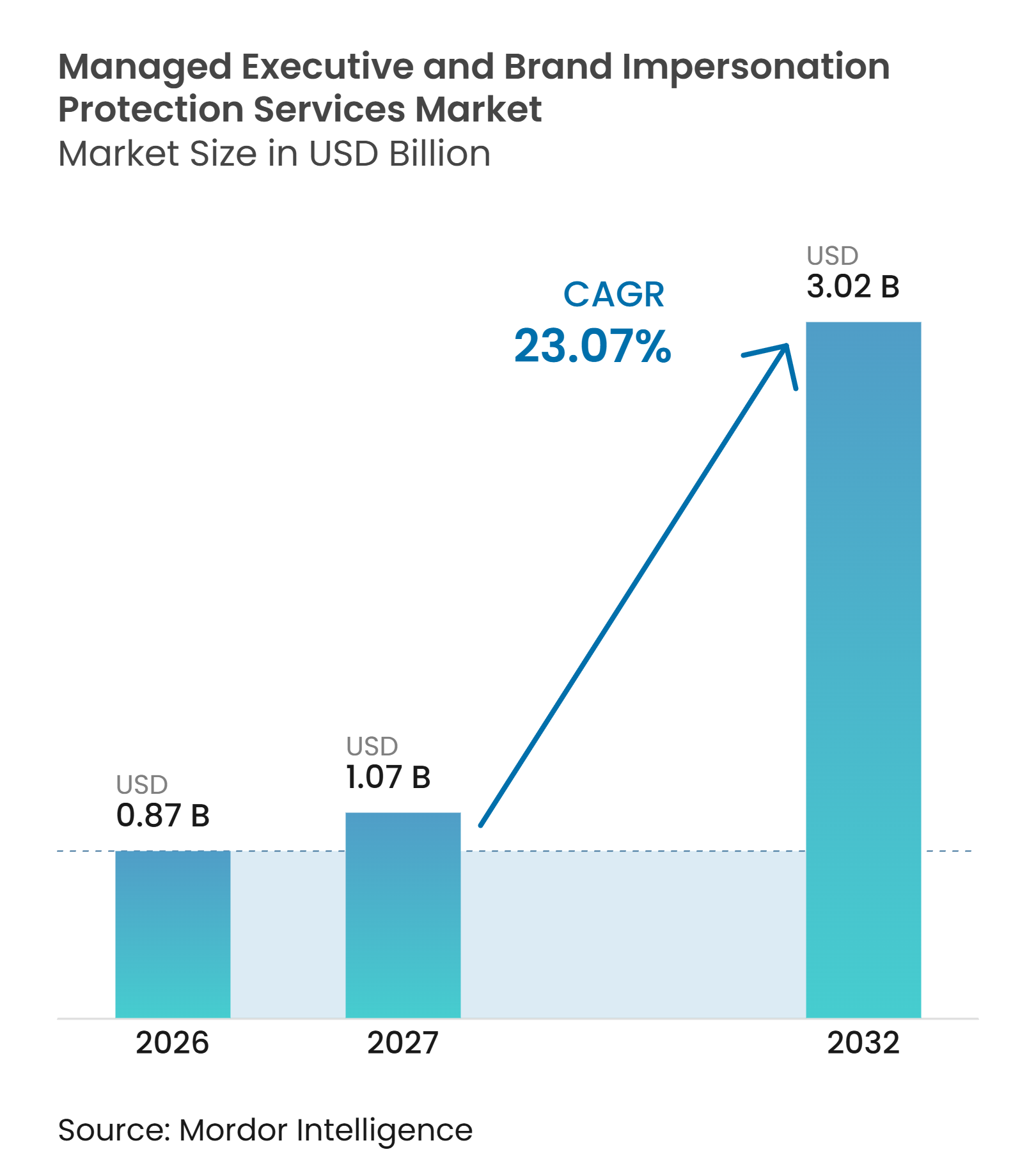
The managed executive and brand impersonation protection services market size is projected to expand from USD 0.87 billion in 2026 and USD 1.07 billion in 2027 to USD 3.02 billion by 2032, registering a CAGR of 23.07% between 2027 to 2032. Financial losses from business email compromise and impersonation are making dedicated monitoring and disruption services a more visible security purchase. Generative AI has made convincing voice, image, and video impersonation easier to produce, which expands the volume of threats that enterprises must review. Regulatory requirements are also tying digital risk monitoring to incident reporting, payment fraud liability, and customer protection. Demand is moving toward managed providers because many organizations cannot hire enough staff with the required cyber and digital trust skills. The managed executive and brand impersonation protection services market is also shifting toward broader programs that combine monitoring, evidence validation, takedowns, and threat intelligence.
Key Report Takeaways
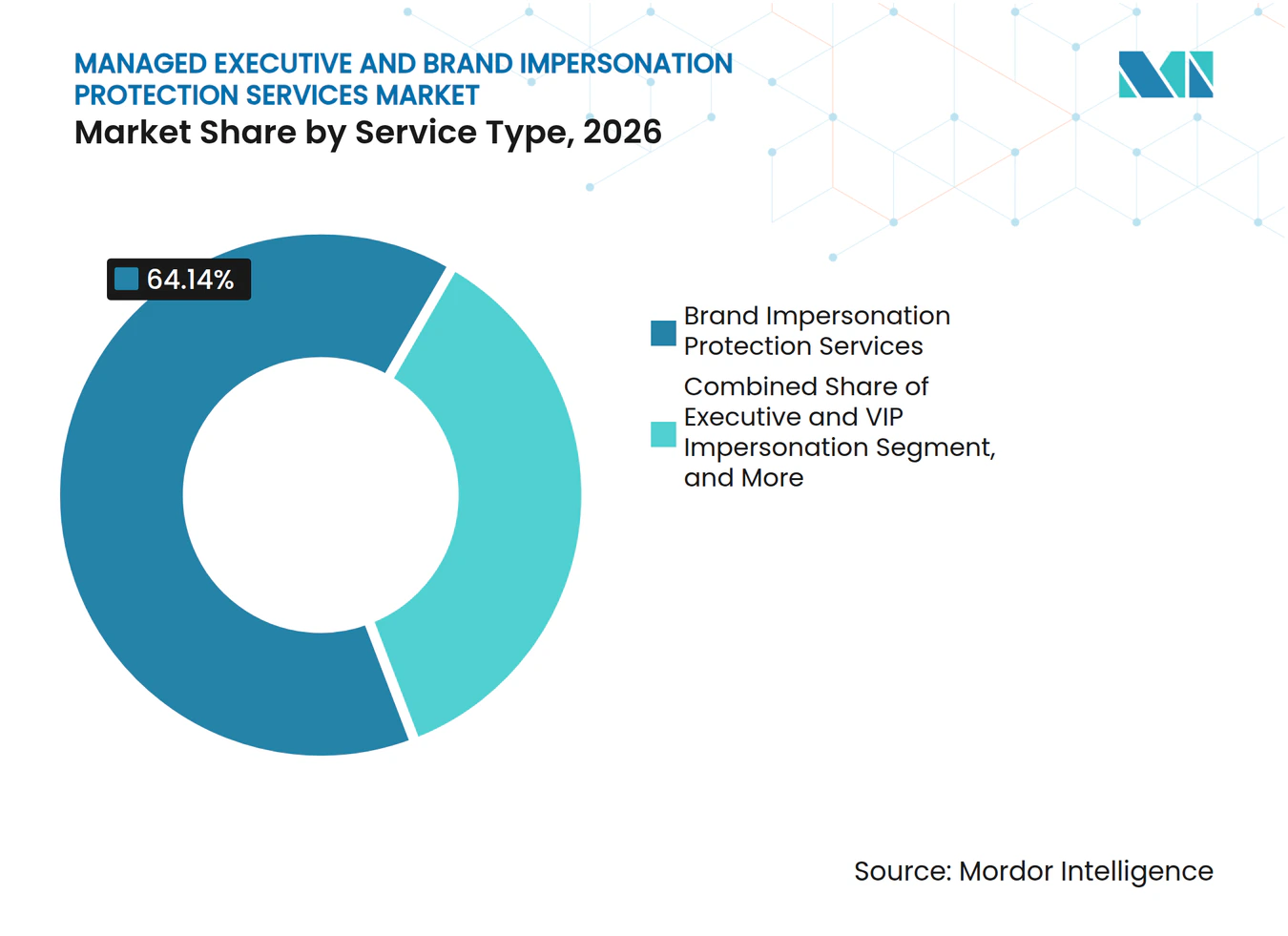
- By service type, brand impersonation protection services held 64.14% of the managed executive and brand impersonation protection services market share in 2026, while executive and VIP impersonation protection services are projected to expand at a 24.12% CAGR through 2032.
- By deployment mode, cloud-based solutions accounted for 68.12% of the managed executive and brand impersonation protection services market share in 2026, while hybrid deployment is projected to grow at a 24.41% CAGR through 2032.
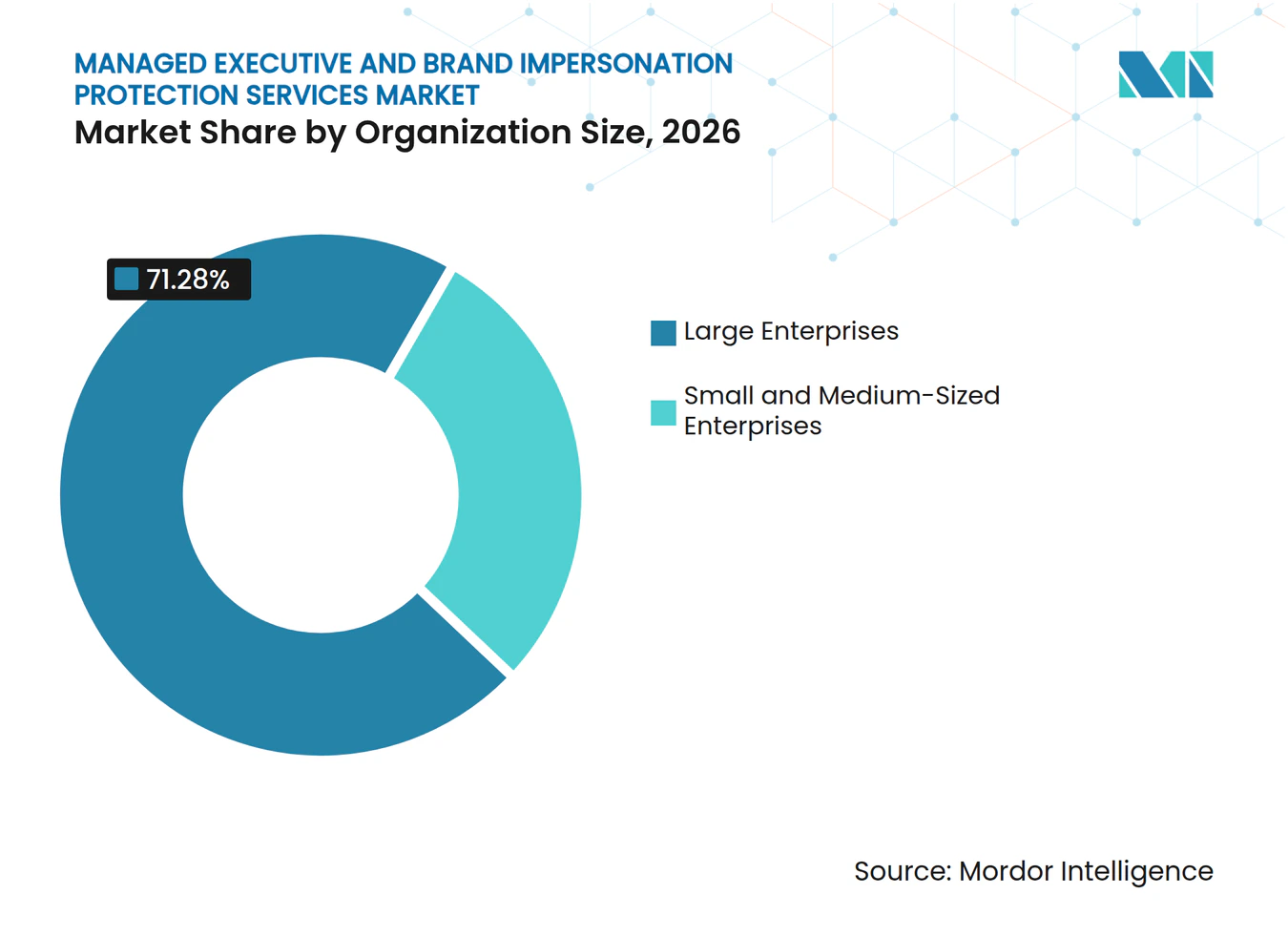
- By organization size, large enterprises held 71.28% of the managed executive and brand impersonation protection services market share in 2026, while SMEs are projected to record a 24.76% CAGR through 2032.
- By end-user industry, BFSI accounted for 28.19% of the managed executive and brand impersonation protection services market size in 2026, while government and public administration is projected to grow at a 23.45% CAGR through 2032.
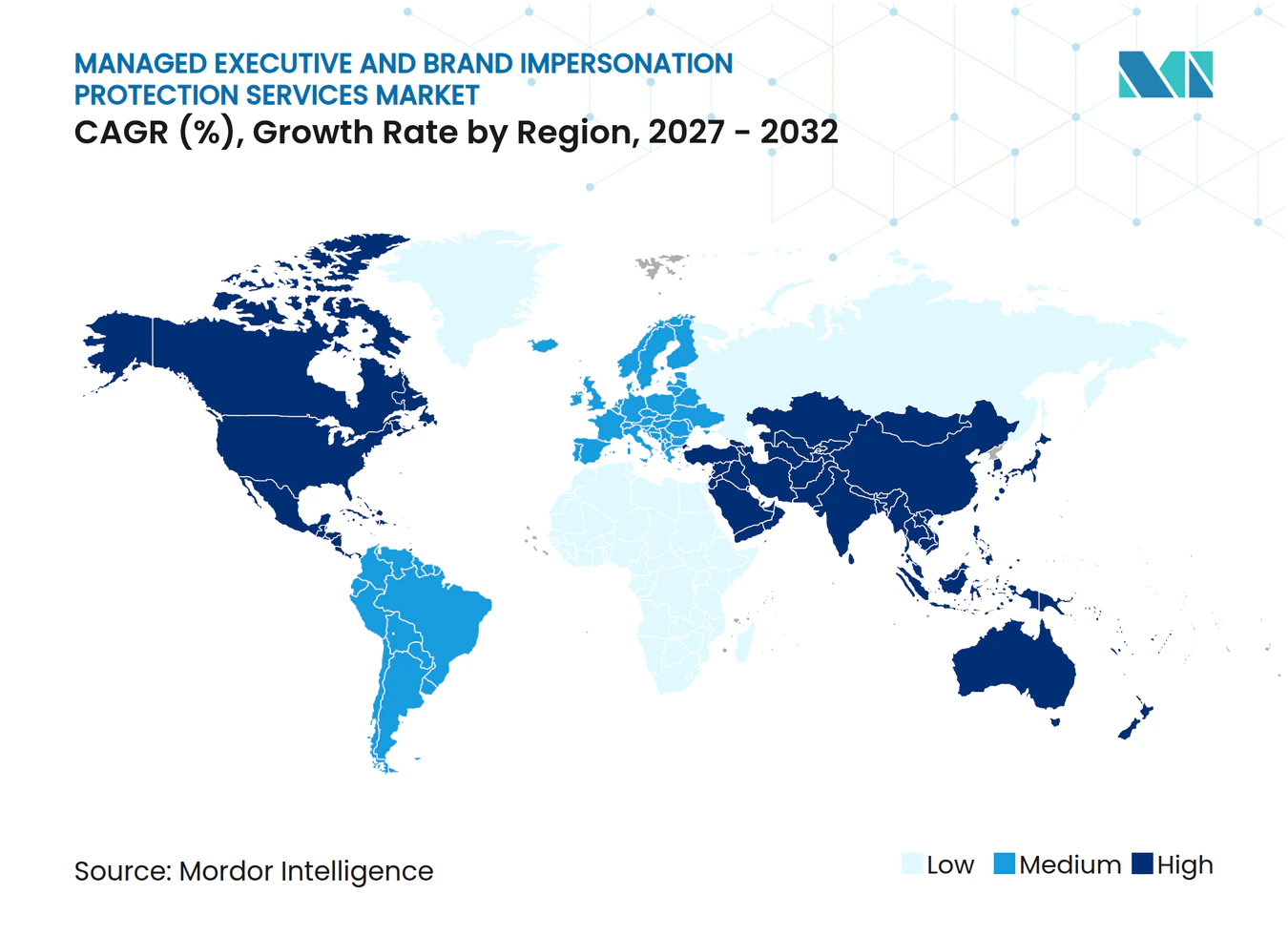
- By geography, North America held 27.18% of the managed executive and brand impersonation protection services market share in 2026, while Asia-Pacific is projected to advance at a 23.88% CAGR through 2032.
Note: Market numbers in this report are based on Mordor Intelligence's proprietary estimation framework, which combines nine months of actuals with Q4 projections for base year 2026.
Market Trends and Insights
Drivers Impact Analysis of Managed Executive and Brand Impersonation Protection Services Market*
| Driver | (~) % Impact on CAGR Forecast | Geographic Relevance | Impact Timeline |
|---|---|---|---|
| Rising Executive Impersonation and Business Email Compromise Losses | +4.8% | Global, with North America and Europe as primary documented-loss centers | Short term (≤ 2 years) |
| Expansion of AI-Generated Identity, Voice, Image, and Video Fraud | +4.2% | Global, with Southeast Asia and Asia-Pacific showing steep criminal-network adoption | Short term (≤ 2 years) |
| Regulatory Pressure for Digital Risk Governance and Incident Disclosure | +3.6% | North America, Europe, and Asia-Pacific | Medium term (2-4 years) |
| Proliferation of Digital Brand Attack Surfaces | +3.0% | Global, especially social-media-intensive markets in Southeast Asia, North America, and Europe | Short term (≤ 2 years) |
| Demand for Managed Coverage Amid Cybersecurity Talent Shortages | +2.4% | Global, with particular pressure in Sub-Saharan Africa, South America, and Asia-Pacific | Medium term (2-4 years) |
| Faster Automated Detection and Takedown Economics | +1.8% | Global, with North America and Europe as early adopters | Medium term (2-4 years) |
| Source: Mordor Intelligence | |||
Rising Executive Impersonation and Business Email Compromise Losses
Business email compromise remains a major source of financial loss for enterprises in the United States. The FBI recorded USD 3.046 billion in business email compromise losses across 24,768 complaints in 2025, and 86% of fraudulent payments moved through wire or ACH channels.[1] The same report attributed more than USD 30 million in losses to business email compromise campaigns with a confirmed AI connection. The Federal Trade Commission reported that business impersonators caused nearly USD 1 billion in losses during 2025.[2] These losses support spending on protection services across BFSI, government, and large enterprises, where fraud events can create direct financial, legal, and reputational consequences. The managed executive and brand impersonation protection services market responds to this need by combining detection with evidence collection and removal support.
Expansion of AI-Generated Identity, Voice, Image, and Video Fraud
AI-generated media is making executive and brand impersonation more accessible to attackers. INTERPOL stated that AI is reducing the traditional signs of a scam and that deepfake creation no longer requires significant technical skill or investment. Its Project SynthWave PLUS campaign also addressed the growing use of deepfakes in fraud and highlighted the need for stronger public awareness. The managed executive and brand impersonation protection services market benefits because organizations need to assess signals across voice, video, images, social accounts, and domains rather than relying on email monitoring alone. High volumes of public executive content can give attackers more source material for synthetic cloning. That exposure makes continuous monitoring and human review more important for organizations with active investor, media, and public communications.
Regulatory Pressure for Digital Risk Governance and Incident Disclosure
Regulation is making digital risk management more formal for financial institutions and critical organizations. The European Parliament reported in November 2025 that the payment services deal includes stronger reimbursement rights where fraudsters impersonate payment service provider employees and victims report the incident. The European Securities and Markets Authority identified cyber risk and digital resilience as supervisory priorities for 2026. In Singapore, the Monetary Authority issued a 2025 circular that addresses cyber risks associated with deepfakes for financial institutions. India also introduced the dedicated 1600 numbering series for financial-sector communications to reduce impersonation-based calls. These developments favor managed services that preserve evidence, support monitoring, and provide an auditable record for internal governance.
Proliferation of Digital Brand Attack Surfaces
Brands and executives can now be impersonated across social media, messaging platforms, websites, mobile applications, and domains. APWG recorded 971,181 phishing attacks during the first quarter of 2026, a 13.8% increase from the prior quarter. The growing range of channels increases the amount of content that security teams need to assess and remove. It also makes a single-channel response less effective when attackers can move users between messaging services, social accounts, and fraudulent sites. The managed executive and brand impersonation protection services market is therefore supported by services that can identify related activity across several digital environments. Providers with established reporting processes and platform relationships can offer more value when coordinated campaigns require rapid, parallel action.
Restraints Impact Analysis of Managed Executive and Brand Impersonation Protection Services Market*
| Restraint | (~) % Impact on CAGR Forecast | Geographic Relevance | Impact Timeline |
|---|---|---|---|
| False Positives and Evidence-Validation Workload | -1.9% | Global | Short term (≤ 2 years) |
| Platform-Specific Takedown Friction and Jurisdictional Variation | -1.5% | Global, with less harmonized enforcement in Asia-Pacific and the Middle East | Medium term (2-4 years) |
| Shortage of Multilingual Threat-Analysis and Enforcement Talent | -1.0% | Global, particularly Asia-Pacific, the Middle East, and Africa | Medium term (2-4 years) |
| Privacy, Data-Residency, and Executive-PII Processing Constraints | -0.7% | Europe, Asia-Pacific, and the Middle East | Long term (≥ 4 years) |
| Source: Mordor Intelligence | |||
False Positives and Evidence-Validation Workload
False positives can limit the scale and efficiency of automated threat detection. Each questionable alert may require an analyst to examine the content, assess supporting evidence, and prepare a platform-specific request. ISC2 noted that deepfake generation and detection develop at different speeds, which makes reliable classification difficult as attack methods change.[3] This workload can constrain the number of concurrent cases that a managed team can investigate and enforce. Netcraft reported a 99.8% success rate across more than 50,000 malicious phone-number takedowns with pilot customers for its Phone Scam Disruption service. Consistent evidence quality is consequently important to buyers evaluating whether a provider can convert detections into successful action.
Platform-Specific Takedown Friction and Jurisdictional Variation
Platforms and jurisdictions do not apply the same takedown procedures, evidence standards, or response times. The European Commission's Digital Services Act framework requires platforms to provide notice-and-action mechanisms, but processes still differ between services. Organizations must also manage local privacy, content, and appeal rules when an impersonation campaign crosses borders. These differences can slow removal activity, particularly when malicious infrastructure operates in jurisdictions with less coordinated enforcement. The managed executive and brand impersonation protection services market therefore rewards providers that maintain specialized operational knowledge and established escalation routes. The restraint remains because such capabilities take time and skilled personnel to build in every relevant language and geography.
*Our forecasts treat driver/restraint impacts as directional, not additive. The impact forecasts reflect baseline growth, mix effects, and variable interactions.
Managed Executive and Brand Impersonation Protection Services Market Segment Analysis
By Service Type:
Brand Protection Leads While Executive Protection AcceleratesBrand impersonation protection services held 64.14% of the managed executive and brand impersonation protection services market size in 2026. The category addresses social media spoofing, look-alike domains, fraudulent advertising, and other misuse of an organization's digital identity. APWG recorded 971,181 phishing attacks in the first quarter of 2026, showing the sustained scale of phishing activity that can involve recognizable brand identities. Phishing and fraud protection, digital asset and domain protection, and related services address adjacent routes used by attackers. Organizations often expand their programs from reactive monitoring toward continuous detection and enforcement as their exposure becomes clearer.
Executive and VIP impersonation protection services are projected to record a 24.12% CAGR from 2027 to 2032. The segment reflects a growing need to protect executives whose public audio, video, and images can be used to create synthetic content. INTERPOL has identified deepfake scams as a serious concern because AI can obscure traditional indicators of fraud. Executive protection programs can include impersonation monitoring, risk assessment, family digital-footprint review, and travel-related threat intelligence. ZeroFox launched HNTR Executive Protection in July 2026 with a dynamic Executive Risk Score, family digital-footprint analysis, and location-aware travel alerts.



By Deployment Mode:
Cloud Leads While Hybrid Addresses Control RequirementsCloud-based solutions accounted for 68.12% of the managed executive and brand impersonation protection services market share in 2026. Cloud delivery supports the collection and analysis of signals from social networks, registrars, app stores, messaging channels, and dark web sources. It can also provide the scale needed to monitor many external channels in real time. This deployment approach suits organizations that need continuous intelligence without building large internal infrastructure. It is especially relevant for distributed enterprises that need a common view of brand and executive threats.
Hybrid deployment is projected to grow at a 24.41% CAGR from 2027 to 2032. The model combines cloud-scale intelligence with local control over executive personal information, incident records, and audit materials. This arrangement can support enterprises that face data-residency, privacy, or internal security requirements. The managed executive and brand impersonation protection services market has room for hybrid offerings because a single deployment choice does not suit every regulated organization. Vendors that offer genuine deployment flexibility can address the needs of organizations that require both broad external visibility and controlled data handling.
By Organization Size:
Large Enterprises Provide the Base While SMEs Expand FasterLarge enterprises held 71.28% of the managed executive and brand impersonation protection services market share in 2026. These buyers generally have greater brand visibility, larger executive teams, and broader compliance obligations. Large enterprises are prominent in BFSI and government, where fraud exposure and reporting requirements can justify more comprehensive contracts. The scale of business email compromise losses recorded by the FBI also supports sustained executive attention in these organizations. Their recurring security requirements provide a stable base of demand for established managed providers.
SMEs are projected to grow at a 24.76% CAGR from 2027 to 2032. Smaller organizations can be vulnerable to the same credibility-based attacks as larger institutions, even when they lack comparable security teams. Subscription-based managed services can provide continuous monitoring and enforcement without requiring a large internal staff. BrandShield launched BrandShield Resolve in May 2025 as a SaaS-based platform with unlimited takedowns, real-time monitoring, and 24/7 security operations center support for lean teams. The managed executive and brand impersonation protection services market can therefore reach smaller buyers through service designs that simplify procurement and operations.

By End-User Industry:
BFSI Leads While Government Demand BuildsBFSI accounted for 28.19% of the managed executive and brand impersonation protection services market size in 2026. Financial institutions face direct exposure to payment fraud, fraudulent customer communications, and executive impersonation in wire-transfer workflows. Their regulatory responsibilities create a need for incident evidence and timely customer protection. The European Parliament's 2025 payment services agreement strengthened protections for victims of employee impersonation fraud. Singapore's central bank also addressed deepfake cyber risks for financial institutions in 2025.
Government and public administration is projected to grow at a 23.45% CAGR from 2027 to 2032. Impersonation of public agencies can affect citizen trust, public health communications, and election-related information as well as direct financial losses. The FTC reported USD 920 million in reported consumer losses from government impersonators during 2025. Healthcare and life sciences, IT and telecommunications, manufacturing, retail and e-commerce, and energy and utilities also face sector-specific threats. Fraudulent pharmaceutical communications, fake supplier invoices, and counterfeit vendor emails increase the value of tailored protection across those sectors.
Geography Analysis
North America Managed Executive and Brand Impersonation Protection Services Market
North America held 27.18% of the managed executive and brand impersonation protection services market size in 2026. The FBI reported USD 3.046 billion in United States business email compromise losses for 2025. The FTC also reported USD 3.5 billion in total imposter scam losses during 2025. These figures keep executive and board attention focused on detection, evidence preservation, and takedowns.
Europe Managed Executive and Brand Impersonation Protection Services Market
Europe is the second-largest regional market for managed executive and brand impersonation protection services. The region is shaped by the Digital Services Act, financial-sector resilience requirements, and broader obligations for critical entities. ENISA published NIS2 technical implementation guidance in June 2025, helping organizations understand implementation expectations. Spain adopted Order TDF/149/2025 in February 2025 to establish measures against impersonation scams through voice calls and SMS.
APAC and MEA Managed Executive and Brand Impersonation Protection Services Market
Asia-Pacific is projected to grow at a 23.88% CAGR from 2027 to 2032. INTERPOL's Asia and South Pacific Cyberthreat Assessment identifies phishing and impersonation-based scams as the most financially damaging threat category. The report noted that 33% of member countries reported more than 10,000 cases. GSMA found that nearly 10% of ASEAN consumers had experienced a scam in the prior year, while 84% believed scam volumes were rising. Demand is also developing in the Middle East and Africa as digital banking, digital identity programs, and customer-facing online services create further impersonation risks, making Asia-Pacific a key growth area for the managed executive and brand impersonation protection services market.
Competitive Landscape
Market Concentration
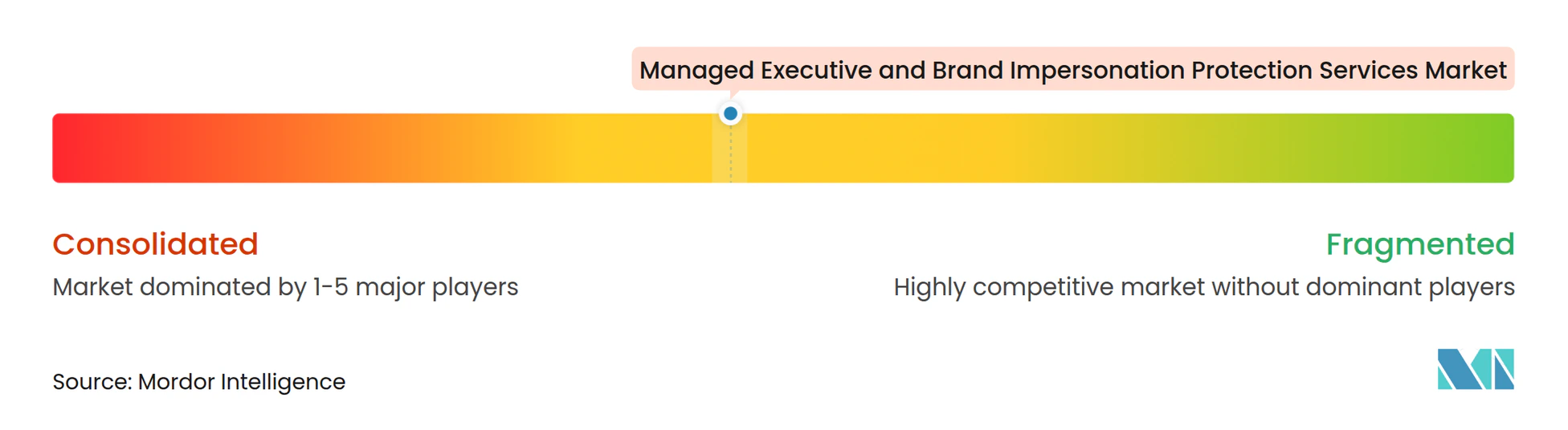
The managed executive and brand impersonation protection services market is moderately fragmented, and competition centers on digital threat coverage, evidence quality, takedown execution, and the ability to identify AI-generated media. Providers are expanding from isolated monitoring tools toward integrated services that combine brand protection, executive protection, dark web intelligence, and disruption across multiple external channels. Buyers increasingly value platforms that can connect detection with documented validation and removal because a detection without a usable evidence package may not result in a takedown. This favors vendors that can support rapid, multilingual action across social, messaging, domain, and web environments. The managed executive and brand impersonation protection services market consequently places value on operational reach as well as the underlying detection technology.
ZeroFox expanded its executive offering in July 2026 through HNTR and HNTR Executive Protection. The service adds dynamic executive risk scoring, family digital-footprint analysis, and travel-related alerts to its digital threat capabilities. In June 2026, ZeroFox also partnered with Reality Defender to add multimodal detection for AI-generated voice, video, and images to its analyst workflow. Netcraft introduced AI-powered Preemptive Domain Disruption in March 2026 to identify and disrupt criminal domain infrastructure before it is used. These moves show how leading suppliers are investing in earlier detection and more complete evidence for customer response teams, which are key service requirements in the managed executive and brand impersonation protection services market.
Several companies in the managed executive and brand impersonation protection services market are addressing different buyer needs through SaaS delivery, partner programs, and specialized intelligence. BrandShield Resolve is designed for lean teams that need real-time monitoring, unlimited takedowns, and 24/7 support. Bolster AI's Brand Guardian partnership extends AI-driven fraud detection and disruption capabilities to enterprise customers. Flare secured USD 30 million in growth capital during November 2025 to accelerate identity exposure management development and pursue strategic M&A.
Managed Executive and Brand Impersonation Protection Services Industry Leaders
-
ZeroFox, Inc.
-
Netcraft Limited
-
Corsearch B.V.
-
Fortra, LLC
-
BrandShield Ltd.
- *Disclaimer: Major Players sorted in no particular order
Managed Executive and Brand Impersonation Protection Services Market Companies Covered in this Report
- ZeroFox, Inc.
- Netcraft Limited
- BrandShield Ltd.
- Bolster, Inc.
- Red Points Solutions, S.L.
- Corsearch B.V.
- Fortra, LLC
- Doppel, Inc.
- KELA Cyber Threat Intelligence Ltd.
- Constella Intelligence, Inc.
- Blackbird.AI, Inc.
- CloudSEK Information Security Private Limited
- Group-IB Global Private Limited
- BrandVerity, Inc.
- MarqVision, Inc.
- OpSec Security, Inc.
- Zacco A/S
- DomainTools, LLC
- Flare Systems Inc.
- ImmuniWeb SA
Recent Industry Developments in Managed Executive and Brand Impersonation Protection Services Market
- September 2026: Netcraft announced that 5 of the top 12 U.S. financial institutions signed as clients in 2026 as takedown volume accelerated, reflecting the sharpening demand from Tier-1 banks for automated brand and impersonation protection as AI-assisted phone, SMS, and web-based fraud campaigns targeting banking customers intensified.
- July 2026: ZeroFox launched HNTR and HNTR Executive Protection, an AI-first platform converging digital risk protection and threat intelligence with converged physical-digital executive threat intelligence. Features include a dynamic Executive Risk Score, family digital-footprint analysis, and location-aware travel risk alerts, reflecting the market's shift toward integrated executive and brand protection under a single managed service.
- June 2026: ZeroFox and Reality Defender announced an integration partnership embedding multimodal AI-generated media detection, covering voice, video, and image, directly into the ZeroFox analyst workflow, enabling security teams to confirm synthetic media origin as part of standard impersonation threat validation and takedown evidence packages.
- April 2026: ZeroFox expanded its MSSP partnership with e92plus to extend external threat protection capabilities, including brand fraud and executive impersonation monitoring, to managed security service providers across the United Kingdom, Ireland, and Benelux, broadening access to mid-market enterprise customers in those geographies.
Global Managed Executive and Brand Impersonation Protection Services Market Report Scope
The Managed Executive and Brand Impersonation Protection Services Market comprises outsourced digital risk protection services that monitor, detect, investigate, and mitigate impersonation threats targeting corporate brands, executives, employees, domains, and digital assets. These services include brand monitoring, executive protection, phishing detection, fraud prevention, domain protection, content takedown, and threat intelligence activities designed to reduce reputational, operational, and financial risks arising from impersonation-based cyber threats.
The Managed Executive and Brand Impersonation Protection Services Market Report is Segmented by Service Type (Brand Impersonation Protection Services, Executive and VIP Impersonation Protection Services, Phishing and Fraud Protection Services, Digital Asset and Domain Protection Services, and Other Service Types), Deployment Mode (Cloud-Based, On-Premises, and Hybrid), Organization Size (Large Enterprises, and Small and Medium-Sized Enterprises), End-User Industry (Banking, Financial Services, and Insurance (BFSI), Government and Public Administration, Healthcare and Life Sciences, IT and Telecommunication, Industrial Manufacturing, Retail and E-commerce, Energy and Utilities, and Other End-User Industries), and Geography (North America, South America, Europe, Asia-Pacific, Middle East, and Africa). The Market Forecasts are Provided in Terms of Value (USD).
Segmentation Overview
| Brand Impersonation Protection Services |
| Executive and VIP Impersonation Protection Services |
| Phishing and Fraud Protection Services |
| Digital Asset and Domain Protection Services |
| Other Service Types |
| Cloud-Based |
| On-Premises |
| Hybrid |
| Large Enterprises |
| Small and Medium-Sized Enterprises |
| Banking, Financial Services, and Insurance (BFSI) |
| Government and Public Administration |
| Healthcare and Life Sciences |
| IT and Telecommunication |
| Industrial Manufacturing |
| Retail and E-commerce |
| Energy and Utilities |
| Other End-User Industries |
| North America | United States |
| Canada | |
| Mexico | |
| South America | Brazil |
| Argentina | |
| Rest of South America | |
| Europe | Germany |
| United Kingdom | |
| France | |
| Italy | |
| Russia | |
| Rest of Europe | |
| Asia-Pacific | China |
| Japan | |
| India | |
| South Korea | |
| Rest of Asia-Pacific | |
| Middle East | Saudi Arabia |
| United Arab Emirates | |
| Rest of Middle East | |
| Africa | South Africa |
| Nigeria | |
| Rest of Africa |
| By Service Type | Brand Impersonation Protection Services | |
| Executive and VIP Impersonation Protection Services | ||
| Phishing and Fraud Protection Services | ||
| Digital Asset and Domain Protection Services | ||
| Other Service Types | ||
| By Deployment Mode | Cloud-Based | |
| On-Premises | ||
| Hybrid | ||
| By Organization Size | Large Enterprises | |
| Small and Medium-Sized Enterprises | ||
| By End-User Industry | Banking, Financial Services, and Insurance (BFSI) | |
| Government and Public Administration | ||
| Healthcare and Life Sciences | ||
| IT and Telecommunication | ||
| Industrial Manufacturing | ||
| Retail and E-commerce | ||
| Energy and Utilities | ||
| Other End-User Industries | ||
| By Geography | North America | United States |
| Canada | ||
| Mexico | ||
| South America | Brazil | |
| Argentina | ||
| Rest of South America | ||
| Europe | Germany | |
| United Kingdom | ||
| France | ||
| Italy | ||
| Russia | ||
| Rest of Europe | ||
| Asia-Pacific | China | |
| Japan | ||
| India | ||
| South Korea | ||
| Rest of Asia-Pacific | ||
| Middle East | Saudi Arabia | |
| United Arab Emirates | ||
| Rest of Middle East | ||
| Africa | South Africa | |
| Nigeria | ||
| Rest of Africa | ||
Key Questions Answered in the Report
What is the managed executive and brand impersonation protection services market size?
The market is projected to increase from USD 0.87 billion in 2026 and USD 1.07 billion in 2027 to USD 3.02 billion by 2032, at a 23.07% CAGR. The forecast reflects growing requirements for managed monitoring, evidence validation, and disruption of impersonation campaigns.
Which service type leads demand for managed impersonation protection?
Brand impersonation protection services lead with a 64.14% share in 2026 because organizations must address spoofed social profiles, domains, and fraudulent advertising across several digital channels.
Why are executive protection services growing quickly?
Executive and VIP impersonation protection is projected to grow at a 24.12% CAGR through 2032 as AI can misuse public executive voice, image, and video content and increase the need for continuous review.
Which deployment model is preferred by enterprises?
Cloud-based solutions hold 68.12% of 2026 spending, while hybrid deployment is forecast to grow faster at a 24.41% CAGR through 2032. Hybrid models can support cloud-scale intelligence with more controlled handling of sensitive information.
Which end-user sector has the largest requirement for these services?
BFSI leads with a 28.19% share in 2026 because payment fraud, customer communications, and regulatory responsibilities create high exposure and a need for documented response processes.
Which region is expanding fastest?
Asia-Pacific is projected to grow at a 23.88% CAGR through 2032, supported by rising digital fraud exposure, more complex cyber threats, and tighter risk-management requirements.