
Managed Edge Infrastructure Services Market Size and Share
Market Overview
| Study Period | 2021 - 2032 |
|---|---|
| Market Size (2027) | USD 28.11 Billion |
| Market Size (2032) | USD 47.87 Billion |
| Growth Rate (2027 - 2032) | 11.23 % |
| Fastest Growing Market | Asia-Pacific |
| Largest Market | North America |
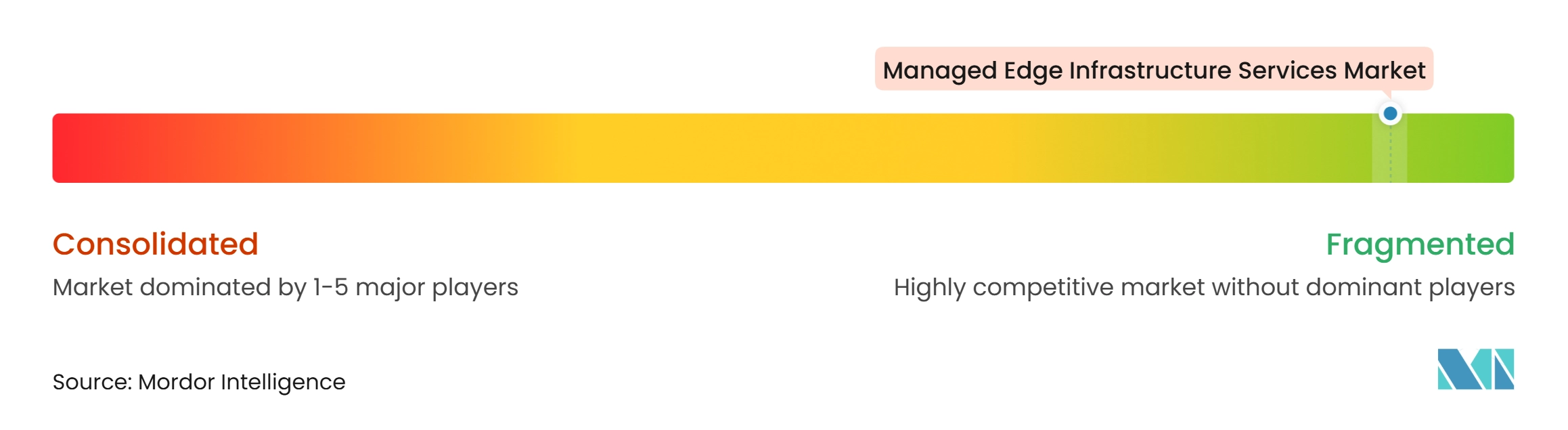
| Market Concentration | Low |
Major Players *Disclaimer: Major Players sorted in no particular order Image © Mordor Intelligence. Reuse requires attribution under CC BY 4.0. | |
Managed Edge Infrastructure Services Market Analysis by Mordor Intelligence
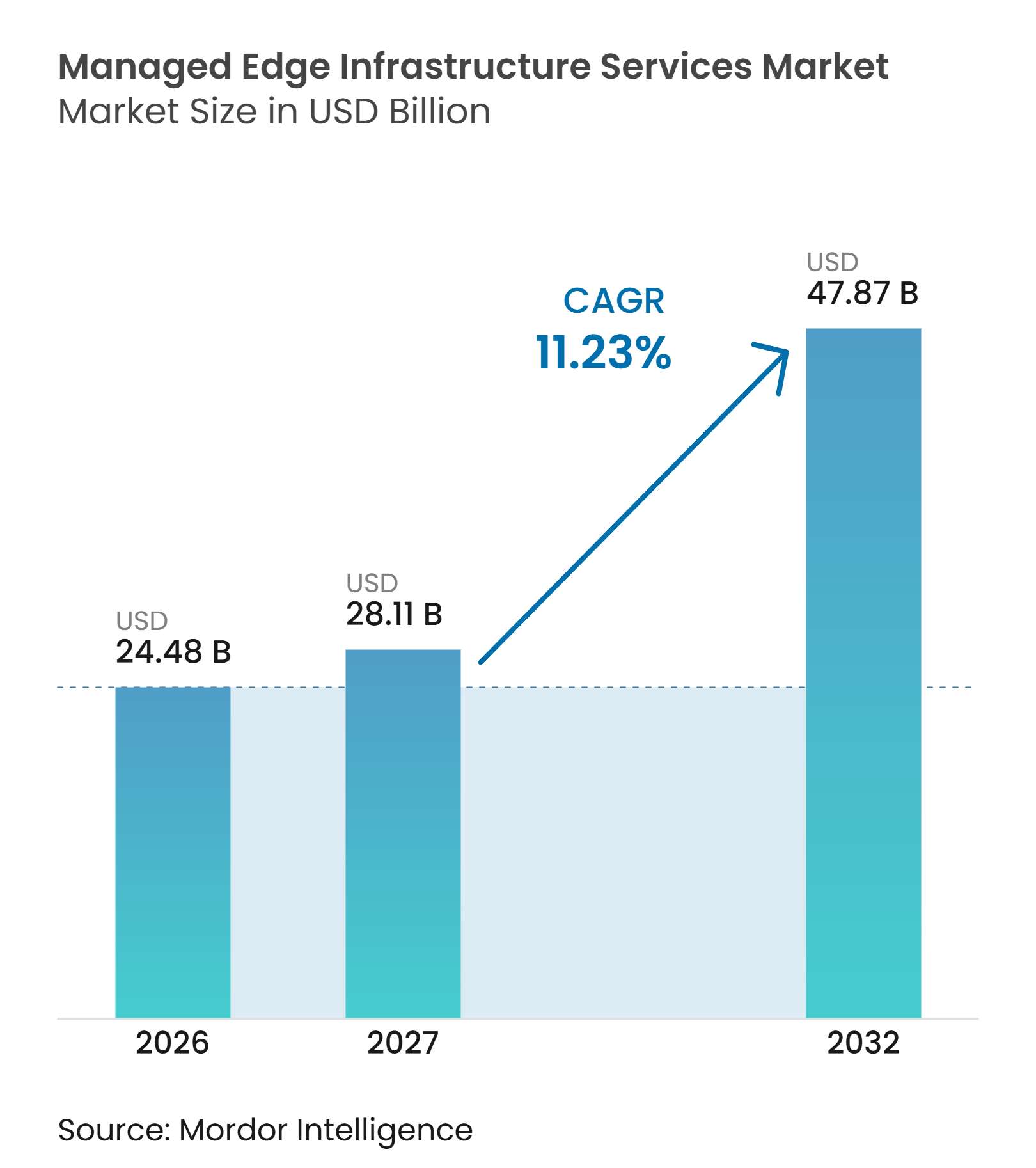
The Managed Edge Infrastructure Services Market was valued at USD 24.48 billion in 2026 and is estimated to grow from USD 28.11 billion in 2027 to USD 47.87 billion by 2032, registering a CAGR of 11.23% during the forecast period (2027-2032). Demand in the Managed Edge Infrastructure Services Market is shifting toward managed operating models because distributed locations now support core workloads rather than secondary extensions of central data centers. Private 5G, local AI inference, and industrial modernization are increasing the need for low-latency processing, resilient operations, and stronger controls over sensitive data. Providers are responding by combining infrastructure management, network operations, security, and application support into broader service packages. This favors firms that can work across operational technology, enterprise IT, and communications networks, while smaller providers may face pressure from higher staffing and certification needs. Data residency requirements also strengthen the case for on-premises and locally managed deployments in regulated sectors.
Key Report Takeaways
- By service type, Edge Infrastructure Management Services held 37.66% of the Managed Edge Infrastructure Services Market share in 2026, while Edge Infrastructure Optimization Services is projected to expand at an 11.46% CAGR through 2032.
- By deployment model, On-Premises Edge held a 33.28% share in 2026, while Regional and Cloud Edge is projected to expand at an 11.83% CAGR through 2032.
- By number of managed edge sites, the 2-10 edge sites tier held a 30.82% share in 2026, while the more-than-50-edge-sites tier is projected to expand at an 11.77% CAGR through 2032.
- By organization size, large enterprises held a 71.88% share in 2026, while SMEs are projected to expand at an 11.38% CAGR through 2032.
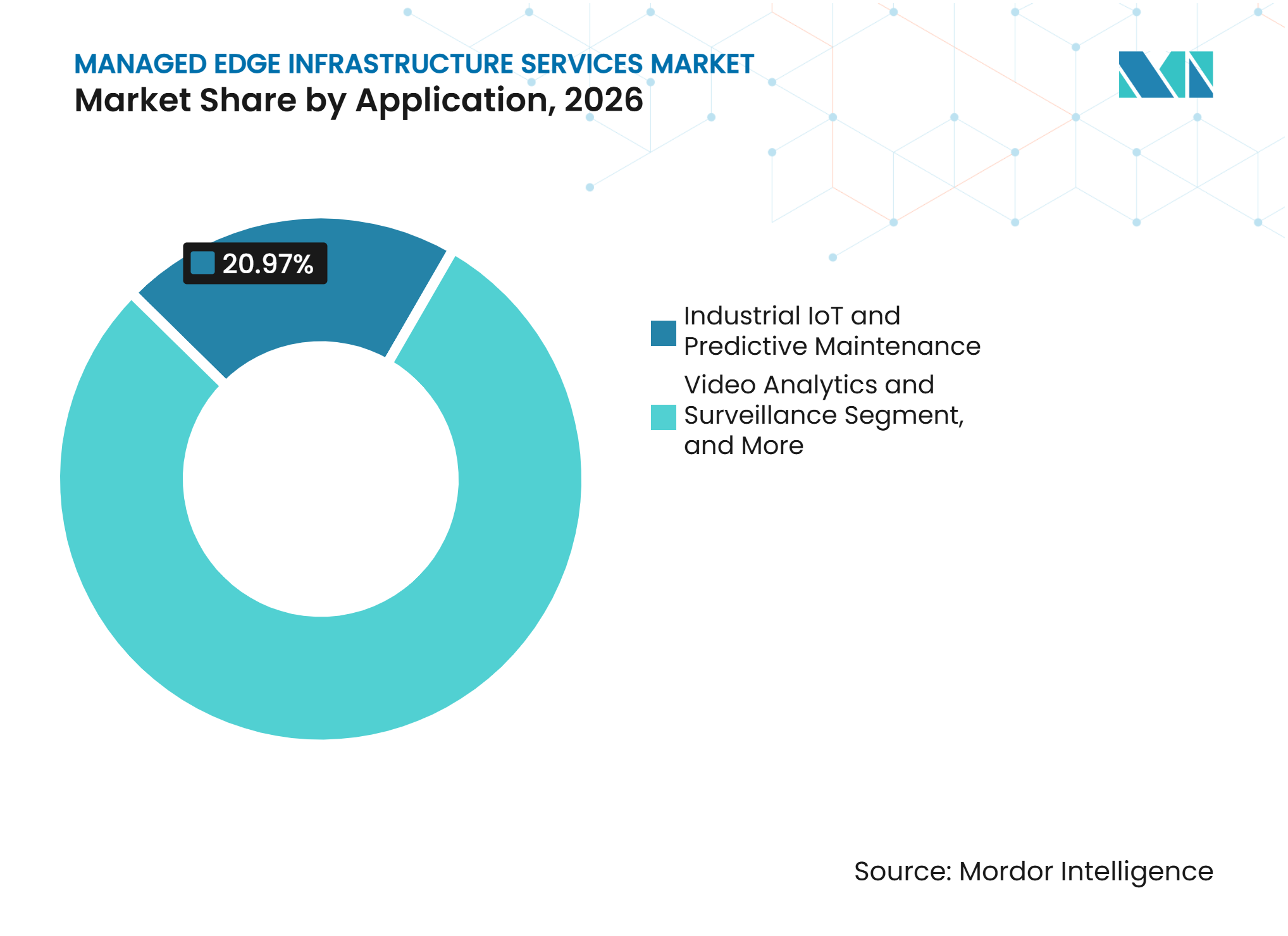
- By application, Industrial IoT and Predictive Maintenance held a 20.97% share in 2026, while Autonomous Vehicles and Drones are projected to expand at an 11.49% CAGR through 2032.
- By end-user industry, Telecommunications and IT held a 22.76% share in 2026, while Automotive and Connected Vehicles is projected to expand at an 11.53% CAGR through 2032.
- By geography, North America held a 35.44% share in 2026, while Asia-Pacific is projected to expand at an 11.62% CAGR through 2032.
Note: Market numbers in this report are based on Mordor Intelligence's proprietary estimation framework, which combines nine months of actuals with Q4 projections for base year 2026.
Market Trends and Insights
Drivers Impact Analysis of Managed Edge Infrastructure Services Market*
| Driver | (~) % Impact on CAGR Forecast | Geographic Relevance | Impact Timeline |
|---|---|---|---|
| 5G Standalone and Private Network Rollouts | +3.2% | Global, concentrated in North America, Asia-Pacific, and Western Europe | Short term (≤ 2 years) |
| AI Inference and Real-Time Analytics at Distributed Sites | +2.8% | North America, Asia-Pacific, including Japan, South Korea, and China, and Western Europe | Short term (≤ 2 years) |
| Industrial IoT and Brownfield Automation Modernization | +2.0% | North America, Germany, China, Japan, and South Korea | Medium term (2-4 years) |
| Data Sovereignty and Local Processing Requirements | +1.5% | European Union, India, China, Southeast Asia, and Middle East and Africa | Medium term (2-4 years) |
| Enterprise Outsourcing of Distributed Edge Operations | +1.2% | North America, Europe, and Asia-Pacific enterprise hubs | Medium term (2-4 years) |
| Edge Fleet Automation and Zero-Touch Provisioning | +0.8% | North America and Europe, with adoption extending to Asia-Pacific | Medium term (2-4 years) |
| Source: Mordor Intelligence | |||
5G Standalone and Private Network Rollouts
Standalone 5G enables multi-access edge computing nodes to be placed at enterprise premises, making network deployment inseparable from infrastructure operations. Each private network needs power oversight, availability management, software updates, radio coordination, and security controls. Rakuten Mobile selected Cisco, Nokia, and F5 in July 2025 for its standalone 5G network in Japan, using cloud-native functions and automated lifecycle operations. TIM Enterprise tested a Nokia-based private 5G network with SAIPEM in January 2026 for industrial video analytics and worker safety. These deployments show why enterprises increasingly procure network, compute, and operational accountability together. Once a facility adopts a private edge management architecture, the effort required to change the operating model can support recurring managed service revenue.
AI Inference and Real-Time Analytics at Distributed Sites
In the Managed Edge Infrastructure Services Market, AI inference is increasing the need for computing resources close to production lines, customer locations, and communications networks. A local workload can avoid the delay created when data moves to a distant cloud region and returns to the operating site. HPE introduced HPE AI Grid in March 2026 to connect distributed AI factories and far-edge inference clusters with zero-touch provisioning and automated security.[1] Akamai launched AI Grid orchestration across more than 4,400 edge locations in March 2026 and disclosed a USD 200 million, 4-year agreement for a metro edge GPU cluster. These examples raise the value of providers that can orchestrate GPU fleets, maintain model versions, and support security at many locations. They also make latency consistency and energy efficiency more important parts of managed edge contracts.
Industrial IoT and Brownfield Automation Modernization
Industrial sites in the Managed Edge Infrastructure Services Market often operate programmable logic controllers, supervisory control systems, and sensors that cannot be replaced without disrupting production. Managed edge services allow operators to connect these assets to modern analytics while retaining established control environments. Emerson introduced Project Beyond in May 2025 as an operations platform that combines on-premises edge computing, cloud analytics, and zero-trust security for industrial environments. A 2026 study of industrial automation described a hierarchical IIoT framework for real-time monitoring in brownfield programmable logic controller environments. These conditions make integration services important because existing operational assets, network protocols, and new applications must work together. Providers that manage the full connection between operational and information systems can develop longer relationships with industrial customers.
Data Sovereignty and Local Processing Requirements
Data sovereignty in the Managed Edge Infrastructure Services Market is influencing where organizations place computing resources and how they manage sensitive data. The European Commission explains that the Data Act sets rules for access to and use of data generated by connected products and related services. Local processing can help regulated organizations limit external data transfers when they manage health, financial, energy, or operational data. Indigitise and Niral Networks partnered in February 2026 to provide sovereign private 5G and edge AI solutions in Australia and Asia-Pacific for customers with data residency requirements. This creates demand for service architectures that can address jurisdictional and sector-specific requirements without moving sensitive workloads across borders. It also gives providers with local delivery capability a stronger position in regulated procurement processes.
Restraints Impact Analysis of Managed Edge Infrastructure Services Market*
| Restraint | (~) % Impact on CAGR Forecast | Geographic Relevance | Impact Timeline |
|---|---|---|---|
| Distributed Power, Cooling, and Site Readiness Costs | -1.8% | Global, most acute in emerging Asia-Pacific markets and constrained North American utility zones | Long term (≥ 4 years) |
| Heterogeneous Edge Stack Integration Complexity | -1.5% | Global | Medium term (2-4 years) |
| Edge Cybersecurity and Physical-Tampering Exposure | -1.2% | Global, highest in industrial and energy sectors | Medium term (2-4 years) |
| Shortage of Edge-to-Core Operations Talent | -0.8% | Global, most acute in Southeast Asia, South America, and Middle East and Africa | Long term (≥ 4 years) |
| Source: Mordor Intelligence | |||
Distributed Power, Cooling, and Site Readiness Costs
Distributed locations in the Managed Edge Infrastructure Services Market can require electrical upgrades, cooling systems, backup power, and construction work before edge equipment can operate. The National Renewable Energy Laboratory discusses how distributed edge data centers and building loads can affect planning for large electrical interconnections.[2] These needs can extend project schedules, especially where utility capacity is constrained. GPU-based inference also raises cooling requirements at sites that were not designed for dense computing loads. For managed service providers, site readiness work can limit margins and create delivery risks that are difficult to transfer through contracts. Early site assessments and clearer responsibility for utility coordination are therefore important before service commitments begin.
Heterogeneous Edge Stack Integration Complexity
Managed Edge Infrastructure Services Market deployments connect operational systems, IT infrastructure, wide-area networks, security tools, and AI platforms from different vendors. Industrial sites can combine MQTT, OPC-UA, Modbus, and PROFINET with containers and cloud-native application interfaces. Akamai’s 2026 AI Grid combines distributed orchestration, hardware-accelerated security, and edge computing across a large network footprint. This breadth makes integration work difficult to standardize and can reduce margins on complex engagements. Smaller providers may not have staff certified across operational technology, networking, security, and AI operations. Larger service firms and hyperscalers can spread those capability costs across wider customer portfolios, which may increase consolidation in the Managed Edge Infrastructure Services Market.
*Our forecasts treat driver/restraint impacts as directional, not additive. The impact forecasts reflect baseline growth, mix effects, and variable interactions.
Managed Edge Infrastructure Services Market Segment Analysis
By Service Type:
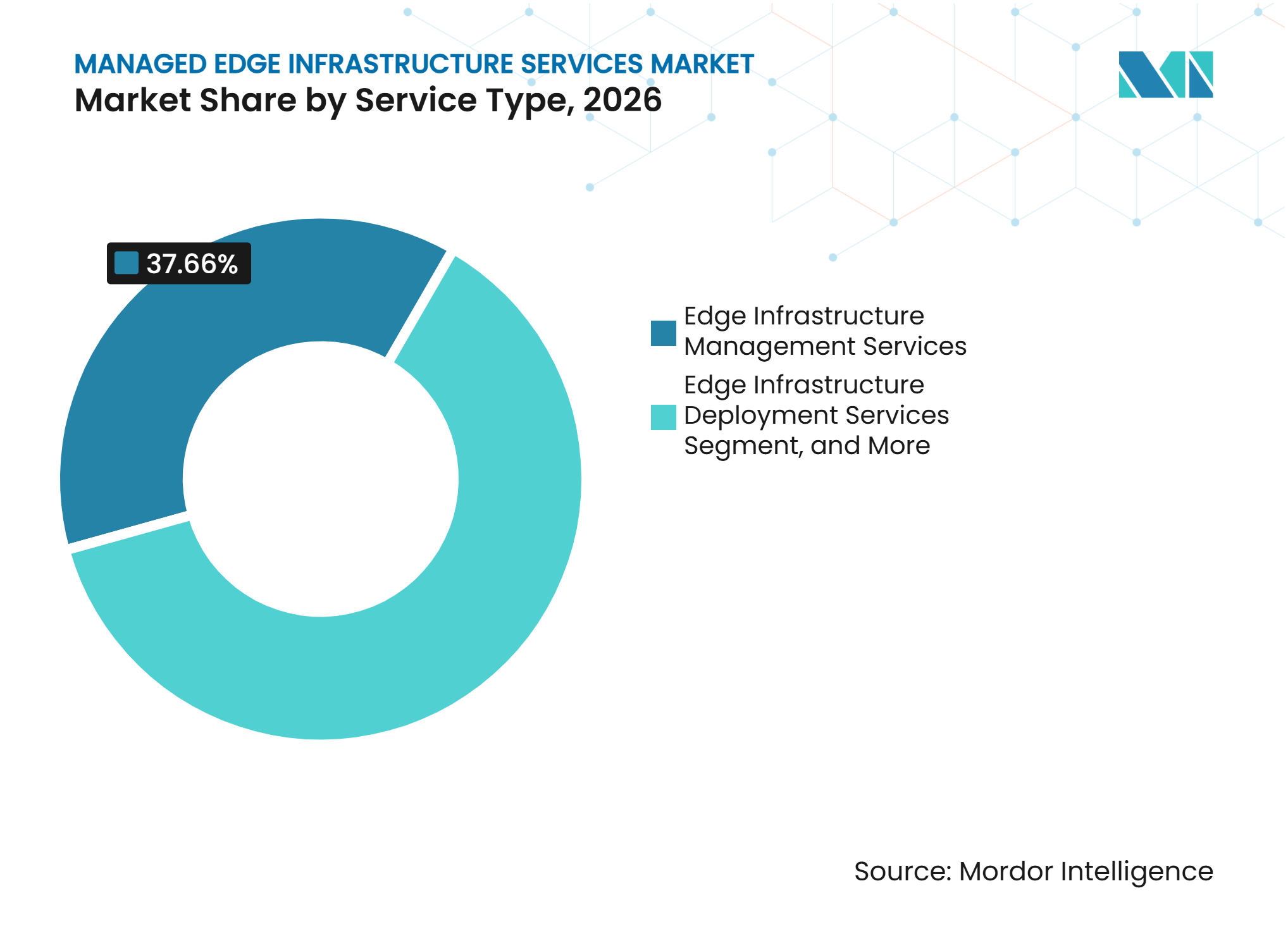
Management Services Support Recurring RevenueEdge Infrastructure Management Services held 37.66% of the Managed Edge Infrastructure Services Market share in 2026. The segment addresses ongoing monitoring, patching, performance assurance, incident response, and availability management. In the Managed Edge Infrastructure Services Market, enterprises often prefer these recurring functions to one-time deployment work because distributed sites need support throughout their operating life. Management contracts can also give providers a continuing role as customers add sites, applications, and security requirements. This segment benefits from the operational complexity created by geographically dispersed hardware and uneven local staffing.
Edge Infrastructure Optimization Services is projected to expand at an 11.46% CAGR through 2032. The segment addresses latency, workload placement, energy use, capacity planning, and service performance as edge environments mature. HPE’s AI Grid shows how deployment and optimization functions are becoming part of a continuing lifecycle model rather than separate phases. Deployment services remain important during initial rollouts, while maintenance services support equipment refresh and lifecycle work. Over time, providers can use performance data from managed sites to identify optimization opportunities. This shifts service demand from installation activity toward longer-term operational improvement.



By Deployment Model:
Cloud Edge Broadens Distributed OperationsOn-premises edge commanded 33.28% of the Managed Edge Infrastructure Services Market size in 2026. Financial services, healthcare, and government users often need local compute because their workloads contain sensitive or regulated data. On-site infrastructure also supports low-latency use cases where data movement to remote regions can affect performance. This model is particularly relevant when customers want direct control over equipment and access procedures. It requires providers to manage locations that may vary widely in their physical conditions and internal technology standards.
Regional and Cloud Edge is projected to expand at an 11.83% CAGR through 2032. In the Managed Edge Infrastructure Services Market, colocation operators and content delivery network providers are adapting distributed infrastructure for AI inference closer to end users. AWS made AWS Interconnect generally available in April 2026 to simplify private connectivity between customer locations and AWS infrastructure.[3]Telco and Network Edge support private 5G and multi-access edge computing deployments, while Hybrid Edge supports organizations using more than 1 infrastructure tier. These models allow sensitive data to remain local while other workloads use regional resources. The arrangement can reduce dependence on a single deployment approach while increasing the need for coordinated management.
By Number of Managed Edge Sites:
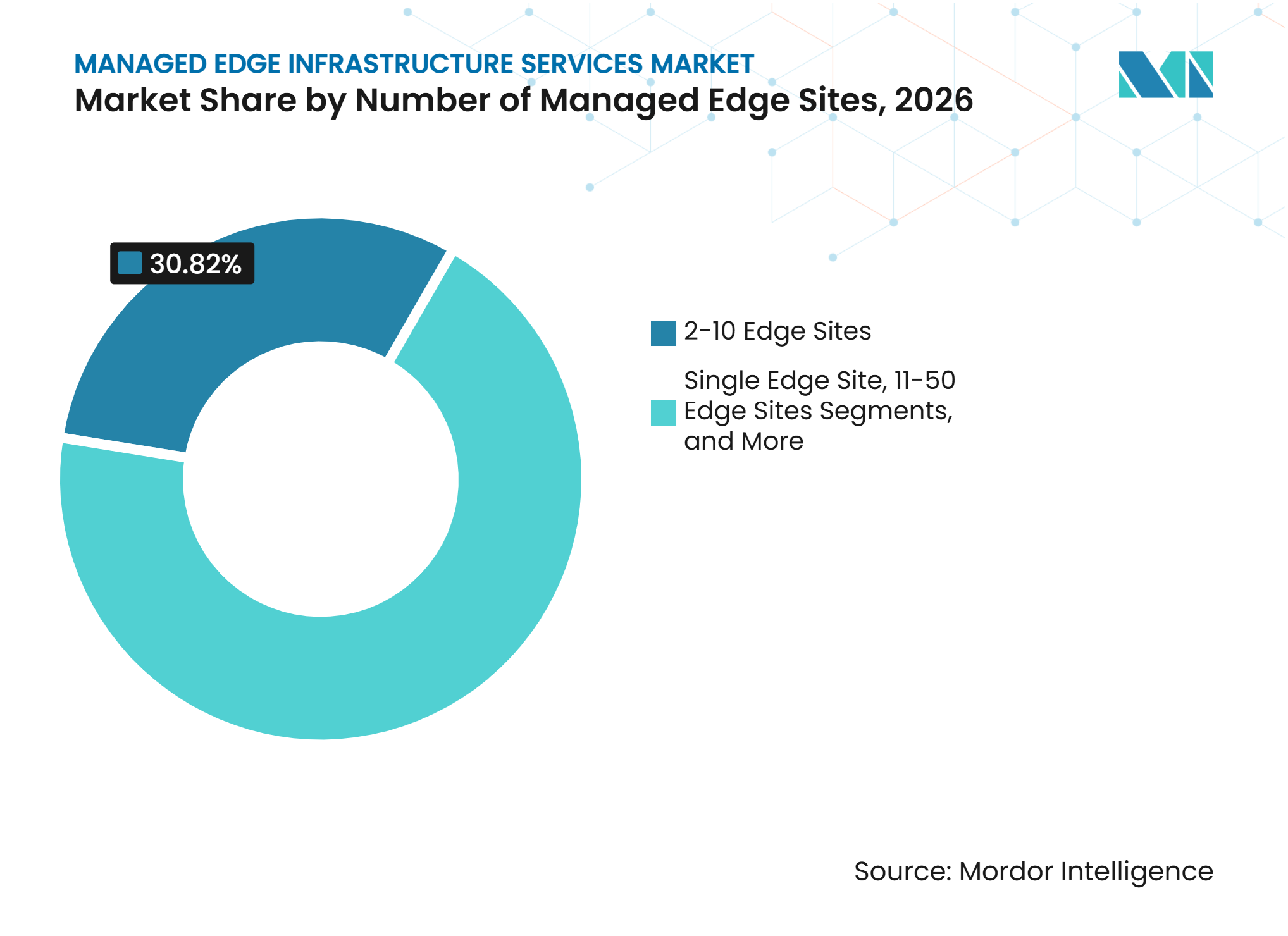
Fleet Scale Changes Service EconomicsThe 2-10 edge sites tier held a 30.82% share in 2026. This group includes organizations that have begun multi-location deployments but have not yet consolidated their sites into a large fleet model. The tier reflects a practical entry point for mid-sized businesses that need managed support without nationwide infrastructure. Customers in this group often use early deployments to validate applications, operating procedures, and commercial returns. Providers can support these customers with standardized service packages and expand coverage as their site count rises.
The more-than-50-edge-sites tier is projected to expand at an 11.77% CAGR through 2032. Across the Managed Edge Infrastructure Services Market, retail chains, communications carriers, and industrial groups can use fleet standardization to lower per-site management effort. Broadcom released VMware Cloud Foundation Edge 9.1 zero-touch provisioning capabilities in May 2026 to automate host activation and cluster registration. Automation reduces the need for on-site intervention and improves the business case for managed fleet operations. Single-site deployments remain useful for pilot projects, while the 11-50 sites tier represents a transition toward broader service contracts. Fleet automation is therefore an important factor in scaling the Managed Edge Infrastructure Services Market.

By Organization Size:
Large Enterprises Lead While SMEs Gain AccessLarge enterprises held 71.88% of the market share in 2026. Their multi-site footprints, compliance obligations, and procurement processes support contracts that cover deployment, management, maintenance, and optimization across many locations. Large organizations also have the resources to integrate edge capabilities into broader digital programs. Their demand is concentrated in use cases that require dependable operations across facilities, branches, networks, or field assets. This makes them important customers for providers that can meet strict service-level and governance requirements.
SMEs are projected to expand at an 11.38% CAGR through 2032. Within the Managed Edge Infrastructure Services Market, carrier-hosted multi-access edge computing and hyperscaler subscriptions reduce the need for upfront investment in enterprise-grade infrastructure. Packaged offerings can help smaller organizations adopt services that were previously limited to larger customers. As the SME base expands, shared infrastructure can improve provider capacity planning and lower site-level costs. This can reduce the minimum viable footprint for managed edge use cases. It also creates an opportunity for providers to offer simpler service catalogs, predictable pricing, and remote operations support.
By Application:
Industrial IoT Leads While Autonomous Systems AdvanceIndustrial IoT and Predictive Maintenance held a 20.97% share of the market size in 2026. Factories and remote industrial assets use local computing to analyze equipment data and support maintenance decisions without depending on constant cloud connectivity. Brownfield environments are especially important because legacy controllers and sensors must remain in service during modernization. Emerson’s Project Beyond is designed to connect existing automation environments with modern computing and security capabilities. This application favors providers that can manage both operational requirements and enterprise systems. It also supports continuing contracts because industrial integration work is rarely completed through a single deployment.
Autonomous Vehicles and Drones is projected to expand at an 11.49% CAGR through 2032. Vehicle-to-everything communication, flight-path management, and collision avoidance require responses that cannot always wait for a centralized cloud connection. Video Analytics and Surveillance also uses edge processing to reduce backhaul demands from AI-enabled cameras. Real-Time Healthcare and Medical Imaging, Connected Retail and Branch Operations, and Smart Grids and Remote Asset Monitoring have different needs but all benefit from local analysis and managed operations. Content Delivery and Network Optimization adds a communications-led use case for distributed capacity. Together, these applications broaden demand beyond traditional data center environments. They also increase the importance of reliable security, workload management, and local support.
By End-User Industry:
Telecommunications and IT Lead While Automotive Gains MomentumTelecommunications and IT held a 22.76% share in 2026. Operators use managed edge capabilities for their own standalone 5G networks and can also offer capacity to enterprise customers. This dual role concentrates early revenue in organizations that already operate network infrastructure and have established enterprise channels. Telecommunications providers can combine spectrum, access networks, and distributed locations with managed services. IT providers complement this position through cloud operations, systems integration, and application support.
Automotive and Connected Vehicles is projected to expand at an 11.53% CAGR through 2032. In the Managed Edge Infrastructure Services Market, vehicle telemetry and roadside infrastructure require persistent, low-latency connections and managed computing resources. Industrial Manufacturing and Transportation and Logistics also depend on local processing for operational visibility and asset coordination. Energy and Utilities uses edge services for grid balancing and predictive asset monitoring. Financial Services applies the model to low-latency processing, branch operations, and fraud detection, while Retail and E-Commerce supports in-store AI applications. These diverse needs reduce reliance on a single end-user sector and encourage providers to develop industry-specific operating models.
Geography Analysis
North America held a 35.44% share in 2026. The Managed Edge Infrastructure Services Market in the region benefits from mature standalone 5G deployment, a dense colocation network, and established outsourcing of distributed IT operations. The United States brings together hyperscaler edge extensions, carrier multi-access edge computing, and enterprise-premise services. AWS announced an AWS Interconnect last-mile preview with Megaport in October 2026, covering managed private connectivity from branches and remote locations to AWS. North America also has a broad pool of personnel with networking, cloud, and operations experience. This can reduce some implementation risks compared with regions where edge-to-core skills are less available.
Asia-Pacific is projected to expand at an 11.62% CAGR through 2032. China, Japan, South Korea, and India are important demand centers in the Managed Edge Infrastructure Services Market because 5G expansion and industrial digitization increase interest in local computing. Equinix opened its CN1 AI-ready data center in Chennai in September 2025 with an initial USD 69 million investment and 800 cabinets. Tata Communications and AWS announced a network deployment connecting Mumbai, Hyderabad, and Chennai in July 2025 to support AI and machine learning workloads. Japan and South Korea have advanced industrial deployments, while Australia is developing sovereign private 5G and edge AI capacity. Regional growth is supported by a mix of enterprise modernization, communications investment, and data residency needs.
Europe’s managed edge demand is shaped by requirements relating to local data control and compliance. Germany, the United Kingdom, and France support demand through manufacturing, financial services, and smart city infrastructure. Nokia deployed a next-generation IP network architecture for Zayo in October 2025, beginning in New York and New Jersey and extending to additional markets.[4] The announcement reflects the need for scalable network foundations that support cloud and edge connectivity. South America remains earlier in adoption, with activity concentrated in financial services and telecommunications. The Middle East and Africa has emerging potential as Saudi Arabia and the United Arab Emirates invest in smart infrastructure linked to economic diversification plans.
Competitive Landscape
Market Concentration
The Managed Edge Infrastructure Services Market includes hyperscalers, telecommunications carriers, IT services firms, and colocation operators. AWS, Microsoft, and Google compete through cloud-native tools and orchestration capabilities. Verizon, AT&T, Ericsson, and Nokia bring network-edge infrastructure, spectrum-related assets, and enterprise customer relationships. Kyndryl, Accenture, NTT DATA, and Capgemini compete where customers need multi-vendor operational technology and IT integration. These groups often address different parts of the same customer requirement, making partnerships as important as direct competition.
AT&T and Cisco introduced a secure access service edge offering in August 2025 that combines Cisco SD-WAN and cloud security with AT&T network operations under a managed contract.[5]GTT expanded its HPE partnership in July 2026 for managed LAN, WLAN, and secure cloud networking services. Akamai’s 2026 AI Grid deployment shows how edge infrastructure providers are adding GPU orchestration and AI services to their network footprints. These moves show that managed edge competition is moving beyond connectivity toward integrated operational responsibility. Providers need to demonstrate that they can manage security, applications, networks, and infrastructure as a coordinated service.
Opportunity in the Managed Edge Infrastructure Services Market remains in packaged services for SMEs and in integrated operational technology and IT management. Smaller buyers may not be able to meet the fleet-size or contract-length requirements commonly associated with enterprise service catalogs. Industrial customers also need providers that can translate protocols, manage edge computing, and coordinate enterprise applications under a consistent operating framework. Emerson approaches this need from the automation side, while IT-focused providers approach it through cloud and systems management. Compliance with ETSI multi-access edge computing and 3GPP standards can improve the position of providers pursuing carrier-grade contracts. Competition is therefore based on execution across domains rather than on a single infrastructure asset.
Managed Edge Infrastructure Services Industry Leaders
-
Amazon Web Services, Inc.
-
Microsoft Corporation
-
Google LLC
-
International Business Machines Corporation
-
Dell Technologies Inc.
- *Disclaimer: Major Players sorted in no particular order
Managed Edge Infrastructure Services Market Companies Covered in this Report
- Amazon Web Services, Inc.
- Microsoft Corporation
- Google LLC
- International Business Machines Corporation
- Dell Technologies Inc.
- Hewlett Packard Enterprise Company
- Cisco Systems, Inc.
- Equinix, Inc.
- Telefonaktiebolaget LM Ericsson
- Nokia Corporation
- Huawei Technologies Co., Ltd.
- Schneider Electric SE
- Vertiv Holdings Co
- NTT DATA Corporation
- Accenture plc
- Capgemini SE
- Kyndryl, Inc.
- Lumen Technologies, Inc.
- Tata Communications Limited
- Verizon Communications Inc.
- AT&T Inc.
- Orange S.A.
- Singtel Group Limited
- Telstra Group Limited
- Akamai Technologies, Inc.
- Cloudflare, Inc.
Recent Industry Developments in Managed Edge Infrastructure Services Market
- August 2026: AWS and Microsoft Azure announced Azure connectivity entering public preview on AWS Interconnect multicloud, completing the first jointly managed interconnect spanning all three non-AWS major cloud providers and eliminating the need for customers to manually configure cross-cloud network connections for enterprise edge architectures.
- July 2026: GTT Communications expanded its global partnership with HPE to deliver managed LAN/WLAN solutions via HPE Aruba Central and a fully managed SASE solution on GTT's Tier 1 global network, enabling enterprises to connect distributed edge environments with zero-trust security under a single managed contract.
- March 2026: HPE announced the HPE AI Grid at NVIDIA GTC 2026, connecting distributed AI factories and far-edge inference clusters with zero-touch provisioning and automated security, with Comcast announcing concurrent AI field trials running small language models on NVIDIA GPUs at its distributed network for small-business services.
- March 2026: Akamai launched AI Grid intelligent orchestration across 4,400+ edge locations and disclosed a USD 200 million 4-year service agreement for a metro edge GPU cluster, representing the industry's first global-scale NVIDIA AI Grid implementation and 1 of the largest publicly disclosed managed edge AI infrastructure contracts.
- November 2025: Cisco debuted its Unified Edge platform for distributed agentic AI workloads, integrating compute, networking, storage, and security into a single managed stack for retail stores, healthcare facilities, and factory floors requiring real-time AI inferencing at the network edge.
Global Managed Edge Infrastructure Services Market Report Scope
The managed edge infrastructure services market covers externally delivered services in which a provider deploys, manages, maintains, and optimizes the compute, storage, networking, and supporting power and cooling infrastructure at distributed edge locations. These locations include on-premises sites, telecom network edges, and regional or cloud edges. Providers take ongoing operational responsibility for the edge fleet under a managed contract. This covers zero-touch provisioning, remote monitoring, patching, lifecycle management, security, and performance optimization, so latency-sensitive and data-intensive workloads run reliably close to where data is generated.
The Managed Edge Infrastructure Services Market Report is Segmented by Service Type (Edge Infrastructure Deployment Services, Edge Infrastructure Management Services, Edge Infrastructure Maintenance Services, and Edge Infrastructure Optimization Services), Deployment Model (On-Premises Edge, Telco and Network Edge, Regional and Cloud Edge, and Hybrid Edge), Number of Managed Edge Sites (Single Edge Site, 2-10 Edge Sites, 11-50 Edge Sites, and More Than 50 Edge Sites), Organization Size (Large Enterprises, and Small and Medium Enterprises), Application (Industrial IoT and Predictive Maintenance, Video Analytics and Surveillance, Autonomous Vehicles and Drones, Connected Retail and Branch Operations, Real-Time Healthcare and Medical Imaging, Content Delivery and Network Optimization, and Smart Grids and Remote Asset Monitoring), End-User Industry (Telecommunications and Information Technology, Industrial Manufacturing, Transportation and Logistics, Energy and Utilities, Financial Services, Automotive and Connected Vehicles, Retail and E-Commerce, and Other End-User Industries), and Geography (North America, South America, Europe, Asia-Pacific, and Middle East and Africa). The Market Forecasts are Provided in Terms of Value (USD).
Segmentation Overview
| Edge Infrastructure Deployment Services |
| Edge Infrastructure Management Services |
| Edge Infrastructure Maintenance Services |
| Edge Infrastructure Optimization Services |
| On-Premises Edge |
| Telco and Network Edge |
| Regional and Cloud Edge |
| Hybrid Edge |
| Single Edge Site |
| 2-10 Edge Sites |
| 11-50 Edge Sites |
| More Than 50 Edge Sites |
| Large Enterprises |
| Small and Medium Enterprises |
| Industrial IoT and Predictive Maintenance |
| Video Analytics and Surveillance |
| Autonomous Vehicles and Drones |
| Connected Retail and Branch Operations |
| Real-Time Healthcare and Medical Imaging |
| Content Delivery and Network Optimization |
| Smart Grids and Remote Asset Monitoring |
| Telecommunications and Information Technology |
| Industrial Manufacturing |
| Transportation and Logistics |
| Energy and Utilities |
| Financial Services |
| Automotive and Connected Vehicles |
| Retail and E-Commerce |
| Other End-User Industries |
| North America | United States |
| Canada | |
| Mexico | |
| South America | Brazil |
| Argentina | |
| Rest of South America | |
| Europe | Germany |
| United Kingdom | |
| France | |
| Italy | |
| Russia | |
| Rest of Europe | |
| Asia-Pacific | China |
| Japan | |
| India | |
| South Korea | |
| Australia | |
| Rest of Asia-Pacific | |
| Middle East and Africa | Saudi Arabia |
| United Arab Emirates | |
| South Africa | |
| Egypt | |
| Rest of Middle East and Africa |
| By Service Type | Edge Infrastructure Deployment Services | |
| Edge Infrastructure Management Services | ||
| Edge Infrastructure Maintenance Services | ||
| Edge Infrastructure Optimization Services | ||
| By Deployment Model | On-Premises Edge | |
| Telco and Network Edge | ||
| Regional and Cloud Edge | ||
| Hybrid Edge | ||
| By Number of Managed Edge Sites | Single Edge Site | |
| 2-10 Edge Sites | ||
| 11-50 Edge Sites | ||
| More Than 50 Edge Sites | ||
| By Organization Size | Large Enterprises | |
| Small and Medium Enterprises | ||
| By Application | Industrial IoT and Predictive Maintenance | |
| Video Analytics and Surveillance | ||
| Autonomous Vehicles and Drones | ||
| Connected Retail and Branch Operations | ||
| Real-Time Healthcare and Medical Imaging | ||
| Content Delivery and Network Optimization | ||
| Smart Grids and Remote Asset Monitoring | ||
| By End-User Industry | Telecommunications and Information Technology | |
| Industrial Manufacturing | ||
| Transportation and Logistics | ||
| Energy and Utilities | ||
| Financial Services | ||
| Automotive and Connected Vehicles | ||
| Retail and E-Commerce | ||
| Other End-User Industries | ||
| By Geography | North America | United States |
| Canada | ||
| Mexico | ||
| South America | Brazil | |
| Argentina | ||
| Rest of South America | ||
| Europe | Germany | |
| United Kingdom | ||
| France | ||
| Italy | ||
| Russia | ||
| Rest of Europe | ||
| Asia-Pacific | China | |
| Japan | ||
| India | ||
| South Korea | ||
| Australia | ||
| Rest of Asia-Pacific | ||
| Middle East and Africa | Saudi Arabia | |
| United Arab Emirates | ||
| South Africa | ||
| Egypt | ||
| Rest of Middle East and Africa | ||
Key Questions Answered in the Report
What is the Managed Edge Infrastructure Services Market size?
The Managed Edge Infrastructure Services Market was valued at USD 24.48 billion in 2026 and is estimated to grow from USD 28.11 billion in 2027 to USD 47.87 billion by 2032, registering a CAGR of 11.23% during the forecast period (2027-2032).
What is driving demand for managed edge infrastructure services?
Private 5G, AI inference, industrial IoT modernization, and data sovereignty requirements are increasing the need for locally managed computing and network operations.
Which service type leads managed edge infrastructure services?
Edge Infrastructure Management Services leads with a 37.66% share in 2026, reflecting demand for monitoring, patching, performance assurance, and incident response.
Which deployment model is expanding fastest?
Regional and Cloud Edge is projected to expand at an 11.83% CAGR through 2032 as distributed facilities support AI inference closer to end users.
Which region leads managed edge infrastructure services?
North America leads with 35.44% share in 2026, while Asia-Pacific is projected to expand fastest at an 11.62% CAGR through 2032.
Which end-user sector is advancing fastest?
Automotive and Connected Vehicles is projected to expand at an 11.53% CAGR through 2032 due to persistent, low-latency connectivity needs.