
Managed Edge AI Infrastructure Services Market Size and Share
Market Overview
| Study Period | 2021 - 2032 |
|---|---|
| Market Size (2027) | USD 5.12 Billion |
| Market Size (2032) | USD 13.01 Billion |
| Growth Rate (2027 - 2032) | 20.44 % |
| Fastest Growing Market | Asia-Pacific |
| Largest Market | North America |
| Market Concentration | Medium |
Major Players *Disclaimer: Major Players sorted in no particular order Image © Mordor Intelligence. Reuse requires attribution under CC BY 4.0. | |
Managed Edge AI Infrastructure Services Market Analysis by Mordor Intelligence
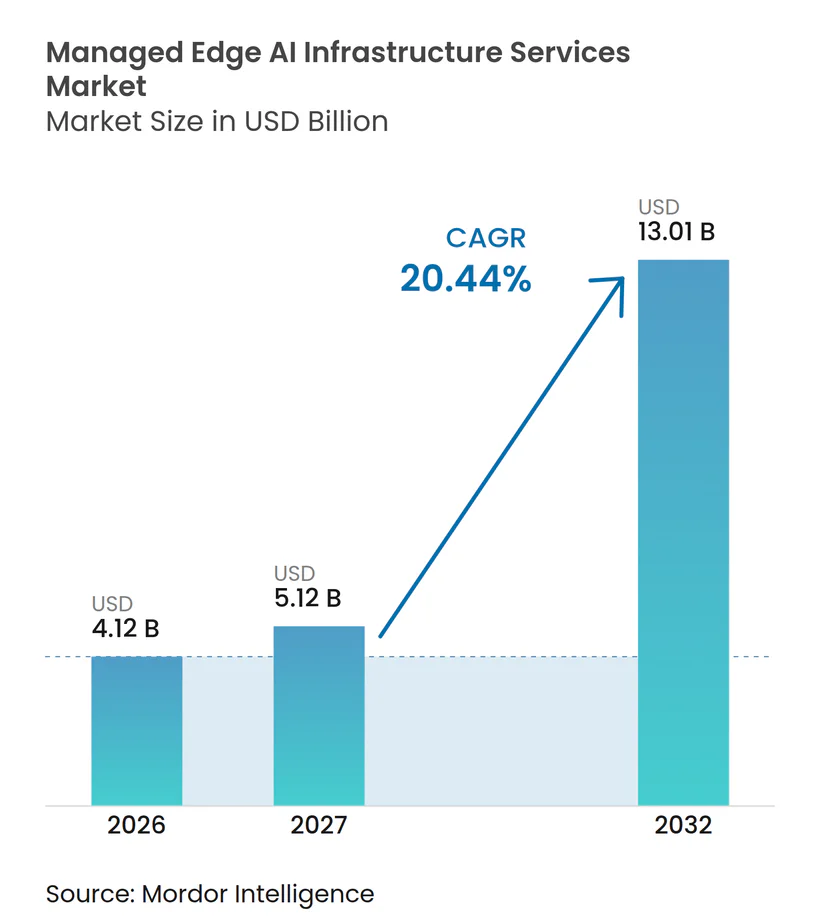
The Managed edge AI infrastructure services market size is projected to expand from USD 4.12 billion in 2026 and USD 5.12 billion in 2027 to USD 13.01 billion by 2032, registering a CAGR of 20.44% between 2027 to 2032. The Managed edge AI infrastructure services market is being shaped by a shift from centralized AI processing toward distributed systems that handle data close to where it is created. This approach suits operations where response time, data control, and dependable local operation matter, including industrial quality checks, logistics, and critical infrastructure. The Managed edge AI infrastructure services market also benefits from enterprise demand for managed operations, since large fleets require consistent monitoring, model maintenance, security, and device management. Providers that combine infrastructure with lifecycle services are better positioned to support buyers that lack specialists across operational technology, information technology, and cloud systems. Higher equipment costs, fragmented software layers, and shortages of cross-disciplinary talent continue to limit adoption, while also making validated managed platforms more relevant.
Key Report Takeaways
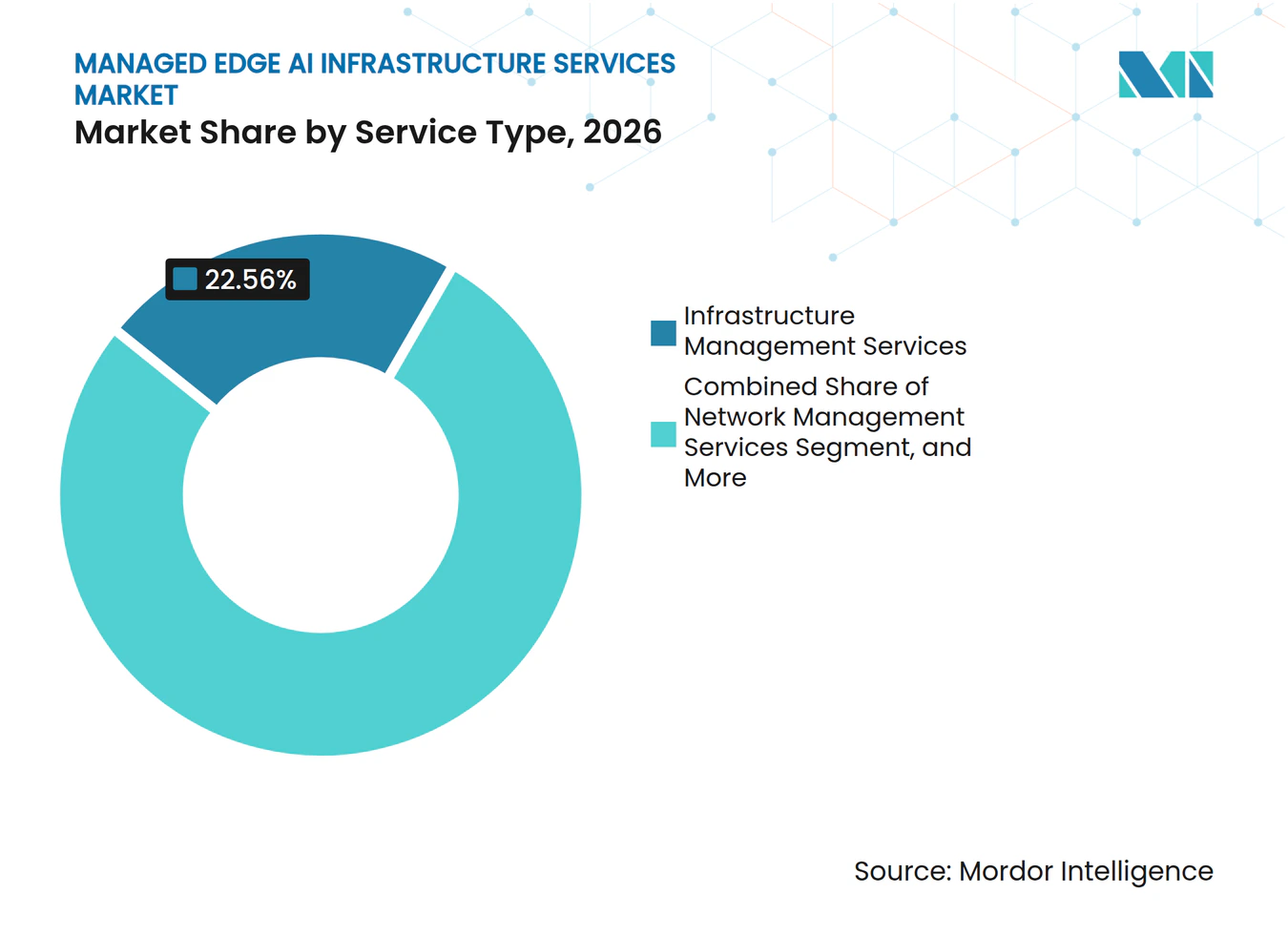
- By service type, infrastructure management services held 22.56% of the Managed edge AI infrastructure services market share in 2026, while model operations and AI lifecycle services are projected to expand at a 21.67% CAGR through 2032.
- By infrastructure type, edge servers and appliances held 28.78% revenue share in 2026, while AI accelerators and inference modules are projected to expand at a 21.85% CAGR through 2032.
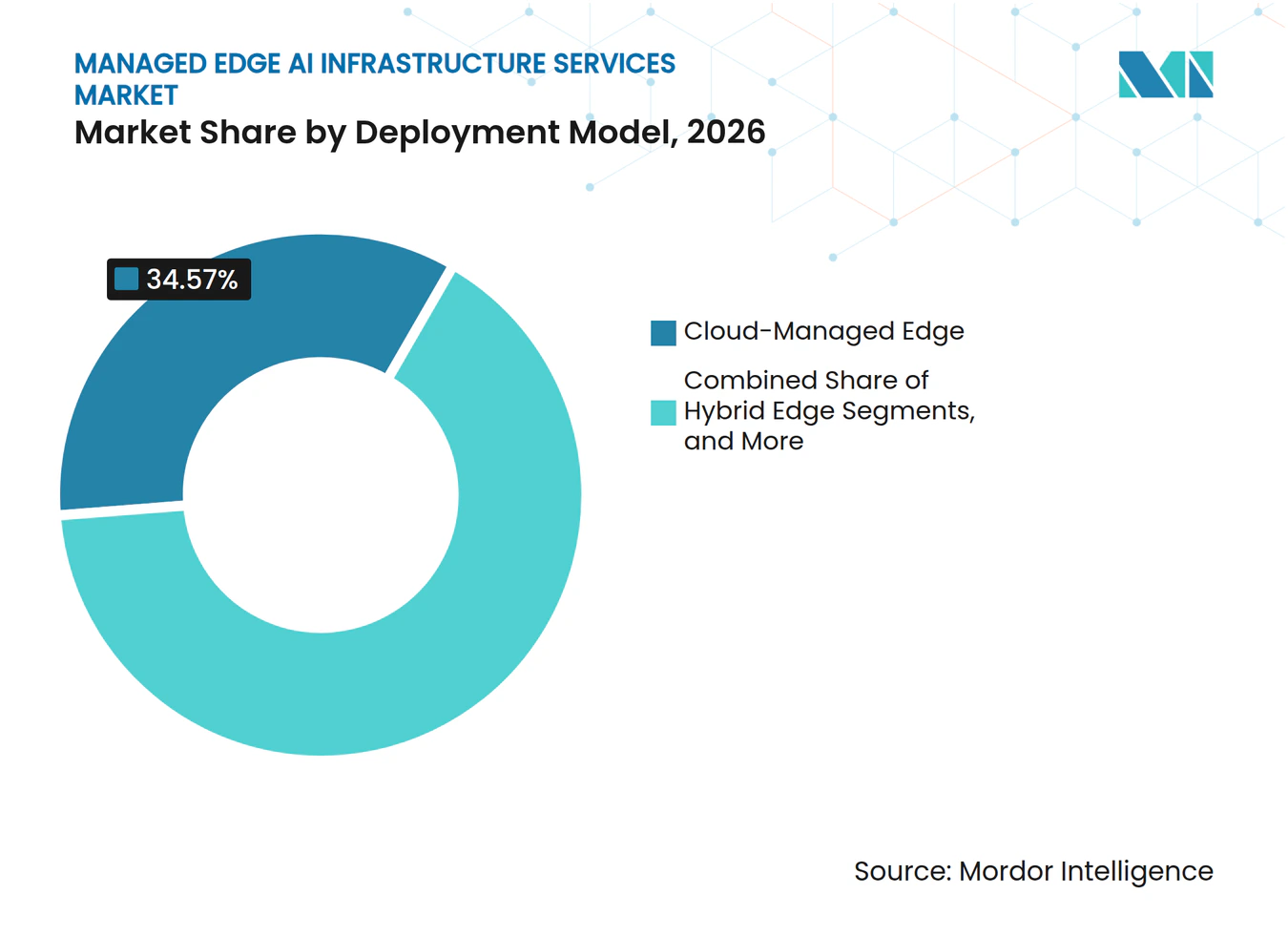
- By deployment model, cloud-managed edge held 34.57% revenue share in 2026 and is projected to expand at a 21.54% CAGR through 2032.
- By geography, North America held 36.76% revenue share in 2026, while Asia-Pacific is projected to expand at a 21.62% CAGR through 2032.
Note: Market numbers in this report are based on Mordor Intelligence's proprietary estimation framework, which combines nine months of actuals with Q4 projections for base year 2026.
Market Trends and Insights
Drivers Impact Analysis of Managed Edge AI Infrastructure Services Market*
| Driver | (~) % Impact on CAGR Forecast | Geographic Relevance | Impact Timeline |
|---|---|---|---|
| Rising Demand for Low-Latency AI Inference | +5.2% | Global, with strong relevance in North American and Asia-Pacific manufacturing and logistics corridors | Short term (≤ 2 years) |
| Expansion of Multi-Site Industrial AI Deployments | +4.1% | North America, Europe, China, Japan, and South Korea | Medium term (2-4 years) |
| Increasing Data Sovereignty and Local Processing Requirements | +3.8% | Europe, India, China, the United Arab Emirates, and Saudi Arabia | Medium term (2-4 years) |
| AI Workload Complexity Outpacing Internal Infrastructure Teams | +2.9% | Global, with pronounced relevance in North America and Western Europe | Short term (≤ 2 years) |
| Growth of Managed Outcome-Based Edge Operations Contracts | +2.2% | North America and Europe, with expansion into core Asia-Pacific countries | Long term (≥ 4 years) |
| Reusable Fleet Telemetry Enabling Cross-Site Model Improvement | +1.5% | North America, Germany, Japan, and South Korea | Long term (≥ 4 years) |
| Source: Mordor Intelligence | |||
Rising Demand for Low-Latency AI Inference
The Managed edge AI infrastructure services market is supported by applications that require an immediate response near the source of data. Computer vision inspection, autonomous material handling, and fraud controls can lose value when data must travel to a distant data center before a decision is made. Agentic AI applications can create far more network activity than conventional chatbot interactions, which increases the need to place computing resources closer to the device or process. Local inference also gives operators a practical option when network availability is uneven or an operational process cannot tolerate interruption. The Managed edge AI infrastructure services market therefore moves beyond equipment installation toward ongoing monitoring of model quality, device health, security controls, and connectivity. This requirement favors providers that can operate distributed estates without asking each site to maintain a full technical team.
Expansion of Multi-Site Industrial AI Deployments
Industrial buyers are moving from isolated pilots toward connected deployments across several facilities. Nokia found that 87% of surveyed on-premise edge adopters achieved a return on investment within 1 year, while 94% used edge technology with AI-driven applications such as predictive maintenance and digital twins.[1] Repeating an AI use case across plants requires consistent device configuration, model versions, logging, and recovery processes. A federated approach can allow local nodes to contribute model updates without transferring raw operational data outside the site. Research on machinery fault diagnosis has documented federated learning methods that improve robustness and efficiency in industrial Internet of Things settings. These requirements broaden the role of service providers from maintaining hardware to coordinating a controlled operating model across the full fleet. The Managed edge AI infrastructure services market gains when industrial firms need that coordination but do not want to build it independently.
Increasing Data Sovereignty and Local Processing Requirements
Data residency requirements are making processing location a material system design decision. Stanford Human-Centered Artificial Intelligence reported 77 data localization measures in East Asia and the Pacific and 66 in Europe and Central Asia in its 2026 AI Index.[2] These controls can affect AI inputs, embeddings, retrieval logs, and model outputs, particularly in regulated sectors. Local inference can help organizations align technical design with the General Data Protection Regulation, China’s Personal Information Protection Law, and similar national rules. The Managed edge AI infrastructure services market is also supported by demand for auditable management practices under frameworks such as ISO/IEC 42001:2023 and the NIST AI Risk Management Framework. Compliance does not remove the need for centralized oversight, but it raises the value of platforms that provide documented local controls and traceable operating records.
AI Workload Complexity Outpacing Internal Infrastructure Teams
Enterprise teams often have separate expertise in models, network operations, industrial systems, and cloud infrastructure. Managing an edge AI deployment combines these areas through tasks such as model optimization, zero-touch provisioning, over-the-air updates, hardware fault response, and network visibility. ManpowerGroup identified AI model and application development and AI literacy as leading hard-to-find skill categories in its 2026 survey of more than 39,000 employers across 41 countries.[3] AspenTech also reported that only 65 of every 100 open IT and operational technology convergence roles were being filled. The staffing gap becomes more difficult as a deployment moves from a small pilot to a larger operational fleet. The Managed edge AI infrastructure services market is therefore supported by organizations that need operational capability without recruiting every specialty internally.
Restraints Impact Analysis of Managed Edge AI Infrastructure Services Market*
| Restraint | (~) % Impact on CAGR Forecast | Geographic Relevance | Impact Timeline |
|---|---|---|---|
| High Total Cost of Ruggedized Edge AI Infrastructure | -3.2% | Global, especially small and medium-sized enterprises and emerging economies | Short term (≤ 2 years) |
| Shortage of OT-IT-Cloud Engineering Talent | -2.4% | Germany, France, the United Kingdom, the United States, Australia, and core Asia-Pacific countries | Medium term (2-4 years) |
| Fragmented Edge Middleware and Interoperability Standards | -1.8% | Global, especially heterogeneous brownfield industrial settings | Long term (≥ 4 years) |
| Distributed Patch, Model, and Data-Custody Complexity | -1.2% | Global | Long term (≥ 4 years) |
| Source: Mordor Intelligence | |||
High Total Cost of Ruggedized Edge AI Infrastructure
Rugged edge systems need stronger thermal protection, enclosure design, and resilience than standard commercial equipment. Their higher initial cost can delay deployment in mid-sized industrial organizations and in regions with constrained capital budgets. The total requirement also includes installation, integration with existing operational systems, power and cooling, maintenance, and later hardware replacement. Equipment may require upgrades every 3-5 years as models become more demanding, which makes the cost a continuing obligation instead of a single purchase. This structure increases interest in managed services that offer consumption-based pricing and spread costs through operating budgets. The Managed edge AI infrastructure services market can address the barrier, but providers still need to show a clear operational benefit that justifies a longer contract.
Shortage of OT-IT-Cloud Engineering Talent
The talent shortage affects both buyers and providers because the same scarce skills are needed to deliver and operate edge systems. Edge AI teams need familiarity with industrial protocols, secure environments, model operations, device management, and cloud orchestration. ManpowerGroup reported that 83% of employers in Germany and 69% in the United States faced talent shortages in its 2026 survey. AspenTech noted that 4 in 10 companies expected shortages in IT and operational technology convergence roles to worsen. This constraint can lengthen project timelines and limit the number of sites that a provider can onboard at one time. It also reinforces demand for repeatable reference architectures and management tools that reduce the amount of specialist effort needed at each site.
*Our forecasts treat driver/restraint impacts as directional, not additive. The impact forecasts reflect baseline growth, mix effects, and variable interactions.
Managed Edge AI Infrastructure Services Market Segment Analysis
By Service Type:
Lifecycle Operations Gain Importance Across Distributed FleetsInfrastructure management services held 22.56% of the Managed edge AI infrastructure services market share in 2026 because every deployment needs provisioning, connectivity management, and uptime support. These services form the operating base for edge installations regardless of the application or device type. Model operations and AI lifecycle services are projected to expand at a 21.67% CAGR through 2032 as buyers place more models into production environments. Model performance can deteriorate when sensors change, equipment wears, or production conditions shift from the data used during training. This makes regular testing, controlled updates, rollback procedures, and documentation central to operational reliability.
The Managed edge AI infrastructure services market size for model operations is supported by the need to manage this work across many distributed sites. Nokia’s industrial research shows that AI-enabled edge use cases are already present in predictive maintenance and digital twins, where reliable performance is linked to operational outcomes. Network management, data observability, and fleet management become more important as deployments move from pilots to production estates with many endpoints. Managed application and inference services also appeal to organizations seeking a specific AI capability without direct responsibility for the underlying platform. The service relationship is increasingly defined by availability, inference quality, and decision throughput rather than basic infrastructure uptime alone.



By Infrastructure Type:
Accelerators Shift Value Toward Integration and ManagementEdge servers and appliances accounted for 28.78% of the Managed edge AI infrastructure services market share in 2026 as the general-purpose layer for inference engines, orchestration software, and operational applications. These systems often combine several functions at the local site, which makes them a practical starting point for enterprise deployments. CPU-only configurations may not meet the required response time for vision systems or large time-series workloads. AI accelerators and inference modules are projected to expand at a 21.85% CAGR through 2032 as purpose-built silicon becomes more widely available. This shift supports applications that need stronger performance within strict power, space, or thermal limits.
NVIDIA stated that its Jetson AGX Thor platform delivers 7.5 times more AI compute and 3.5 times greater energy efficiency than its predecessor. Greater chip efficiency can move some workloads from larger server-class systems into smaller inference modules. That change increases the importance of integration, lifecycle management, and software support in the Managed edge AI infrastructure services market. Edge gateways and industrial computers retain a clear role in older industrial sites because they translate legacy operational technology protocols for AI applications. Micro data centers, ruggedized enclosures, storage systems, and edge networks support deployment where local retention, reliability, or harsh conditions require dedicated equipment.
By Deployment Model:
Cloud-Managed Edge Combines Local Execution With Central OversightCloud-managed edge held 34.57% of the Managed edge AI infrastructure services market size in 2026 and is projected to expand at a 21.54% CAGR through 2032. It allows local systems to run low-latency workloads while central teams retain a consistent management plane. The model reduces the need to deploy dedicated technical resources at each location. It also provides a clearer way to standardize policy, updates, access controls, and reporting across a dispersed estate. This balance between local execution and centralized oversight explains why the model leads both current share and forecast expansion.
Hybrid edge deployments serve organizations that must process sensitive information locally but still want centralized monitoring and control. On-premises edge remains important in air-gapped environments such as defense manufacturing, nuclear facilities, and financial infrastructure, where buyers accept a higher internal operating burden. Telco and multi-access edge computing is gaining relevance as communications providers make distributed network resources available for enterprise use cases. HPE introduced the HPE AI Grid in March 2026 as a distributed inference solution designed to let service providers manage many sites as one system. Colocation and distributed data center edge gives enterprises an option when they need local capacity without purchasing dedicated infrastructure.

Geography Analysis
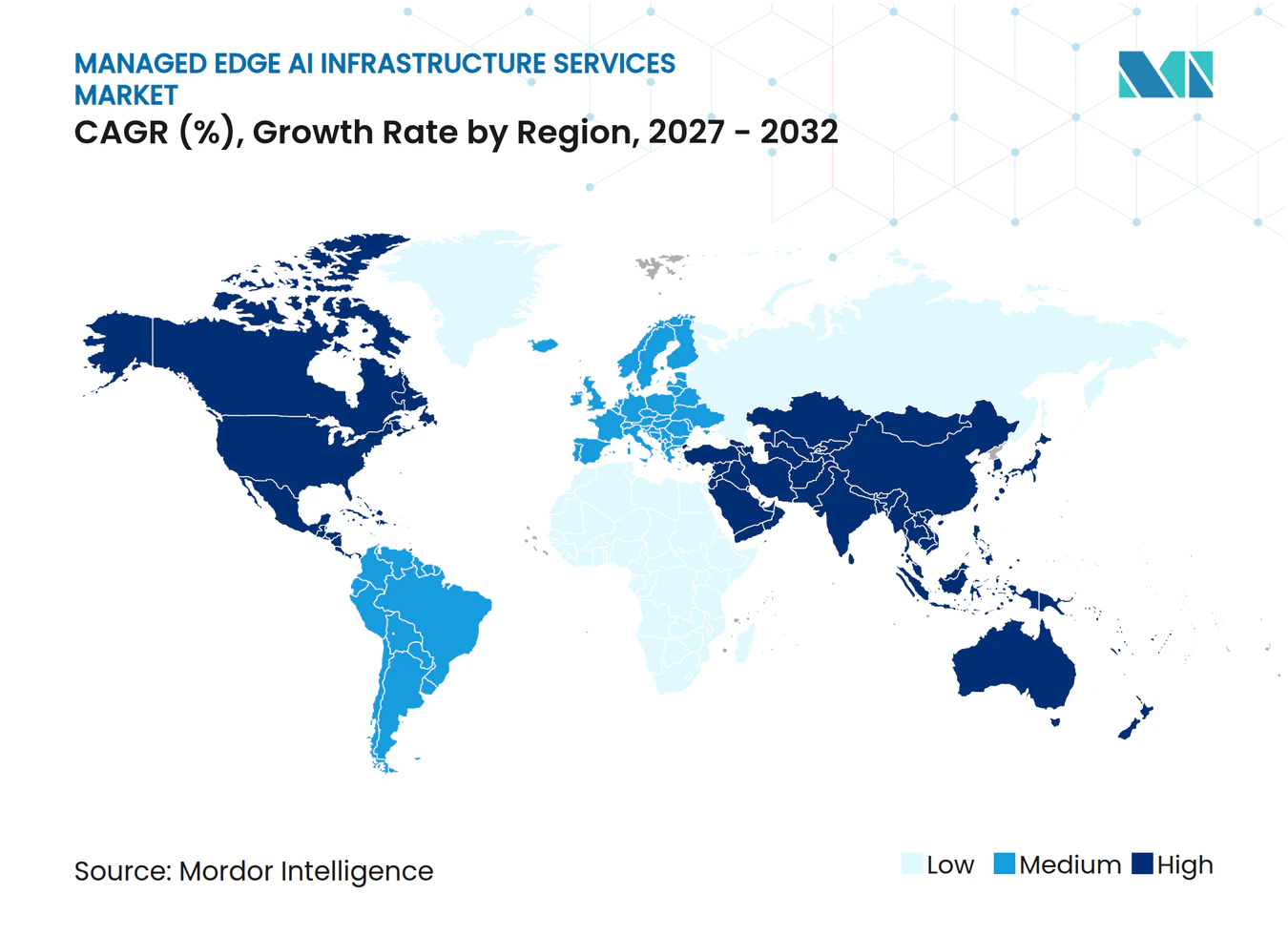
North America accounted for 36.76% of the Managed edge AI infrastructure services market share in 2026. The region benefits from established enterprise technology budgets, mature managed service relationships, and a large installed base of cloud-connected organizations. Manufacturing, logistics, and regulated public-sector workloads provide practical settings for local AI processing, while U.S. federal AI governance requirements support controlled architectures for sensitive work. Cisco’s Unified Edge work reflects the need for secure, AI-ready infrastructure across distributed enterprise locations.
Asia-Pacific is projected to expand at a 21.62% CAGR through 2032, giving it the fastest regional outlook in the Managed edge AI infrastructure services market. China combines hardware demand with smart city and industrial digitalization programs, while India is supported by Digital India, expanding 5G coverage, and local data handling requirements. Japan’s automotive, robotics, and semiconductor equipment sectors need fast inference for quality control and coordinated automation. Microsoft Research has identified cellular connectivity as a potential foundation for industrial AI edge systems, a model relevant to the region’s expanding wireless infrastructure.
Europe is shaped by the General Data Protection Regulation, the EU AI Act, and the EU Data Act, which has applied since September 2025. These compliance factors make local processing and documented control of AI data more relevant in financial services, health care, and critical infrastructure. Saudi Arabia’s Vision 2030 and the United Arab Emirates’ national AI strategy support industrial digitalization in the Middle East. Aramco Digital, Armada, and Microsoft announced an industrial distributed cloud collaboration in Saudi Arabia during February 2025, showing how ruggedized edge capacity can support energy and process operations. Africa and South America offer longer-term opportunities in utility management, agriculture, and financial inclusion where connectivity makes local processing necessary.
Competitive Landscape
Market Concentration
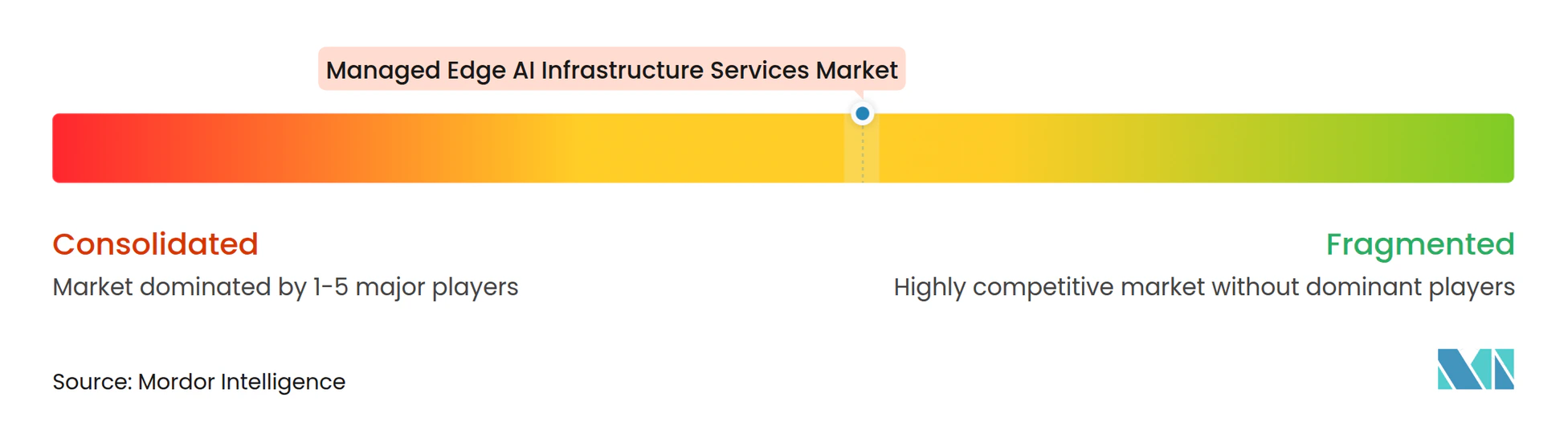
The Managed edge AI infrastructure services market remains moderately fragmented because no provider controls every layer from hardware through management software and managed delivery. Dell Technologies, HPE, Cisco, Lenovo, and Supermicro compete through validated platforms and services, while Siemens, Honeywell, Schneider Electric, and Rockwell Automation bring plant-floor expertise and direct industrial relationships. Advantech, Kontron, ADLINK, and AAEON compete through rugged hardware, long product lifecycles, and industry-specific integrations. Partnerships matter because customers often need components and expertise from several technology domains.
NVIDIA announced in August 2025 that Cisco, Dell Technologies, HPE, Lenovo, and Supermicro would bring RTX PRO 6000 Blackwell Server Edition GPUs to mainstream enterprise servers. Cisco announced the Secure AI Factory with NVIDIA in March 2026, including the Cisco AI Grid for service providers seeking managed edge AI delivery. HPE also announced its AI Grid in March 2026 for distributed inference environments. These actions emphasize repeatable reference architectures, including security, management, and support across many locations.
Cross-vendor orchestration remains a gap for enterprises operating mixed estates of devices, networks, software, and cloud services. Telecom operators and newer managed service providers can use multi-access edge computing assets for hosted inference services. Kontron positions its ManagedEdge IoT bundle around CRA-compliant and NIS-2-ready infrastructure for industrial buyers focused on regulation and asset longevity. Fleet-level model updates, data custody, and operational support remain important differentiators. Competitive success depends on ecosystem depth and operational execution rather than hardware specifications alone.
Managed Edge AI Infrastructure Services Industry Leaders
-
NVIDIA Corporation
-
Dell Technologies Inc.
-
Hewlett Packard Enterprise Company
-
Lenovo Group Limited
-
Cisco Systems, Inc.
- *Disclaimer: Major Players sorted in no particular order
Managed Edge AI Infrastructure Services Market Companies Covered in this Report
- NVIDIA Corporation
- Dell Technologies Inc.
- Hewlett Packard Enterprise Company
- Lenovo Group Limited
- Cisco Systems, Inc.
- Huawei Technologies Co., Ltd.
- Super Micro Computer, Inc.
- Advantech Co., Ltd.
- Siemens Aktiengesellschaft
- Schneider Electric SE
- Rockwell Automation, Inc.
- Honeywell International Inc.
- Nokia Corporation
- Ericsson AB
- Intel Corporation
- Advanced Micro Devices, Inc.
- Qualcomm Incorporated
- Kontron AG
- ADLINK Technology Inc.
- Fujitsu Limited
- NEC Corporation
- Mitsubishi Electric Corporation
- AAEON Technology Inc.
- Juniper Networks, Inc.
- OnLogic, Inc.
Recent Industry Developments in Managed Edge AI Infrastructure Services Market
- October 2026: Dell Technologies announced the expansion of its Dell AI Factory with NVIDIA, incorporating AI observability via Dynatrace, an agentic AI platform with Mistral, and computer vision solutions with Fogsphere. Dell Managed Services for AI is confirmed for availability in Q1 CY27, formalizing its end-to-end managed edge AI delivery model and addressing the growing enterprise demand for fully outsourced AI infrastructure operations.
- October 2026: Schneider Electric, NVIDIA, and HPE announced a strategic collaboration to accelerate Physical AI adoption in process and heavy industries, launching Industrial AI Agents at the Edge with initial applications focused on OT monitoring, cybersecurity, and energy optimization, directly extending managed edge AI services into the process industry vertical.
- March 2026: HPE announced the HPE AI Grid, an end-to-end distributed inference solution built on the NVIDIA reference architecture, enabling service providers to deploy and manage thousands of distributed inference sites as one intelligent system. Comcast, TELUS, and CityFibre were named as early ecosystem partners exploring the solution for edge inference use cases.
- March 2026: Cisco announced the Cisco Secure AI Factory with NVIDIA at GTC 2026, introducing NVIDIA RTX PRO 4500 Blackwell GPU support across its Unified Edge portfolio and launching the Cisco AI Grid with NVIDIA for service providers to offer managed edge AI services with carrier-grade reliability and data sovereignty controls.
Global Managed Edge AI Infrastructure Services Market Report Scope
The Managed Edge AI Infrastructure Services Market refers to the industry focused on the outsourced design, deployment, integration, monitoring, optimization, security, and lifecycle management of edge-based artificial intelligence infrastructure across distributed environments.
The Managed Edge AI Infrastructure Services Market Report is Segmented by Service Type (Infrastructure Management Services, Security Management Services, Network Management Services, Data Management and Observability Services, Device and Fleet Management Services, Model Operations and AI Lifecycle Services, and Managed Application and Inference Services), Infrastructure Type (Edge Servers and Appliances, AI Accelerators and Inference Modules, Edge Gateways and Industrial Computers, Micro Data Centers and Ruggedized Enclosures, Edge Storage and Data Protection Systems, and Edge Network Infrastructure), Deployment Model (Cloud-Managed Edge, On-Premises Edge, Hybrid Edge, Telco and Multi-Access Edge Computing, and Colocation and Distributed Data Center Edge), and Geography (North America [United States, Canada, and Mexico], South America [Brazil, Argentina, and Rest of South America], Europe [Germany, United Kingdom, France, Italy, Spain, and Rest of Europe], Asia-Pacific [China, Japan, India, South Korea, Australia, and Rest of Asia-Pacific], Middle East [Saudi Arabia, United Arab Emirates, Turkey, and Rest of Middle East], and Africa [South Africa, Nigeria, Egypt, and Rest of Africa]). The Market Forecasts are Provided in Terms of Value (USD).
Segmentation Overview
| Infrastructure Management Services |
| Security Management Services |
| Network Management Services |
| Data Management and Observability Services |
| Device and Fleet Management Services |
| Model Operations and AI Lifecycle Services |
| Managed Application and Inference Services |
| Edge Servers and Appliances |
| AI Accelerators and Inference Modules |
| Edge Gateways and Industrial Computers |
| Micro Data Centers and Ruggedized Enclosures |
| Edge Storage and Data Protection Systems |
| Edge Network Infrastructure |
| Cloud-Managed Edge |
| On-Premises Edge |
| Hybrid Edge |
| Telco and Multi-Access Edge Computing |
| Colocation and Distributed Data Center Edge |
| North America | United States |
| Canada | |
| Mexico | |
| South America | Brazil |
| Argentina | |
| Rest of South America | |
| Europe | Germany |
| United Kingdom | |
| France | |
| Italy | |
| Spain | |
| Rest of Europe | |
| Asia-Pacific | China |
| Japan | |
| India | |
| South Korea | |
| Australia | |
| Rest of Asia-Pacific | |
| Middle East | Saudi Arabia |
| United Arab Emirates | |
| Turkey | |
| Rest of Middle East | |
| Africa | South Africa |
| Nigeria | |
| Egypt | |
| Rest of Africa |
| By Service Type | Infrastructure Management Services | |
| Security Management Services | ||
| Network Management Services | ||
| Data Management and Observability Services | ||
| Device and Fleet Management Services | ||
| Model Operations and AI Lifecycle Services | ||
| Managed Application and Inference Services | ||
| By Infrastructure Type | Edge Servers and Appliances | |
| AI Accelerators and Inference Modules | ||
| Edge Gateways and Industrial Computers | ||
| Micro Data Centers and Ruggedized Enclosures | ||
| Edge Storage and Data Protection Systems | ||
| Edge Network Infrastructure | ||
| By Deployment Model | Cloud-Managed Edge | |
| On-Premises Edge | ||
| Hybrid Edge | ||
| Telco and Multi-Access Edge Computing | ||
| Colocation and Distributed Data Center Edge | ||
| By Geography | North America | United States |
| Canada | ||
| Mexico | ||
| South America | Brazil | |
| Argentina | ||
| Rest of South America | ||
| Europe | Germany | |
| United Kingdom | ||
| France | ||
| Italy | ||
| Spain | ||
| Rest of Europe | ||
| Asia-Pacific | China | |
| Japan | ||
| India | ||
| South Korea | ||
| Australia | ||
| Rest of Asia-Pacific | ||
| Middle East | Saudi Arabia | |
| United Arab Emirates | ||
| Turkey | ||
| Rest of Middle East | ||
| Africa | South Africa | |
| Nigeria | ||
| Egypt | ||
| Rest of Africa | ||
Key Questions Answered in the Report
What is the size of the managed edge AI infrastructure services market?
The managed edge AI infrastructure services market is projected to expand from USD 4.12 billion in 2026 and USD 5.12 billion in 2027 to USD 13.01 billion by 2032, at a 20.44% CAGR.
What is driving adoption of managed edge AI infrastructure services?
Low-latency inference, data sovereignty requirements, and the difficulty of running distributed AI fleets are supporting adoption. The Managed Edge AI Infrastructure Services Market benefits when organizations need this operating capability without building every specialist function internally.
Which service type is expected to expand fastest?
Model operations and AI lifecycle services are projected to expand at a 21.67% CAGR through 2032 as enterprises need continuous model monitoring and updates.
Which infrastructure type holds the largest share?
Edge servers and appliances held 28.78% revenue share in 2026 because they support local inference, orchestration, and application workloads.
Why do organizations use cloud-managed edge deployments?
Cloud-managed edge combines local processing with centralized monitoring, policy management, software updates, and reporting across multiple sites.
Which region has the fastest outlook for managed edge AI services?
Asia-Pacific is projected to expand at a 21.62% CAGR through 2032, supported by digital infrastructure, industrial automation, and local processing needs. The Managed Edge AI Infrastructure Services Market also reflects differing regulatory and network conditions across the region.