
Managed Data Storage Optimization Services Market Size and Share
Market Overview
| Study Period | 2021 - 2032 |
|---|---|
| Market Size (2027) | USD 19.59 Billion |
| Market Size (2032) | USD 28.81 Billion |
| Growth Rate (2027 - 2032) | 8.02 % |
| Fastest Growing Market | Asia-Pacific |
| Largest Market | North America |
| Market Concentration | Medium |
Major Players *Disclaimer: Major Players sorted in no particular order Image © Mordor Intelligence. Reuse requires attribution under CC BY 4.0. | |
Managed Data Storage Optimization Services Market Analysis by Mordor Intelligence
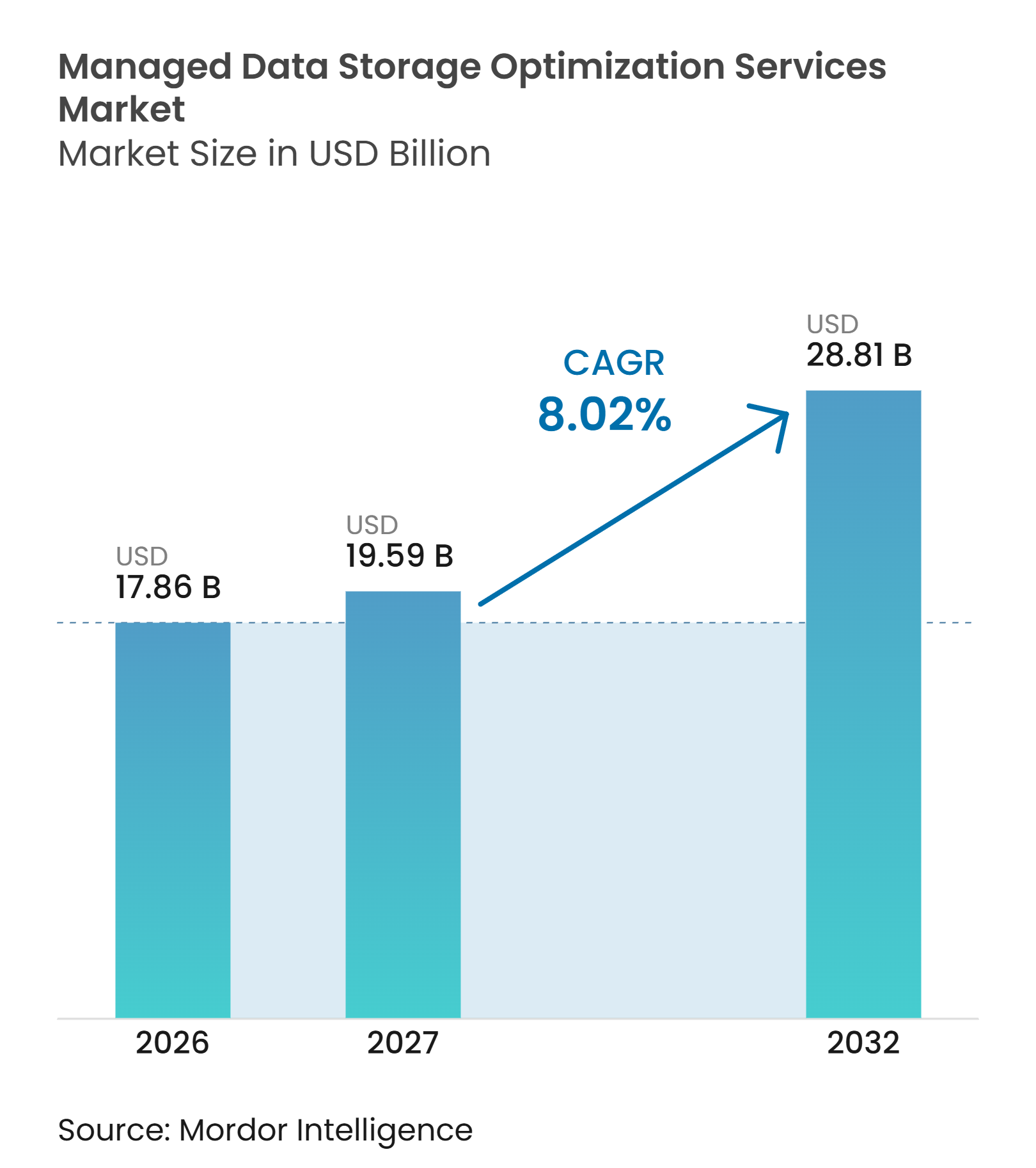
The managed data storage optimization services market size is projected to expand from USD 17.86 billion in 2026 and USD 19.59 billion in 2027 to USD 28.81 billion by 2032, registering a CAGR of 8.02% between 2027 to 2032. AI systems add new logs, synthetic datasets, and model artifacts to enterprise storage estates, making data classification and lifecycle management more important for teams that must decide what data to retain, protect, move, or remove. Organizations are also managing storage across on-premises systems, colocation sites, and public cloud platforms, which increases the need for consistent policies, visibility, practical accountability for data held in different locations and used by different applications, and clearer coordination when an organization changes its storage architecture or introduces new business systems that create additional data. Providers are responding by combining capacity operations with governance, security, cost controls, recovery support, and reporting that can help clients understand daily storage use, prepare for a change in workload demand, and bring storage, security, and application teams into a more consistent process for reviewing older data, checking recovery readiness, tracking policy changes, and documenting how operational decisions affect availability, cost, access, recovery, compliance, retention, contractual obligations, and internal service commitments across the full data lifecycle. The managed data storage optimization services market is therefore moving beyond capacity administration toward services that identify where data resides, who owns it, whether it remains useful, and how it can be protected without creating unnecessary cost, making the service relationship more closely connected to application priorities, data retention requirements, and business continuity requirements. Consumption-based offerings also widen access for organizations that do not want to make large infrastructure investments, while giving them a clearer path to add management support as data needs become more complex.
Key Report Takeaways
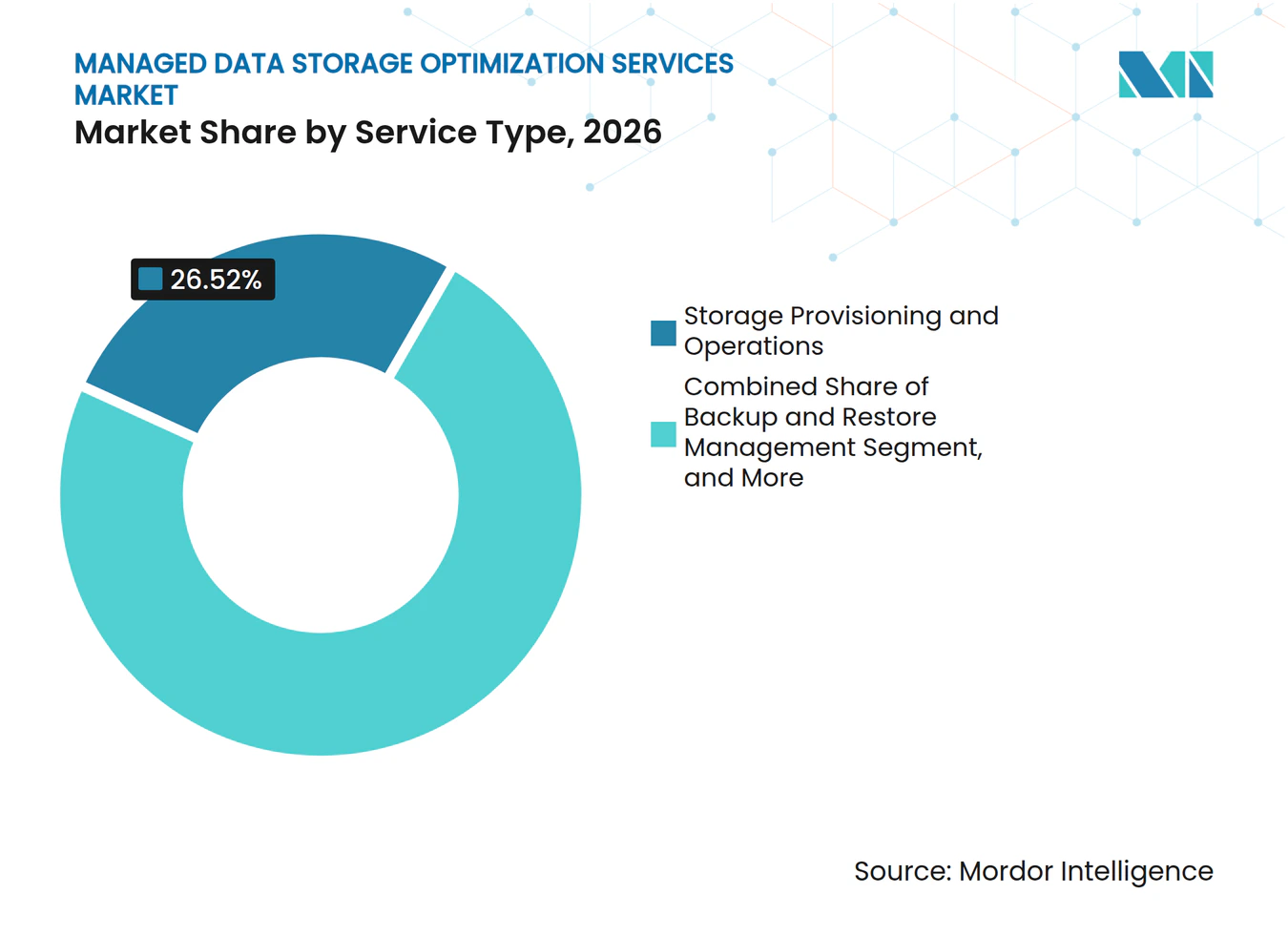
- By service type, Storage Provisioning and Operations held 26.52% share in 2026, while Compliance and Security Management is projected to expand at a 10.66% CAGR through 2032.
- By deployment model, Hybrid held 46.19% of the managed data storage optimization services market share in 2026, while Cloud-Native is projected to expand at an 11.34% CAGR through 2032.
- By organization size, Large Enterprises held 70.69% share in 2026, while Small and Medium Enterprises are projected to expand at a 10.39% CAGR through 2032.
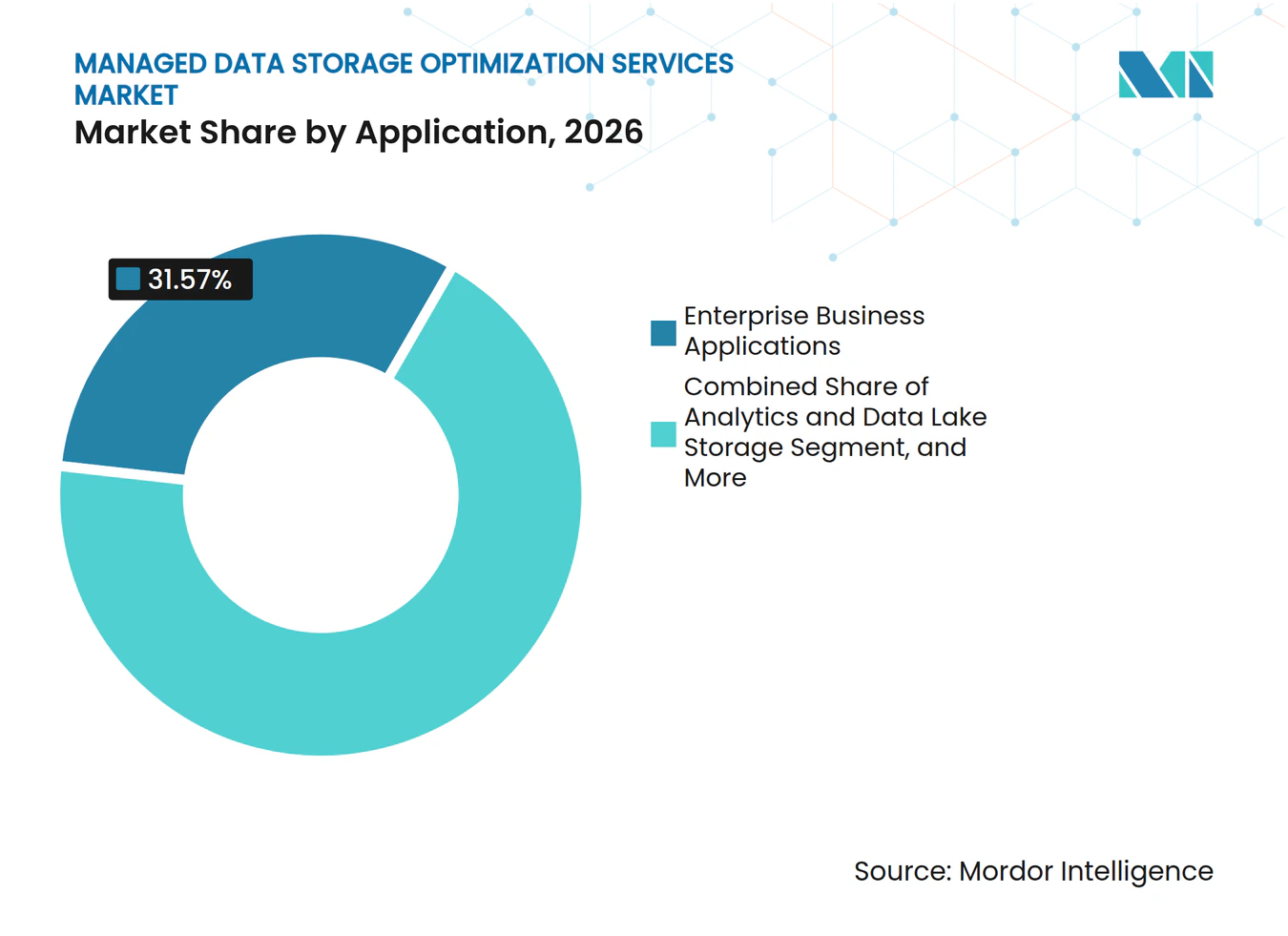
- By application, Enterprise Business Applications held 31.57% of the managed data storage optimization services market share in 2026, while AI and Machine Learning Workloads are projected to expand at a 12.41% CAGR through 2032.
- By end user, BFSI held 24.61% share in 2026, while Healthcare and Life Sciences are projected to expand at a 9.77% CAGR through 2032.
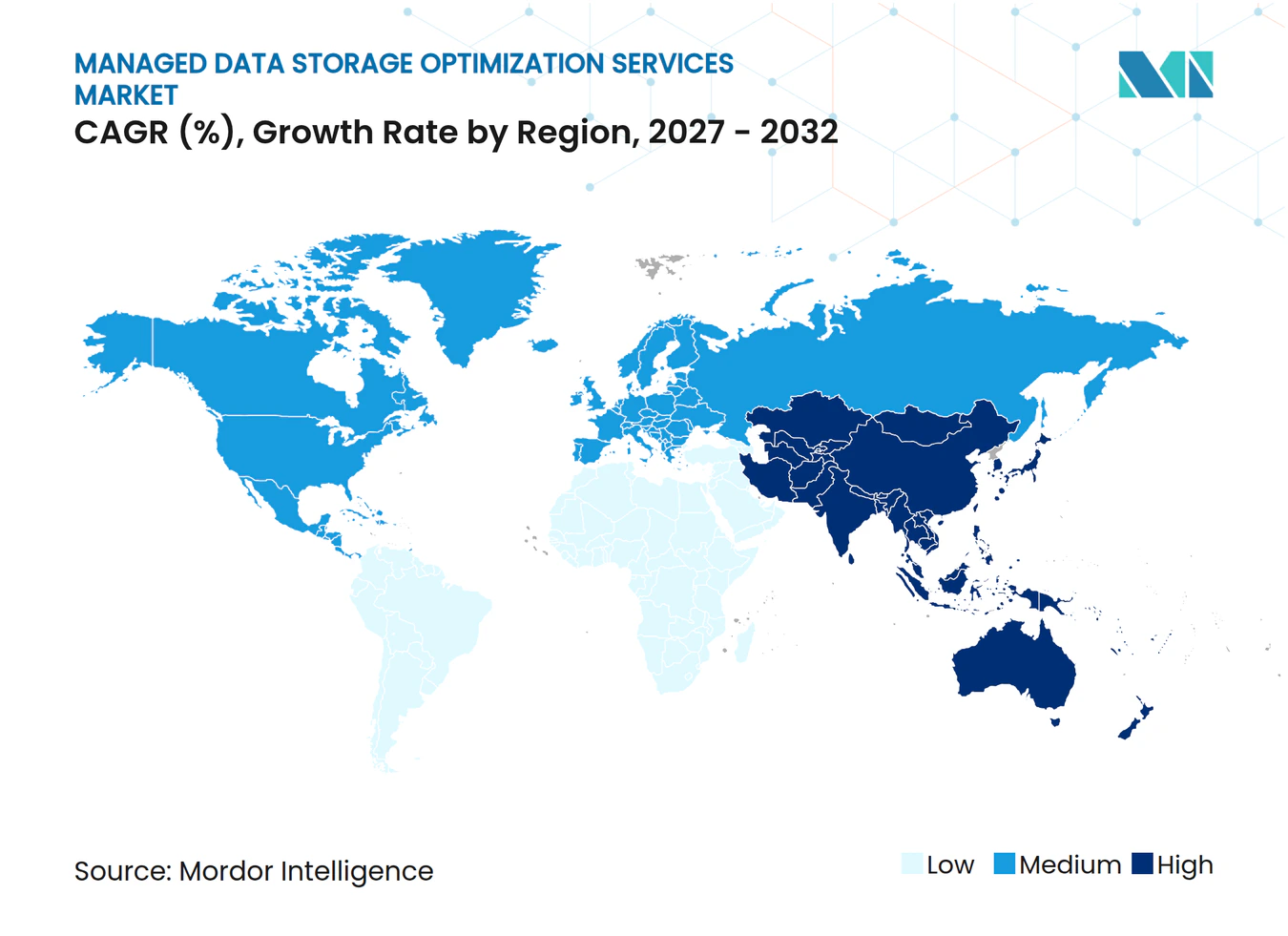
- By geography, North America held 37.73% share of the managed data storage optimization services market in 2026, while Asia-Pacific is projected to expand at a 10.49% CAGR through 2032.
Note: Market numbers in this report are based on Mordor Intelligence's proprietary estimation framework, which combines nine months of actuals with Q4 projections for base year 2026.
Market Trends and Insights
Drivers Impact Analysis of Managed Data Storage Optimization Services Market*
| Driver | (~) % Impact on CAGR Forecast | Geographic Relevance | Impact Timeline |
|---|---|---|---|
| Enterprise Data Growth and Storage Sprawl | +1.8% | Global, highest density in North America and Asia-Pacific | Short term (≤ 2 years) |
| AI and Analytics Workload Expansion | +1.6% | Global, with AI infrastructure concentration in North America and China | Medium term (2-4 years) |
| Cloud and Hybrid-Cloud Modernization | +1.5% | North America, Europe, Asia-Pacific core | Medium term (2-4 years) |
| Ransomware-Resilient Backup and Recovery Requirements | +1.4% | Global, acute in BFSI, healthcare, and government sectors | Short term (≤ 2 years) |
| Storage FinOps and Chargeback Adoption | +0.9% | North America and Europe, expanding to Asia-Pacific | Medium term (2-4 years) |
| Autonomous Placement of Cold and Duplicate Data | +0.7% | Global, highest impact in manufacturing, research, and media | Long term (≥ 4 years) |
| Source: Mordor Intelligence | |||
Enterprise Data Growth and Storage Sprawl
Enterprise data volumes have made manual storage management less practical for large organizations because data often sits across separate systems, teams, and retention practices. Komprise reported that 74% of IT and storage leaders stored more than 5 petabytes of unstructured data, a 57% increase from 2024, while 85% expected storage spending to rise in 2026.[1] Proofpoint found that 27% of cloud storage was abandoned, creating cost and security issues without supporting a business use case. This condition supports recurring services that identify, classify, and retire inactive data before it adds further cost or makes security oversight harder, particularly when the data is scattered across business units with different operating practices. It also shifts provider discussions from adding capacity to managing data that no longer has a clear owner, purpose, access requirement, or retention value, while helping clients distinguish information that must be retained from information that simply remains because no one has reviewed it. Clients can use this work to establish more consistent policies across business units without requiring every internal team to operate storage tools directly. The managed data storage optimization services market benefits when clients need ongoing policy enforcement, documented governance, regular review, and support in applying those rules across different storage environments rather than a single migration project.
AI and Analytics Workload Expansion
AI workloads change the volume, speed, and lifecycle of stored information, particularly where organizations repeatedly retrieve data to support models and user interactions. A Western Digital survey conducted by Foundry found that AI and machine learning workloads used an average of 24% of enterprise storage infrastructure, and 68% of respondents identified them as the main reason for higher storage needs. Western Digital and IDC reported that stored data created for AI persists and compounds after the original workload, including data needed for inference activity. Traditional tiering rules based only on file age or recent access may not suit dynamic AI data with changing retrieval and retention requirements. Providers that build policies around retrieval needs, retention rules, data classification, and appropriate storage tiers can address this change. They can also help application teams avoid treating every data object as if it needs the same level of performance and availability. AI and Machine Learning Workloads are, therefore, an important source of demand within the managed data storage optimization services market.
Cloud and Hybrid-Cloud Modernization
Organizations are distributing data across cloud and on-premises environments rather than completing a single migration, leaving them with a wider set of operating and governance decisions. Western Digital and IDC reported that 74.6% of enterprise data was held in warm, cool, and cold tiers, while 75.9% of organizations were bringing archived data back online for AI workloads. This movement between tiers requires metadata integrity, lifecycle controls, visibility across locations, and clear procedures for restoring data to active use. Hybrid deployments also require consistent access, backup, governance, and retention rules, even when the underlying storage platforms differ. Managed providers can support these requirements across environments that internal teams and isolated platform tools may manage separately. They can reduce the operational burden of coordinating policies between older systems and newer cloud services. The managed data storage optimization services market gains from this need for coordinated storage operations and a consistent view of data across locations.
Ransomware-Resilient Backup and Recovery Requirements
Ransomware has made backup repositories a direct security concern because recovery copies can be targeted alongside production systems. Veeam found that 69% of surveyed organizations experienced a ransomware attack involving encryption or exfiltration during the preceding 12 months. The same research stated that organizations emphasizing data resilience could recover up to 7 times faster than peers that did not. Immutable storage is becoming a baseline requirement rather than a premium feature for organizations that need a recovery option outside the affected environment. Clients also need confirmation that backup copies are clean before restoration and that recovery procedures are tested before an incident occurs. This expands demand for managed recovery validation, retention policies, resilient storage environments, and operating support during high-pressure recovery work. It also makes backup management more closely connected to broader security and continuity planning.
Restraints Impact Analysis of Managed Data Storage Optimization Services Market*
| Restraint | (~) % Impact on CAGR Forecast | Geographic Relevance | Impact Timeline |
|---|---|---|---|
| Data Egress and Data-Movement Charges | -1.2% | Global, most acute in multi-cloud and hybrid deployments | Short term (≤ 2 years) |
| Migration Complexity and Data Gravity | -0.9% | Global, highest impact in petabyte-scale enterprises | Medium term (2-4 years) |
| Incomplete Metadata and Ownership Records | -0.6% | Global, most severe in manufacturing, research, and media | Long term (≥ 4 years) |
| Optimization Policies Conflicting with Latency and Retention SLAs | -0.5% | North America and Europe, regulated industries | Medium term (2-4 years) |
| Source: Mordor Intelligence | |||
Data Egress and Data-Movement Charges
Data egress charges can make cloud storage decisions harder, even when capacity pricing appears attractive, especially where applications and data must move between providers. Backblaze and Dimensional Research found that 95% of organizations managing more than 250 TB of cloud data had received unexpected storage charges, and 58% cited the cost of moving or accessing data as the main barrier to multi-cloud strategies. The research also found that 56% of organizations were reducing stored datasets and 46% were tightening retention policies to manage costs.[2] These actions can limit the data available for training and refining AI models, particularly when older information is deleted before its future use is understood. They can also delay multi-cloud programs that depend on regular data movement, synchronization, and access across different environments. Service providers can address part of the problem through architectures that reduce unnecessary transfers and make data movement more deliberate, but the charges still limit client budgets. The restraint remains relevant because cost management can change both storage behavior and the pace of modernization.
Migration Complexity and Data Gravity
Large datasets create dependencies that make movement costly and disruptive, particularly when applications, users, and related services are already connected to a location. The 451 Alliance reported that the share of respondents affected by egress charges during migration increased from 53% in 2024 to 72% in 2025. It also found that 36% of organizations reported security exposures during migration and 25% experienced unplanned downtime. These risks can postpone an optimization project even when the long-term case is clear, and there is a need for better control of storage costs. The managed data storage optimization services market can benefit when clients use external specialists to plan, stage, test, and execute migrations. However, risk, cost, and operational disruption remain material barriers for petabyte-scale estates with many dependencies. Providers must demonstrate that optimization can be introduced in a controlled sequence rather than through a disruptive change to every system at once.
*Our forecasts treat driver/restraint impacts as directional, not additive. The impact forecasts reflect baseline growth, mix effects, and variable interactions.
Managed Data Storage Optimization Services Market Segment Analysis
By Service Type:
Operations Lead While Compliance Demand AcceleratesStorage Provisioning and Operations held 26.52% of the managed data storage optimization services market share in 2026. Organizations continue to need support for capacity allocation, performance monitoring, incident response, and the operation of hybrid block and file environments. These everyday activities remain labor-intensive where systems span several hardware generations, vendors, and operating procedures. Managed teams also coordinate routine configuration work, usage reviews, service requests, and escalation procedures that must be performed without disrupting business applications. This operational role is particularly relevant when internal infrastructure teams are responsible for other modernization programs at the same time. Backup and Restore Management is also important because clients want reliable recovery procedures when repositories are targeted. Archiving and Retention Management supports organizations that need long retention periods, defensible deletion practices, and auditable controls. Capacity Planning and Reporting adds visibility into available resources, expected demand, and the cost implications of storage decisions. Together, these service areas make operations work a continuing requirement rather than an occasional technology project.
Compliance and Security Management is projected to expand at a 10.66% CAGR through 2032. The segment addresses continuous monitoring, policy changes, access requirements, and audit documentation across changing hybrid environments. Its role extends beyond confirming that a storage system is available because organizations must also show that information is retained, protected, and recoverable according to applicable requirements. Cyber insurance and security requirements increase the value placed on certified, immutable, and well-documented storage practices. Clients are seeking managed support because maintaining these controls internally requires specialized staffing, recurring reviews, and sustained attention. Service providers can standardize these processes across data locations while still applying client-specific retention and access policies. The managed data storage optimization services market is therefore giving greater weight to compliance services alongside operational storage work. This shift favors providers that can connect security management to daily administration rather than treating it as a separate activity.



By Deployment Model:
Hybrid Remains Central While Cloud-Native Use ExpandsHybrid accounted for 46.19% of the market in 2026. Large organizations commonly operate across on-premises data centers, colocation facilities, and more than 1 public cloud platform. This arrangement often reflects earlier technology investments, application requirements, and the need to keep some data close to business operations. Hybrid managed services help apply governance, access controls, backup policies, and lifecycle rules consistently across these locations. They also provide a central operating model for teams that would otherwise use separate dashboards and processes for each environment. This remains difficult when organizations use a single-cloud toolset or a separate on-premises operating model. On-premises deployments also remain relevant in government and regulated sectors where sovereignty, control, or operational requirements limit full cloud migration. These clients need modernization support without a forced change to the location of every dataset. Hybrid services, therefore, retain a practical role in gradual infrastructure transitions.
Cloud-Native is projected to expand at an 11.34% CAGR through 2032. Cloud-first mandates among smaller businesses and digital-native organizations support this demand. These organizations often want storage services that scale with application use and do not require them to purchase, install, and maintain their own infrastructure. Storage-as-a-service models provide enterprise features without a large capital commitment. They can also make it easier to start with a limited deployment and add capacity or management functions as data volumes increase. Flexera reported that 60% of organizations were using managed service providers to control cloud spending, and 59% used or planned to use dedicated FinOps teams.[3] This shows why cloud cost visibility has become a core part of cloud-native managed storage services. Providers that explain usage, identify idle resources, and support budgeting can make cloud adoption more manageable for clients.
By Organization Size:
Large Enterprises Provide Scale While SMEs Adopt Flexible ServicesLarge Enterprises held 70.69% of the market in 2026. Their contracts are supported by multi-site infrastructure, legacy environments, and a high volume of storage assets that internal teams must coordinate. These estates often include different hardware generations, varied vendor relationships, and applications that cannot be interrupted during a change program. They need lifecycle management and policy harmonization across a broad data footprint. Large enterprises also face a greater need to define who is accountable for data, how long it should be retained, and where recovery copies should be held. Managed providers can apply repeatable processes across locations while giving central teams a clearer operating view. NetApp described a financial institution that generated more than USD 4 million in savings within 1 year after using Data Infrastructure Insights for chargeback management. The example illustrates why storage cost allocation and infrastructure visibility matter to organizations with complex environments. These requirements help explain the segment’s leading position.
Small and Medium Enterprises are projected to expand at a 10.39% CAGR through 2032. Consumption-based pricing replaces large capital outlays with recurring and more predictable charges. This can be useful for cloud-native firms that have no large legacy estate but still accumulate unstructured data from collaboration tools, customer data platforms, and AI applications. These organizations may have lean technology teams that need help with policy setting, backup administration, and cost review as their operations expand. A managed service gives them access to specialized storage practices without building a large internal operations group. Asia-Pacific is an important setting for this model because digitalization is proceeding quickly among many smaller organizations. The managed data storage optimization services market can reach these clients through service packages that are easier to adopt than traditional infrastructure programs. Clear service levels and usage-based charges can also improve budget planning for businesses with changing workloads. The segment’s outlook reflects both a lower adoption barrier and the growing need for formal data governance.
By Application:
Business Applications Lead While AI Changes Data Management NeedsEnterprise Business Applications accounted for 31.57% of the market in 2026. ERP, database management, and transaction-processing workloads create structured and comparatively predictable storage requirements. These systems support core activities such as finance, customer management, order processing, and internal operations. Their data may be less variable than AI workloads, but it still requires dependable availability, backup controls, and retention management. Data Protection and Disaster Recovery follow as organizations place greater attention on recovery readiness and the protection of important operational records. Analytics and Data Lake Storage is also gaining relevance as centralized platforms serve business intelligence and AI activities. These applications require a balance between controlled retention, availability, retrieval performance, and cost management. Providers must understand application priorities before moving data to a lower-cost tier or changing a retention policy. This keeps application knowledge central to managed storage planning.
AI and Machine Learning Workloads are projected to expand at a 12.41% CAGR through 2032. Western Digital and IDC found that 75.9% of organizations were bringing cold-tier data online for AI workloads, and 96% expected to need faster archive retrieval for inference and retrieval-augmented generation uses. The data used by these workloads may be created, reviewed, retrieved, and retained on a different cycle from conventional business records. Providers must accommodate both archival economics and rapid retrieval needs. They also need to understand when data should remain readily available and when it can return to lower-cost storage. Dynamic tiering policies can help data move between lower-cost and high-performance environments as workload requirements change. This requires accurate metadata and close coordination with the teams responsible for AI applications. The application is reshaping how managed providers define storage lifecycle management. It also supports demand for services that link storage operations to data governance and retrieval performance.

By End User:
BFSI Holds the Largest Position While Healthcare AdvancesBFSI accounted for 24.61% of the market in 2026. The sector combines long retention requirements, high transactional data volumes, and elevated cyber exposure. Managed contracts often span multiple jurisdictions and integrate with core banking systems, payment platforms, and other important services. Clients need documented and tamper-evident storage trails to meet operational and retention requirements. They must also ensure that recovery procedures do not undermine the availability or integrity of sensitive financial information. These conditions create switching costs and support longer service relationships. IT and Telecommunications, Government and Public Sector, Manufacturing, and Retail and E-Commerce also contribute demand through network telemetry, citizen records, design and production files, and transaction data. Each sector brings different requirements for performance, retention, access, and recovery. Managed providers must tailor their operating practices to these different data patterns.
Healthcare and Life Sciences are projected to expand at a 9.77% CAGR through 2032. Medical imaging, AI diagnostic tools, and longer record retention needs increase the scale and importance of storage planning. Clinical providers must manage rapidly expanding files while making relevant information available to authorized users. TierPoint and Pure Storage introduced an imaging storage-as-a-service offering in June 2025 with per-study billing for healthcare providers. The model addresses cost predictability, imaging workloads, and long-term clinical data retention. It also shows the value of a commercial approach that aligns storage charges more closely with healthcare activity. Healthcare clients place value on managed services that combine compliance requirements with ransomware resilience. The sector requires providers to handle critical data carefully while supporting changing imaging and diagnostic needs. These combined requirements support its faster expansion outlook.
Geography Analysis
North America Managed Data Storage Optimization Services Market
North America held 37.73% of the managed data storage optimization services market share in 2026. The region has a large base of enterprise data centers, developed managed services procurement, and extensive data governance requirements in financial services, healthcare, and defense. Large enterprises are modernizing legacy storage estates through hybrid and multi-cloud architectures, often while keeping critical applications and sensitive data subject to established operating requirements. Flexera reported that 60% of U.S.-based organizations were using managed service providers to improve control over cloud spending. The United States provides most regional revenue, while Canada and Mexico add demand from government digitalization, manufacturing, and the need to manage operational data across changing technology environments.
APAC Managed Data Storage Optimization Services Market
Asia-Pacific is projected to expand at a 10.49% CAGR through 2032. Digital-native SMEs in India, Indonesia, and Southeast Asia can adopt cloud-native storage services without the same legacy infrastructure burden seen in many Western enterprises. Data center activity in China and Japan creates related demand for optimization and management services, while government cloud programs support public-sector procurement across the region and add formal requirements for how agencies handle stored information. Fujitsu launched its Mission Critical Transformation Service in October 2025 to provide end-to-end migration support in Japan.[4] South Korea and Australia contribute through financial services and public-sector technology spending, giving the region a mix of mature and rapidly digitizing client groups.
EMEA and South America Managed Data Storage Optimization Services Market
Europe has a significant position because data sovereignty, data residency, and retention practices influence cloud storage decisions. Wasabi reported that 29% of German IT decision-makers prioritized data sovereignty capabilities when choosing cloud storage, while 90% of European organizations identified at least 1 fee-related factor in cloud storage budget overruns. The United Kingdom, Germany, and France provide the largest regional revenues, while Italy and other European countries add demand through public-sector digitalization and manufacturing data management, where access and retention controls remain important. South America remains an emerging area led by Brazil, and Middle East and Africa demand is supported by data center investment in Saudi Arabia and the UAE and financial services digitalization in South Africa.
Competitive Landscape
Market Concentration
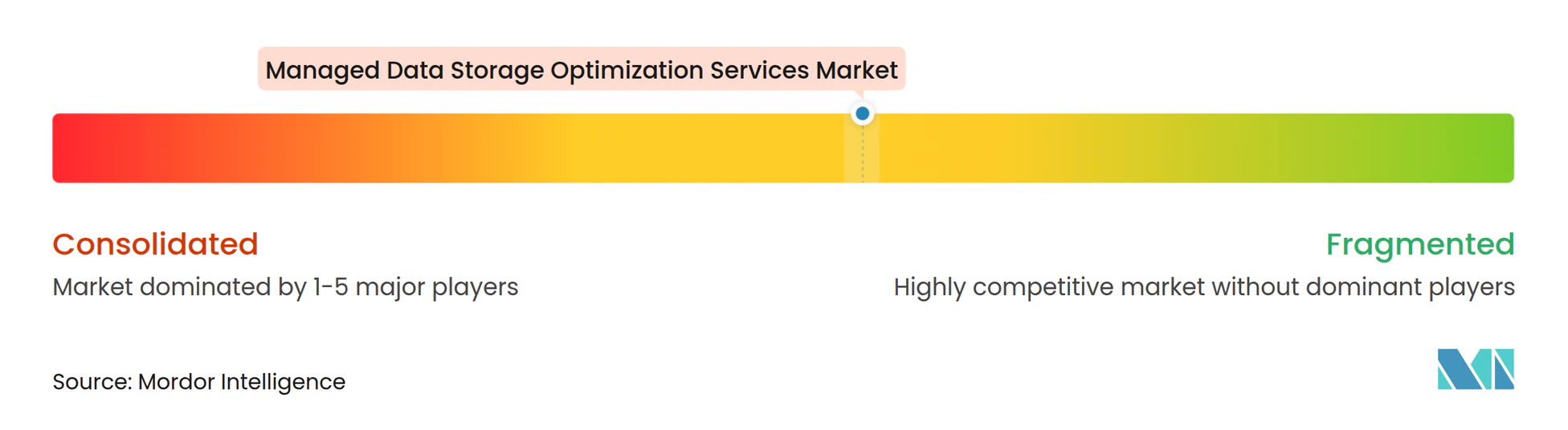
The managed data storage optimization services market is moderately fragmented. Hyperscalers and large infrastructure vendors, including AWS, Microsoft, Google, IBM, Dell Technologies, and Hewlett Packard Enterprise, compete through integrated platform ecosystems that combine storage with broader cloud or infrastructure services. Storage specialists and data protection vendors, including NetApp, Pure Storage, Commvault, Rubrik, Veeam, Cohesity, and Druva, compete through data intelligence, recovery reliability, and cross-cloud portability. The competitive focus includes AI-ready infrastructure, cyber resilience, and consumption-based commercial models, with Dell APEX and HPE GreenLake reflecting the use of flexible consumption structures to reach clients that do not want a major capital investment.
Providers are using product integration and data intelligence to differentiate their offers. Komprise, Druva, and Datadobi focus on visibility into data usage, classification, and ownership across multi-vendor environments. Komprise reported that visibility, classification, and ownership were leading data-management challenges for 56% of surveyed IT leaders. Cyber insurance and regulated-sector requirements also favor providers that can support air-gapped and immutable backup practices. In January 2025, Rubrik launched Cloud Vault, a managed air-gapped and immutable vault for on-premises and cloud-native backups, placing verified recovery and resilience at the center of competitive positioning.
Strategic moves also show a focus on cloud integration and AI data flows. NetApp and Oracle announced a fully managed cloud storage service for Oracle Cloud Infrastructure in September 2026, targeting AI pipelines, regulated applications, and high-performance computing workloads. In February 2026, Google Cloud NetApp Volumes reached general availability for iSCSI block storage, helping organizations move on-premises SAN workloads without application redesign. Veeam acquired Securiti in March 2026 to extend its platform from backup and recovery into data security and governance, adding data intelligence to its existing recovery capabilities. The competitive opportunity lies in managing warm and cold data as AI agent activity changes retrieval patterns, governance needs, and storage costs. Providers that combine data visibility, trusted recovery, cross-environment operations, and a clear consumption model are better positioned to retain complex enterprise accounts.
Managed Data Storage Optimization Services Industry Leaders
-
Amazon Web Services, Inc.
-
Microsoft Corporation
-
IBM Corporation
-
NetApp, Inc.
-
Fujitsu Limited
- *Disclaimer: Major Players sorted in no particular order
Managed Data Storage Optimization Services Market Companies Covered in this Report
- Amazon Web Services, Inc.
- Microsoft Corporation
- Google LLC
- IBM Corporation
- Dell Technologies Inc.
- Hewlett Packard Enterprise Company
- NetApp, Inc.
- Pure Storage, Inc.
- Oracle Corporation
- Hitachi Vantara LLC
- Huawei Technologies Co., Ltd.
- Fujitsu Limited
- NTT DATA Corporation
- DXC Technology Company
- Capgemini SE
- Accenture plc
- Tata Consultancy Services Limited
- Wipro Limited
- Commvault Systems, Inc.
- Rubrik, Inc.
- Veeam Software Group GmbH
- Veritas Technologies LLC
- Druva Inc.
- Cohesity, Inc.
- Zadara Storage, Inc.
- Datadobi NV
- Komprise, Inc.
- Lucidity Networks Private Limited
Recent Industry Developments in Managed Data Storage Optimization Services Market
- October 2026: Veeam made Intelligent ResOps for Microsoft 365 generally available on October 15, 2026, as an add-on to Veeam Data Cloud. The product maps AI agent activity across Microsoft 365 tenants, identifies sensitive-data exposure, and enables file-by-file rollback of agent-generated changes. Availability extends through Veeam Cloud and Service Providers.
- October 2026: AWS launched storage migration assessments within AWS Transform on October 21, 2026, enabling enterprises to upload on-premises storage inventories and receive automated workload-to-service mapping across Amazon S3, EBS, EFS, and FSx, with total cost of ownership projections and deployment comparisons.
- September 2026: NetApp and Oracle announced a fully managed cloud storage service for Oracle Cloud Infrastructure on September 29, 2026, bringing NetApp ONTAP data management capabilities to OCI for enterprise AI pipelines, regulated applications, and high-performance computing workloads.
- September 2026: NetApp launched Novus, a storage architecture for AI factory environments, at NetApp Insight 2026. Novus delivers throughput of up to 100 Tbps through a zettabyte-scale file system for high-density AI training and inference environments.
Global Managed Data Storage Optimization Services Market Report Scope
Managed data storage optimization services refer to third-party IT services that analyze, clean, and reconfigure an organization's data storage infrastructure to reduce costs and improve performance. Instead of managing complex storage hardware and cloud volumes in-house, companies outsource this responsibility to specialized vendors who continuously fine-tune where and how data is kept
The Managed Data Storage Optimization Services Market Report is Segmented by Service Type (Storage Provisioning and Operations, Backup and Restore Management, Archiving and Retention Management, Capacity Planning and Reporting, Compliance and Security Management, and Other Service Types), Deployment Model (On-Premises, Hybrid, Cloud-Native), Organization Size (Large Enterprises and Small and Medium-Sized Enterprises), Application (Enterprise Business Applications, Data Protection and Disaster Recovery, Analytics and Data Lake Storage, AI and Machine Learning Workloads, and Other Applications), End-User Industry (Banking, Financial Services, and Insurance, IT and Telecommunications, Healthcare and Life Sciences, Government and Public Sector, Manufacturing, Retail and E-Commerce, and Other End-User Industries), and Geography (North America, South America, Europe, Asia-Pacific, Middle East, and Africa). The Market Forecasts are Provided in Terms of Value (USD).
Segmentation Overview
| Storage Provisioning and Operations |
| Backup and Restore Management |
| Archiving and Retention Management |
| Capacity Planning and Reporting |
| Compliance and Security Management |
| Other Service Types |
| On-Premises |
| Hybrid |
| Cloud-Native |
| Large Enterprises |
| Small and Medium Enterprises |
| Enterprise Business Applications |
| Data Protection and Disaster Recovery |
| Analytics and Data Lake Storage |
| AI and Machine Learning Workloads |
| Other Applications |
| Banking, Financial Services, and Insurance |
| IT and Telecommunications |
| Healthcare and Life Sciences |
| Government and Public Sector |
| Manufacturing |
| Retail and E-Commerce |
| Other End Users |
| North America | United States |
| Canada | |
| Mexico | |
| South America | Brazil |
| Argentina | |
| Rest of South America | |
| Europe | United Kingdom |
| Germany | |
| France | |
| Italy | |
| Rest of Europe | |
| Asia-Pacific | China |
| Japan | |
| India | |
| South Korea | |
| Rest of Asia-Pacific | |
| Middle East | Saudi Arabia |
| United Arab Emirates | |
| Rest of Middle East | |
| Africa | South Africa |
| Nigeria | |
| Rest of Africa |
| By Service Type | Storage Provisioning and Operations | |
| Backup and Restore Management | ||
| Archiving and Retention Management | ||
| Capacity Planning and Reporting | ||
| Compliance and Security Management | ||
| Other Service Types | ||
| By Deployment Model | On-Premises | |
| Hybrid | ||
| Cloud-Native | ||
| By Organization Size | Large Enterprises | |
| Small and Medium Enterprises | ||
| By Application | Enterprise Business Applications | |
| Data Protection and Disaster Recovery | ||
| Analytics and Data Lake Storage | ||
| AI and Machine Learning Workloads | ||
| Other Applications | ||
| By End User | Banking, Financial Services, and Insurance | |
| IT and Telecommunications | ||
| Healthcare and Life Sciences | ||
| Government and Public Sector | ||
| Manufacturing | ||
| Retail and E-Commerce | ||
| Other End Users | ||
| By Geography | North America | United States |
| Canada | ||
| Mexico | ||
| South America | Brazil | |
| Argentina | ||
| Rest of South America | ||
| Europe | United Kingdom | |
| Germany | ||
| France | ||
| Italy | ||
| Rest of Europe | ||
| Asia-Pacific | China | |
| Japan | ||
| India | ||
| South Korea | ||
| Rest of Asia-Pacific | ||
| Middle East | Saudi Arabia | |
| United Arab Emirates | ||
| Rest of Middle East | ||
| Africa | South Africa | |
| Nigeria | ||
| Rest of Africa | ||
Key Questions Answered in the Report
What is the managed data storage optimization services market size?
The managed data storage optimization services market size is USD 17.86 billion in 2026 and is projected to reach USD 28.81 billion by 2032 at an 8.02% CAGR.
What services lead managed data storage optimization demand?
Storage Provisioning and Operations leads with 26.52% share in 2026, while Compliance and Security Management has the fastest projected expansion at a 10.66% CAGR.
Why are AI workloads changing storage management needs?
AI workloads require greater data classification, faster retrieval, and changing tiering rules as organizations bring archived data online for AI activities.
Which deployment model is most widely used for managed storage optimization?
Hybrid deployment leads with 46.19% share in 2026 because enterprises operate across on-premises locations, colocation sites, and public cloud platforms.
Which end-user sector has the fastest expansion outlook?
Healthcare and Life Sciences is projected to expand at a 9.77% CAGR through 2032, supported by medical imaging, diagnostic AI, and record-retention needs.
Which region has the fastest outlook for these services?
Asia-Pacific is projected to expand at a 10.49% CAGR through 2032, supported by SME digitalization, data center activity, and government cloud programs.