
Managed Backup and Recovery Services Market Size and Share
Market Overview
| Study Period | 2021 - 2032 |
|---|---|
| Market Size (2027) | USD 16.84 Billion |
| Market Size (2032) | USD 39.31 Billion |
| Growth Rate (2027 - 2032) | 18.47 % |
| Fastest Growing Market | Asia-Pacific |
| Largest Market | North America |
| Market Concentration | Low |
Major Players *Disclaimer: Major Players sorted in no particular order Image © Mordor Intelligence. Reuse requires attribution under CC BY 4.0. | |
Managed Backup and Recovery Services Market Analysis by Mordor Intelligence
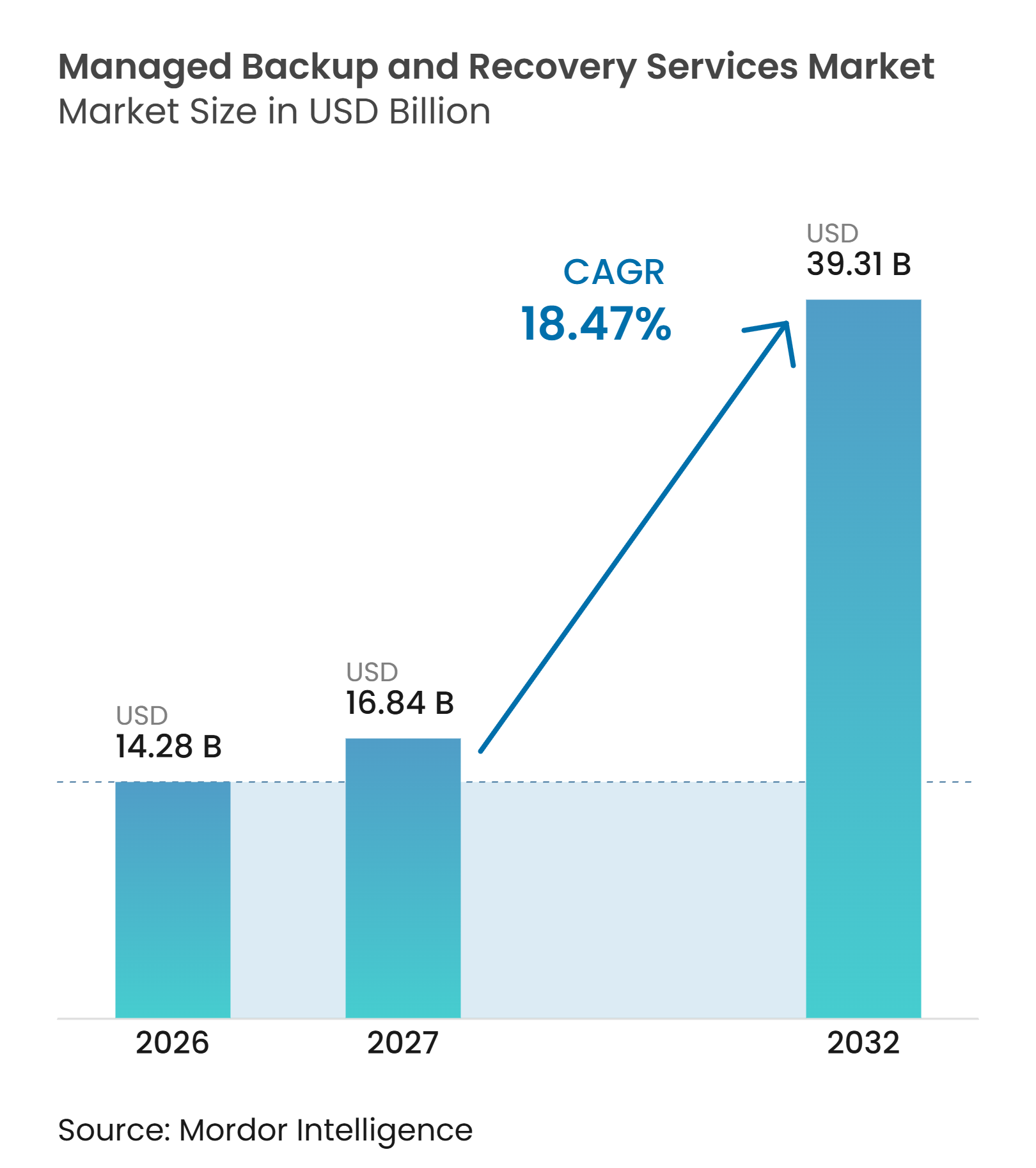
The managed backup and recovery services market size is projected to expand from USD 14.28 billion in 2026 to USD 16.84 billion in 2027, and to USD 39.31 billion by 2032, registering a CAGR of 18.47% between 2027 and 2032. The managed backup and recovery services market is being shaped by ransomware risk, which has moved backup integrity from an operational concern to a board-level priority. The reported average global cost of a data breach of USD 4.4 million makes managed protection more commercially viable for organizations that once relied on internal teams. Cyber-insurance requirements are also making immutable and tested backups an important condition for coverage. Providers are responding by combining protection, validation, and recovery capabilities rather than competing only on storage capacity. The managed backup and recovery services market also faces friction from residency rules and shortages of data-resilience talent, which raise delivery costs while reinforcing the value of managed services.
Key Report Takeaways
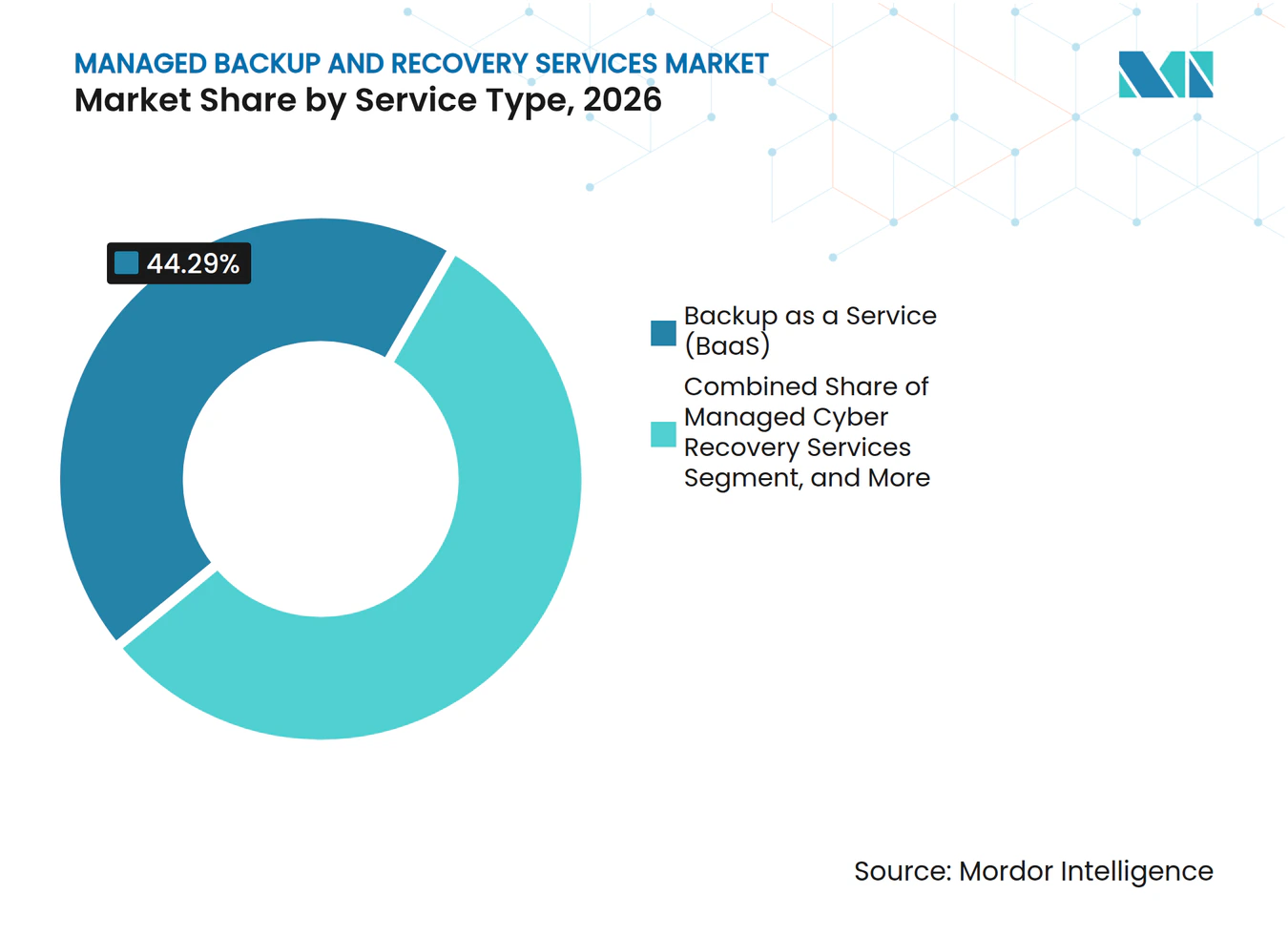
- By service type, Backup as a Service held 44.29% of the managed backup and recovery services market share in 2026, while Managed Cyber Recovery Services is projected to expand at a 19.66% CAGR through 2032.
- By deployment mode, public cloud accounted for 58.18% of the managed backup and recovery services market share in 2026, while hybrid cloud is expected to expand at a 19.98% CAGR through 2032.
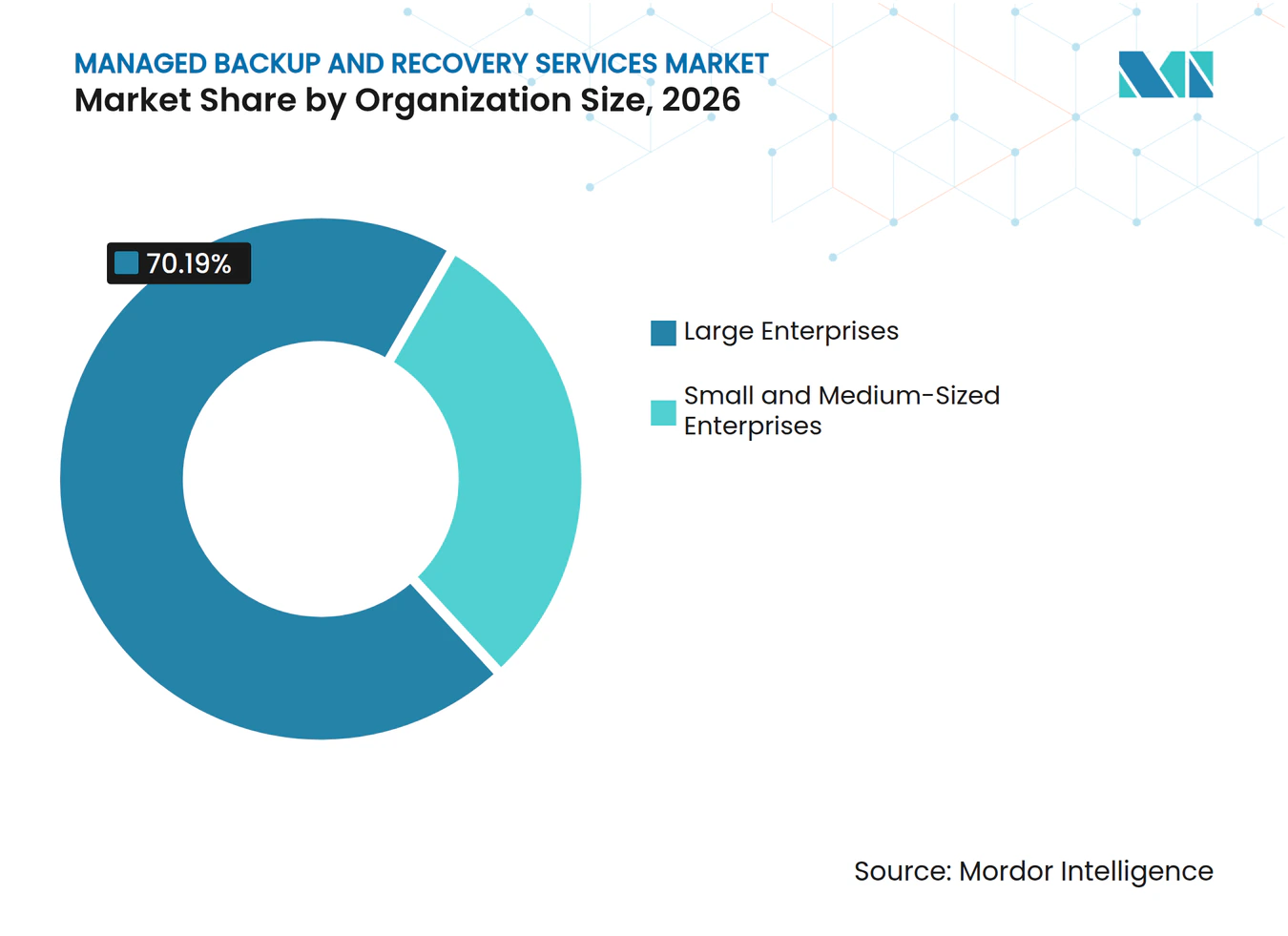
- By organization size, large enterprises accounted for 70.19% of the managed backup and recovery services market revenue in 2026, while small and medium-sized enterprises are projected to expand at a 20.31% CAGR through 2032.
- By end-user industry, BFSI accounted for 28.12% of the managed backup and recovery services market revenue in 2026, while Government and Public Administration is projected to expand at an 18.82% CAGR through 2032.
- By geography, North America accounted for 36.17% of the managed backup and recovery services market revenue in 2026, while Asia-Pacific is projected to expand at a 19.23% CAGR through 2032.
Note: Market numbers in this report are based on Mordor Intelligence's proprietary estimation framework, which combines nine months of actuals with Q4 projections for base year 2026.
Global Managed Backup and Recovery Services Market Trends and Insights
Drivers Impact Analysis*
| Driver | (~) % Impact on CAGR Forecast | Geographic Relevance | Impact Timeline |
|---|---|---|---|
| Escalating Ransomware and Cyberattack Exposure | +5.8% | Global | Short term (≤ 2 years) |
| Accelerating Hybrid and Multicloud Adoption | +3.5% | Global, led by North America and Europe | Medium term (2-4 years) |
| Stricter Data Retention and Sovereignty Requirements | +2.3% | Europe, Asia-Pacific, and North America | Medium term (2-4 years) |
| Rising Recovery Expectations for SaaS and Cloud Workloads | +1.9% | North America and Europe, with Asia-Pacific spillover | Medium term (2-4 years) |
| AI-Assisted Backup Operations and Recovery Automation | +1.6% | Global, with early gains in North America | Long term (≥ 4 years) |
| Managed Resilience Demand From IT Skills Shortages | +1.4% | Global, most acute in North America and Europe | Short term (≤ 2 years) |
| Source: Mordor Intelligence | |||
Escalating Ransomware and Cyberattack Exposure
Ransomware has changed the buying logic in the managed backup and recovery services market because attackers increasingly target backup repositories before demanding payment. A self-hosted backup environment may not provide an independent path to recovery when the attacker can reach stored copies. This risk makes immutable storage and tested restoration central to service selection. The USD 4.4 million global average cost of a data breach reported for 2025 supports the commercial case for stronger recovery preparation. Insurers have begun to treat tested, immutable backups as an important condition for cyber liability coverage. MSP360 reported that cyberattacks were the leading client concern in its 2025 backup research, exceeding the next-highest category, disruption, by ratios ranging from 2:1 to 4:1.
Accelerating Hybrid and Multicloud Adoption
The managed backup and recovery services market benefits from increasingly mixed enterprise infrastructure. Flexera reported that 89% of enterprises had adopted multicloud strategies and that 73% were operating hybrid cloud environments in 2025. Protection now needs to cover on-premises systems, SaaS applications, cloud-native containers, and edge environments. Each environment can have different interfaces, retention rules, and recovery requirements. A single cloud-native tool does not necessarily cover all these layers with a single consistent policy. Providers that coordinate protection across the full data estate can broaden contract scope and compete on operational consistency rather than on infrastructure alone.
Stricter Data Retention and Sovereignty Requirements
The managed backup and recovery services market is driven by compliance requirements that apply to both backup copies and primary systems. The EU Data Act became applicable on September 12, 2025, and its cloud-switching provisions set the direction for the removal of switching-related charges from January 12, 2027. India, China, and Russia have data residency requirements that complicate the design of a single-region backup for global organizations. GDPR, ISO 27001, HIPAA, and PCI DSS also require documented and tested backup and recovery controls. Acronis has noted that organizations need controls that account for sovereignty and cross-border backup compliance. Providers with regional infrastructure, documented controls, and clear key management practices can have an advantage in compliance-led procurement.
Rising Recovery Expectations for SaaS and Cloud Workloads
Organizations are recognizing that SaaS platforms do not provide full recovery for all customer-generated content. Customers retain responsibility for recovering their own data under the shared-responsibility approach used by Microsoft, Google, and Salesforce. Fewer than half of enterprises had tested their SaaS data-recovery procedures as of 2025, according to Kaseya. Druva introduced Microsoft 365 Copilot Chat backup and native eDiscovery in July 2026, extending protection toward AI-generated content and Legal Hold for Copilot Chat sessions. This development shows how the recovery requirement is extending beyond conventional collaboration data. Managed providers can respond with recovery-point validation, clean-room testing, and recovery-time commitments across SaaS and infrastructure workloads.
Restraints Impact Analysis*
| Restraint | (~) % Impact on CAGR Forecast | Geographic Relevance | Impact Timeline |
|---|---|---|---|
| Data Residency and Cross-Border Transfer Complexity | -1.2% | Europe, Asia-Pacific, and North America | Medium term (2-4 years) |
| Legacy-System Integration and Migration Friction | -0.9% | Global, most acute in North America and Europe | Medium term (2-4 years) |
| Cloud Egress Costs and Provider Lock-In Risk | -0.8% | Global | Short term (≤ 2 years) |
| Shortage of Data-Resilience Engineering Talent | -0.6% | Global | Long term (≥ 4 years) |
| Source: Mordor Intelligence | |||
Data Residency and Cross-Border Transfer Complexity
Data residency creates procurement friction even though compliance obligations also stimulate demand for managed protection. A provider serving global accounts may need regionally isolated capacity in the European Economic Area, India, China, and other jurisdictions. This approach requires separate encryption-key management and replication controls. Local-storage mandates in Russia, China, and India can prevent a single-region recovery design. Organizations may also face compliance exposure where older backup jobs replicate data across borders without reflecting newer localization rules. AWS recommends recovery designs that retain workloads within the required jurisdiction and apply storage policy controls at the workload level.[1] Operational complexity increases the cost and time required to deploy globally consistent services.
Legacy-System Integration and Migration Friction
Many enterprises continue to operate backup infrastructure that predates cloud-first deployment models. Tape libraries, older agents, and proprietary deduplication appliances can create migration risk and require a period of parallel operations. This issue is especially material in manufacturing, financial services, and healthcare because change-control procedures and recovery commitments limit the scope for rapid replacement. The Indian Health Service renewed a single-source managed backup contract with Iron Mountain in September 2026, citing data-loss risk and the cost of reformatting years of backup chains. Cohesity acquired Stone Ram in October 2025 to reduce migration friction for NetBackup customers. Cohesity stated that the acquired technology can reduce upgrade time by 75%, making migration tooling a more important competitive capability.
*Our forecasts treat driver/restraint impacts as directional, not additive. The impact forecasts reflect baseline growth, mix effects, and variable interactions.
Segment Analysis
By Service Type: BaaS Holds the Largest Revenue Position While Cyber Recovery Leads Growth
Backup as a Service held 44.29% of revenue in 2026. Its pay-per-use model, centralized management interface, and immutability features address demand for predictable and auditable protection in the managed backup and recovery services market. Cyber-insurance requirements that specify cloud-native and immutable backups further support its adoption. The service eliminates the need for organizations to maintain backup infrastructure solely through capital spending. It also brings policy management and oversight into a contract-based service model.
Managed Cyber Recovery Services is projected to expand at a 19.66% CAGR through 2032. The managed backup and recovery services market is placing greater value on verifying that recovery data is clean before restoration. Restoring a copy that contains dormant malware can reproduce the underlying incident rather than return operations to a secure state. Disaster Recovery as a Service holds the second-largest share of service-type revenue, while Managed Data Protection Services serve the middle tier by outsourcing policy management and compliance reporting. Clean-room environments are becoming increasingly important because they enable forensic validation within an isolated cloud partition before a production cutover. Rubrik and CrowdStrike integrated their platforms in September 2026 to reduce identity infrastructure recovery times from days to hours through threat telemetry and automated clean-recovery-point identification.



By Deployment Mode: Public Cloud Leads While Hybrid Cloud Gains Ground
Public cloud accounted for 58.18% of revenue in 2026. It provides the managed backup and recovery services market with geographic redundancy and consumption-based pricing without upfront capital requirements. These characteristics support broad deployment across standard enterprise workloads. Private cloud accounts for much of the remaining non-hybrid demand in financial services, government, and defense. In these settings, operational control and residency requirements can outweigh the cost advantages associated with public cloud.
Hybrid cloud is projected to expand at a 19.98% CAGR through 2032 as organizations balance recovery needs, residency obligations, and performance requirements. The managed backup and recovery services industry is seeing hybrid adoption, as a single public cloud region cannot meet every requirement at once. The managed backup and recovery services market must therefore support recovery across distinct environments. A 2026 survey of German enterprises found that 57% used hybrid cloud as their primary model, with 54% planning to retain that approach. Full restoration of 100 terabytes from AWS S3 Standard could incur USD 9,000 in transfer charges under the published pricing tiers, which encourages some organizations to retain primary recovery copies in private cloud or colocation environments. Providers that explain egress costs and commit to multicloud portability can differentiate in enterprise evaluations.
By Organization Size: Large Enterprises Lead Revenue While SMEs Expand Faster
Large enterprises accounted for 70.19% of the managed backup and recovery services market size in 2026. Their position reflects larger data estates across multiple regions, workload types, and regulatory environments. These organizations often have high contract values and extended procurement processes. Migration complexity can also keep their spending concentrated with established platform providers. Their requirements commonly include documented controls, repeatable testing, and recovery commitments across many systems.
Small and medium-sized enterprises are projected to expand at a 20.31% CAGR through 2032. In the managed backup and recovery services market, cloud-native delivery lowers the entry cost of managed protection for these buyers. Cyber-insurance requirements and predictable per-user pricing also support adoption. SMEs often buy through managed service providers that bundle backup with endpoint management, monitoring, and security into a single monthly contract. Kaseya found that backup and disaster recovery ranked as the second-strongest year-over-year MSP revenue growth area in 2026, while nearly half of MSPs applied automation most heavily to backup workflows. NAKIVO reported 25% revenue expansion in Q4 2025 and added direct-connect capabilities for secure multi-tenant management in version 11.1.

By End-User Industry: BFSI Leads Spending While Government Accelerates
BFSI accounted for 28.12% of the managed backup and recovery services market in 2026. This position reflects the sector’s high regulatory exposure and the cost of service disruption. The EU’s Digital Operational Resilience Act has been in force since January 2025 and requires financial entities to have documented, tested recovery capabilities.[2] Healthcare and life sciences constitute the third-largest revenue pool because downtime can have consequences for patient care and finances. IT and telecommunications providers are also substantial buyers because they handle high data volumes and maintain service-level commitments to customers.
Government and Public Administration is projected to expand at an 18.82% CAGR through 2032. This part of the managed backup and recovery services market is supported by national digitalization programs and growing cyberattacks on public infrastructure. Jeskell Systems and Cobalt Iron introduced an AI- and analytics-driven Backup as a Service offering for United States federal agencies in November 2025. Industrial manufacturing is another emerging demand area because Industry 4.0 deployments generate industrial IoT feeds, SCADA logs, and digital-twin configurations that require protection distinct from conventional IT data. Retail and e-commerce demand is tied to seasonal transaction activity, while education and research institutions are adopting managed services as research data volumes and ransomware exposure rise.
Geography Analysis
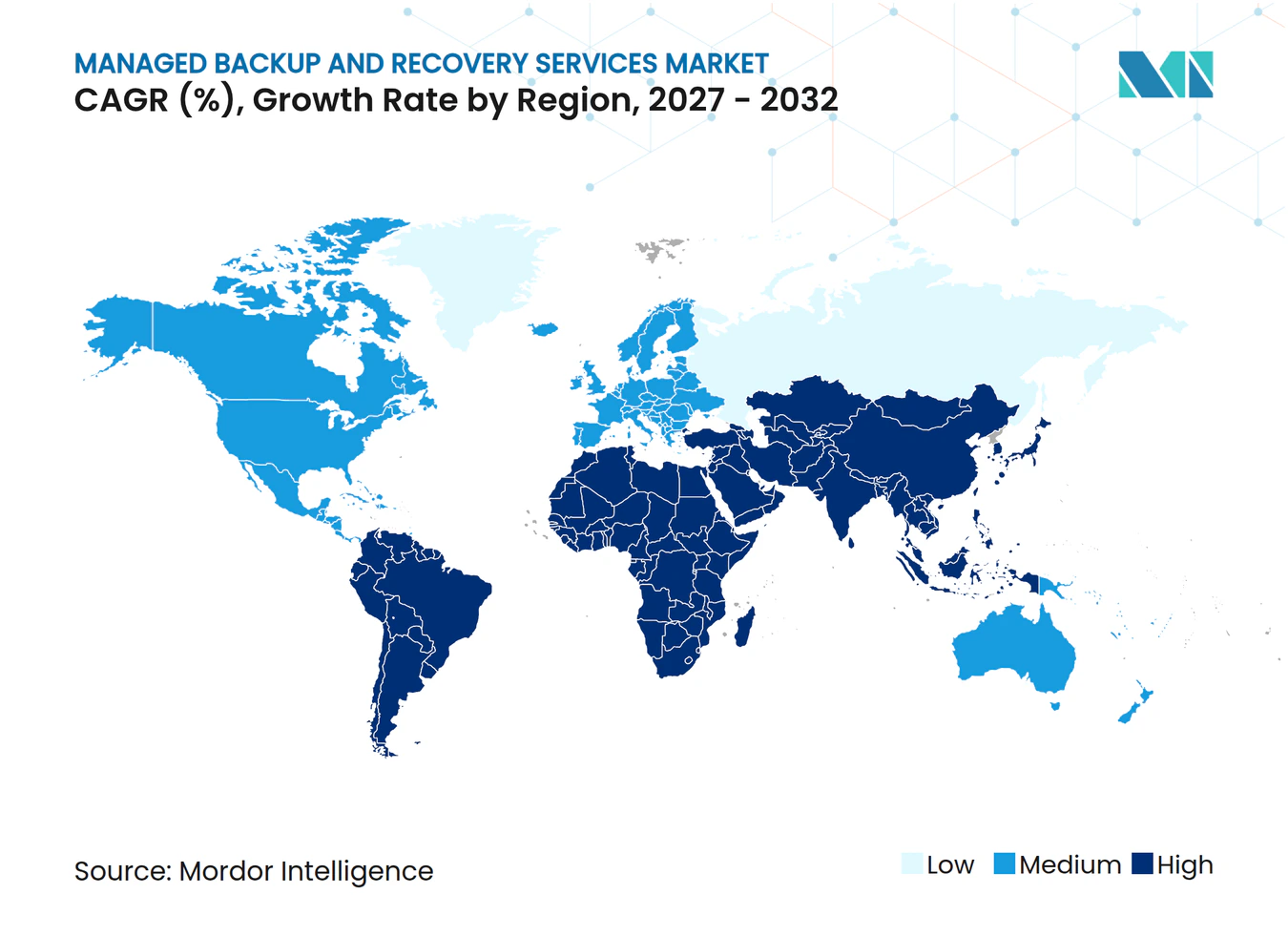
North America accounted for 36.17% of revenue in 2026. The managed backup and recovery services market in the region benefits from mature cloud infrastructure, cyber-insurance practices, and a large base of enterprises with complex multicloud estates. The Indian Health Service renewed a managed backup agreement with Iron Mountain in September 2026, citing data-loss risk from switching and the cost of reformatting historical backup chains. Such public-sector procurement can reinforce established provider relationships over multiple years.
Europe holds the second-largest regional revenue position in the managed backup and recovery services market. Germany, the United Kingdom, and France support demand for auditable architectures in regulated sectors through GDPR, the EU Data Act, and the Digital Operational Resilience Act. Hybrid cloud is important because organizations need locally compliant recovery designs, and 57% of German organizations identified it as their primary model in a 2026 survey. This pattern reflects the importance of sovereignty and resilience in European technology decisions.
Asia-Pacific is projected to expand at a 19.23% CAGR through 2032, the highest regional rate in the managed backup and recovery services market. Japan’s domestic backup and recovery segment was valued at USD 385 million in July 2026, up 9.7% year over year. ITR projected a 12% CAGR through fiscal year 2030 as ransomware-related supply chain risk rises on corporate agendas. China, India, and South Korea are accelerating cloud workload migration as regional data-center capacity expands. India is both a source of demand and a delivery hub because IT services firms use managed backup internally and resell related services to global enterprises. South America, the Middle East, and Africa remain emerging demand pools, with Brazilian financial-sector rules, du Tech’s UAE National Hypercloud platform, and the Development Bank of Southern Africa’s 2025 five-year managed DRaaS tender showing institution-led demand.
Competitive Landscape
Market Concentration
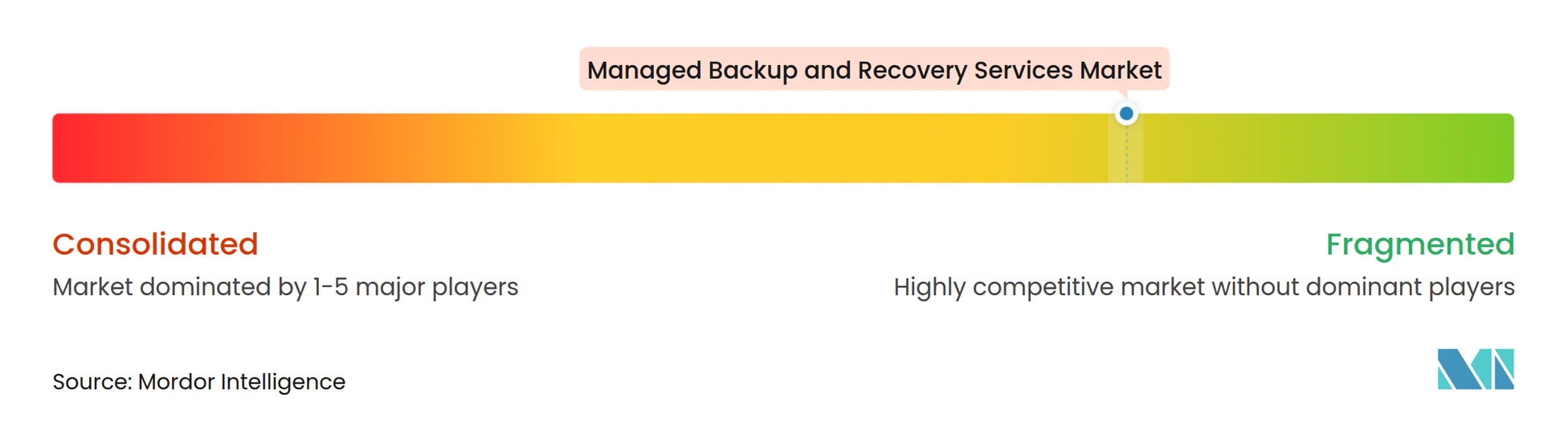
The managed backup and recovery services market is moderately concentrated among major platforms and fragmented among specialist and regional providers. Cohesity’s December 2024 acquisition of Veritas’ data protection portfolio created a combined organization that RBC Capital Markets estimated at 19% share, making it the leader after no provider had held a double-digit share. Veeam and Commvault form the next competitive tier, while Rubrik’s April 2024 public listing created a visible valuation reference point at USD 17 billion. The 2026 Gartner Magic Quadrant retained the same 6 leaders as the prior year, indicating stable leadership in the core platform segment.
Competition in the managed backup and recovery services market is moving beyond basic backup functionality toward greater depth in cyber resilience. Key areas include ransomware detection, validation of clean recovery points, identity restoration, and AI-workload protection. Veeam completed its USD 1.725 billion acquisition of Securiti AI in December 2025, combining data resilience with data security posture management, privacy governance, and AI trust.[3] Commvault announced Threat Scan and Data Posture 360 for Microsoft 365 in October 2026, applying current threat intelligence to historical immutable backups. ISO 22301 and ISO 27001 certifications, together with clean-room recovery capabilities, can improve a provider’s position in procurement in the regulated sector.
Independent providers remain relevant in the managed backup and recovery services market, where buyers seek bundled backup, endpoint management, monitoring, and security. This is particularly important for SMEs without dedicated resilience teams. Sovereign-cloud backup outside North America and AI-native recovery remain areas of opportunity. Assured Data Protection created a United States Public Sector Division in November 2025 to deliver Rubrik Security Cloud as a fully managed service for public agencies, while Veeam acquired Object First in January 2026 to strengthen immutable-storage control across hardware and software. The competition, therefore, combines leading platforms with specialist providers focused on regional, mid-market, and sector-specific needs.
Managed Backup and Recovery Services Industry Leaders
-
Veeam Software Group GmbH
-
Commvault Systems, Inc.
-
Rubrik, Inc.
-
Cohesity, Inc.
-
Druva, Inc.
- *Disclaimer: Major Players sorted in no particular order
Recent Industry Developments
- October 2026: Veeam made Intelligent ResOps for Microsoft 365 generally available as an add-on to Veeam Data Cloud, connecting production data and backup context through the DataAI Command Graph to enable precision recovery of AI-agent data, sensitive-data discovery, and file-level change tracing without data migration or re-architecture.
- October 2026: Commvault announced Threat Scan and Data Posture 360 for Microsoft 365, enabling organizations to apply current threat intelligence to historical, immutable backups across Exchange, OneDrive, SharePoint, and Teams to identify threats that were missed at the time of initial protection. General availability is targeted for early 2027 as paid add-ons to Commvault Backup and Recovery for Microsoft 365.
- September 2026: Druva launched Ransomware Detection for AWS EC2, EBS, VMware, and Azure virtual machines on September 17, 2026. The multi-stage detection uses behavioral indicators and entropy validation against clean baselines, with Druva stating the capability reduces false positives by 98%.
- August 2026: Wipro and Rubrik launched Enterprise Resilience as a Service on August 5, 2026, a consulting-led managed offering that makes resilience a predictive, continuously managed capability. AI capabilities run through Wipro’s WINGS delivery platform on Rubrik’s immutable protection and threat-aware recovery architecture.
Global Managed Backup and Recovery Services Market Report Scope
The Managed Backup and Recovery Services Market comprises outsourced data protection, backup management, disaster recovery, cyber recovery, and recovery orchestration services designed to ensure business continuity, data resilience, and rapid restoration of workloads following operational disruptions, cyberattacks, accidental deletion, system failures, or disasters. These services include backup administration, disaster recovery management, data protection operations, cyber recovery planning, monitoring, testing, and recovery execution across cloud and hybrid environments.
The Managed Backup and Recovery Services Market Report is Segmented by Service Type (Backup as a Service [BaaS], Disaster Recovery as a Service [DRaaS], Managed Data Protection Services, and Managed Cyber Recovery Services), Deployment Mode (Public Cloud, Private Cloud, and Hybrid Cloud), Organization Size (Large Enterprises, and Small and Medium-Sized Enterprises), End-User Industry (Banking, Financial Services, and Insurance [BFSI], Government and Public Administration, Healthcare and Life Sciences, IT and Telecommunication, Industrial Manufacturing, Retail and E-commerce, Education and Research Institutions, and Other End-User Industries), and Geography (North America, South America, Europe, Asia-Pacific, Middle East, and Africa). The Market Forecasts are Provided in Terms of Value (USD).
| Backup as a Service (BaaS) |
| Disaster Recovery as a Service (DRaaS) |
| Managed Data Protection Services |
| Managed Cyber Recovery Services |
| Public Cloud |
| Private Cloud |
| Hybrid Cloud |
| Large Enterprises |
| Small and Medium-Sized Enterprises |
| Banking, Financial Services, and Insurance (BFSI) |
| Government and Public Administration |
| Healthcare and Life Sciences |
| IT and Telecommunication |
| Industrial Manufacturing |
| Retail and E-commerce |
| Education and Research Institutions |
| Other End-User Industries |
| North America | United States |
| Canada | |
| Mexico | |
| South America | Brazil |
| Argentina | |
| Rest of South America | |
| Europe | Germany |
| United Kingdom | |
| France | |
| Italy | |
| Russia | |
| Rest of Europe | |
| Asia-Pacific | China |
| Japan | |
| India | |
| South Korea | |
| Rest of Asia-Pacific | |
| Middle East | Saudi Arabia |
| United Arab Emirates | |
| Rest of Middle East | |
| Africa | South Africa |
| Nigeria | |
| Rest of Africa |
| By Service Type | Backup as a Service (BaaS) | |
| Disaster Recovery as a Service (DRaaS) | ||
| Managed Data Protection Services | ||
| Managed Cyber Recovery Services | ||
| By Deployment Mode | Public Cloud | |
| Private Cloud | ||
| Hybrid Cloud | ||
| By Organization Size | Large Enterprises | |
| Small and Medium-Sized Enterprises | ||
| By End-User Industry | Banking, Financial Services, and Insurance (BFSI) | |
| Government and Public Administration | ||
| Healthcare and Life Sciences | ||
| IT and Telecommunication | ||
| Industrial Manufacturing | ||
| Retail and E-commerce | ||
| Education and Research Institutions | ||
| Other End-User Industries | ||
| By Geography | North America | United States |
| Canada | ||
| Mexico | ||
| South America | Brazil | |
| Argentina | ||
| Rest of South America | ||
| Europe | Germany | |
| United Kingdom | ||
| France | ||
| Italy | ||
| Russia | ||
| Rest of Europe | ||
| Asia-Pacific | China | |
| Japan | ||
| India | ||
| South Korea | ||
| Rest of Asia-Pacific | ||
| Middle East | Saudi Arabia | |
| United Arab Emirates | ||
| Rest of Middle East | ||
| Africa | South Africa | |
| Nigeria | ||
| Rest of Africa | ||
Key Questions Answered in the Report
What is the managed backup and recovery services market size?
The managed backup and recovery services market is valued at USD 14.28 billion in 2026 and is projected to reach USD 39.31 billion by 2032 at an 18.47% CAGR from 2027.
What is driving demand for managed backup and recovery services?
Ransomware exposure, cyber-insurance requirements, multicloud complexity, and stronger recovery expectations for SaaS data are expanding demand.
Which managed backup service type has the largest share?
Backup as a Service leads service types with 44.29% revenue share in 2026, supported by predictable pricing and centralized management.
Which deployment model is expanding the fastest?
Hybrid cloud is projected to expand at a 19.98% CAGR through 2032 because organizations need to balance recovery performance, residency controls, and cloud scalability.
Which customer group is adopting managed backup fastest?
Small and medium-sized enterprises are projected to expand at a 20.31% CAGR through 2032, supported by MSP-led bundled service models.
Which region has the strongest projected expansion?
Asia-Pacific is projected to expand at a 19.23% CAGR through 2032 as enterprises migrate workloads to cloud environments and address rising ransomware risks.