
Managed Dark Web Monitoring Services Market Size and Share
Market Overview
| Study Period | 2021 - 2032 |
|---|---|
| Market Size (2027) | USD 0.51 Billion |
| Market Size (2032) | USD 1.49 Billion |
| Growth Rate (2027 - 2032) | 23.82 % |
| Fastest Growing Market | Asia-Pacific |
| Largest Market | North America |
| Market Concentration | Medium |
Major Players *Disclaimer: Major Players sorted in no particular order Image © Mordor Intelligence. Reuse requires attribution under CC BY 4.0. | |
Managed Dark Web Monitoring Services Market Analysis by Mordor Intelligence
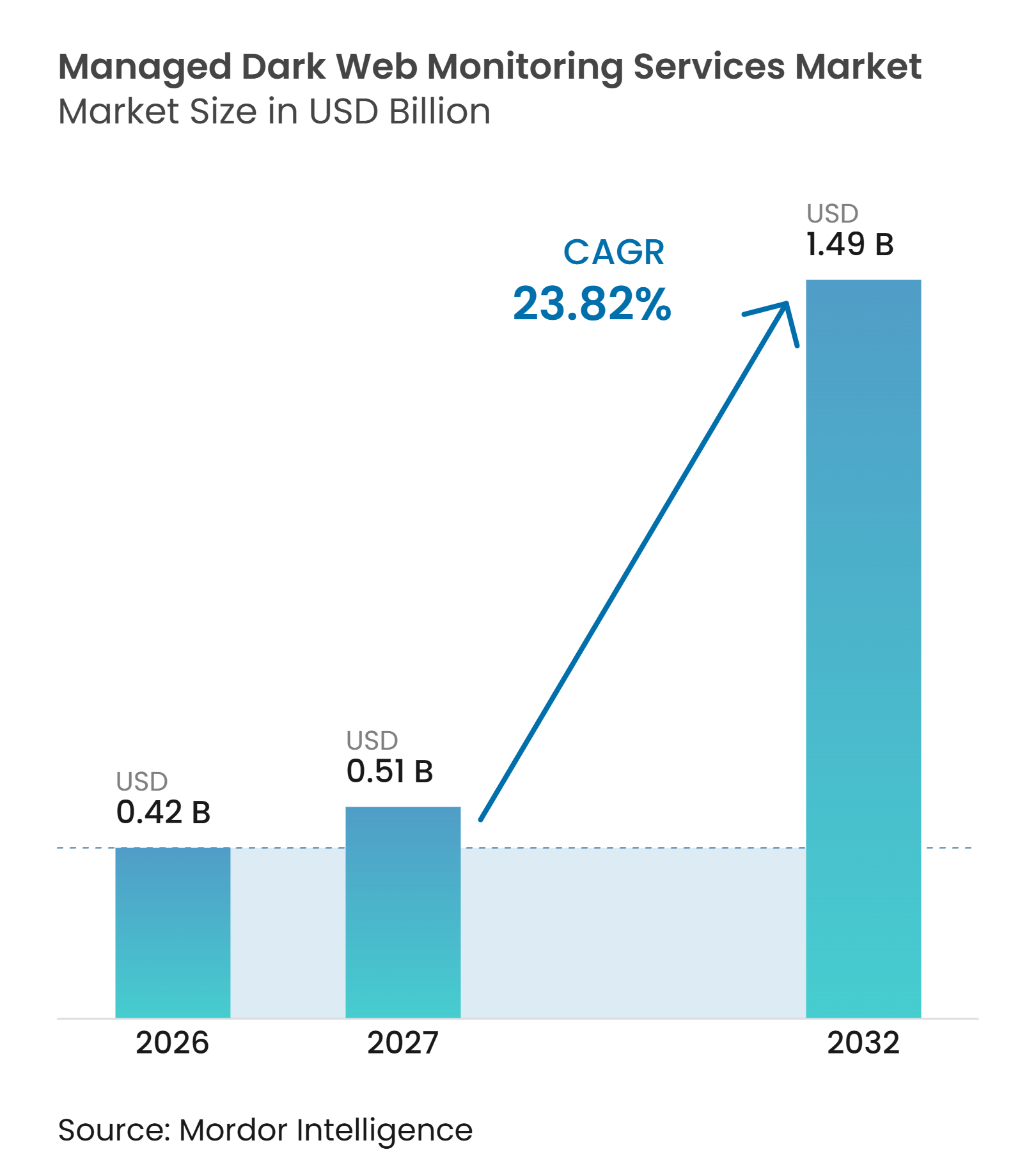
The managed dark web monitoring services market size is projected to expand from USD 0.42 billion in 2026 to USD 0.51 billion in 2027, and to USD 1.49 billion by 2032, registering a CAGR of 23.82% between 2027 and 2032. The managed dark web monitoring services market is being shaped by a sustained rise in stolen credentials, which creates exposure across employee accounts, customer identities, and business applications. Ransomware groups and initial-access brokers are also shifting their focus to higher-value targets and supplier networks, making early intelligence more important for security teams. Regulatory requirements in Europe and North America are strengthening the case for continuous monitoring and incident readiness. Providers are responding with AI-supported collection and alert prioritization, while buyers continue to weigh these capabilities against false alerts, data access limits, and deployment requirements. The managed dark web monitoring services market, therefore, offers room for providers that can combine broad coverage with relevant, validated alerts.
Key Report Takeaways
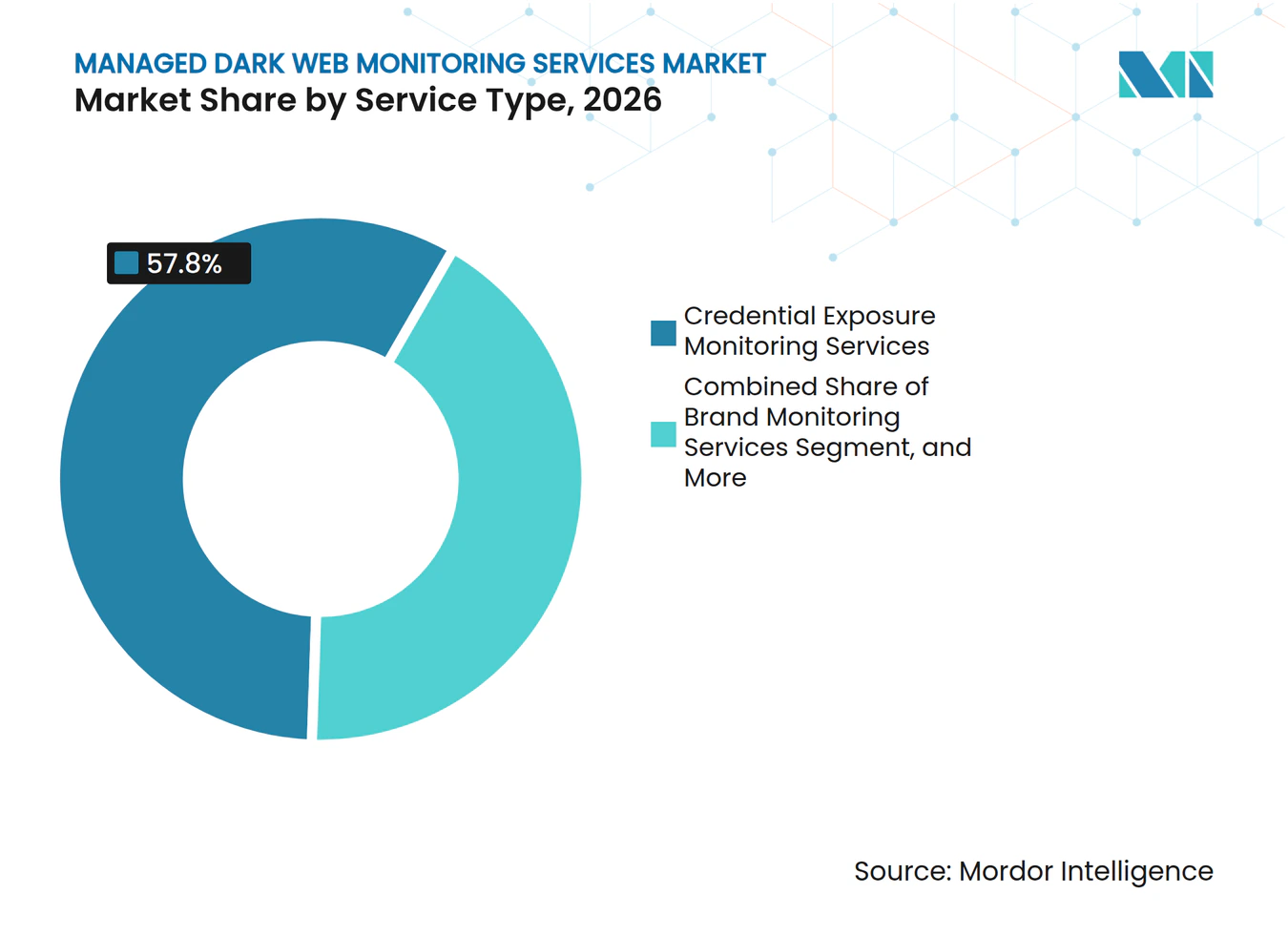
- By service type, Credential Exposure Monitoring Services held 57.80% of the managed dark web monitoring services market in 2026, while Third-Party and Vendor Monitoring Services are projected to expand at a 24.88% CAGR through 2032.
- By deployment mode, On-Premises held 66.42% of the managed dark web monitoring services market revenue share in 2026, while Cloud is projected to expand at a 25.16% CAGR through 2032.
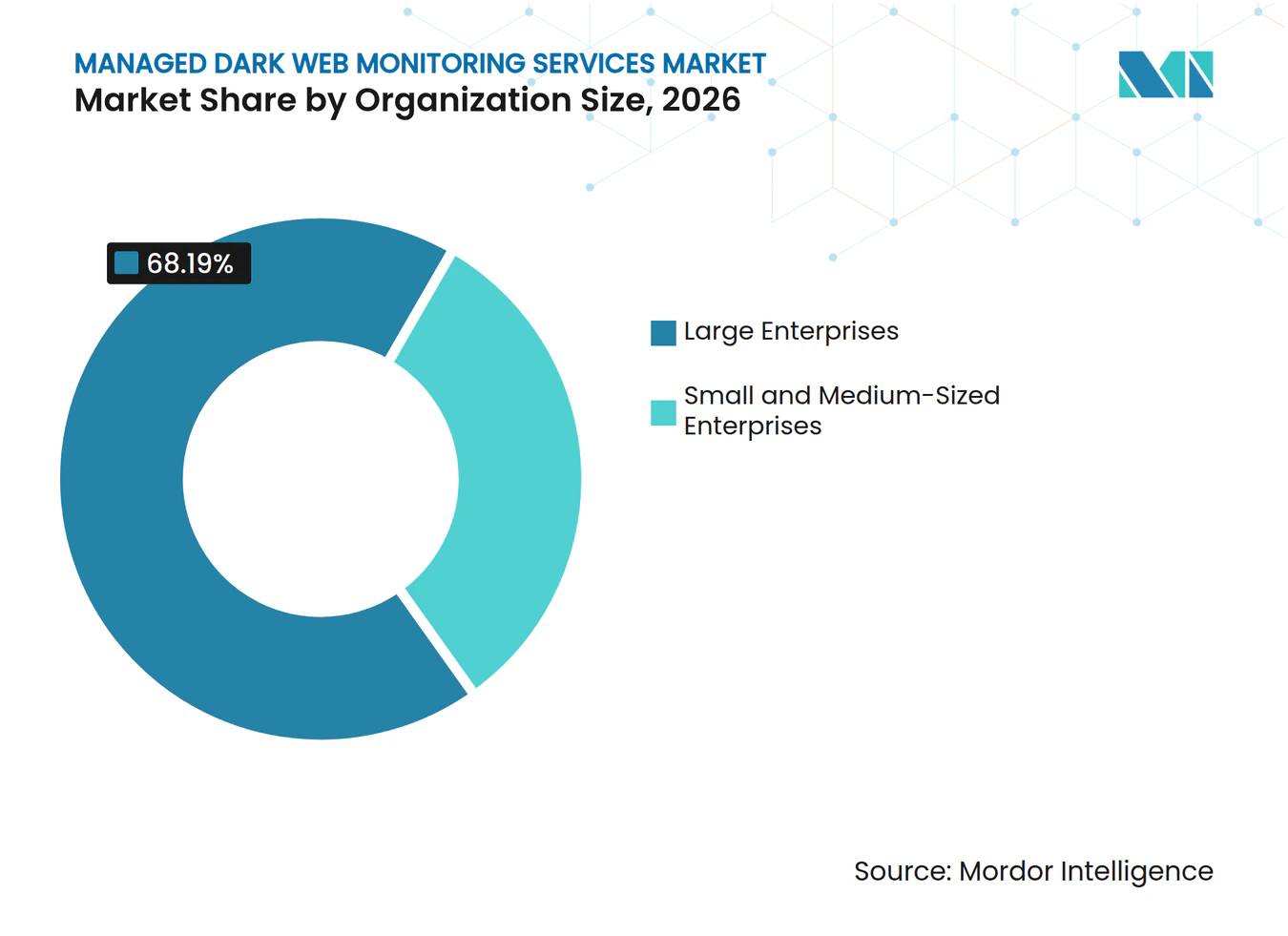
- By organization size, Large Enterprises held 68.19% of the managed dark web monitoring services market revenue share in 2026, while SMEs are projected to expand at a 25.47% CAGR through 2032.
- By end-user industry, BFSI held 28.78% of the managed dark web monitoring services market revenue share in 2026, while Government and Public Administration is projected to expand at a 24.16% CAGR through 2032.
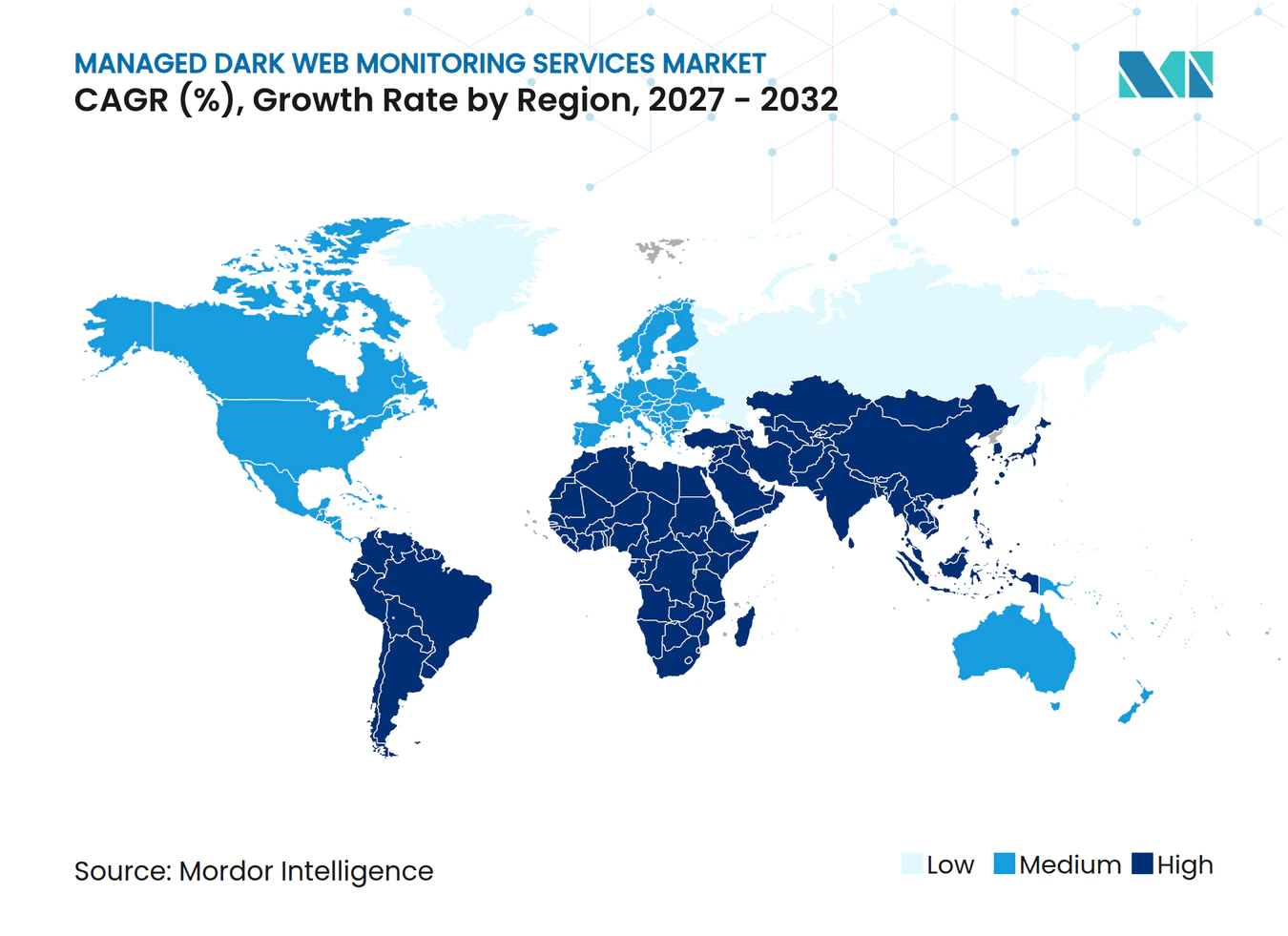
- By geography, North America held 36.81% of the managed dark web monitoring services market revenue share in 2026, while Asia-Pacific is projected to expand at a 24.45% CAGR through 2032.
Note: Market numbers in this report are based on Mordor Intelligence's proprietary estimation framework, which combines nine months of actuals with Q4 projections for base year 2026.
Market Trends and Insights
Drivers Impact Analysis of Managed Dark Web Monitoring Services Market*
| Driver | (~) % Impact on CAGR Forecast | Geographic Relevance | Impact Timeline |
|---|---|---|---|
| Rising Credential Theft and Account Takeover | +3.8% | Global | Short term (≤ 2 years) |
| Expansion of Ransomware-as-a-Service and Initial-Access-Broker Ecosystems | +3.2% | Global, concentrated in North America, United Kingdom, and India | Short term (≤ 2 years) |
| Regulatory Pressure for Breach Detection and Incident Readiness | +2.8% | Europe and North America core, spill-over to Asia-Pacific and Middle East | Medium term (2-4 years) |
| AI-Assisted Threat Hunting and Correlation Workflows | +2.4% | Global | Medium term (2-4 years) |
| Covert Acquisition of Stolen Data by Fraud and Financial-Crime Teams | +1.8% | North America, Europe, and Asia-Pacific core | Short term (≤ 2 years) |
| Demand from Critical-Infrastructure and Defense Units | +1.5% | North America and Europe, early gains in South Korea, Japan, and Gulf states | Medium term (2-4 years) |
| Source: Mordor Intelligence | |||
Rising Credential Theft and Account Takeover
Account takeover, a suspected form of digital fraud, reached 3.14% of all digital fraud reported to TransUnion in 2025, up 37% from 2024. eSentire recorded a 389% year-over-year rise in account compromise events across its global customer base during 2025. The managed dark web monitoring services market benefits because infostealer and phishing toolkits make credential collection accessible to a wider range of criminal operators. Recorded Future found that 36.4% of indexed stolen credentials appeared within 24 hours of exfiltration in 2025. It also identified 276 million indexed credentials carrying active session cookies, which can bypass password and multifactor authentication controls while the session remains valid. Continuous monitoring helps organizations identify this short exposure window before stolen access is used against connected systems.
Expansion of Ransomware-as-a-Service and Initial-Access-Broker Ecosystems
Ransomware-as-a-service has developed into a franchise-like ecosystem in which access, tooling, and extortion activity can be supplied by different actors. Flashpoint reported a 45% increase in ransomware-as-a-service victims and 1.7 billion stolen credentials harvested in its 2026 midyear findings. Rapid7 found that average initial-access-broker asking prices rose 4,055% year over year to USD 113,275 in its H2 2025 forum analysis. The analysis linked this shift to targets with alleged average revenues of USD 3.24 billion, including government, retail, and IT organizations. ZeroFox tracked a decline in public network-access listings from 620 in Q1 2025 to 370 in Q1 2026 as activity shifted to private channels. The managed dark web monitoring services market consequently needs collection methods that extend beyond visible forum listings.
Regulatory Pressure for Breach Detection and Incident Readiness
European rules are moving dark-web monitoring closer to a compliance requirement for regulated organizations. The Digital Operational Resilience Act became applicable in January 2025 and requires financial entities to manage and report ICT-related incidents. NIS2 requires appropriate cybersecurity risk-management measures for essential entities across the European Union. Its scope covers sectors such as energy, banking, healthcare, and digital infrastructure, which broadens the buyer base for relevant threat intelligence. GDPR requires notification of qualifying personal data breaches within 72 hours, raising the value of early signals indicating credential exposure. The managed dark web monitoring services market gains a steadier demand base when detection and readiness are treated as operational obligations rather than discretionary security purchases.
AI-Assisted Threat Hunting and Correlation Workflows
AI-supported threat hunting is changing monitoring from periodic review toward continuous collection and prioritization. An IEEE conference study published in 2025 found that NLP and LLM methods achieved 72% threat-prediction accuracy when applied to unstructured dark-web forum data. These methods can help relate signals from forums, identity data, and enterprise security tools before an analyst begins validation. The managed dark web monitoring services market is therefore placing greater value on services that reduce repetitive manual searches and organize evidence around the customer environment. AI tools do not eliminate the need for analyst judgment, as context, attribution, and business relevance still require review. Providers that combine automation with clear validation processes are better positioned to make alert volumes usable for security operations teams.
Restraints Impact Analysis of Managed Dark Web Monitoring Services Market*
| Restraint | (~) % Impact on CAGR Forecast | Geographic Relevance | Impact Timeline |
|---|---|---|---|
| High False-Positive Rates in Open-Web and Dark-Web Correlation | -1.4% | Global | Short term (≤ 2 years) |
| Operational Friction from Encrypted, Decentralized and Ephemeral Sources | -1.1% | Global | Medium term (2-4 years) |
| Shortage of Skilled Analysts for Triage and Validation | -0.9% | Global, acute in Asia-Pacific and South America | Long term (≥ 4 years) |
| Legal and Ethical Constraints on Data Collection and Attribution | -0.7% | Europe, GDPR and NIS2, and North America, CFAA and ECPA | Medium term (2-4 years) |
| Source: Mordor Intelligence | |||
High False-Positive Rates in Open-Web and Dark-Web Correlation
High false-positive rates can reduce confidence in a monitoring program and limit the budget available for longer contracts. Traditional keyword and regular-expression methods can create substantial alert volumes without establishing whether the material is relevant to a specific organization. The managed dark web monitoring services market must address this issue because teams may lack enough analysts to investigate every signal. Cross-source correlation requires context from surface-web activity, underground forums, and private messaging channels, as well as a defensible view of threat-actor behavior. Adding AI-supported triage can improve prioritization, but it may also increase service costs for smaller buyers. This tradeoff can slow adoption among SMEs that need affordable coverage but have limited internal validation capacity.
Operational Friction from Encrypted, Decentralized and Ephemeral Sources
Monitoring systems designed for indexed Tor sites have a coverage challenge when criminal activity moves to private and short-lived channels. ZeroFox found that references to encrypted private messaging tools increased from 2.2% of initial-access-broker activity in 2023 to 11.6% in 2025.[1] Rapid7 reported that initial-access-broker threads on XSS declined from 200 in 2024 to 20 in H2 2025 as brokers moved to RAMP and DarkForums. Some Telegram channels may exist for only a few hours, so that daily collection cycles may miss a relevant signal. The managed dark web monitoring services market incurs higher operating costs when providers require private forum access or human intelligence to improve coverage. Those costs can create pricing friction for buyers who are already constrained by limited security budgets.
*Our forecasts treat driver/restraint impacts as directional, not additive. The impact forecasts reflect baseline growth, mix effects, and variable interactions.
Managed Dark Web Monitoring Services Market Segment Analysis
By Service Type:
Credential Monitoring Anchors Demand and Vendor Intelligence Drives ExpansionCredential Exposure Monitoring Services held 57.80% market share in the managed dark web monitoring services market in 2026. This position reflects the direct connection between stolen identity data and the risk of account compromise across an organization. Recorded Future indexed 1.95 billion credentials from malware combo lists in 2025. It reported that the second half of 2025 generated 50% more exposed records than the first half. Kaspersky reported that more than 1 million banking accounts at the world’s 100 largest banks had credentials circulating on the dark web. These conditions sustain demand for monitoring that identifies exposed credentials before they are used.
Brand Monitoring Services serve organizations concerned about executive impersonation, phishing domains, and social media fraud. Executive Monitoring Services are commonly included in enterprise contracts where senior personnel face targeted fraud and impersonation risks. Other Service Types include related uses such as takedown support and fraud-intelligence feeds. Third-Party and Vendor Monitoring Services are projected to grow the fastest, at a 24.88% CAGR through 2032. Initial-access brokers can use a supplier environment to reach multiple downstream organizations, thereby increasing the relevance of vendor-specific intelligence. BitSight launched Dark Web Intelligence for Supply Chains in February 2026 to map deep-web and dark-web signals across more than 72,000 vendor profiles.[2] The managed dark web monitoring services market is therefore extending from first-party exposure monitoring toward a wider supplier-risk view.



By Deployment Mode:
On-Premises Sovereignty Meets Cloud VelocityOn-premises deployment accounted for 66.42% of revenue in 2026. Government, defense, and regulated financial organizations often favor this approach because data residency and control requirements affect how threat data is handled. CMMC 2.0 Phase 1 enforcement began in November 2025, reinforcing compliance expectations in the U.S. defense industrial base. FISMA, CJIS, and NIST SP 800-53 requirements can also shape deployment decisions for agencies handling classified or controlled unclassified information. For these buyers, operational control may remain more important than rapid deployment. The managed dark web monitoring services market continues to need deployment options that fit these requirements.
Cloud deployment is projected to grow at a 25.16% CAGR through 2032. SaaS delivery can make continuous monitoring more accessible to SMEs and mid-market organizations without enterprise-level budgets. Multi-tenant managed security architectures allow providers to offer coverage without requiring each customer to build a dedicated monitoring environment. Cloud services may also support faster integration with broader security operations workflows. Hybrid arrangements provide an intermediate option when cloud-based collection must connect to on-premises SIEM and SOAR tools. This combination allows the managed dark web monitoring services market to address both scale requirements and data-sovereignty concerns.
By Organization Size:
Enterprise Depth and SME VelocityLarge Enterprises held 68.19% of revenue in 2026. These organizations often require integrations with SIEM, SOAR, and XDR systems so that alerts can lead to automated remediation steps. Their procurement criteria increasingly include multi-source correlation, AI-supported triage, and coverage of private channels. This raises expectations for service depth and can put pressure on providers that offer only basic, surface-level monitoring. Large enterprises also have broader application environments and supplier networks, increasing the number of possible identity and access exposures. The managed dark web monitoring services market retains an enterprise focus because these customers can support deeper operational integration.
SMEs are projected to grow at a 25.47% CAGR through 2032. Affordable SaaS models and cyber-insurance requirements are helping smaller organizations adopt monitoring services. Ransomware operators may target smaller organizations as routes into larger partner or customer networks. Flashpoint reported a 45% rise in ransomware-as-a-service victims in its 2026 midyear findings. Managed security service providers are increasingly embedding dark-web monitoring into standard service packages for these buyers. The managed dark web monitoring services industry is consequently reducing the adoption gap that previously separated SME purchasing cycles from large-enterprise demand.

By End-User Industry:
BFSI Anchors Share and Government Demand EscalatesBFSI held 28.78% of revenue in 2026. Financial credentials have immediate value for fraud, giving banks, insurers, and payment organizations a strong reason to track exposure in underground channels. Kaspersky found that India, Spain, and Brazil recorded the highest median compromised banking accounts per bank in 2025. The managed dark web monitoring services market size for BFSI is supported by the need to identify stolen credentials before account takeover or fraud activity occurs. Regulatory reporting duties add to this demand because financial entities need rapid incident assessment. Healthcare and Life Sciences, IT and Telecommunication, Industrial Manufacturing, Retail and E-commerce, and Energy and Utilities also represent relevant secondary customer groups.
Government and Public Administration is projected to grow at a 24.16% CAGR through 2032. KELA recorded 2,332 ransomware attacks against critical sectors between January 1 and September 1, 2025. This represented a 34% year-over-year increase and 50% of all ransomware activity in the period. FISMA and NIST SP 800-53 considerations can favor sovereign, on-premises monitoring deployments among federal and state agencies. Government buyers also need intelligence that can be assessed against critical services risk and national security requirements. These conditions support the managed dark web monitoring services market as public-sector organizations strengthen their cyber readiness.
Geography Analysis
North America Managed Dark Web Monitoring Services Market
North America held 36.81% of the managed dark web monitoring services market share in 2026. The region combines established security budgets, specialist vendors, and a regulatory environment that gives proactive breach detection board-level importance. Rapid7 found that U.S.-targeting listings accounted for 30.9% of global initial-access-broker forum threads in its H2 2025 analysis.[3] eSentire reported a 389% rise in account compromise in 2025, while Canada is gaining attention as its financial and critical infrastructure operators expand monitoring following significant breaches.
Europe Managed Dark Web Monitoring Services Market
Europe is supported by the combined effect of GDPR, DORA, and NIS2 across financial services, healthcare, and critical infrastructure, with Germany, the United Kingdom, and France as important demand centers. The European Commission states that NIS2 establishes cybersecurity risk management measures for covered entities and sectors. The United Kingdom’s Digital Marketplace lists managed dark-web monitoring services, reflecting an established government procurement route. Russia’s role as a source of substantial criminal dark-web activity also gives organizations with Eastern European operations a specific intelligence-gathering need.
APAC and MEA Managed Dark Web Monitoring Services Market
Asia-Pacific is projected to grow at a 24.45% CAGR through 2032. Rapid digitalization, expanding attack surfaces, and local-language threat activity can limit the effectiveness of English-only monitoring systems. Japan’s Financial Services Agency included dark-web monitoring among risk-assessment tools in its April 2026 research on third-party cybersecurity risk management. SCSK Security launched a dark-web monitoring service with Searchlight Cyber in August 2025. India’s digital payment ecosystem is a high-value target for credential theft, while Saudi Arabia, the UAE, South Africa, and Nigeria are seeing early adoption in financial services and telecommunications.
Competitive Landscape
Market Concentration
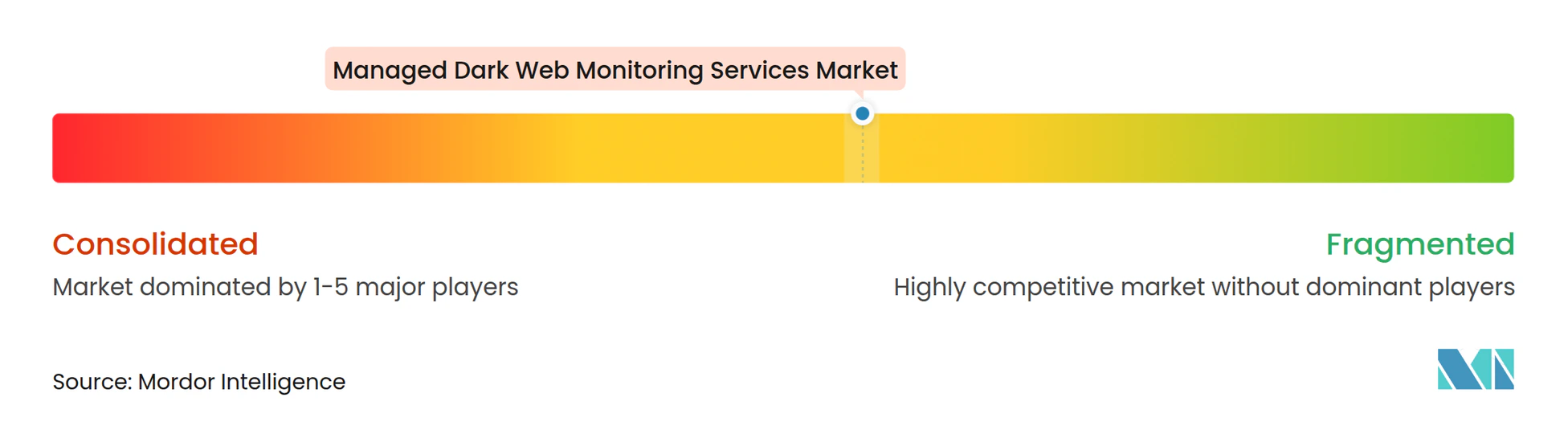
The managed dark web monitoring services market is moderately concentrated in its upper tier. Leading providers compete on threat-actor coverage, access to private and non-English-language sources, and alert-triage quality, while specialists below this group focus on brand monitoring, executive protection, supply-chain intelligence, or white-labeled feeds. The managed dark web monitoring services market remains fragmented at this level because focused vendors can serve individual use cases. Platform consolidation is an important strategy, as it combines credential exposure, brand protection, third-party risk, and executive monitoring into a single workspace. This approach can reduce analyst workload, increase switching costs, and meet differentiated buyer requirements for deployment, source coverage, and integration.
The managed dark web monitoring services market also has an unmet need for sovereign on-premises deployments in government and defense. DarkOwl received an “Awardable” rating in the CDAO Tradewinds marketplace in June 2026, opening a federal procurement path for its platform. Providers are also developing supply-chain intelligence that links threat signals to specific vendor relationships. BitSight’s February 2026 supply-chain launch illustrates this focus on defense contractors and critical suppliers, while Searchlight Cyber acquired Intangic in October 2025 to link dark-web exposure intelligence with quantitative financial-risk scoring. This product design addresses boards and audit committees that need a clearer connection between cyber exposure and investment decisions.
AI is increasing competitive expectations across the managed dark web monitoring services market. Recorded Future launched Autonomous Threat Operations in October 2025 to automate multi-source correlation across its Intelligence Graph. CrowdStrike released Falcon Adversary Intelligence in August 2025, tracking more than 265 nation-state, eCrime, and hacktivist groups for customer-specific analysis.[4] Providers must demonstrate that automation produces relevant alerts and that broad source coverage, credible validation, and integration with security operations will remain central points of competition.
Managed Dark Web Monitoring Services Industry Leaders
-
ZeroFox Holdings, Inc.
-
DarkOwl, LLC
-
Rapid7, Inc.
-
SpyCloud, Inc.
-
BitSight Technologies, Inc.
- *Disclaimer: Major Players sorted in no particular order
Managed Dark Web Monitoring Services Market Companies Covered in this Report
- Recorded Future, Inc.
- CrowdStrike, Inc.
- ZeroFox Holdings, Inc.
- DarkOwl, LLC
- Flashpoint Intelligence, LLC
- KELA Group Ltd.
- Cybersixgill Ltd.
- Rapid7, Inc.
- ReliaQuest, LLC
- Searchlight Cyber Ltd.
- SpyCloud, Inc.
- OneAvenue Ltd.
- EclecticIQ B.V.
- ThreatConnect, Inc.
- BitSight Technologies, Inc.
- Cyberint Ltd.
- Constella Intelligence, Inc.
- Flare Systems Inc.
- CloudSEK Information Security Private Limited
- Axur S.A.
Recent Industry Developments in Managed Dark Web Monitoring Services Market
- September 2026: Searchlight Cyber expanded its Cerberus threat intelligence solution with an RST Cloud integration, broadening indicator-of-compromise and threat-feed coverage to enable deeper dark-web correlation in enterprise SOC environments.
- August 2026: Searchlight Cyber launched its Preemptive Threat Exposure Management Platform, repositioning the company from reactive dark-web monitoring toward proactive exposure identification before adversary exploitation, a capability designed to respond to AI-accelerated attack timelines.
- June 2026: SpyCloud surpassed 1 trillion recaptured identity assets and simultaneously launched a Cybercrime Investigations Research Agent, combining automated investigation automation with its recaptured-credential corpus to support insider-threat and criminal-infrastructure analysis at scale.
- June 2026: DarkOwl was assessed “Awardable” for Department of War contracts in the CDAO Tradewinds Solutions Marketplace, opening a formal federal procurement pathway for its darknet intelligence platform to U.S. defense agencies.
Global Managed Dark Web Monitoring Services Market Report Scope
The Managed Dark Web Monitoring Services Market comprises outsourced cybersecurity and threat intelligence services that continuously monitor, analyze, validate, and report information obtained from dark web forums, underground marketplaces, leak sites, encrypted communication channels, and other illicit online sources. These services help organizations identify credential exposure, brand abuse, executive targeting, third-party risk, and other cyber threats, supporting fraud prevention, incident readiness, cyber-risk management, and threat intelligence programs. The market includes managed monitoring services, analyst investigations, reporting, consulting, implementation, support, maintenance, and ongoing threat monitoring.
The Managed Dark Web Monitoring Services Market Report is Segmented by Service Type (Credential Exposure Monitoring Services, Brand Monitoring Services, Executive Monitoring Services, Third-Party and Vendor Monitoring Services, and Other Service Types), Deployment Mode (On-Premises, and Cloud), Organization Size (Large Enterprises, and Small and Medium-Sized Enterprises), End-User Industry (Banking, Financial Services, and Insurance [BFSI], Government and Public Administration, Healthcare and Life Sciences, IT and Telecommunication, Industrial Manufacturing, Retail and E-commerce, Energy and Utilities, and Other End-User Industries), and Geography (North America, South America, Europe, Asia-Pacific, Middle East, and Africa). The Market Forecasts are Provided in Terms of Value (USD).
Segmentation Overview
| Credential Exposure Monitoring Services |
| Brand Monitoring Services |
| Executive Monitoring Services |
| Third-Party and Vendor Monitoring Services |
| Other Service Types |
| On-Premises |
| Cloud |
| Large Enterprises |
| Small and Medium-Sized Enterprises |
| Banking, Financial Services, and Insurance (BFSI) |
| Government and Public Administration |
| Healthcare and Life Sciences |
| IT and Telecommunication |
| Industrial Manufacturing |
| Retail and E-commerce |
| Energy and Utilities |
| Other End-User Industries |
| North America | United States |
| Canada | |
| Mexico | |
| South America | Brazil |
| Argentina | |
| Rest of South America | |
| Europe | Germany |
| United Kingdom | |
| France | |
| Italy | |
| Russia | |
| Rest of Europe | |
| Asia-Pacific | China |
| Japan | |
| India | |
| South Korea | |
| Rest of Asia-Pacific | |
| Middle East | Saudi Arabia |
| United Arab Emirates | |
| Rest of Middle East | |
| Africa | South Africa |
| Nigeria | |
| Rest of Africa |
| By Service Type | Credential Exposure Monitoring Services | |
| Brand Monitoring Services | ||
| Executive Monitoring Services | ||
| Third-Party and Vendor Monitoring Services | ||
| Other Service Types | ||
| By Deployment Mode | On-Premises | |
| Cloud | ||
| By Organization Size | Large Enterprises | |
| Small and Medium-Sized Enterprises | ||
| By End-User Industry | Banking, Financial Services, and Insurance (BFSI) | |
| Government and Public Administration | ||
| Healthcare and Life Sciences | ||
| IT and Telecommunication | ||
| Industrial Manufacturing | ||
| Retail and E-commerce | ||
| Energy and Utilities | ||
| Other End-User Industries | ||
| By Geography | North America | United States |
| Canada | ||
| Mexico | ||
| South America | Brazil | |
| Argentina | ||
| Rest of South America | ||
| Europe | Germany | |
| United Kingdom | ||
| France | ||
| Italy | ||
| Russia | ||
| Rest of Europe | ||
| Asia-Pacific | China | |
| Japan | ||
| India | ||
| South Korea | ||
| Rest of Asia-Pacific | ||
| Middle East | Saudi Arabia | |
| United Arab Emirates | ||
| Rest of Middle East | ||
| Africa | South Africa | |
| Nigeria | ||
| Rest of Africa | ||
Key Questions Answered in the Report
What is the managed dark web monitoring services market size?
The managed dark web monitoring services market size is projected to rise from USD 0.42 billion in 2026 and USD 0.51 billion in 2027 to USD 1.49 billion by 2032, at a 23.82% CAGR.
What is driving demand for managed dark web monitoring services?
Rising credential theft, account takeover, ransomware activity, and regulatory expectations are increasing the need for continuous exposure monitoring.
Which service type leads managed dark web monitoring demand?
Credential Exposure Monitoring Services led with 57.80% revenue share in 2026 because stolen credentials can create direct account-compromise risk.
Which deployment model is growing fastest?
Cloud deployment is projected to grow at a 25.16% CAGR through 2032, supported by SaaS delivery and accessible service models for SMEs.
Which end-user group is expanding fastest?
Government and Public Administration is projected to grow at a 24.16% CAGR through 2032 as public agencies strengthen cyber readiness and compliance practices.
Which region is expanding fastest for these services?
Asia-Pacific is projected to grow at a 24.45% CAGR through 2032, supported by digitalization, local-language threat activity, and growing financial-sector demand.