
Malaysia Wire and Cable Market Size and Share
Market Overview
| Study Period | 2020 - 2031 |
|---|---|
| Forecast Data Period | 2026 - 2031 |
| Base Year Market Size (2025) | USD 488.11 Million |
| Market Size (2026) | USD 510.21 Million |
| Market Size (2031) | USD 655.32 Million |
| Growth Rate (2026 - 2031) | 5.13% CAGR |
| Market Concentration | Medium |
Major Players *Disclaimer: Major Players sorted in no particular order Image © Mordor Intelligence. Reuse requires attribution under CC BY 4.0. | |
Malaysia Wire and Cable Market Analysis by Mordor Intelligence
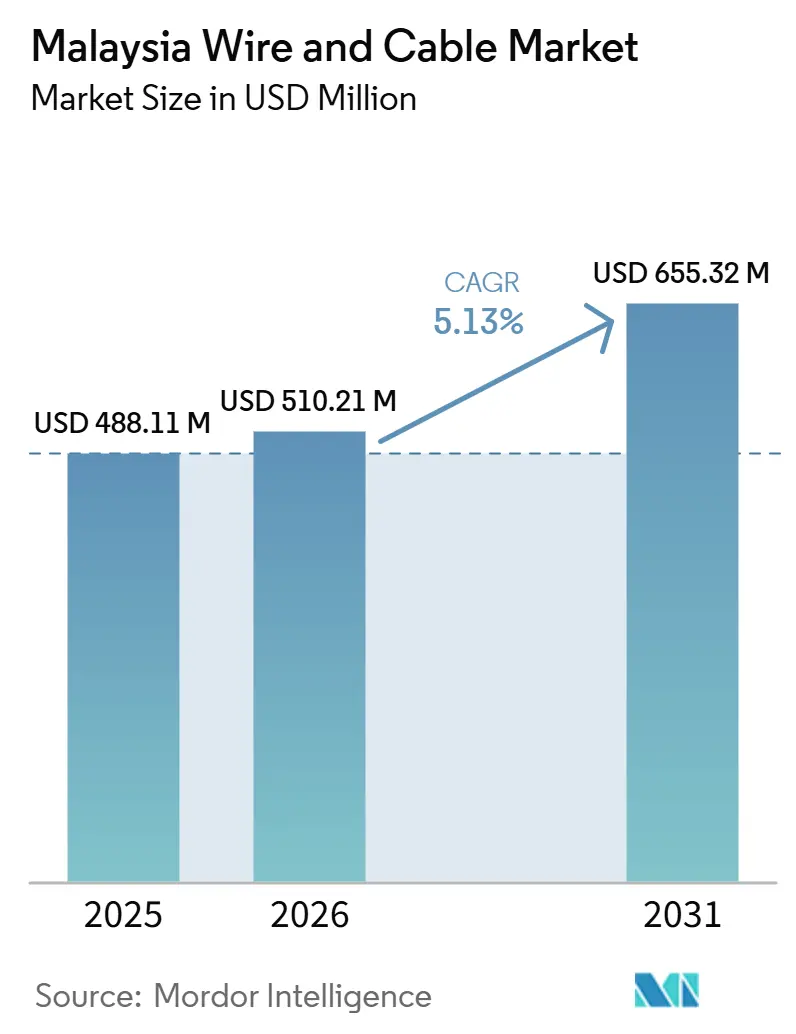
The Malaysia Wire and Cable Market size was valued at USD 488.11 million in 2025 and is estimated to grow from USD 510.21 million in 2026 to reach USD 655.32 million by 2031, at a CAGR of 5.13% during the forecast period (2026-2031). Grid modernization, data center construction, and renewable-energy connections are shifting demand toward higher-voltage power and fiber-optic products. Tenaga Nasional Berhad's grid program and the growth of large digital facilities are increasing the need for underground and extra-high-voltage systems. This change favors suppliers that can meet demanding product qualifications and deliver larger projects. Residential, commercial, and industrial work continues to support regular demand for low-voltage and insulated products. Input cost pressure remains a concern for suppliers under fixed-price contracts and with limited ability to pass through material costs.
Key Report Takeaways
- By voltage, low-voltage cables held 41.23% of the Malaysia wire and cable market share in 2025, while extra- and high-voltage cables are projected to expand at a 6.12% CAGR through 2031.
- By cable type, power cables accounted for 38.98% of the Malaysia wire and cable market share in 2025, while fiber-optic cables are expected to grow at a 7.03% CAGR through 2031.
- By conductor material, copper held 39.50% of revenue in 2025, while aluminum is projected to record a 6.76% CAGR through 2031.
- By installation, underground systems held 40.14% of revenue in 2025, while submarine cables are expected to expand at a 7.15% CAGR through 2031.
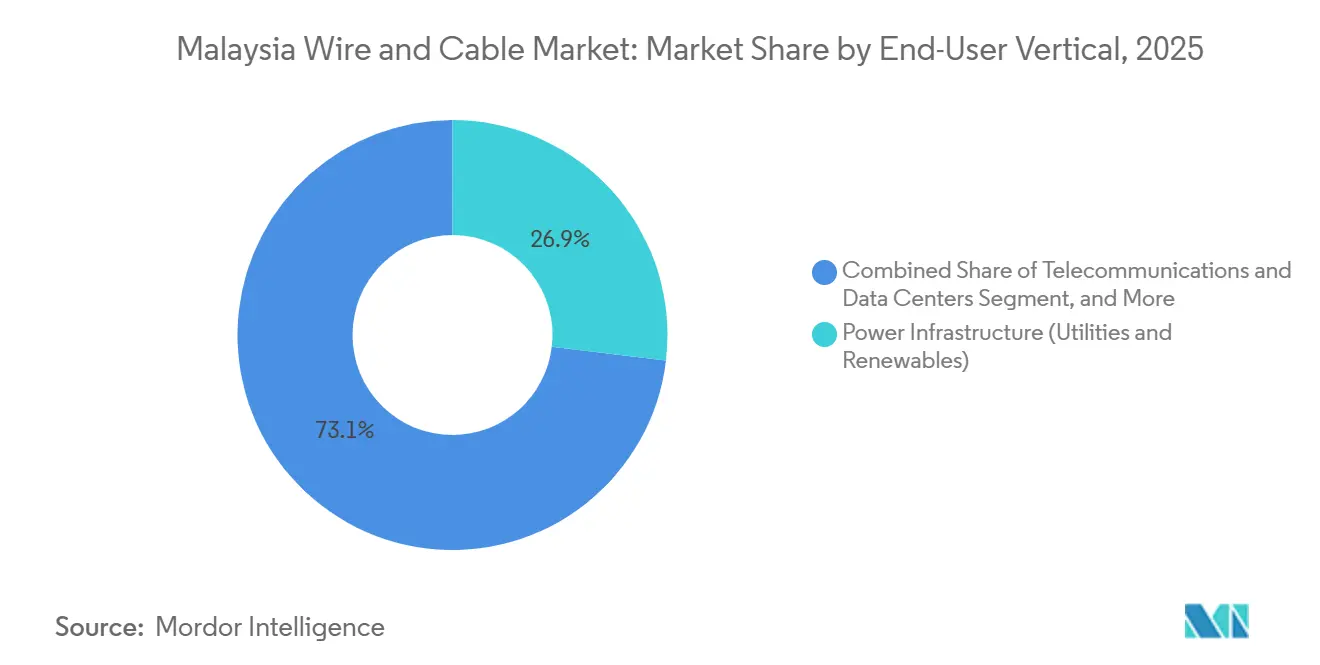
- By end-user vertical, power infrastructure, including utilities and renewables, held 26.89% of revenue in 2025, while telecommunications and data centers are projected to grow at a 7.11% CAGR through 2031.
- By insulation, insulated cables accounted for 78.98% of revenue in 2025 and are projected to grow at a 6.89% CAGR through 2031.
Note: Market size and forecast figures in this report are generated using Mordor Intelligence’s proprietary estimation framework, updated with the latest available data and insights as of January 2026.
Malaysia Wire and Cable Market Trends and Insights
Drivers Impact Analysis*
| DRIVER | (~) % IMPACT ON CAGR FORECAST | GEOGRAPHIC RELEVANCE | IMPACT TIMELINE |
|---|---|---|---|
| Data Center and Cloud Infrastructure Expansion | +1.5% | Johor, Selangor, and Negeri Sembilan | Short term (≤ 2 years) |
| National Grid Modernization and Reliability Investment | +1.2% | National, with emphasis on Peninsular Malaysia transmission corridors | Medium term (2-4 years) |
| Renewable Energy Interconnection and Storage Build-Out | +0.8% | National, including Sarawak, northeastern Peninsular Malaysia, and Johor | Medium term (2-4 years) |
| Public Transport, Industrial Parks, and Building Electrification | +0.4% | National, especially Johor and Klang Valley urban nodes | Short term (≤ 2 years) |
| Integrated Power and Fiber Requirements in Smart Infrastructure | +0.3% | Klang Valley, Johor, and Sarawak smart-city corridors | Medium term (2-4 years) |
| Local Extra-High-Voltage Manufacturing and Import Substitution | +0.2% | National manufacturing hubs, including Kedah and Selangor | Long term (≥ 4 years) |
| Source: Mordor Intelligence | |||
Data Center and Cloud Infrastructure Expansion
Large data center projects are raising demand for extra-high-voltage underground power cables and fiber backbones in Johor and Selangor. Equinix announced in May 2026 that its KL2 facility in Cyberjaya will involve an investment of more than USD 190 million and will provide more than 2,200 cabinets upon completion.[1]Equinix, “Equinix to Develop Purpose-Built IBX Data Center in Kuala Lumpur to Support Malaysia's AI and Cloud Growth,” Equinix Newsroom, newsroom.equinix.com These facilities need dedicated bulk-power connections rather than standard building wiring. The resulting projects increase demand for products that few domestic suppliers currently manufacture at scale. This procurement pattern also shortens the qualification cycle for local producers who can meet high-voltage standards.
National Grid Modernization and Reliability Investment
TNB's MYR 43 billion grid modernization commitment is increasing the need for medium-voltage, high-voltage, and extra-high-voltage cables. TNB and the State Grid Corporation of China agreed in October 2025 to collaborate on power system planning, resilient network design, and AI-enabled grid management.[2]Tenaga Nasional Berhad, “TNB and State Grid Corporation of China Ink MoU to Strengthen Technology Cooperation in Power Grid Modernisation,” Tenaga Nasional Berhad, tnb.com.my These programs require products that meet tighter technical and reliability requirements than standard distribution cables. Utility procurement, therefore, places greater value on testing records, certified quality, and delivery capacity. The Malaysia wire and cable market benefits from grid expansion and reliability work distribute demand across major transmission corridors.
Renewable Energy Interconnection and Storage Build-Out
Renewable-energy projects need power, control, and signal cables for generation sites, substations, and storage assets. Malaysia's Energy Commission requirements and the planned expansion of grid infrastructure strengthen demand for qualified cable systems. The Sarawak-Sabah interconnection was energized in January 2026, increasing demand for high-voltage transmission equipment across East Malaysia. Cross-border electricity proposals also support interest in submarine and high-voltage transmission systems. Renewable projects create demand across multiple cable types rather than in a single application. This wider procurement base supports the Malaysia wire and cable market as projects move from development to connection work.
Public Transport, Industrial Parks, and Building Electrification
Electric-vehicle charging, industrial parks, and building automation add to demand for low-voltage, control, and structured-cabling products. The Energy Commission issued electric-vehicle charging guidelines in February 2025, and the Ministry of Works published a related guideline in May 2026.[3]Malaysian National News Agency, “Works Ministry Launches EV Charging System Guidelines Book,” Bernama, bernama.com The guidelines specify dedicated cable circuits for charging installations and reinforce the importance of compliant design. Industrial and digital tenants in Johor need medium-voltage supply, fiber networks, and internal control wiring. These projects help maintain demand for established cable categories when large utility projects are delayed.
Restraints Impact Analysis*
| RESTRAINT | (~) % IMPACT ON CAGR FORECAST | GEOGRAPHIC RELEVANCE | IMPACT TIMELINE |
|---|---|---|---|
| Copper, Aluminum, and Polymer Input Price Volatility | -0.4% | National, especially low-voltage manufacturing in the Klang Valley and Kedah | Short term (≤ 2 years) |
| Construction Cycle and Project-Approval Exposure | -0.3% | National, with greater exposure in Johor and Peninsular Malaysia, residential activity | Short term (≤ 2 years) |
| Limited Domestic Qualification Capacity for Advanced Cable Systems | -0.2% | National, most evident in extra-high-voltage and submarine systems | Medium term (2-4 years) |
| Thermal, Land, and Water Constraints Around Hyperscale Data Centers | -0.1% | Johor, with possible spillover to Selangor and Negeri Sembilan | Medium term (2-4 years) |
| Source: Mordor Intelligence | |||
Copper, Aluminum, and Polymer Input Price Volatility
Copper, aluminum, and polymer costs remain important risks because they account for a large share of cable production costs. Polymer pricing is particularly difficult for suppliers operating under long-term fixed-price agreements. Commodity-linked purchase orders can reduce exposure for larger manufacturers, while smaller low-voltage suppliers have less protection. Cost changes can therefore narrow margins even when order volumes remain healthy. The Malaysia wire and cable market may see greater preference for contracts that allow raw-material price adjustments.
Construction Cycle and Project-Approval Exposure
Demand for low-voltage cable remains closely tied to residential, commercial, and industrial construction activity. Delays in approvals or slower property development can delay procurement for several quarters. Data center proposals also face closer scrutiny of site resources and sustainability requirements. A delayed project can create revenue gaps for suppliers working on project-specific orders. A balanced customer mix across utilities, construction, and industrial users reduces this exposure.
*Our forecasts treat driver/restraint impacts as directional, not additive. The impact forecasts reflect baseline growth, mix effects, and variable interactions.
Segment Analysis
By Voltage: Extra-High-Voltage Demand Raises Technical Requirements
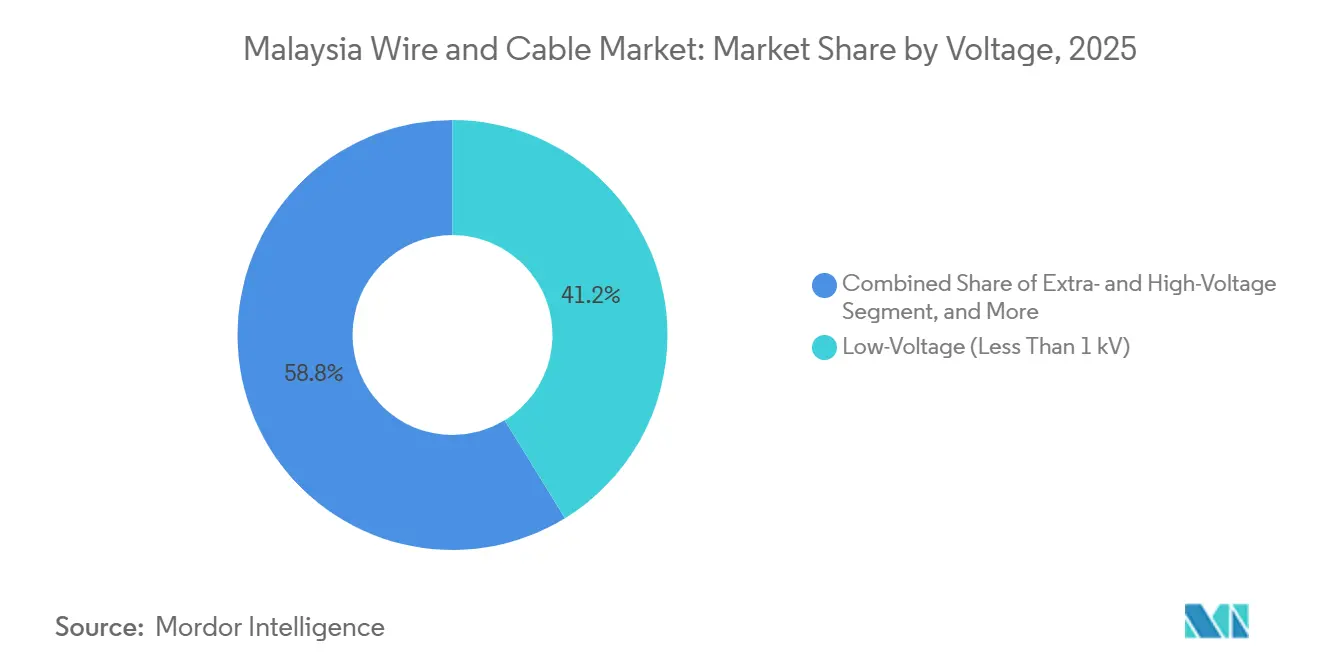
Low-voltage cables held 41.23% of the Malaysia wire and cable market share in 2025, supported by demand from homes, commercial buildings, and industrial facilities. This category remains the largest-volume application because these projects need extensive internal wiring and distribution networks. Competition in this tier is more fragmented, and material costs can put pressure on pricing. Medium-voltage products serve industrial parks, renewable-energy substations, and commercial developments. These applications provide a stable demand between major transmission projects.
Extra- and high-voltage cables are expected to grow at a 6.12% CAGR from 2026 to 2031. Grid investment and large data center connections require products with higher technical specifications. TNB's cooperation with the State Grid Corporation of China includes resilient network design and power system planning, which support the need for advanced transmission equipment. SIRIM testing and Energy Commission requirements raise the qualification threshold for grid-connected products. Southern Cable Group is adding medium- and extra-high-voltage production lines, targeting full operation in 2027, demonstrating how domestic suppliers are addressing this capability gap.



By Cable Type: Fiber-Optic Systems Grow Faster Than Power Cables
Power cables accounted for 38.98% of the Malaysia wire and cable market share in 2025. Utility distribution work, renewable-energy connections, and building construction continue to support this large category. Power-cable demand is expected to grow in value as grid upgrades and connection projects proceed. The category also benefits from steady replacement requirements within existing electricity networks. Its broad use across end users gives suppliers a relatively diverse order base.
Fiber-optic cables are projected to grow at a 7.03% CAGR through 2031. Data center construction requires high-capacity fiber systems between facilities and across internal networks. Telekom Malaysia joined the CANDLE submarine cable consortium in September 2025 to develop an 8,000 km system linking Malaysia with several Asian markets and scheduled for operations in 2028. Signal and control cables also benefit from industrial automation, smart-building systems, and charging infrastructure. Telecommunications installations must meet relevant type-approval and IEC requirements, which channels demand toward compliant products.
By Conductor Material: Aluminum Gains Ground Against Copper
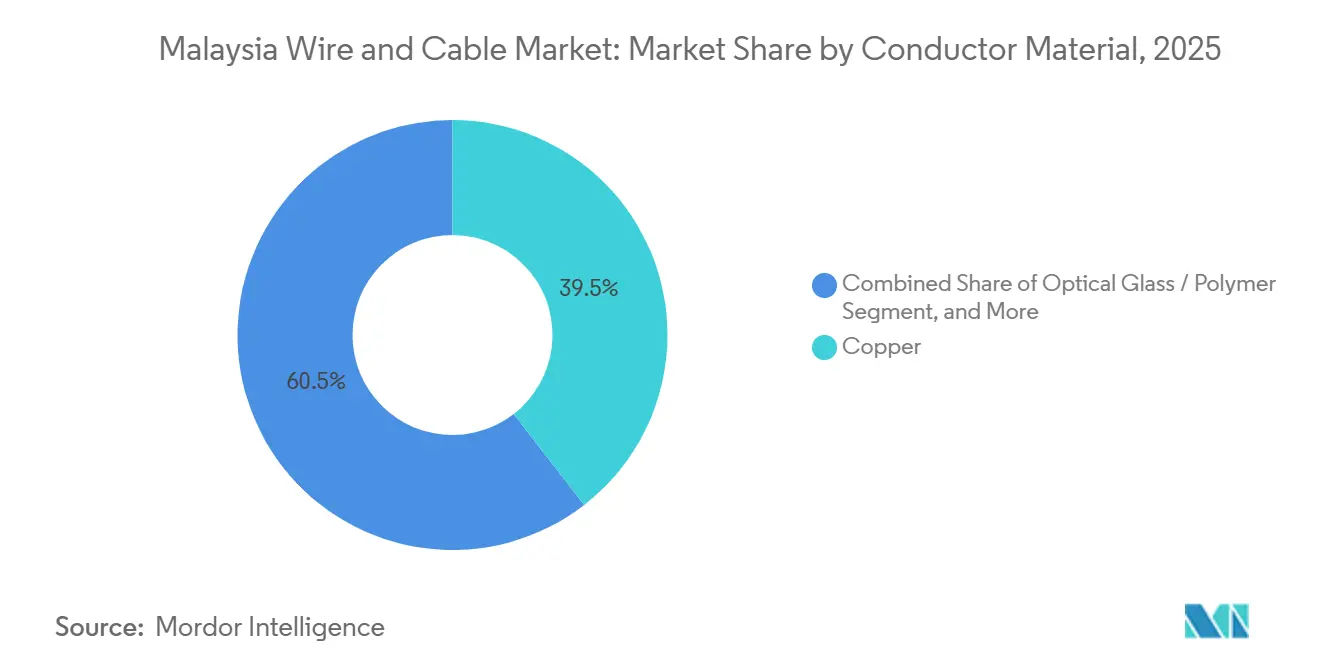
Copper held 39.50% of the Malaysia wire and cable market share in 2025. It remains important in building wiring, data cables, and telecommunications applications where conductivity and established specifications matter. Copper-based products also support the low-voltage market, which continues to serve homes and commercial properties. However, higher copper prices encourage engineering and procurement teams to examine material alternatives in large projects. This shift is most relevant where conductor size and total material costs are substantial.
Aluminum is expected to grow at a 6.76% CAGR between 2026 and 2031. It is increasingly used in medium- and high-voltage overhead and underground transmission systems due to its lower weight and relative material cost advantage. Southern Cable Group commissioned a high-capacity aluminum furnace in early 2026, increasing annual aluminum rod output to more than 60,000 metric tons. Optical glass and polymer materials remain smaller by volume but are necessary for fiber systems. Cable producers without aluminum capability may lose some utility project volumes as specifications change at the start of major projects.
By Installation: Submarine Projects Create a Specialized Supply Tier
Underground systems held 40.14% of the Malaysia wire and cable market share in 2025. Urban development, safety rules, and the need for a reliable power supply at data centers support this installation method. Underground systems are particularly important in dense commercial locations where overhead lines are less suitable. Overhead networks remain relevant in rural extensions and long-distance corridors because they can be installed more quickly. Their use is likely to remain important outside high-density urban areas.
Submarine cables are projected to grow at a 7.15% CAGR through 2031. The Sarawak-Sabah interconnection and planned regional projects support demand for power links in East Malaysia. The SALAM initiative was proposed as a 5,582 km domestic submarine system connecting Peninsular Malaysia with Sabah and Sarawak through 10 landing stations. Submarine work requires high technical and marine installation expertise. This creates a supply tier in which global manufacturers with specialized references have a stronger position.
By End-User Vertical: Data Centers Change Digital Cable Demand
Power infrastructure, including utilities and renewables, accounted for 26.89% of the Malaysia wire and cable market share in 2025. Grid upgrades, distribution work, and large-scale generation projects sustain procurement across power cable categories. This end-user group also needs control and signal cables for substations and storage systems. The range of utility applications gives the category a major role in domestic demand. Tighter product qualification requirements can favor manufacturers with strong technical records.
Telecommunications and data centers are projected to grow at a 7.11% CAGR through 2031. Equinix stated that KL2 will support the country's AI and cloud growth through a purpose-built facility in Cyberjaya. These projects require an extra-high-voltage supply, fiber backbones, and control networks, rather than just standard telecommunications cabling. Residential construction continues to provide a stable base for low-voltage wiring. Oil, gas, petrochemicals, mobility, and industrial manufacturing broaden the customer base with specialized and automation-related requirements.
By Insulation: XLPE Becomes the Higher-Value Technical Standard
Insulated cables held 78.98% of the Malaysia wire and cable market share in 2025 and are projected to grow at a 6.89% CAGR through 2031. They are specified across utility, data center, commercial, and residential work. The large share reflects the broad need for safe, durable cable systems across most applications. Non-insulated products remain relevant for overhead transmission and bare aluminum conductors. Their use is more limited in dense urban corridors that prefer underground networks.
Cross-linked polyethylene (XLPE) is replacing polyvinyl chloride in higher-voltage and data center applications. XLPE products have higher unit costs and are suitable for more demanding operating conditions. Cable testing procedures published through the Energy Commission framework reinforce the importance of qualified products for relevant projects.[4]Energy Commission Malaysia, “Procedure for Cable Testing,” Energy Commission Malaysia, st.gov.my Investment in XLPE extrusion equipment creates a barrier to entry for suppliers focused only on standard PVC products. This difference can lead to more defensible pricing for manufacturers serving utility-grade applications.
Geography Analysis
Johor is a major center for high-value cable procurement, driven by its large digital infrastructure pipeline. The state requires extra-high-voltage underground cables, fiber backbones, and control networks for large campuses and related construction. In May 2026, AirTrunk stated that it was investing MYR 12 billion (USD 2.7 billion) in JHB3 and JHB4 in Iskandar Puteri. Its total commitment in Malaysia reached MYR 27 billion (USD 6.1 billion) across four campuses. These facilities increase the technical specifications and value of cable demand compared to typical building projects.
Kuala Lumpur and Selangor form another major demand hub for the Malaysia wire and cable market. Equinix's KL2 project in Cyberjaya represents an investment of more than USD 190 million and is expected to deliver more than 2,200 cabinets upon completion. Commercial development, public infrastructure, and digital networks support demand for power and fiber products across this corridor. TNB's grid work supports the demand for medium- and high-voltage cables across Peninsular Malaysia. Its October 2025 cooperation agreement with State Grid Corporation of China covered smart and resilient network design and AI-enabled grid management.
Sarawak and Sabah are strategically important for high-voltage and submarine cable demand, despite their smaller current contribution to domestic volume. The Sarawak-Sabah Grid Interconnection was energized in January 2026 and established a high-voltage backbone between the two states. The proposed SALAM system would connect East Malaysia and Peninsular Malaysia through 5,582 km of submarine cable and 10 landing stations. These projects support the longer-term need for specialized transmission, marine, and communications cable capabilities.
Competitive Landscape
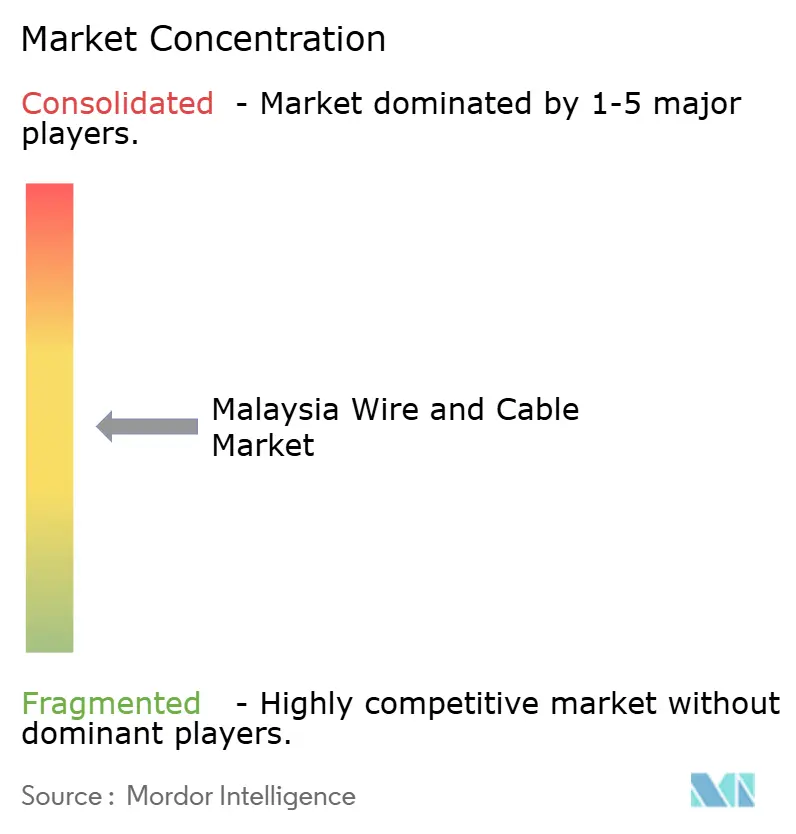
The Malaysia wire and cable market is moderately fragmented in low-voltage and medium-voltage products. Domestic producers compete on product quality, certification, delivery performance, and price. Southern Cable Group Berhad, Leader Cable Industry Berhad, and Universal Cable (M) Berhad are established domestic suppliers in these categories. Local manufacturing capabilities and familiarity with utility and construction requirements support their market positions. Smaller producers remain more exposed to price competition and changes in material costs.
Extra-high-voltage and submarine systems are more concentrated because suppliers must meet demanding qualification requirements and demonstrate relevant project references. Prysmian Group, Nexans, and LS Cable and System have international engineering and marine installation capabilities for these projects. TNB and State Grid Corporation of China's October 2025 agreement on advanced grid planning and resilient design highlights the growing need for technical capability in transmission projects. Southern Cable Group is expanding its capacity with XLPE and aluminum production lines targeted to support more advanced cable applications by 2027. This move addresses the gap between domestic capability and the expected pipeline for higher-voltage systems.
Equinix's development of KL2 in Cyberjaya demonstrates how end-user investment creates demand for specialized power and digital infrastructure. Telekom Malaysia's participation in the CANDLE system also highlights the role of value chain participants in supporting regional fiber connectivity. Manufacturers are using commodity-linked purchasing, aluminum integration, and investments in XLPE production to protect margins and improve product capabilities. Compliance testing also increases the value of established quality systems.
Malaysia Wire and Cable Industry Leaders
Southern Cable Group Berhad
Prysmian Group Malaysia Sdn Bhd
Nexans Malaysia Sdn Bhd
LS Cable & System Ltd.
Belden Inc.
- *Disclaimer: Major Players sorted in no particular order

Recent Industry Developments
- May 2026: AirTrunk announced MYR 12 billion (USD 2.7 billion) in new investment across 2 hyperscale campuses in Iskandar Puteri, JHB3 and JHB4, raising its total Malaysia commitment to MYR 27 billion (USD 6.1 billion) across 4 campuses. The company reported more than 700 MW of combined IT load across the campuses.
- May 2026: Equinix announced the development of KL2, a purpose-built IBX data center in Cyberjaya, with a total investment of more than USD 190 million and more than 2,200 cabinets upon completion.
- January 2026: The Sarawak-Sabah Power Grid Interconnection was energized, establishing a high-voltage backbone between the 2 East Malaysian states.
- September 2025: Telekom Malaysia joined the CANDLE submarine cable consortium to develop a 24-fiber-pair, 8,000 km cable linking Japan, Taiwan, the Philippines, Indonesia, Malaysia, and Singapore, with operations scheduled for 2028.


Malaysia Wire and Cable Market Report Scope
The Malaysia Wire and Cable Market Report is Segmented by Voltage (Extra-and High-Voltage [Greater Than 35 kV], Medium-Voltage [1-35 kV], and Low-Voltage [Less Than 1 kV]), Cable Type (Power Cable, Fiber-Optic Cable, Signal and Control Cable, and Coaxial and Data Cable), Conductor Material (Copper, Aluminum, and Optical Glass / Polymer), Installation (Overhead, Underground, and Submarine), End-User Vertical (Residential Construction, Commercial Construction, Power Infrastructure, Telecommunications and Data Centers, Oil and Gas and Petrochemicals, Automotive and Mobility, and Industrial Manufacturing), and Insulation (Insulated, and Non-Insulated). The Market Forecasts are Provided in Terms of Value (USD).
| Extra- and High-Voltage (Greater Than 35 kV) |
| Medium-Voltage (1-35 kV) |
| Low-Voltage (Less Than 1 kV) |
| Power Cable |
| Fiber-Optic Cable |
| Signal and Control Cable |
| Coaxial and Data Cable |
| Copper |
| Aluminum |
| Optical Glass / Polymer |
| Overhead |
| Underground |
| Submarine |
| Residential Construction |
| Commercial Construction |
| Power Infrastructure (Utilities and Renewables) |
| Telecommunications and Data Centers |
| Oil and Gas and Petrochemicals |
| Automotive and Mobility |
| Industrial Manufacturing |
| Insulated |
| Non-Insulated |
| By Voltage | Extra- and High-Voltage (Greater Than 35 kV) |
| Medium-Voltage (1-35 kV) | |
| Low-Voltage (Less Than 1 kV) | |
| By Cable Type | Power Cable |
| Fiber-Optic Cable | |
| Signal and Control Cable | |
| Coaxial and Data Cable | |
| By Conductor Material | Copper |
| Aluminum | |
| Optical Glass / Polymer | |
| By Installation | Overhead |
| Underground | |
| Submarine | |
| By End-User Vertical | Residential Construction |
| Commercial Construction | |
| Power Infrastructure (Utilities and Renewables) | |
| Telecommunications and Data Centers | |
| Oil and Gas and Petrochemicals | |
| Automotive and Mobility | |
| Industrial Manufacturing | |
| By Insulation | Insulated |
| Non-Insulated |


Key Questions Answered in the Report
What is the Malaysia wire and cable market size?
The Malaysia wire and cable market was valued at USD 488.11 million in 2025 and is estimated at USD 510.21 million in 2026. It is forecast to reach USD 655.32 million by 2031 at a 5.13% CAGR.
What is driving demand for wire and cable products in Malaysia?
Grid modernization, data centers, renewable-energy connections, construction, and electric-vehicle charging are expanding demand across power, fiber, and control cable categories.
Which voltage category is growing fastest in Malaysia?
Extra- and high-voltage cables are projected to grow at a 6.12% CAGR through 2031, supported by grid upgrades and large data center connections.
Why are fiber-optic cables growing faster than power cables?
Fiber-optic cables are expected to grow at a 7.03% CAGR through 2031, driven by data centers, digital networks, and submarine connectivity projects that require high-capacity communications infrastructure.
Which end users create the strongest demand for cable suppliers?
Power infrastructure held 26.89% of revenue in 2025, while telecommunications and data centers are projected to grow fastest at a 7.11% CAGR through 2031.
How does aluminum affect cable demand in Malaysia?
Aluminum is projected to expand at a 6.76% CAGR through 2031 as utility projects seek a lighter and lower-cost alternative to copper for transmission applications.
Page last updated on:






