
Malaysia Liquid Packaging Cartons Market Size and Share
Market Overview
| Study Period | 2021 - 2032 |
|---|---|
| Forecast Data Period | 2027 - 2032 |
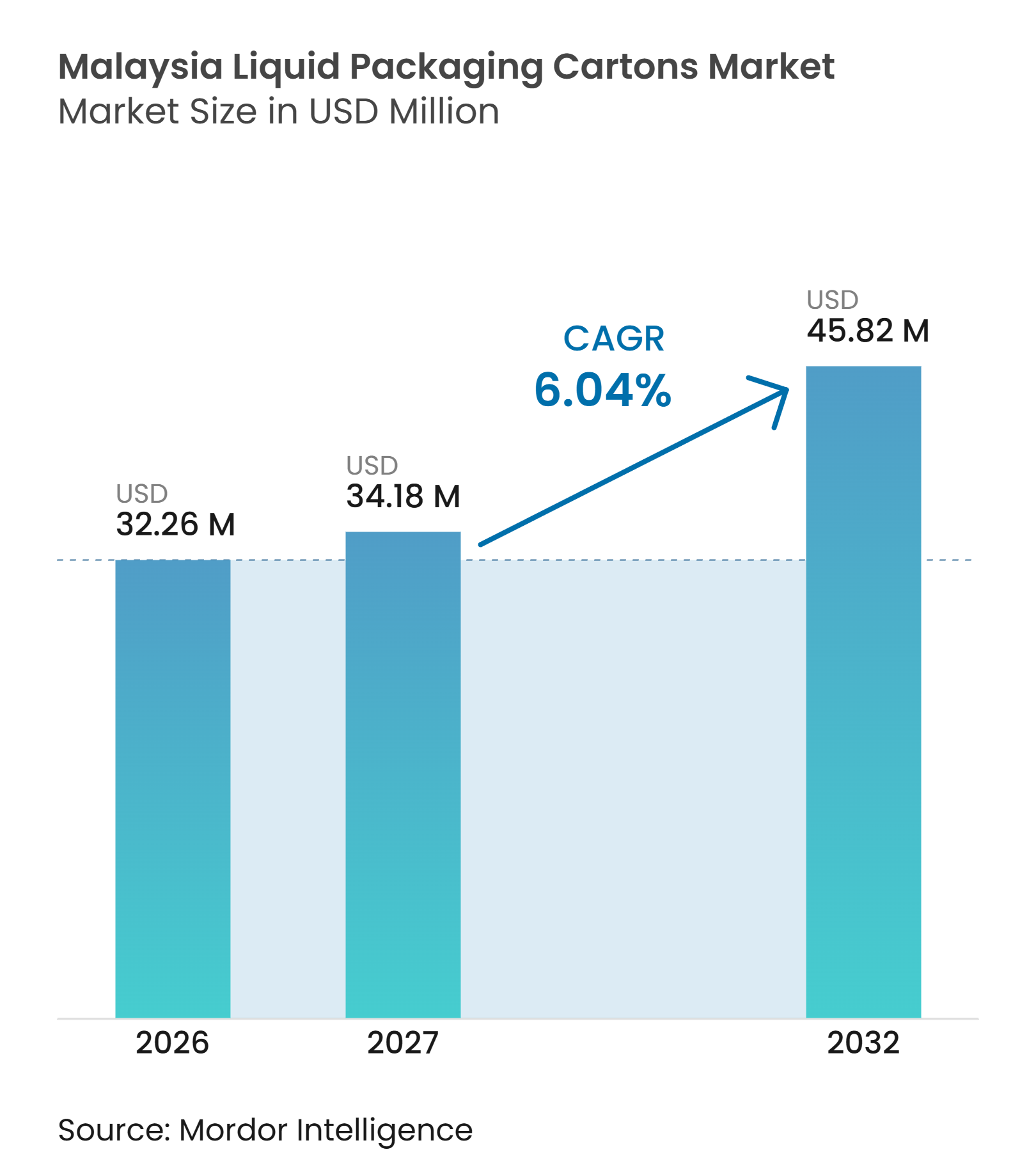
| Base Year Market Size (2026) | USD 32.26 Million |
| Market Size (2027) | USD 34.18 Million |
| Market Size (2032) | USD 45.82 Million |
| Growth Rate (2027 - 2032) | 6.04 % |
| Market Concentration | High |
Major Players *Disclaimer: Major Players sorted in no particular order Image © Mordor Intelligence. Reuse requires attribution under CC BY 4.0. | |
Malaysia Liquid Packaging Cartons Market Analysis by Mordor Intelligence
The Malaysia liquid packaging cartons market size is projected to grow from USD 32.26 million in 2026 to USD 45.82 million by 2032, at a CAGR of 6.04% from 2027 to 2032. The Malaysia liquid packaging cartons market benefits from a distribution model in which shelf-stable products can reach retail outlets without a continuous refrigerated chain. This advantage supports UHT milk, ready-to-drink beverages, and newer plant-based products across urban, rural, and East Malaysian channels, where retailers and institutional buyers can manage stock without the operational burden of continuous chilled storage and frequent temperature-controlled replenishment. Producers are responding with carton formats that serve individual consumption and larger household occasions, allowing brands to align pack choices with school, commuting, home-use, and food-service needs.
Key Report Takeaways
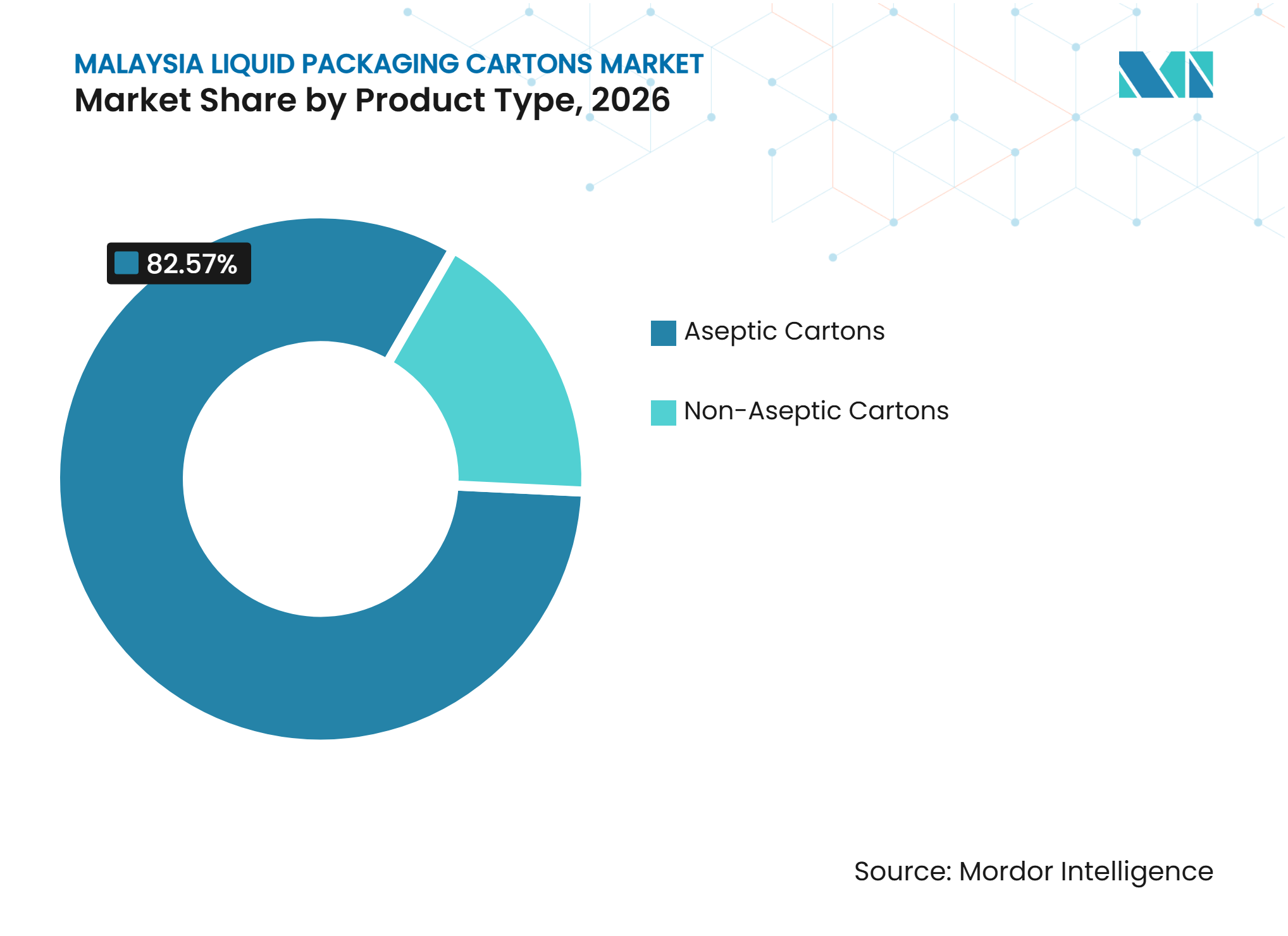
- By product type, aseptic cartons held 82.57% of the Malaysia liquid packaging cartons market share in 2026.
- By applications, energy and functional drinks are projected to expand at a 6.52% CAGR through 2032.
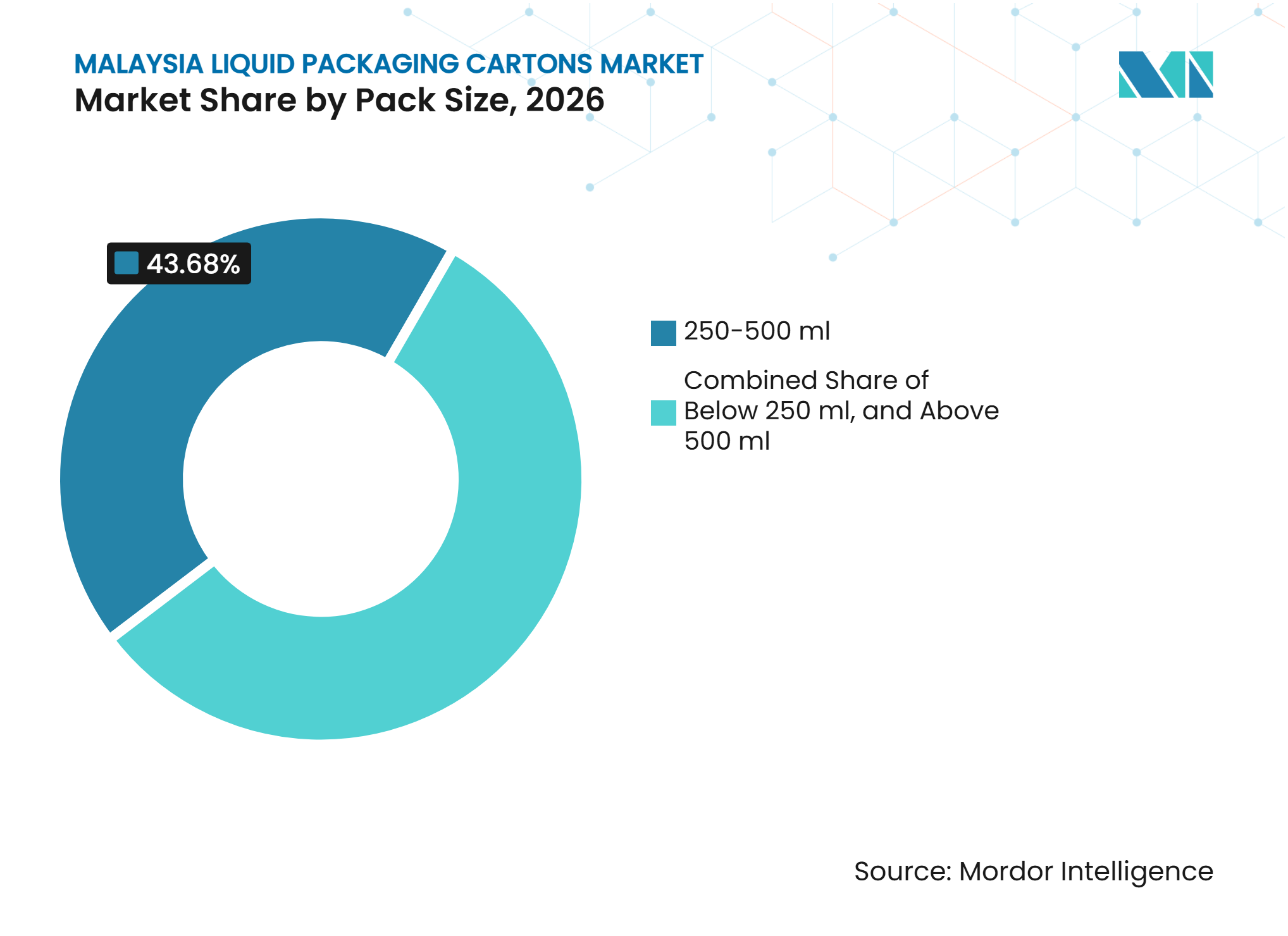
- By pack size, 250-500 ml held a 43.68% of the Malaysia liquid packaging cartons market share in 2026.
Note: Market numbers in this report are based on Mordor Intelligence's proprietary estimation framework, which combines nine months of actuals with Q4 projections for base year 2026.
Market Trends and Insights
Drivers Impact Analysis of Malaysia Liquid Packaging Cartons Market*
| Driver | (~) % Impact on CAGR Forecast | Geographic Relevance | Impact Timeline |
|---|---|---|---|
| Ambient Distribution for Tropical and Dispersed Geography | +2.1% | National, strongest in Sabah, Sarawak, and rural Peninsular corridors | Long term (≥ 4 years) |
| Growth of Ready-to-Drink Coffee, Tea, and Functional Beverages | +1.6% | Urban Peninsular Malaysia, with modern-trade spillover to East Malaysia | Medium term (2-4 years) |
| UHT Milk and Flavored Milk Consumption | +1.2% | National, especially rural and semi-urban areas with limited cold-chain coverage | Long term (≥ 4 years) |
| Plant-Based Beverage and Dairy-Alternative Innovation | +0.8% | Klang Valley and Penang, with ASEAN export potential | Medium term (2-4 years) |
| Portion-Controlled and On-the-Go Pack Demand | +0.6% | National, with early gains in Kuala Lumpur, Petaling Jaya, and Johor Bahru | Short term (≤ 2 years) |
| Retailer and Producer Shift Toward Fiber-Based Packaging | +0.4% | National, with early compliance activity in large-format retail | Medium term (2-4 years) |
| Source: Mordor Intelligence | |||
Ambient Distribution for Tropical and Dispersed Geography
Malaysia’s warm and humid conditions make refrigerated distribution costly across many rural routes and across East Malaysia. Aseptic cartons enable shelf-stable products to move through ambient supply chains, which supports wider access to liquid dairy and beverages. The Malaysia liquid packaging cartons market therefore serves a practical distribution need rather than only a packaging preference, since suppliers must maintain shelf-stable quality during long store-to-store movements, seasonal demand changes, and delivery schedules that do not support refrigeration. Tetra Pak stated that its Binh Duong facility in Vietnam supplies 95% of Malaysia’s packaging requirements and produces formats intended for on-the-go beverage distribution.[1] The same supply arrangement can create procurement exposure because a large share of material originates from one regional production location. PET bottles and flexible pouches may compete in some categories, but they do not remove the need for ambient shelf life where refrigeration is unavailable, particularly for distributors serving supermarkets, small local stores, schools, and food-service customers, where simpler handling can protect availability, lower spoilage exposure, and reduce reliance on chilled storage capacity.
Growth of Ready-to-Drink Coffee, Tea, and Functional Beverages
Ready-to-drink coffee, tea, and functional beverages are widening the application base of the Malaysia liquid packaging cartons market. Low-sugar and functional formulations can be positioned for consumers seeking convenient products with specific nutrition or hydration attributes. Tetra Pak introduced the Tetra Prisma Aseptic 1000 Square with HeliCap 27 and Tetra Brik Aseptic 1000 Slim formats for Malaysia’s ready-to-drink coffee category.[2] These formats support both at-home consumption and professional use, which broadens the occasions served by cartons. Malaysia’s sugar tax adds pressure on mainstream sweetened soft drinks and encourages product development in lower-sugar categories. This favors manufacturers that can offer ambient products without depending on refrigerated retail space, particularly when convenience stores and traditional outlets have limited chilled display capacity or must allocate that capacity to fresh products.
UHT Milk and Flavored Milk Consumption
UHT milk remains a core source of carton demand because it combines a familiar product format with extended shelf life. Dutch Lady Milk Industries Berhad reported FY2025 revenue above RM 1.5 billion, equal to USD 336 million, with 3.8% growth and new UHT products in its portfolio.[3] Farm Fresh Berhad reported FY2025 revenue of RM 981.18 million, equal to USD 220 million, with 21.1% growth, partly supported by higher UHT sales. These results indicate that large dairy suppliers still have a strong commercial reason to maintain ambient formats. Farm Fresh also increased gable-top carton production when HDPE resin supply conditions became difficult, showing that cartons can provide a packaging alternative during supply disruption. The Malaysia liquid packaging cartons market gains stability from this established dairy base, even as beverage demand becomes more diverse, because the installed retail network, familiar serving formats, and recurring household purchases provide a dependable base for material demand.
Plant-Based Beverage and Dairy-Alternative Innovation
Plant-based beverages are giving carton suppliers access to a product category that needs shelf-stable distribution and product differentiation. In April 2026, Pure Mylk and Tetra Pak announced a partnership at The Mylky Way innovation hub in Pulau Indah, Selangor, to support plant-based functional beverage development. The project combines processing support with aseptic packaging for products that can remain shelf stable for up to 12 months. This lowers development barriers for brands that cannot build their own specialized production capability. Aluminum-free cartons also give producers a way to link packaging choices with environmental positioning. The Malaysia liquid packaging cartons market can benefit when plant-based brands scale from niche retail into broader modern-trade and traditional-trade distribution, especially when producers need packaging that protects sensitive formulations while presenting a clear shelf-stable proposition to retailers.
Restraints Impact Analysis of Malaysia Liquid Packaging Cartons Market*
| Restraint | (~) % Impact on CAGR Forecast | Geographic Relevance | Impact Timeline |
|---|---|---|---|
| Competition From PET Bottles and Flexible Pouches | -1.8% | National, most acute in energy drinks, juices, and plant-based beverages in Klang Valley | Short term (≤ 2 years) |
| Multilayer Carton Collection and Separation Gaps | -1.0% | National, especially municipalities without organized used-carton collection | Medium term (2-4 years) |
| Imported Board and Foreign-Exchange Exposure | -0.6% | National, with direct effects on converter margins | Medium term (2-4 years) |
| Filling-Line Capital Intensity and Supplier Switching Costs | -0.4% | National, most restrictive for small and mid-size producers | Long term (≥ 4 years) |
| Source: Mordor Intelligence | |||
Competition From PET Bottles and Flexible Pouches
PET bottles and flexible pouches remain strong alternatives in price-sensitive beverage categories. Their lower material use and limited tooling requirements appeal to producers that are testing new drinks or selling at low price points. The risk is greatest in energy drinks, juices, supplements, herbal drinks, and electrolyte products, where convenience and branding can outweigh the benefit of an aseptic carton. This pressure is less severe in established UHT dairy products because producers already operate suitable filling lines and consumers recognize the carton format. The Malaysia liquid packaging cartons market may lose incremental volumes in newer applications if carton suppliers cannot meet target prices and pack-format needs. Suppliers must therefore match the speed, flexibility, and commercial terms offered by plastic and flexible-packaging alternatives.
Multilayer Carton Collection and Separation Gaps
Liquid cartons use paperboard, polyethylene, and aluminum layers, so they require specialized collection and separation systems after use. Malaysia’s National Circular Economy Council approved an extended producer responsibility policy framework in May 2025 that identifies cartons as one of 6 priority packaging materials. The voluntary phase begins in 2026, while mandatory compliance is planned by 2030. Tetra Pak and KPT Recycle launched the Sort and Drop, Recycle the Cartons project in Ipoh in April 2025, and Tetra Pak estimated that national expansion could collect more than 6,000 tons of used beverage cartons annually. The Malaysia liquid packaging cartons market faces a transition period in which recyclability claims must be supported by dependable local recovery systems, regular consumer participation, clear sorting guidance, and stable end markets for recovered fiber and other materials, or brand owners may find it difficult to show alignment with stated environmental commitments and emerging compliance expectations. Brand owners will also need to prepare for customer sustainability reviews and future producer responsibility obligations.
*Our forecasts treat driver/restraint impacts as directional, not additive. The impact forecasts reflect baseline growth, mix effects, and variable interactions.
Malaysia Liquid Packaging Cartons Market Segment Analysis
By Product Type:
Aseptic Technology Anchors DemandAseptic cartons commanded 82.57% of the Malaysia liquid packaging cartons market share in 2026. Their position reflects use in UHT milk, ready-to-drink beverages, plant-based drinks, and institutional dairy distribution. Once a producer invests in an aseptic line and approves a carton specification, changing the package system can involve capital loss, technical validation, and consumer communication. That creates long supply relationships between fillers and system providers. SIG reported 24% year-on-year global sales growth for its alu-layer-free aseptic cartons in 2025, with the SIG Terra portfolio delivering 2 billion liters of food and beverages. The performance indicates demand for lower-material formats that can run on established equipment. The Malaysia liquid packaging cartons industry can use this type of format innovation to defend a mature installed base while responding to sustainability requirements.
Tetra Pak introduced a paper-based barrier for juice packaging with García Carrión in December 2025. The Tetra Brik Aseptic 200 ml Slim Leaf carton has 80% paper content and a 43% lower carbon footprint than aluminum-foil-barrier formats, according to the company. This development shows that aseptic cartons can evolve without changing the central benefits of barrier protection and ambient distribution. Non-aseptic cartons occupy a smaller role in fresh chilled dairy, cold-pressed juice, and flavored milk. Farm Fresh increased gable-top paper carton production during HDPE resin supply disruption, which demonstrates their value as a backup packaging route. These formats can help dairy processors manage supply risk, although they do not substitute for aseptic cartons in long ambient distribution. The product mix therefore combines a dominant aseptic platform with a smaller gable-top segment that has operational value during disruptions.



By Applications:
Functional Beverages Lead Growth While Milk Holds ScaleMilk held 38.92% of the Malaysia liquid packaging cartons market size in 2026. It remains important because school programs, retail familiarity, and established dairy brands support repeat demand for ambient products. Energy and functional drinks are projected to expand at a 6.52% CAGR from 2027 to 2032. These beverages fit single-serve consumption and can carry hydration, protein, immunity, or other functional propositions. SIG’s Drinksplus technology supports aseptic cartons for beverages containing up to 10% particulate content, including oats, nata de coco, and grains. This gives food and beverage producers more room to develop textured drinks without moving to refrigerated or canned formats. The Malaysia liquid packaging cartons market has an opportunity to build volume in these newer products without depending solely on dairy.
Juices remain a meaningful secondary application because aseptic packs preserve ambient shelf life and can support premium positioning. Tetra Pak’s paper-based barrier development for juice provides an additional material option for producers considering future packaging specifications. Plant-based beverages are also becoming more accessible to new brands through development and co-packing support. The Mylky Way partnership provides a platform for testing products before larger commercial commitments. Dairy products excluding milk include drinking yogurt, cream, and flavored cultured drinks, which add volume through modern retail and food service. Liquid food applications include soups, coconut milk, broths, and sauces, while other uses include liquid eggs and specialty nutritional beverages. Together, these applications reduce dependence on a single end use and create more paths for carton suppliers to grow.
By Pack Size:
Convenience Packs Accelerate While Mid-Sized Packs LeadThe 250-500 ml range held 43.68% share of the Malaysia liquid packaging cartons market size in 2026. It serves household UHT milk, school servings, and single-serve ready-to-drink products sold through convenience stores and modern retail. The common 250 ml brick carton has strong consumer familiarity and remains an important format for institutional purchases. Dutch Lady’s reclosable sip and seal pack shows how suppliers are adding practical features within a mature volume tier. These features can improve convenience and support modest product differentiation without requiring a new consumption occasion. This pack size continues to be the base of the Malaysia liquid packaging cartons industry because it suits routine purchasing and established distribution channels.
Below 250 ml is projected to grow at a 6.74% CAGR from 2027 to 2032. Small cartons meet demand for portability, portion control, school programs, and on-the-go consumption in cities. SIG MiniBloc and SIG XSlimBloc formats support aseptic filling from 80 ml to 250 ml and allow quicker format changes on compatible lines. This can reduce the need for separate equipment when producers add smaller packs to an existing portfolio. Above 500 ml formats serve households, food service, and HORECA buyers, particularly for ready-to-drink coffee and tea. Large formats remain more price sensitive, but they can support premium products when recloseable closures and product quality matter. The pack-size structure balances high-volume mid-sized cartons with small-format growth and multi-serve demand.

Geography Analysis
Peninsular Malaysia and the West Coast Industrial Corridor
Peninsular Malaysia is the principal demand center for the Malaysia liquid packaging cartons market because it concentrates modern retail, food service, manufacturing, and a dense consumer base. Greater Kuala Lumpur, Selangor, Penang, and Johor Bahru support high levels of hypermarket, supermarket, convenience-store, and food-service activity, while consumers have broad access to UHT milk, ready-to-drink coffee, tea, juices, and functional beverages. The corridor also supports plant-based product development and co-packing activity, where rapid access to retail buyers can shorten the path from product testing to a commercial launch. JAKIM halal certification is a major compliance factor for dairy and non-dairy products serving the mass market, so suppliers that combine halal compliance, shelf stability, and convenient portion sizes are better placed across this retail corridor.
East Malaysia: Sabah and Sarawak
East Malaysia relies on ambient distribution because dispersed communities, challenging terrain, and longer transport routes can restrict refrigerated delivery. This makes UHT milk and other shelf-stable liquid products particularly suitable for Sabah and Sarawak, where aseptic packaging helps maintain quality during extended transport without refrigeration. Smaller cartons also match school programs and convenience retail, especially where institutional demand supports predictable volumes and regular product replenishment. The Malaysia liquid packaging cartons market has a structural advantage in these states because it can supply remote outlets with fewer cold-chain requirements, although suppliers need reliable inventory planning when transport interruptions affect availability. A stronger recovery network for used cartons would align East Malaysian growth with the national circular-economy framework and provide brand owners with clearer evidence of post-consumer material management.
Northern, East Coast, Southern, and Inland Markets
Northern Peninsular states benefit from long-standing familiarity with UHT products and growing interest in ready-to-drink tea and functional beverages. Ipoh became an early location for carton recovery efforts when Tetra Pak and KPT Recycle began their collection project in April 2025, providing a test for collection systems that could support wider producer responsibility requirements. Kelantan, Terengganu, and Pahang remain important for traditional-trade distribution because ambient cartons can reach outlets beyond refrigerated supply chains, while rural Johor, Negeri Sembilan, and other inland areas are seeing more convenience-channel presence through petrol-station minimarts. Across these mixed geographies, packaging suppliers need to pair accessible formats with collection solutions and local retail execution.
Competitive Landscape
Market Concentration
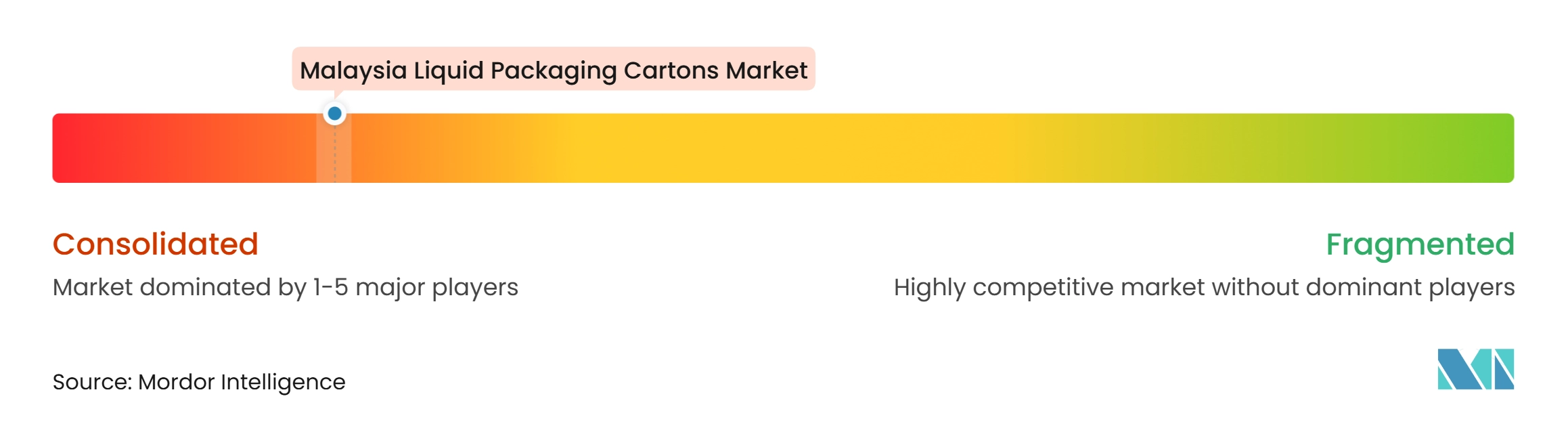
The Malaysia liquid packaging cartons market is highly concentrated at the filling-system level because 2 integrated providers supply proprietary aseptic filling machines and matched carton materials to much of the installed base. Producers that invest in these systems face long depreciation periods and technical constraints that make a rapid supplier change difficult, creating stable relationships in established dairy and beverage lines. Chinese-origin suppliers, including Greatview Aseptic Packaging, Lami Packaging, Shandong Bihai Packaging Materials, TidePak Aseptic Packaging Material, and Shanghai Skylong Aseptic Package Material, compete where producers operate non-proprietary or dual-compatible lines. Their position is stronger in energy drinks, liquid foods, and plant-based beverages where production systems may be less locked in. Price competition is therefore most visible in applications with lower switching barriers.
Incumbent suppliers are defending their positions through material innovation, format variety, and technical service. SIG’s alu-layer-free formats aim to lower the material footprint while continuing to work with established filling assets. Tetra Pak’s paper-based barrier for juice similarly raises the value offered beyond standard carton supply, showing that technological differentiation is being used to manage pressure from lower-cost material suppliers.
SIG expanded its Neo filling-machine portfolio in October 2026 with high-speed and high-flexibility options that support rapid format changes, which can appeal to Malaysian producers that want to serve several pack sizes without expanding their facilities and need frequent production changes for new beverage categories. Tetra Pak’s April 2026 work with Pure Mylk places the company earlier in beverage development, which can make the relationship more durable than a material-supply contract. Billerud launched CrownBoard Carry and CrownBoard Light in September 2025 without wet-strength additives, positioning the products for recyclability requirements, and board suppliers are also responding to regulatory and buyer expectations. The Malaysia liquid packaging cartons market remains concentrated, but competition is becoming more active in flexible filling systems, sustainable materials, and support for new beverage launches.
Malaysia Liquid Packaging Cartons Industry Leaders
-
Tetra Pak (Malaysia) Sdn Bhd
-
SIG Combibloc Malaysia Sdn Bhd
-
Greatview Aseptic Packaging Company Limited
-
Elopak ASA
-
Lami Packaging (Kunshan) Co., Ltd.
- *Disclaimer: Major Players sorted in no particular order
Malaysia Liquid Packaging Cartons Market Companies Covered in this Report
- Tetra Pak (Malaysia) Sdn Bhd
- SIG Combibloc Malaysia Sdn Bhd
- Elopak ASA
- Greatview Aseptic Packaging Company Limited
- Lami Packaging (Kunshan) Co., Ltd.
- Nippon Paper Industries Co., Ltd.
- UFlex Limited
- IPI Srl
- Stora Enso Oyj
- Amcor plc
- Mondi plc
- Billerud AB
- Shandong Bihai Packaging Materials Co., Ltd.
- TidePak Aseptic Packaging Material Co., Ltd.
- Shanghai Skylong Aseptic Package Material Co., Ltd.
- Italpack Srl
- Parksons Packaging Ltd.
- Obeikan Investment Group
- Evergreen Packaging LLC
Recent Industry Developments in Malaysia Liquid Packaging Cartons Market
- July 2026: Tetra Pak Malaysia showcased end-to-end processing, ASEAN smart factory automation, and Tetra Recart shelf-stable food cartons at the Malaysian International Food & Beverage (MIFB) Trade Fair 2026 in Kuala Lumpur. It helps local food and beverage producers accelerate time-to-market for ready-to-drink functional beverages and transition ambient soups and sauces from cans into paperboard cartons.
- April 2026: Malaysian plant-based innovator Pure Mylk and Tetra Pak announced a partnership to help brands develop and launch plant-based functional beverages at The Mylky Way innovation hub in Pulau Indah, Selangor, bringing Tetra Pak’s aseptic processing technology and sustainable packaging capabilities into Southeast Asia’s first end-to-end plant-based beverage facility. The collaboration provides Malaysian brands access to pilot-scale testing and co-packing with aseptic carton packaging enabling shelf-stable products for up to 12 months without refrigeration.
- March 2026: SIG Group reported that sales of its alu-layer-free aseptic cartons grew 24% year-on-year in 2025, delivering 2 billion liters of food and beverage under the SIG Terra portfolio in 2025 alone. The result validated demand for carton formats that reduce carbon footprint while running on installed SIG filling lines without capital expenditure, a business case relevant to Malaysian producers evaluating sustainability upgrades.
- February 2026: SCG Packaging strengthened its Malaysian footprint by rolling out advanced barrier packaging innovations designed to extend shelf life and reduce material weight. It supports local beverage manufacturers in lowering packaging material costs and cutting logistics emissions across Peninsular and East Malaysia.
Malaysia Liquid Packaging Cartons Market Report Scope
The Malaysia Liquid Packaging Cartons Market encompasses the manufacturing and supply of paperboard-based packaging solutions designed for the safe storage, transportation, and distribution of liquid beverages and food products. These cartons provide product protection, extended shelf life, and convenient handling while supporting efficient packaging and distribution. The market includes packaging solutions designed to maintain product freshness, prevent contamination, and meet evolving food safety and sustainability requirements.
The Malaysia Liquid Packaging Cartons Market Report is Segmented by Product Type (Aseptic Cartons, and Non-Aseptic Cartons), Applications (Milk, Juices, Plant Based Beverages, Dairy Products Excluding Milk, Energy and Functional Drinks, Liquid Food, and Other Applications), and Pack Size (Below 250 ml, 250-500 ml, and Above 500 ml). The Market Forecasts are Provided in Terms of Value (USD).
Segmentation Overview
| Aseptic Cartons |
| Non-Aseptic Cartons |
| Milk |
| Juices |
| Plant Based Beverages |
| Dairy Products (Excluding Milk) |
| Energy and Functional Drinks |
| Liquid Food |
| Other Applications |
| Below 250 ml |
| 250-500 ml |
| Above 500 ml |
| By Product Type | Aseptic Cartons |
| Non-Aseptic Cartons | |
| By Applications | Milk |
| Juices | |
| Plant Based Beverages | |
| Dairy Products (Excluding Milk) | |
| Energy and Functional Drinks | |
| Liquid Food | |
| Other Applications | |
| By Pack Size | Below 250 ml |
| 250-500 ml | |
| Above 500 ml |
Key Questions Answered in the Report
What is the size of the Malaysia liquid packaging cartons market?
The Malaysia liquid packaging cartons market is projected to grow from USD 32.26 million in 2026 to USD 45.82 million by 2032, at a 6.04% CAGR from 2027 to 2032.
Which product type leads liquid carton demand in Malaysia?
Aseptic cartons lead with 82.57% share in 2026 because the Malaysia liquid packaging cartons market depends on formats that support UHT milk, ready-to-drink beverages, and plant-based products without a cold chain.
Which application is expected to grow fastest through 2032?
Energy and functional drinks are projected to expand at a 6.52% CAGR from 2027 to 2032 as brands develop convenient, shelf-stable products.
Which carton pack size has the largest share in Malaysia?
The 250-500 ml range held 43.68% share in 2026 because it supports household UHT milk, school servings, and ready-to-drink beverages.
Why are aseptic cartons important in East Malaysia?
They allow the Malaysia liquid packaging cartons market to serve longer distribution routes without continuous refrigeration, which suits dispersed communities and difficult transport routes in Sabah and Sarawak.
What are the main challenges facing carton suppliers?
PET and flexible pouches create price pressure, while collection and separation infrastructure must improve before mandatory producer responsibility requirements begin in 2030.