
Machine Vision Software Market Size and Share
Market Overview
| Study Period | 2020 - 2031 |
|---|---|
| Market Size (2026) | USD 5.11 Billion |
| Market Size (2031) | USD 7.24 Billion |
| Growth Rate (2026 - 2031) | 7.22 % |
| Fastest Growing Market | Asia-Pacific |
| Largest Market | Asia-Pacific |
| Market Concentration | Medium |
Major Players *Disclaimer: Major Players sorted in no particular order Image © Mordor Intelligence. Reuse requires attribution under CC BY 4.0. | |
Machine Vision Software Market Analysis by Mordor Intelligence
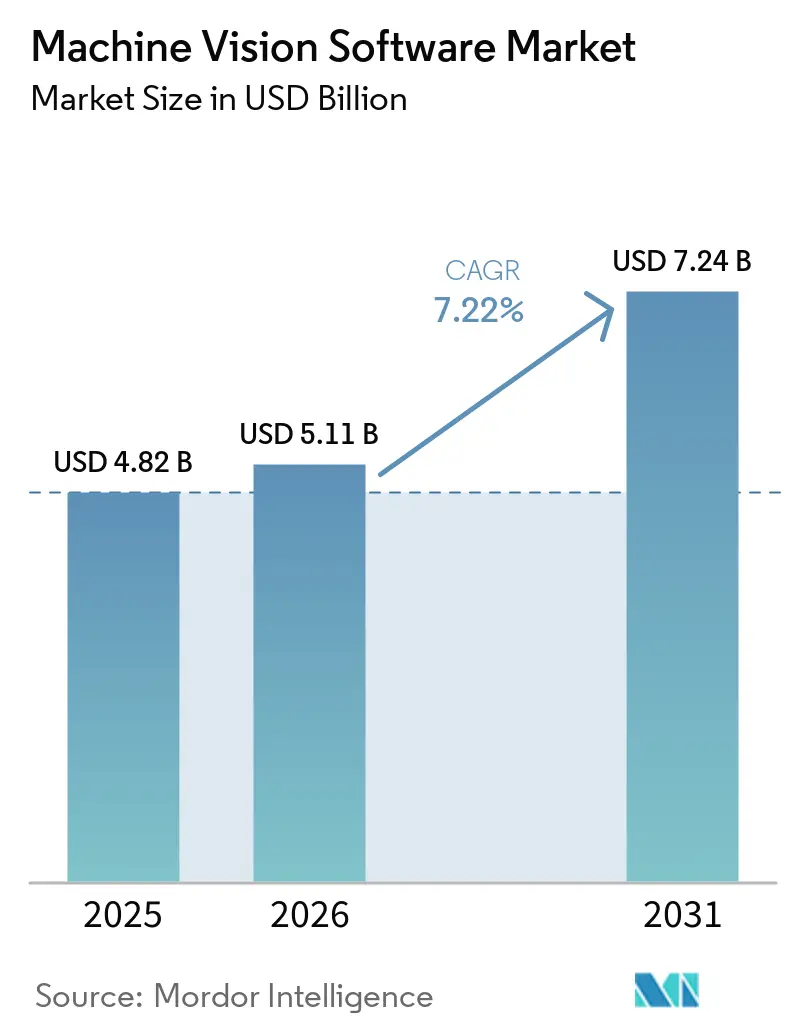
The machine vision software market size was valued at USD 4.82 billion in 2025 and estimated to grow from USD 5.11 billion in 2026 to reach USD 7.24 billion by 2031, at a CAGR of 7.22% during the forecast period (2026-2031). The machine vision software market is benefiting from manufacturers replacing sample-based checks with 100% inline inspection. Automotive, electronics, logistics, and process manufacturers are applying AI-based tools where product variation and small defects limit rule-based methods. The commercial opportunity increasingly depends on connecting inspection data to production systems so that operators can respond while a line is running. Vendors are also competing on deployment speed, model governance, and integration support, rather than image analysis performance alone. These conditions extend the machine vision software market into smaller manufacturers that previously lacked enough defect images or specialist staff to deploy AI inspection.
Key Report Takeaways
- By software type, Vision Inspection and Quality Assurance Software held 33.21% of the machine vision software market share in 2025, while AI and Deep Learning Vision Software is projected to expand at a CAGR of 8.63% through 2031.
- By deployment model, On-Premises and Edge Software held 72.34% revenue share in 2025, while Cloud-Based Software is expected to grow at a CAGR of 7.89% through 2031.
- By application, Quality Inspection and Defect Detection accounted for 34.78% revenue share in 2025, while Robot Guidance and Bin Picking are projected to grow at a CAGR of 7.76% through 2031.
- By industry vertical, Automotive and Mobility held 23.78% revenue share in 2025, while EV and Battery Manufacturing is expected to expand at a CAGR of 8.16% through 2031.
- By geography, Asia-Pacific accounted for 34.88% of the machine vision software market in 2025 and is projected to grow at a CAGR of 8.71% through 2031.
Note: Market size and forecast figures in this report are generated using Mordor Intelligence’s proprietary estimation framework, updated with the latest available data and insights as of January 2026.
Global Machine Vision Software Market Trends and Insights
Drivers Impact Analysis*
| Driver | (~) % Impact on CAGR Forecast | Geographic Relevance | Impact Timeline |
|---|---|---|---|
| Zero-Defect Manufacturing and Automated Inspection | +2.0% | Global, with concentrated intensity in Asia-Pacific advanced manufacturing clusters and European automotive OEMs | Short term (≤ 2 years) |
| AI and Deep-Learning Adoption in Vision Workflows | +1.7% | Global, strongest in North America for technology development and Asia-Pacific for deployment scale | Medium term (2-4 years) |
| Vision-Guided Robotics and Smart-Factory Deployment | +1.3% | North America and Europe, with rapid Asia-Pacific expansion in EV assembly and electronics | Medium term (2-4 years) |
| Labor Scarcity and Rising Inspection Costs | +0.9% | North America and the EU, with an emerging effect in Japan and South Korea | Short term (≤ 2 years) |
| Traceability Requirements in Food, Pharmaceutical, and Electronics Production | +0.6% | North America and the EU, with spillover to Asia-Pacific and the Middle East and Africa under GS1 and DSCSA alignment | Medium term (2-4 years) |
| Reusable Vision Models and Synthetic Defect Data for Low-Volume Production | +0.3% | Global, with early gains in European aerospace and North American medical device clusters | Long term (≥ 4 years) |
| Source: Mordor Intelligence | |||
Zero-Defect Manufacturing and Automated Inspection
The shift from sample checks to comprehensive inline inspection remains a central driver of demand in the machine vision software market. OEM contracts increasingly set extremely low defect limits that manual inspection cannot consistently meet. Deep learning models achieved very high detection accuracy in controlled settings, although most documented implementations remained at the prototype or pilot stage in a recent review. This presents a substantial rollout opportunity for suppliers capable of supporting deployment across several plants. Automotive and medical device quality requirements also favor inspection systems that provide repeatable and verifiable records. The value of the software increases when inspection results trigger corrective action through manufacturing execution systems rather than remaining a standalone quality record.
AI and Deep-Learning Adoption in Vision Workflows
Deep learning is changing the machine vision software market, as legacy suppliers must add neural network capabilities while AI-native suppliers enter established inspection applications. Adoption is strongest in automotive, electronics, and logistics, where tight tolerances and product variation limit the effectiveness of fixed inspection rules. A Cognex survey published in March 2026 found that 57% of respondents already used AI in machine vision operations and 30% planned near-term deployment. MVTec released HALCON 26.05 in May 2026 with improved AI and rule-based performance, multimodal visual prompting, and tools to reduce training image requirements. Platforms that allow non-specialists to build and maintain models can address the limited supply of vision-AI integration talent. This emphasis on usability can expand adoption beyond applications that have historically required specialist engineering teams.
Vision-Guided Robotics and Smart-Factory Deployment
Vision-guided robotics adds demand because bin picking, assembly guidance, and collaborative robot work depend on software that interprets position and orientation in real time. The machine vision software market, therefore, benefits when factories add flexible robotic cells to assembly, logistics, and kitting operations. A 2026 A3 member survey found that 86% of employers identified AI, machine vision, and collaborative robotics as key tools for business transformation. The same research identified AI vision as the leading automation priority for 41% of manufacturers. Simulation-first workflows allow teams to test robotic vision cells in digital-twin settings before site commissioning. Low-code platforms and reusable models can reduce the time required to adapt a vision system to a new product or line layout.
Labor Scarcity and Rising Inspection Costs
Labor shortages are making automated inspection a practical requirement for maintaining production capacity. The cited 2026 outlook reported 425,000 unfilled manufacturing positions in the United States.[1]Association for Advancing Automation, “2026 Smart Factory Outlook,” IIoT World, iiot-world.com. AI-based inline inspection can apply the same decision criteria throughout a shift, avoiding the fatigue effects associated with repetitive manual review. This shifts quality workers toward root-cause analysis, defect review, and process improvement. Those tasks create an additional need for software that records, traces, and analyzes defects across lines and plants. The machine vision software market can therefore benefit from both the initial automation purchase and the related demand for data management functions.
Restraints Impact Analysis*
| Restraint | (~) % Impact on CAGR Forecast | Geographic Relevance | Impact Timeline |
|---|---|---|---|
| High Total Cost of Ownership for Integrated Vision Cells | -0.8% | Global, with an amplified effect in cost-sensitive Asia-Pacific Tier-2 suppliers and SMEs in Europe and North America | Short term (≤ 2 years) |
| Legacy-System Integration and Commissioning Complexity | -0.5% | Global, most acute in mature industrial economies with installed PLC and SCADA infrastructure, including Germany, Japan, and the United States | Medium term (2-4 years) |
| Shortage of Vision-AI Integration Specialists | -0.4% | Global, most acute in North America and Europe, and cited as the top barrier by 47% of manufacturing firms | Medium term (2-4 years) |
| Cybersecurity and Data-Governance Exposure in Connected Vision Systems | -0.3% | North America and the EU under NIS2 and ISA/IEC 62443 frameworks, and Asia-Pacific under emerging data-sovereignty mandates | Long term (≥ 4 years) |
| Source: Mordor Intelligence | |||
High Total Cost of Ownership for Integrated Vision Cells
The total cost of an integrated vision cell is a material restraint for the machine vision software market, particularly for mid-sized manufacturers. Integration services for multi-line deployments can cost USD 15,000 to USD 45,000 before AI model training, operator training, and later retraining costs are included. Hardware amortization and integration labor represented 52% of the first-year deployment cost in the cited benchmark. Costs later shift toward software, support, and recurring operating expenses, which can conflict with procurement plans centered on a one-time equipment purchase. Cognex made OneVision generally available in May 2026 and reported cost reductions of up to 50% for scaling deployments. Centralized model management can address some cost issues, but it also requires buyers to assess long-term subscription and platform dependencies.
Legacy-System Integration and Commissioning Complexity
Brownfield facilities often use PLCs, SCADA systems, and manufacturing execution systems from several suppliers and across multiple technology generations. A vision system must connect to these systems without disrupting production, which increases the time and cost of commissioning. In regulated pharmaceutical and medical device settings, formal change controls and validation records add further time to software changes. MVTec's MERLIC 26.03 release in March 2026 added audit-trail functions and ISO/IEC-compliant 2D code verification, demonstrating how these needs are shaping product design.
*Our forecasts treat driver/restraint impacts as directional, not additive. The impact forecasts reflect baseline growth, mix effects, and variable interactions.
Segment Analysis
By Software Type: Inspection Software Leads as AI Tools Expand
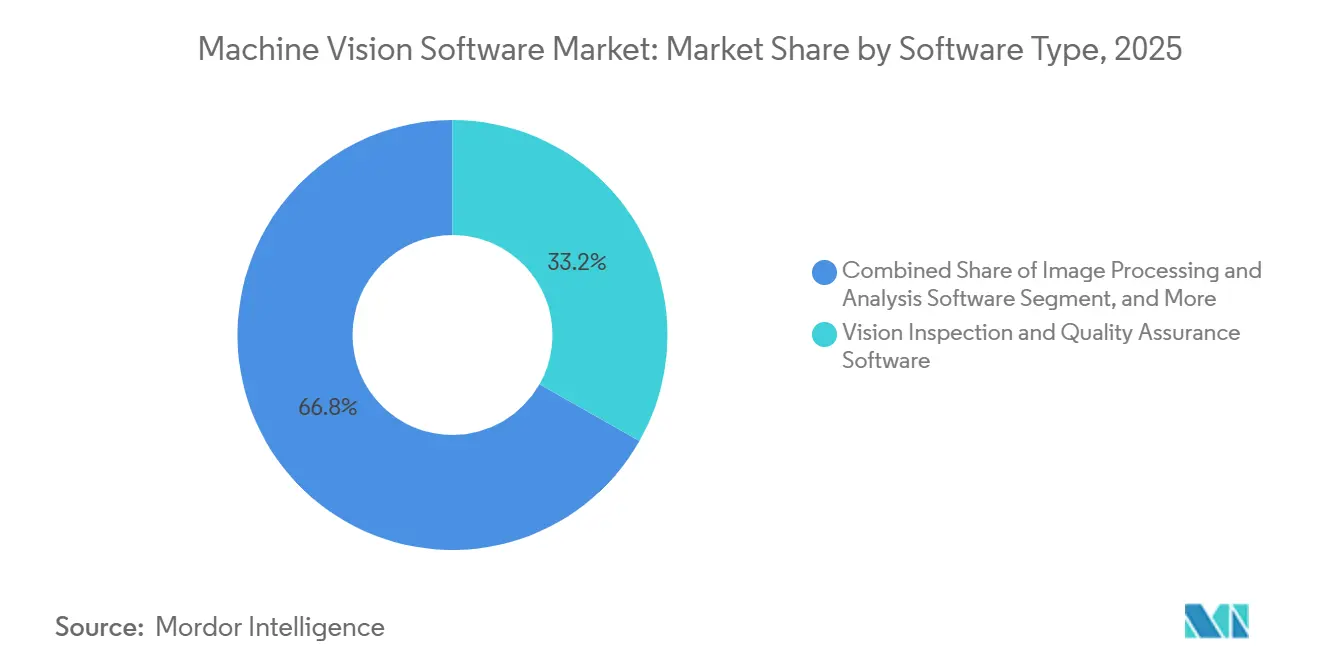
Vision Inspection and Quality Assurance Software accounted for 33.21% of the machine vision software market share in 2025. Its established position reflects long-term use in defect detection across automotive, consumer electronics, and food packaging lines. The machine vision software market size for AI and Deep Learning Vision Software is projected to grow at a CAGR of 8.63% through 2031. This growth is linked to the difficulty that rule-based tools face when products have cosmetic variation, new defect patterns, or complex surfaces. Low-volume, high-mix producers in aerospace, specialty chemicals, and medical devices can increasingly train models on synthetic defect data rather than on extensive libraries of real defect images.
Vision Development and Programming Software remains important for integrators and internal engineering teams that build customized applications. Image Processing and Analysis Software also remains core infrastructure for applications requiring specialized measurement or classification. HALCON 26.05 added speed improvements for AI and rule-based methods, support for multimodal language models, and improved object detection generation. Calibration, configuration, and system-management tools tend to grow with the installed base of vision systems. Suppliers increasingly bundle these functions into subscriptions instead of selling separate licenses. This approach can raise software revenue per customer while making costs less visible in hardware-led purchasing decisions.



By Deployment Model: Edge Execution Remains Essential While Cloud Management Grows
On-Premises and Edge Software held 72.34% of revenue in 2025. This position reflects the need for production lines running at 200 or more units per minute to receive inference results in under 10 ms. Cloud-Based Software is projected to advance at a CAGR of 7.89% through 2031. The machine vision software market uses cloud systems mainly for centralized model training, version control, cross-site governance, and aggregated analytics. Cloud use does not eliminate the requirement for local execution when an inspection decision controls rejection equipment. This makes hybrid architectures relevant for manufacturers that require both rapid line decisions and coordinated model management.
Cognex introduced OneVision as a cloud-to-edge environment in May 2026. It supports centralized training and governance while allowing local inspection to continue without cloud connectivity during production. The architecture can limit latency, bandwidth, and factory-floor exposure by keeping routine inspection at the edge. Hybrid deployment is particularly relevant for enterprises operating more than 100 inspection points. In those settings, edge devices can filter most image frames locally while cloud tools manage flagged cases and retraining. The machine vision software market is therefore developing as a combined local execution and centralized governance model rather than a simple shift from on-premises systems to the cloud.
By Application: Quality Inspection Leads While Robot Guidance Gains Momentum
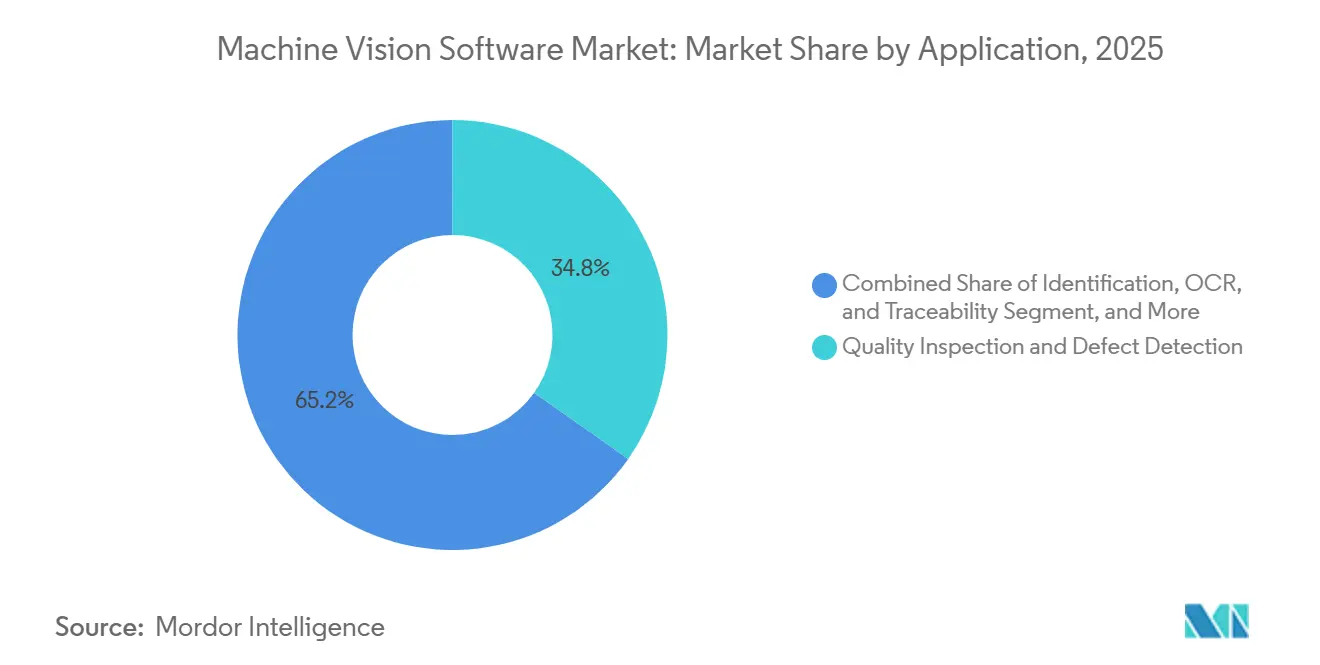
Quality Inspection and Defect Detection held 34.78% of revenue in 2025. The machine vision software market uses this application because manufacturers need to identify nonconforming items before assembly or packaging, when the cost of the issue increases. Robot Guidance and Bin Picking are projected to grow at a CAGR of 7.76% through 2031. Collaborative robots use vision to handle variations in workpiece position that fixed teach-pendant programming cannot efficiently manage. Measurement and Metrology applications are also moving toward inline, noncontact systems. These systems can provide data for statistical process control without the delay associated with offline measurement rooms.
Identification, OCR, and Traceability tools have an important role in pharmaceutical and electronics production. The U.S. Drug Supply Chain Security Act requires interoperable electronic tracing for prescription drug products, while the framework supports serialized product verification requirements.[2]U.S. Food and Drug Administration, “Drug Supply Chain Security Act,” U.S. Food and Drug Administration, fda.gov. The machine vision software market can verify 2D codes at line speed and generate records that meet audit requirements. Assembly Verification and Process Monitoring produce steady demand in automotive and electronics manufacturing. More electronic content in vehicles and more PCB layers increase the number of inspection points on each unit. Broader application libraries can therefore favor platforms that support several tasks over suppliers focused on a single use case.
By Industry Vertical: Automotive Remains Largest While EV Battery Production Accelerates
Automotive and Mobility held 23.78% of revenue in 2025. The sector has used automated inspection for decades across body, powertrain, and assembly processes. EV and Battery Manufacturing is expected to expand at a CAGR of 8.16% through 2031. The machine vision software market supports cell, module, and pack producers that need inline inspection to detect coating voids, weld anomalies, and sealant defects. A 2025 study reported that a YOLOv8-based system achieved 98.5% detection accuracy and a false alarm rate below 0.1% at a battery electrode line speed of 30 m/min. The same study reported a 67% reduction in defects and an 81% reduction in total quality-control costs compared with traditional approaches.
Electronics and Semiconductors require high precision for wafer features and PCB solder joints. This precision supports premium licensing and recurring model-maintenance work. Pharmaceuticals and Medical Devices require validated inspection records that can be retained for audits. Food, Beverage, and Packaging adds diversified demand for inspection and traceability. Aerospace and Defense has a lower production volume but particularly demanding inspection requirements. AI vision is being used in EV battery assembly to support quality decisions at production speed.
Geography Analysis
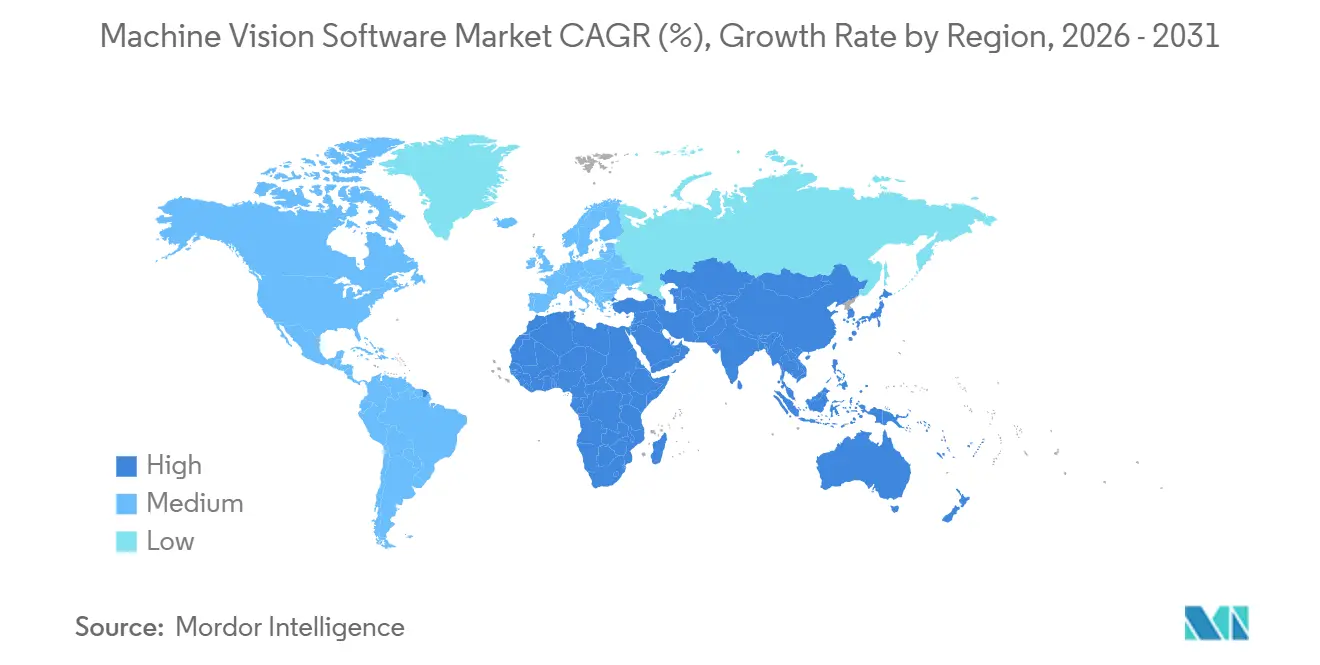
Asia-Pacific accounted for 34.88% of revenue in 2025 and is projected to grow at a CAGR of 8.71% through 2031. The machine vision software market in the region combines a large manufacturing base with extensive investment in battery plants, semiconductor fabrication, and electronics assembly. China is driving sustained procurement demand through additions in battery gigafactory and semiconductor capacity. Japan has a distinct market structure because Keyence integrates software licensing into system contracts in semiconductor backend inspection. India is building electronics manufacturing capacity through Production Linked Incentive programs as global OEMs add production in the country.
North America was the second-largest region in 2025. The machine vision software market is supported by automotive assembly, aerospace, medical device production, and advanced semiconductor fabrication. The region places greater emphasis on AI-native development platforms, cloud-to-edge model management, and pharmaceutical traceability. These applications can produce higher software license values and more recurring subscription revenue than hardware-centered deployments. Mexico is becoming an important procurement location as North American OEMs near-shore vehicle production and apply common quality standards across their manufacturing networks.
Europe is shaped by Germany's dense automotive OEM and Tier-1 supplier base. BMW's Gen6 battery production line at Plant Woodruff, commissioned in 2026, uses AI-assisted inline inspection for weld seams and 100% end-of-line battery inspection.[3]Automotive Powertrain Technology International “BMW Details Gen6 Battery Production Process at Plant Woodruff,” automotivepowertraintechnologyinternational.com. The United Kingdom, France, Italy, and Spain support demand from automotive, aerospace, food packaging, and pharmaceutical production. European buyers increasingly assess cybersecurity, audit trails, and on-premises options for connected inspection systems. Middle East and South America remain smaller markets, although greenfield investment in Saudi Arabia and the UAE and automotive and food processing demand in Brazil support new deployments.

Competitive Landscape
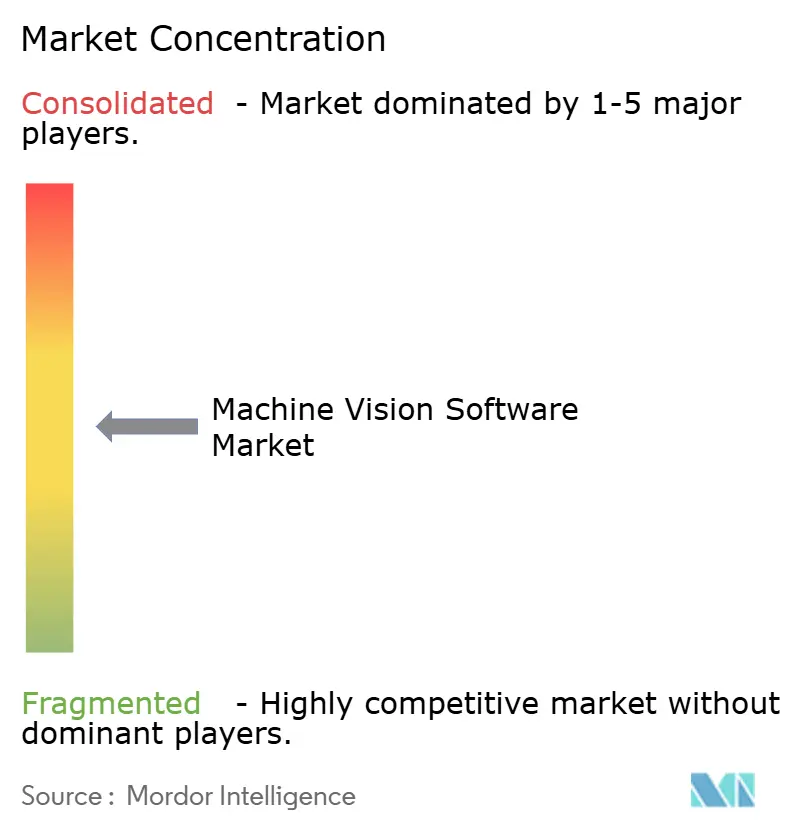
The machine vision software market has a moderately concentrated structure. Cognex, Keyence, and MVTec have strong positions through application libraries, integrator relationships, and long-established computer-vision capabilities. However, AI-native suppliers are reducing some barriers that once protected incumbent pricing. Landing AI offers low-code deep learning tools for manufacturers with limited vision engineering resources. NVIDIA provides the Metropolis AI-compute layer used by third-party software providers. Siemens is positioning vision functions within a broader industrial AI system, which places vision spending within wider manufacturing software budgets.
Incumbent suppliers are extending their platforms rather than replacing established products. Cognex made OneVision generally available in May 2026, combining cloud model management with local edge inspection. SICK launched AI-powered 3D quality inspection for its Nova platform in August 2026.[4]SICK AG, “Where Height Meets Intelligence,” SICK, sick.com. MVTec expanded HALCON 26.05 with multimodal language-model support and tools that reduce the number of training images required. These moves focus on lowering integration effort and making AI functions usable across several facilities.
Food and beverage, industrial machinery, and greenfield plants in emerging markets remain areas where adoption can broaden. Synthetic defect data, compressed edge models, and vision-language interfaces are becoming important areas of technical development. Suppliers that make model development easier through low-code tools, pre-trained models, or simulation-first workflows may reach more customers. Faster deployment can be decisive where multi-site rollouts have historically taken months. Cognex reported that OneVision helped reduce scaling costs by up to 50% and compressed multi-site deployment timelines from months to days.
Machine Vision Software Industry Leaders
Cognex Corporation
Keyence Corporation
Teledyne Technologies Incorporated
Omron Corporation
Basler AG
- *Disclaimer: Major Players sorted in no particular order

Recent Industry Developments
- August 2026: SICK AG launched AI-powered 3D quality inspection capabilities for its Nova machine vision platform, combining deep learning neural networks with high-precision 3D height-data analysis. The Nova AI software enables example-based model training directly on-device, with an anomaly heatmap interface targeting EV battery assembly verification, automotive tyre inspection, electronics surface inspection, and package deformation detection, expanding 3D machine vision beyond traditional rule-based limits without requiring additional hardware.
- May 2026: Cognex Corporation announced the general availability of OneVision, its cloud-to-edge AI vision development environment, following a June 2025 beta with more than 100 manufacturing customers. Essity validated an inspection application in under 1 day that previously required more than 1 year of iteration, and Schneider Electric reported doubled yield and dramatically reduced false rejections through centralized AI model deployment across global production sites.
- May 2026: MVTec Software GmbH released HALCON 26.05, introducing significant speed improvements for both AI and rule-based vision methods, expanded multimodal LLM support with visual prompting for its AI development assistant, a new object detection generation requiring fewer training images, and automated contour optimization for shape-based matching.
- April 2026: Cognex launched the In-Sight 6900 Vision Controller, powered by NVIDIA Jetson technology, enabling high-capacity AI processing at the edge for demanding industrial workloads without external PCs or distributed architectures. The modular design allows manufacturers to configure cameras, optics, and lighting independently from the AI compute platform.


Global Machine Vision Software Market Report Scope
The machine vision software market comprises software solutions that enable machines to capture, process, and analyze visual data from cameras and imaging systems. These solutions support automated inspection, quality control, measurement, and guidance across industrial applications. Machine vision software uses algorithms, artificial intelligence, and deep learning to improve accuracy, efficiency, and operational automation.
The Machine Vision Software Market Report is Segmented by Software Type (Vision Development and Programming Software, Image Processing and Analysis Software, AI/Deep Learning Vision Software, Vision Inspection and Quality Assurance Software, and Other Software Types), Deployment Model (On-Premises/Edge Software, Cloud-Based Software, and Hybrid Software), Application (Quality Inspection and Defect Detection, Measurement and Metrology, Robot Guidance and Bin Picking, Identification, OCR, and Traceability, Assembly Verification, and Process Monitoring), Industry Vertical (Automotive and Mobility, Electronics and Semiconductors, Industrial Machinery and Equipment, EV and Battery Manufacturing, Pharmaceuticals and Medical Devices, Food, Beverage, and Packaging, Aerospace and Defense, and Other Industry Verticals), and Geography (North America, South America, Europe, Asia-Pacific, Middle East, and Africa). The Market Forecasts are Provided in Terms of Value (USD).
| Vision Development and Programming Software |
| Image Processing and Analysis Software |
| AI / Deep Learning Vision Software |
| Vision Inspection and Quality Assurance Software |
| Other Software Types |
| On-Premises / Edge Software |
| Cloud-Based Software |
| Hybrid Software |
| Quality Inspection and Defect Detection |
| Measurement and Metrology |
| Robot Guidance and Bin Picking |
| Identification, OCR, and Traceability |
| Assembly Verification |
| Process Monitoring |
| Automotive and Mobility |
| Electronics and Semiconductors |
| Industrial Machinery and Equipment |
| EV and Battery Manufacturing |
| Pharmaceuticals and Medical Devices |
| Food, Beverage, and Packaging |
| Aerospace and Defense |
| Other Industry Verticals |
| North America | United States |
| Canada | |
| Mexico | |
| South America | Brazil |
| Argentina | |
| Chile | |
| Rest of South America | |
| Europe | Germany |
| United Kingdom | |
| France | |
| Italy | |
| Spain | |
| Rest of Europe | |
| Asia-Pacific | China |
| Japan | |
| India | |
| South Korea | |
| Australia | |
| Rest of Asia-Pacific | |
| Middle East | United Arab Emirates |
| Saudi Arabia | |
| Qatar | |
| Rest of Middle East | |
| Africa | South Africa |
| Egypt | |
| Nigeria | |
| Rest of Africa |
| By Software Type | Vision Development and Programming Software | |
| Image Processing and Analysis Software | ||
| AI / Deep Learning Vision Software | ||
| Vision Inspection and Quality Assurance Software | ||
| Other Software Types | ||
| By Deployment Model | On-Premises / Edge Software | |
| Cloud-Based Software | ||
| Hybrid Software | ||
| By Application | Quality Inspection and Defect Detection | |
| Measurement and Metrology | ||
| Robot Guidance and Bin Picking | ||
| Identification, OCR, and Traceability | ||
| Assembly Verification | ||
| Process Monitoring | ||
| By Industry Vertical | Automotive and Mobility | |
| Electronics and Semiconductors | ||
| Industrial Machinery and Equipment | ||
| EV and Battery Manufacturing | ||
| Pharmaceuticals and Medical Devices | ||
| Food, Beverage, and Packaging | ||
| Aerospace and Defense | ||
| Other Industry Verticals | ||
| By Geography | North America | United States |
| Canada | ||
| Mexico | ||
| South America | Brazil | |
| Argentina | ||
| Chile | ||
| Rest of South America | ||
| Europe | Germany | |
| United Kingdom | ||
| France | ||
| Italy | ||
| Spain | ||
| Rest of Europe | ||
| Asia-Pacific | China | |
| Japan | ||
| India | ||
| South Korea | ||
| Australia | ||
| Rest of Asia-Pacific | ||
| Middle East | United Arab Emirates | |
| Saudi Arabia | ||
| Qatar | ||
| Rest of Middle East | ||
| Africa | South Africa | |
| Egypt | ||
| Nigeria | ||
| Rest of Africa | ||


Key Questions Answered in the Report
What is the machine vision software market size?
The machine vision software market size is USD 5.11 billion in 2026 and is projected to reach USD 7.24 billion by 2031 at a CAGR of 7.22%.
What is driving demand for machine vision software?
Manufacturers are adopting 100% inline inspection, AI-based defect detection, vision-guided robotics, and software that links quality data to production actions.
Which machine vision software deployment model is growing fastest?
Cloud-Based Software is projected to grow at a CAGR of 7.89% through 2031, mainly for model training, governance, and cross-site analytics.
Which application is growing fastest?
Robot Guidance and Bin Picking is projected to grow at a CAGR of 7.76% through 2031 as collaborative robots require real-time spatial guidance.
Which vertical is growing fastest for machine vision software?
EV and Battery Manufacturing is expected to expand at a CAGR of 8.16% through 2031 because battery plants require high-coverage inline defect inspection.
Page last updated on:





