
Machine Vision Optical Filters Market Size and Share
Market Overview
| Study Period | 2020 - 2031 |
|---|---|
| Market Size (2026) | USD 379.55 Million |
| Market Size (2031) | USD 585.73 Million |
| Growth Rate (2026 - 2031) | 9.07 % |
| Fastest Growing Market | Asia-Pacific |
| Largest Market | Asia-Pacific |
| Market Concentration | Low |
Major Players *Disclaimer: Major Players sorted in no particular order Image © Mordor Intelligence. Reuse requires attribution under CC BY 4.0. | |
Machine Vision Optical Filters Market Analysis by Mordor Intelligence
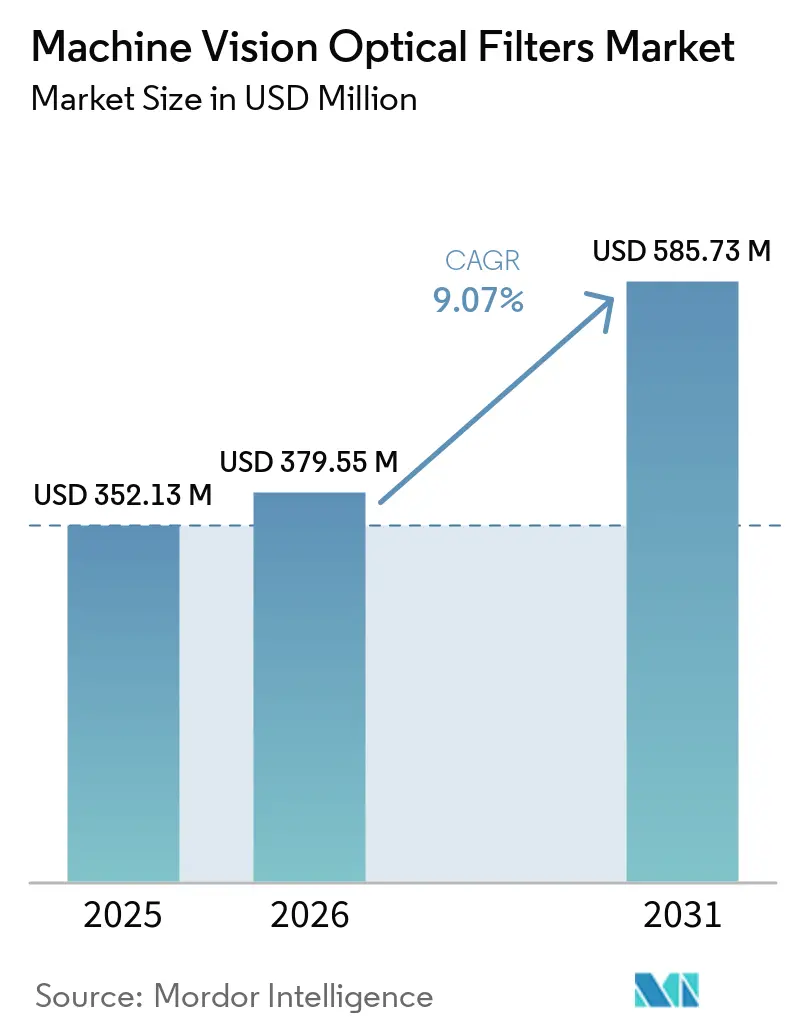
The Machine Vision Optical Filters Market size was USD 352.13 million in 2025 and is estimated at USD 379.55 million in 2026, reaching USD 585.73 million by 2031, at a CAGR of 9.07% during the forecast period 2026-2031. Automated inspection is expanding across electronics, automotive production, and food processing, which increases demand for optical components that isolate specific wavelengths. Thin-film interference filters remain central to these systems because they support stable wavelength control in industrial settings and withstand repeated operating cycles. Suppliers are moving beyond catalog sales toward application-specific programs that combine coating expertise with rapid prototyping and closer engineering collaboration. Semiconductor investment programs in the United States, European Union, Japan, and India support new fabrication capacity, which in turn requires machine vision equipment through several process stages. The Machine Vision Optical Filters Market also benefits from broader SWIR use in food and pharmaceutical inspection, where material contrast can improve verification of products and packaged contents.
Key Report Takeaways
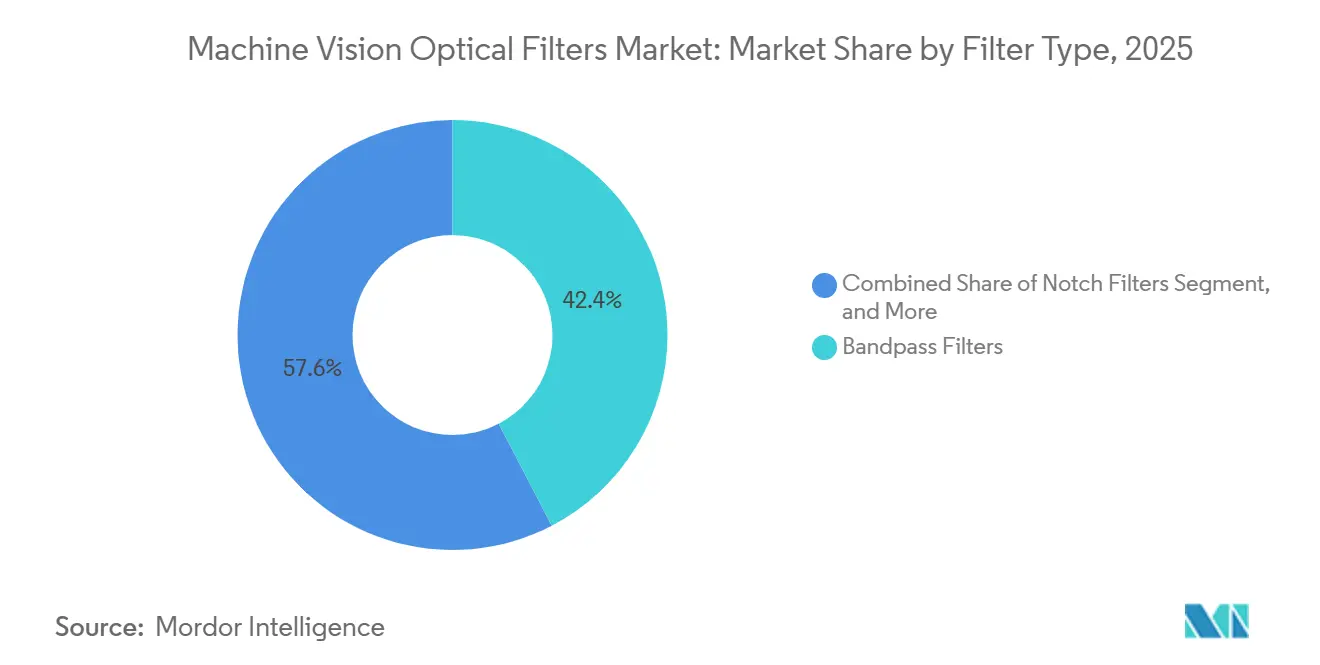
- By filter type, bandpass filters holds 42.37% share of the Machine Vision Optical Filters Market and are projected to record the highest CAGR of 11.42% through 2031.
- By wavelength range, visible filters held 46.28% of the Machine Vision Optical Filters Market share in 2025, while SWIR filters are projected to expand at a 12.38% CAGR through 2031.
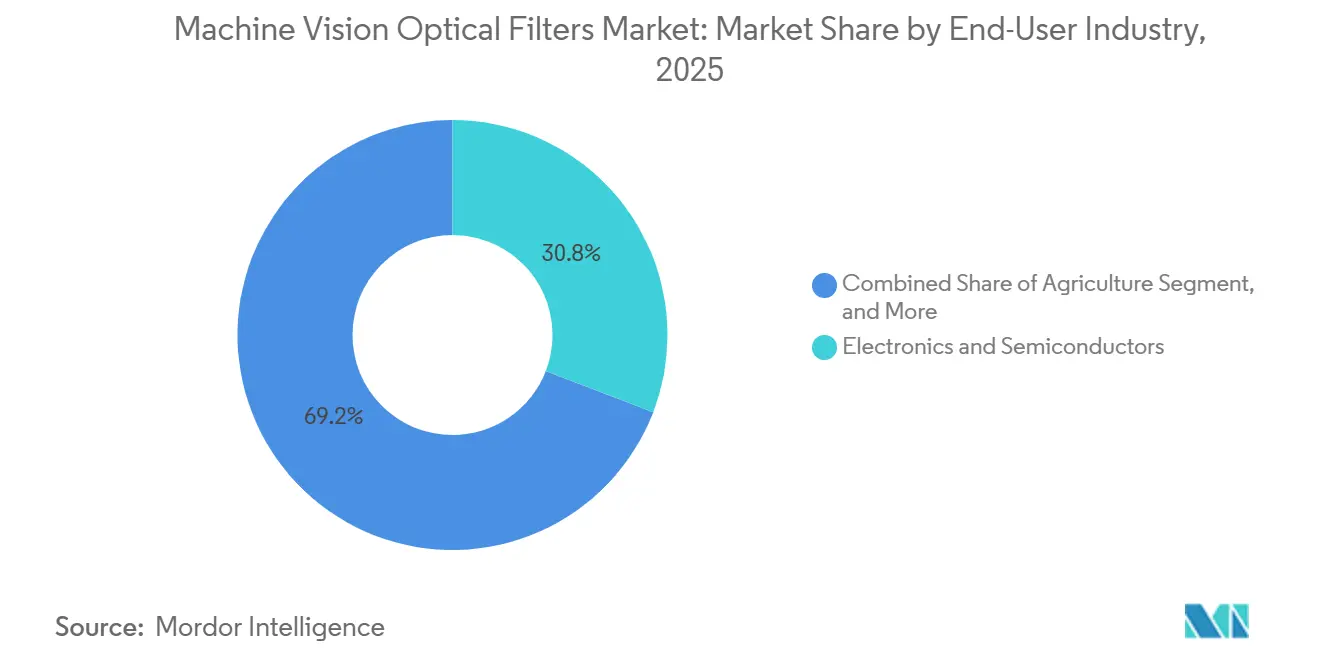
- By end-user industry, electronics and semiconductors accounted for 30.84% of the Machine Vision Optical Filters Market share in 2025 and are projected to expand at a 13.86% CAGR through 2031.
- By geography, Asia-Pacific held 43.76% share in 2025 and is projected to expand at a 12.21% CAGR through 2031.
Note: Market size and forecast figures in this report are generated using Mordor Intelligence’s proprietary estimation framework, updated with the latest available data and insights as of January 2026.
Market Trends and Insights
Drivers Impact Analysis of Machine Vision Optical Filters Market*
| Driver | (~) % Impact on CAGR Forecast | Geographic Relevance | Impact Timeline |
|---|---|---|---|
| Expansion of Automated Quality Inspection | +2.8% | Global, with highest intensity in Asia-Pacific and North America | Short term (≤ 2 years) |
| Growth of Semiconductor and Electronics Inspection | +2.0% | Asia-Pacific, North America, and Europe | Medium term (2-4 years) |
| Rising Adoption of Robotic Guidance and 3D Vision | +1.6% | Global, concentrated in North America, Europe, and Asia-Pacific | Medium term (2-4 years) |
| Demand for Spectral Selectivity in AI-Enabled Imaging | +1.2% | North America and Europe, expanding into Asia-Pacific | Long term (≥ 4 years) |
| Increased Use of SWIR Filters for Material-Specific Inspection | +0.5% | Global, with high concentration in Europe and Asia-Pacific | Medium term (2-4 years) |
| Filter Co-Design With Strobing and Multiband Illumination | +0.4% | Global, with highest activity in North America and Germany | Long term (≥ 4 years) |
| Source: Mordor Intelligence | |||
Expansion of Automated Quality Inspection Raises Filter Performance Requirements
Each automated inspection station requires precision optical filters, making equipment deployment a direct driver of demand for the Machine Vision Optical Filters Market. These components help cameras distinguish the intended illumination from background light on fast production lines. Automated optical inspection equipment was valued at USD 1.71 billion in 2025 and is expected to reach USD 4.99 billion by 2031 at a CAGR of 19.57%. Asia-Pacific held 56.65% of automated optical inspection equipment revenue in 2025, supported by China’s USD 49 billion semiconductor equipment outlays. Chiplet packaging inspection is moving from 2D imaging toward 3D metrology for features below 10 µm, increasing the need for narrow bandwidths, sharp wavelength cutoffs, and OD 4+ blocking. IPC-A-610 Class 3 requirements for PCB inspection raise the threshold for spectral discrimination in high-value OEM programs. Suppliers increasingly need system-level verification alongside component measurement to compete for these programs.
Growth of Semiconductor and Electronics Inspection Supports Custom Filter Programs
Semiconductor and electronics inspection requires stable spectral performance because it affects chip yield, mask qualification throughput, and defect detection. These systems operate across wafer processing, advanced packaging, board inspection, and final test, rather than at one production point. ZEISS introduced its AIMS EUV 3.0 mask qualification system in 2025, supporting Low-NA and High-NA EUV inspection and tripling mask throughput.[1]ZEISS Semiconductor Manufacturing Technology, “ZEISS AIMS EUV 3.0 New Generation Triples Mask Throughput,” ZEISS, Canatu’s carbon nanotube debris filters provide up to 97% EUV transmission while blocking unwanted DUV and infrared wavelengths. SPIE’s 2025 proceedings identified hybrid bonding, backside power delivery, and heterogeneous integration as developing inspection challenges. These requirements extend beyond standard catalog designs and support longer custom filter programs. The Machine Vision Optical Filters Market, therefore, depends on suppliers that can manage demanding performance specifications at advanced process nodes.[2]SPIE, “Metrology, Inspection, and Process Control XXXIX,” SPIE
Robotic Guidance and 3D Vision Broaden Demand Across Applications
Vision-guided robotics uses narrowband NIR filters for bin picking, precision assembly, and sensor calibration across automotive, electronics, and logistics applications. These systems need reliable contrast when reflective surfaces, changing ambient light, and moving objects affect image capture. Structured-light and time-of-flight systems often use 850-940 nm bandpass elements to separate active illumination from ambient light. Stereo platforms are also adopting multiband filters that enable visible color imaging and NIR depth sensing in a single element. Research published in 2025 found that in-sensor AI systems that use wavelength-selective filtering can reduce latency in robotic vision data pipelines. Flexible manufacturing requires frequent robotic retooling, which favors smaller, application-matched filter batches. This requirement makes rapid prototyping more important than catalog breadth in parts of the Machine Vision Optical Filters Market.[3]Pi et al., “AI-Native Robotic Vision Systems Enabled by In-Sensor Computing,” Nature Partner Journals Robotics
Spectral Selectivity for AI-Enabled Imaging Changes Design Priorities
AI-based vision systems use richer spectral data than conventional rule-based systems, increasing interest in multiband and tunable filters. This approach allows software to distinguish materials that appear similar in standard color images. A 2025 study reported that hyperpixel filter arrays achieved 2.4-times higher spectral unmixing accuracy and a 3.47-times reduction in the imaging condition number compared with standard bandpass arrays. Liquid-crystal tunable bandpass filters spanning 420 nm to 1,800 nm can support spectral neural networks without mechanical filter wheels. Suppliers that help select spectral bands during system design can secure a role before final component selection. National AI infrastructure programs in the United States, the European Union, Japan, and China also encourage domestic sourcing of AI optical hardware. This creates a longer-term opportunity for Machine Vision Optical Filters Market suppliers with local qualification and design capabilities.[4]Hyun et al., “Hyperpixels Pixel Filter Arrays of Multivariate Optical Elements for Optimized Spectral Imaging,” Light Advanced Manufacturing
Restraints Impact Analysis of Machine Vision Optical Filters Market*
| Restraint | (~) % Impact on CAGR Forecast | Geographic Relevance | Impact Timeline |
|---|---|---|---|
| High Customization and Qualification Costs | -1.2% | Global, most acute in North America and Europe | Medium term (2-4 years) |
| Tight Tolerance Requirements for Coatings and Blocking | -0.8% | Global, most severe in semiconductor and defense end uses | Medium term (2-4 years) |
| Limited Availability of Skilled Thin-Film Engineering Talent | -0.5% | North America and Europe, emerging as a constraint in Asia-Pacific | Long term (≥ 4 years) |
| Application-Specific Standards and Long OEM Validation Cycles | -0.4% | Global, most pronounced in medical device and defense segments | Long term (≥ 4 years) |
| Source: Mordor Intelligence | |||
High Customization and Qualification Costs Limit Demand Flexibility
Machine vision filter customization requires application-specific substrate selection, coating design, passband tolerances, and durability testing. The work begins before production volumes are confirmed, which exposes suppliers and customers to higher development costs. Qualification of a new supplier for precision manufacturing typically takes 9-18 months. Defense and medical device designs can require USD 50,000 to USD 150,000 for testing and documentation, although the supporting source is excluded because it is not an approved source. European Union recertification for revised coating chemistries and machinery documentation can further extend introduction cycles. OEMs facing compressed timelines may opt for catalog products rather than purpose-optimized filters. This can limit early adoption of higher-performance optics even when these components could improve inspection results.
Tight Coating Tolerances Constrain Scale-Up
Narrow bandwidths, sharp filter edges, and OD 5+ blocking reduce the production yield of conforming filters for advanced inspection systems. These constraints are most significant when a filter must maintain performance across its full aperture and through repeated industrial use. Ion-beam sputtering and magnetron sputtering require nanometer-level thickness control across the aperture, and small process drift can lead to stripping and recoating. Hafnium dioxide and tantalum pentoxide faced 20% to 35% year-over-year spot-price volatility through 2024 and 2025, but the supporting source is excluded because it is not an approved source. Schneider-Kreuznach describes SWIR filters that achieve over 80% transmission with a 25 nm full width at half maximum and OD 4 blocking across a broad rejection band. Such requirements limit throughput and make custom production lead times of 10-16 weeks common. Skilled thin-film engineering talent and lengthy OEM validation cycles can add further pressure where performance requirements are strict.
*Our forecasts treat driver/restraint impacts as directional, not additive. The impact forecasts reflect baseline growth, mix effects, and variable interactions.
Machine Vision Optical Filters Market Segment Analysis
By Filter Type:
Bandpass Filters Combine Growth With Broad System UseBandpass filters account for 42.37% share of the market and futher projected to expand at an 11.42% CAGR from 2026 to 2031, making them the fastest-growing filter type in the Machine Vision Optical Filters Market. They pass a defined illumination band while rejecting ambient radiation, which is well-suited to LED-matched inspection designs used throughout the Machine Vision Optical Filters Market. Multiband designs can pass 2-4 separate wavelength windows, allowing one camera to replace a multi-filter carousel with lower mechanical complexity and less failure risk. Alluxa’s SIRRUS plasma PVD platform produces narrow bandpass filters from UV through SWIR with steep edge profiles. These capabilities support a shift from custom applications toward repeatable production programs in the Machine Vision Optical Filters Market.
MidOpt launched its NX Series neutral density filters in October 2025 for broadband imaging from 400 nm to 2,000 nm, supporting CMOS, InGaAs, and CQD sensor technologies. Longpass and shortpass filters complement bandpass filters, in which the spectral edge matters more than the narrow passband. Notch filters support laser-line rejection in structured-light and Raman material identification systems. Polarizing filters reduce glare on reflective plastic and metal surfaces in automated optical inspection of electronics. Hybrid filters combine bandpass and polarizing functions in compact optical stacks, giving the Machine Vision Optical Filters Market several formats for different inspection conditions.



By Wavelength Range:
SWIR Filters Support Molecular Contrast InspectionVisible filters accounted for 46.28% of the Machine Vision Optical Filters Market in 2025 because silicon cameras and standard LED illumination remain widely used in industrial inspection. SWIR filters are projected to expand at a 12.38% CAGR from 2026 to 2031 as manufacturers seek molecular absorption contrast that visible cameras cannot provide. SWIR imaging between 900 nm and 1,700 nm can detect bruising, moisture in pharmaceutical blister packs, foreign matter in sealed packages, and voids in silicon wafers, extending inspection beyond surface appearance. Sony’s SenSWIR technology supports non-destructive content verification through opaque packaging at production-line speeds. These capabilities create a distinct role for SWIR products in the Machine Vision Optical Filters Market.
Allied Vision’s allPIXA SWIR linescan cameras are designed for food-safety and pharmaceutical packaging inspection on conveyor systems. NIR filters serve high-volume structured-light and laser-triangulation systems for robotic guidance. UV filters are used in photolithography alignment and fluorescence inspection, where 200 nm to 400 nm band selection affects excitation efficiency. MWIR and LWIR filters remain specialized for thermographic quality control and defense sensing, with suppliers extending plasma-assisted deposition beyond 5 µm for these applications. Visible filters dominate current volume, but SWIR and NIR filters shape the next technology cycle in the Machine Vision Optical Filters Market.
By End-User Industry:
Electronics and Semiconductors Lead Demand and GrowthElectronics and semiconductors accounted for 30.84% of Machine Vision Optical Filters Market share in 2025 and are projected to expand at a 13.86% CAGR through 2031. This end-user segment uses filters for wafer defect inspection, chiplet packaging alignment, automated optical inspection of PCBs, and semiconductor metrology. Each production node has its own spectral requirements, which creates several opportunities for Machine Vision Optical Filters Market suppliers. SPIE reported in 2025 that hybrid bonding, backside power delivery, and heterogeneous integration are widening inspection requirements. Canatu’s CNT-based EUV membranes combine up to 97% EUV transmission with durability for high-vacuum and thermal-cycling conditions.
Automotive and transportation applications use filters for paint inspection, surface defect detection, and ADAS sensor calibration. Food and beverage, pharmaceutical, and medical device users are expanding their use of SWIR systems for content verification and contaminant detection in sealed packaging. Manufacturing and industrial automation provide a broad volume base for all major filter types in the Machine Vision Optical Filters Market. Logistics and warehousing are emerging applications as e-commerce fulfillment centers deploy machine vision equipment. Agriculture remains the smallest current application, but hyperspectral drones and field sensors can increase demand for NIR and SWIR bandpass filters.
Geography Analysis
APAC Machine Vision Optical Filters Market
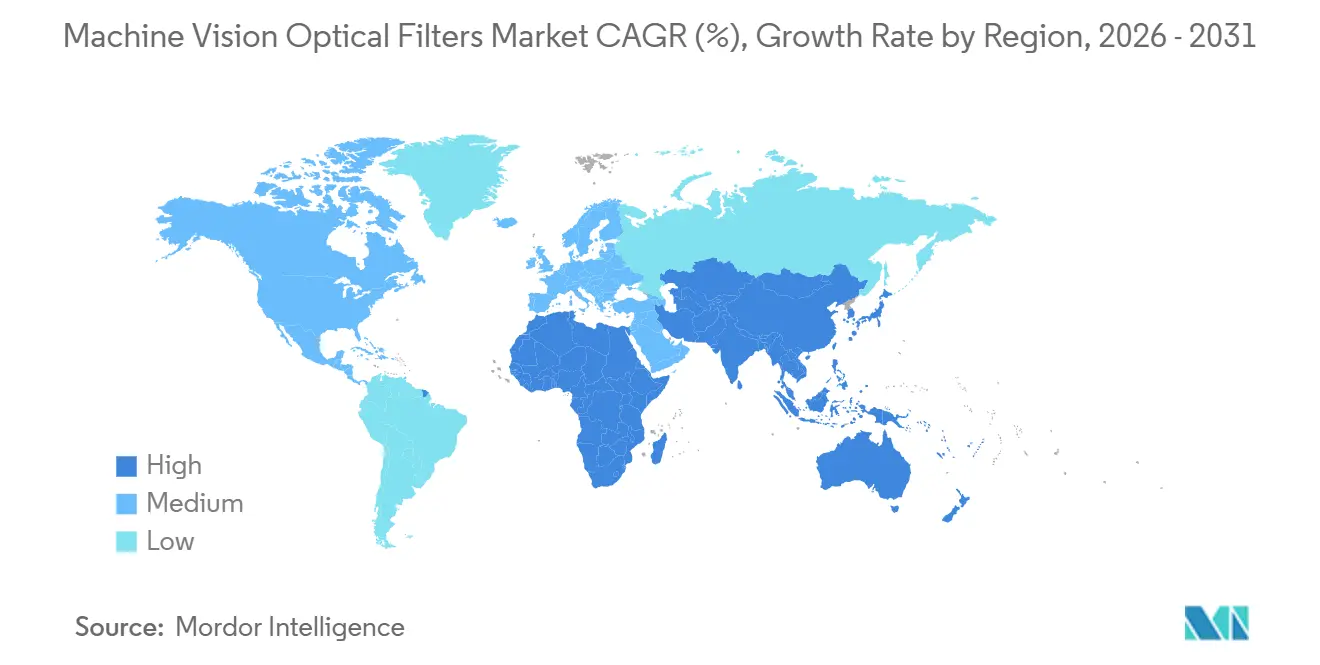
Asia-Pacific held 43.76% share in 2025 and is projected to expand at a 12.21% CAGR through 2031. China, Japan, and South Korea drive demand for Machine Vision Optical Filters through semiconductor fabrication, electronics assembly, and automotive manufacturing. China’s semiconductor self-sufficiency program included USD 49 billion in semiconductor equipment outlays in 2025. New fabrication plants require inspection infrastructure at the wafer, advanced packaging, and final-test stages. Japan is both a major demand center and a precision filter production hub with suppliers known for interference filter quality.
India and ASEAN Machine Vision Optical Filters Market
India is the fastest-growing country in the region, supported by its Production-Linked Incentive program and the early stages of domestic semiconductor fabrication. Its automated optical inspection system segment was valued at USD 106.29 million in 2026 and is projected to expand at an 18.54% CAGR through 2034, although the supporting source is excluded because it is not an approved source. Vietnam, Malaysia, and Thailand are receiving production capacity moved from China. These countries are creating new machine vision demand clusters outside established regional hubs.
The Americas and EMEA Machine Vision Optical Filters Market
North America and Europe are the second- and third-largest regional markets, with demand concentrated in semiconductor equipment, defense, life sciences, and premium industrial inspection. The United States has a broad group of vertically integrated suppliers, including Edmund Optics, Alluxa, Chroma Technology, Omega Optical, Andover Corporation, and Iridian Spectral Technologies. Edmund Optics expanded its SWIR imaging portfolio in September 2025 and acquired Son-x in January 2025 to increase manufacturing capacity. Germany and the DACH region are Europe’s key demand centers, and Jenoptik announced expanded optics capacity in Jena in September 2025. South America, the Middle East, and Africa remain smaller-demand regions, with Brazil and Argentina focused on food processing and agricultural automation, while the United Arab Emirates, Saudi Arabia, South Africa, and Egypt are building inspection capabilities in logistics, energy, manufacturing, and mining.

Competitive Landscape
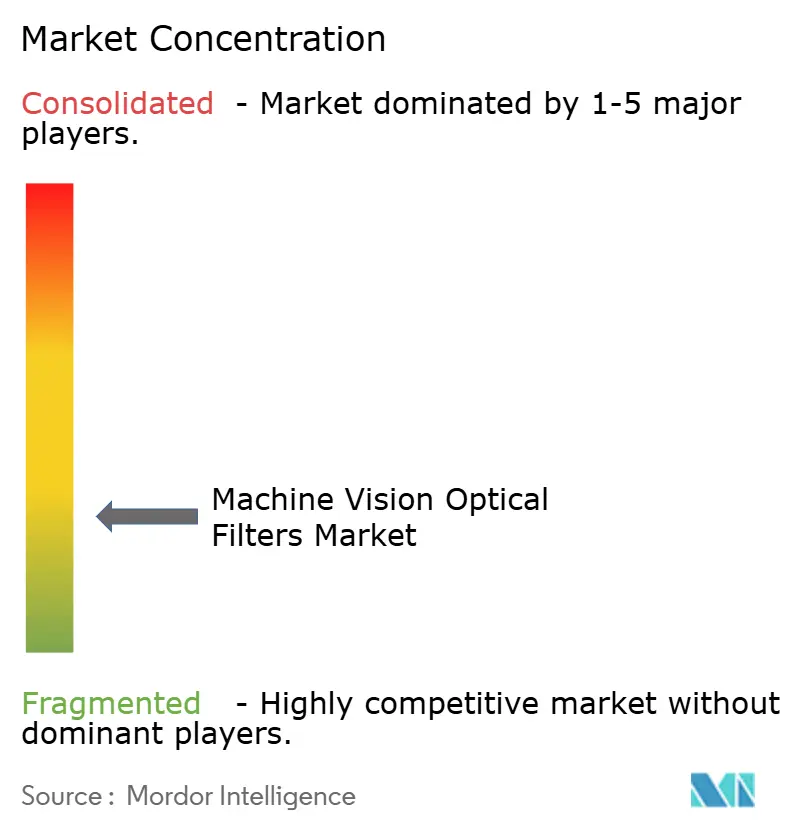
The Machine Vision Optical Filters Market is fragmented at the system level, while premium application tiers are served by a smaller group of specialists. Chroma Technology, Alluxa, and Delta Optical Thin Film compete through thin-film capability, wide spectral coverage, and co-design services. Chroma Technology offers 2-week rapid prototyping, while Alluxa’s SIRRUS plasma PVD platform covers wavelengths from 200 nm to 14 µm. Chinese suppliers, including Shanghai Optics and FOCtek Photonics, compete on catalog pricing but face higher barriers in tolerance-critical semiconductor and defense work.
ISO 9001 and MIL-SPEC-13830 requirements provide an advantage to established suppliers that are already qualified for regulated OEM programs. Jenoptik’s Dresden micro-optics capability and Delta Optical Thin Film’s linear variable filter designs show continued investment in proprietary processes. Jenoptik inaugurated its Dresden fab in May 2025, adding 2,000 m² of cleanroom and production space for micro-optics and sensors used in semiconductor equipment. Alluxa launched its ULTRA low-stress dichroic deposition process in August 2025, using SIRRUS plasma PVD to make fully dense dielectric coatings on thin substrates. Edmund Optics expanded its manufacturing capability through the January 2025 acquisition of son-x, strengthening its position in the Machine Vision Optical Filters Market.
Integrated filter, illumination, LED-driver, and strobe-controller design remains fragmented despite its value for system integrators. A 2025 U.S. patent on multi-function machine vision illumination with multiband strobing indicates active development in this area. Competitive-cost SWIR filter supply for food and pharmaceutical users is limited to a small number of specialists, including Materion Balzers Optics and Schneider-Kreuznach. Tunable filters for AI-native hyperspectral imaging must compete on latency and power use as well as spectral precision. The available information does not provide combined company shares, so a concentration score cannot be assigned under the stated share-based methodology.
Machine Vision Optical Filters Industry Leaders
Midwest Optical Systems, Inc.
Chroma Technology Corporation
Iridian Spectral Technologies, Ltd.
Omega Optical, Inc.
Delta Optical Thin Film A/S
- *Disclaimer: Major Players sorted in no particular order
Machine Vision Optical Filters Market Companies Covered in this Report
- Edmund Optics, Inc.
- Midwest Optical Systems, Inc.
- Chroma Technology Corporation
- Iridian Spectral Technologies, Ltd.
- Omega Optical, Inc.
- Opto Engineering S.p.A.
- FOCtek Photonics, Inc.
- MORITEX Corporation
- Thorlabs, Inc.
- Schneider-Kreuznach
- HOYA Corporation
- Knight Optical (UK) Limited
- Jenoptik AG
- Andover Corporation
- Delta Optical Thin Film A/S
- Materion Balzers Optics AG
- Alluxa, Inc.
- Felix Glass Group
- AHF analysentechnik AG
- Shanghai Optics, Inc.

Recent Industry Developments in Machine Vision Optical Filters Market
- July 2026: Edmund Optics launched LUMIMAX configurable ring lights as an off-the-shelf product and expanded optical window sourcing across UV, visible, and IR ranges, deepening system integrator access to matched illumination and filter-adjacent components from a single supplier.
- June 2026: Chroma Technology added 2 new 8 nm SHO-based narrowband filter sets, SHO and SHO+LRGB configurations, extending precision narrowband filter availability for multi-source machine vision inspection and emission spectroscopy applications.
- March 2026: Edmund Optics expanded its scientific imaging portfolio through a strategic partnership with Teledyne Photometrics, broadening high-performance imaging offerings for precision life science and industrial machine vision customers requiring integrated optics-and-detector solutions.
- January 2026: Chroma Technology announced the sale of its subsidiary 89 North to Oxxius, enabling Chroma to concentrate resources on high-performance optical filter manufacturing and machine vision and semiconductor inspection filter programs.


Global Machine Vision Optical Filters Market Report Scope
Machine Vision Optical Filters are precision optical components designed to selectively transmit, block, or modify specific wavelengths of light entering machine vision cameras, enhancing image contrast, reducing glare, and improving signal-to-noise ratio for accurate automated inspection, measurement, and recognition across diverse industrial and scientific applications.
The Machine Vision Optical Filters Market Report is Segmented by Filter Type (Bandpass Filters, Longpass Filters, Shortpass Filters, Notch Filters, Polarizing Filters, Neutral Density Filters, and Other Filter Types), Wavelength Range (Ultraviolet (UV), Visible, Near-Infrared (NIR), Short-Wave Infrared (SWIR), Mid-Wave Infrared (MWIR), and Long-Wave Infrared (LWIR)), End-User Industry (Automotive and Transportation, Electronics and Semiconductors, Food and Beverage, Pharmaceuticals and Medical Devices, Manufacturing and Industrial, Logistics and Warehousing, Agriculture, Aerospace and Defense, and Other End-User Industries), and Geography (North America, South America, Europe, Asia-Pacific, Middle East, Africa). The Market Forecasts are Provided in Terms of Value (USD).
| Bandpass Filters |
| Longpass Filters |
| Shortpass Filters |
| Notch Filters |
| Polarizing Filters |
| Neutral Density Filters |
| Other Filter Types |
| Ultraviolet (UV) |
| Visible |
| Near-Infrared (NIR) |
| Short-Wave Infrared (SWIR) |
| Mid-Wave Infrared (MWIR) |
| Long-Wave Infrared (LWIR) |
| Automotive and Transportation |
| Electronics and Semiconductors |
| Food and Beverage |
| Pharmaceuticals and Medical Devices |
| Manufacturing and Industrial |
| Logistics and Warehousing |
| Agriculture |
| Aerospace and Defense |
| Other End-User Industries |
| North America | United States |
| Canada | |
| Mexico | |
| South America | Brazil |
| Argentina | |
| Rest of South America | |
| Europe | Germany |
| United Kingdom | |
| France | |
| Italy | |
| Spain | |
| Rest of Europe | |
| Asia-Pacific | China |
| Japan | |
| India | |
| South Korea | |
| Australia | |
| Rest of Asia-Pacific | |
| Middle East | United Arab Emirates |
| Saudi Arabia | |
| Rest of Middle East | |
| Africa | South Africa |
| Egypt | |
| Rest of Africa |
| By Filter Type | Bandpass Filters | |
| Longpass Filters | ||
| Shortpass Filters | ||
| Notch Filters | ||
| Polarizing Filters | ||
| Neutral Density Filters | ||
| Other Filter Types | ||
| By Wavelength Range | Ultraviolet (UV) | |
| Visible | ||
| Near-Infrared (NIR) | ||
| Short-Wave Infrared (SWIR) | ||
| Mid-Wave Infrared (MWIR) | ||
| Long-Wave Infrared (LWIR) | ||
| By End-User Industry | Automotive and Transportation | |
| Electronics and Semiconductors | ||
| Food and Beverage | ||
| Pharmaceuticals and Medical Devices | ||
| Manufacturing and Industrial | ||
| Logistics and Warehousing | ||
| Agriculture | ||
| Aerospace and Defense | ||
| Other End-User Industries | ||
| By Geography | North America | United States |
| Canada | ||
| Mexico | ||
| South America | Brazil | |
| Argentina | ||
| Rest of South America | ||
| Europe | Germany | |
| United Kingdom | ||
| France | ||
| Italy | ||
| Spain | ||
| Rest of Europe | ||
| Asia-Pacific | China | |
| Japan | ||
| India | ||
| South Korea | ||
| Australia | ||
| Rest of Asia-Pacific | ||
| Middle East | United Arab Emirates | |
| Saudi Arabia | ||
| Rest of Middle East | ||
| Africa | South Africa | |
| Egypt | ||
| Rest of Africa | ||


Key Questions Answered in the Report
What is the Machine Vision Optical Filters Market size?
The market was estimated at USD 379.55 million in 2026 and is projected to reach USD 585.73 million by 2031 at a CAGR of 9.07%.
Which filter type is expanding fastest?
Bandpass filters are projected to record the fastest CAGR of 11.42% through 2031, supported by LED-matched inspection systems.
Why are SWIR filters becoming more important?
SWIR filters support inspection of moisture, bruising, foreign matter, and subsurface wafer voids that visible systems cannot reliably detect.
Which end-user application has the strongest outlook?
Electronics and semiconductors held 30.84% share in 2025 and are projected to expand at a 13.86% CAGR through 2031.
Which region leads demand?
Asia-Pacific held 43.76% share in 2025 and is projected to expand at a 12.21% CAGR through 2031.
What limits wider adoption of custom optical filters?
Long supplier qualification cycles, demanding coating tolerances, scarce thin-film talent, and extended OEM validation can delay adoption.
Page last updated on:





