
Logistics Software Market Size and Share
Market Overview
| Study Period | 2020 - 2031 |
|---|---|
| Market Size (2026) | USD 17.74 Billion |
| Market Size (2031) | USD 23.58 Billion |
| Growth Rate (2026 - 2031) | 5.86 % |
| Fastest Growing Market | Asia-Pacific |
| Largest Market | North America |
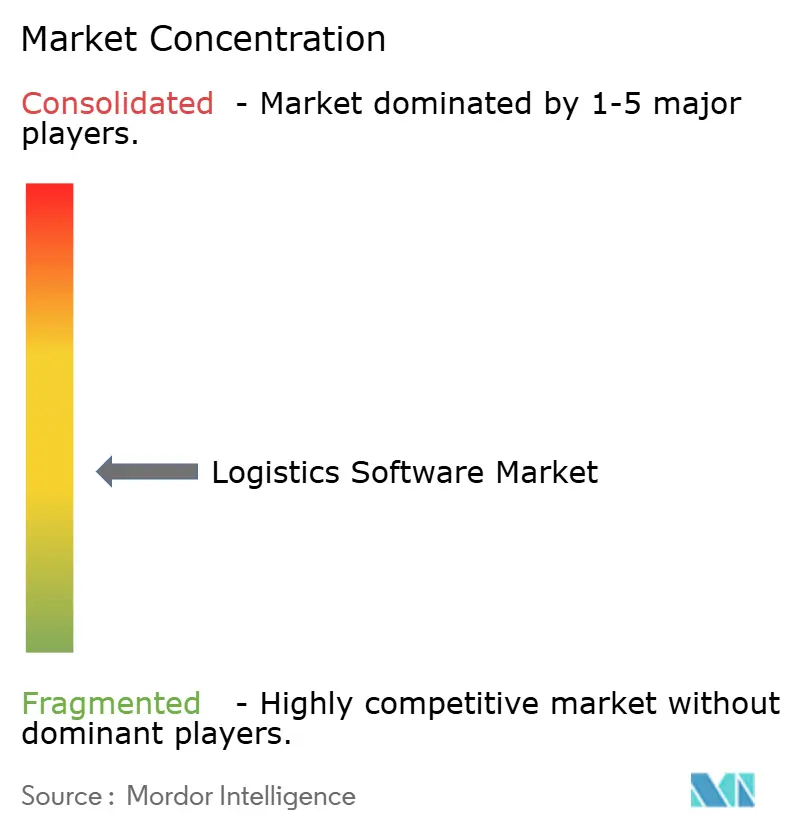
| Market Concentration | Medium |
Major Players *Disclaimer: Major Players sorted in no particular order Image © Mordor Intelligence. Reuse requires attribution under CC BY 4.0. | |
Logistics Software Market Analysis by Mordor Intelligence
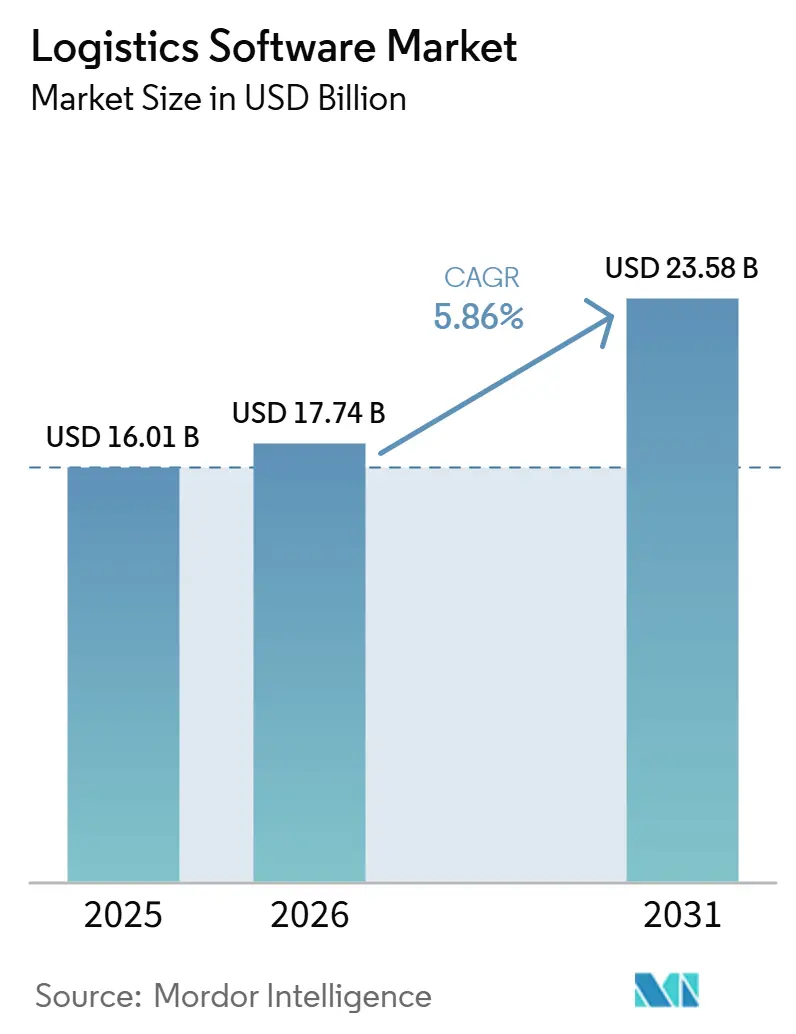
The logistics software market size is expected to increase from USD 16.01 billion in 2025 to reach USD 23.58 billion by 2031, growing at a CAGR of 5.86% over 2026-2031. The logistics software market is becoming the operating layer that connects demand signals, carrier networks, and warehouse work in real time. E-commerce growth, AI-based platform design, and freight data rules are shortening buying cycles across customer groups by enabling systems to combine orders, carrier signals, warehouse activity, inventory status, and compliance data without relying on disconnected manual processes. Spending is moving from discretionary IT budgets to operations budgets because logistics execution is now essential to daily service levels. Platform vendors are broadening their product sets, while specialized providers are adding broader decision-support functions, changing the logistics software market from a set of separate applications into a more connected set of operating systems. Integration difficulty and data compliance remain major barriers, but they also favor vendors with established connectors, certified integration tools, and compliance-ready hosting because these capabilities can reduce uncertainty for customers with legacy data, multiple carriers, and cross-border operating requirements.
Key Report Takeaways
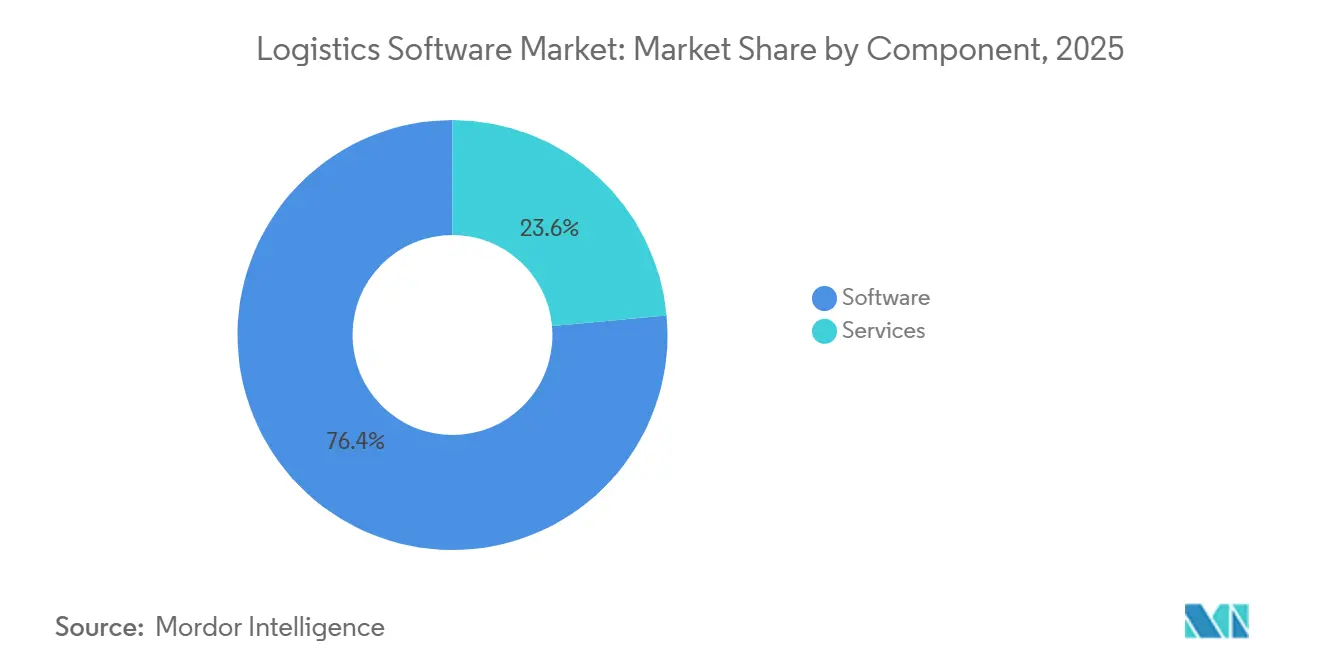
- By component, software accounted for 76.44% of the logistics software market in 2025 and is projected to grow at a 6.38% CAGR through 2031.
- By deployment mode, cloud-based deployment held 63.91% share of the logistics software market in 2025 and is expected to expand at a 7.28% CAGR through 2031.
- By end use enterprise size, large enterprises held 58.74% share in 2025, while small and medium enterprises are projected to expand at a 7.43% CAGR through 2031.
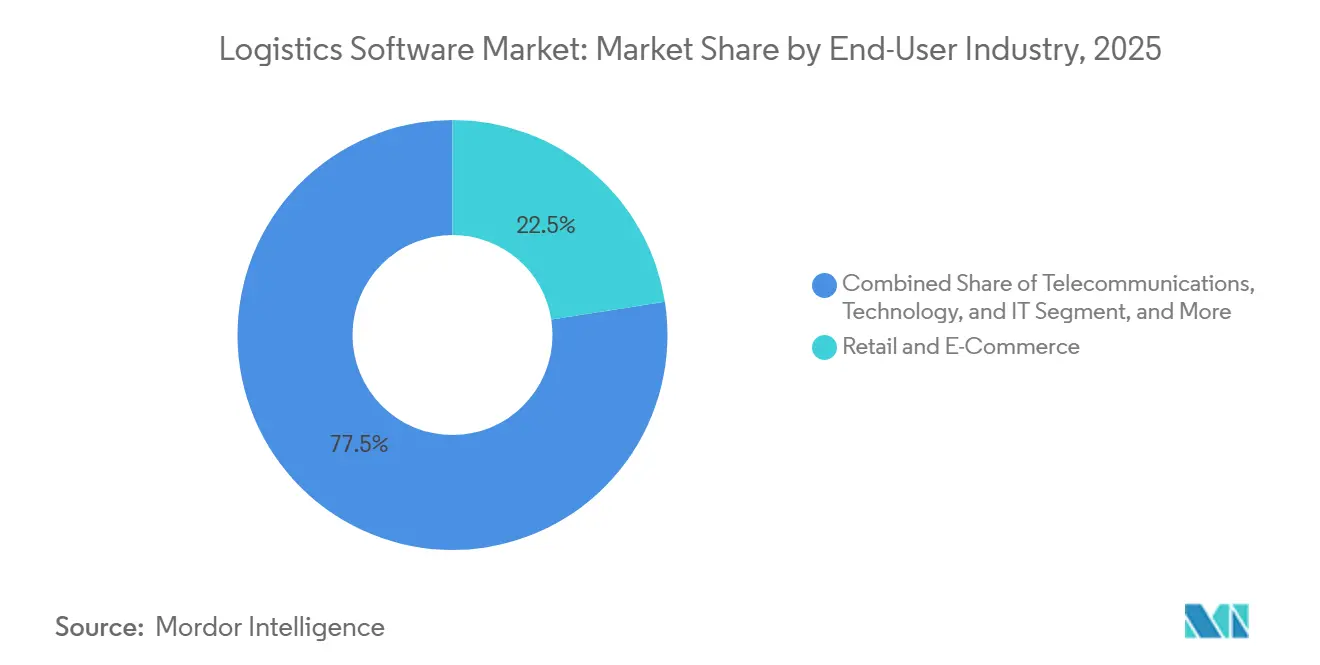
- By end-user industry, retail and e-commerce accounted for 22.53% share of the logistics software market in 2025 and is expected to grow at a 7.36% CAGR through 2031.
- By mode of transportation, roadways held 55.76% share in 2025, while maritime is projected to expand at a 6.92% CAGR through 2031.
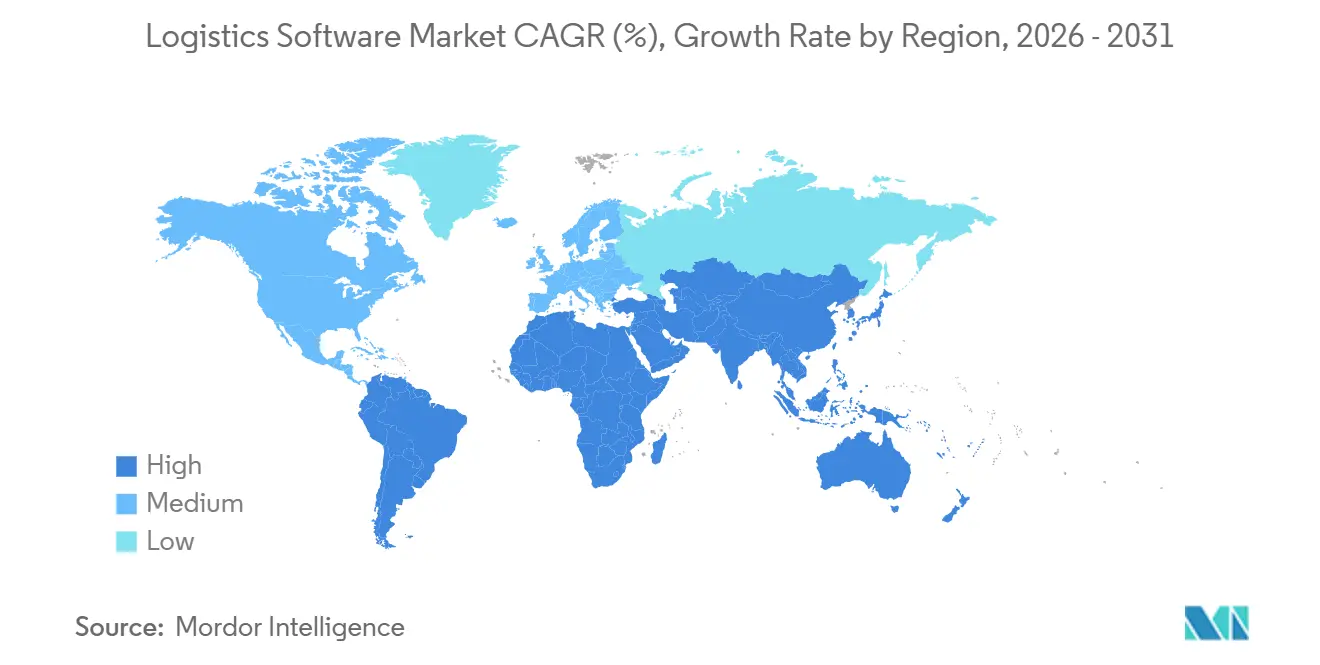
- By geography, North America accounted for 37.04% of revenue in 2025, while Asia-Pacific is expected to expand at a 7.57% CAGR through 2031.
Note: Market size and forecast figures in this report are generated using Mordor Intelligence’s proprietary estimation framework, updated with the latest available data and insights as of January 2026.
Global Logistics Software Market Trends and Insights
Drivers Impact Analysis*
| Driver | (~) % Impact on CAGR Forecast | Geographic Relevance | Impact Timeline |
|---|---|---|---|
| E-Commerce and Omnichannel Delivery Complexity | +1.5% | Global, concentrated in North America and Asia-Pacific | Medium term (2–4 years) |
| Cloud-Native Logistics Software Adoption by SMEs | +1.0% | Global, highest in Asia-Pacific and South America | Short term (≤ 2 years) |
| AI-Enabled Predictive ETA and Route Optimization | +0.8% | North America and Europe lead, Asia-Pacific is scaling | Medium term (2–4 years) |
| Warehouse Automation and Labor Productivity Requirements | +0.6% | North America, Europe, and Asia-Pacific | Medium term (2–4 years) |
| Regulatory Digitization of Freight and Emissions Data | +0.4% | Europe, with spillover to Asia-Pacific and the Middle East | Medium term (2–4 years) |
| Network Disruption and Supply Chain Resilience Investment | +0.3% | Global | Long term (≥ 4 years) |
| Source: Mordor Intelligence | |||
E-Commerce and Omnichannel Delivery Complexity
E-commerce has changed the logistics software market from a routing category into a system for managing fulfillment across channels and locations. A 2025 MIT Center for Transportation and Logistics survey of 647 supply chain professionals found that 51% identified online and offline channel integration as their main strategic challenge, up from 44% in the prior year.[1]MIT Center for Transportation and Logistics, “State of Supply Chain Omnichannel Report Findings,” MIT Center for Transportation and Logistics, ctl.mit.edu. The same study reported that 81% of respondents continued to experience e-commerce growth, which added to operating complexity. Reported cost-to-serve pressure rose from 38% to 42%, while returns-related cost pressure increased from 33% to 40%. Transportation, order, and last-mile software can route orders across stores, distribution centers, and third-party logistics nodes without manual intervention. Companies that cannot connect inventory visibility with logistics execution face a higher risk of fulfillment errors as the number of selling channels grows.
Cloud-Native Logistics Software Adoption by SMEs
Cloud-native products are broadening the logistics software market by enabling smaller operators to access capabilities once limited to large enterprises, including carrier connectivity, shipment visibility, routing support, and workflow tools, without building extensive local infrastructure. Subscription pricing removes the upfront capital commitment that had kept many small and medium enterprises from adopting enterprise-grade tools. Cloud deployments can be completed in weeks, while older on-premises projects often require months of configuration and infrastructure work. Transaction-based and user-based pricing also allows vendors to serve operators that previously relied on spreadsheets or carrier-provided tools. Asia-Pacific and South America are seeing strong adoption because many smaller operators are installing their first formal transportation or warehouse system rather than replacing an older platform. Japan's Comprehensive Logistics Policy Outline for 2026-2030 supports logistics digitization and green transformation, including measures that can encourage adoption by smaller operators.
AI-Enabled Predictive ETA and Route Optimization
AI-based estimated arrival times and route optimization are replacing static planning rules in many mid-sized and large logistics operations. The logistics software market increasingly values models that use carrier behavior, dwell patterns, lane performance, and driver-related operational signals, because these details help operations teams assess whether a shipment is progressing as expected and where a response may be needed. Platforms with broad carrier networks can use this information to improve prediction quality within their connected ecosystems. That data advantage can be difficult for a new provider to reproduce through algorithm design alone. The same AI layer can identify exceptions and routine disruptions before they require extensive manual review. This helps logistics teams focus on decisions that need judgment rather than repetitive follow-up work, including disruptions that affect customer commitments, carrier performance, inventory availability, warehouse capacity, and delivery schedules across complex operating networks.
Warehouse Automation and Labor Productivity Requirements
Warehouse labor constraints are making software for task coordination a higher operating priority in the logistics software market, particularly where facilities must coordinate workers, automated equipment, changing order volumes, and delivery deadlines through the same daily operating process. Logistics platforms can coordinate autonomous mobile robots, conveyor systems, and warehouse workers through a common workflow. Hardware investments can underperform when task sequencing and exception handling are not connected to the warehouse execution system. This links investment in goods-to-person systems and other automation equipment to demand for warehouse management, warehouse control, and orchestration software. Buyers are paying closer attention to labor-aware task management, automation flexibility, and real-time exception handling, as these functions determine how well people and equipment can respond when order flows, staffing levels, or warehouse conditions change during a shift. These needs support software spending even when companies are cautious about broader capital expenditure.
Restraints Impact Analysis*
| Restraint | (~) % Impact on CAGR Forecast | Geographic Relevance | Impact Timeline |
|---|---|---|---|
| Legacy ERP, EDI, and Telematics Integration Complexity | -1.0% | Global | Long term (≥ 4 years) |
| Cybersecurity, Data Sovereignty, and Operational Technology Exposure | -0.8% | Global, European emphasis under NIS2 | Medium term (2–4 years) |
| High Implementation Cost and Change-Management Burden | -0.5% | Emerging markets, SMEs globally | Short term (≤ 2 years) |
| Fragmented Carrier Data Standards and Limited Data Completeness | -0.3% | Global | Long term (≥ 4 years) |
| Source: Mordor Intelligence | |||
Legacy ERP, EDI, and Telematics Integration Complexity
Integration is a major restraint on the logistics software market because large shippers often operate systems assembled over many years, with important business processes spread across systems that were purchased, customized, and maintained by different teams at different times. These environments can include older EDI gateways, customized on-premises enterprise resource planning systems, and carrier-specific telematics connections. Each layer can use different data formats, update speeds, and business rules. Undocumented EDI mappings may also contain carrier exceptions, route rules, and financial reconciliation processes that are difficult to replace without disrupting operations. Batch EDI processing and real-time application programming interfaces can create timing differences in data even after a technical connection is established. Vendors that offer dedicated ERP, EDI, and transportation management system connectors can reduce deployment time and improve their position in complex enterprise requests.
Cybersecurity, Data Sovereignty, and Operational Technology Exposure
Logistics platforms connect information technology and operational technology assets, which expands security exposure as carrier, warehouse, and cross-border links increase. Supply chains also depend on third-party carriers and port systems, making security controls a shared operational concern. The European Union's NIS2 Directive establishes cybersecurity obligations for relevant entities and reinforces the need for governance across logistics and transport operations. Data sovereignty rules can add requirements for data storage, access controls, and deployment design in multiple jurisdictions. These obligations can lengthen procurement and implementation cycles, especially for cloud deployments that exchange data across national borders. They can also raise entry barriers and support premium positioning for vendors that can meet security and compliance requirements.
*Our forecasts treat driver/restraint impacts as directional, not additive. The impact forecasts reflect baseline growth, mix effects, and variable interactions.
Segment Analysis
By Component: Software Platforms Lead Revenue
Software held 76.44% of the logistics software market share in 2025, making it the principal component category, and subscription and license revenue were the main sources of category spending. Transportation management systems, warehouse management systems, and supply chain visibility products are increasingly offered as connected modules on shared cloud platforms, providing users with a common data environment for multiple execution tasks. Enterprise buyers often prefer a single-platform contract rather than multiple point-solution contracts because a single provider can support coordinated decisions across transport, warehouse, and shipment visibility workflows. This preference limits the scope of independent software products that cover only one workflow and do not integrate easily with related operating systems. Services accounted for the remaining component demand through implementation, training, integration, and managed support, particularly when customers have complex processes that require extensive configuration.
The logistics software market is projected to grow at a 6.38% CAGR from 2026 to 2031, supported by recurring platform adoption and the addition of functions within existing customer accounts. Vendors can increase software revenue from current customers as they add AI agents, emissions monitoring, yard management, and related capabilities that extend the original system. Embedded AI can operate in warehouse and transportation workflows instead of sitting outside the platform as a separate analytics layer, which can make new functions easier to use in daily work. This product approach can increase the value of a common platform across several logistics functions and can reduce the need for separate data transfers between applications. Commission Implementing Regulation (EU) 2025/2243 sets functional requirements for eFTI platforms, creating a compliance consideration for vendors serving European freight information workflows and encouraging upgrades where older systems do not meet required functions or security specifications.


By Deployment Mode: Cloud-Based Systems Extend Adoption
Cloud-based deployment commanded a 63.91% share of the logistics software market in 2025 and was the largest deployment model, reflecting the broad adoption of vendor-managed systems across customer groups. Cloud systems reduce the need for customers to buy, operate, and maintain server infrastructure within their own facilities. They also shift software upgrades from periodic internal projects to vendor-managed releases, giving users access to updated capabilities without the same level of local technical work. This model can reduce the technical burden for companies with limited internal technology resources and can support quicker access to connected carrier, warehouse, and visibility services. On-premises deployment still has a role among large manufacturers and government-related shippers with strict data control requirements, where deployment choice is increasingly shaped by compliance obligations rather than preference alone.
Cloud-based deployment is projected to grow at a 7.28% CAGR through 2031, the highest rate among deployment modes, as subscription economics reduce the cost barrier that once favored on-premises implementations. Hybrid models can keep sensitive operating data on local systems while placing visibility, analytics, and selected coordination functions in the cloud. This approach is relevant in markets such as China, India, and Germany, where data sovereignty requirements can affect system architecture and the location of operational data. Mid-market and SME customers are an important source of cloud demand because many are making their first formal investment in transportation, warehouse, or visibility technology. In Asia-Pacific and South America, fewer legacy on-premises commitments can make cloud adoption easier than in mature regions, while Japan's 2026-2030 logistics policy gives further attention to logistics system standards and digitization.
By End-Use Enterprise Size: SMEs Expand the Customer Base
Large enterprises held a 58.74% share of the logistics software market in 2025, supported by multi-modal and multi-country networks that require extensive transportation, warehousing, and visibility capabilities. Their operations often need customized workflows, broad carrier connectivity, supplier compliance controls, and coordinated data across business units and national borders. Established technology estates also create substantial demand for integration and deployment services, as new systems must operate alongside existing enterprise resource planning, EDI, and telematics tools. Large enterprises, therefore, remain important customers for broad platform vendors that can provide a wide functional range under long-term contracts. Their buying decisions commonly involve multiple operating teams and detailed requirements for reliability, process control, security, and the management of complex freight relationships.
Small and medium enterprises are projected to expand at a 7.43% CAGR through 2031, the fastest rate across enterprise size groups, as cloud products lower entry costs and reduce deployment demands. These organizations are adopting subscription products that already include carrier connectivity, route optimization, and shipment visibility within the platform. This reduces the upfront cost and internal change-management work that once made formal software deployment difficult for smaller businesses with limited technology teams, while still giving them access to structured workflows for carrier selection, delivery planning, shipment tracking, and customer communication. Micro enterprises remain an early-stage opportunity for vendors using simplified onboarding, narrower workflow designs, and usage-based pricing that fits lower shipment volumes. Government support for logistics digitization can strengthen the case for smaller operators to adopt formal software systems, particularly where policy places digitization and green transformation among stated logistics priorities.
By End-User Industry: Retail and E-Commerce Lead Demand
Retail and e-commerce captured 22.53% share in the logistics software market in 2025, the largest share among end-user industries, because these companies coordinate orders across physical stores, distribution centers, online platforms, and third-party fulfillment partners. Higher stock-keeping unit counts, a growing mix of selling channels, and tighter delivery expectations increase the need for real-time inventory information and order routing decisions. MIT reported that 81% of surveyed organizations continued to experience e-commerce growth in 2025, adding to the workload that operators must manage across their fulfillment networks. The same research recorded greater use of AI in warehouse management, transportation, and fulfillment work, showing the growing computational needs of multi-channel logistics operations. These conditions support demand for dedicated logistics applications that existing e-commerce tools cannot provide, including routing, data visibility, exception handling, and inventory reconciliation.
Retail and e-commerce are expected to grow at a 7.36% CAGR through 2031, the fastest rate among end-user industries, as more complex consumer commerce networks require connected execution systems. Brands operating fewer than 3 sales channels may use order management functions embedded in their existing e-commerce systems because their routing and inventory requirements are less extensive. Organizations managing 3 or more channels across physical and digital locations need more advanced fulfillment routing, inventory reconciliation, and coordination with external logistics providers. Third-party logistics providers also need real-time visibility because shippers increasingly treat it as a contractual requirement rather than an added service. Manufacturing and automotive users focus on inbound supply control, lean inventory processes, and supplier compliance, while healthcare, pharmaceuticals, food, and beverage users need support for temperature-sensitive shipments, serialization, and cold-chain reporting workflows.

By Mode of Transportation: Maritime Records the Fastest Growth
Roadways held a 55.76% share of the logistics software market in 2025, reflecting the central role of road freight in major supply chains and the wide range of activities managed through transportation systems. Road freight platforms cover carrier selection, route planning, load planning, freight audit, shipment tracking, and communication with carriers, shippers, and delivery locations. This is the most mature and competitive transport software category because road operations occur across nearly every geography and end-user industry. Railway systems serve specialized needs around asset use and network capacity planning, where longer operating cycles and infrastructure constraints affect software requirements. Air freight systems support time-sensitive use cases in healthcare and technology supply chains, while each transport mode creates different data, operating, integration, and compliance requirements for providers.
Maritime is projected to grow at a 7.92% CAGR through 2031, making it the fastest-growing transport mode as emissions reporting and port digitization make integrated software more necessary. The International Maritime Organization requires annual reporting under its Carbon Intensity Indicator framework, which increases the need for consistent emissions data collection from vessel operations.[2]International Maritime Organization, “Carbon Intensity Indicator,” International Maritime Organization, imo.org. European policy discussions on counting greenhouse gas emissions from transport services are also based on ISO 14083 principles, reinforcing interest in common data and reporting approaches on relevant trade lanes. Port community system digitization and machine-readable documentation further support integrated maritime software use by carriers, freight forwarders, ports, and customers with complex shipping networks. These users need systems that connect operational activity with shipper reporting requests, making compliance capability an important part of maritime platform selection.
Geography Analysis
North America held 37.04% of the logistics software market share in 2025, the largest regional share, supported by dense carrier networks and the broad adoption of transportation and warehouse management systems among large shippers. The United States accounts for most regional demand and is moving from individual applications toward contracts that combine transportation, warehousing, and visibility functions under a single vendor relationship. Canada and Mexico add demand through cross-border trade workflows, and the United States-Mexico-Canada Agreement requires coordinated information sharing across logistics partners. A concentrated group of vendors is developing AI capabilities for logistics operations in the region, increasing competitive pressure on shippers and logistics providers to improve planning and exception management, while mature transportation management system deployments are driving interest in connected functions rather than just first-time adoption.
Europe is a major logistics software market because its regulatory complexity supports demand for compliant freight information platforms and reliable logistics data exchange. Commission Implementing Regulation (EU) 2025/2243 provides detailed functional requirements for eFTI platforms that support electronic freight transport information across transport modes. The iLEAP protocol, launched by the Smart Freight Centre and SINE Foundation in June 2025, provides a framework for structuring and exchanging logistics emissions data between systems.[3]Smart Freight Centre and SINE Foundation, “iLEAP A Protocol for Logistics Emissions,” Open Logistics Foundation, openlogisticsfoundation.org. These rules and data standards increase demand for systems that capture, exchange, and report freight and emissions data in a consistent way. Germany, the United Kingdom, France, and the Netherlands have the highest concentration of software spending in Europe, while Southern and Eastern European markets remain at an earlier point in their adoption cycle and have more room for first-time system adoption.
Asia-Pacific is projected to grow at a 7.57% CAGR through 2031 and is the fastest-growing regional market, supported by China's industrial e-commerce volume, India's expanding third-party logistics sector, and Japan's digitization agenda. Japan's Comprehensive Logistics Policy Outline for 2026-2030 places logistics digitization and green transformation within national policy priorities. Middle East markets, particularly Saudi Arabia and the United Arab Emirates, are using digital infrastructure programs and port modernization projects to support logistics technology adoption. Africa is at an earlier stage, with South Africa, Nigeria, and Egypt showing the highest use in port logistics, government freight compliance, and consumer goods distribution. Better broadband and cloud infrastructure would support wider adoption across African markets, while South America remains a growing focus for vendor investment in last-mile delivery management.

Competitive Landscape
The logistics software market has a broad platform tier and a fragmented group of specialized providers, creating different competitive conditions for enterprise contracts and focused applications. Large platform vendors compete for enterprise relationships that combine transportation, warehouse, visibility, and compliance functions under multi-year contracts with expanding user bases. Specialized vendors concentrate on particular modes, regions, or operating workflows and compete by deepening their understanding of specific customer needs. The first group is expanding its functional coverage, while the second is adding wider decision-support functions, which creates pressure on providers that offer only a single capability. Consolidation is increasing because acquisitions can add carrier networks, regional presence, specialized data, and product functions faster than internal development can build them.
Descartes acquired Drivin in July 2026 for USD 30 million, with a performance-based earn-out of up to USD 5 million, adding South American last-mile delivery management capabilities and route optimization functions. WiseTech Global reported that its August 2025 acquisition of e2open expanded its addressable customer base and reached a USD 50 million annualized cost synergy target in January 2026, ahead of its stated target date. Manhattan Associates introduced Manhattan Marketplace in May 2026 as an ecosystem for supply chain commerce AI agents and extensions that customers and partners can discover and deploy.[4]Manhattan Associates, “Manhattan Associates Unveils Manhattan Marketplace,” Manhattan Associates, manh.com. These moves show how acquisitions, connected ecosystems, and AI functions are shaping competitive positioning, raising the value of established networks and shared data environments, and explaining why vendors seek wider platform coverage alongside specialized capabilities that improve their core products.
Project44 created separate businesses for enterprise shippers and logistics service providers in July 2026, with LSP44 focused on AI-based infrastructure for logistics providers and project44 focused on shipper workflows. The move reflects the different requirements of shippers and third-party logistics operators, even when both groups need data visibility and operational coordination. The mid-market remains an opportunity because operators with USD 100 million to USD 1 billion in freight spend can exceed the capabilities of entry-level tools without having the resources for a full enterprise implementation. ISO 14083-aligned emissions reporting is becoming important for enterprise contract eligibility in regulated trade lanes, increasing the value of vendors that can manage emissions data within operational workflows. The logistics software market remains fragmented outside the leading platform tier, with no verified combined share for the top vendors in the available material, so platform breadth, integration capability, carrier connections, and regulatory readiness remain more useful indicators of competitive position than an unsupported concentration estimate.
Logistics Software Industry Leaders
Manhattan Associates, Inc.
Blue Yonder Group, Inc.
SAP SE
Oracle Corporation
The Descartes Systems Group Inc.
- *Disclaimer: Major Players sorted in no particular order

Recent Industry Developments
- July 2026: project44 restructured into two focused businesses: project44, the enterprise shipper-focused Decision Intelligence Platform covering TMS, visibility, yard management, and last mile, and LSP44, an AI-native infrastructure platform already serving 9 of the world's 10 largest logistics providers. The bifurcation signals a broader specialization trend in supply chain visibility as shipper and logistics service provider requirements diverge.
- July 2026: Descartes Systems Group acquired Drivin, a South American last-mile delivery management software provider headquartered in Santiago, Chile, for USD 30 million with an additional performance-based earn-out of up to USD 5 million. The acquisition strengthens Descartes' presence across urban South American delivery markets and adds machine learning-based route optimization and agentic AI capabilities to its fleet management portfolio.
- July 2026: WiseTech Global and IBS Software, in collaboration with Lufthansa Cargo, successfully implemented IATA's ONE Record unified data standard for cargo transport in a production environment, one of the first large-scale, multi-stakeholder implementations of the standard, establishing a new benchmark for cross-platform air cargo data interoperability.
- July 2026: Symbotic acquired ARMS Innovations Ltd., a UK-based software company specializing in real-time operational intelligence for automated warehouse environments, to advance a new category it terms Warehouse Operations Optimization, combining AI-enabled robotics with operational intelligence software to create an integrated system for complex fulfillment centers.


Global Logistics Software Market Report Scope
Logistics software refers to digital solutions that help organizations plan, execute, monitor, and optimize the movement, storage, and delivery of goods across the supply chain. These solutions support functions such as transportation management, warehouse management, inventory management, order management, freight management, route optimization, shipment tracking, and analytics.
The Logistics Software Market Report is Segmented by Component (Software [Transportation Management Systems, Warehouse Management Systems, Fleet and Carrier Management Software, Supply Chain Visibility Software, Order Fulfillment and Delivery Management, Freight Execution and Audit Software, and Yard Management Systems] and Services), Deployment Mode (Cloud-Based, On-Premises, and Hybrid), End Use Enterprise Size (Large Enterprises, Small and Medium Enterprises, and Micro Enterprises), End-User Industry (Industrial Manufacturing, Retail and E-Commerce, Third-Party Logistics and Logistics Service Providers, Food and Beverage, Healthcare and Pharmaceuticals, Automotive, Oil and Gas, Government and Defense, and Technology, Telecommunications, and IT), Mode of Transportation (Roadways, Railways, Airways, and Maritime), and Geography (North America, South America, Europe, Asia-Pacific, Middle East, and Africa). The Market Forecasts are Provided in Terms of Value (USD).
| Software | Transportation Management Systems |
| Warehouse Management Systems | |
| Fleet and Carrier Management Software | |
| Supply Chain Visibility Software | |
| Order Fulfillment and Delivery Management | |
| Freight Execution and Audit Software | |
| Yard Management Systems | |
| Services |
| Cloud-Based |
| On-Premises |
| Hybrid |
| Large Enterprises |
| Small and Medium Enterprises |
| Micro Enterprises |
| Industrial Manufacturing |
| Retail and E-Commerce |
| Third-Party Logistics and Logistics Service Providers |
| Food and Beverage |
| Healthcare and Pharmaceuticals |
| Automotive |
| Oil and Gas |
| Government and Defense |
| Technology, Telecommunications, and IT |
| Roadways |
| Railways |
| Airways |
| Maritime |
| North America | United States |
| Canada | |
| Mexico | |
| South America | Brazil |
| Argentina | |
| Rest of South America | |
| Europe | Germany |
| United Kingdom | |
| France | |
| Italy | |
| Spain | |
| Russia | |
| Rest of Europe | |
| Asia-Pacific | China |
| Japan | |
| India | |
| South Korea | |
| Australia and New Zealand | |
| Rest of Asia-Pacific | |
| Middle East | Saudi Arabia |
| United Arab Emirates | |
| Turkey | |
| Rest of Middle East | |
| Africa | South Africa |
| Nigeria | |
| Egypt | |
| Rest of Africa |
| By Component | Software | Transportation Management Systems |
| Warehouse Management Systems | ||
| Fleet and Carrier Management Software | ||
| Supply Chain Visibility Software | ||
| Order Fulfillment and Delivery Management | ||
| Freight Execution and Audit Software | ||
| Yard Management Systems | ||
| Services | ||
| By Deployment Mode | Cloud-Based | |
| On-Premises | ||
| Hybrid | ||
| By End Use Enterprise Size | Large Enterprises | |
| Small and Medium Enterprises | ||
| Micro Enterprises | ||
| By End-User Industry | Industrial Manufacturing | |
| Retail and E-Commerce | ||
| Third-Party Logistics and Logistics Service Providers | ||
| Food and Beverage | ||
| Healthcare and Pharmaceuticals | ||
| Automotive | ||
| Oil and Gas | ||
| Government and Defense | ||
| Technology, Telecommunications, and IT | ||
| By Mode of Transportation | Roadways | |
| Railways | ||
| Airways | ||
| Maritime | ||
| By Geography | North America | United States |
| Canada | ||
| Mexico | ||
| South America | Brazil | |
| Argentina | ||
| Rest of South America | ||
| Europe | Germany | |
| United Kingdom | ||
| France | ||
| Italy | ||
| Spain | ||
| Russia | ||
| Rest of Europe | ||
| Asia-Pacific | China | |
| Japan | ||
| India | ||
| South Korea | ||
| Australia and New Zealand | ||
| Rest of Asia-Pacific | ||
| Middle East | Saudi Arabia | |
| United Arab Emirates | ||
| Turkey | ||
| Rest of Middle East | ||
| Africa | South Africa | |
| Nigeria | ||
| Egypt | ||
| Rest of Africa | ||


Key Questions Answered in the Report
What is the size of the logistics software market?
The logistics software market was USD 16.01 billion in 2025 and is expected to reach USD 23.58 billion by 2031, at a 5.86% CAGR from 2026 to 2031.
What is driving demand for logistics software?
E-commerce complexity, cloud adoption by SMEs, AI-based route and ETA tools, warehouse automation needs, freight data rules, and supply chain resilience investment are supporting demand. These factors increase the need to manage data and workflows across carriers, warehouses, sales channels, and delivery locations.
Which deployment model leads logistics software adoption?
Cloud-based deployment led with 63.91% share in 2025 and is projected to grow at a 7.28% CAGR through 2031. It reduces infrastructure needs and makes continuous vendor-managed updates easier for customers with smaller internal technology teams.
Which customer group is expanding fastest?
Small and medium enterprises are projected to grow at a 7.43% CAGR through 2031 as subscription systems reduce upfront cost and deployment requirements.
Which end-user sector has the strongest demand?
Retail and e-commerce held 22.53% share in 2025 and is expected to grow at a 7.36% CAGR through 2031 because multi-channel fulfillment needs more connected systems.
Which region is growing fastest for logistics platforms?
Asia-Pacific is projected to grow at a 7.57% CAGR through 2031, supported by e-commerce, third-party logistics growth, and government-led digitization programs.
Page last updated on:





