
Location-Based Entertainment (LBE) XR Software Platforms Market Size and Share
Market Overview
| Study Period | 2020 - 2031 |
|---|---|
| Market Size (2026) | USD 0.98 Billion |
| Market Size (2031) | USD 1.91 Billion |
| Growth Rate (2026 - 2031) | 14.28 % |
| Fastest Growing Market | Asia-Pacific |
| Largest Market | Asia-Pacific |
| Market Concentration | Medium |
Major Players *Disclaimer: Major Players sorted in no particular order Image © Mordor Intelligence. Reuse requires attribution under CC BY 4.0. | |
Location-Based Entertainment (LBE) XR Software Platforms Market Analysis by Mordor Intelligence
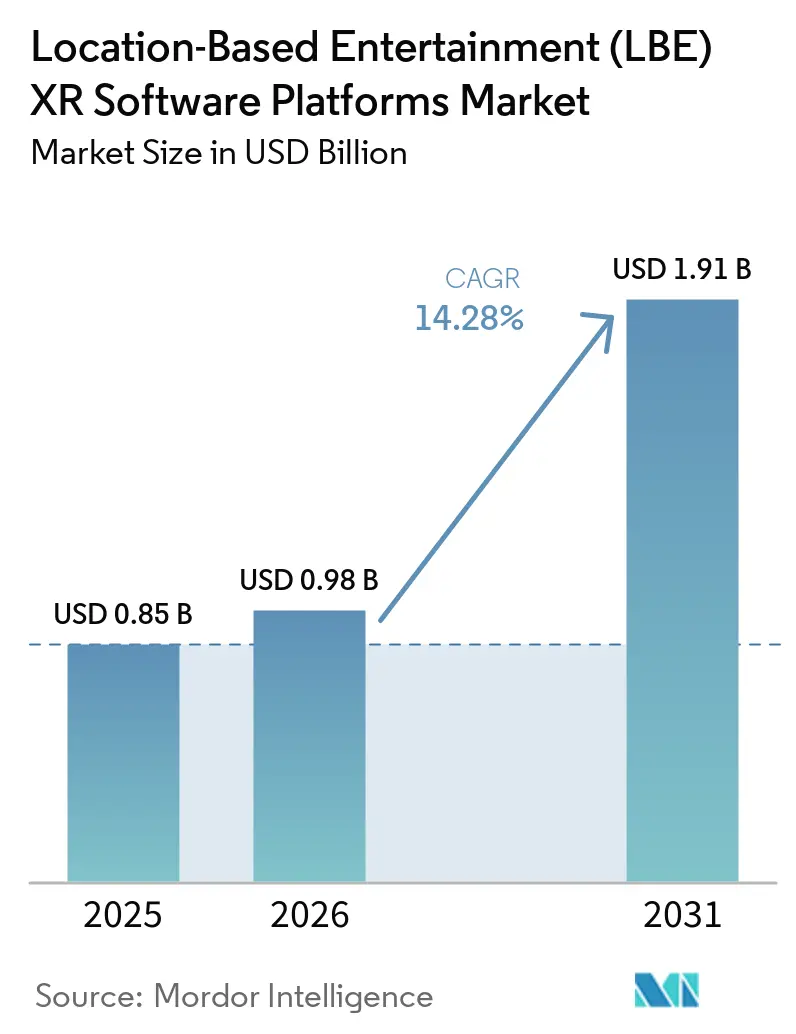
The location-based entertainment (LBE) XR software platforms market size is projected to expand from USD 0.85 billion in 2025 and USD 0.98 billion in 2026 to USD 1.91 billion by 2031, registering a CAGR of 14.28% between 2026 to 2031. Venue operators are moving away from separate, hardware-linked tools toward integrated systems for content, operations, analytics, and device management. This change supports subscription and managed-service contracts that replace large software purchases with recurring payments. Multi-site operators increasingly require centralized telemetry, content updates, and maintenance planning before committing to wider rollouts. These requirements favor platforms that can support consistent operations across different headset fleets and venue formats. The location-based entertainment (LBE) XR software platforms market is also shaped by content licensing, venue financing, data governance, and the availability of premium multiplayer experiences.
Key Report Takeaways
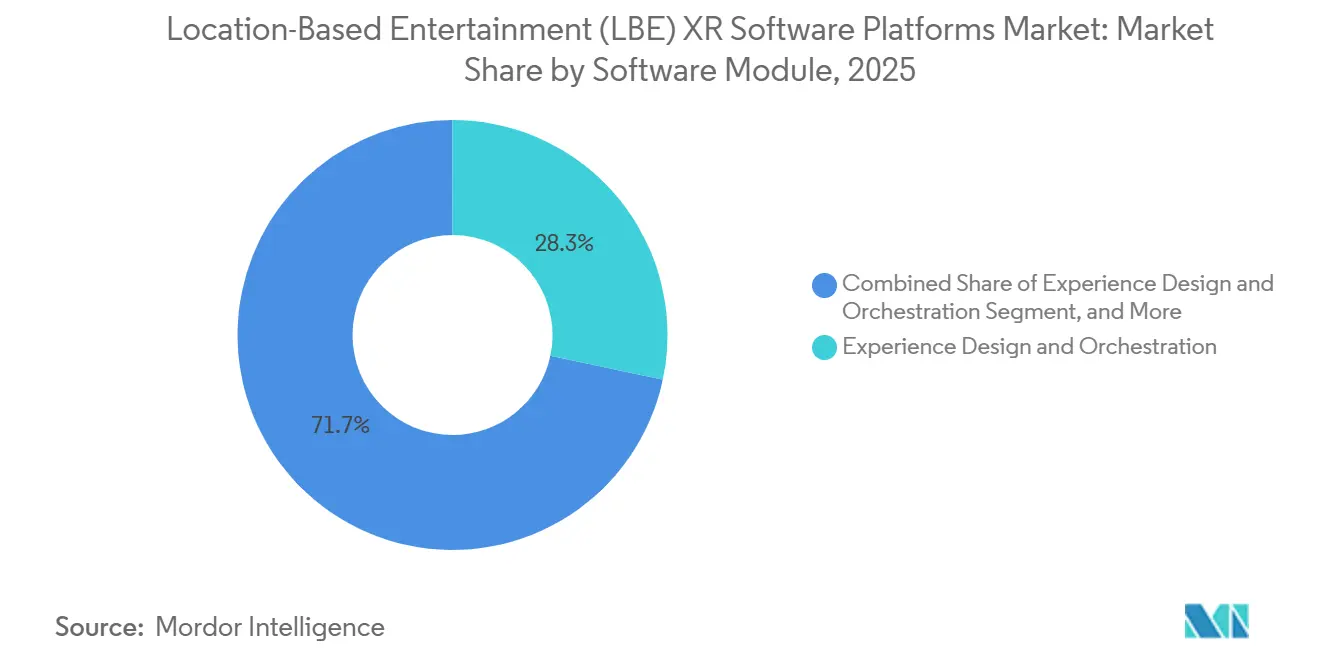
- By software module, Experience Design and Orchestration held 28.32% of the location-based entertainment (LBE) XR software platforms market share in 2025, while Analytics, Monitoring, and Predictive Diagnostics is projected to expand at a 14.88% CAGR through 2031.
- By deployment model, Cloud-Hosted held 58.62% of the location-based entertainment (LBE) XR software platforms market share in 2025 and is projected to expand at a 14.74% CAGR through 2031.
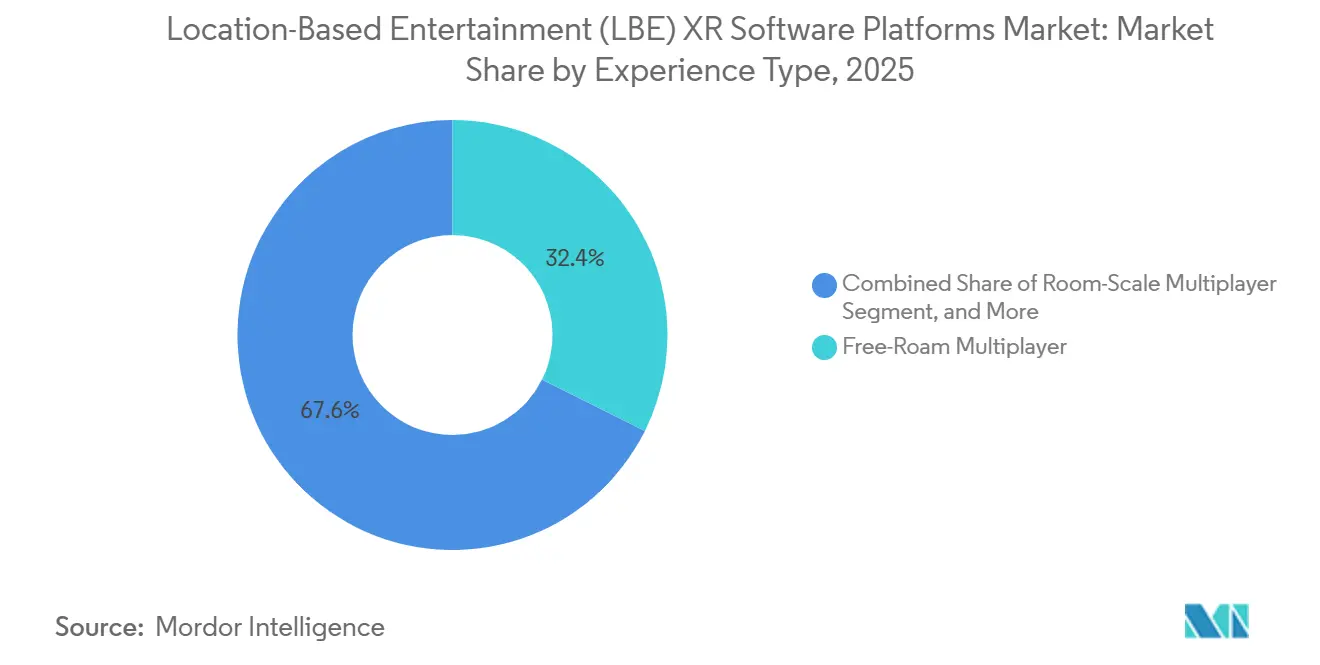
- By experience type, Free-Roam Multiplayer held 32.36% revenue share in 2025, while Augmented and Mixed Reality Attractions is projected to expand at a 14.64% CAGR through 2031 in the location-based entertainment (LBE) XR software platforms market.
- By venue type, VR Arcades and Family Entertainment Centers held 34.38% revenue share in 2025, while Hotels, Resorts, Cruise Ships, and Hospitality Venues is projected to expand at a 14.52% CAGR through 2031.
- By business model, Subscription and Software-as-a-Service held 36.57% revenue share in 2025 and is projected to expand at a 14.68% CAGR through 2031.
- By content and IP type, Original Game IP held 38.42% revenue share in 2025, while Film, Television, and Streaming IP is projected to expand at a 14.57% CAGR through 2031.
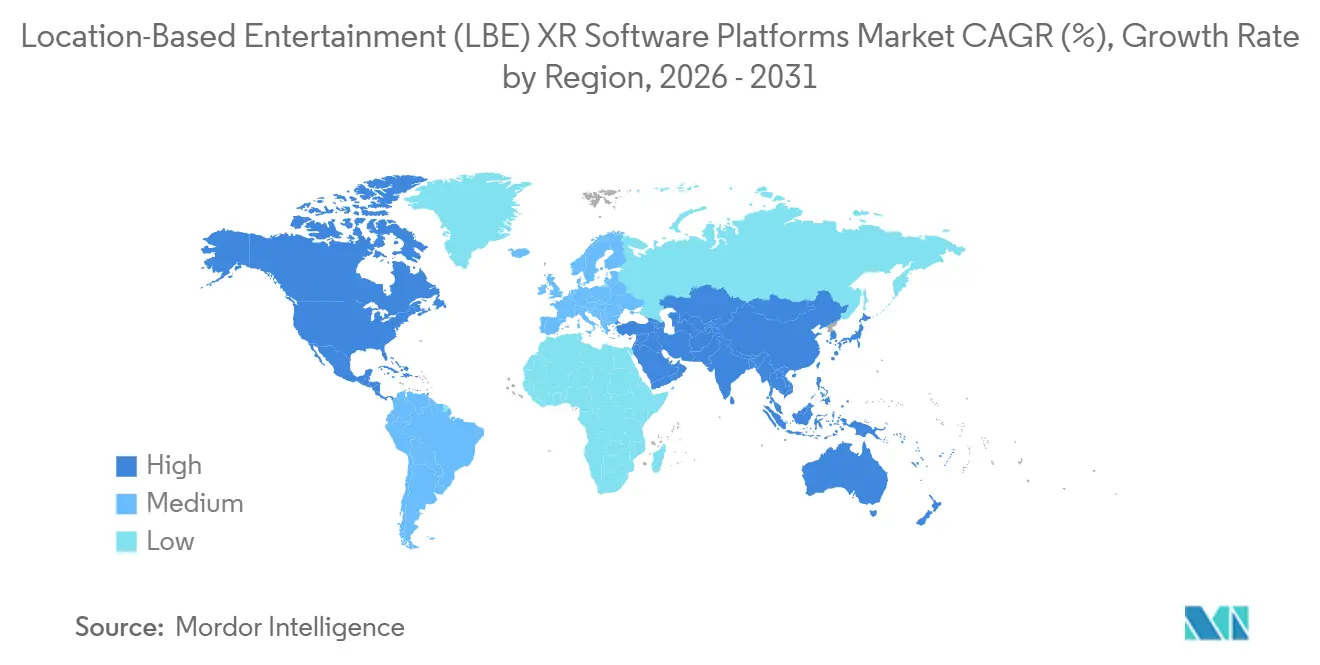
- By geography, North America held 39.42% revenue share in 2025, while Asia-Pacific is projected to expand at a 14.62% CAGR through 2031.
Note: Market size and forecast figures in this report are generated using Mordor Intelligence’s proprietary estimation framework, updated with the latest available data and insights as of January 2026.
Market Trends and Insights
Drivers Impact Analysis of Location-Based Entertainment (LBE) XR Software Platforms Market*
| Driver | (~) % Impact on CAGR Forecast | Geographic Relevance | Impact Timeline |
|---|---|---|---|
| Falling XR Hardware Costs Improving Venue Payback | +2.8% | Global, with pronounced gains in North America and Europe | Short term (≤ 2 years) |
| Demand for Social and Shared Out-of-Home Experiences | +2.5% | Global, concentrated in North America, Europe, and Asia-Pacific | Short term (≤ 2 years) |
| Blockbuster IP Partnerships Increasing Conversion | +2.2% | North America and Europe, with spillover to Asia-Pacific and the Middle East | Medium term (2-4 years) |
| 5G and Edge Rendering Reducing Venue Compute Costs | +1.8% | Asia-Pacific core, with spillover to North America and Europe | Medium term (2-4 years) |
| Machine-Generated Content Lowering Experience Refresh Costs | +1.5% | Global, led by North America, the United Kingdom, and Japan | Medium term (2-4 years) |
| Cross-Venue Identity and Persistent Progress Increasing Repeat Visits | +1.0% | North America and Europe initially, extending to Asia-Pacific | Long term (≥ 4 years) |
| Source: Mordor Intelligence | |||
Falling XR Hardware Costs Improving Venue Payback
Falling prices for standalone headsets reduce the hardware share of a venue’s initial investment. Operators can redirect more of their budget toward content licensing, device management, analytics, and venue operations tools. SynthesisVR stated that a commercial 10-headset fleet with device management software can reduce daily staff intervention by up to 60 minutes per unit compared with consumer hardware deployments.[1] This operational saving can improve the value of subscription software because staff time becomes available for guest service and additional sessions. Multi-site franchises are also better placed to request common application programming interfaces before approving a rollout. As headset hardware becomes less differentiated, the location-based entertainment (LBE) XR software platforms market places greater value on interoperable management systems.
Demand For Social and Shared Out-Of-Home Experiences
Group XR attractions respond to consumer demand for social experiences outside the home. Free-roam formats require reliable coordination of several players, headset status, and session timing. These operating needs make platform reliability relevant to ticket revenue and venue capacity. Operators also need systems that connect session behavior with customer relationship management and loyalty programs. Such records can help a venue identify repeat visitors, season-pass opportunities, and content preferences. The location-based entertainment (LBE) XR software platforms market therefore benefits when software supports both group play and post-session customer engagement.
Blockbuster IP Partnerships Increasing Conversion
Recognizable film and game properties can help venues attract guests who may not otherwise try an XR attraction. In November 2025, Falcon’s Beyond and CD PROJEKT RED announced a global licensing agreement for Cyberpunk 2077 themed experience concepts. In 2025, Hero Zone announced a multi-year deal with STUDIOCANAL for Terminator 2: Judgment Day and planned Terminator: Uprising distribution across 450 locations in 46 countries. These agreements increase the need for tools that track rights, territory restrictions, title availability, and royalty reporting. Platforms that provide this information can be more useful to studios and distributed venue networks. This makes licensed content administration an important capability within the location-based entertainment (LBE) XR software platforms market.
5G And Edge Rendering Reducing Venue Compute Costs
Edge rendering can reduce the need for every venue to maintain local graphics processing servers. A 2025 research paper described adaptive 5G mobile edge computing methods that sustained sub-20 ms latency for interactive XR remote rendering.[2] This capability can support high-fidelity sessions while reducing the equipment housed at a venue. Experiencenet offers a venue service developed with HP and Citymesh at EUR 499-999 per month, equivalent to USD 565-1,130 per month, for off-site rendering. Operators still need local controls and fail-safe processes when a connection is interrupted. The location-based entertainment (LBE) XR software platforms market can benefit from software that manages cloud, edge, and local computing options through the same interface.
Restraints Impact Analysis of Location-Based Entertainment (LBE) XR Software Platforms Market*
| Restraint | (~) % Impact on CAGR Forecast | Geographic Relevance | Impact Timeline |
|---|---|---|---|
| High Upfront Capex and Maintenance Requirements | -2.5% | Global, most acute in emerging markets and independent operators | Short term (≤ 2 years) |
| Limited Premium Multiplayer Content Supply | -1.8% | Global | Short term (≤ 2 years) |
| Shared-Headset Hygiene and Turnover Friction | -1.2% | Global, most acute in high-throughput venues | Medium term (2-4 years) |
| Fragmented Safety, Insurance, and Liability Standards | -0.8% | North America and Europe | Medium term (2-4 years) |
| Source: Mordor Intelligence | |||
High Upfront Capex and Maintenance Requirements
Initial capital requirements remain a barrier for independent operators and venues with limited financing access. SynthesisVR reported that a 10-headset free-roam fleet can understate initial investment by 15-30% when planning excludes space build-out, network infrastructure, and integration labor. Commercial device-management tools also add recurring costs, even when they reduce longer-term staffing needs. Operators that select an unsuitable platform can face significant switching costs after launch. SynthesisVR estimated payroll expenses of USD 97,333 over 24 months for a 10-headset fleet in its operating comparison. The location-based entertainment (LBE) XR software platforms market must therefore serve operators that need flexible licensing, financing support, and managed-service options.
Limited Premium Multiplayer Content Supply
Premium multiplayer experiences require extended development work, content rights agreements, and technical coordination. These requirements limit the volume of new titles that can justify premium ticket prices. In 2025, STUDIOCANAL appointed IMG Licensing as its global location-based entertainment rights representative for franchises including Terminator 2, Rambo, and Evil Dead. The arrangement formalizes studio-to-venue licensing, but it can concentrate access to major properties among a limited number of intermediaries. Google demonstrated a Gemini workflow in 2026 for creating interactive XR experiences from creative prompts. Such workflows may reduce selected production tasks, but venue-level adoption requires integration with operational software. The location-based entertainment (LBE) XR software platforms market remains constrained when content updates cannot keep pace with venue demand.
*Our forecasts treat driver/restraint impacts as directional, not additive. The impact forecasts reflect baseline growth, mix effects, and variable interactions.
Location-Based Entertainment (LBE) XR Software Platforms Market Segment Analysis
By Software Module:
Analytics Extends the Value of Venue PlatformsExperience Design and Orchestration accounted for 28.32% of the location-based entertainment (LBE) XR software platforms market size in 2025. The module manages synchronized multi-user environments across different headset fleets. This capability provides the basic operating layer for commercial session delivery. Content Management and Licensing is becoming more relevant as operators add titles and locations. Venue Operations, Ticketing, and Membership tools also support multi-site revenue reconciliation and guest administration.
Analytics, Monitoring, and Predictive Diagnostics is projected to expand at a 14.88% CAGR through 2031. Operators use session records such as dwell time, replay behavior, group composition, and hardware faults to guide pricing and maintenance. Real-time diagnostics can help staff address device issues before peak operating periods. Platforms that combine analytics, content administration, and ticketing can reduce reliance on disconnected vendor tools. The Others category includes safety monitoring, training overlays, and localization capabilities that become more relevant as international deployments increase.

By Deployment Model:
Cloud Delivery Supports Multi-Site OperationsCloud-Hosted deployment accounted for 58.62% of the location-based entertainment (LBE) XR software platforms market size in 2025. It is also projected to expand at a 14.74% CAGR through 2031. Centralized delivery lets a franchise send software updates and configuration changes to many venues without on-site visits. Hydra’s Experiencenet platform was designed for XR venues and was developed in partnership with HP and Citymesh.
On-Premises deployment remains relevant where connectivity is limited, data rules are stringent, or equipment needs local processing. Museum networks, theme parks, and training facilities may retain local systems because of these requirements. Edge-connected venues create a hybrid option that combines streamed rendering with local session control. A consistent interface across cloud, edge, and on-premises configurations can help operators use different infrastructure across their portfolios. This flexibility is increasingly important when enterprise buyers evaluate platform contracts.
By Experience Type:
Mixed Reality Broadens Venue FormatsFree-Roam Multiplayer accounted for 32.36% of the experience-type segment in 2025. The format has established revenue-per-square-foot economics in mature venues. Zero Latency reported a network of 150 venues in 30 countries after its 2025 launch in Rabat, Morocco. Free-roam sites need systems that coordinate player groups, venue maps, and staff oversight. Wireless headsets are also reducing cable constraints and the minimum footprint for some deployments.
Augmented and Mixed Reality Attractions is projected to expand at a 14.64% CAGR through 2031. These formats can overlay digital material on physical settings and can appeal to guests reluctant to wear shared headsets. They may allow larger groups, shorter sessions, and lower staffing needs than fully immersive installations. Interactive Projection and Spatial Computing is also becoming relevant for mall and retail sites that want less equipment handling. Software providers must increasingly manage headset-based and display-based attractions through a shared operating dashboard.
By Venue Type:
Hospitality Creates Recurring Software DemandVR Arcades and Family Entertainment Centers accounted for 34.38% of the venue-type segment in 2025. Their needs include walk-in ticketing, rapid content changes, and frequent headset cycling. These requirements define a core functional baseline for the location-based entertainment (LBE) XR software platforms industry. Free-Roam Arenas typically use larger spaces ranging from 5,000 to 20,000 square feet. Their software must coordinate concurrent groups, obstacle awareness, and real-time staff dashboards.
Hotels, Resorts, Cruise Ships, and Hospitality Venues is projected to expand at a 14.52% CAGR through 2031. Hospitality operators are adding weather-independent amenities intended to increase time spent on site and related guest purchases. Their captive audiences and recurring content needs can make them suitable customers for subscription platforms. Museums, Cultural Centers, and Educational Venues are also adopting XR to extend exhibit engagement and support funded programs. SynthesisVR introduced Step Into Webb in June 2026 for school groups, museums, and science centers using NASA-based material.
By Business Model:
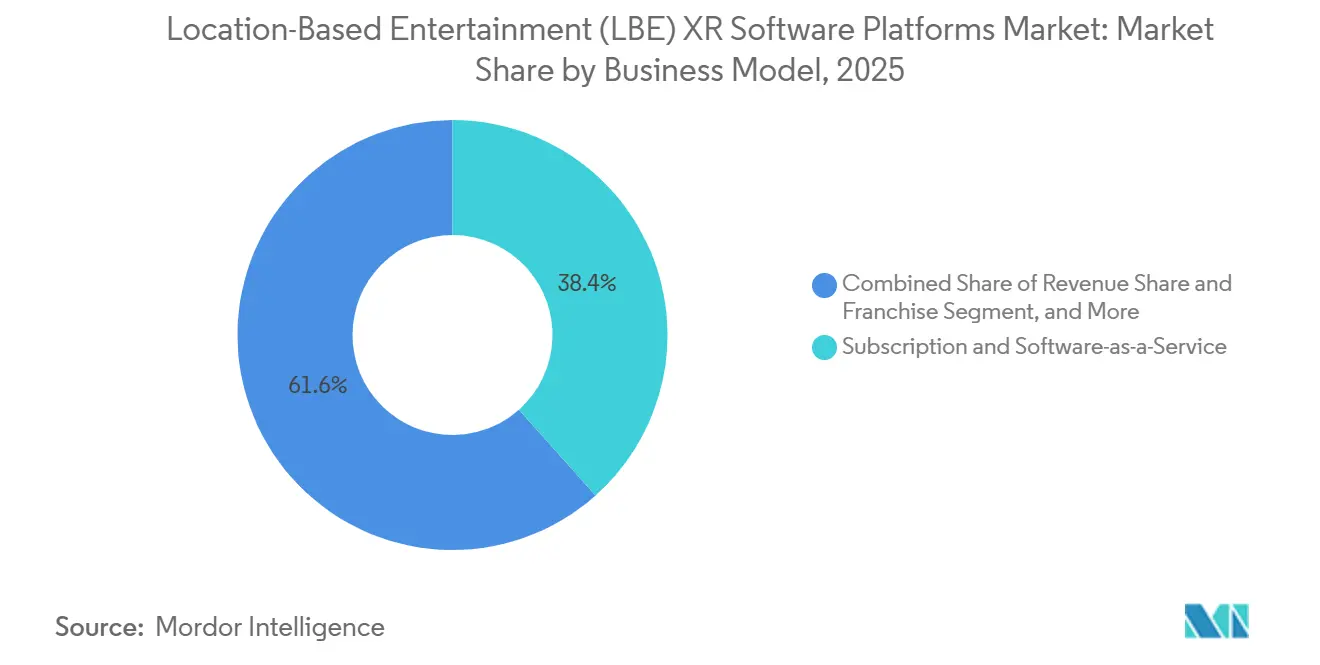
Subscriptions Align Payments With OperationsSubscription and Software-as-a-Service accounted for 36.57% of the business-model segment in 2025. It is also projected to expand at a 14.68% CAGR through 2031. Monthly payments can replace large and variable licensing outlays during a venue’s opening period. Operators can retain access to new features and content without separate purchasing cycles. This overlap between the largest and fastest-expanding model indicates strong support for recurring contract structures.
Revenue Share and Franchise arrangements remain important for larger free-roam networks and operators with limited capacity for fixed annual contracts. Software License and Royalty arrangements continue to suit institutional users that want ownership and maintain internal technology teams. Turnkey Attraction and Managed Service contracts fit hotels and resorts that lack specialized XR operating staff. In June 2026, SynthesisVR announced an exclusive distribution agreement with Holomia for free-roam and escape-room experiences.
By Content And IP Type:
Studio Content Gains GroundOriginal Game IP accounted for 38.42% of the content and IP type segment in 2025. Purpose-built multiplayer titles remain central to many VR arcade and free-roam libraries. They are designed around group play, session management, and venue throughput. Their established operating history gives operators familiar content and predictable audience expectations. The location-based entertainment (LBE) XR software platforms industry relies on these titles for a substantial share of current venue programming.
Film, Television, and Streaming IP is projected to expand at a 14.57% CAGR through 2031. Studio licensing arrangements are creating clearer routes for recognized properties to enter location-based formats. In May 2026, Behaviour Interactive and PHI Studio announced a Blade Runner immersive experience for several North American cities in 2027.[3] Sports and Esports IP has relevance in Asia-Pacific, while music and performing-arts content remains a smaller premium category. Education, Training, and Cultural Content also supports museums and science centers where funding and curriculum needs can be independent of ticket prices.
Geography Analysis
North America and Europe Location-Based Entertainment (LBE) XR Software Platforms Market
North America accounted for 39.42% of the location-based entertainment (LBE) XR software platforms market size in 2025. The region has a dense base of branded free-roam venues, established franchise licensing, and consumer demand for premium experiences. The United States remains the main source of regional software demand in urban entertainment districts and high-traffic malls. Canada and Mexico are secondary markets for family entertainment center deployments in mixed-use retail projects. Europe is an active deployment region, led by Germany, the United Kingdom, and France. HOLOGATE reported in July 2026 that its team had exceeded 100 members, reflecting further investment in AI-based development tools and enterprise training content.
APAC Location-Based Entertainment (LBE) XR Software Platforms Market
Asia-Pacific is projected to expand at a 14.62% CAGR through 2031. Government digital infrastructure initiatives, higher leisure spending, and locally competitive XR hardware manufacturing support venue development. China’s 5G rollout supports edge-rendered multiplayer experiences in mall venues. South Korea’s advanced connectivity supports cloud-hosted models for esports-linked and K-pop themed attractions. Japan offers a developed IP licensing environment across anime, games, and live events. India presents an important country opportunity as organized retail entertainment and urbanization support new venue formation.
South America and MEA Location-Based Entertainment (LBE) XR Software Platforms Market
South America remains at an earlier stage, with Brazil offering the region’s largest addressable base because of its urban population and organized retail entertainment activity. Currency volatility and import duties on XR equipment can constrain initial venue budgets and software spending. The Middle East is strategically important as entertainment projects create potential sites for immersive experiences. Saudi Arabia’s Public Investment Fund launched QSAS in 2024 to develop immersive experiences inspired by the country’s heritage, culture, and history. Africa remains nascent, although Zero Latency’s 2025 Rabat opening established its presence across all 6 inhabited continents.
Competitive Landscape
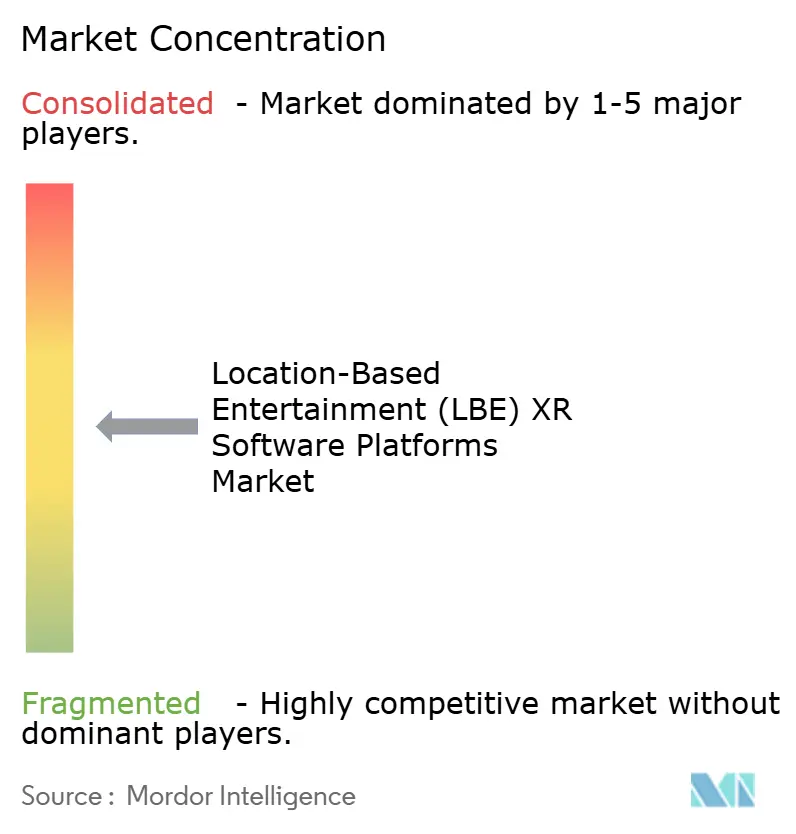
The location-based entertainment (LBE) XR software platforms market has a moderately fragmented structure. Vertically integrated operators work alongside middleware providers, marketplace distributors, and analytics specialists. Integrated operators control software, hardware relationships, and content libraries. This structure can support exclusivity and hardware optimization. However, closed systems can create switching costs for venue networks seeking interoperability. In June 2026, SynthesisVR added Wanadev Studio’s 10-title Octopod VR catalog to its commercial licensing marketplace. This move illustrates how marketplace platforms can consolidate third-party content distribution.
Opportunities remain in persistent player identities across venues, automated royalty administration, and predictive maintenance interfaces. Franchise operators increasingly need one view of bookings, customer records, session activity, and royalty reporting. A platform that links these functions can reduce the operational burden of separate systems. Generative tools could shorten selected content-production stages and support more frequent scene updates. Google’s 2026 workflow showed how creative prompts can be converted into interactive XR experiences. Commercial use still depends on reliable integration with venue workflows and content controls.
Data consent and retention requirements also affect platform selection when venues collect biometric or movement-related information. Providers that build privacy controls into their operating systems can be more attractive to multi-state or multi-country operators. Patent-backed tracking and spatial-mapping technologies can create technical advantages for integrated providers. In May 2026, Merlin Entertainments, Sony Pictures Entertainment, and Triotech announced plans for Jumanji-themed interactive experiences at 4 Madame Tussauds locations in the United States and Australia. In May 2026, HOLOGATE introduced AgiS, a modular training replica platform for law enforcement, military, and security organizations. These moves show that established suppliers are extending software capabilities across entertainment and adjacent use cases.
Location-Based Entertainment (LBE) XR Software Platforms Industry Leaders
-
Sandbox VR
-
Zero Latency VR
-
HOLOGATE
-
Dreamscape Immersive, Inc.
-
HTC Corporation
- *Disclaimer: Major Players sorted in no particular order
Location-Based Entertainment (LBE) XR Software Platforms Market Companies Covered in this Report
- Sandbox VR
- Zero Latency VR
- HOLOGATE
- Dreamscape Immersive, Inc.
- VRstudios Inc.
- Vertigo Games Holding B.V.
- EXIT VR GmbH
- Survios, Inc.
- Tyffon Inc.
- Neurogaming Limited
- Ctrl V Inc.
- IMAX Corporation
- Spaces LLC
- Nomadic Inc.
- The VOID LLC
- HTC Corporation
- Facebook Technologies LLC
- Disney Parks, Experiences and Products Inc.
- Pico Interactive Inc.
- DPVR Co. Ltd.
- SynthesisVR, Inc.
- Univrse
- 4Experience sp. z o.o.
Recent Industry Developments in Location-Based Entertainment (LBE) XR Software Platforms Market
- July 2026: HOLOGATE surpasses 100 team members after roughly doubling headcount within the prior year, with expanded focus on AI-powered development tools and AgiS, a modular training replica platform for law enforcement, military, and security organizations, signaling the company’s strategic extension of its LBE software capabilities into enterprise training verticals beyond entertainment.
- July 2026: SynthesisVR lists 10 titles from Wanadev Studio, the game catalog formerly distributed via Octopod VR, on its commercial licensing marketplace, consolidating arcade catalog distribution under a single platform and reducing per-title licensing complexity for venue operators globally.
- June 2026: SynthesisVR launches Holomia, formerly MissionX, as an exclusive platform content partner, combining competitive free-roam and cooperative escape room experiences under one ecosystem with regional distribution advantages for operators in North America and Europe.
- May 2026: Behaviour Interactive and PHI Studio announce a 2027 LBE XR experience based on the Blade Runner universe, in collaboration with Alcon Entertainment, with planned launches across several North American cities.
Global Location-Based Entertainment (LBE) XR Software Platforms Market Report Scope
The Location-Based Entertainment (LBE) XR Software Platforms Market encompasses software platforms, development frameworks, content management systems, deployment tools, analytics solutions, and operational software designed to create, manage, deliver, and optimize extended reality (XR) experiences in location-based entertainment venues.
The Location-Based Entertainment XR Software Platforms Market Report is Segmented by Software Module (Content Management and Licensing, Experience Design and Orchestration, Analytics, Monitoring, and Predictive Diagnostics, Venue Operations, Ticketing, and Membership, and Other Software Modules), Deployment Model (Cloud-Hosted and On-Premises), Experience Type (Free-Roam Multiplayer, Room-Scale Multiplayer, Seated and Cinematic VR, Augmented and Mixed Reality Attractions, and Interactive Projection and Spatial Computing), Venue Type (VR Arcades and Family Entertainment Centers, Free-Roam Arenas, Theme Parks and Immersive Attractions, Cinemas, Malls, and Retail Venues, Museums, Cultural Centers, and Educational Venues, and Hotels, Resorts, Cruise Ships, and Hospitality Venues), Business Model (Software License and Royalty, Subscription and Software-as-a-Service, Revenue Share and Franchise, and Turnkey Attraction and Managed Service), Content and IP Type (Original Game IP, Film, Television, and Streaming IP, Sports and Esports, Music, Live Events, and Performing Arts, and Education, Training, and Cultural Content), and Geography (North America, South America, Europe, Asia-Pacific, Middle East, and Africa). The Market Forecasts are Provided in Terms of Value (USD).
| Content Management and Licensing |
| Experience Design and Orchestration |
| Analytics, Monitoring, and Predictive Diagnostics |
| Venue Operations, Ticketing, and Membership |
| Other Software Modules |
| Cloud-Hosted |
| On-Premises |
| Free-Roam Multiplayer |
| Room-Scale Multiplayer |
| Seated and Cinematic VR |
| Augmented and Mixed Reality Attractions |
| Interactive Projection and Spatial Computing |
| VR Arcades and Family Entertainment Centers |
| Free-Roam Arenas |
| Theme Parks and Immersive Attractions |
| Cinemas, Malls, and Retail Venues |
| Museums, Cultural Centers, and Educational Venues |
| Hotels, Resorts, Cruise Ships, and Hospitality Venues |
| Software License and Royalty |
| Subscription and Software-as-a-Service |
| Revenue Share and Franchise |
| Turnkey Attraction and Managed Service |
| Original Game IP |
| Film, Television, and Streaming IP |
| Sports and Esports |
| Music, Live Events, and Performing Arts |
| Education, Training, and Cultural Content |
| North America | United States |
| Canada | |
| Mexico | |
| South America | Brazil |
| Argentina | |
| Rest of South America | |
| Europe | Germany |
| United Kingdom | |
| France | |
| Spain | |
| Italy | |
| Russia | |
| Rest of Europe | |
| Asia-Pacific | China |
| Japan | |
| South Korea | |
| India | |
| Australia | |
| Rest of Asia-Pacific | |
| Middle East | United Arab Emirates |
| Saudi Arabia | |
| Turkey | |
| Rest of Middle East | |
| Africa | South Africa |
| Egypt | |
| Nigeria | |
| Rest of Africa |
| By Software Module | Content Management and Licensing | |
| Experience Design and Orchestration | ||
| Analytics, Monitoring, and Predictive Diagnostics | ||
| Venue Operations, Ticketing, and Membership | ||
| Other Software Modules | ||
| By Deployment Model | Cloud-Hosted | |
| On-Premises | ||
| By Experience Type | Free-Roam Multiplayer | |
| Room-Scale Multiplayer | ||
| Seated and Cinematic VR | ||
| Augmented and Mixed Reality Attractions | ||
| Interactive Projection and Spatial Computing | ||
| By Venue Type | VR Arcades and Family Entertainment Centers | |
| Free-Roam Arenas | ||
| Theme Parks and Immersive Attractions | ||
| Cinemas, Malls, and Retail Venues | ||
| Museums, Cultural Centers, and Educational Venues | ||
| Hotels, Resorts, Cruise Ships, and Hospitality Venues | ||
| By Business Model | Software License and Royalty | |
| Subscription and Software-as-a-Service | ||
| Revenue Share and Franchise | ||
| Turnkey Attraction and Managed Service | ||
| By Content and IP Type | Original Game IP | |
| Film, Television, and Streaming IP | ||
| Sports and Esports | ||
| Music, Live Events, and Performing Arts | ||
| Education, Training, and Cultural Content | ||
| By Geography | North America | United States |
| Canada | ||
| Mexico | ||
| South America | Brazil | |
| Argentina | ||
| Rest of South America | ||
| Europe | Germany | |
| United Kingdom | ||
| France | ||
| Spain | ||
| Italy | ||
| Russia | ||
| Rest of Europe | ||
| Asia-Pacific | China | |
| Japan | ||
| South Korea | ||
| India | ||
| Australia | ||
| Rest of Asia-Pacific | ||
| Middle East | United Arab Emirates | |
| Saudi Arabia | ||
| Turkey | ||
| Rest of Middle East | ||
| Africa | South Africa | |
| Egypt | ||
| Nigeria | ||
| Rest of Africa | ||
Key Questions Answered in the Report
What is the size of the location-based entertainment XR software platforms market?
The location-based entertainment XR software platforms market was valued at USD 0.85 billion in 2025, is estimated at USD 0.98 billion in 2026, and is forecast to reach USD 1.91 billion by 2031 at a 14.28% CAGR.
Which software module leads location-based entertainment XR platforms?
Experience Design and Orchestration led with a 28.32% market share in 2025 because venues require reliable coordination of multi-user sessions and headset fleets.
What deployment model is most widely used for XR venue software?
Cloud-Hosted deployment held a 58.62% market share in 2025 and is projected to expand at a 14.74% CAGR through 2031.
Which XR attraction format is expanding most quickly?
Augmented and Mixed Reality Attractions is projected to expand at a 14.64% CAGR through 2031 as venues seek formats with less shared-headset reliance.
Why are subscriptions important for venue operators?
Subscription and Software-as-a-Service (SaaS) held a 36.57% market share in 2025, as monthly payments can align software costs with a venue's operating revenue.
Which region is projected to expand most quickly?
Asia-Pacific is projected to expand at a 14.62% CAGR through 2031, supported by digital infrastructure, leisure spending, and local XR hardware supply.