
Liveness Detection Market Size and Share
Market Overview
| Study Period | 2021 - 2032 |
|---|---|
| Market Size (2027) | USD 1.99 Billion |
| Market Size (2032) | USD 5.03 Billion |
| Growth Rate (2027 - 2032) | 20.83 % |
| Fastest Growing Market | Asia-Pacific |
| Largest Market | North America |
| Market Concentration | Medium |
Major Players *Disclaimer: Major Players sorted in no particular order Image © Mordor Intelligence. Reuse requires attribution under CC BY 4.0. | |
Liveness Detection Market Analysis by Mordor Intelligence
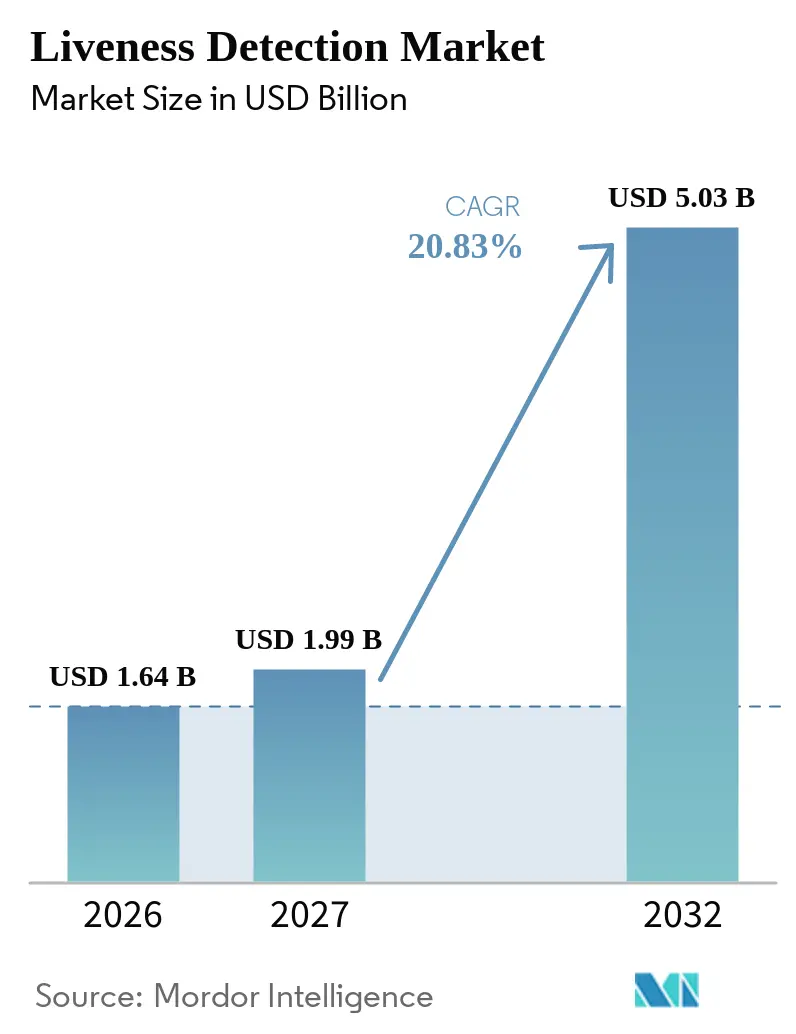
The Liveness Detection Market size is projected to expand from USD 1.64 billion in 2026 and USD 1.99 billion in 2027 to USD 5.03 billion by 2032, registering a CAGR of 20.38% between 2027 to 2032. Regulatory requirements are making biometric presence checks a standard control for financial institutions, while accessible generative AI tools are lowering the cost of fraudulent biometric attacks. Commercial buyers are also adopting identity assurance approaches that were first developed for government programs. The Liveness Detection Market is shifting toward passive, server-side checks with active challenges used only when risk is elevated, which favors vendors whose software can work within a wider identity verification platform. Privacy, data residency, and faster changes in attack methods create costs and procurement delays, but they also increase the importance of certified, adaptable liveness tools. The strongest opportunities favor suppliers that combine adaptable detection with deployment options suited to regulated buyers and established enterprise systems.
Key Report Takeaways
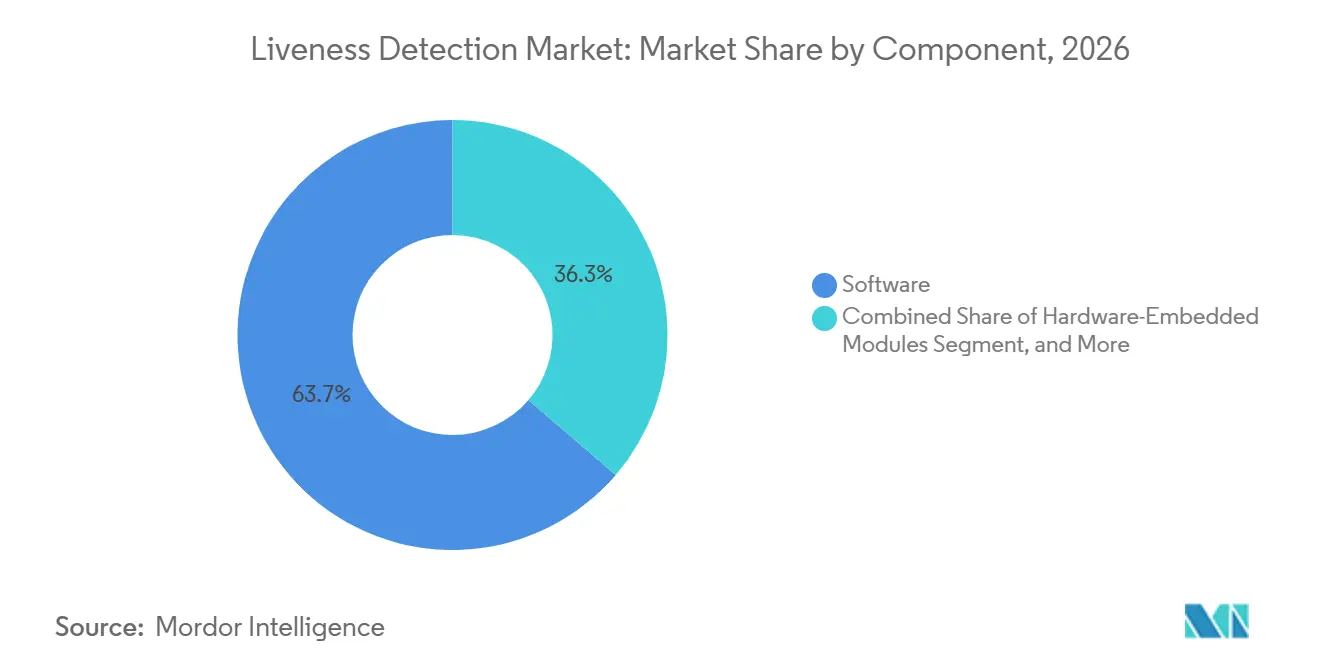
- By component, software held 63.72% of the Liveness Detection Market share in 2026, while services are projected to expand at a 23.17% CAGR through 2032.
- By detection method, passive liveness detection held 46.17% revenue share in 2026 and is projected to expand at a 23.34% CAGR through 2032.
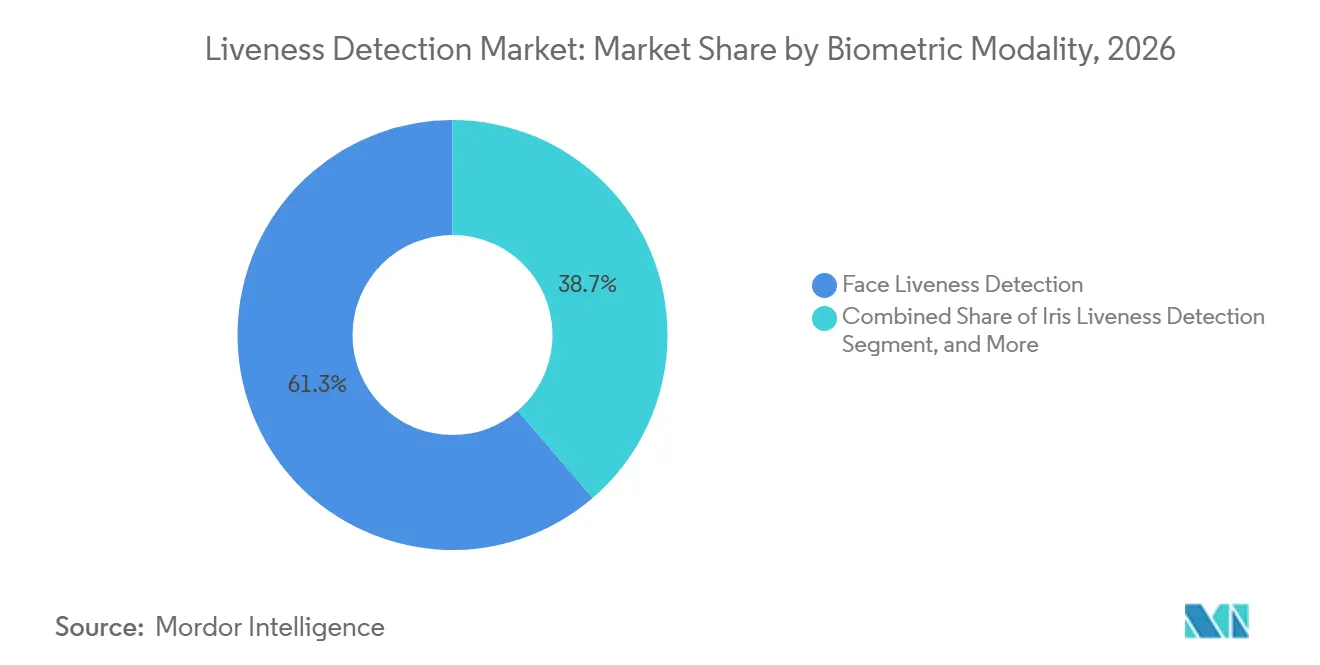
- By biometric modality, face liveness detection held 61.30% revenue share in 2026, while multimodal liveness detection is projected to expand at a 24.19% CAGR through 2032.
- By deployment mode, cloud-based deployment held 52.23% revenue share in 2026, while hybrid cloud is projected to expand at a 23.79% CAGR through 2032.
- By application, remote identity verification and eKYC held 42.27% revenue share in 2026, while access control and continuous authentication are projected to expand at a 24.11% CAGR through 2032.
- By end-user industry, banking, financial services, and insurance held 36.21% revenue share in 2026, while retail and e-commerce is projected to expand at a 25.10% CAGR through 2032.
- By geography, North America held 35.53% of the Liveness Detection Market share in 2026, while Asia-Pacific is projected to expand at a 24.50% CAGR through 2032.
Note: Market numbers in this report are based on Mordor Intelligence's proprietary estimation framework, which combines nine months of actuals with Q4 projections for base year 2026.
Global Liveness Detection Market Trends and Insights
Drivers Impact Analysis*
| Driver | (~) % Impact on CAGR Forecast | Geographic Relevance | Impact Timeline |
|---|---|---|---|
| Digital Onboarding and KYC/AML Compliance | +4.5% | Global, intense in EU, India, and Southeast Asia | Short term (≤ 2 years) |
| Escalating Deepfake and Injection Attack Threats | +4.0% | Global, acute in North America and Western Europe | Short term (≤ 2 years) |
| Expansion of Mobile Payments and Remote Identity Services | +3.5% | Asia-Pacific core, spillover to Middle East and South America | Medium term (2-4 years) |
| Government Digital ID and Border Modernization | +2.8% | North America, Europe, Middle East | Medium term (2-4 years) |
| Rising Demand for Frictionless Risk-Based Authentication | +2.5% | Global, early adoption in BFSI and e-commerce | Medium term (2-4 years) |
| Real-Time Threat Intelligence and Edge-AI Capability Expansion | +2.0% | Global, early gains in critical infrastructure and government | Long term (≥ 4 years) |
| Source: Mordor Intelligence | |||
Digital Onboarding and KYC/AML Compliance
Compliance requirements are creating non-discretionary demand for the Liveness Detection Market. The EU Anti-Money Laundering Authority expanded direct supervision of high-risk financial institutions in 2025, increasing the importance of reliable identity checks across member states. The Financial Action Task Force clarified in February 2025 that non-face-to-face onboarding need not be inherently high risk when sound biometric liveness controls are in place. This clarification supports the use of sound biometric controls as an alternative to viewing remote onboarding as inherently unsuitable. Regulatory requirements are also extending biometric verification into payment, electronic money, and other services where remote customer identification is used. The eIDAS 2.0 requirement for High assurance in AML onboarding by 2027 is expected to make liveness checks a common purchasing requirement for European enterprises.
Escalating Deepfake and Injection Attack Threats
The threat environment is changing faster than many deployed models can be retrained. Entrust reported that deepfakes accounted for 1 in 5 biometric fraud attempts globally, while deepfaked selfie attempts increased 58% in 2025, and injection attacks rose 40% year over year. The World Economic Forum reported an 88% year-over-year increase in injection attacks observed by Jumio in 2025. Its January 2026 analysis also documented commercial deepfake face-swapping tools priced from USD 25.95, making biometric attacks more accessible to organized fraud networks. This shift moves the security focus from physical presentation attacks toward synthetic video streams injected at the software layer. Vendors are therefore being pushed to combine ISO/IEC 30107-3 presentation attack detection with CEN/TS 18099 injection attack detection, expanding technical work and recurring certification needs.
Expansion of Mobile Payments and Remote Identity Services
Mobile payment authentication is extending liveness use beyond account opening and into repeated transaction checks. Razorpay, Mastercard, and Visa launched an RBI-compliant biometric passkey in India on March 31, 2026, enabling face or fingerprint authentication for card transactions.[1] Visa described device-bound payment passkeys as a related architecture for digital identity in its January 2025 research. This changes the relevant volume base from isolated onboarding events to payment authentication events. Those events occur much more often and create demand for passive liveness tools that can respond quickly. Providers that can maintain deepfake detection while operating below 300 milliseconds are better placed for payment-related use cases.
Government Digital ID and Border Modernization
Government programs give the Liveness Detection Market an important scale and certification reference point. The UK Home Office began contactless biometric eGate deployment at airports from October 6, 2026, matching live facial scans with verified passport information. The US Department of Homeland Security finalized a rule in October 2025 that extends biometric collection to all aliens at airport, land, and seaport departure points.[2] Border and national identity programs give commercial buyers visible examples of how live biometric checks can operate at scale. These deployments establish ISO/IEC 30107-3 and ISO/IEC 18013-5 as reference architectures for commercial evaluation. Commercial procurement teams often use those public-sector requirements as a practical starting point for their own vendor assessments.
Restraints Impact Analysis*
| Restraint | (~) % Impact on CAGR Forecast | Geographic Relevance | Impact Timeline |
|---|---|---|---|
| Biometric Privacy, Consent, and Data-Residency Complexity | -3.5% | EU, India, US state-level, including Illinois and Texas, China | Long term (≥ 4 years) |
| Integration and Total Cost Burden for Legacy Systems and SMEs | -2.5% | Global, most pronounced in South America, Africa, and Southeast Asia | Medium term (2-4 years) |
| Performance Variability Across Devices, Lighting, and Demographic Conditions | -1.5% | Asia-Pacific and Africa, lower-income device segments globally | Medium term (2-4 years) |
| Adversarial Adaptation and Shortening Model-Revalidation Cycles | -1.5% | Global | Short term (≤ 2 years) |
| Source: Mordor Intelligence | |||
Biometric Privacy, Consent, and Data-Residency Complexity
Biometric data rules remain fragmented, which complicates deployment in the Liveness Detection Market even where demand is strong. The EU AI Act treats real-time biometric identification systems as high risk, requiring conformity assessments and audit trails that can lengthen procurement cycles for mid-size buyers. China’s Personal Information Protection Law and GA/T 1723.3 require biometric templates to remain within device or institutional boundaries in financial and government applications. This can exclude global cloud providers unless they establish local infrastructure partnerships. In jurisdictions requiring affirmative consent, including those governed by GDPR-style rules and emerging US biometric statutes, consumers can abandon onboarding before verification is complete. Vendors must manage the dual effect of regulation, where rules support demand for verified identity but slow implementation through localization, consent, and audit requirements.
Integration and Total Cost Burden for Legacy Systems and SMEs
Per-transaction API prices do not capture the full cost of deploying liveness controls in the Liveness Detection Market. Legacy banking, insurance, and government systems often require middleware and phased integration because they predate modern REST-based software development kits. Large institutions can face implementation periods of 12-36 months. Small and medium-sized enterprises in South America, Africa, and Southeast Asia may find that third-party certification costs exceed annual API spending. iBeta PAD Level 2 testing, ISO/IEC 17025-accredited injection evaluations, and FIDO Alliance document authentication certifications can each bring recurring costs. This leaves well-capitalized platforms better able to bundle certified liveness within identity orchestration services, while smaller operators depend more heavily on white-labeled offerings. The Liveness Detection Market must therefore address affordability as well as detection quality, integration needs, and certification evidence.
*Our forecasts treat driver/restraint impacts as directional, not additive. The impact forecasts reflect baseline growth, mix effects, and variable interactions.
Segment Analysis
By Component: Software Leads as Services Scale at the Fastest Pace
Software held 63.72% of the component mix in 2026, giving it the largest component share within this segmentation. Enterprises favor cloud-delivered application programming interfaces because they avoid long hardware procurement cycles. The software layer includes standalone liveness software development kits and broader identity verification platforms. These platforms can combine document authentication, watchlist screening, and liveness checks in the same workflow. They can also support adaptive deepfake detection models that update as attack patterns change. Faster adaptation is becoming important because fraud tools and attack methods can change between planned product releases. This approach supports organizations that need controls to change without replacing their complete identity workflow. Software, therefore, remains central to the Liveness Detection Market, where companies need scalable remote verification and ongoing risk management. The component also gives enterprise buyers a practical way to add liveness checks to systems that already manage documents and customer records. This can simplify procurement when organizations prefer fewer suppliers and a more consistent review process.
Services is projected to expand at a 23.17% CAGR from 2027 to 2032, the fastest rate among components. As clients operate liveness systems in production, they need model revalidation, red-team testing, audit support, and integration services. These needs become more important when a fraud method changes after initial deployment. The World Economic Forum reported that new deepfake tool variants can emerge on a sub-monthly cycle. Annual certification alone can therefore be insufficient for active fraud environments. Managed threat intelligence services help clients monitor these changes between formal testing cycles. They can also help teams document the controls needed for regulatory reviews and procurement renewals. Hardware-embedded modules will remain relevant for access control, border kiosks, and ATM authentication, particularly when cloud connectivity creates latency or data sovereignty concerns. These two component groups serve different operating needs but can be used together in a single identity workflow. This combination supports the Liveness Detection Market by linking remote analysis with local capabilities where needed.

By Detection Method: Passive Liveness Consolidates Leadership Across Share and Growth Outlook
Passive liveness detection held 46.17% of the detection method segment in 2026 and is projected to expand at a 23.34% CAGR through 2032. This position gives passive technology both the largest share and the strongest forecast rate within the detection method segment. Buyers are moving away from active challenge-response checks that require users to follow visible instructions. Scripted deepfake attacks can imitate those instructions, which reduces the advantage of predictable challenges. Passive systems instead assess features such as texture, remote photoplethysmography pulse signals, and monocular depth cues. These methods allow a user to complete a check with less visible friction. A 2025 Scientific Reports study found that depth-map fusion with central difference convolution improved cross-domain generalization compared with single-cue approaches. The evidence supports a design direction that uses several signals rather than relying on one observable response. This is useful for the Liveness Detection Market, where organizations need stronger verification without adding a visible task to each customer interaction.
Hybrid liveness is becoming the preferred architecture for many regulated financial institutions in 2026. It uses passive analysis as the normal check and activates an active step-up challenge for sessions that appear risky. This design reduces friction in routine interactions while retaining a stronger option for unusual cases. Active liveness still has a role where regulations expressly require challenge-response behavior. Its broader use is limited by the added user effort in high-volume consumer transactions. CEN/TS 18099 defines expectations for injection attack detection, while ISO/IEC 30107-3 provides the framework for presentation attack detection. Both standards influence whether passive and hybrid products qualify for government and regulated-enterprise procurement. The Liveness Detection Market is therefore rewarding systems that balance low-friction verification with a clear escalation path. This structure makes the chosen verification method responsive to the risk associated with each individual session.
By Biometric Modality: Face Liveness Detection Dominates While Multimodal Systems Accelerate
Face liveness detection commanded 61.30% of the biometric modality segment in 2026. Its lead reflects the wide availability of front-facing cameras in consumer smartphones. It is also supported by frameworks that accept face-based remote checks as comparable with in-person verification. These include eIDAS 2.0, India’s V-CIP guidelines, and Brazil’s Digital CNH acceptance. Face checks suit account opening because consumers can usually complete them with a device already in use. Fingerprint liveness remains relevant in physical access control and mobile banking where sensors are already installed. Iris liveness serves high-assurance border control and national identification programs. Voice liveness supports call-center fraud prevention as voice cloning tools become more capable. These uses show that the Liveness Detection Market requires different modalities for different verification settings and available device hardware.
Multimodal liveness detection is projected to expand at a 24.19% CAGR from 2027 to 2032, the fastest rate in the modality group. It combines face, voice, and behavioral indicators to reduce the exposure that remains with a single biometric signal. An attacker would need to defeat several controls at the same time. A 2026 study in Discover Artificial Intelligence showed that lightweight deep neural networks can perform multimodal liveness detection on edge devices in real time. This reduces the prior compute barrier that restricted multimodal systems to server-side operations. NEC announced a face authentication method in February 2025 that uses encrypted computation without storing biometric data.[3] Such approaches can help address data-residency concerns in privacy-sensitive markets. They also make multimodal deployment more practical where organizations need stronger assurance without central storage of biometric templates. The combination of modalities can also support a stronger decision when one signal is less reliable in a particular setting.
By Deployment Mode: Cloud-Based Leads, Hybrid Cloud Redefines the Enterprise Upgrade Cycle
Cloud-based deployment held 52.23% of the Liveness Detection Market size in 2026. The model fits application programming interface-first identity platforms that need central model updates. It also lets providers aggregate fraud signals across many transactions and customers. Central deployment can help vendors identify emerging attack patterns more quickly. For buyers, it reduces the need to install every model update on local devices. On-premises deployment remains necessary for classified government, defense, and localized biometric environments. In these settings, security policy or regulation can prohibit internet-connected inference. The deployment decision thus depends on the required balance between centralized intelligence and local control. The continuing role of on-premises systems means the Liveness Detection Market still needs locally managed options. This creates a continuing need for deployment choices that align with the data handling rules of each buyer.
Hybrid cloud is projected to expand at a 23.79% CAGR from 2027 to 2032. This configuration keeps selected biometric activity near the user or within the institution while using cloud endpoints for threat intelligence and feature updates. It offers an upgrade route for institutions that cannot move every identity function fully to the cloud. Local processing can address security policy and data-residency needs. Cloud-connected functions can distribute updated intelligence without requiring a complete local replacement. Hybrid cloud can therefore match security requirements with cost-per-transaction considerations. It gives buyers a way to retain local safeguards while accessing updates that are difficult to maintain independently. The model is particularly relevant where teams need consistent controls across branch, mobile, and remote channels. It also supports gradual modernization of established identity systems.
By Application: eKYC Anchors Volume, Access Control Drives the Fastest Revenue Growth
Remote identity verification and eKYC held 42.27% of the application mix in 2026. Digital account-opening rules across banking, insurance, and telecommunications support this leading position. Liveness adds a presence check to document and identity data that might otherwise be copied or manipulated. Jumio processed more than 1 million Brazil Digital CNH verifications after the digital driver’s license was accepted for onboarding in January 2025. The company reported a 10% conversion increase from this process. The example shows that eKYC can affect commercial onboarding outcomes as well as compliance. Payment authentication, border control, and account recovery broaden demand beyond the first account-opening event. This wider use means the Liveness Detection Market must support different risk levels and verification journeys rather than a single onboarding process. It also creates value for providers that can apply the same controls across a customer’s full account lifecycle.
Access control and continuous authentication are projected to expand at a 24.11% CAGR from 2027 to 2032. Enterprises are applying step-up biometric checks to high-privilege operations where credentials alone may be inadequate. Video-call participant verification is also becoming relevant as deepfake-enabled impersonation affects enterprise communications. iProov launched Verified Meetings in March 2026 to verify human presence in video calls and detect deepfake and injection attacks in live streams. These products show that liveness is moving from physical access and onboarding into regular enterprise operating processes. This use extends the control to password resets, account recovery, and other triggers that can signal elevated risk. The opportunity depends on keeping verification strong without disrupting normal work. Organizations will also need to define when a step-up check is needed so that routine users are not asked to repeat unnecessary verification.
By End-User Industry: BFSI Anchors Demand as Retail and E-Commerce Accelerates Fastest
Banking, financial services, and insurance held 36.21% of the end-user industry mix in 2026. KYC and AML duties make identity assurance a necessary control for this customer group. Fraud loss economics add a direct business reason to deploy biometric liveness. Veriff reported that impersonation fraud represented more than 85% of all fraudulent verification attempts in its 2026 Identity Fraud Report. The company also found that digitally presented media was 300% more likely to be fully AI-generated or altered in 2025 than in 2024. Government and defense buyers prioritize certified detection performance and classified deployment options. Healthcare uses liveness for telehealth patient identity and prescription authentication. Telecommunications providers use it to reduce SIM-swap fraud and verify remote subscribers. Together, these industries link the Liveness Detection Market to the prevention of fraud, operational risk, and identity misuse.
Retail and e-commerce is projected to expand at a 25.10% CAGR from 2027 to 2032. Account takeover and loyalty-program abuse are increasing the need for stronger checks across both buyer and seller accounts. Passive liveness can reduce the conversion friction that historically made biometric checks less suitable at checkout. Veriff launched its Marketplace Suite in February 2026 with liveness checks, biometric authentication, and profile image capture for marketplace platforms. The offering is designed to create a continuing trust process rather than a single onboarding check. This model addresses fraud involving both sides of a marketplace transaction. Retail platforms will need to judge security controls against customer completion rates, especially in low-value transactions. The Liveness Detection Market can gain from this segment when providers integrate checks into the customer journey without creating a disruptive extra step. The value proposition is strongest when a platform can protect transactions and preserve a straightforward purchase process. Providers also need to show that the protection can operate across the different stages of a marketplace relationship.
Geography Analysis
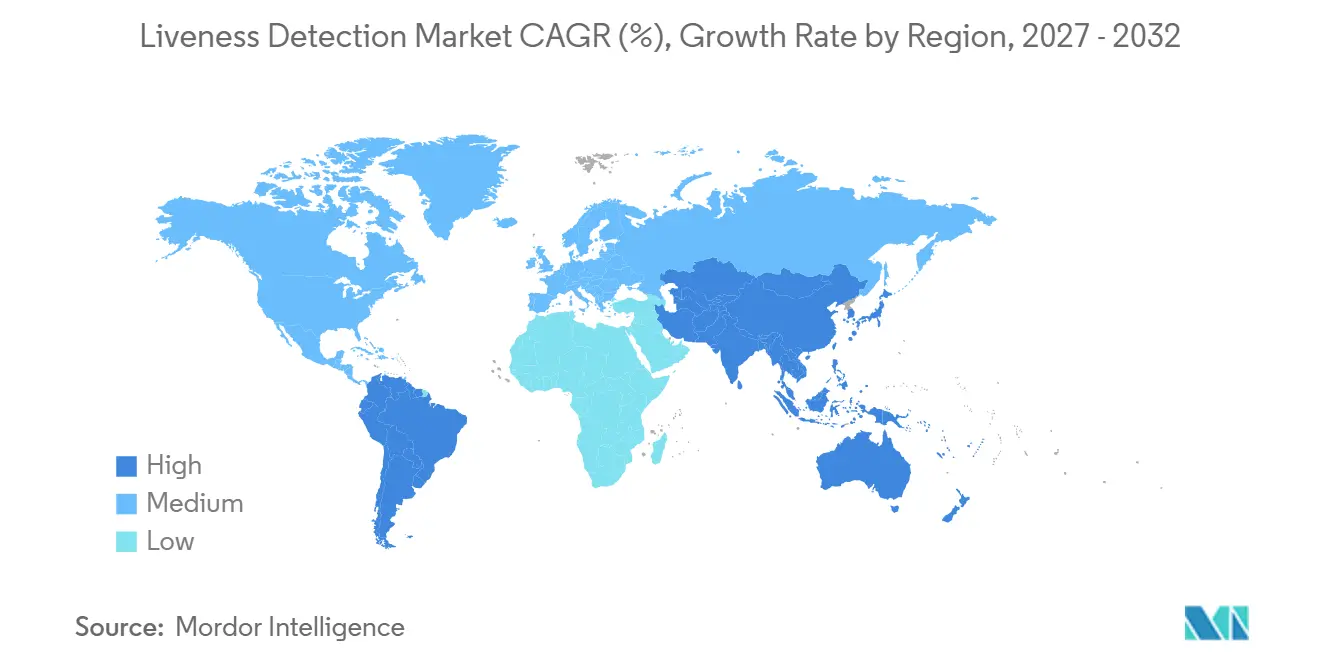
North America held 35.53% of the global liveness detection market in 2026. The United States is the main volume driver across BFSI, government, and technology-platform applications. The US Department of Homeland Security’s October 2025 rule extended biometric collection to all aliens at airport, land, and seaport departure points.[4] Canada’s provincial digital identity programs and Mexico’s digital lending and remittance platforms broaden regional demand. Jumio, iProov, FaceTec, Veriff, Mitek, and Paravision have major commercial operations in the region, increasing price competition and encouraging buyers to select broader platform contracts.
Europe is shaped by compliance requirements that create structural demand in the Liveness Detection Market. The EES rollout at Schengen borders continued through April 2026, and the UK started its contactless eGate upgrade from October 6, 2026. eIDAS 2.0 requires EU Digital Identity Wallets to meet High assurance for AML onboarding by 2027. The UK Digital Identity Sectoral Analysis Report 2026 found that providers offering biometrics and liveness detection increased from 45% to 57%, while IDEMIA, Thales, Veriff, and FacePhi Biometria address government and commercial opportunities.
Asia-Pacific is projected to expand at a 24.50% CAGR from 2027 to 2032, the highest regional rate. India’s Aadhaar scale, China’s required architecture upgrades, Japan’s 2027 IC chip mandate, and Southeast Asian financial inclusion programs are increasing digital onboarding volumes. China’s 2026 clarification under GA/T 1723.3 requires 3D liveness and anti-deepfake algorithms in financial, government, and border applications rather than 2D RGB recognition. NEC’s privacy-preserving face authentication, NTT DATA’s CAFIS passkey service, and GMO Aozora Net Bank’s biometric account security deployment show institutional investment in Japan’s identity verification systems. Saudi Arabia, the UAE, Brazil, South Africa, Nigeria, and Kenya reflect different stages of adoption, with infrastructure and device diversity limiting progress in some African markets.
Competitive Landscape
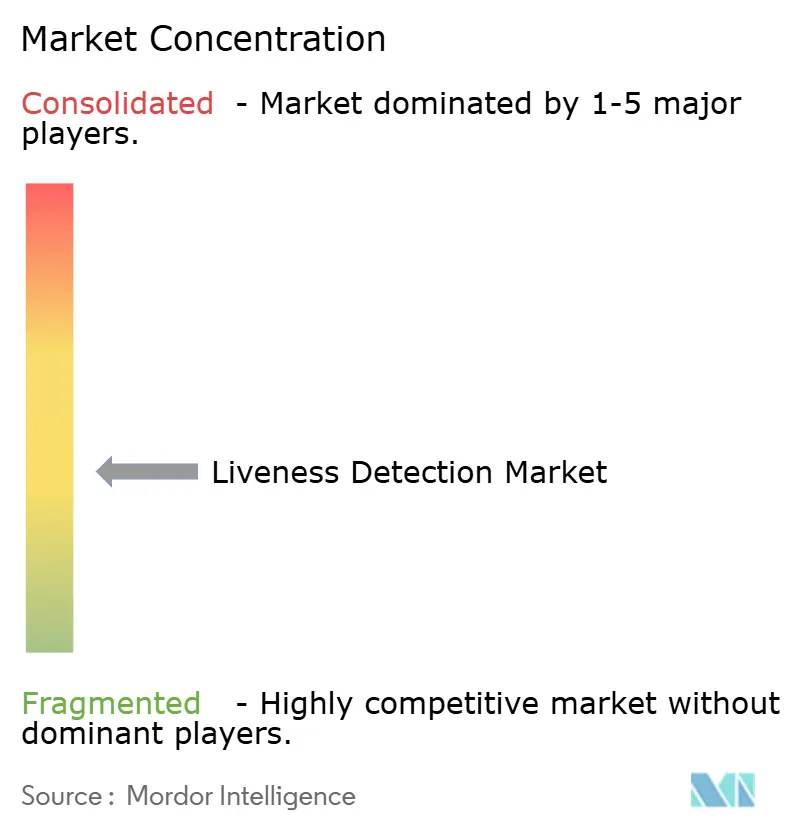
The Liveness Detection Market is moderately fragmented at the product level but is becoming more consolidated at the identity-platform level. Entrust completed its USD 400 million acquisition of Onfido in April 2025, while LexisNexis Risk Solutions acquired IDVerse in February 2025, showing why enterprise distribution relationships can outweigh a stand-alone liveness interface. Specialist providers must still demonstrate strong security performance to remain attractive partners or acquisition targets. The combination of large platforms, focused specialists, and embedded hardware vendors keeps the competitive field broad. Buyers increasingly favor vendors that combine liveness, document review, fraud signals, and compliance processes in one service.
Third-party certification is an important basis for competition among specialist providers. ISO/IEC 30107-3 testing, emerging CEN/TS 18099 expectations, and NIST 800-63-4 give buyers common ways to assess presentation and injection attack resistance. This provides government and regulated-enterprise buyers with a clear initial product filter. Certification can raise entry barriers because smaller firms may lack the resources for repeated testing and adversarial research. Verified performance is therefore more meaningful than vendor accuracy claims that have not been independently assessed.
Workforce verification, edge-native liveness, and reusable identity are drawing simultaneous vendor activity in the Liveness Detection Market. Microchip Technology demonstrated a single-camera, on-device facial recognition and liveness solution in July 2026 for sovereignty-sensitive critical infrastructure applications. Jumio’s selfie.DONE rollout and Sumsub’s October 2026 reusable KYC gateway enable a certified identity event to be reused across regulated services. ISO/IEC 18013-5-based interoperability could reduce the distinctiveness of proprietary liveness interfaces over a five-to-seven-year period, increasing the value of workflow integration, distribution, and certified performance.
Liveness Detection Industry Leaders
-
NEC Corporation
-
Thales S.A.
-
Jumio Corporation
-
Daon, Inc.
-
FaceTec, Inc.
- *Disclaimer: Major Players sorted in no particular order
Recent Industry Developments
- October 2026: Sumsub launched a reusable KYC gateway on October 7, 2026, enabling verified identity credentials from a single compliance check to be reused across multiple regulated platforms. The solution reduces per-onboarding friction for consumers and lowers compliance cost for enterprises managing multi-product ecosystems, advancing a portable identity model that competes with per-session liveness API economics.
- July 2026: Microchip Technology demonstrated a secure edge AI facial recognition and single-camera liveness detection solution at the 2026 Embedded Vision Summit, running entirely on-device on a Microchip MPU without cloud dependency. The demonstration addressed data-sovereignty and latency requirements for critical-infrastructure access control that cloud-first vendors cannot serve without architectural redesign.
- April 2026: Veriff achieved the FIDO Alliance Document Authenticity Certification for its Full Auto Identity Verification solution on April 22, 2026, covering 19 document types from 12 countries without human intervention, positioning Veriff among the first global identity verification providers to meet this standard.
- March 2026: iProov launched its Workforce Solutions Suite and iProov Verified Meetings, delivering genuine human presence verification for enterprise hiring, high-risk account recovery, and video-call participant authentication, with real-time detection of deepfake and injection attacks in live video streams.
Global Liveness Detection Market Report Scope
Liveness detection is a biometric security technique that verifies whether a facial photo originates from a live human being rather than a spoofed representation, such as a mask, photo, or video. By serving as a live-presence filter, it mitigates biometric fraud before a sample is trusted. Organizations can deploy active liveness detection for high-risk verification flows or passive liveness detection to minimize user friction in lower-risk scenarios.
The Liveness Detection Market Report is Segmented by Components (Software, Hardware-Embedded Modules, and Services), Detection Method (Passive Liveness Detection, Active Liveness Detection, and Hybrid Liveness Detection), Biometric Modality (Face Liveness Detection, Fingerprint Liveness Detection, Iris Liveness Detection, Voice Liveness Detection, and Multimodal Liveness Detection), Deployment Mode (Cloud-Based, On-Premises, and Hybrid Cloud), Application (Remote Identity Verification and eKYC, Access Control and Continuous Authentication, Payment Authentication, Account Recovery and High-Risk Transaction Verification, Border Control, Immigration, and eVisa, and Other Applications), End-user Industry (BFSI, Government and Defense, Healthcare and Life Sciences, Retail and E-commerce, Telecommunications, Travel and Transport, and Other End-user Industries), and Geography (North America, South America, Europe, Asia-Pacific, Middle East, and Africa). The Market Forecasts are Provided in Terms of Value (USD).
| Software |
| Hardware-Embedded Modules |
| Services |
| Passive Liveness Detection |
| Active Liveness Detection |
| Hybrid Liveness Detection |
| Face Liveness Detection |
| Fingerprint Liveness Detection |
| Iris Liveness Detection |
| Voice Liveness Detection |
| Multimodal Liveness Detection |
| Cloud-Based |
| On-Premises |
| Hybrid Cloud |
| Remote Identity Verification and eKYC |
| Access Control and Continuous Authentication |
| Payment Authentication |
| Account Recovery and High-Risk Transaction Verification |
| Border Control, Immigration, and eVisa |
| Other Applications |
| BFSI |
| Government and Defense |
| Healthcare and Life Sciences |
| Retail and E-commerce |
| Telecommunications |
| Travel and Transport |
| Other End-user Industries |
| North America | United States |
| Canada | |
| Mexico | |
| South America | Brazil |
| Argentina | |
| Rest of South America | |
| Europe | Germany |
| United Kingdom | |
| France | |
| Italy | |
| Spain | |
| Rest of Europe | |
| Asia-Pacific | China |
| India | |
| Japan | |
| South Korea | |
| Australia | |
| Rest of Asia-Pacific | |
| Middle East | Saudi Arabia |
| United Arab Emirates | |
| Turkey | |
| Rest of Middle East | |
| Africa | South Africa |
| Nigeria | |
| Egypt | |
| Rest of Africa |
| By Component | Software | |
| Hardware-Embedded Modules | ||
| Services | ||
| By Detection Method | Passive Liveness Detection | |
| Active Liveness Detection | ||
| Hybrid Liveness Detection | ||
| By Biometric Modality | Face Liveness Detection | |
| Fingerprint Liveness Detection | ||
| Iris Liveness Detection | ||
| Voice Liveness Detection | ||
| Multimodal Liveness Detection | ||
| By Deployment Mode | Cloud-Based | |
| On-Premises | ||
| Hybrid Cloud | ||
| By Application | Remote Identity Verification and eKYC | |
| Access Control and Continuous Authentication | ||
| Payment Authentication | ||
| Account Recovery and High-Risk Transaction Verification | ||
| Border Control, Immigration, and eVisa | ||
| Other Applications | ||
| By End-user Industry | BFSI | |
| Government and Defense | ||
| Healthcare and Life Sciences | ||
| Retail and E-commerce | ||
| Telecommunications | ||
| Travel and Transport | ||
| Other End-user Industries | ||
| By Geography | North America | United States |
| Canada | ||
| Mexico | ||
| South America | Brazil | |
| Argentina | ||
| Rest of South America | ||
| Europe | Germany | |
| United Kingdom | ||
| France | ||
| Italy | ||
| Spain | ||
| Rest of Europe | ||
| Asia-Pacific | China | |
| India | ||
| Japan | ||
| South Korea | ||
| Australia | ||
| Rest of Asia-Pacific | ||
| Middle East | Saudi Arabia | |
| United Arab Emirates | ||
| Turkey | ||
| Rest of Middle East | ||
| Africa | South Africa | |
| Nigeria | ||
| Egypt | ||
| Rest of Africa | ||
Key Questions Answered in the Report
What is the size of the Liveness Detection Market?
The Liveness Detection Market is projected at USD 1.99 billion in 2027 and is forecast to reach USD 5.03 billion by 2032, at a 20.38% CAGR from 2027 to 2032.
What is driving demand for liveness detection solutions?
KYC and AML requirements, increasing deepfake and injection attacks, digital payment authentication, and public-sector identity programs are supporting demand.
Which liveness detection method is expanding the fastest?
Passive liveness detection leads the detection method segment and is projected to expand at a 23.34% CAGR through 2032.
Which business users are adopting liveness verification most rapidly?
Retail and e-commerce is projected to expand at a 25.10% CAGR through 2032 as platforms address account takeover and buyer-seller fraud.
Which region has the strongest projected expansion?
Asia-Pacific is projected to expand at a 24.50% CAGR through 2032, supported by digital identity programs and financial onboarding activity.
Why are hybrid deployment models important for biometric verification?
Hybrid models retain selected processing locally while using cloud services for threat intelligence and updates, helping organizations balance data control, performance, and adaptability.