
Liquorice Shellac Market Size and Share
Market Overview
| Study Period | 2021 - 2031 |
|---|---|
| Market Size (2026) | USD 1.11 Billion |
| Market Size (2031) | USD 1.36 Billion |
| Growth Rate (2026 - 2031) | 4.15 % |
| Fastest Growing Market | Asia-Pacific |
| Largest Market | Asia-Pacific |
| Market Concentration | Low |
Major Players *Disclaimer: Major Players sorted in no particular order Image © Mordor Intelligence. Reuse requires attribution under CC BY 4.0. | |
Liquorice Shellac Market Analysis by Mordor Intelligence
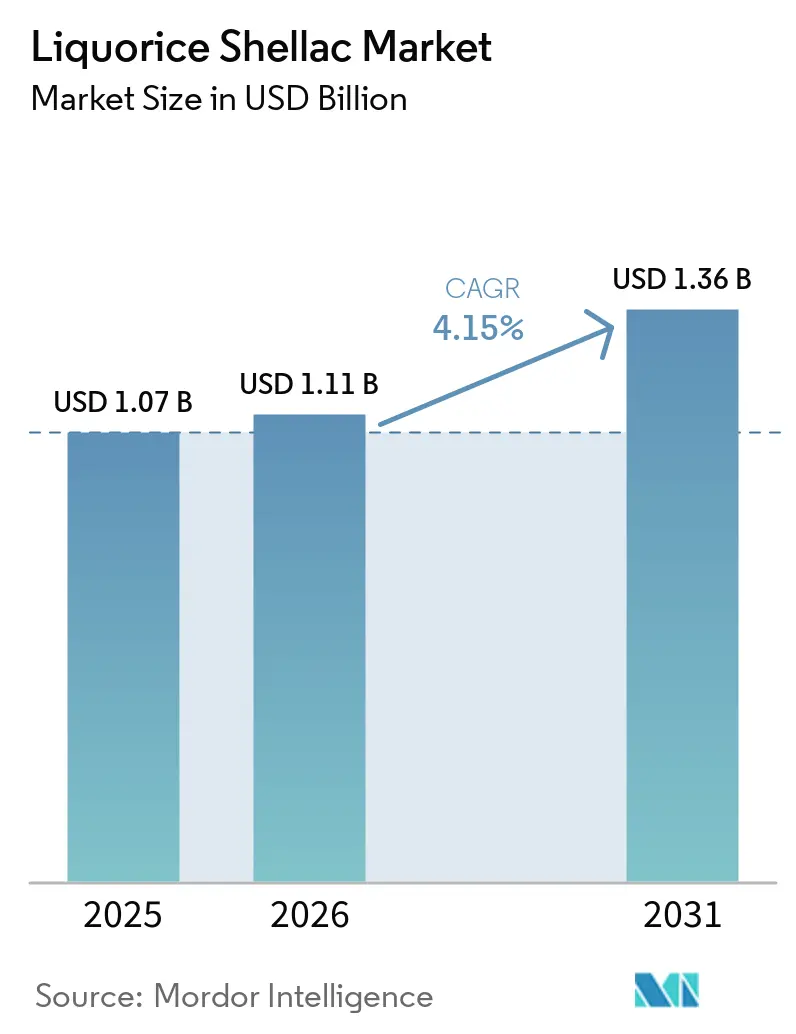
The liquorice shellac market was valued at USD 1.07 billion in 2025 and is projected to grow from USD 1.11 billion in 2026 to USD 1.36 billion by 2031, registering a CAGR of 4.15% during the forecast period (2026-2031). Market growth is supported by the use of shellac as a glazing agent in food products and an enteric coating for tablets. Shellac is approved as a food additive E904 under European food additive regulations, while its inclusion in Food and Drug Administration ingredient listings supports its use in regulated formulations. Although food coatings represent a substantial demand base, pharmaceutical-grade shellac presents stronger growth opportunities due to customer requirements for documented quality and regulatory compliance. However, demand for insect-derived coatings faces pressure from the growing popularity of vegan food products, particularly in Europe and North America, which is shifting market demand toward pharmaceutical applications, specialty foods, and selected industrial uses where performance and compliance outweigh concerns about ingredient origin.
Key Report Takeaways
- By form, dry shellac held 63.57% of the global market share in 2025, while liquid shellac is forecast to grow at a 5.21% CAGR through 2031.
- By grade, food grade held 47.03% of the global market share in 2025, while pharmaceutical grade is forecast to grow at a 5.47% CAGR through 2031.
- By application, food and beverages accounted for 49.11% of the liquorice shellac market size in 2025, while pharmaceuticals are forecast to grow at a CAGR of 5.13% through 2031.
- By geography, Asia-Pacific held 38.25% of the global market share in 2025 and is forecast to grow at a CAGR of 5.34% through 2031.
Note: Market size and forecast figures in this report are generated using Mordor Intelligence’s proprietary estimation framework, updated with the latest available data and insights as of January 2026.
Market Trends and Insights
Drivers Impact Analysis of Liquorice Shellac Market*
| Driver | (~) % Impact on CAGR Forecast | Geographic Relevance | Impact Timeline |
|---|---|---|---|
| Growing confectionery and premium food consumption | +1.0% | Global, with concentration in North America, Europe, and urban Asia-Pacific | Medium term (2–4 years) |
| Rising demand for natural and clean-label food ingredients | +0.8% | North America and Europe core; spill-over to Asia-Pacific and Middle East | Medium term (2–4 years) |
| Growth of pharmaceutical production and tablet coating applications | +0.7% | Global, with Asia-Pacific core (India, China, Japan) and North America | Short to medium term (≤ 4 years) |
| Adoption of bio-based coating alternatives | +0.5% | Europe and North America primarily | Long term (≥ 4 years) |
| Expansion of wood finishing and natural coating applications | +0.3% | Europe, North America, and Asia-Pacific | Long term (≥ 4 years) |
| Increasing demand for functional food coatings | +0.3% | Global, with early gains in Europe, North America, and East Asia | Medium term (2–4 years) |
| Source: Mordor Intelligence | |||
Growing Confectionery and Premium Food Consumption
Growing confectionery consumption and the rising preference for premium food products support demand for food-grade shellac in the United States. According to the National Confectioners Association’s State of Treating 2026, 99.8% of United States households purchased confectionery at least once in 2025, highlighting the category’s broad consumer penetration[1]. This widespread consumption increases the use of shellac as a glazing and protective coating for chocolate confectionery, chewing gum, sugar-coated candies, lozenges, and coated nuts. Moreover, consumer demand for premium, visually appealing confectionery products drives the adoption of shellac, as it provides a smooth, glossy finish while improving surface protection, thereby creating a favorable demand outlook for the liquorice shellac market.
Rising Demand for Natural and Clean-Label Food Ingredients
Consumer perceptions of healthy food increasingly depend on the use of simple, recognizable, and naturally derived ingredients, which supports demand for natural food ingredients and coatings. According to the International Food Information Council Food & Health Survey 2025, 25% of Americans consider food healthier when it contains limited or no artificial ingredients or preservatives, while 24% associate healthfulness with foods labeled as natural[2]. These preferences strengthen the appeal of bio-sourced shellac as a glazing and protective coating, particularly in confectionery, fruits, vegetables, and nuts, where it enhances surface appearance, provides a glossy finish, and helps protect products during handling and distribution. However, because shellac is derived from insects, its use may face limitations in vegan and plant-based product categories, where consumers increasingly seek animal-free and plant-based ingredient alternatives.
Growth of Pharmaceutical Production and Tablet Coating Applications
The expansion of pharmaceutical manufacturing is increasing the use of shellac in tablet and capsule coating applications, where it provides critical functional benefits such as moisture resistance, taste masking, improved appearance, and enteric-release properties. According to the India Brand Equity Foundation (IBEF), the Indian pharmaceutical market stood at Rs. 4,97,000 crore (USD 57.61 billion) in 2025, underscoring the substantial scale of pharmaceutical production and consumption in one of the world’s major shellac-producing countries[3]. As pharmaceutical companies increasingly prioritize high-quality coating materials that improve product stability, control drug release, and enhance patient compliance, the growing pharmaceutical industry is expected to support demand for quality-controlled shellac grades, particularly for use in regulated tablet and capsule coating applications.
Adoption of Bio-Based Coating Alternatives
Rising demand for sustainable and bio-based coating solutions is prompting manufacturers to adopt alternatives to conventional petroleum-derived materials, thereby increasing competitive pressure on shellac in wood finishing and coating applications. Renewable raw materials, including cellulose, lignin, vegetable oils, and other plant-based substances, are increasingly being incorporated into coating formulations that offer moisture resistance, UV protection, durability, and lower environmental impact. While shellac continues to provide effective film-forming, adhesive, gloss-enhancing, and protective characteristics, the growing availability of bio-based coating technologies gives manufacturers a broader range of formulation options for wood furniture, flooring, and decorative finishes. This trend is particularly significant in wood coatings, where cost, durability, and sustainability requirements are driving material substitution. However, shellac maintains a stronger position in established food and pharmaceutical applications, where its functional performance, natural origin, and ability to meet specific regulatory and quality requirements continue to support its use.
Restraints Impact Analysis of Liquorice Shellac Market*
| Restraint | (~) % Impact on CAGR Forecast | Geographic Relevance | Impact Timeline |
|---|---|---|---|
| Availability and price volatility of raw materials | -0.7% | Global supply chain; acutely felt in Europe, North America, and Japan as import-dependent markets | Short to medium term (≤ 4 years) |
| Competition from synthetic and alternative coating materials | -0.5% | North America, Europe and Asia-Pacific | Medium term (2–4 years) |
| Regulatory restrictions on food and pharmaceutical applications | -0.3% | Europe and North America primarily | Short term (≤ 2 years) |
| Concerns regarding animal origin | -0.4% | Europe and North America, with emerging relevance in urban Asia-Pacific | Medium to long term (2–4 years+) |
| Source: Mordor Intelligence | |||
Availability and Price Volatility of Raw Materials
The liquorice shellac market faces significant supply-side and pricing risks due to its dependence on raw lac, which is primarily sourced from major producing countries, including India, Thailand, and China. Raw lac production relies on the Kerria lacca insect and suitable host trees, making the availability of this key input susceptible to changes in weather patterns, crop cycles, pest activity, and broader environmental conditions. Such factors can disrupt harvesting volumes and create volatility in raw-material supply. In India, open-market lac prices ranged from INR 700 to INR 800 per kg during 2024–2025, placing additional cost pressure on shellac processors and manufacturers. Fluctuations in raw-lac prices can increase production costs, complicate procurement planning, and reduce profit margins, particularly for companies that rely heavily on sourcing from a limited number of regional suppliers.
Concerns Regarding Animal Origin
Shellac is derived from the resinous secretion of the Kerria lacca insect, which can restrict its use in vegan, vegetarian, and certain plant-based food products, as these consumer groups increasingly favor ingredients perceived as animal-free and sustainably sourced. This limitation is particularly relevant for food and confectionery manufacturers seeking to develop clean-label, vegan-certified, or plant-based product formulations. Depending on application requirements, manufacturers may use alternatives such as carnauba wax or gum acacia for vegan products, while beeswax may serve as an alternative in non-vegan formulations. The restraint is particularly significant in North American and European confectionery markets, where demand for vegan and animal-free products continues to increase. However, its impact is comparatively lower in pharmaceutical and industrial applications, where manufacturers prioritize functional performance, regulatory compliance, moisture resistance, gloss, and coating properties over vegan or plant-based positioning.
*Our forecasts treat driver/restraint impacts as directional, not additive. The impact forecasts reflect baseline growth, mix effects, and variable interactions.
Liquorice Shellac Market Segment Analysis
By Form:
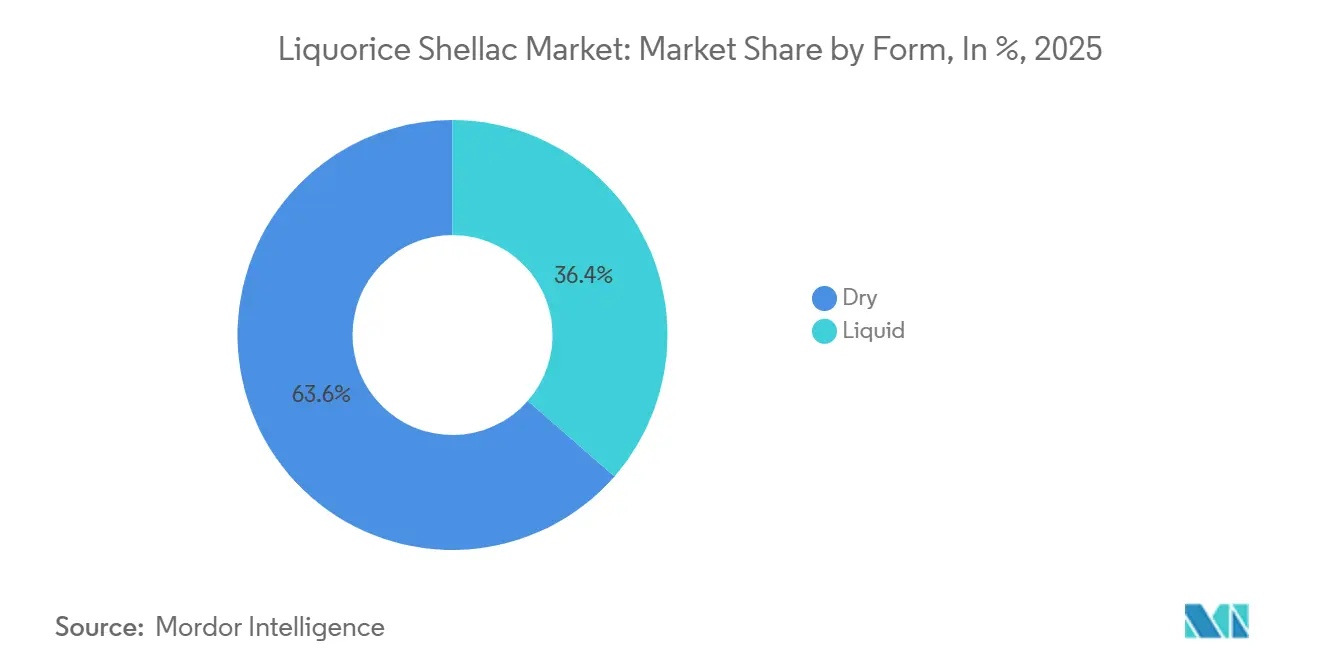
Dry Shellac’s Handling Advantages Support Industrial Supply ChainsDry shellac dominated the liquorice shellac market, accounting for 63.57% of the market share in 2025, owing to its extensive use in food glazing, pharmaceutical coatings, and industrial applications. Its stability, ease of storage, and efficient transportation make it a preferred format for manufacturers across end-use industries. Dry shellac also offers formulation flexibility, enabling its use in a range of coating and protective applications. These advantages continue to support its strong adoption among food, pharmaceutical, and industrial product manufacturers.
Liquid shellac is projected to expand at a CAGR of 5.21% through 2031, driven by rising demand for ready-to-use coating solutions and convenient application across food, pharmaceutical, cosmetic, and wood-finishing applications. Food-grade shellac holds a significant market share due to its use as a glazing and protective coating for confectionery, bakery products, fruits, vegetables, and nuts. Pharmaceutical-grade shellac is expected to benefit from increasing pharmaceutical production and demand for effective tablet and capsule coating materials, while industrial-grade shellac remains important for applications requiring protective and film-forming properties. Growing preference for naturally derived coating materials is expected to support demand across all three grades.
By Grade:
Pharmaceutical Grade Gains From Tighter Quality RequirementsFood grade shellac accounted for 47.03% of the Global Liquorice Shellac Market in 2025, supported by its widespread use as a glazing and protective coating in confectionery, bakery products, fruits, vegetables, and nuts. Its natural origin and ability to provide a glossy finish make it suitable for improving the visual appeal of food products. Food manufacturers also use shellac to protect products from moisture and enhance their stability during storage. Growing demand for natural and functional food coatings is expected to support the segment’s continued market presence.
Pharmaceutical grade shellac is projected to grow at a CAGR of 5.47% through 2031, making it the fastest-growing grade segment. The segment benefits from increasing pharmaceutical production and rising demand for effective tablet and capsule coating materials. Shellac provides moisture protection, taste masking, and film-forming properties, which support its use in oral solid dosage formulations. Expanding requirements for high-quality, compliant coating solutions in the pharmaceutical industry are expected to further drive demand for pharmaceutical grade shellac.
By Application:
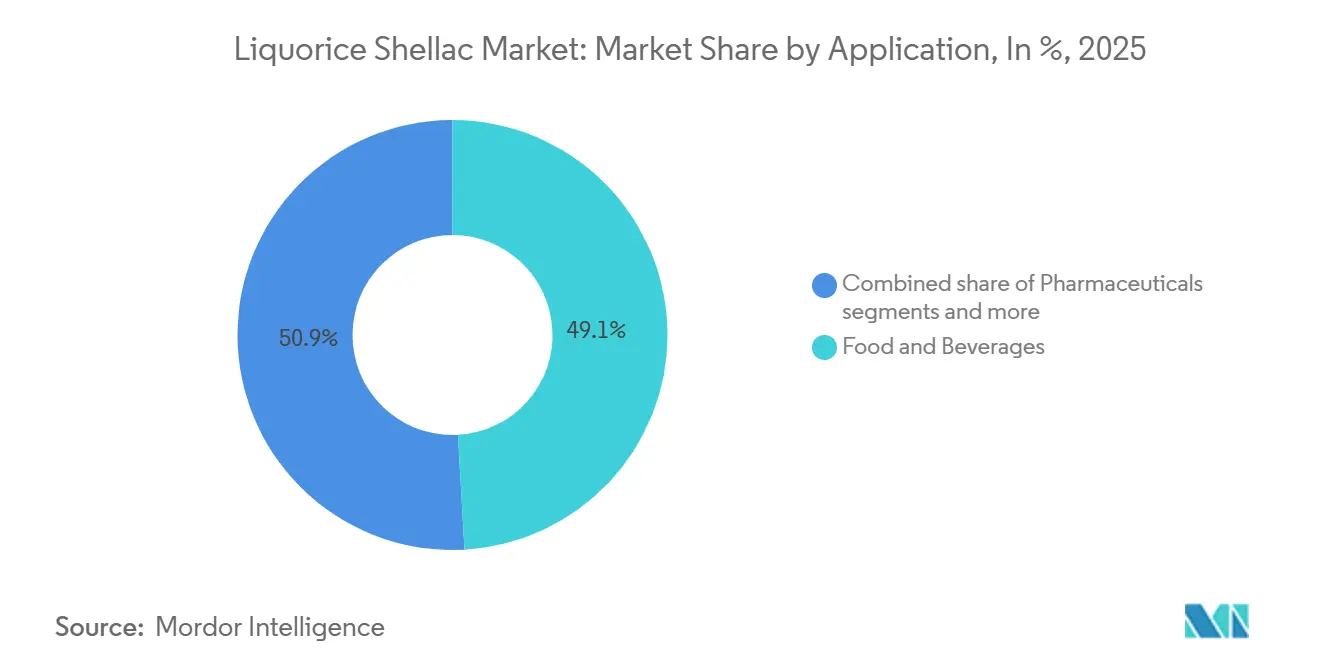
Food and Beverages Provide Volume While Pharmaceuticals Add ValueFood and beverages accounted for 49.11% of the Global Liquorice Shellac Market in 2025, supported by the extensive use of shellac as a glazing and protective coating across confectionery, bakery products, fruits, vegetables, and nuts. Manufacturers use shellac to create an attractive, glossy finish and enhance the visual appeal of food products. Its protective properties also help maintain surface quality and improve product stability during storage and distribution. Growing demand for naturally derived food coatings is expected to further support segment growth.
Pharmaceuticals are projected to be the fastest-growing application segment, expanding at a CAGR of 5.13% through 2031. The segment’s growth is driven by rising pharmaceutical production and increasing use of shellac in tablet and capsule coating formulations. Shellac provides effective film-forming, moisture-protective, and taste-masking properties that support product stability and performance. The increasing demand for reliable coating materials in oral solid dosage forms is expected to drive adoption across the pharmaceutical industry.

Geography Analysis
APAC Liquorice Shellac Market
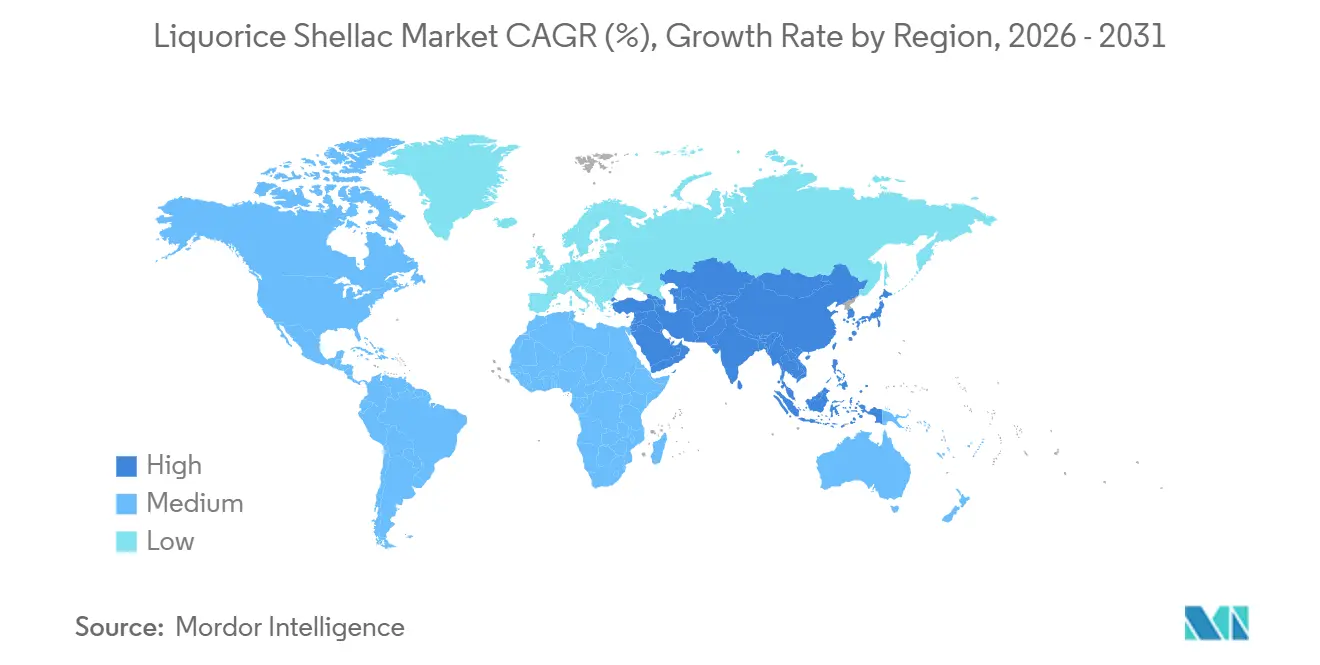
Asia-Pacific accounted for 38.25% of the Global Liquorice Shellac Market in 2025 and is projected to register the fastest CAGR of 5.3% through 2031. The region remains a major source of raw lac and refined shellac, supported by significant production and processing activities in India, Thailand, and China. Strong availability of raw materials and established processing infrastructure continue to strengthen the region’s position in the global market. Expanding food processing and pharmaceutical manufacturing activities further support regional demand for liquorice shellac.
South and East Asia Liquorice Shellac Market
India, Thailand, and China play critical roles in the regional supply chain through raw lac cultivation, shellac refining, and exports to international markets. The region’s established refining capabilities enable manufacturers to supply food- and pharmaceutical-grade shellac for a range of end-use applications. Growing demand for confectionery coatings, bakery products, tablets, and capsules is also contributing to higher consumption. Rising investments in food processing and pharmaceutical production are expected to sustain market growth across Asia-Pacific.
The Americas and EMEA Liquorice Shellac Market
North America and Europe remain important demand centers for food- and pharmaceutical-grade liquorice shellac, driven by established food processing and pharmaceutical industries. Demand in these regions is supported by the use of shellac in confectionery coatings, bakery products, tablets, and capsules, as well as specialty applications. South America, the Middle East, and Africa represent smaller but developing markets, with growth supported by food processing, pharmaceuticals, cosmetics, and specialty coatings. However, lower production capacity and developing specialty-ingredient distribution networks continue to limit market penetration relative to Asia-Pacific, North America, and Europe.
Competitive Landscape
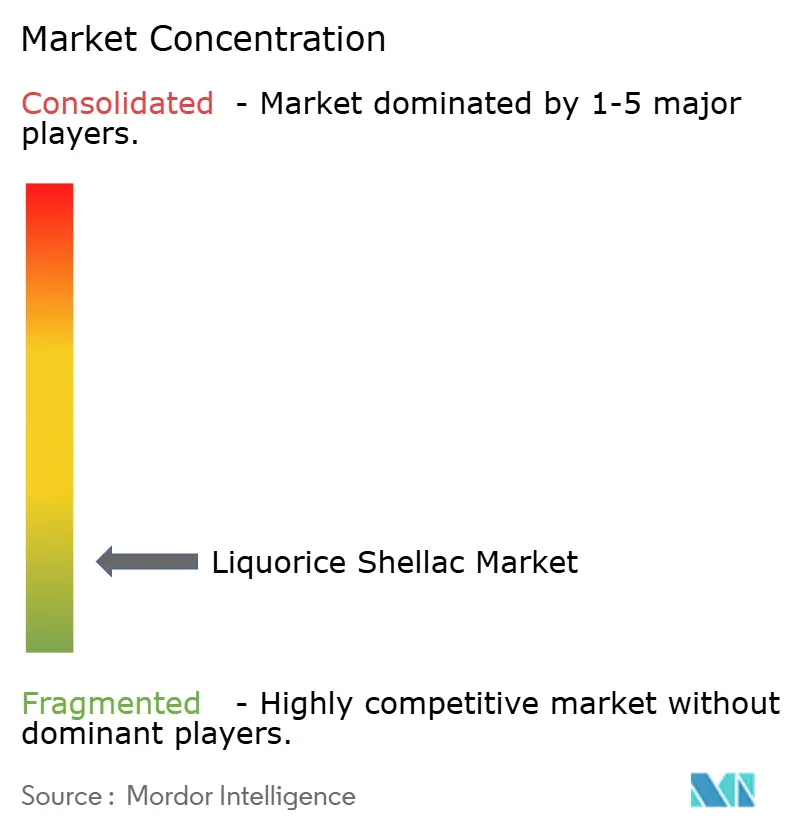
The global liquorice shellac market is highly fragmented, with competition involving specialized shellac manufacturers, processors, and suppliers serving food, pharmaceutical, nutraceutical, and technical applications. Companies differentiate their offerings through product quality, grade availability, processing capabilities, raw material sourcing, and compliance with applicable food and pharmaceutical regulations. D. Manoharlal (Shellac) Pvt. Ltd. maintains a strong competitive position through its extensive portfolio of shellac products and its proximity to major lac-producing regions in India. This geographic advantage supports efficient raw material procurement, manufacturing operations, and supply reliability for domestic and international customers.
Aadhya International competes through its diversified shellac offerings and presence in international markets, catering to requirements across multiple end-use industries. Vishnu Shellac Factory and Mahabir Shellac Factory also contribute to the competitive landscape through their manufacturing capabilities and focus on supplying shellac products for a range of application requirements. Stroever GmbH & Co. KG (SSB Stroever) differentiates itself by its specialized portfolio of pharmaceutical-grade shellac. Its products support applications such as enteric coating, controlled-release formulations, taste masking, and moisture protection, enabling the company to address the technical requirements of pharmaceutical and nutraceutical manufacturers.
Overall, companies in the liquorice shellac market increasingly compete on factors beyond price, including consistent product quality, supply reliability, regulatory compliance, technical expertise, and application-specific performance. Customers in food and pharmaceutical applications require shellac products that meet stringent safety, quality, and functional standards, increasing the importance of specialized processing and quality assurance capabilities. Established suppliers with reliable sourcing networks, efficient manufacturing infrastructure, and the ability to provide customized shellac solutions are better positioned to strengthen their market presence and maintain long-term customer relationships.
Liquorice Shellac Industry Leaders
-
D. Manoharlal (Shellac) Pvt. Ltd.
-
Aadhya International
-
Vishnu Shellac Factory
-
Mahabir Shellac Factory
-
Stroever GmbH & Co. KG (SSB Stroever)
- *Disclaimer: Major Players sorted in no particular order
Liquorice Shellac Market Companies Covered in this Report
- D. Manoharlal (Shellac) Pvt. Ltd.
- Aadhya International
- Vishnu Shellac Factory
- Mahabir Shellac Factory
- Gupta Brothers (Shellac)
- Prakash Shellacs Factory
- Hind Suter Shellac
- Stroever GmbH & Co. KG (SSB Stroever)
- Chuxiong DES Shellac Co., Ltd.
- Kunming Forest Products Chemical Co., Ltd.
- Gifu Shellac Manufacturing Co., Ltd.
- Tajna Shellac Pvt. Ltd.
- Jagdamba Lac Factory
- Shri Gopal Shellac Industries
- The Japan Shellac Industries, Ltd.
- Tolaram Overseas Corporation
- Tawheed Usmani Production Co. Ltd.
- Creasia Group
- Excom Europe Ltd.
- Ferrotex Ltd.
Recent Industry Developments in Liquorice Shellac Market
- January 2026: The EU Commission published Regulation (EU) 2026/189, formally expanding shellac's (E 904) authorization as a glazing agent to food for special medical purposes in tablet and coated tablet forms, with a maximum use level of 46,000 mg/kg. This regulatory milestone opens a previously restricted medical nutrition niche to shellac suppliers qualified to Ph.Eur. and USP standards and signals continued institutional confidence in shellac's safety profile for sensitive applications.
- June 2026: Zhenkang County, Yunnan Province, China, reported the expansion of lac cultivation to over 110 acres with more than 80 participating farmer households, as part of a provincial bioeconomy and rural revitalization program. The 2025 shellac purchase price in the county reached a maximum of CNY 50 per jin, compared to a stable baseline of CNY 30 per jin, materially above traditional crop economics.
- August 2024: EFSA published its re-evaluation of shellac (E 904) as a food additive, establishing an acceptable daily intake of 4 mg/kg body weight per day for wax-free, physically decolorized shellac. The opinion also recommended revising additive specifications to separate chemically bleached from physically decolorized shellac, lower maximum lead limits, and collect data on organochlorine impurities.
Global Liquorice Shellac Market Report Scope
Liquorice shellac is a naturally derived coating and glazing material with film-forming, gloss-enhancing, moisture-resistant, and protective properties, which supports its use across food, pharmaceutical, cosmetic, and industrial applications. The Global Liquorice Shellac Market is segmented by form into dry and liquid; by grade into food grade, pharmaceutical grade, and industrial grade; and by application into food and beverages, pharmaceuticals, cosmetics and personal care, wood finishes and coatings, and others. Within food and beverages, the market includes confectionery coatings, bakery coatings, fruit and vegetable coatings, nuts and seeds coatings, and others, while pharmaceutical applications include tablet coatings, capsule coatings, and others. The study covers North America, Europe, Asia-Pacific, South America, and the Middle East & Africa, with market forecasts presented in terms of value (USD).
| Dry |
| Liquid |
| Food Grade |
| Pharmaceutical Grade |
| Industrial Grade |
| Food and Beverages | Confectionery Coatings |
| Bakery Coatings | |
| Fruit and Vegetable Coatings | |
| Nuts and Seeds Coatings | |
| Others | |
| Pharmaceuticals | Tablet coating |
| Capsule coating | |
| Others | |
| Cosmetics and Personal Care | |
| Wood Finishes and Coatings | |
| Others |
| North America | United States |
| Canada | |
| Mexico | |
| Rest of North America | |
| Europe | Germany |
| United Kingdom | |
| Italy | |
| France | |
| Spain | |
| Rest of Europe | |
| Asia-Pacific | China |
| Japan | |
| India | |
| Australia | |
| Rest of Asia-Pacific | |
| South America | Brazil |
| Argentina | |
| Rest of South America | |
| Middle East and Africa | South Africa |
| Saudi Arabia | |
| Rest of Middle East and Africa |
| By Form | Dry | |
| Liquid | ||
| By Grade | Food Grade | |
| Pharmaceutical Grade | ||
| Industrial Grade | ||
| By Application | Food and Beverages | Confectionery Coatings |
| Bakery Coatings | ||
| Fruit and Vegetable Coatings | ||
| Nuts and Seeds Coatings | ||
| Others | ||
| Pharmaceuticals | Tablet coating | |
| Capsule coating | ||
| Others | ||
| Cosmetics and Personal Care | ||
| Wood Finishes and Coatings | ||
| Others | ||
| By Geography | North America | United States |
| Canada | ||
| Mexico | ||
| Rest of North America | ||
| Europe | Germany | |
| United Kingdom | ||
| Italy | ||
| France | ||
| Spain | ||
| Rest of Europe | ||
| Asia-Pacific | China | |
| Japan | ||
| India | ||
| Australia | ||
| Rest of Asia-Pacific | ||
| South America | Brazil | |
| Argentina | ||
| Rest of South America | ||
| Middle East and Africa | South Africa | |
| Saudi Arabia | ||
| Rest of Middle East and Africa | ||
Key Questions Answered in the Report
What is the forecast growth rate for liquorice shellac through 2031?
The liquorice shellac market is forecast to grow at a CAGR of 4.15% from 2026 to 2031, reaching USD 1.36 billion.
Which form of liquorice shellac leads demand?
Dry shellac led with 63.57% share in 2025 because it offers ambient storage stability and flexible use across several coating applications.
Why is pharmaceutical-grade shellac growing faster than other grades?
Pharmaceutical grade is forecast to expand at a CAGR of 5.47% through 2031 due to enteric-coating demand and stricter quality requirements.
Which region has the largest demand for liquorice shellac?
Asia-Pacific held 38.25% share in 2025 and is forecast to grow at a CAGR of 5.34% through 2031.