
Line-Scan Industrial Camera Market Size and Share
Market Overview
| Study Period | 2020 - 2031 |
|---|---|
| Market Size (2026) | USD 6.46 Billion |
| Market Size (2031) | USD 10.12 Billion |
| Growth Rate (2026 - 2031) | 9.39 % |
| Fastest Growing Market | Asia-Pacific |
| Largest Market | Asia-Pacific |
| Market Concentration | Low |
Major Players *Disclaimer: Major Players sorted in no particular order Image © Mordor Intelligence. Reuse requires attribution under CC BY 4.0. | |
Line-Scan Industrial Camera Market Analysis by Mordor Intelligence
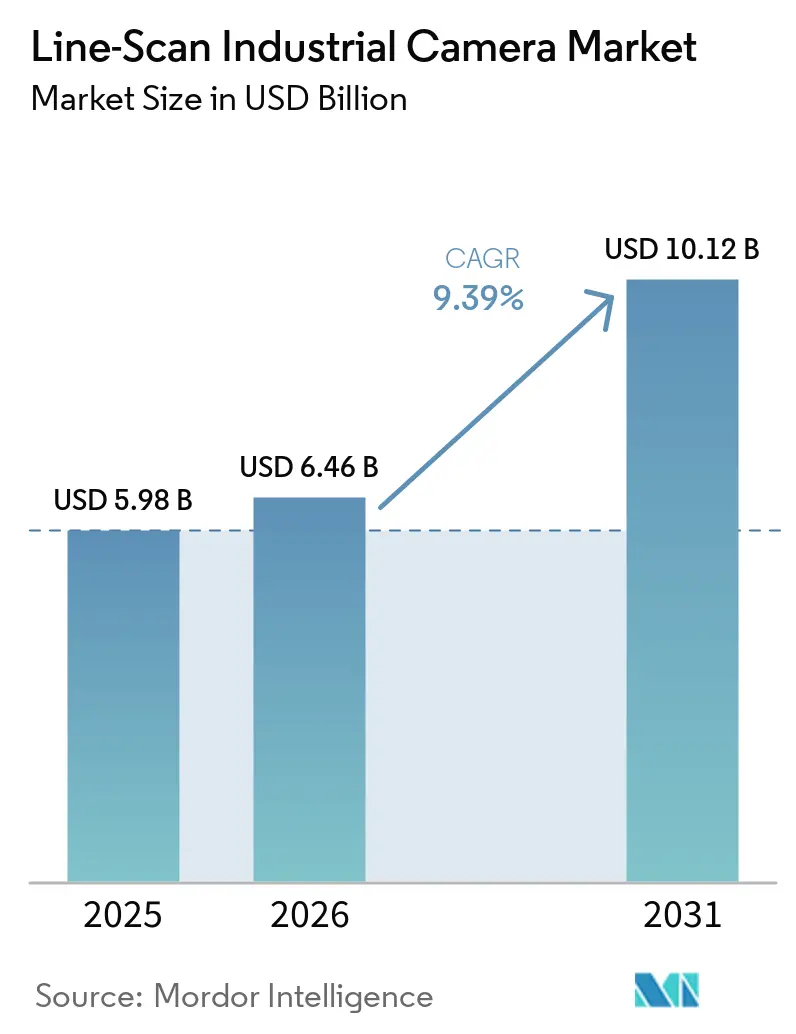
The line-scan industrial camera market size was USD 5.98 billion in 2025, and USD 6.46 billion in 2026, and is projected to reach USD 10.12 billion by 2031, expanding at a CAGR of 9.39% during 2026-2031. Manufacturing sites are moving toward continuous inspection because sampling methods do not meet tighter quality requirements in semiconductor, battery, and high-speed printing operations. This change places line-scan cameras within core production equipment rather than as peripheral inspection tools. The cost of an undetected defect is particularly high in advanced fabrication, which supports demand for dependable inspection systems. Suppliers are increasingly competing through integrated systems, software compatibility, and support for complex deployments. AI-based defect classification can increase system value, even as price competition intensifies in the camera hardware market.
Key Report Takeaways
- By product type, single-line cameras held 48.26% of the line-scan industrial camera market share in 2025, while 3D and stereo cameras are projected to expand at an 10.39% CAGR through 2031.
- By sensor architecture, CMOS cameras accounted for 72.84% of revenue in 2025, while InGaAs cameras are expected to expand at a 10.21% CAGR through 2031.
- By interface, GigE Vision and 10GigE held 38.65% of revenue in 2025, while CoaXPress and CoaXPress-over-Fiber are projected to expand at a 10.17% CAGR through 2031.
- By end-user, electronics and semiconductor applications accounted for 27.92% of revenue in 2025, while battery and energy storage are expected to expand at a 11.23% CAGR through 2031.
- By geography, Asia-Pacific held 42.18% of revenue in 2025 and is projected to expand at a 10.36% CAGR through 2031.
Note: Market size and forecast figures in this report are generated using Mordor Intelligence’s proprietary estimation framework, updated with the latest available data and insights as of January 2026.
Global Line-Scan Industrial Camera Market Trends and Insights
Drivers Impact Analysis*
| Driver | (~) % Impact on CAGR Forecast | Geographic Relevance | Impact Timeline |
|---|---|---|---|
| Semiconductor and Display Inspection Capacity Expansion | +2.3% | Global, with core demand in Asia-Pacific and additional demand in North America | Long term (≥ 4 years) |
| Industry 4.0 Adoption and Automated Quality Control | +1.8% | Global, with strong demand in Germany, China, Japan, and the United States | Medium term (2-4 years) |
| Battery Electrode and Separator Inspection Demand | +1.4% | Asia-Pacific, with further demand in Europe and North America | Medium term (2-4 years) |
| High-Speed Web Inspection Applications | +1.1% | Global, including Europe, North America, and Asia-Pacific | Short term (≤ 2 years) |
| Multispectral Imaging for Material Classification | +0.7% | North America and Europe, with early use in Asia-Pacific | Medium term (2-4 years) |
| Replacement of Aging Camera Systems | +0.5% | Global, especially Europe and North America | Short term (≤ 2 years) |
| Source: Mordor Intelligence | |||
Semiconductor and Display Inspection Capacity Expansion
New semiconductor and display capacity requires automated optical inspection at several stages of production. Line-scan cameras support wafer review, front-end inspection, and advanced packaging checks on continuous production lines. The line-scan industrial camera market benefits when new facilities move from installation to production qualification. Geographic diversification also requires suppliers to qualify systems across different process environments and local technical requirements. These requirements increase the value of suppliers with established inspection experience and support capabilities. The resulting procurement activity can continue after a facility begins production because inspection systems are adjusted as yield requirements change.
Industry 4.0 Adoption and Automated Quality Control
Manufacturers are connecting cameras to production data systems and automated control platforms. This makes image capture part of a broader quality-control process instead of a separate visual check. A 2026 systematic review found that deep learning methods are increasingly used in closed-loop manufacturing control systems for real-time quality decisions. Buyers assess compatibility with edge processing, communication protocols, manufacturing execution systems, and established factory automation environments. IDS demonstrated this direction in 2025 through an AI-powered camera network for automotive component surface inspection. Consequently, the line-scan industrial camera market can reach manufacturers outside the semiconductor and battery sectors.
Battery Electrode and Separator Inspection Demand
Battery cell production requires continuous inspection of electrode coatings and separator materials. Production lines need to identify defects, alignment issues, and contamination before materials move into later stages. This need increases demand for cameras because manual sampling cannot cover the entire web at commercial production speeds. Basler describes line-scan vision systems for electrode-web inspection and separator-foil verification in battery cell production.[1]Basler AG, “Vision Solutions for Battery Cell Manufacturing,” Basler AG, baslerweb.com. A single camera platform can support more than 1 inspection stage, which increases camera requirements within each plant. The line-scan industrial camera market, therefore, benefits from quality requirements that persist after initial battery factory construction.
High-Speed Web Inspection Applications
Printing, packaging, paper, textiles, and photovoltaic films remain important applications for continuous inspection. Higher web speeds and resolution requirements can make installed camera systems inadequate. CoaXPress 2.0 supports data transmission configurations that are designed for high-resolution camera systems and demanding industrial environments. IMAGO Technologies introduced its Vision CAM LM2 in 2025 with a 250 kHz line rate and embedded processing for on-camera deep learning. Facilities that replace older systems may need to update cameras, cabling, interfaces, and processing hardware together. This favors providers that can support the complete inspection system rather than only the camera.
Restraints Impact Analysis*
| Restraint | (~) % Impact on CAGR Forecast | Geographic Relevance | Impact Timeline |
|---|---|---|---|
| System Integration and Synchronization Complexity | -1.3% | Global, especially Asia-Pacific | Short term (≤ 2 years) |
| Specialized Image-Sensor and FPGA Component Shortages | -1.0% | Global, particularly for BSI CMOS TDI sensors | Medium term (2-4 years) |
| Limited Skilled Machine-Vision Integrators | -0.8% | Global, particularly South America, the Middle East, Africa, India, and Southeast Asia | Short term (≤ 2 years) |
| Camera, Optics, Illumination, and Frame-Grabber Compatibility Risk | -0.6% | Global, especially in brownfield installations | Short term (≤ 2 years) |
| Source: Mordor Intelligence | |||
System Integration and Synchronization Complexity
Line-scan deployments require precise coordination between encoders, triggers, illumination, and image capture. A small timing error can distort an image and reduce the reliability of defect classification. The challenge becomes greater when several camera types must remain synchronized on the same line. A 2025 study found that PLC-integrated machine vision systems require deterministic synchronization for reliable real-time quality control. Existing factory systems may require upgrades before they can support this level of coordination. Complex projects also place more influence on experienced system integrators, which can extend deployment schedules and increase total project costs.
Specialized Image-Sensor and FPGA Component Shortages
High-performance cameras depend on specialized image sensors and field-programmable gate arrays. These parts have limited qualified supply options and cannot be easily replaced with standard consumer imaging components. Teledyne DALSA launched its Linea HS2 8k camera in June 2026 with a 5 µm-pixel, backside-illuminated CMOS TDI sensor and a maximum line rate of 1 MHz.[2]Teledyne DALSA, “Teledyne Launches Linea HS2 8k Camera for Ultra-High-Speed Imaging in Low-Light Conditions,” Teledyne Vision Solutions, teledynevisionsolutions.com. Component constraints can delay the availability of premium TDI and multispectral camera systems. Delays can affect factory commissioning and encourage customers to qualify more than 1 supplier. The constraint also makes component access and vertical integration more important for suppliers serving demanding applications.
*Our forecasts treat driver/restraint impacts as directional, not additive. The impact forecasts reflect baseline growth, mix effects, and variable interactions.
Segment Analysis
By Product Type: Single-Line Cameras Anchor Demand, While 3D Formats Accelerate
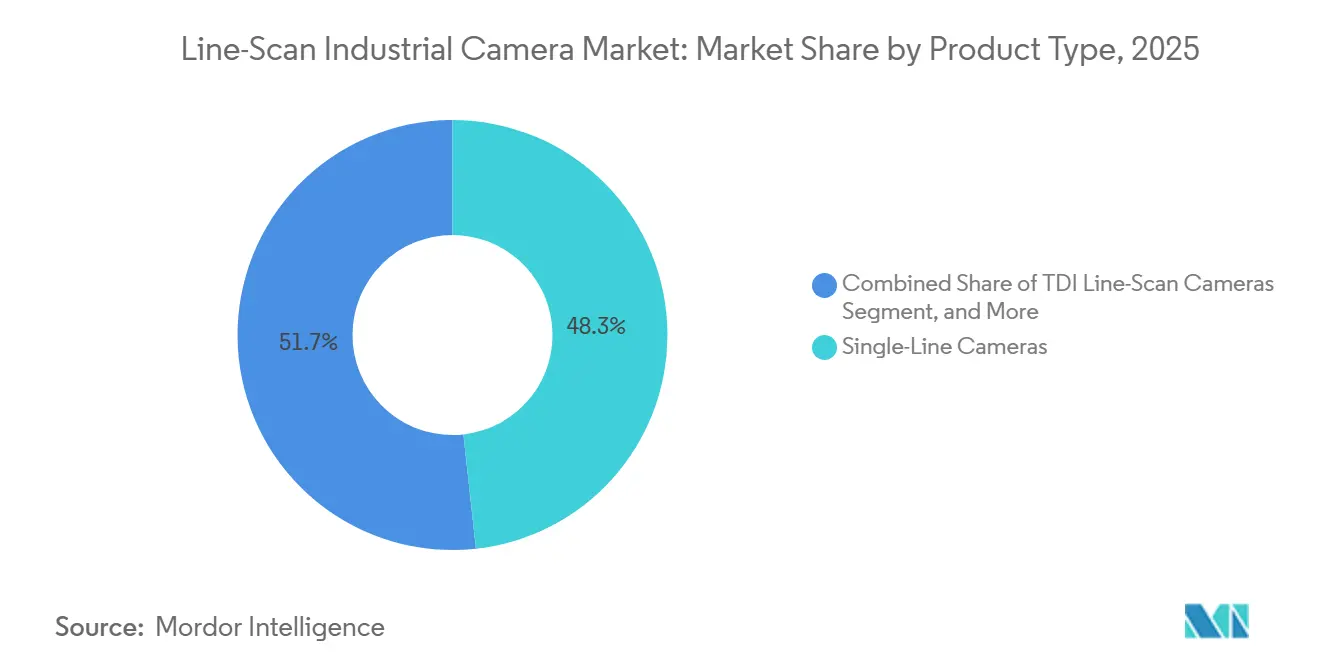
Single-line cameras accounted for 48.26% of revenue in 2025, the largest product category in the line-scan industrial camera market. Their position supports the line-scan industrial camera market through use in web inspection, logistics sorting, food grading, and electronics assembly verification. A single-row pixel design can capture the information needed in standard-resolution applications at practical line rates. Long-standing use in printing and packaging has created a wide base of compatible frame grabbers, lighting systems, and integration software. This installed base can make replacement decisions more deliberate because a new platform may require changes across the inspection line. Multi-line and TDI cameras serve more demanding applications that require higher throughput or stronger sensitivity. Bilinear and trilinear designs support color imaging without prism optics. TDI systems support short-exposure applications in semiconductor inspection, where a single-line camera may not deliver sufficient defect sensitivity. These technical differences keep several camera formats relevant within the same production facility.
3D and stereo cameras are projected to expand at an 10.39% CAGR through 2031, the highest rate among product types in the line-scan industrial camera market size. These systems are used when 2D grayscale imaging cannot measure height variation or dimensional differences. Automotive panel inspection, semiconductor package measurement, and battery electrode thickness control are important use cases. Chromasens' 3DPIXA platform captures 2D color data and 3D height data in a single scan pass. This approach can reduce the need for separate color and laser-triangulation systems. Other formats include hyperspectral push-broom cameras for pharmaceutical, recycling, and food-sorting applications. These products combine line-scan imaging with material identification. Their use can expand as quality programs require a clearer distinction between materials and contaminants. The product category, therefore, includes both dimensional measurement and material-discrimination requirements.



By Sensor Architecture: CMOS Leads, While InGaAs Gains Strategic Traction
CMOS cameras held 72.84% of revenue by sensor architecture in 2025. Modern CMOS designs combine cost efficiency with the scalability needed for high-resolution and high-line-rate operation. They are suited to 8K and larger arrays where CCD designs become less economical. The technology also supports broad adoption in standard machine vision applications. CCD cameras remain relevant in legacy web inspection and in selected high-dynamic-range imaging conditions. Their resistance to blooming can still offer a practical advantage in certain scenes. However, CMOS backside-illuminated technology is reducing the remaining sensitivity gap. This shifts new procurement toward CMOS platforms across many inspection environments. It also supports camera designs that can be adapted to different resolution and throughput needs.
InGaAs cameras are expected to grow at a 10.21% CAGR through 2031, making them the fastest-growing sensor architecture. These cameras operate in the short-wave infrared range and can reveal moisture variation, subsurface defects, and material differences that silicon sensors cannot see. Their coverage extends across semiconductor, food, battery, and web inspection applications. Larger pixels can improve light collection in low-light SWIR environments. Allied Vision and Xenics are advancing uncooled InGaAs designs to reduce system complexity. Lower complexity can broaden access for pharmaceutical and food applications. The line-scan industrial camera market may therefore see InGaAs move beyond its traditional specialist uses. Wider deployment remains contingent on users being able to justify the added cost through improved material detection. Users can apply this sensing capability where visible-light imaging does not provide enough information.
By Interface: GigE Vision Leads in Volume, While CoaXPress Dominates Value
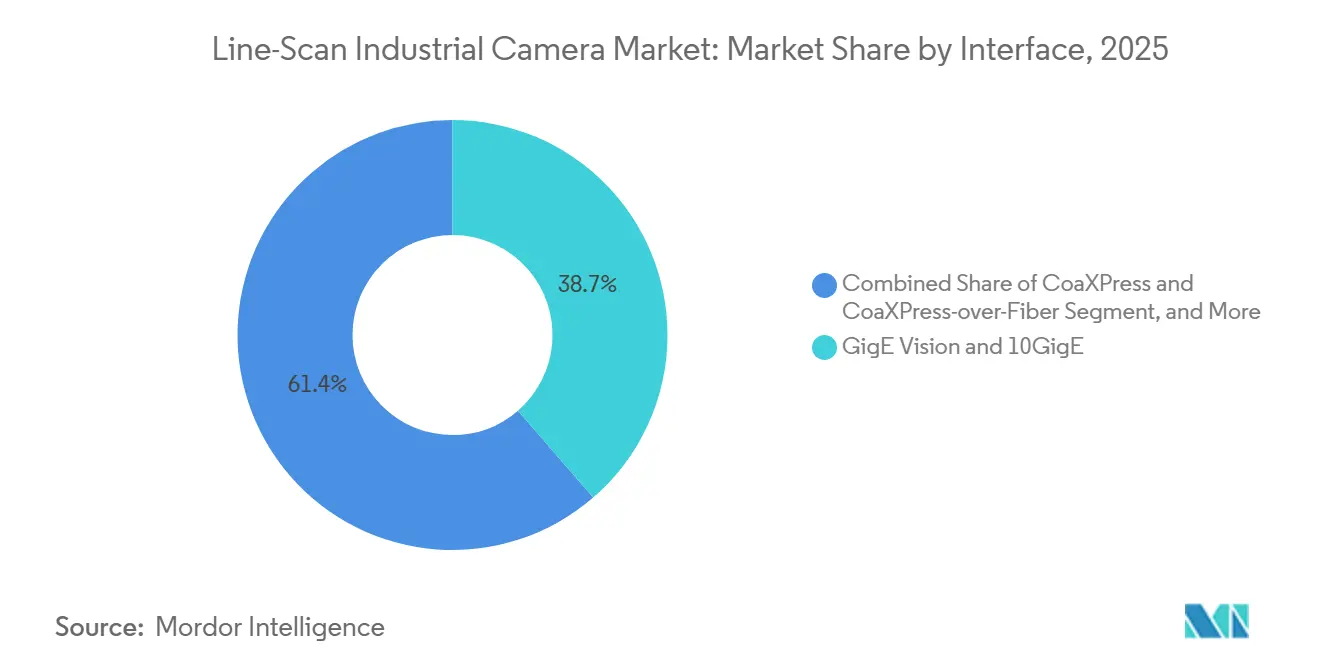
GigE Vision and 10GigE held 38.65% of interface revenue in 2025, making them the largest interface category. Their use supports the line-scan industrial camera market through lower infrastructure costs and long cable runs without active components. Logistics, food inspection, and general web scanning often use these interfaces because they balance cost and performance. The 10GigE format can support many 8K CMOS deployments operating at high line rates. Emergent Vision provides 10GigE, 25GigE, and 100GigE interface options for high-bandwidth machine vision applications. Camera Link and Camera Link HS continue to serve installed semiconductor inspection systems. Their predictable latency and established use with TDI cameras preserve their role in specialized applications. Interface selection remains dependent on required bandwidth, cable distance, and integration constraints. This keeps Ethernet-based formats important where flexible infrastructure is a priority.
CoaXPress and CoaXPress-over-Fiber are projected to expand at a 10.17% CAGR through 2031, the fastest rate among interfaces in the line-scan industrial camera market. The standard supports high data volumes from 16K TDI cameras and other demanding systems. CoaXPress 3.0 adds higher-speed channels, error correction, and faster cross-camera triggering. CoaXPress-over-Fiber also supports long distances in industrial sites where electrical interference is a concern. These capabilities are relevant for semiconductor, genomics, and precision web inspection. The interface can make a complete system more expensive because it may require specialized frame grabbers and cabling. Suppliers are responding by combining cameras, interface cards, and processing into more integrated solutions. This gives the line-scan industrial camera industry a path to compete on system performance rather than only on camera specifications. It also aligns interface selection more closely with the inspection process's performance needs.
By End-User: Electronics and Semiconductor Anchor Demand, While Battery Applications Lead Growth
Electronics and semiconductor applications accounted for 27.92% of end-user revenue in 2025. This represents the largest end-user position in the line-scan industrial camera market. Wafer fabrication, substrate processing, printed circuit board inspection, and semiconductor package inspection need continuous defect detection. These environments require precise imaging because process defects can affect yield and production reliability. Smaller process nodes can increase the need for high line rates, smaller pixel pitches, and stronger signal performance. Automotive manufacturing also contributes to demand through paint inspection, body-panel checks, and electronics testing. Automotive suppliers use vision systems for battery-module inspection and advanced driver-assistance system component checks. These applications provide a continuing base of demand beyond front-end semiconductor production. They also connect camera demand with quality requirements across several stages of electronics manufacturing.
Battery and energy storage applications are expected to expand at a 11.23% CAGR through 2031. Electrode coating and separator inspection require continuous coverage that periodic human checks cannot provide at cell-production speeds. Line-scan systems can identify agglomerates, coating defects, and metallic contamination during production. Basler identifies battery cell manufacturing as an application for machine vision across multiple production steps. This application can require several cameras in 1 facility because inspection occurs from material preparation through winding and assembly. Pharmaceutical and life sciences users apply related systems to tablet serialization, blister-pack inspection, and label verification. Documentation and verification requirements within regulated production support these uses. The line-scan industrial camera market thus serves both capital-intensive factories and compliance-driven production environments. This mix gives suppliers exposure to diverse production workflows and inspection requirements.
Geography Analysis
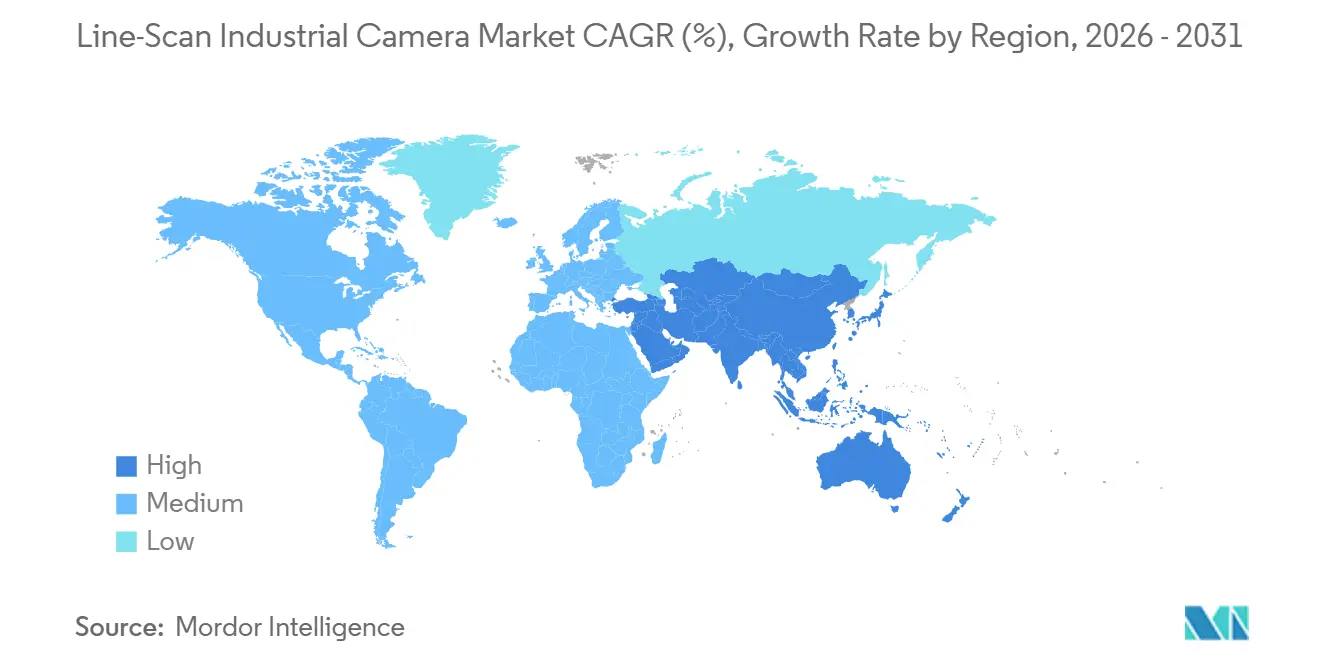
Asia-Pacific accounted for 42.18% of revenue in 2025 and is expected to grow at a 10.36% CAGR through 2031. The line-scan industrial camera market in the region is supported by semiconductor, display, and battery manufacturing. China, Japan, South Korea, and Taiwan contain many production settings that require continuous, high-resolution inspection. Japan remains an important center for machine vision development. Mitsubishi Electric and Sony Semiconductor Solutions announced a joint venture in July 2026 to develop AI-powered vision sensor solutions for manufacturing.[3]Mitsubishi Electric Corporation, “Mitsubishi Electric and Sony Semiconductor Solutions Agree to Establish a Joint Venture to Build AI Vision Sensor Solutions for Manufacturing Applications,” Mitsubishi Electric Corporation, mitsubishielectric.com.
North America and Europe constitute the second- and third-largest geographic clusters for the line-scan industrial camera market. Both regions have established demand in semiconductor metrology, pharmaceutical serialization, and precision web printing. North American projects support demand in the line-scan industrial camera market as facilities progress through equipment installation and production qualification. Europe benefits from a large industrial automation base, particularly in Germany. European battery manufacturing also requires stronger quality documentation and traceability to support repeatable visual checks.
South America, the Middle East, and Africa accounted for smaller demand volumes. Brazil's electronics assembly and automotive parts production form much of South American demand. Saudi Arabia and the United Arab Emirates are beginning to use machine vision in petrochemical quality control and pharmaceutical manufacturing. The line-scan industrial camera market in Africa is concentrated in South African automotive assembly and Egyptian electronics production, while demand across these regions remains exposed to investment conditions and local procurement requirements.

Competitive Landscape
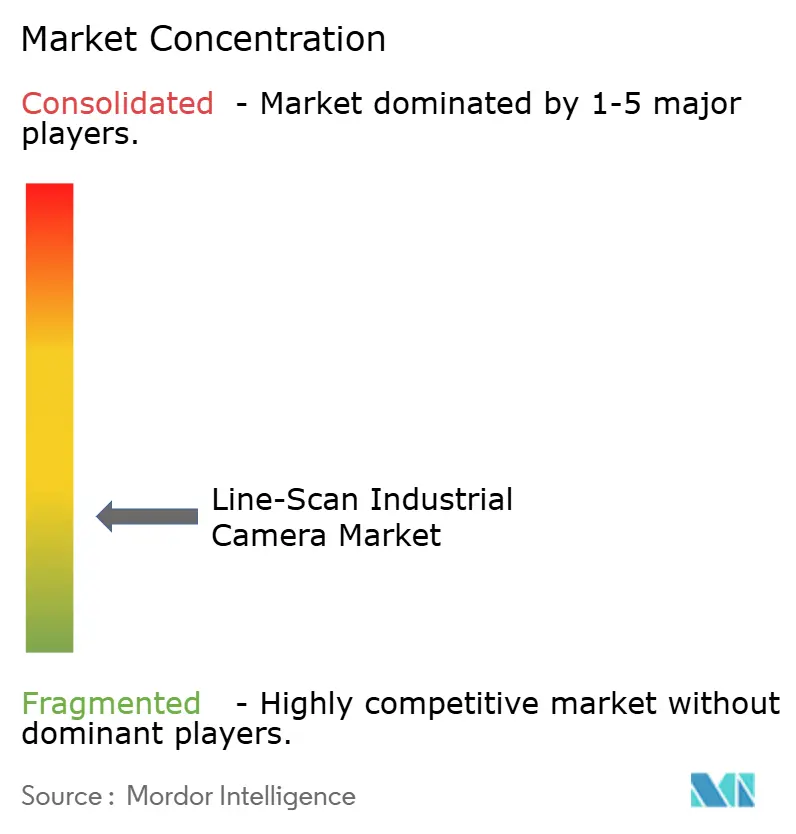
The line-scan industrial camera market is established, with premium suppliers, and fragmented. Teledyne DALSA, Basler AG, JAI A/S, and Allied Vision Technologies have strong positions in TDI, CMOS multiline, and multispectral applications. Chinese manufacturers are increasing competition in CMOS single-line and GigE Vision systems. Teledyne's approach includes integration across image sensors, camera manufacturing, and interface technology. Its June 2026 Linea HS2 8k launch shows this approach through a high-speed, backside-illuminated CMOS TDI platform.
Teledyne Technologies announced an agreement in August 2026 to acquire Varex Imaging for USD 1.1 billion. The transaction expands its imaging portfolio to include X-ray technology, which can complement optical inspection at semiconductor and battery facilities. Teledyne DALSA also expanded its AxCIS contact image sensor family in May 2026 with models up to 1,800 dpi and widths up to 1,500 mm. The expansion addresses compact design, calibration simplicity, and faster installation. The line-scan industrial camera market is increasingly shaped by solutions that reduce integration work for customers.
Opportunities remain in uncooled InGaAs cameras, compact contact image sensor modules, and AI-enabled smart line-scan cameras. IMAGO Technologies combines line-scan capture and embedded inference in its Vision CAM LM2 platform. Tucsen introduced its Gemini 8K TDI sCMOS camera in March 2025 with a 100G CoaXPress-over-Fiber interface and a 1 MHz line rate. Established European and Japanese suppliers retain an advantage through interoperability certifications and experience with multi-vendor systems.
Line-Scan Industrial Camera Industry Leaders
Teledyne DALSA, Inc.
Basler AG
JAI A/S
Allied Vision Technologies GmbH
Vieworks Co., Ltd.
- *Disclaimer: Major Players sorted in no particular order

Recent Industry Developments
- August 2026: Teledyne Technologies announced a definitive agreement to acquire Varex Imaging Corporation for USD 18.90 per share in cash, representing an aggregate transaction value of USD 1.1 billion. The acquisition expands Teledyne's imaging portfolio into X-ray detector and source technology, with strategic significance for combined multi-modality inspection offerings in semiconductor and battery manufacturing facilities where X-ray and optical line-scan imaging serve as complementary quality gates.
- July 2026: Mitsubishi Electric Corporation and Sony Semiconductor Solutions Corporation announced the formation of Advanced Vision Solutions Co., Ltd., Mitsubishi Electric 60% and Sony Semiconductor Solutions 40%, a joint venture scheduled to begin operations in October 2026. The venture develops AI-powered vision sensor solutions integrating Sony's image sensors and edge AI with Mitsubishi Electric's factory automation control systems and Serendie digital platform, targeting fully automated and multimodal production inspection for the factory automation domain.
- June 2026: Teledyne DALSA launched the Linea HS2 8k, a backside-illuminated CMOS TDI line-scan camera with 5 µm pixel pitch and a maximum line rate of 1 MHz. It was designed for semiconductor wafer, high-density-interconnect, and genomics flow-cell inspection. The 8k model complements the existing 16k Linea HS2 and offers a cost-calibrated option for medium-resolution, high-speed applications that do not require ultra-wide-field coverage.
- May 2026: Teledyne DALSA expanded its AxCIS Contact Image Sensor family to resolutions up to 1,800 dpi and widths up to 1,500 mm. The range integrates sensors, lenses, and lighting into a single compact module for semiconductor wafer, battery electrode, and print inspection. The expansion targets production environments where calibration simplicity, compact form factor, and fast installation are purchasing priorities alongside imaging performance.


Global Line-Scan Industrial Camera Market Report Scope
The Line-Scan Industrial Camera Market comprises imaging devices that capture images one line at a time for continuous or high-speed inspection, measurement, sorting, and quality-control applications in industrial and manufacturing environments. Line-scan industrial cameras capture successive lines of an object or continuously moving material and combine them to generate a complete image, enabling inspection of products, webs, surfaces, and materials that require continuous imaging or high-resolution imaging at production-line speeds.
The Line-Scan Industrial Camera Market Report is Segmented by Product Type (Single-Line Cameras, Multi-Line Cameras, TDI Line-Scan Cameras, 3D and Stereo Line-Scan Cameras, and Other Line-Scan Cameras), Sensor Architecture (CMOS Line-Scan Cameras, CCD Line-Scan Cameras, InGaAs Line-Scan Cameras, and Other Sensor Architectures), Interface (GigE Vision and 10GigE, CoaXPress and CoaXPress-over-Fiber, Camera Link and Camera Link HS, and USB and Other Interfaces), End-User (Electronics and Semiconductor, Automotive, Battery and Energy Storage, Food, Beverage and Consumer Goods, Printing, Packaging and Paper, Textile, Logistics and E-commerce, Pharmaceutical and Life Sciences, and Other End-User Industries), and Geography (North America, Europe, Asia-Pacific, South America, Middle East, and Africa). The Market Forecasts are Provided in Terms of Value (USD).
| Single-Line Cameras |
| Multi-Line Cameras (Non-TDI) |
| TDI Line-Scan Cameras |
| 3D and Stereo Line-Scan Cameras |
| Other Product Types |
| CMOS Line-Scan Cameras |
| CCD Line-Scan Cameras |
| InGaAs Line-Scan Cameras |
| Other Sensor Architectures |
| GigE Vision and 10GigE |
| CoaXPress and CoaXPress-over-Fiber |
| Camera Link and Camera Link HS |
| USB and Other Interfaces |
| Electronics and Semiconductor |
| Automotive |
| Battery and Energy Storage |
| Food, Beverage and Consumer Goods |
| Printing, Packaging and Paper |
| Textile |
| Logistics and E-Commerce |
| Pharmaceuticals and Life Sciences |
| Other End-User Industries |
| North America | United States |
| Canada | |
| Mexico | |
| South America | Brazil |
| Argentina | |
| Rest of South America | |
| Europe | Germany |
| United Kingdom | |
| France | |
| Italy | |
| Rest of Europe | |
| Asia-Pacific | China |
| Japan | |
| South Korea | |
| Taiwan | |
| India | |
| Southeast Asia | |
| Australia | |
| Rest of Asia-Pacific | |
| Middle East | Turkey |
| Saudi Arabia | |
| United Arab Emirates | |
| Rest of Middle East | |
| Africa | South Africa |
| Egypt | |
| Rest of Africa |
| By Product Type | Single-Line Cameras | |
| Multi-Line Cameras (Non-TDI) | ||
| TDI Line-Scan Cameras | ||
| 3D and Stereo Line-Scan Cameras | ||
| Other Product Types | ||
| By Sensor Architecture | CMOS Line-Scan Cameras | |
| CCD Line-Scan Cameras | ||
| InGaAs Line-Scan Cameras | ||
| Other Sensor Architectures | ||
| By Interface | GigE Vision and 10GigE | |
| CoaXPress and CoaXPress-over-Fiber | ||
| Camera Link and Camera Link HS | ||
| USB and Other Interfaces | ||
| By End-User | Electronics and Semiconductor | |
| Automotive | ||
| Battery and Energy Storage | ||
| Food, Beverage and Consumer Goods | ||
| Printing, Packaging and Paper | ||
| Textile | ||
| Logistics and E-Commerce | ||
| Pharmaceuticals and Life Sciences | ||
| Other End-User Industries | ||
| By Geography | North America | United States |
| Canada | ||
| Mexico | ||
| South America | Brazil | |
| Argentina | ||
| Rest of South America | ||
| Europe | Germany | |
| United Kingdom | ||
| France | ||
| Italy | ||
| Rest of Europe | ||
| Asia-Pacific | China | |
| Japan | ||
| South Korea | ||
| Taiwan | ||
| India | ||
| Southeast Asia | ||
| Australia | ||
| Rest of Asia-Pacific | ||
| Middle East | Turkey | |
| Saudi Arabia | ||
| United Arab Emirates | ||
| Rest of Middle East | ||
| Africa | South Africa | |
| Egypt | ||
| Rest of Africa | ||


Key Questions Answered in the Report
What is the size of the line-scan industrial camera market?
The line-scan industrial camera market was valued at USD 5.98 billion in 2025 and is projected to reach USD 10.12 billion by 2031 at a 9.39% CAGR.
Which product type leads demand for line-scan industrial cameras?
Single-line cameras led product demand with 48.26% of revenue in 2025 because they support a wide range of standard inspection applications.
Which sensor technology is advancing fastest in line-scan cameras?
InGaAs is expected to expand at a 10.21% CAGR through 2031 because it supports short-wave infrared inspection of materials, moisture, and subsurface defects.
Why are line-scan cameras important for battery cell production?
They provide continuous inspection of electrode coatings and separators, helping manufacturers identify defects and contamination during production.
Which region has the strongest demand for line-scan industrial cameras?
Asia-Pacific led with 42.18% of revenue in 2025 and is expected to expand at a 10.36% CAGR through 2031.
Which interface is expected to advance fastest through 2031?
CoaXPress and CoaXPress-over-Fiber are projected to expand at a 10.17% CAGR because high-resolution TDI systems need greater bandwidth.
Page last updated on:


 Your data is secure and never sold or shared.


