
Market Overview
| Study Period | 2020 - 2031 |
|---|---|
| Forecast Data Period | 2026 - 2031 |
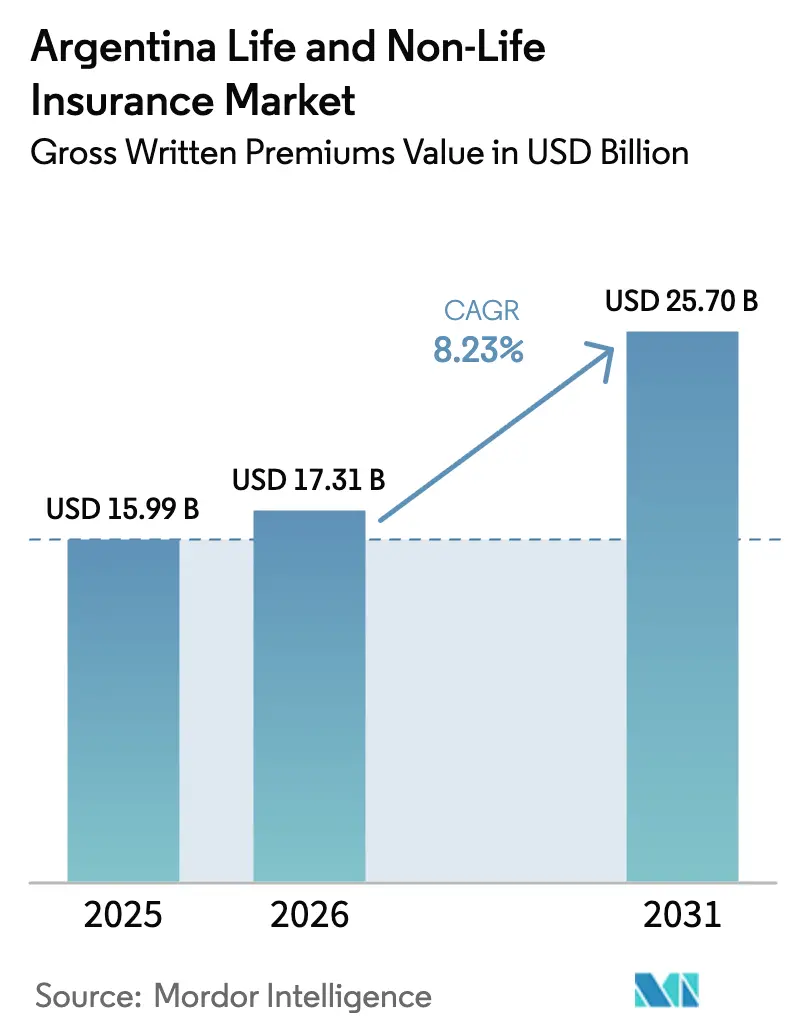
| Base Year Market Size (2025) | USD 15.99 Billion |
| Market Size (2026) | USD 17.31 Billion |
| Market Size (2031) | USD 25.70 Billion |
| Growth Rate (2026 - 2031) | 8.23 % |
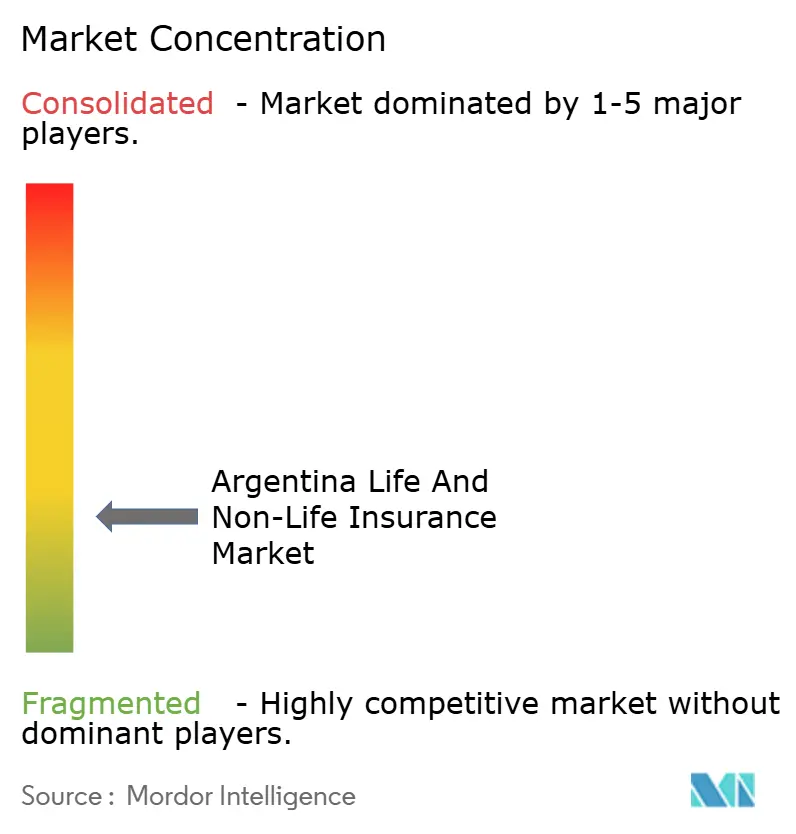
| Market Concentration | Low |
Major Players *Disclaimer: Major Players sorted in no particular order Image © Mordor Intelligence. Reuse requires attribution under CC BY 4.0. | |
Argentina Life And Non-Life Insurance Market Analysis by Mordor Intelligence
The Argentina Life And Non-Life Insurance Market size in terms of gross written premiums value is projected to expand from USD 15.99 billion in 2025 and USD 17.31 billion in 2026 to USD 25.70 billion by 2031, registering a CAGR of 8.23% between 2026 to 2031.
The Argentina life and non-life insurance market operates under active regulatory supervision and is navigating disinflation in 2026 after a sharp CPI deceleration through late 2025, which supports a gradual improvement in pricing stability for multi-year covers. Capital adequacy reforms and reserve methodology changes remain an important driver of prudential resilience in the Argentina life and non-life insurance market, while the shift to automatic product authorization shortens time to market for new offerings. Distribution is still led by brokers and agents, and the Argentina life and non-life insurance market is adding scale in digital channels as customer onboarding and claims workflows digitize at pace. Market concentration is moderately low, and top-tier insurers are positioned to consolidate share under the new solvency thresholds in the Argentina life and non-life insurance market.
Key Report Takeaways
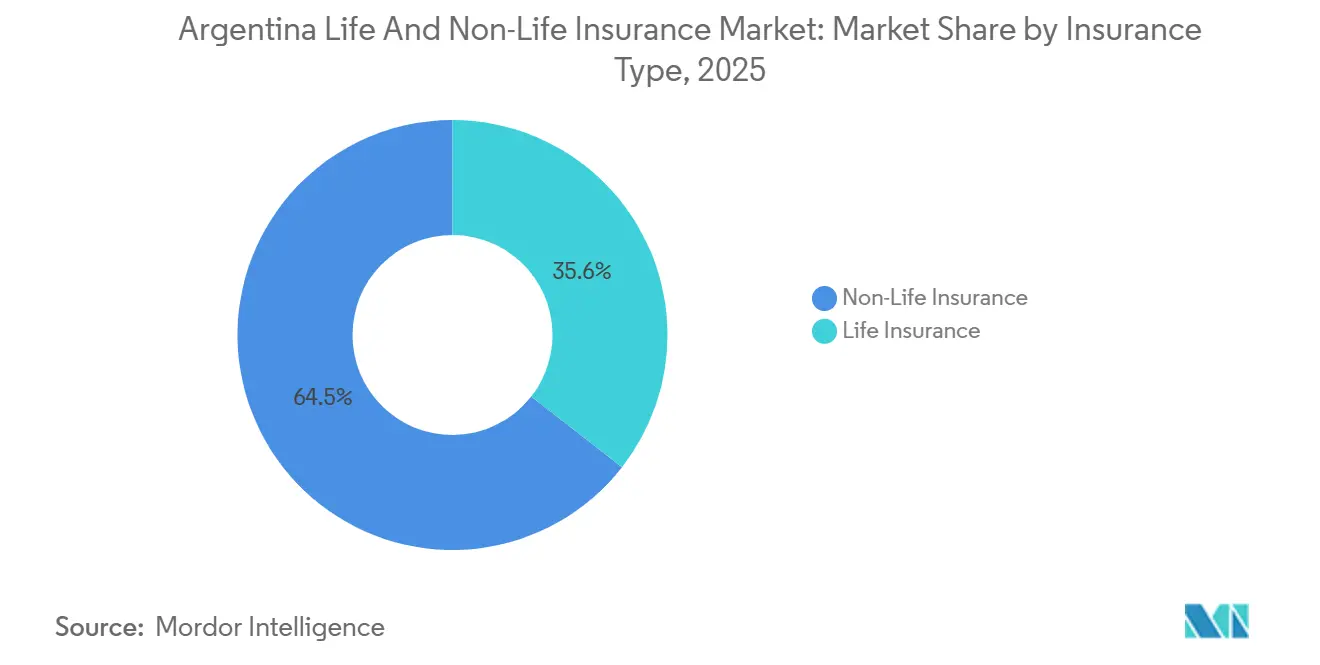
- By product line, non-life insurance led with 64.45% share of Argentina life and non-life insurance market size in 2025, and is projected as the fastest-growing line at a 14.2% CAGR through 2031.
- By distribution channel, brokers and agents held 55.30% of Argentina life and non-life insurance market size in 2025, and digital channels are expected to record the highest projected CAGR at 12.5% through 2031.
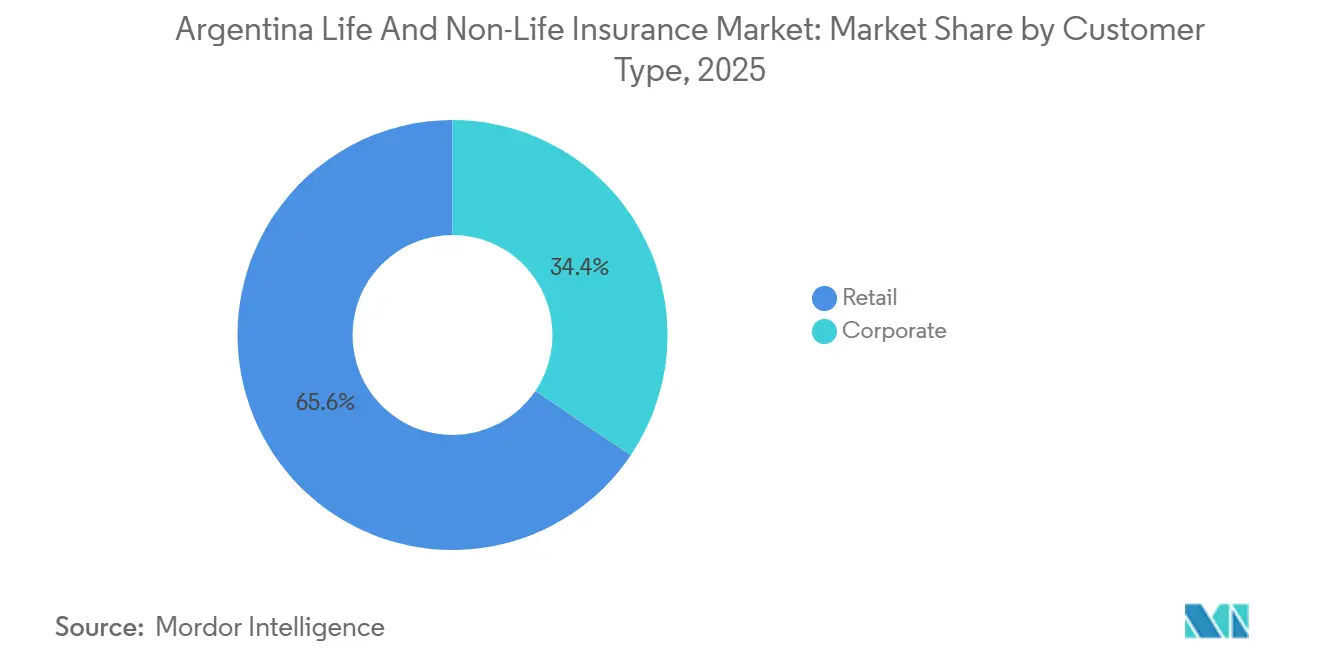
- By customer type, retail accounted for 65.56% of Argentina life and non-life insurance market size in 2025, and SMEs are projected to expand at a 10.8% CAGR between 2026 and 2031.
- Among companies, the top five insurers commanded a combined 35% share of Argentina life and non-life insurance market in 2025.
Note: Market size and forecast figures in this report are generated using Mordor Intelligence’s proprietary estimation framework, updated with the latest available data and insights as of January 2026.
Market Trends and Insights
Drivers Impact Analysis of Argentina Life And Non-Life Insurance Market*
| Driver | (~) % Impact on CAGR Forecast | Geographic Relevance | Impact Timeline |
|---|---|---|---|
| Low insurance penetration and catch-up potential | +1.8% | Nationwide | Long term (≥ 4 years) |
| Strong regulatory framework and active SSN supervision | +1.2% | Nationwide | Medium term (2-4 years) |
| Insurance as long-term capital for investment and infrastructure | +0.8% | Nationwide, project corridors | Long term (≥ 4 years) |
| Growing risk awareness in health and catastrophe exposures | +1.0% | Nationwide, agricultural provinces | Medium term (2-4 years) |
| Consumer protection and contract transparency | +0.6% | Nationwide | Medium term (2-4 years) |
| Innovation, parametric, and inflation-adjusted covers | +1.1% | Nationwide, agro belts and major urban centers | Long term (≥ 4 years) |
| Source: Mordor Intelligence | |||
Low Insurance Penetration and Large Catch-Up Potential
Insurance penetration stood near 3.5% of GDP in 2025, which placed the Argentina life and non-life insurance market below regional benchmarks and indicates a meaningful long-term expansion runway as macro conditions stabilize and real incomes recover[1]. The depth of financial intermediation also remained low, with private sector credit at 10.6% of GDP in March 2025, and this supports the case that rising formalization can unlock new premium pools for the market as credit and savings products deepen across the cycle[2]. Beyond these structural indicators, disinflation extending into 2026 reduces policy limit erosion and enhances product relevance for households and SMEs, supporting more sustainable premium growth. Improving macro conditions, alongside OECD projections of renewed economic momentum, provide a favorable environment for commercial insurance demand as businesses expand assets and employment, lifting uptake across property, liability, and workers’ compensation lines. At the same time, greater use of digital distribution and claims processing lowers onboarding frictions and strengthens underwriting quality, enabling broader adoption of voluntary covers. Together, these factors point to a multi-year catch-up phase in which historically low coverage across life, health, property, and agricultural insurance can gradually converge toward regional norms as stability becomes entrenched.
Strong Regulatory Framework And Active Supervision By SSN
The SSN’s law-based supervisory mandate and the RGAA framework provide clear authority for prudential oversight, conduct rules, and market transparency, which in turn strengthens confidence in the Argentina life and non-life insurance market. The reform cycle since 2024 has centered on solvency, operational deregulation, and transparency, with key resolutions overhauling capital thresholds and allowing automatic plan authorization to shorten product launch cycles in the market. The unified minimum capital based on UVA for direct insurers and local reinsurers simplifies capital structure management and reduces fragmentation by line of business, which can support diversification strategies across the market. The open data portal and the “Tu Tablero Asegurador” dashboard enhance disclosure on solvency, claims ratios, and financial indicators, enabling buyers and distributors to compare options across the market. New reserve methodology for IBNR and pending claims aligns with actuarial techniques and inflation updates, which supports reserve adequacy as litigation flows evolve. Reporting deadlines and electronic systems for mediated and judicial claims strengthen supervisory monitoring, which promotes discipline across carriers.
Use of Insurance To Promote Long-Term Investment And Infrastructure
Insurers serve as core institutional investors, holding a portfolio near 5% of GDP in 2024, and this positions the Argentina life and non-life insurance market as a channel for long-dated capital formation that can finance infrastructure and productive projects. Portfolio composition at the end of 2023 showed broad use of inflation-linked government securities and mutual funds alongside corporate bonds, which helps align assets with inflation-indexed liabilities within the market. Regulatory constraints require that locally registered carriers hold investments and cash equivalents in Argentina, which concentrates exposure domestically while channeling savings into the local economy. Allocation requirements to SMEs support productive sector financing where bank credit depth remains limited, and this can strengthen the customer base for commercial covers[3]. Broader reforms in investment rules have expanded the use of closed-end funds and sub-sovereign instruments, which enable insurers to diversify within domestic limits and match liability profiles in the market. Inflation-linked units such as CER and UVA published by the central bank provide technical tools for liability matching, which is important for longer-duration lines in the market.
Growing Risk Awareness Including Health And Catastrophe Risks
Health-related price dynamics raised awareness of out-of-pocket exposure and accelerated demand for supplemental protection in 2025, as regulated health system prices posted strong year-over-year gains and households prioritized financial safeguards. Employers increasingly use group health and group life to differentiate compensation packages as formal employment conditions improve, which supports premium growth. Climate variability and extreme weather events have drawn attention to parametric solutions that trigger on objective indices and pay quickly, which opens a path for drought and flood coverage innovations in the market. UNDP diagnostics have highlighted gaps in disaster risk finance and microinsurance penetration, and the inclusive insurance agenda can expand access for vulnerable groups. Property owners are reviewing sums insured due to rising replacement costs, which helps address legacy underinsurance risks. Reserve reforms that use longer claims histories for long-tail lines acknowledge evolving litigation patterns and support stability in the Argentina life and non-life insurance market.
Restraints Impact Analysis of Argentina Life And Non-Life Insurance Market*
| Restraint | (~) % Impact on CAGR Forecast | Geographic Relevance | Impact Timeline |
|---|---|---|---|
| Chronic high inflation and currency instability | -1.5% | Nationwide | Short term (≤ 2 years) |
| Risk of underinsurance and outdated coverage limits | -0.9% | Nationwide | Short term (≤ 2 years) |
| Macroeconomic and sovereign risk pressures on insurers’ balance sheets | -1.2% | Nationwide | Medium term (2-4 years) |
| Regulatory and operating complexity with frequent rule changes | -0.8% | Nationwide | Medium term (2-4 years) |
| Source: Mordor Intelligence | |||
Chronic High Inflation And Currency Instability
Persistent inflation has impaired premium adequacy and reserve dynamics, and the CPI path that fell to 31.4% year over year by November 2025 followed a peak period that strained underwriting results in the market. Pricing models faced difficulty as medical costs, vehicle prices, and legal expenses moved at different rates, which weakened the predictive value of historical loss ratios. Exchange rate volatility raised the local currency cost of reinsurance and foreign obligations, and the official wholesale rate stood near ARS 1,469.61 per USD in early January 2026, which affected payables and recoveries across the market[4]. Control liberalization in April 2025 eased settlement timelines for cross-border reinsurance, although counterparties still weigh policy risk when assessing commitments. Domestic investment rules require local asset allocation for carriers, which constrains hard currency diversification and links balance sheets to local inflation cycles. In this environment, underinsurance becomes a direct consequence of inflation, and policyholders often need limit adjustments to maintain real protection in the Argentina life and non-life insurance market.
Macroeconomic And Sovereign Risk Pressures On Insurers’ Balance Sheets
Insurers hold a large share of portfolios in sovereign securities and mutual funds that themselves hold government bonds, which creates correlated exposure to public finance shifts in the Argentina life and non-life insurance market. Sovereign spread volatility transmits to insurance asset valuations and solvency ratios, and this pressure can coincide with higher reserve needs when inflation expectations rise. The economy contracted in 2024, then returned to growth in 2025 and 2026 in OECD projections, and that cycle shaped demand for commercial lines and capital budgets across the market. Quasi-fiscal dynamics have been under adjustment, yet the legacy structure of central bank liabilities and their conversion to Treasury instruments means refinancing risk remains a factor for financial markets that insurers depend on in the Argentina life and non-life insurance market. Restrictions that require local investment for carriers limit the ability to hedge external shocks with offshore assets, and this reinforces exposure to domestic macro cycles. Regulatory changes have allowed amortization of reserve increases over set periods, and such provisions helped manage the transition to new methodologies without immediate solvency strain in the market.
*Our forecasts treat driver/restraint impacts as directional, not additive. The impact forecasts reflect baseline growth, mix effects, and variable interactions.
Argentina Life And Non-Life Insurance Market Segment Analysis
By Product Line:
Non-life remains dominant with motor as the anchorNon-life insurance contributed 64.45% of premiums in 2025. Motor insurance led total premiums in 2025, and it captured the largest share within non-life, which continued to anchor the Argentina life and non-life insurance market as mass risk coverage with compulsory foundations. Health coverage has been the fastest-growing line on a forward basis, and the Argentina life and non-life insurance market is seeing accelerated interest in products that address medical cost volatility and employer benefits demand. The market has also seen a steady focus on liability and property covers, as business asset bases shift with the investment cycle and require more precise risk transfer. Parametric products for agriculture and catastrophe events are gaining traction and complement traditional indemnity structures. The share held by motor aligns with Argentina’s large vehicle fleet and mandatory third-party liability, and this supports a stable premium foundation across cycles.
Motor held a significant share of total premiums in 2025, which highlights the centrality of mobility risks. Health is positioned as the fastest-expanding line as regulated health system prices and household expectations sustain demand, and the non-life insurance market size is projected to expand at a 14.2% CAGR between 2026 and 2031. Property and liability growth aligns with investment activity, and this adds diversity to non-life premium sources in the Argentina life and non-life insurance market. Life covers remain a smaller share than regional peers, yet benefit from improved consumer protection and solvency clarity, and these reforms strengthen trust in the Argentina life and non-life insurance market. New index-linked and foreign currency-eligible contracts broaden design choices and help maintain coverage relevance through inflation cycles in the Argentina life and non-life insurance market.
By Distribution Channel:
Intermediation dominated by brokers, digital gains momentumBrokers and agents commanded 55.30% of distribution in 2025, and this intermediation model remains the principal route to market for carriers operating in the market. Bancassurance and direct channels provide complementary reach across retail and SME segments, and the industry continues to evolve as digital workflows improve quote issuance and policy servicing. The market is adopting advanced onboarding tools that reduce cycle times, which helps close coverage gaps and supports better policy persistence. Regulatory measures for digital transparency and opt-out processes increase consumer confidence and aid channel diversification in the market.
Digital distribution is expected to be the fastest-growing route, and the market size for digital issuance and servicing is projected to expand at a 12.5% CAGR through 2031 as carriers scale analytics and self-service platforms. Brokers remain essential for complex commercial risks and tailored coverage, and this preserves an advisory-led core in the market. Direct channels reduce acquisition costs where products are simple and standardized, which benefits retail conversions. Bancassurance grows with credit expansion and cross-selling in retail and SME portfolios, and this adds distribution diversity to the Argentina life and non-life insurance market. Combined, this channel mix supports resilience and reach in the Argentina life and non-life insurance industry.
By Customer Type:
Retail anchors demand, SMEs drive incremental growthRetail customers accounted for 65.56% in 2025, and this underscores the central role of households in driving premium flows in the market. The SME segment is the fastest-growing customer group on a forward basis, and this reflects formalization and increased adoption of commercial covers for credit and investment recovery. Employers are prioritizing group health and group life benefits to attract talent, which supports retail-linked growth. Property and liability needs expand as SMEs add assets and employees, and this broadens the product footprint in the market.
Retail’s share highlights the weight of personal lines and mandatory covers in the Argentina life and non-life insurance market share. The SME segment is projected to grow at a 10.8% CAGR through 2031, and the market size for SME-targeted solutions is expected to rise with equipment, fleet, and employee-related risks. As underwriting models gain more data and pricing balance improves in a disinflationary setting, conversion rates can lift in both retail and commercial books. Consumer protection and financial disclosure reforms elevate trust, and that benefits multi-year retention across segments. Together, retail depth and SME momentum form the dual growth engines.
Geography Analysis
In 2026, market activity in Argentina's life and non-life insurance sector remains concentrated in economically vibrant provinces, with the Buenos Aires metropolitan area serving as the focal point. This distribution mirrors national GDP trends and formal employment densities. By mid-2025, Argentina's population approached 46.39 million, with major urban centers driving demand for property, motor, health, and group insurance covers. Provinces with higher per capita incomes enjoy broader insurance awareness and a diverse product mix. In contrast, rural areas, often tied to agriculture, are increasingly turning to parametric and weather-linked insurance solutions. As macroeconomic stability strengthens, there is a notable expansion of SMEs in interior provinces, leading to a broader uptake of insurance products.
Regional insurance activity is closely tied to employment rates and household financial health. In Q3 2025, an unemployment rate of 6.6% underscored stable labor market conditions, bolstering employer benefits. Investments in provincial infrastructure are diversifying premium pools, extending beyond Argentina's core urban corridors. A 2025 shift in the exchange rate regime facilitated smoother cross-border settlements for reinsurance, bolstering placements for catastrophe and large commercial risks. Local investment regulations ensure that insurance portfolios remain within Argentina, tying premium-funded savings to domestic development across provinces.
Regional differences influence both claims patterns and product preferences. Agricultural provinces lean towards weather risk tools, while urban centers show a preference for liability and health insurance. Multilateral assessments have highlighted disaster risk financing gaps, suggesting that municipal and provincial programs could harness parametric designs to bolster resilience in flood-prone regions. Nationwide consumer protection measures standardize key contract terms, helping to bridge regional disparities in buyer confidence. As disinflation takes hold, real-term affordability improves, paving the way for broader adoption of voluntary insurance policies across the country.
Regulatory Landscape
Insurance activity in Argentina is supervised by the Superintendencia de Seguros de la Nacion (SSN) under a reform cycle that combines stronger prudential baselines with operational deregulation. A key anchor is the unified minimum capital framework expressed in UVA, set at 750,000 UVA for direct insurers (and 3,750,000 UVA for local reinsurers), with full applicability referenced to June 2026. That requirement has led carriers to reassess capitalization, portfolio complexity, and potential consolidation pathways under clearer solvency thresholds.
On conduct and market functioning, the SSN has moved to speed product go-to-market and broaden permissible product formats. Resolution 471/2025 updated the definition and operating rules for Grandes Riesgos, allowing certain large-risk policies to be marketed without prior SSN authorization, while Resolution 184/2024 introduced digital record-keeping requirements for insurance and reinsurance operations. In 2026, the SSN issued additional updates, including Resolution 103/2026 on voluntary liquidation processes and Resolution 258/2026 enabling health insurance commercialization under a prestacional (service provision) modality, which expands the design space for health offerings while reinforcing policyholder protection.
Value Chain Analysis
The Argentina life and non-life insurance value chain begins with product design, pricing, and risk selection, supported by actuarial reserving and reinsurance placement. It then moves into distribution, policy administration, premium collection, claims handling, and dispute management. The SSN functions as the central governance node through licensing, conduct rules, reporting, and solvency oversight. Industry bodies such as AACS, ADEAA, AACMS, AAPAS, and FAPASA also shape technical standards, professional training, and channel representation.
Distribution remains the pivotal link in value creation because it affects customer acquisition cost, data quality at onboarding, and cross-sell depth. Under Law 22.400, producers and intermediaries must register with the SSN, and intermediary-led selling continues to dominate. As of June 30, 2025, individual producers represented 45.9% of total production and broker societies 24%, versus 18.4% for direct sales and 11.6% for institutional agents. Operationally, insurers manage underwriting and claims through increasingly digital workflows, but long-tail claims, mediations, and judicial processes remain material downstream cost drivers, keeping legal management, reserving discipline, and recoveries (including reinsurance) central to the economics of several non-life lines.
Competitive Landscape
In mid-2025, Argentina boasted a diverse institutional base for its life and non-life insurance market, with 189 entities authorized by the SSN. These included a mix of patrimonial and mixed insurers, life companies, retirement providers, ART carriers, and public transport mutual entities. By 2024, the top five groups commanded a notable market share, indicating a moderately low concentration in the sector. As 2026 approached, leading carriers were honing in on solvency strength, reserve adequacy, and cost discipline. With reserve recalibration and inflation normalization on the horizon, active balance sheet and pricing management became paramount. Concurrently, regulators emphasized transparency and standardized disclosures, intensifying competition based on product clarity, service quality, and claims performance.
Reforms linking capital requirements to UVA thresholds established a clear solvency baseline. With compliance deadlines set for mid-2026, operators were urged to optimize capital, consider mergers in cases of suboptimal scale, and rationalize their portfolios. The move towards automatic plan authorization empowered both established players and newcomers to swiftly innovate in product design. This shift heightened competitive intensity and fostered a trend towards modular covers. Local investment mandates ensured that assets remained within domestic markets, influencing asset allocation strategies crucial for spread income and duration matching. Brokers and agents continued to dominate distribution, with partnerships for digital onboarding and claims automation gaining traction.
In 2026, major carriers converged on reserve methodology changes, electronic reporting for litigated and mediated claims, and refined IBNR rules. Mastery in these technical areas became the distinguishing factor for market leaders. While health and group life segments emerged as key growth areas, motor and property portfolios demanded vigilance, especially concerning inflation indexation and parts cost dynamics. Following FX liberalization, international channels for reinsurance payments saw marked improvement, bolstering treaty stability for catastrophe and large industrial risks. In summary, the competitive landscape of 2026 was shaped by factors like solvency readiness, the pace of product refreshes, and channel execution.
Argentina Life And Non-Life Insurance Industry Leaders
-
Federación Patronal Seguros
-
Grupo Sancor Seguros
-
La Segunda Cooperativa de Seguros
-
Nación Seguros S.A.
-
Provincia ART S.A.
- *Disclaimer: Major Players sorted in no particular order
Argentina Life And Non-Life Insurance Market Companies Covered in this Report
- Grupo Sancor Seguros
- Federacion Patronal Group
- Nacion Seguros Group (Banco Nacion)
- MAPFRE Group (Argentina)
- Swiss Medical Group (SMG Seguros)
- La Segunda Group
- Grupo Parana Seguros
- Integrity Group
- Chubb Group (Argentina)
- Assurant Group (Argentina)
- Libra Seguros Group
- Life Seguros Group
- Origenes Group
- ASOCIART Group
- Galicia Seguros Group
- Zurich Argentina Group
- Provincia Seguros Group
- San Cristobal Seguros Group
- Mercantil Andina Group
- BBVA Seguros Argentina Group
Read Analysis of Argentina Life And Non-Life Insurance Companies
Market Opportunities and Future Outlook
Product expansion in regulated-adjacent health is emerging as a concrete whitespace as the SSN opened a new commercialization route for health covers under the prestacional modality via Resolution 258/2026. This enables insurers to package service-provision benefits with clearer terms and faster servicing, and to compete on convenience in retail and employer-sponsored segments using digitized onboarding and claims. In parallel, deregulation for large risks, reinforced by the updated Grandes Riesgos framework under Resolution 471/2025, supports faster customization for industrial, energy, and infrastructure-related covers where policy structures and limits need rapid iteration.
Data-driven underwriting and claims governance is also taking shape as an execution opportunity after the SSN launched a new data collection and analysis scheme (SINIAS and RI). The rollout calendar includes mandatory use of the financial information module in October 2026 and the claims system in January 2027. Carriers that align data capture across brokers, direct channels, and claims partners can reduce cycle times, strengthen fraud controls, and manage reserve development more effectively, particularly in segments carrying litigation load. On the asset-liability side, Resolution 272/2026 introduced a temporary regime through December 31, 2027 permitting certain national public bonds purchased in primary auctions to be carried at technical value within a defined limit, which feeds into investment strategy decisions under domestic allocation constraints and affects how insurers balance solvency metrics with spread income.
Recent Industry Developments in Argentina Life And Non-Life Insurance Market
- July 2026: The SSN launched a new data collection and analysis scheme (SINIAS and RI) and published rollout milestones, including mandatory use of the financial information module in October 2026 and the claims system in January 2027. The program shifts supervision toward more automated, preventive monitoring and increases the importance of data readiness across underwriting, claims, and litigation tracking.
- June 2026: La Segunda Seguros partnered with Inbenta, with support from the EU-LAC Digital Accelerator, to deploy conversational AI for retirement-plan advisory processes. The deployment strengthens assisted digital servicing in a segment that still relies heavily on advisor interaction, while improving scalability and response consistency across customer journeys.
- July 2025: The SSN issued RESOL-2025-287-APN-SSN, strengthening reserve methodologies for pending claims, mediations, and IBNR by branch with inflation updates. The change raised the operational importance of claims data quality and longer-tail reserving practices, affecting capital planning and profitability management across non-life lines.
Argentina Life And Non-Life Insurance Market Report Scope and Research Methodology
Market Definition and Coverage
This market is defined as the total value of gross written premiums generated from life and non-life insurance policies sold in Argentina, converted to USD for comparability, and counted at the insurer level for the stated period.
Scope exclusions: Reinsurance premiums booked between insurers and pure investment returns on insurers' asset portfolios are excluded to avoid double counting.
Segments Covered in This Report
- By Insurance Type
- Life Insurance
- Non-Life Insurance
- Motor Insurance
- Health Insurance
- Property Insurance
- Liability Insurance
- Other Insurance
- By Customer Segment
- Retail
- Corporate
- By Distribution Channel
- Brokers/Agents
- Banks
- Direct Sales
- Other Channels
Data Sources, Market Sizing, and Validation
Desk Research
To build the base data, we started with public statistics and regulatory disclosures that describe premium volumes, insurer counts, and line-of-business mix in Argentina. The sources used typically include official publications from the Argentine insurance supervisor, central bank releases for inflation and exchange-rate series, national statistics for income and employment indicators, and international datasets such as IMF and World Bank for macro normalization.
Next, we reviewed insurer annual reports, audited financial statements, investor presentations, association websites, and reputed press coverage to understand how premium growth has been moving across key lines such as motor, health, property, and life. Where helpful, we also used paid subscriptions for company financials and intelligence, news and financials, and an import-export shipment-level database only for broad economic context checks rather than direct premium sizing. The sources named above are illustrative only and not exhaustive, and many other references were also consulted for data collection, validation, and clarification.
Primary Interviews and Surveys
Primary work was used to verify what sits behind premium growth, including rate revisions, underwriting tightening, claims pressure, and channel mix changes across brokers, banks, and direct sales. We spoke with a mix of insurers, distributors, and industry specialists, and the inputs were balanced across major operating hubs and provincial demand pockets so the assumptions could be tested against on-the-ground selling and renewal behavior.
Distribution of primary research fieldwork respondents
| Company type | Respondent position |
|---|---|
| Top tier: 27% | CXOs: 14% |
| Mid tier: 58% | Functional/Unit leaders: 40% |
| Smaller Players: 15% | Managers: 46% |
Market-Sizing & Forecasting
Sizing was built using a top-down approach where regulatory premium totals and line-of-business shares were reconstructed into a single written-premium value pool, then converted into USD using year-average currency assumptions to keep timing consistent. The totals were then checked with selective bottom-up approximations, such as sampling insurer premium disclosures and multiplying observed average premium levels by policy and exposure proxies to see if the order of magnitude stayed realistic.
Key inputs used in the model included inflation and FX movement, since these strongly affect nominal premium reporting, changes in the insured vehicle parc and motor rate trends, shifts in health claims inflation, penetration indicators such as premiums as a share of GDP, and the mix between retail and corporate policies. For forecasting, scenario analysis was used around inflation and currency paths, since small changes can materially swing USD values even if local-currency premiums look stable. Where a line lacked clean public splits in a given year, we bridged gaps using adjacent-year regulator shares and interview-based adjustments before the final roll-up was locked.
Data Validation & Update Cycle
Outputs were cross-checked against independent signals, including historical premium growth patterns, line-of-business mix stability, and macro indicators like GDP and inflation, and then reviewed for breaks that did not match known market events. When outliers appeared, assumptions were re-tested, and follow-up calls were triggered to confirm whether the driver was pricing, exposure growth, or reporting timing.
Before sign-off, the model goes through multi-step analyst review so arithmetic, conversions, and share allocations are consistent across years. Reports are refreshed annually, and interim updates are made when material events occur that can shift premium volumes or reporting comparability. Right before delivery, a final pass is completed so clients receive the latest updated view.
Mordor Intelligence's Argentina Life Non Life Insurance Market Size Compared Against Other Published Estimates
It is normal to see different market values for Argentina insurance, even when everyone is discussing life and non-life together, because the measurement base and conversion choices are not always aligned. Differences typically come from whether the figure is strictly gross written premiums, how fiscal-year timing is treated, and whether the USD translation follows spot rates or year averages.
In this study, the key spread drivers are usually the treatment of inflation-linked repricing, the year used for currency conversion during volatile periods, and whether reinsurance flows are mixed into the same total. Some publishers also smooth growth using a single macro trend line, which can understate short-cycle premium resets in motor and health, and then others project recovery paths without a clear check against penetration ratios and line-of-business shares.
Benchmark comparison
| Source | Market Size | Gaps in Research Methodology |
|---|---|---|
| Mordor Intelligence | USD 15.99 B (2025) | |
| Global Consultancy A | USD 15.01 B (2024) | Uses an earlier base year and a shorter horizon, and the USD value can shift if conversion timing is not matched to the premium reporting year. |
| Industry Publisher B | USD 15.01 B (2024) | Often presents a broad market value statement without a clear rule on excluding reinsurance flows and without detailing the FX averaging method used. |
The table shows that a one-year shift in the base period and the USD conversion rule can explain much of the gap, especially in high-inflation years. When gross written premiums are kept as the value pool, reinsurance is kept out to avoid double counting, and year-average FX is applied consistently, the published spread becomes easier to reproduce step by step, which is how the Argentina totals are handled here by Mordor Intelligence.
Key Questions Answered in the Report
What is the current size and growth outlook for the Argentina insurance market?
The Argentina insurance market size is USD 17.31 billion in 2026 and is projected to reach USD 25.70 billion by 2031 at an 8.23% CAGR.
Which segment leads premium contribution in the Argentina insurance market?
Non-life leads with 64.45% of 2025 premiums, supported by compulsory motor and workers’ compensation, property, and health-related covers.
How are regulations shaping the Argentina insurance market in 2026?
Reforms implemented in 2025 streamlined product approvals, unified capital floors, and improved reporting standards, supporting faster innovation and more predictable oversight.
What distribution channels are growing fastest in the Argentina insurance market?
Other channels that include embedded and direct digital are forecast to grow at a 12.5% CAGR through 2031, while bancassurance reports high digital issuance and broad reach.
Where are the strongest geographic growth drivers within Argentina?
Buenos Aires remains dominant by premium share, while Neuquén and the Northwest provinces are expanding with energy and mining projects that require specialized insurance.
What underwriting challenges remain in the Argentina insurance market?
Elevated claims severity in motor, sovereign-exposure volatility, and underinsurance from inflation continue to pressure results, making repricing, claims efficiency, and valuation discipline critical.