
Kitchen Sink Market Size and Share
Market Overview
| Study Period | 2021 - 2032 |
|---|---|
| Market Size (2027) | USD 4.48 Billion |
| Market Size (2032) | USD 5.60 Billion |
| Growth Rate (2027 - 2032) | 4.57 % |
| Fastest Growing Market | Asia-Pacific |
| Largest Market | Asia-Pacific |
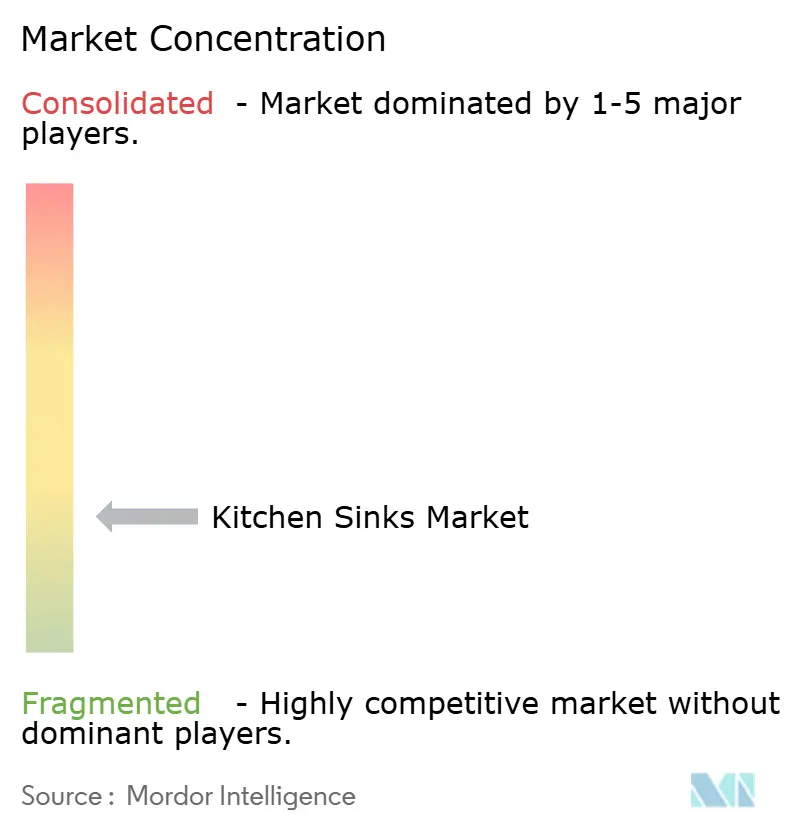
| Market Concentration | Low |
Major Players *Disclaimer: Major Players sorted in no particular order Image © Mordor Intelligence. Reuse requires attribution under CC BY 4.0. | |
Kitchen Sink Market Analysis by Mordor Intelligence
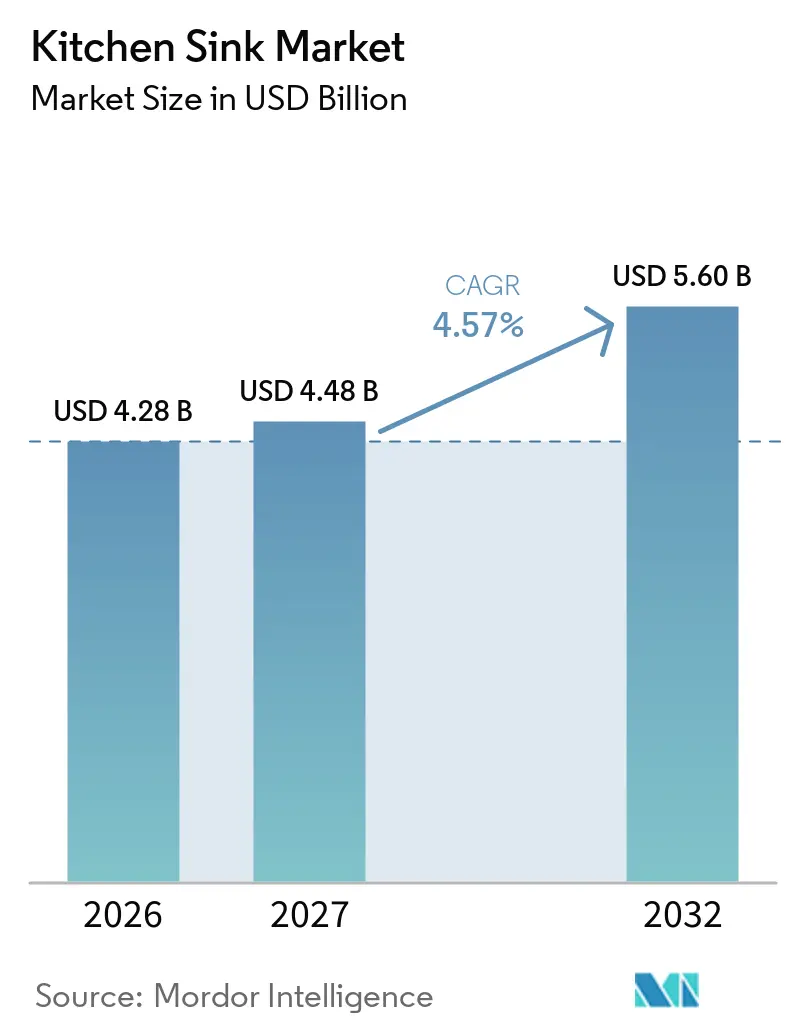
The kitchen sink market size is expected to increase from USD 4.12 billion in 2026 to USD 4.48 billion in 2027, and reach USD 5.60 billion by 2032, at a CAGR of 4.57% during the forecast period (2027-2032). Renovation activity is becoming a more reliable demand source than new residential construction in several mature economies. Premium fixture choices are also raising the value of many replacement projects, even where unit demand is stable. Commercial foodservice, hospitality, and cloud kitchens add demand that is less tied to household renovation cycles. Digital retail is widening access to premium products, while manufacturers are investing in materials, accessories, and installation support. The kitchen sink market therefore favors suppliers that can address replacement, professional specification, and online discovery through separate channel approaches.
Key Report Takeaways
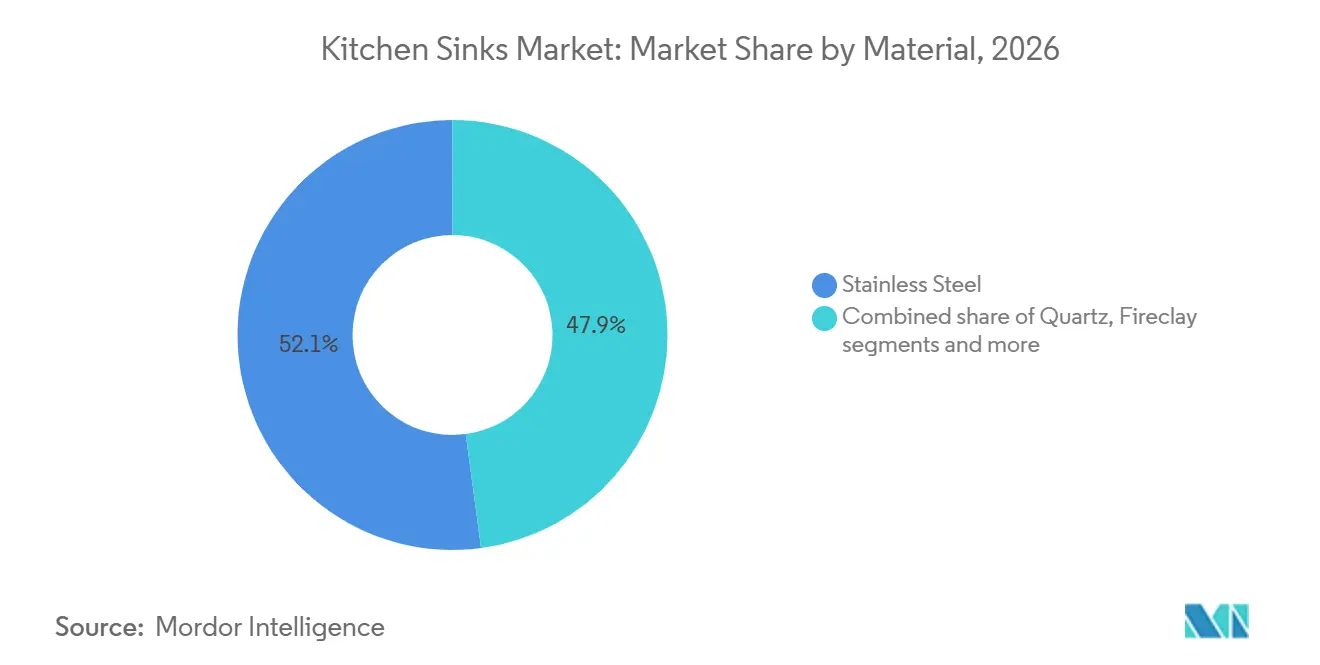
- By material, stainless steel held 52.12% of the kitchen sink market share in 2026, while quartz composite is forecast to expand at an 8.58% CAGR through 2032.
- By installation type, top-mount or drop-in sinks held 43.26% of the kitchen sink market share in 2026, while flush-mount sinks are forecast to expand at a 5.96% CAGR through 2032.
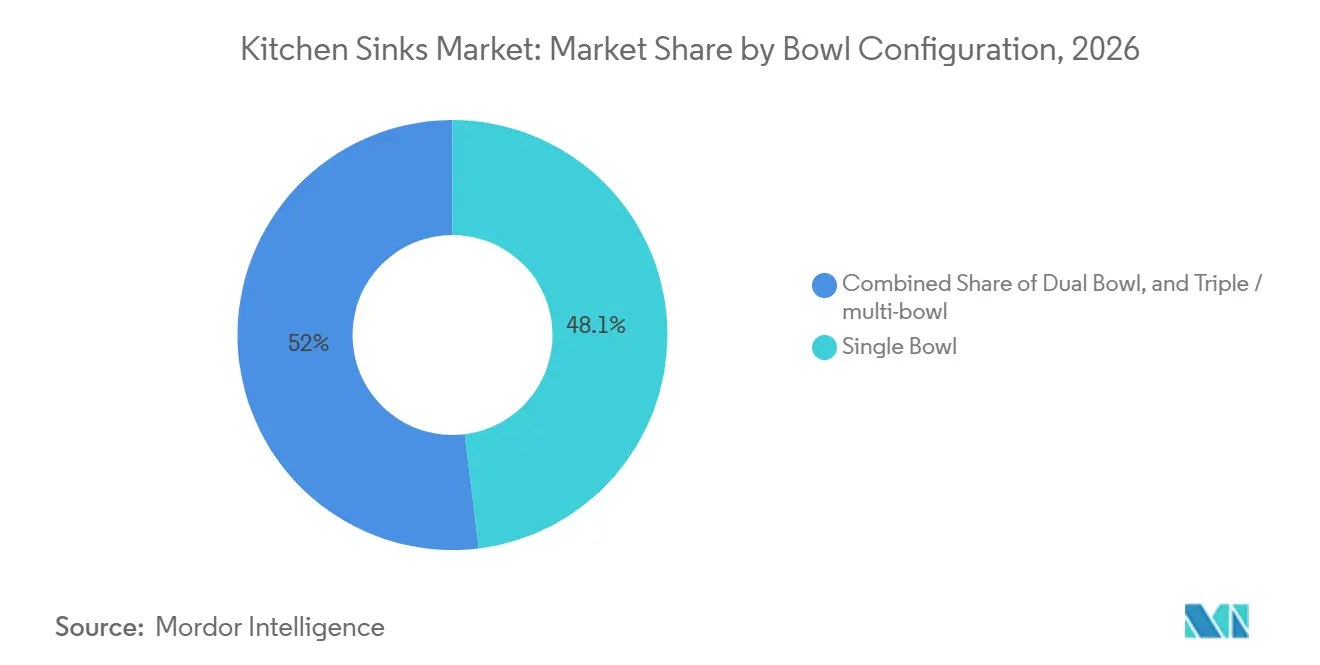
- By bowl configuration, single-bowl sinks held 48.05% of the kitchen sink market share in 2026 and are forecast to expand at a 5.22% CAGR through 2032.
- By end user, residential users held 73.20% of the kitchen sink market share in 2026, while commercial users are forecast to expand at a 5.74% CAGR through 2032.
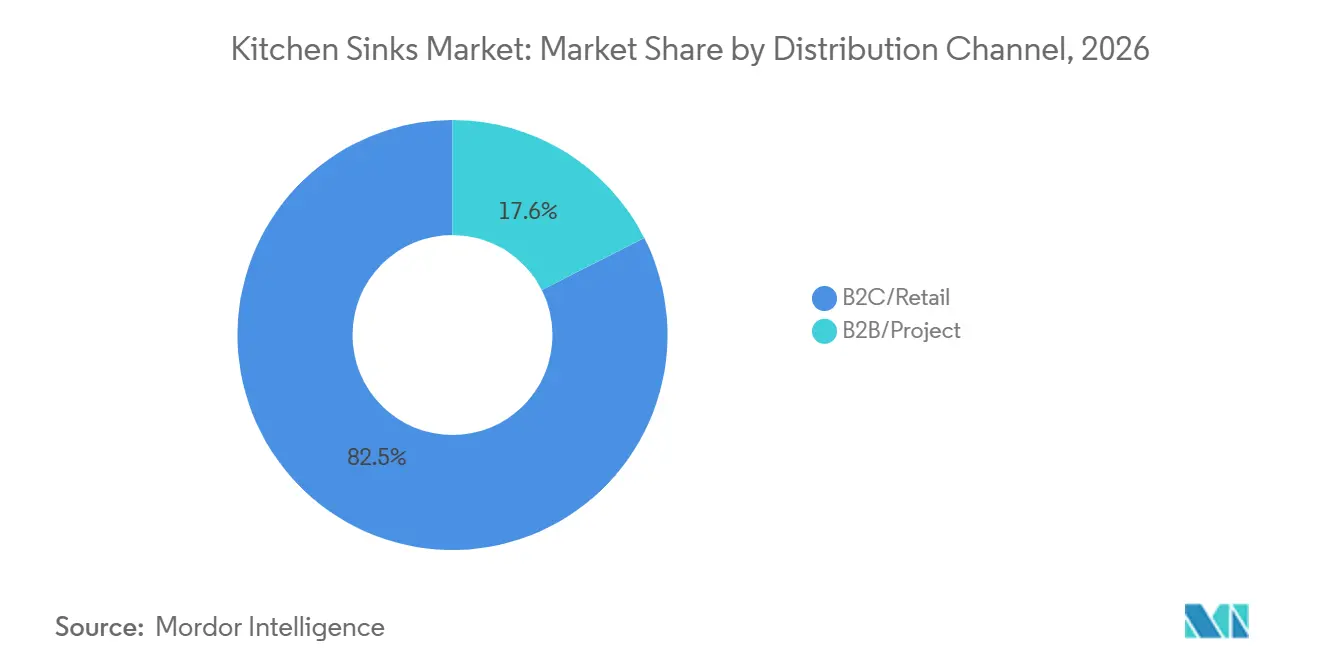
- By distribution channel, B2C and retail held 82.45% of the kitchen sink market share in 2026 and are forecast to expand at a 5.03% CAGR through 2032.
- By geography, Asia-Pacific held 45.03% of the kitchen sink market share in 2026 and is forecast to expand at a 5.51% CAGR through 2032.
Note: Market numbers in this report are based on Mordor Intelligence's proprietary estimation framework, which combines nine months of actuals with Q4 projections for base year 2026.
Market Trends and Insights
Drivers Impact Analysis of Kitchen Sink Market*
| Driver | (~) % Impact on CAGR Forecast | Geographic Relevance | Impact Timeline |
|---|---|---|---|
| Residential Construction and Kitchen Renovation | +1.1% | Global, with the largest effect in North America and South and Southeast Asia | Medium term (2-4 years) |
| Rising Disposable Income and Premium Fixture Upgrades | +0.9% | Asia-Pacific, with spillover to the Middle East and Africa and South America | Long term (≥ 4 years) |
| E-Commerce and Omnichannel Home-Improvement Expansion | +0.6% | Global, with India and China leading volume and the United States and Europe leading value | Medium term (2-4 years) |
| Hospitality, Foodservice, and Cloud-Kitchen Expansion | +0.5% | Asia-Pacific, the Middle East and Africa, and Western Europe | Short term (≤ 2 years) |
| Demand for Hygienic, Durable, and Low-Maintenance Materials | +0.5% | Global, with strong relevance in urban Asia-Pacific and commercial applications | Medium term (2-4 years) |
| Export Manufacturing and Private-Label Production Networks | +0.4% | Manufacturing hubs in India and China, serving North America and Europe | Long term (≥ 4 years) |
| Source: Mordor Intelligence | |||
Accelerating Residential Construction and Kitchen Renovation
Kitchen renovation supports replacement demand when new construction activity slows. The National Kitchen and Bath Association projected that the United States residential kitchen and bath spending would be USD 228 billion for 2026, up 0.1%, with repair-and-remodel spending forecast to rise 2.9% while new-construction-related spending declines 3%[1]. Renovation buyers can select higher-value materials and workstation-style formats instead of standard builder-grade fixtures, making replacement activity an important revenue source even when housing starts are subdued. In China, real estate development investment declined by 17.2% in 2025[2], highlighting the need for manufacturers to serve the renovation segment rather than rely solely on new construction projects. The kitchen sink market benefits when renovations involve countertop replacement, cabinetry upgrades, or complete kitchen redesigns, as consumers are less likely to replace sinks as standalone purchases. This relationship increases the importance of installer networks, contractor relationships, and product compatibility information. Drop-in sinks remain relevant because they offer a simpler installation option, while undermount, fireclay, and integrated products become more viable when homeowners replace countertops. This mix can increase value per project without comparable growth in fixture volumes. Renovation projects also allow buyers to evaluate basin depth, drainage and waste systems, and matching faucets. Suppliers that present these options as practical packages can reduce the likelihood of sinks being treated as late-stage, price-driven purchases, improving the value and quality of each sale.
Rising Disposable Income and Premium Kitchen Fixture Upgrades
Higher renovation budgets support demand for kitchen sinks that combine material performance, aesthetics, and integrated accessories. Premium buyers may consider fireclay, quartz composite, and multi-accessory workstation designs when budgets allow for broader upgrades, as these products offer surface durability and a finished appearance that complements the overall kitchen design. Such products can generate higher unit values than standard stainless steel models. In January 2026, Kohler launched its Audrine fireclay collection with Studio McGee in apron-front, undermount, and bar formats, highlighting the role of design partnerships and accessories in premium product positioning [3]. Premium demand also influences manufacturing investment and product development. In March 2025, Carysil announced an INR 500 crore investment program to double its quartz sink production capacity to 2 million units annually, signaling confidence in composite sink demand and export potential[4]. Manufacturers with branded composite materials can differentiate beyond price through coordinated accessories, color options, and countertop guidance. Higher-value products can improve the kitchen sink industry’s revenue mix when household budgets support broader renovation projects; however, premium demand varies by buyer group and region. Manufacturers need a clear good-better-best product range to prevent lower-budget renovation projects from shifting to private-label alternatives, while enabling retailers to attract shoppers with recognized premium products and offer practical entry-level options.
E-Commerce and Omnichannel Home-Improvement Expansion
Online retail is changing how households compare sink materials, dimensions, colors, and installation options, increasing the visibility of fixtures and related home products in digital purchasing journeys. Online product pages expand access to composite, fireclay, and workstation sinks beyond major showroom markets, enabling the kitchen sink market to reach customers in secondary cities through accurate specifications and reliable delivery. However, digital retail does not eliminate the need for physical channels or professional guidance, as buyers still require clear information on cabinet width, cutout size, faucet reach, drain placement, and countertop compatibility. Brands that provide comparison tools, detailed product photography, and installation instructions can reduce pre-purchase uncertainty. B2C and retail remain the largest distribution channel, as online sales operate within, rather than replace, broader retail demand. Strong omnichannel coverage supports online research, in-store selection, and installation through professional partners while enabling suppliers to track demand for specific sizes, finishes, and configurations. This information can guide inventory decisions, reduce the risk of carrying slow-moving specialty products, and reinforce the need for responsive customer service.
Hospitality, Foodservice, and Cloud-Kitchen Expansion
Commercial kitchens create distinct demand for durable, specification-driven sink procurement. Large foodservice and cloud kitchen operators procure standardized stainless steel products across multiple locations, highlighting their importance within commercial equipment supply chains. Commercial buyers assess hygiene, durability, and service support alongside purchase price. In North America, NSF/ANSI 2 influences food equipment specifications, while European food safety requirements shape commercial kitchen design. These standards favor materials that withstand intensive cleaning and professional use. Stainless steel remains well established due to its durability and familiarity among foodservice buyers. Cloud kitchen facilities also generate replacement demand when operators change or sites undergo refurbishment. Consequently, suppliers benefit from dedicated B2B sales teams, product certifications, and service arrangements. Although the commercial channel remains smaller than the residential channel, its 5.74% CAGR presents a clear opportunity for manufacturers with relevant capabilities. Long procurement cycles favor suppliers that maintain compliant documentation, reliable product availability, and responsive replacement support. Large facility operators may prefer a limited, standardized product range that can be replicated across sites, enabling well-qualified suppliers to establish longer-term relationships than those serving one-off retail purchases.
Restraints Impact Analysis of Kitchen Sink Market*
| Restraint | (~) % Impact on CAGR Forecast | Geographic Relevance | Impact Timeline |
|---|---|---|---|
| Stainless Steel, Composite, and Ceramic Input-Cost Volatility | -0.9% | Global, with the strongest effect in European and East Asian manufacturing hubs | Medium term (2-4 years) |
| Fragmented Competition and Private-Label Price Pressure | -0.7% | Global, with the strongest effect in Asia-Pacific and North American mass-market channels | Long term (≥ 4 years) |
| Skilled Installation Requirements for Premium Sink Formats | -0.6% | North America, Europe, and premium Asia-Pacific urban markets | Medium term (2-4 years) |
| Non-Standard Cabinet and Plumbing Interfaces Across Markets | -0.4% | Global, with the strongest effect in South American and Middle Eastern and African renovation markets | Long term (≥ 4 years) |
| Source: Mordor Intelligence | |||
Stainless Steel, Composite, and Ceramic Input-Cost Volatility
Material costs remain a persistent challenge for kitchen sink products that use stainless steel, resins, minerals, or ceramic inputs. Nickel, a key input in 304-grade stainless steel, and the costs of acrylic resin and mineral fillers can pressure manufacturers competing in price-sensitive retail categories. Buyers may delay purchases or trade down following repeated price adjustments, making supply contracts, recycled content, and material efficiency important commercial tools. In July 2025, Franke and POSCO signed a material supply agreement for premium stainless steel sinks made with more than 90% recycled scrap and renewable energy, with TÜV SÜD certifying a 60% lower product carbon footprint than stated benchmark products. Such procurement can reduce supply risks and support environmental compliance, creating cost and compliance advantages for larger manufacturers. Smaller suppliers may find it more difficult to absorb certification costs and manage long-term material contracts. Private-label and commodity products can intensify price pressure at the lower end of the kitchen sink market, requiring producers that cannot pass on higher material costs to simplify features or revise their product mix. Manufacturers with substantiated material claims, reliable supply, and verified product information may have greater scope to defend pricing, making procurement discipline a practical competitive factor.
Skilled Installation Requirements for Premium Sink Formats
Premium sink formats require precise installation and compatible surrounding materials. Flush-mount products need careful countertop routing and sealing. At the same time, farmhouse and undermount fireclay sinks may require cabinet reinforcement or full countertop replacement, increasing total project costs beyond the fixture price. Skilled labor shortages and rising trade costs remain downside risks for renovation activity, particularly for buyers seeking premium design within limited budgets. Manufacturers can mitigate this restraint through standardized cutouts, improved templates, installer training, and certified installer networks. Products compatible with multiple countertop materials offer greater flexibility for retailers and fabricators. In 2025, BLANCO introduced the INTEOS workstation sink, with stainless steel and SILGRANIT models using a single cutout dimension, simplifying specification and reducing installation uncertainty. Clear digital instructions and upfront communication of cabinet modifications, countertop requirements, and labor availability can support customers and help prevent failed or delayed installations that could negatively affect the overall renovation experience.
*Our forecasts treat driver/restraint impacts as directional, not additive. The impact forecasts reflect baseline growth, mix effects, and variable interactions.
Kitchen Sink Market Segment Analysis
By Material:
Stainless Steel Anchors Share as Composites Capture ValueStainless steel held 52.12% of the kitchen sink market share in 2026, making it the leading material category. It is widely used because it is familiar, durable, and suited to both household and commercial applications. Its broad price range also supports use in replacement projects and large-scale commercial procurement. Foodservice requirements reinforce its role in professional kitchens where cleanability and durability are central purchase factors. Acrylic serves entry-level and compact urban demand, while fireclay and stone-based materials serve higher-value applications. Material choice therefore reflects not only appearance but also installation context, buyer budget, and expected intensity of use.
Quartz composite is is projected to be the fastest-growing material, with the kitchen sink market size for this segment forecast to grow at an 8.58% CAGR through 2032. Its scratch resistance, sound reduction, color options, and nonporous surface appeal to buyers seeking a premium upgrade. BLANCO introduced VELGRANIT in March 2026 as a composite material positioned for resistance to heat, staining, and impact. Franke’s Fragranite range similarly supports a differentiated composite offer. Suppliers with established composite brands can earn greater value per unit than commodity stainless producers. The material mix is likely to remain two-tiered, with stainless steel supporting volume and composite products supporting premium revenue. Stainless steel suppliers can still differentiate through bowl depth, gauge, noise reduction, and accessory systems. Composite brands need to show the practical benefit of their material claims, not only a wider color palette. The strongest portfolios can serve standard replacements while offering an evident path to a better specified product.

By Installation Type:
Drop-In Leads While Flush-Mount Gains Premium DemandTop-mount and drop-in formats held 43.26% of the kitchen sink market share in 2026. Their installed base benefits from retrofit compatibility, especially in kitchens with laminate or tiled countertops. The format is often less difficult to install than other options and can reduce project cost. This matters in older homes and price-conscious renovation work. Undermount products remain common in premium engineered-stone countertop projects. Farmhouse and apron-front products address buyers who place high value on visible design features.
Flush-mount products are forecast to grow at a 5.96% CAGR through 2032. They support a design approach where the sink and countertop are treated as one coordinated surface. This approach requires closer coordination between sink suppliers, countertop fabricators, and installers. BLANCO’s OOVALON product was introduced for undermount or flush-mount applications and was recognized with an iF Design Award in 2026. Dual-mount models provide flexibility when retailers need to cover more installation settings with fewer product lines. The kitchen sink industry can benefit from this mix because accessible drop-in products and integrated premium products serve distinct renovation needs. Product planning must account for the fact that a homeowner may select a format long before a final countertop is chosen. Suppliers that provide dimensions, templates, and professional support early in the process can remain involved in the specification. This makes installation type a route to customer retention as well as a design decision.
By Bowl Configuration:
Single-Bowl Workstations Lead Utility-Focused DemandSingle-bowl products accounted for 48.05% of the kitchen sink market share in 2026. Single-bowl sinks are also projected to grow at the fastest CAGR among configurations, at 5.22% through 2032. A large single bowl can accommodate oversized cookware and create a flexible preparation area. Accessory ledges can support cutting boards, colanders, and drying racks without taking additional counter space. This design is relevant to both premium homes and compact kitchens that need flexible work surfaces. It also suits commercial settings that require an uncomplicated and durable basin design.
Kohler introduced the Synthos Workstation in November 2025 with sizes from 30 inches to 72 inches and noise-reduction technology. Zurn Elkay also extended its Quartz Luxe and Circuit Chef workstation catalogs in January 2025. Dual-bowl products remain relevant where users prefer task separation or dishwashers are less common. Multi-bowl formats retain an institutional role where food handling processes require separate washing and rinsing stages. The configuration choice will continue to depend on household routines, appliance penetration, and commercial hygiene requirements. A single large bowl can be compelling where counter space is limited, but some households will still prioritize separate work areas. Manufacturers should therefore avoid treating one configuration as universally suitable. A clear range allows retailers and designers to match functional preferences with the available kitchen space.
By End User:
Residential Remains the Core While Commercial Demand Grows FasterResidential users accounted for 73.20% of the kitchen sink market share in 2026. The category benefits from the large installed base of homes and the recurring need to update kitchens. Renovation spending is especially important in mature economies where new construction activity can be uneven. The National Kitchen and Bath Association expects remodeling product spending to outpace new-construction spending in 2025. This relationship supports demand for replacement sinks across a wide range of price points. Premium renovation activity can further shift demand toward fireclay, composite, and workstation products.
Commercial end users are forecast to expand at a 5.74% CAGR through 2032. Their procurement decisions often give priority to specifications, lifecycle durability, cleaning, and supplier service. Hospitality groups, restaurant chains, foodservice operators, and cloud kitchens use standardized equipment across multiple sites. This creates an opportunity for suppliers that can offer certified products and consistent service. Commercial demand also helps reduce reliance on household renovation cycles. The kitchen sink market should see commercial buyers gradually represent a greater share of total value as their growth remains above the overall forecast. Commercial buyers also create demand for dependable spare parts, technical documents, and timely replacement support. These requirements can be difficult for retail-focused suppliers to meet without separate service processes. Suppliers that build that capability can pursue a wider range of foodservice and hospitality projects.
By Distribution Channel:
Retail Leads as Online Shopping Expands AccessB2C and retail held 82.45% of the kitchen sink market share in 2026. The channel includes home centers, specialist retailers, brand outlets, local hardware stores, and online platforms. Physical stores remain useful because consumers often want to assess material, depth, finish, and accessory options before buying. Retailers also play a role in matching the fixture to cabinets, countertops, and faucets. In emerging markets, local stores and contractor relationships remain important for household purchase decisions. The channel’s breadth helps it retain the largest share of category sales.
B2C and retail are forecast to grow at a 5.03% CAGR through 2032 because online retail is expanding within the wider channel. Amazon India’s reported growth in sink purchases shows that buyers are willing to purchase fixtures through digital platforms. B2B and project channels remain important for developers, hospitality companies, and cloud kitchen operators. These customers often buy through direct manufacturer relationships and standard project specifications. Private-label procurement can widen assortment for retailers while intensifying price competition for brands without material differentiation. Manufacturers need channel-specific product content and service models to manage both opportunities. A retail listing should make product selection simple, while a project specification needs technical depth and compliance detail. Treating both audiences the same can limit conversion in one channel or create unnecessary complexity in the other. Channel discipline can therefore improve the efficiency of selling as well as the customer experience.
Geography Analysis
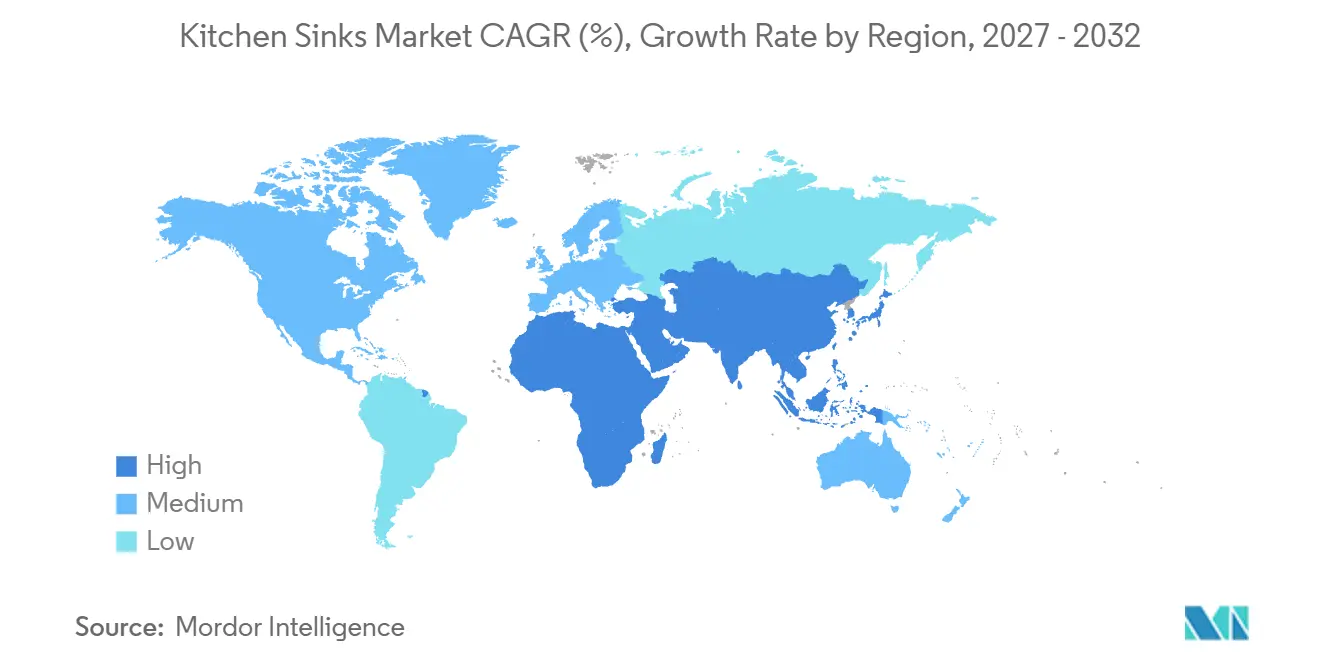
Asia-Pacific held 45.03% of the kitchen sink market share in 2026 and is forecast to grow at a 5.51% CAGR through 2032. The region combines large residential construction needs, urban household formation, and expanding renovation activity. India supports demand through premium housing development and a growing manufacturing base for stainless and composite products. Kohler launched its Strive stainless steel sink range for India in April 2025 with deeper basins and SilentShield sound absorption. The product shows why regional adaptation matters in a market with distinct household requirements.
China’s real estate development investment fell 17.2% in 2025, according to the National Bureau of Statistics of China. This raises the importance of replacement activity, renovation, and upgrading rather than dependence on greenfield housing. Vietnam, Indonesia, the Philippines, and Malaysia continue to offer demand potential as formal kitchen and plumbing infrastructure develops. Asia-Pacific also benefits from the presence of export-oriented manufacturers that serve local and overseas customers. The kitchen sink market size in the region reflects both volume demand and a widening premium segment. Online retail can help companies reach cities that have fewer specialized showrooms. Local production capacity can shorten delivery times and allow suppliers to offer a range suited to local cabinetry and household practices. At the same time, rising premium demand does not eliminate the need for durable value products in lower-price urban housing. Suppliers operating in Asia-Pacific need product ladders that recognize substantial differences in income, project type, and retail infrastructure across the region.
North America remains a high-value renovation market. Premium workstation, composite, farmhouse, and flush-mount formats are well established in the region. Franke opened a USD 82 million foodservice manufacturing facility in San Luis Potosí, Mexico, in July 2025 to serve commercial demand across the Americas. Europe remains a design-focused market where product certification, flush-mount design, and composite material innovation matter. South America has uneven income conditions and remains sensitive to wider economic stability. The Middle East and Africa are supported by hospitality, residential development, and commercial project activity, with GCC markets carrying particular importance. Product specifications in these markets often reflect the needs of large projects rather than individual retail replacement. This can favor suppliers with regional distributors, dependable lead times, and the ability to support project documentation. South America requires a different approach because affordability and economic conditions can affect the timing of home improvement spending.
Competitive Landscape
The kitchen sink market is fragmented. Premium global suppliers compete through proprietary materials, design credentials, accessories, and channel coverage. Franke, Kohler, and BLANCO have visible positions in premium residential and professional product categories. Indian composite manufacturers and Chinese stainless steel fabricators add competitive pressure through scale and export reach. This structure gives buyers a broad range of price points and materials. It also creates a clear distinction between patented or branded products and commodity offerings. A proprietary material or coordinated accessory system can make direct price comparison more difficult for competitors. However, these advantages need to be backed by product availability and credible installation support. Cost-focused competitors retain an important position where standard stainless products meet the buyer’s needs. The competitive field is therefore defined by both technical differentiation and execution in local channels.
BLANCO has focused on product design and material development. Its INTEOS workstation sink received a 2025 Red Dot Award, while the OOVALON and LUNEOO UNIT received an iF Design Award in 2026. Kohler expanded its premium portfolio through the Audrine collection with Studio McGee in 2026. Carysil’s capacity expansion demonstrates how Indian producers are seeking a larger role in quartz composite supply. These moves show that material differentiation and manufacturing capacity are both central to competition.
Companies also need to manage changing procurement requirements. Recycled material content and product carbon information can matter in European commercial and public projects. Connected product platforms are an emerging area, although their practical value depends on consumer adoption and compatibility. BLANCO announced planned integration of its UNIT app with the Home Assistant smart-home ecosystem in September 2026. Suppliers that can support DIY e-commerce buyers and professional B2B specifiers will be better placed to serve varied demand. Competition is likely to remain balanced between design-led global brands and cost-competitive regional manufacturers. Large global brands can apply design expertise, established retailer relationships, and recognized material names across several geographies. Regional producers can respond quickly to local price points and may benefit from shorter supply chains.
Kitchen Sink Industry Leaders
-
Kohler Co.
-
Franke Holding AG
-
BLANCO GmbH + Co KG
-
Elkay Manufacturing Company
-
Teka Group
- *Disclaimer: Major Players sorted in no particular order
Kitchen Sink Market Companies Covered in this Report
- Franke Group
- Kohler Co.
- BLANCO GmbH + Co KG
- Elkay Manufacturing Company
- Teka Industrial S.A.
- Carysil Limited
- Bareno
- Roca Sanitario, S.A.
- Duravit Aktiengesellschaft
- Reginox B.V.
- Baekjo
- Alveus d.o.o.
- Nirali BG
- Hindware Home Innovation Ltd.
- Oliveri
- TOTO LTD.
- LIXIL Corporation
- Jaquar and Company Private Limited
- JOMOO Group
- Villeroy & Boch AG
Recent Industry Developments in Kitchen Sink Market
- September 2026: BLANCO unveiled the VION sink and LAVIN faucet as a coordinated UNIT at Küchenmeile 2026, introduced Durinox stainless steel in gold and platinum colorways, and announced planned integration of the BLANCO UNIT app with the open-source Home Assistant smart home ecosystem.
- March 2025: BLANCO launched the OOVALON sink in patented VELGRANIT composite alongside the LUNEOO faucet, and the OOVALON and LUNEOO UNIT received an iF Design Award in 2026.
- January 2026: Kohler Co. launched the Audrine kitchen sink collection with Studio McGee in apron-front, undermount, and bar configurations with integrated accessories.
- August 2025: Middleby Corporation announced a supply agreement with CloudKitchens to equip up to 750 delivery kitchen sites across France, Spain, Portugal, Poland, the Netherlands, and Italy.
Global Kitchen Sink Market Report Scope
Segmentation Overview
| Stainless Steel |
| Quartz |
| Fireclay |
| Granite and Marble |
| Acrylic |
| Other Materials |
| Top-Mount/Drop-In |
| Undermount |
| Farmhouse/Apron-Front |
| Flush Mount |
| Dual Mount |
| Other Installation Types |
| Single Bowl |
| Dual Bowl |
| Triple /Multi-Bowl |
| Residential |
| Commercial |
| B2C/Retail | Home Centers/DIY |
| Exclusive Brand Outlets | |
| Local Hardware Shops/Unorganized Market | |
| Online | |
| Other Distribution Channels | |
| B2B/Project (Direct from the Manufacturers) |
| North America | Canada |
| United States | |
| Mexico | |
| South America | Brazil |
| Peru | |
| Chile | |
| Argentina | |
| Rest of South America | |
| Europe | United Kingdom |
| Germany | |
| France | |
| Spain | |
| Italy | |
| BENELUX (Belgium, Netherlands, Luxembourg) | |
| NORDICS (Denmark, Finland, Iceland, Norway, Sweden) | |
| Rest of Europe | |
| Asia-Pacific | India |
| China | |
| Japan | |
| Australia | |
| South Korea | |
| South-East Asia | |
| Rest of Asia-Pacific | |
| Middle East & Africa | United Arab Emirates |
| Saudi Arabia | |
| South Africa | |
| Nigeria | |
| Rest of Middle East & Africa |
| By Material | Stainless Steel | |
| Quartz | ||
| Fireclay | ||
| Granite and Marble | ||
| Acrylic | ||
| Other Materials | ||
| By Installation Type | Top-Mount/Drop-In | |
| Undermount | ||
| Farmhouse/Apron-Front | ||
| Flush Mount | ||
| Dual Mount | ||
| Other Installation Types | ||
| By Bowl Configuration | Single Bowl | |
| Dual Bowl | ||
| Triple /Multi-Bowl | ||
| By End User | Residential | |
| Commercial | ||
| By Distribution Channel | B2C/Retail | Home Centers/DIY |
| Exclusive Brand Outlets | ||
| Local Hardware Shops/Unorganized Market | ||
| Online | ||
| Other Distribution Channels | ||
| B2B/Project (Direct from the Manufacturers) | ||
| By Geography | North America | Canada |
| United States | ||
| Mexico | ||
| South America | Brazil | |
| Peru | ||
| Chile | ||
| Argentina | ||
| Rest of South America | ||
| Europe | United Kingdom | |
| Germany | ||
| France | ||
| Spain | ||
| Italy | ||
| BENELUX (Belgium, Netherlands, Luxembourg) | ||
| NORDICS (Denmark, Finland, Iceland, Norway, Sweden) | ||
| Rest of Europe | ||
| Asia-Pacific | India | |
| China | ||
| Japan | ||
| Australia | ||
| South Korea | ||
| South-East Asia | ||
| Rest of Asia-Pacific | ||
| Middle East & Africa | United Arab Emirates | |
| Saudi Arabia | ||
| South Africa | ||
| Nigeria | ||
| Rest of Middle East & Africa | ||
Key Questions Answered in the Report
What is the projected value of the kitchen sink sector by 2032?
The kitchen sink sector is projected to reach USD 535 billion by 2032, growing at a 4.57% CAGR from 2027.
Which kitchen sink material is growing fastest?
Quartz composite is the fastest-growing material, with an 8.58% CAGR forecast through 2032.
Why do stainless steel sinks remain widely used?
Stainless steel held a 52.12% share in 2026 because it offers durability, broad price coverage, and established use in residential and commercial kitchens.
Which installation type is expected to grow fastest?
Flush-mount sinks are forecast to grow at a 5.96% CAGR through 2032 as integrated countertop designs gain adoption.
What is driving commercial kitchen sink demand?
Hospitality, foodservice, and cloud kitchen operators need standardized, durable products and are forecast to support 5.74% CAGR growth in commercial end use.