
Keystroke Dynamics Biometrics Market Size and Share
Market Overview
| Study Period | 2021 - 2032 |
|---|---|
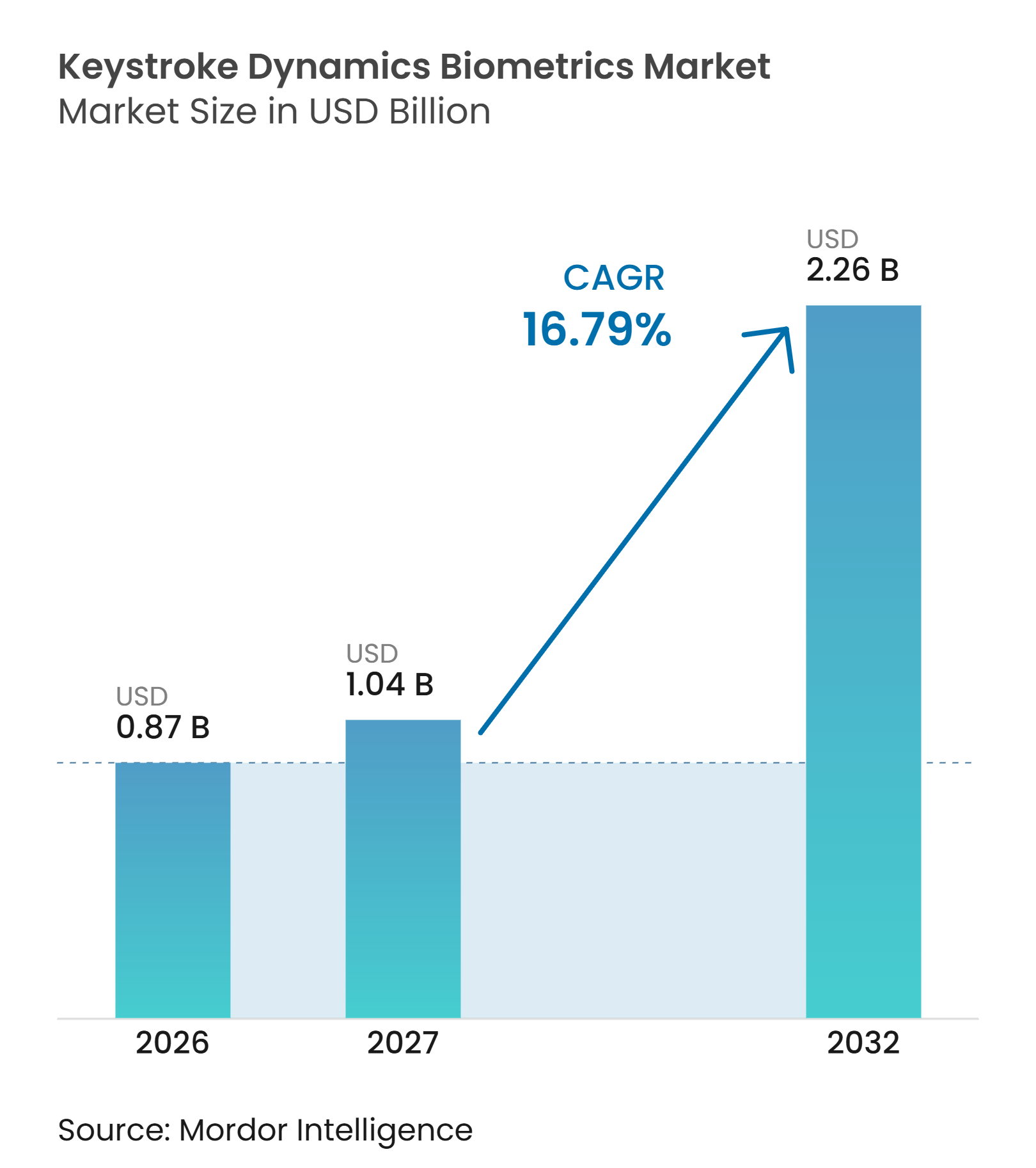
| Market Size (2027) | USD 1.04 Billion |
| Market Size (2032) | USD 2.26 Billion |
| Growth Rate (2027 - 2032) | 16.79 % |
| Fastest Growing Market | Asia-Pacific |
| Largest Market | North America |
| Market Concentration | Medium |
Major Players *Disclaimer: Major Players sorted in no particular order Image © Mordor Intelligence. Reuse requires attribution under CC BY 4.0. | |
Keystroke Dynamics Biometrics Market Analysis by Mordor Intelligence
The Keystroke Dynamics Biometrics Market size is expected to increase from USD 0.87 billion in 2026 to USD 2.26 billion by 2032, advancing at a CAGR of 16.79% over 2027-2032. The Keystroke Dynamics Biometrics Market benefits from software-based deployment because it works through existing keyboards and does not require fingerprint or iris hardware. This model suits distributed workforces, where separate biometric hardware can add cost and complexity. Rising account-takeover fraud is making continuous verification more relevant for financial and healthcare platforms. Cloud delivery supports scalable deployments, while privacy rules are encouraging local processing of behavioral signals. Passkeys can strengthen initial login assurance, and keystroke analysis can add verification during the session.
Key Report Takeaways
- By component, software held 57.73% of revenue in 2026, while services are projected to expand at a 17.22% CAGR through 2032.
- By authentication type, static authentication held 52.89% of revenue in 2026, while continuous authentication is projected to expand at a 17.34% CAGR through 2032.
- By deployment model, cloud-based deployment held 56.87% of revenue in 2026 and is projected to expand at a 17.43% CAGR through 2032.
- By application, fraud detection and prevention held 40.93% of revenue in 2026, while risk and compliance management is projected to expand at a 17.21% CAGR through 2032.
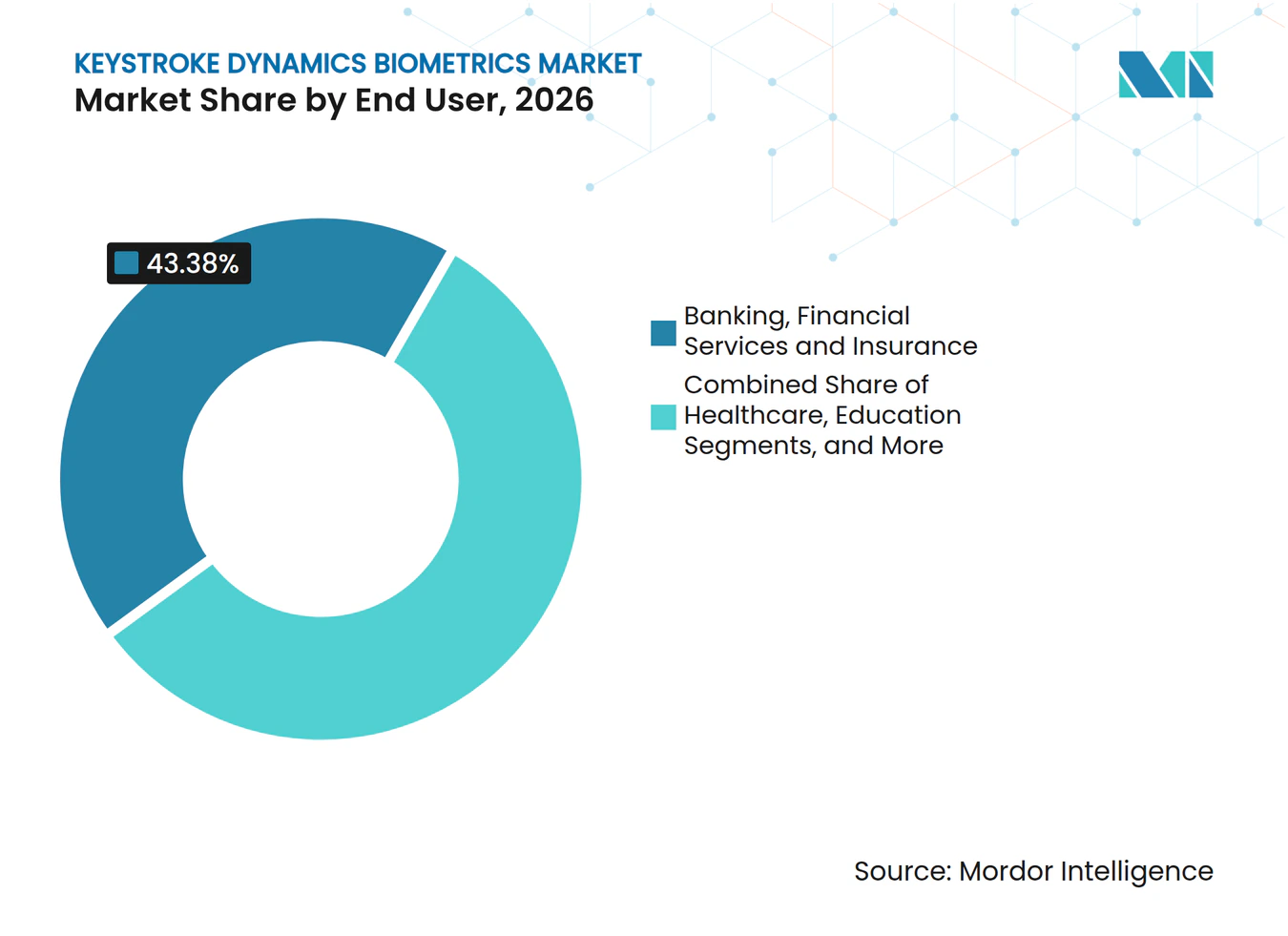
- By end user, banking, financial services and insurance held 43.38% of Keystroke Dynamics Biometrics Market revenue in 2026, while healthcare is projected to expand at a 17.46% CAGR through 2032.
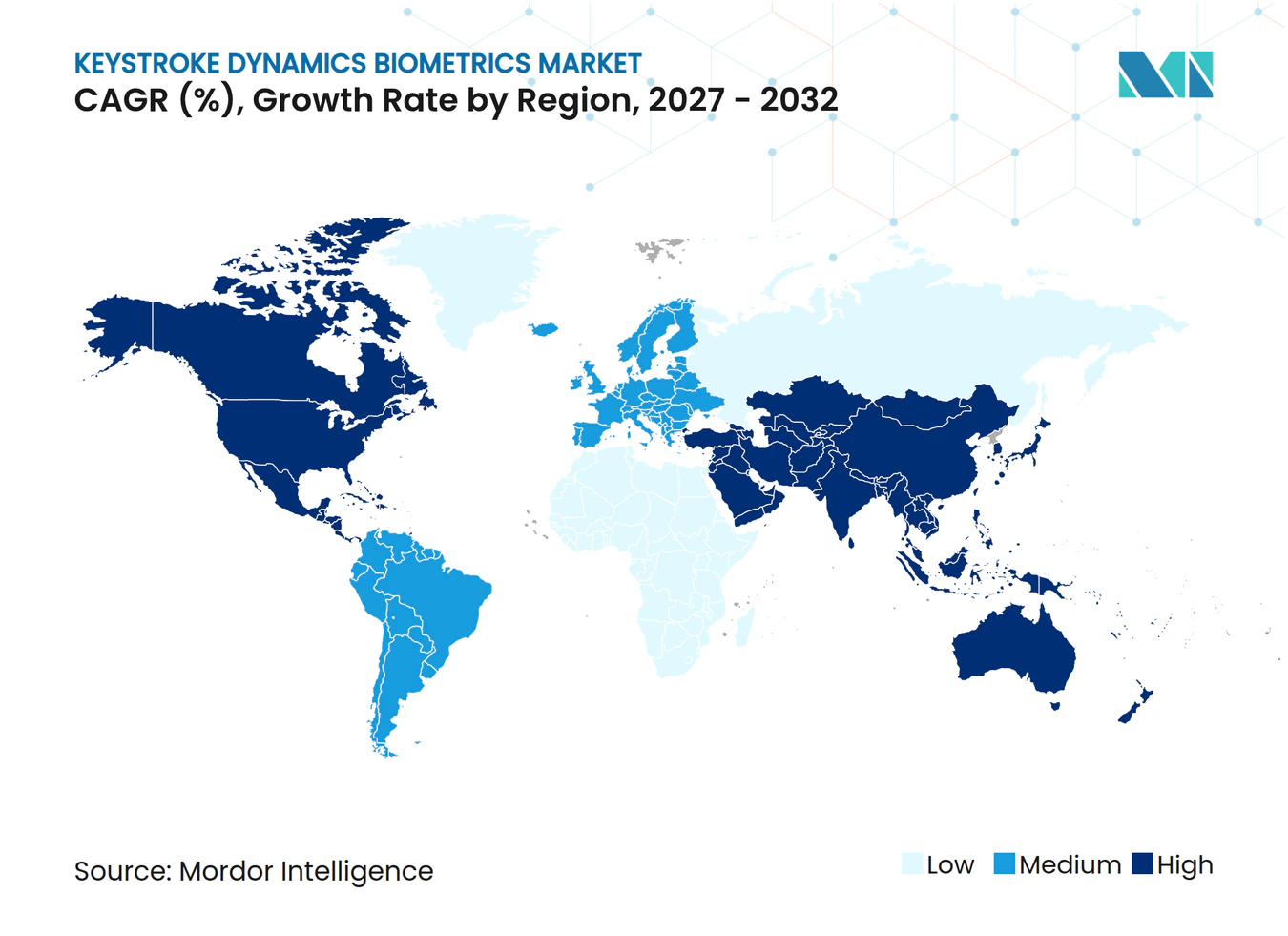
- By geography, North America held 36.27% of revenue in 2026, while Asia-Pacific is projected to expand at a 17.58% CAGR through 2032.
Note: Market numbers in this report are based on Mordor Intelligence's proprietary estimation framework, which combines nine months of actuals with Q4 projections for base year 2026.
Market Trends and Insights
Drivers Impact Analysis of Keystroke Dynamics Biometrics Market*
| Driver | (~) % Impact on CAGR Forecast | Geographic Relevance | Impact Timeline |
|---|---|---|---|
| Increasing Account-Takeover and Digital-Transaction Fraud | +5.2% | Global, concentrated in North America and Asia-Pacific | Short term (≤ 2 years) |
| Growing Adoption of Continuous and Passive Authentication | +4.1% | Global, with strongest enterprise uptake in North America and Europe | Medium term (2-4 years) |
| Expansion of Cloud, Mobile, and Remote-Work Security | +3.6% | Global, especially North America, Asia-Pacific, and Europe | Short term (≤ 2 years) |
| Integration With FIDO2, Passwordless Authentication, and Zero-Trust Architectures | +2.8% | North America and Europe, expanding into Asia-Pacific | Medium term (2-4 years) |
| Rising Regulatory Requirements for Strong Customer Authentication | +2.3% | Europe, with compliance spillover to other markets | Medium term (2-4 years) |
| AI-Enabled Behavioral Pattern Recognition and Edge Inference | +1.9% | Global, with leading deployment in North America and Europe | Long term (≥ 4 years) |
| Source: Mordor Intelligence | |||
Increasing Account-Takeover and Digital-Transaction Fraud
Account-takeover fraud is increasing the need for controls that identify the person operating an account after credentials are compromised. The FBI received more than 5,100 account-takeover complaints from January through November 2025, with reported losses exceeding USD 262 million and targets including financial, payroll, and health savings accounts.[1] LexisNexis Risk Solutions reported that login-stage account-takeover attacks rose 89% in 2025, with desktop attacks increasing by more than 200%.[2] Typing cadence, keystroke latency, and hold times can provide a behavioral signal before funds leave an account. BioCatch reported that its network analyzed 18 billion user sessions each month across more than 357 financial institutions in Q1 2026. This scale makes fraud prevention the central commercial application for the Keystroke Dynamics Biometrics Market.
Growing Adoption of Continuous and Passive Authentication
Continuous authentication addresses the weakness of verifying identity only at login and then trusting the session. NIST SP 800-63B Revision 4 includes session monitoring requirements that support periodic identity reassertion for federal use cases. Keyboard activity provides a recurring signal without requiring an extra step from the user. This approach can identify changes caused by session hijacking, device sharing, or unauthorized access after login. TypingDNA stated that ActiveLock 3.5 processes behavioral verification on the device rather than sending raw keystrokes for real-time authentication. That design can help regulated organizations address privacy concerns while applying continuous controls.
Expansion of Cloud, Mobile, and Remote-Work Security
Remote work, personal devices, and cloud applications have moved identity checks beyond the traditional enterprise perimeter. A 2025 study found that systems combining keystrokes, mouse movement, and contextual factors reached 98.25% accuracy in remote-work authentication testing. Cloud-based platforms can refresh behavioral models as attack patterns change, without requiring an on-premises update cycle. The 56.87% cloud-based revenue share in 2026 shows that this delivery model is already central to the Keystroke Dynamics Biometrics Market. Shared intelligence can also improve detection when vendors identify comparable anomaly patterns across client environments. Bring-your-own-device policies reinforce the need for authentication that does not depend on endpoint ownership or a specific hardware configuration.
Integration With FIDO2, Passwordless Authentication, and Zero-Trust Architectures
The FIDO Alliance reported 5 billion passkeys in use globally by May 2026, while 68% of surveyed organizations had deployed or were deploying passkeys for employee sign-ins. Passkeys improve assurance at the login event, but they do not independently verify the person who continues to use a session. Keystroke dynamics can provide this session-level check after a FIDO2 login. TypingDNA has positioned continuous typing authentication as a means to support zero-trust objectives and government-contractor compliance needs. Research from the University of Potsdam proposed FIDOnuous, an extension of FIDO2 and WebAuthn that incorporates continuous behavioral authentication. These integrations create a role for behavioral verification alongside, rather than instead of, passwordless authentication.
Restraints Impact Analysis of Keystroke Dynamics Biometrics Market*
| Restraint | (~) % Impact on CAGR Forecast | Geographic Relevance | Impact Timeline |
|---|---|---|---|
| Privacy, Consent, and Biometric-Data Governance Requirements | -2.1% | Europe, North America, and global markets | Medium term (2-4 years) |
| False Rejections Across Diverse Typing Behaviors and User Populations | -1.4% | Global, with greater exposure in mobile-first and multilingual markets | Medium term (2-4 years) |
| Legacy-System Integration and Cross-Device Compatibility Constraints | -1.0% | Global, with greater exposure in government and healthcare | Long term (≥ 4 years) |
| Limited Awareness and Implementation Resources Among Small and Medium Enterprises | -0.7% | Global, with greater exposure in South America, Africa, and Southeast Asia | Medium term (2-4 years) |
| Source: Mordor Intelligence | |||
Privacy, Consent, and Biometric-Data Governance Requirements
European data protection rules can treat typing-pattern data used for identification as special-category personal data. The European Commission explains that processing special-category data requires a valid Article 9 condition, including explicit consent in specified cases. The UK Information Commissioner's Office states that biometric recognition needs a lawful basis and an Article 9 condition, with consent requiring a freely given and specific choice.[3] CEN/TR 18241:2025 sets out biometric privacy management practices across the product lifecycle. These requirements favor local processing and data-minimization designs over centrally stored behavioral templates. Compliance work can raise entry barriers and lengthen deployment schedules in the Keystroke Dynamics Biometrics Market.
False Rejections Across Diverse Typing Behaviors and User Populations
False rejections can affect users who type in non-Latin scripts, switch devices, use touchscreens, or have motor variability. National Science Foundation-supported research identifies behavioral variability as a major challenge for continuous authentication systems. A 2025 survey in Computers and Security found that many keystroke and mouse systems do not sufficiently account for behavior changes caused by injury, new habits, or device switching. A personalized few-shot learning study using the Aalto University Mobile Keystroke Dynamics Dataset evaluated anomaly detection with as few as 15 samples for each user. Vendors need to show reliable results across diverse populations and input conditions. This requirement is especially important where buyers must demonstrate fairness, accessibility, and accuracy to regulators or internal governance teams.
*Our forecasts treat driver/restraint impacts as directional, not additive. The impact forecasts reflect baseline growth, mix effects, and variable interactions.
Keystroke Dynamics Biometrics Market Segment Analysis
By Component:
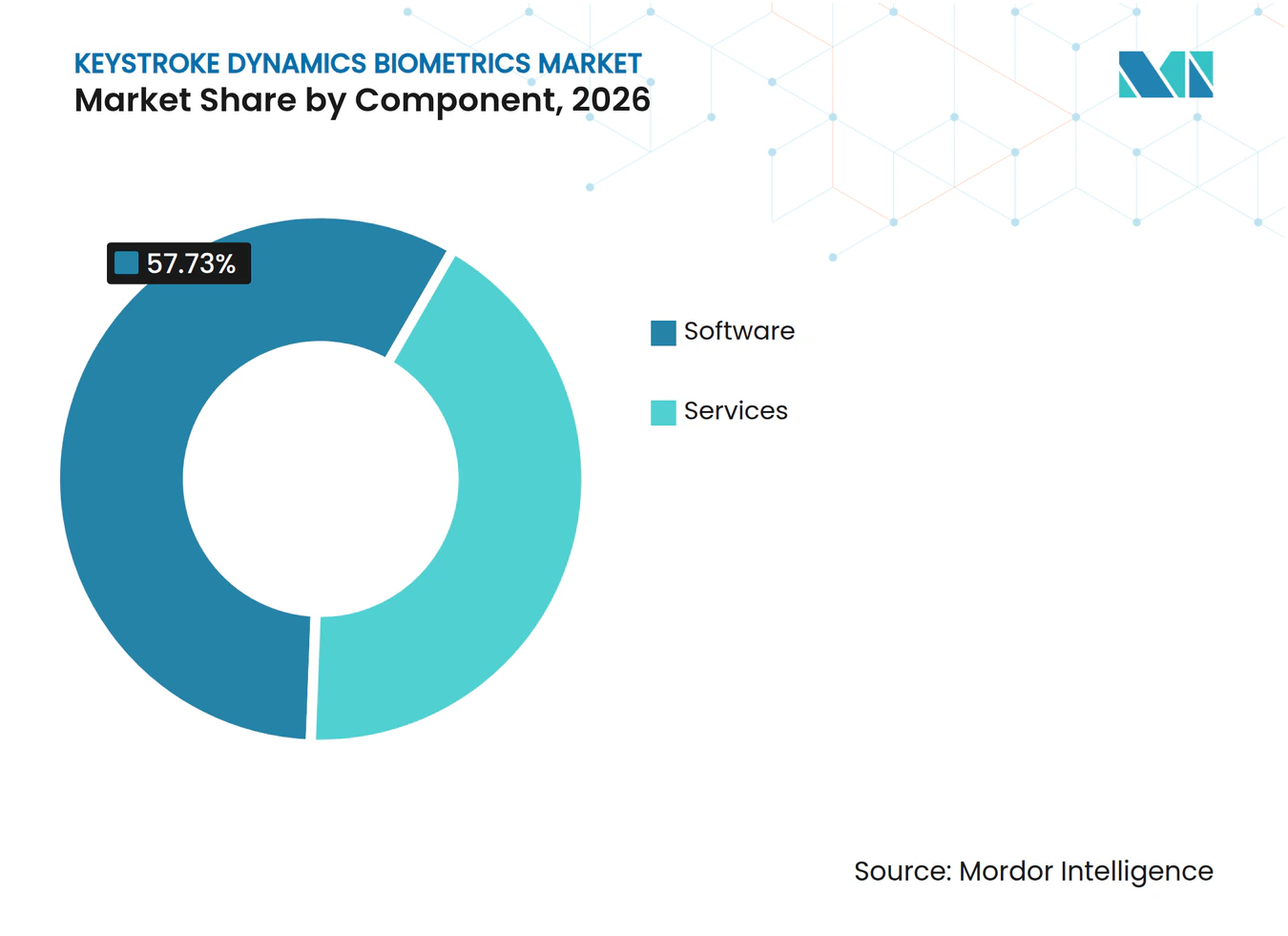
Software Dominance Supports Revenue While Services Gain MomentumSoftware held 57.73% of Keystroke Dynamics Biometrics Market revenue in 2026. Enterprises generally license behavioral analytics engines because typing-based authentication uses existing keyboard infrastructure. A 2025 IEEE study of the Type2Branch model reported equal error rates as low as 0.77% in desktop evaluation sets covering 15,000 subjects. These results support the use of software platforms in enterprise identity and fraud settings. The component does not require a dedicated fingerprint scanner, facial camera, or iris reader. This lowers provisioning needs for organizations with remote or hybrid workforces.
Services are projected to expand at a 17.22% CAGR through 2032, faster than the overall market. Implementation, integration, managed analytics, and post-deployment support create recurring work for providers. Large banking and healthcare customers often need customized integration across cloud, hybrid, and legacy systems. They also need audit records and service-level commitments that internal teams may not be prepared to manage. A 2025 study of the KeyRecs dataset found that gradient-boosting models achieved an 80% F1 score for binary typing-behavior classification. The result supports software productization, while deployment complexity supports sustained services demand.


By Authentication Type:
Static Authentication Retains Scale While Continuous Controls AccelerateStatic authentication accounted for 52.89% of the Keystroke Dynamics Biometrics Market share in 2026. Most deployed systems verify a user during a login event through a fixed text entry or passphrase. This approach has lower integration complexity than continuous session monitoring. It also fits established identity-proofing workflows where one enrollment action creates a behavioral reference. Static verification remains useful where the main requirement is stronger login assurance. It does not, however, independently identify a change in the person using an already authenticated session.
Continuous authentication is projected to expand at a 17.34% CAGR through 2032. It monitors behavioral patterns throughout an active session to identify session hijacking, device sharing, and post-login impersonation. A 2025 IEEE paper found that a genetic-algorithm approach combined with Isolation Forest detection improved mobile continuous-authentication performance across behavioral tasks. NIST session monitoring requirements also support periodic identity reassertion in relevant federal environments. Hospitals can apply these controls to shared workstations, while privileged-access teams can use them to identify unusual behavior. These uses extend keystroke verification beyond login-focused security.
By Deployment Model:
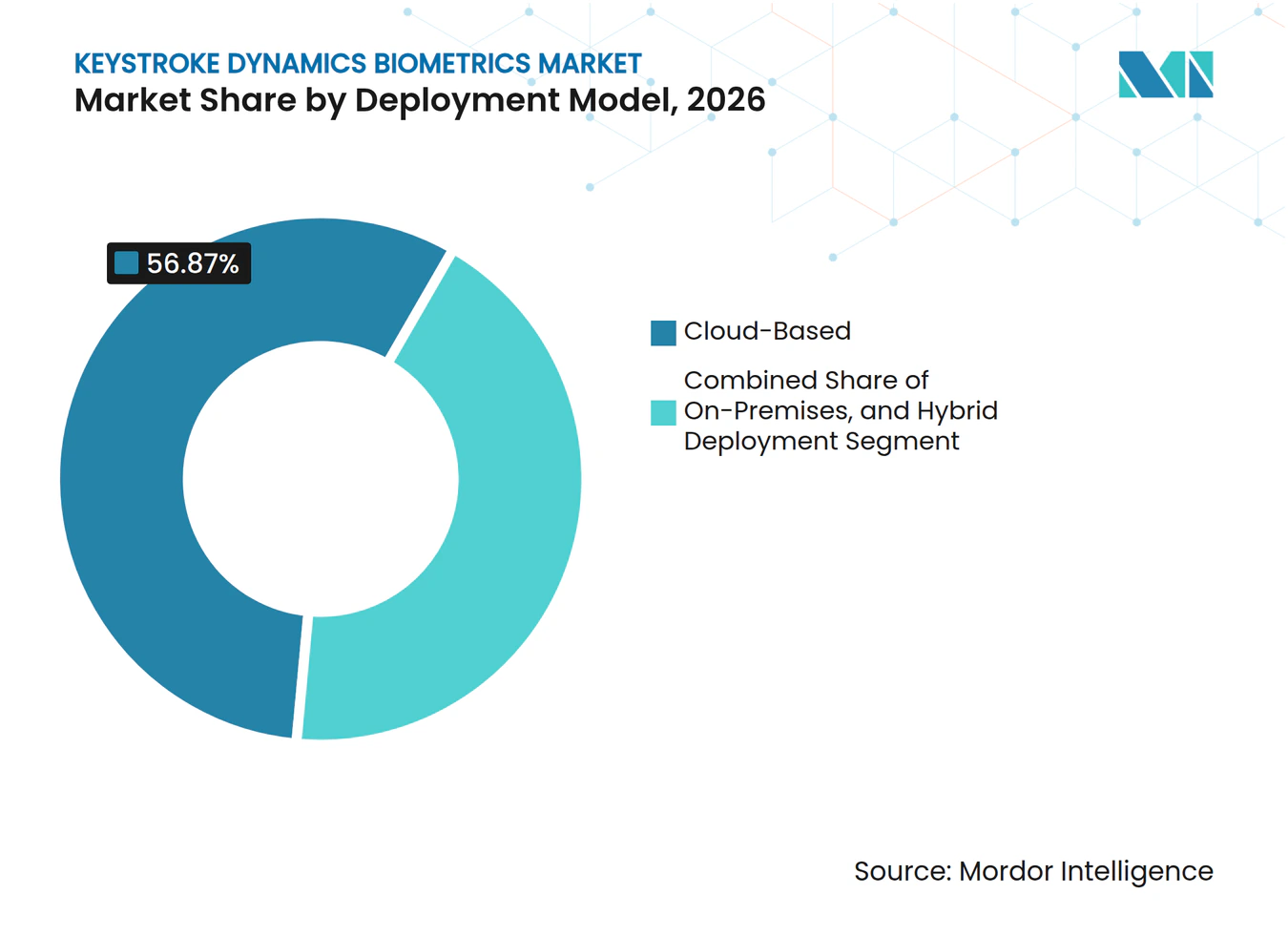
Cloud-Based Delivery Combines Scale With Model AdaptabilityCloud-based deployment accounted for 56.87% of Keystroke Dynamics Biometrics Market revenue in 2026. It is also projected to expand at a 17.43% CAGR through 2032. Cloud delivery allows vendors to refresh behavioral models as fraud tactics evolve. This can give enterprises current protection without waiting for planned on-premises maintenance windows. Shared platform intelligence may also improve detection when comparable fraud patterns appear across client networks. These advantages explain why organizations without an established deployment often select cloud-first designs.
On-premises systems remain relevant for government, defense, and critical infrastructure environments with air-gapped or classified networks. Hybrid designs combine centralized administration and model training with local endpoint inference. TypingDNA stated that ActiveLock 3.5 processed keystroke patterns locally on Windows, Mac, and Linux devices, including offline environments. Local inference can help organizations meet data-minimization requirements while retaining administrative reporting. The Keystroke Dynamics Biometrics Market therefore supports several deployment paths, rather than a single architecture. Hybrid models are especially relevant to European buyers balancing detection performance with data-residency needs.


By Application:
Fraud Prevention Leads While Compliance Uses ExpandFraud detection and prevention held 40.93% of Keystroke Dynamics Biometrics Market application revenue in 2026. Banking providers use behavioral signals to distinguish legitimate behavior from account takeover after login. A 2025 IEEE banking study found that behavioral metrics can identify unauthorized access attempts that static login checks can miss. This supports the investment case for integrating typing analytics into digital banking workflows. Behavioral data can be assessed before a payment or account change is completed. This improves the opportunity for timely intervention.
Risk and compliance management is projected to expand at a 17.21% CAGR through 2032. Compliance teams can use session-level behavioral records as evidence that an authorized user continued to access a sensitive system. This approach can support governance processes without adding another authentication prompt for employees. Identity proofing also remains relevant in remote onboarding. Privileged-access monitoring can identify a handoff of a high-risk session to an unauthorized person. Research on the Duolingo English Test showed that keystroke analysis can identify copy-typing and organized cheating patterns in remote assessment settings. This broadens application potential into education and insider-risk programs.
By End User:
BFSI Leads Demand While Healthcare Has The Fastest OutlookBanking, financial services and insurance held 43.38% of Keystroke Dynamics Biometrics Market revenue in 2026. The sector faces direct exposure to account takeover, payment fraud, and credential misuse. The European Banking Authority recognized behavioral biometrics as a possible inherence element for strong customer authentication under PSD2. This regulatory recognition supports investment by European financial institutions. Digital banks can use typing patterns to assess risk during login, payment, and account-management sessions. The link to fraud prevention keeps BFSI at the center of the Keystroke Dynamics Biometrics Market.
Healthcare is projected to expand at a 17.46% CAGR through 2032. Shared clinical workstations and frequent access to electronic health records create a need for low-friction identity verification. The HIPAA Security Rule requires covered entities to implement technical safeguards for electronic protected health information. A 2025 study of combined keystroke and gait authentication reported 98.25% accuracy and a 2.35% equal error rate in its evaluation. Retail and e-commerce organizations use behavioral controls against credential stuffing. Government, defense, education, and telecommunications users apply them to privileged access, remote assessments, and distributed endpoint security.
Geography Analysis
North America and Europe Keystroke Dynamics Biometrics Market
North America held 36.27% of Keystroke Dynamics Biometrics Market revenue in 2026. Advanced financial-services infrastructure and early enterprise adoption support the region's leading position. The FBI's 2025 account-takeover alert increased attention on fraud losses and digital-account security. NIST session-monitoring guidance is also relevant to federal agencies and their supply chains. Europe combines banking regulation with critical-infrastructure requirements, including Germany's NIS-2 guidance on multi-factor authentication.
APAC Keystroke Dynamics Biometrics Market
Asia-Pacific is projected to expand at a 17.58% CAGR through 2032, the fastest regional rate. Japan reported JPY 690 billion (USD 4.44 billion) in 2025 account-takeover losses, and Sumitomo Mitsui Trust Bank deployed a cloud-based FIDO authentication solution with SCSK Corporation and OneSpan in January 2026. India and China add volume through expanding digital-finance and mobile-payment ecosystems. A July 2026 BioCatch survey of 100 Singapore banking fraud and compliance leaders found that 91% considered behavioral biometrics a priority investment.
EMEA and South America Keystroke Dynamics Biometrics Market
The Middle East is developing through banking modernization and fraud-prevention programs in Saudi Arabia and the UAE. South American adoption is concentrated in Brazil and Argentina, where mobile banking and digital fraud both remain relevant to buyer demand. A University of Lodz study documented a tenfold increase in Polish banking fraud value from 2019 to 2024, with behavioral biometrics identified as a potential mitigation measure. Africa remains earlier in adoption, although mobile-first banking in South Africa, Kenya, and Nigeria creates a hardware-independent opportunity. Limited vendor distribution and implementation skills constrain near-term scale across several of these countries.
Competitive Landscape
Market Concentration
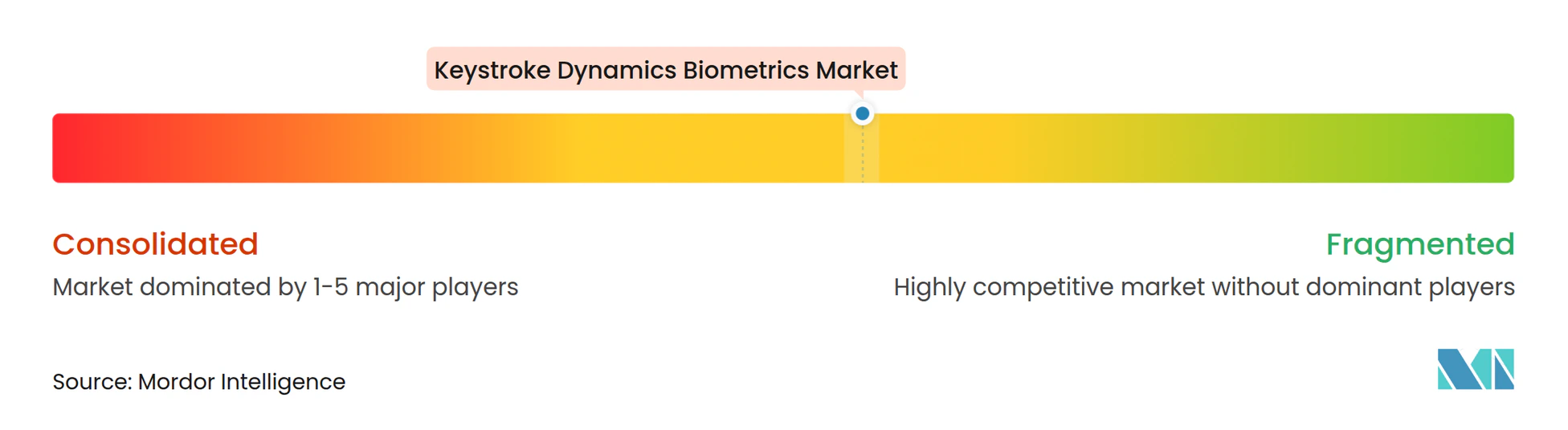
The Keystroke Dynamics Biometrics Market is fragmented among specialists but is consolidating within broader identity and payments platforms. Visa announced a USD 2.4 billion cash agreement to acquire BioCatch in August 2026. The transaction would place behavioral intelligence within Visa's payments-security infrastructure. BioCatch reported 357 financial institutions, 18 billion monthly sessions, 680 million protected accounts, and 1.7 billion devices in Q1 2026. Larger session volumes can improve fraud models and strengthen customer retention.
LexisNexis Risk Solutions has integrated BehavioSec capabilities with its ThreatMetrix Dynamic Decision Platform. This reflects a strategy of embedding keystroke and mouse signals within established device-intelligence and identity-orchestration systems. TypingDNA differentiates through on-device processing that avoids sending raw keystrokes for real-time verification. ThreatMark received a European Patent Office grant for behavioral analytics technology in 2025. Callsign has received recognition from the European Banking Authority for its swipe-authentication mechanism as an inherence factor under PSD2.
OneSpan expanded its portfolio through the June 2025 acquisition of Nok Nok Labs, adding FIDO2 and passkey capabilities. It also made an October 2025 strategic investment in ThreatFabric, a mobile banking fraud-prevention provider. Providers are competing on data privacy, fraud intelligence, integration depth, and vertical specialization. Healthcare, education, mid-market enterprises, and operational-technology environments remain areas where broader distribution could create new opportunities.
Keystroke Dynamics Biometrics Industry Leaders
-
BioCatch Ltd.
-
BehavioSec, Inc.
-
Mastercard Incorporated
-
TypingDNA Inc.
-
Plurilock Security Inc.
- *Disclaimer: Major Players sorted in no particular order
Keystroke Dynamics Biometrics Market Companies Covered in this Report
- BioCatch Ltd.
- Mastercard Incorporated
- LexisNexis Risk Solutions Inc.
- BehavioSec, Inc.
- TypingDNA Inc.
- Plurilock Security Inc.
- Zighra Inc.
- ID Control BV
- KeyTrac GmbH
- AuthenWare Corporation
- Daon, Inc.
- Deepnet Security Ltd.
- Delfigo Security
- Intensity Analytics Corporation
- SERBAN Biometrics
- OneSpan Inc.
- IBM Corporation
- Microsoft Corporation
- NEC Corporation
- Fujitsu Limited
- ThreatMark S.R.O.
- Callsign Inc.
- Experian PLC
- Aware, Inc.
Recent Industry Developments in Keystroke Dynamics Biometrics Market
- August 2026: Visa announced a USD 2.4 billion cash agreement to acquire BioCatch, the leading behavioral biometrics and financial-crime prevention platform, from funds advised by Permira. The transaction integrates BioCatch's behavioral intelligence, covering keystroke, mouse, and touchscreen analytics across 18 billion user sessions per month and protecting 680 million accounts, into Visa's payments-security infrastructure, marking the largest-ever acquisition in the behavioral biometrics sector and signaling that behavioral authentication is core to the future of payment-network security.
- August 2026: TypingDNA launched Human Likeness, a novel bot-detection capability that leverages typing biometrics and behavioral modeling to distinguish human users from AI agents and automated bots. The product targets enterprises facing AI-generated credential misuse and is currently in private evaluation, with a published underlying methodology advancing the research basis for human-AI behavioral differentiation.
- July 2026: BioCatch published findings from a survey of 100 fraud management and compliance leaders at Singaporean banks, with 91% of respondents citing behavioral biometrics as a priority investment as account-takeover fraud attempts rise. The research supports BioCatch's geographic expansion into Southeast Asian banking markets and signals a regional procurement cycle with cross-border implications.
- March 2026: BioCatch unveiled DeviceIQ, a comprehensive device identification and intelligence product enabling financial institutions to assess device trustworthiness during digital banking sessions. DeviceIQ extends BioCatch's platform beyond behavioral signals to incorporate device-layer risk scoring, allowing simultaneous evaluation of both user behavior and device risk within a single session assessment workflow.
Global Keystroke Dynamics Biometrics Market Report Scope
The Keystroke Dynamics Biometrics Market is Segmented by Component (Software, Services), Authentication Type (Static, Continuous), Deployment (Cloud-Based, On-Premises, Hybrid), Application (Fraud Detection and Prevention, Identity Proofing, Risk and Compliance Management, Access Control and Privileged Access Monitoring, and Insider-Threat Detection), End User (Banking, Financial Services, and Insurance, Retail and E-Commerce, Healthcare, Government and Defense, Education, Information Technology and Telecommunications, Consumer Services and Other End Users), and Geography (North America, South America, Europe, Asia-Pacific, Middle East, Africa). The Market Forecasts are Provided in Terms of Value (USD).
Segmentation Overview
| Software |
| Services |
| Static Authentication |
| Continuous Authentication |
| Cloud-Based |
| On-Premises |
| Hybrid Deployment |
| Identity Proofing |
| Fraud Detection and Prevention |
| Risk and Compliance Management |
| Access Control and Privileged Access Monitoring |
| Insider-Threat Detection |
| Banking, Financial Services, and Insurance |
| Retail and E-Commerce |
| Healthcare |
| Government and Defense |
| Education |
| Information Technology and Telecommunications |
| Consumer Services |
| Other End Users |
| North America | United States |
| Canada | |
| Mexico | |
| Rest of North America | |
| South America | Brazil |
| Argentina | |
| Rest of South America | |
| Europe | Germany |
| United Kingdom | |
| France | |
| Italy | |
| Spain | |
| Russia | |
| Rest of Europe | |
| Asia-Pacific | China |
| Japan | |
| India | |
| South Korea | |
| Australia and New Zealand | |
| Rest of Asia-Pacific | |
| Middle East | Saudi Arabia |
| United Arab Emirates | |
| Israel | |
| Rest of Middle East | |
| Africa | South Africa |
| Egypt | |
| Rest of Africa |
| By Component | Software | |
| Services | ||
| By Authentication Type | Static Authentication | |
| Continuous Authentication | ||
| By Deployment Model | Cloud-Based | |
| On-Premises | ||
| Hybrid Deployment | ||
| By Application | Identity Proofing | |
| Fraud Detection and Prevention | ||
| Risk and Compliance Management | ||
| Access Control and Privileged Access Monitoring | ||
| Insider-Threat Detection | ||
| By End User | Banking, Financial Services, and Insurance | |
| Retail and E-Commerce | ||
| Healthcare | ||
| Government and Defense | ||
| Education | ||
| Information Technology and Telecommunications | ||
| Consumer Services | ||
| Other End Users | ||
| By Geography | North America | United States |
| Canada | ||
| Mexico | ||
| Rest of North America | ||
| South America | Brazil | |
| Argentina | ||
| Rest of South America | ||
| Europe | Germany | |
| United Kingdom | ||
| France | ||
| Italy | ||
| Spain | ||
| Russia | ||
| Rest of Europe | ||
| Asia-Pacific | China | |
| Japan | ||
| India | ||
| South Korea | ||
| Australia and New Zealand | ||
| Rest of Asia-Pacific | ||
| Middle East | Saudi Arabia | |
| United Arab Emirates | ||
| Israel | ||
| Rest of Middle East | ||
| Africa | South Africa | |
| Egypt | ||
| Rest of Africa | ||
Key Questions Answered in the Report
What is the size of the Keystroke Dynamics Biometrics Market?
The Keystroke Dynamics Biometrics Market is valued at USD 0.87 billion in 2026 and is forecast to reach USD 2.26 billion by 2032 at a 16.79% CAGR.
Why are organizations adopting keystroke dynamics biometrics?
Organizations use it to identify account takeover, session hijacking, and unauthorized access without deploying dedicated biometric hardware.
Which component leads revenue?
Software leads with 57.73% of revenue in 2026 because enterprises primarily deploy behavioral analytics through software platforms.
Which deployment model has the strongest outlook?
Cloud-based deployment leads with 56.87% of revenue in 2026 and is projected to expand at a 17.43% CAGR through 2032.
Which end-user sector has the largest demand?
Banking, financial services and insurance leads with 43.38% of revenue in 2026, supported by fraud prevention and account-security requirements.
Which region is projected to expand fastest?
Asia-Pacific is projected to expand at a 17.58% CAGR through 2032, supported by digital banking and mobile-payment adoption.