
Jump Starter Market Size and Share
Market Overview
| Study Period | 2020 - 2032 |
|---|---|
| Market Size (2027) | USD 0.98 Billion |
| Market Size (2032) | USD 1.34 Billion |
| Growth Rate (2027 - 2032) | 6.47 % |
| Fastest Growing Market | Asia-Pacific |
| Largest Market | North America |
| Market Concentration | Medium |
Major Players *Disclaimer: Major Players sorted in no particular order Image © Mordor Intelligence. Reuse requires attribution under CC BY 4.0. | |
Jump Starter Market Analysis by Mordor Intelligence
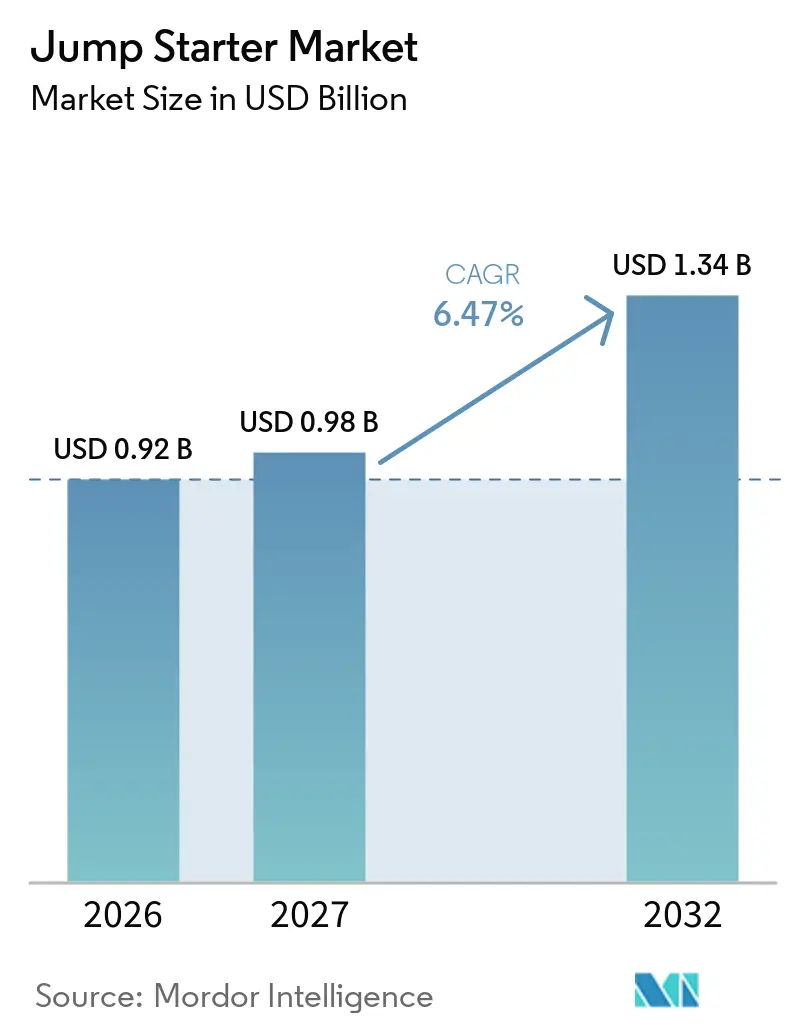
The jump starter market size was valued at USD 0.92 billion in 2026 and is estimated to grow from USD 0.98 billion in 2027 to reach USD 1.34 billion by 2032, at a CAGR of 6.47% during the forecast period (2027-2032). An aging vehicle fleet in mature economies supports replacement demand because battery failure becomes more frequent as vehicles remain in service for longer. Lithium-ion products account for 73.45% of 2026 revenue, and lower battery input costs have widened the range of compact, high-output products available to consumers and professionals. Multi-function designs combine a starter, inflator, power bank, and light, giving manufacturers more room to maintain value as basic units face price pressure. Professional users are becoming an important growth pool, while online selling gives newer brands broad access but also makes verified performance and safety documentation more important. The jump starter market therefore depends on reliable standby performance, credible output ratings, and products that meet the safety and transport requirements of the regions where they are sold.
Key Report Takeaways
- By product type, lithium-ion held 73.45% of the jump starter market share in 2026 and is forecast to grow at a 7.45% CAGR through 2032.
- By peak current, 1,000-2,000 A held 61.27% of the jump starter market share in 2026, while above 2,000 A is forecast to grow at a 7.87% CAGR through 2032.
- By voltage, 12 V accounted for 65.53% of revenue in 2026, while 24 V is forecast to expand at a 7.67% CAGR through 2032.
- By vehicle type, passenger cars held 68.84% of revenue in 2026, while motorcycles are forecast to grow at an 8.06% CAGR through 2032.
- By features, multi-function products held 78.47% of revenue in 2026 and are forecast to grow at an 7.24% CAGR through 2032.
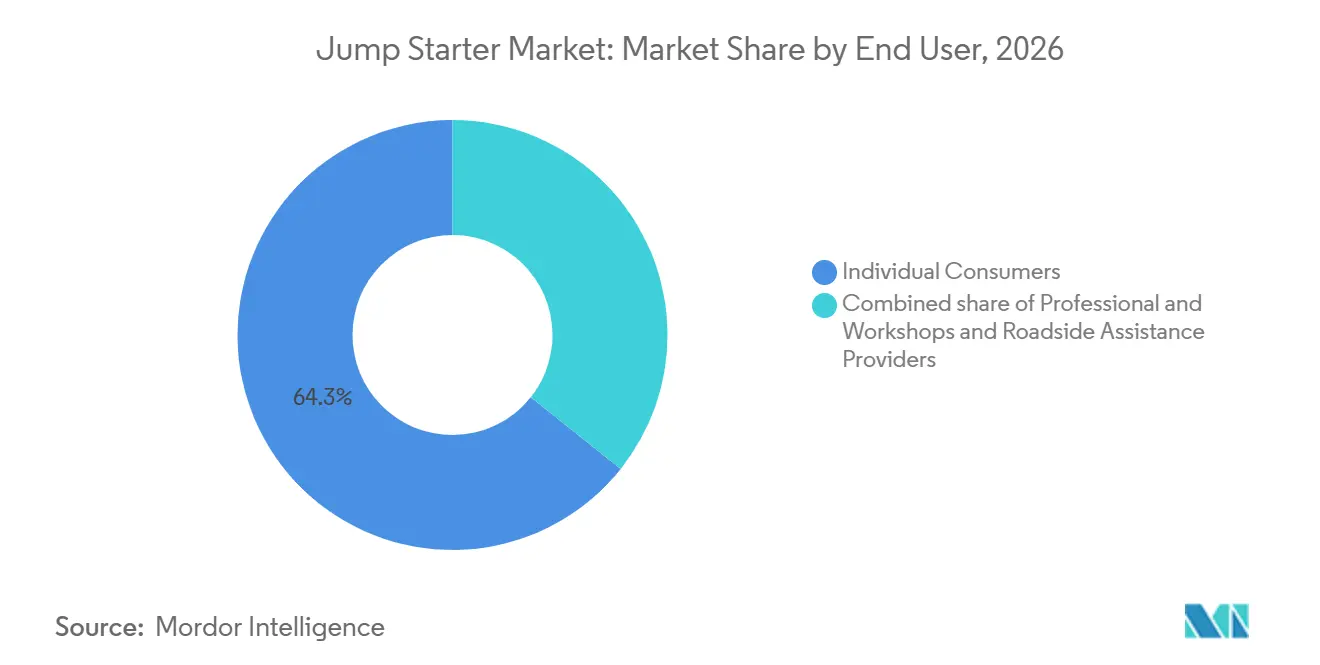
- By end user, individual consumers held 64.25% of revenue in 2026, while professional users and workshops are forecast to grow at an 8.13% CAGR through 2032.
- By distribution channel, online sales held 58.62% of revenue in 2026 and are forecast to grow at an 8.22% CAGR through 2032.
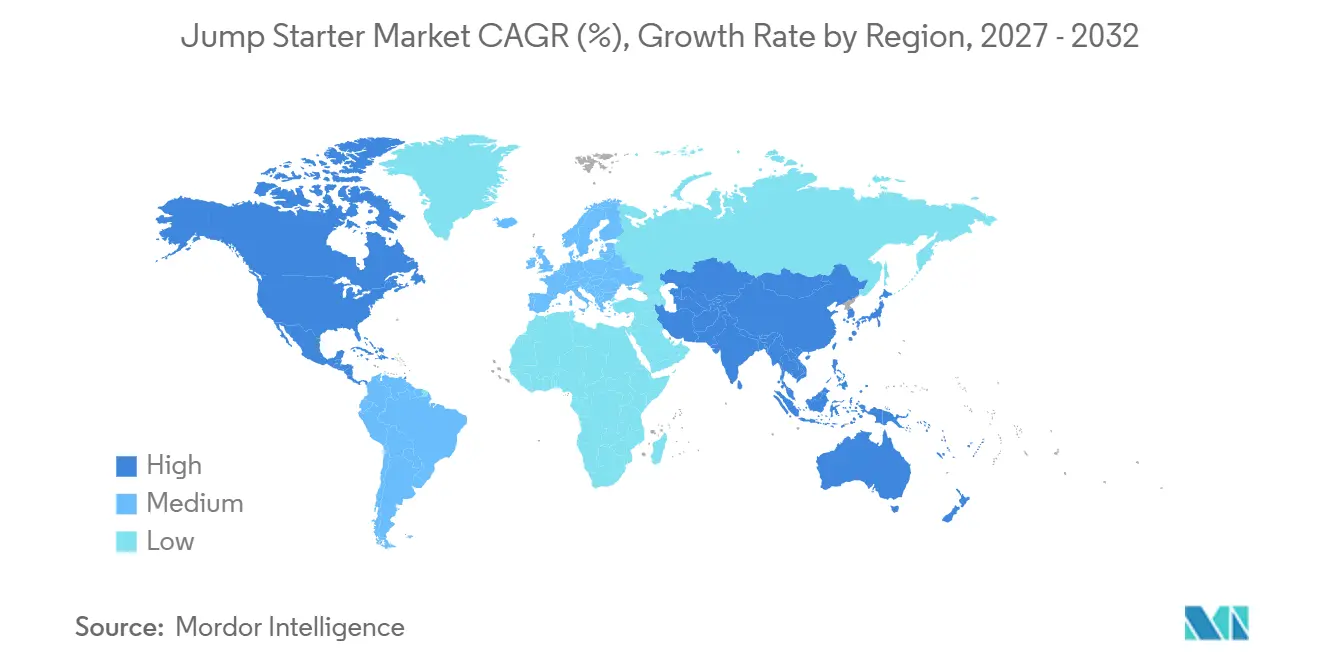
- By geography, North America held 39.84% of revenue in 2026, while Asia-Pacific is forecast to grow at an 8.26% CAGR through 2032.
Note: Market numbers in this report are based on Mordor Intelligence's proprietary estimation framework, which combines nine months of actuals with Q4 projections for base year 2026.
Market Trends and Insights
Drivers Impact Analysis of Jump Starter Market*
| Driver | (~) % Impact on CAGR Forecast | Geographic Relevance | Impact Timeline |
|---|---|---|---|
| Lithium-Ion Cost and Energy-Density Improvements | +1.5% | Global | Medium term (2–4 years) |
| Rising Consumer Preference for Self-Rescue Battery Solutions | +1.3% | Global | Short term (≤ 2 years) |
| Growth of Multi-Function Emergency Power Devices | +1.0% | Global, leading uptake in North America and Europe | Medium term (2–4 years) |
| Expansion of E-Commerce Availability and Product Discovery | +0.9% | Global, strongest in Asia-Pacific | Short term (≤ 2 years) |
| Cold-Weather and Vehicle-Storage Reliability Requirements | +0.7% | North America, Northern and Central Europe | Long term (≥ 4 years) |
| Higher Demand for Battery-Agnostic, Deep-Discharge Starting in Modern Vehicles | +0.6% | Global, early gains in North America and Germany | Long term (≥ 4 years) |
| Source: Mordor Intelligence | |||
Lithium-Ion Cost and Energy-Density Improvements
Lithium-ion cost and performance improvements support smaller products with stronger starting capability. The resulting products can provide a practical mix of portability, charge storage, and starting output for personal vehicles. The same change lets jump starter market suppliers offer stronger peak-current specifications without increasing retail price bands. Lithium-ion designs also reduce weight compared with lead-acid alternatives, which matters for products kept in passenger vehicles or carried by technicians. The outcome is a wider selection of compact products, though published peak-current claims still need verification through independent testing. The transition does not remove lead-acid from price-sensitive workshop applications, but it narrows its role in consumer equipment.
Rising Consumer Preference for Self-Rescue Battery Solutions
Roadside independence is a practical purchase reason for owners who cannot depend on immediate assistance. In India, domestic two-wheeler sales reached 19.61 million units in FY2025, up 9.1%, which adds a large base of battery-dependent vehicles. [1] The jump starter market benefits when owners view a portable unit as a way to restore mobility rather than an occasional emergency accessory. Cold seasons in North America and Europe make low-battery events easier to anticipate, which encourages keeping a product in the vehicle. Long storage periods also create a later replacement need when an older portable unit no longer holds its charge. This pattern gives the jump starter market demand beyond a first purchase, although product reliability remains necessary for that replacement cycle to hold.
Growth of Multi-Function Emergency Power Devices
Multi-function designs have shifted from a premium option to a common product format in the jump starter market. Products combine battery starting with tire inflation, device charging, and emergency lighting, allowing consumers to address more than one roadside problem with one purchase. The product structure can raise selling prices because buyers compare the usefulness of a package rather than current output alone. USB-C charging also makes a portable unit easier to use between emergencies, which can improve the likelihood that its battery is maintained. The jump starter market gains when the device is treated as regular vehicle equipment instead of an item left unused in storage. Basic models still have a role where the initial price is the main decision factor, especially in lower-income consumer groups.
Expansion of E-Commerce Availability and Product Discovery
Online retail is a major route for consumers to compare price, features, and customer feedback before buying. The online channel accounted for 58.62% of 2026 revenue and is forecast to grow at an 8.22% CAGR to 2032. This gives newer suppliers a way to reach buyers without building a wide physical retail network. It also gives established brands a direct route to explain certification, warranty terms, and proper use. The same transparency creates a problem when unverified specifications are promoted beside tested products. As a result, the jump starter market has a stronger need for clear output descriptions and safety documentation that online buyers can assess before purchase.
Restraints Impact Analysis of Jump Starter Market*
| Restraint | (~) % Impact on CAGR Forecast | Geographic Relevance | Impact Timeline |
|---|---|---|---|
| Battery Aging and Standby-Readiness Failure | -0.5% | Global | Medium term (2–4 years) |
| Safety, Thermal-Runaway, and Misuse Liability | -0.4% | Global | Short term (≤ 2 years) |
| Peak-Amp Specification Inflation and Consumer Trust Erosion | -0.3% | Global, most acute in Asia-Pacific online channels | Short term (≤ 2 years) |
| Shipping, Returns and Warranty Costs for Lithium Products | -0.3% | Global | Short term (≤ 2 years) |
| Source: Mordor Intelligence | |||
Battery Aging and Standby-Readiness Failure
Jump starters may remain unused for many months, and a stored lithium battery can lose charge and capacity over time. This creates a gap between a product's initial rating and the current it can deliver after extended storage. Negative reviews often follow when a unit does not start a vehicle during an emergency, even when the issue is poor standby readiness rather than a manufacturing defect. LFP chemistry can reduce self-discharge relative to some older lithium formulations, but it does not eliminate the need for periodic maintenance. The restraint limits recommendations and repeat purchases more than it prevents a first purchase. The jump starter market therefore benefits from clearer maintenance instructions, charge indicators, and designs that reduce loss of readiness.
Safety, Thermal-Runaway, and Misuse Liability
Safety concerns arise from cell chemistry, product construction, charging practices, and user error. The U.S. Consumer Product Safety Commission published a January 2025 decisional package on a proposed safety standard for lithium-ion batteries and micromobility products. [2] The action indicates continuing regulatory attention to portable lithium battery risks, even though product-specific requirements can vary by category. UL 2743 Third Edition includes a peak discharge current rating test for portable power packs, providing a useful reference point for verified performance. [3] Third-party testing and compliance work add cost for smaller suppliers, but they can also distinguish products with documented safety practices. The jump starter market can lose consumer confidence when unsafe or poorly labeled products lead to incidents, making credible certification important for retailers and buyers.
*Our forecasts treat driver/restraint impacts as directional, not additive. The impact forecasts reflect baseline growth, mix effects, and variable interactions.
Jump Starter Market Segment Analysis
By Product Type:
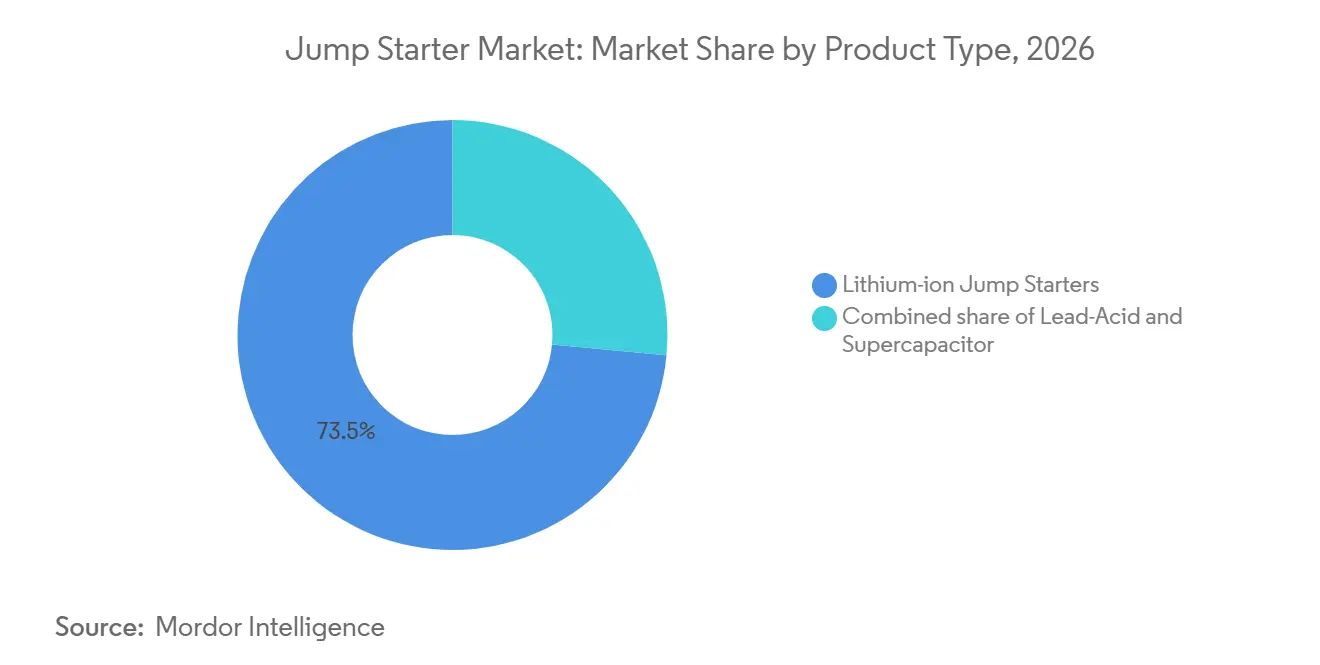
Lithium-Ion Chemistry Builds a Wider Performance LeadLithium-ion held 73.45% of 2026 revenue, giving the segment the leading position in the jump starter market. Lower pack costs and stronger energy density support compact designs that are easier to store in a vehicle. Suppliers can use this advantage to offer greater starting capability without moving every product into a premium price range. Lithium-ion also suits multi-function devices because a compact battery can support USB charging and lights alongside jump-start use.
Lead-acid products retain a place in workshops and other settings where familiar charging routines and a lower purchase price remain important. Supercapacitor products serve a smaller professional use case where rapid readiness and repeated cycling are valued. Milwaukee Tool launched the M18 HotShot in June 2025 as a capacitor-based jump starter for transportation maintenance professionals. Product certification is increasingly relevant for retail access in North America and Europe, particularly where buyers want credible peak-discharge information. UL 2743 Third Edition gives manufacturers a framework for documenting portable power pack performance. Chemistry choice therefore depends on the duty cycle, storage pattern, and vehicle type rather than on rated output alone. Suppliers that explain these practical differences can reduce the risk of buyers selecting an unsuitable product simply because it carries a higher peak-current number.

By Peak Current:
Higher-Output Products Address Commercial Starting NeedsThe 1,000-2,000 A range held 61.27% of revenue in 2026, reflecting demand from mainstream passenger vehicle owners. This tier provides enough output for many 12 V vehicles while staying within a consumer-oriented size and price range. The jump starter market share held by this band shows why it remains the core volume category. Buyers in this range also tend to value charging ports, lights, and compressors alongside rated output.
Above-2,000 A units are forecast to grow at a 7.87% CAGR through 2032 as commercial users seek dependable starting power for larger engines. TOPDON introduced the V3000 in August 2025 with 3,000 A peak current for large gasoline and diesel engines. Professional technicians use a unit frequently and have less tolerance for uncertain output ratings. Below-1,000 A models continue to address motorcycles and compact cars in price-sensitive settings. Verified current data becomes more important as output rises because professional buyers are more likely to compare tool performance against a specific workload. A workshop also considers how quickly the unit can be returned to service after a start, since charging interruptions reduce the usefulness of a shared tool. This puts attention on charging systems, clamp durability, and consistent results across repeated daily use. A verified rating helps procurement teams match a tool to the engine types they service. It also helps technicians avoid relying on unsuitable equipment during time-sensitive calls.
By Voltage:
Passenger-Car Demand Sustains 12 V LeadershipThe 12 V segment accounted for 65.53% of revenue in 2026 because passenger vehicles commonly depend on a 12 V auxiliary battery. This installed base keeps 12 V equipment central to the jump starter market. Consumer-oriented designs generally focus on this voltage because they are smaller and meet the needs of most personal vehicles. The segment also supports the largest selection of products sold through online channels. Buyers often choose these products for routine family vehicles, which makes simple charging guidance and visible safety features part of the purchase decision. Suppliers can also use the large installed base to sell feature-rich models without asking consumers to change their existing vehicle maintenance habits.
The 24 V segment is forecast to grow at a 7.67% CAGR through 2032 as commercial fleet operators seek portable support for higher-voltage vehicles. Dual-voltage products can reduce the need for separate tools across mixed fleets. TOPDON's V4000 HD, introduced in March 2026, is a 12/24 V heavy-duty model designed for commercial applications. Higher-voltage products require appropriate cell configurations and protection systems, which creates a technical distinction from simpler 12 V equipment. This makes the professional segment more favorable to suppliers that can document reliable output and safety controls. Fleet buyers are likely to favor one product platform when it can cover several vehicle classes without reducing operating confidence. That preference can support supplier relationships that include training, technical support, and replacement service.
By Vehicle Type:
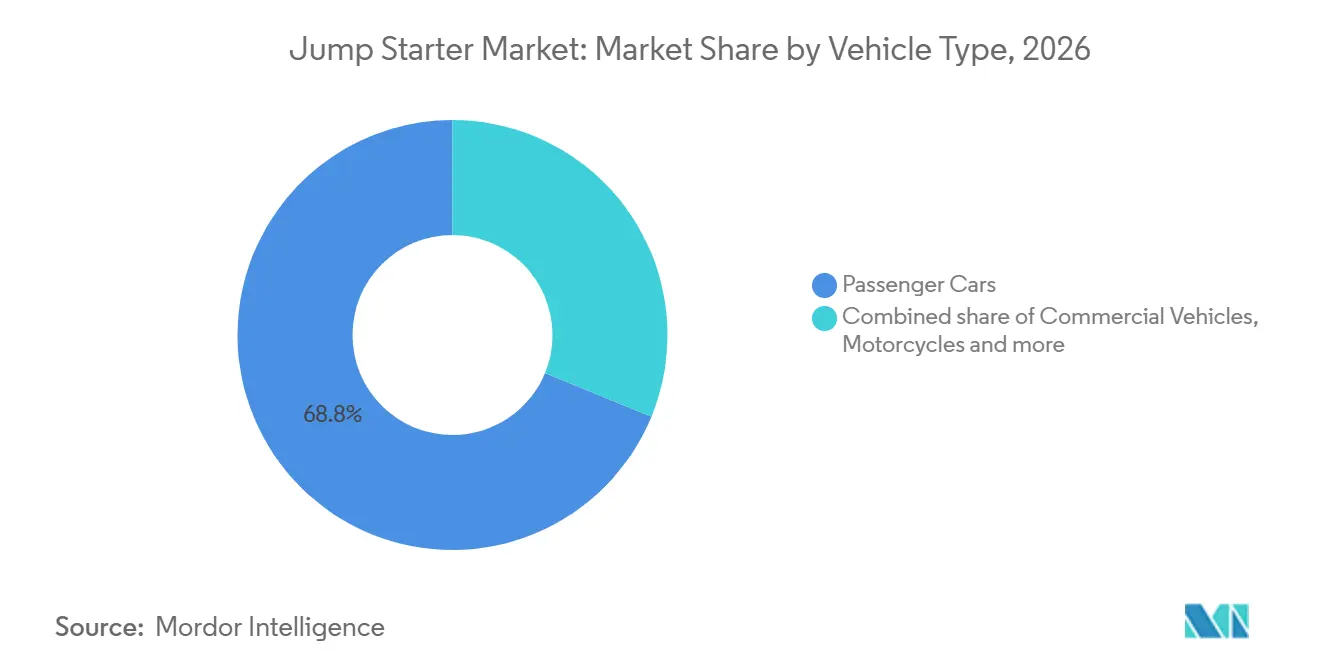
Motorcycles Create a Faster-Growing Demand BasePassenger cars accounted for 68.84% of 2026 revenue, supported by vehicle ownership patterns in North America and Europe. The passenger-car base favors compact 12 V products that can be kept in a trunk or garage. Consumer purchase decisions in this segment commonly include portability, price, and access to a local or online retailer. This scale gives passenger cars a durable role in the jump starter market even as other vehicle types expand faster.
Motorcycles are forecast to grow at an 8.06% CAGR through 2032, supported by growing two-wheeler use in South and Southeast Asia. India's FY2025 domestic two-wheeler sales of 19.61 million units show the scale of the addressable vehicle base. Compact starters can fit the practical needs of motorcycle users when battery access and roadside assistance are limited. Commercial and marine vehicles remain in lower-volume categories, but they often require stronger equipment and can support higher selling prices. Suppliers that can substantiate performance for larger engines may therefore gain more value per professional sale than in the high-volume consumer category. Motorcycle users need equipment that is compact enough to carry and simple enough to connect without workshop support. That favors clear instructions, protective features, and a design that can be stored without creating an unnecessary burden for the rider.
By Features:
Multi-Function Products Become Default PackageMulti-function products held 78.47% of 2026 revenue and are forecast to grow at an 7.24% CAGR through 2032. The multi-function jump starter market size is expanding because buyers increasingly assess the overall package of emergency tools. An integrated compressor helps address a flat tire, while USB charging and lighting give the product uses between emergency events. These additions make the device more useful to consumers who may otherwise leave it unused for long periods.
Feature integration also allows manufacturers to separate their products from basic units competing mainly on price. More complex devices must still manage heat, charging safety, and the durability of multiple components. Basic starters retain demand where buyers want only battery starting at the lowest initial cost. The feature race favors suppliers that can explain practical benefits without relying on inflated peak-current claims. Buyers can recognize the value of an integrated inflator when it removes the need to carry a separate roadside appliance. Manufacturers must still avoid adding features that reduce usability, increase maintenance needs, or make the product too large for normal vehicle storage.
By End User:
Professional Buyers Provide a Higher-Use OpportunityIndividual consumers accounted for 64.25% of 2026 revenue, driven by self-rescue preferences and the accessibility of online retail. Consumers typically choose compact products that are easy to store and include useful emergency features. Growth in this group is likely to be steadier in mature regions where ownership is already common. Consumer satisfaction depends heavily on a product being ready when an unexpected no-start event occurs.
Professional users and workshops are forecast to grow at an 8.13% CAGR through 2032, the fastest rate in this segmentation. The professional jump starter market size benefits from repeated use by fleet technicians, roadside assistance providers, and workshops. These buyers place more weight on output consistency, charging speed, service support, and product life than a casual consumer does. Milwaukee's M18 HotShot and TOPDON's V3000 show continued supplier attention to professional-grade equipment. Multi-year arrangements can give brands predictable demand and visibility among technicians who influence tool selection. The total ownership cost matters because a unit that fails during a service call can delay the technician and the vehicle owner. Suppliers can respond with durable clamps, accessible service support, and product specifications tied to defined commercial tasks.
By Distribution Channel:
Online Sales Lead, While Physical Access Remains RelevantOnline sales held 58.62% of revenue in 2026 and are forecast to grow at an 8.22% CAGR through 2032. This channel gives the jump starter market a wide reach because shoppers can compare product capacity, features, prices, reviews, and warranty terms in one place. E-commerce-first brands can launch products quickly without securing national shelf space. Online listings also give established suppliers a direct setting to communicate certified performance and correct use.
Physical outlets retain importance for customers who want same-day availability or a product demonstration. Auto parts retailers, hypermarkets, and workshop distributors are particularly relevant to professional users and buyers with an immediate need. The combination of online research and offline purchase means channel strategies need to support both product discovery and timely local supply. Supplier credibility can be strengthened when a product is available through recognized retail and workshop networks. Online dominance will not remove the need for physical distribution where service support and procurement relationships influence the purchase. Physical displays can help buyers understand dimensions, clamp construction, and feature controls before they take a product home. Retail staff and workshop distributors can also reinforce safe use and charging practices that may receive less attention in a fast online purchase. Channel partners also provide a practical path for returns and warranty claims, which can be important when the product is needed for an unexpected vehicle problem. This service role can be particularly relevant for buyers who are not confident in assessing charging status or safe connection procedures. Suppliers therefore need channel coverage that considers customer support as well as sales volume.
Geography Analysis
North America
North America held 39.84% of 2026 revenue, the largest regional jump starter market share. High vehicle density, weather variation, and broad access to automotive retail support demand across consumer and professional buyers. Canadian winter conditions and hot climates in parts of the United States increase the relevance of battery reliability and roadside preparedness. Established brands have strong distribution in the region, where purchasers often place greater weight on warranty coverage and documented safety practices. UL 2743 is an important performance and certification reference for portable power packs. The CPSC's January 2025 proposed-rule work on lithium-ion battery safety adds to the regulatory attention surrounding portable battery products. The region has more first-purchase maturity than Asia-Pacific, but product replacement and upgrades to multi-function equipment can sustain demand. Professional buyers also create a route for higher-output and dual-voltage products.
Asia-Pacific
Asia-Pacific is forecast to grow at an 8.26% CAGR through 2032, making it the fastest-growing regional segment. The regional jump starter market size is supported by expanding vehicle ownership, two-wheeler use, and uneven availability of roadside assistance outside large cities. India's FY2025 domestic two-wheeler sales reached 19.61 million units, providing a large potential base for compact starting products. High temperatures can add pressure to vehicle batteries and support the practical value of portable starting equipment. China also supports online-led discovery through large e-commerce platforms and a deep manufacturing supply base. Buyers in the region are sensitive to price, so suppliers need clear performance claims and value-added features. Certification and compliance expectations vary across national markets, which requires localized product documentation and distribution planning. These conditions give e-commerce-native suppliers an advantage, but they also heighten the importance of customer trust in product claims.
Europe, South America, and the Middle East and Africa
European demand is supported by a mature professional aftermarket in countries such as Germany, the United Kingdom, and France. Manufacturers are directing higher-output products toward technicians and commercial fleet users, as shown by TOPDON's V4000 HD release in March 2026. Compliance factors linked to portable battery safety and performance can influence which products gain access to established retail and workshop channels. South American demand centers on affordable 12 V products for older vehicle fleets and areas where roadside support is limited outside major cities. E-commerce provides a useful route where physical aftermarket distribution is uneven. In the Middle East and Africa, high ambient temperatures can shorten battery life and strengthen the appeal of self-contained starting equipment. Saudi Arabia and the United Arab Emirates have a heat-related demand pattern, while Egypt and South Africa offer longer-run potential as vehicle ownership and import logistics improve. Across these mixed markets, suppliers need product ranges that balance price, heat resilience, and accessible support rather than relying on one global retail model.
Competitive Landscape
The jump starter market is moderately concentrated, with no supplier holding a dominant position across every geography, channel, and price band. Established U.S. brands, including NOCO, Schumacher Electric, and Clore Automotive, are associated with premium positioning and professional distribution. Shenzhen-based manufacturers, including CARKU, BOLTPower, AVAPOW, and Gooloo, compete through online reach, rapid product updates, and competitive pricing. The broad supplier set makes product verification and after-sales support important ways to build differentiation. UL 2743 Third Edition adds a peak discharge current rating test for portable power packs, making credible performance testing more visible in the purchase decision. This favors companies that can support certification work and explain it clearly to retailers and buyers. It also raises the value of transparent instructions, tested components, and records that support warranty decisions. These factors can reduce uncertainty for retail partners.
Competitive strategies focus on multi-function design, higher current output, and access to professional users. TOPDON launched the V3000 in August 2025 and the V4000 HD in March 2026, extending its range from high-output consumer products toward heavy-duty and dual-voltage applications. Milwaukee Tool entered the professional segment with the capacitor-based M18 HotShot in June 2025, using its established battery ecosystem for tradespeople. These moves show that the competitive field includes automotive specialists, e-commerce-focused brands, and adjacent tool suppliers.
Online brands can build awareness quickly through visible product comparisons, but they still need credible warranty processes when a product does not meet expectations. Traditional automotive brands have stronger established distribution, but they need product launches that match the pace of online feature competition. Retailers can influence the competitive balance by giving more space to tested products with clear specifications and accessible support. The jump starter market rewards a balance of documented performance, multi-function value, dependable distribution, and post-sale support. Product planning is increasingly shaped by the fact that entry-level buyers see a crowded online category, while professional buyers see a tool that must perform on demand.
Jump Starter Industry Leaders
-
CARKU Technology Co., Ltd.
-
BOLTPower Energy Co., Ltd.
-
Shenzhen Gooloo E-Commerce Co., Ltd.
-
Antigravity Batteries LLC
-
AVAPOW Technology Inc.
- *Disclaimer: Major Players sorted in no particular order

Jump Starter Market Companies Covered in this Report
- The NOCO Company
- Clore Automotive, LLC
- Schumacher Electric Corporation
- Stanley Black & Decker, Inc.
- Anker Innovations Limited
- AstroAI Limited
- CARKU Technology Co., Ltd.
- BOLTPower Energy Co., Ltd.
- Shenzhen Gooloo E-Commerce Co., Ltd.
- Antigravity Batteries LLC
- TOPDON Technology USA, Inc.
- AVAPOW Technology Inc.
- HULKMAN
- WOLFBOX Technology Co., Ltd.
- Scosche Industries, Inc.
- Wagan Corporation
- HELVI S.p.A.
- Powervamp Ltd.
- AGA Technology Co., Ltd.
- Shenzhen Veestb Technology Co., Ltd.
Recent Industry Developments in Jump Starter Market
- October 2026: Battery Tender introduced four new chargers and jump starters, including the Jump N Start 2000 A lithium jump starter and an 800 A jump starter with tire inflator, across more than 5,000 Advance Auto Parts and Carquest stores and online.
- June 2026: Lectron launched a portable jump starter with 4,000 A peak current, a 20,000 mAh battery, and 60 W two-way USB-C charging, extending its range beyond EV charging products.
- March 2026: TOPDON USA launched the V4000 HD, a 4,000 A, 12/24 V heavy-duty jump starter for fleet owners, shop managers, and roadside professionals, sold through its national distribution network.
- September 2025: UL Standards published UL 2743 Third Edition on September 24, 2025, adding a peak discharge current rating test for jump starter booster functions.
- June 2025: Milwaukee Tool launched the M18 HotShot, a 2,000 A, IP65-rated, capacitor-based jump starter for transportation maintenance professionals.
Global Jump Starter Market Report Scope
The jump starter market report is segmented by product type (lithium-ion, lead-acid, and supercapacitor), peak current (below 1,000 A, 1,000-2,000 A, and above 2,000 A), voltage (12 V, 24 V, and 12/24 V), vehicle type (passenger cars, commercial vehicles, motorcycles, and marine and other specialty vehicles), features (basic and multi-function), end user (individual consumers, professional and workshops, and roadside assistance providers), distribution channel (online and offline), and geography (North America, Europe, Asia-Pacific, South America, and Middle East and Africa). The market forecasts are provided in terms of value (USD) and volume (units).
Segmentation Overview
| Lithium-ion Jump Starters |
| Lead-Acid Jump Starters |
| Supercapacitor Jump Starters |
| Below 1,000 A |
| 1,000-2,000 A |
| Above 2,000 A |
| 12 V |
| 24 V |
| 12/24 V |
| Passenger Cars |
| Commercial Vehicles |
| Motorcycles |
| Marine and Other Specialty Vehicles |
| Basic | |
| Multi-Function | Air Compressor |
| Power Bank | |
| Light |
| Individual Consumers |
| Professional and Workshops |
| Roadside Assistance Providers |
| Online | |
| Offline | Auto Parts Retail |
| Hypermarkets |
| North America | United States |
| Canada | |
| Mexico | |
| Rest of North America | |
| Europe | Germany |
| United Kingdom | |
| France | |
| Italy | |
| Spain | |
| Russia | |
| Rest of Europe | |
| Asia-Pacific | China |
| Japan | |
| India | |
| South Korea | |
| Australia | |
| Rest of Asia-Pacific | |
| South America | Brazil |
| Argentina | |
| Chile | |
| Rest of South America | |
| Middle East and Africa | Saudi Arabia |
| United Arab Emirates | |
| Turkey | |
| South Africa | |
| Egypt | |
| Rest of Middle East and Africa |
| By Product Type | Lithium-ion Jump Starters | |
| Lead-Acid Jump Starters | ||
| Supercapacitor Jump Starters | ||
| By Peak Current | Below 1,000 A | |
| 1,000-2,000 A | ||
| Above 2,000 A | ||
| By Voltage | 12 V | |
| 24 V | ||
| 12/24 V | ||
| By Vehicle Type | Passenger Cars | |
| Commercial Vehicles | ||
| Motorcycles | ||
| Marine and Other Specialty Vehicles | ||
| By Features | Basic | |
| Multi-Function | Air Compressor | |
| Power Bank | ||
| Light | ||
| By End User | Individual Consumers | |
| Professional and Workshops | ||
| Roadside Assistance Providers | ||
| By Distribution Channel | Online | |
| Offline | Auto Parts Retail | |
| Hypermarkets | ||
| By Geography | North America | United States |
| Canada | ||
| Mexico | ||
| Rest of North America | ||
| Europe | Germany | |
| United Kingdom | ||
| France | ||
| Italy | ||
| Spain | ||
| Russia | ||
| Rest of Europe | ||
| Asia-Pacific | China | |
| Japan | ||
| India | ||
| South Korea | ||
| Australia | ||
| Rest of Asia-Pacific | ||
| South America | Brazil | |
| Argentina | ||
| Chile | ||
| Rest of South America | ||
| Middle East and Africa | Saudi Arabia | |
| United Arab Emirates | ||
| Turkey | ||
| South Africa | ||
| Egypt | ||
| Rest of Middle East and Africa | ||
Key Questions Answered in the Report
What is the projected growth rate for jump starters through 2032?
The category is forecast to grow at a 6.47% CAGR from 2027 to 2032, reaching USD 1.34 billion by 2032. The outlook reflects replacement needs, multi-function adoption, and rising professional use. It also assumes that suppliers continue to address price pressure through credible, useful product features.
Which jump starter product type leads global demand?
Lithium-ion products lead with 73.45% of 2026 revenue because they support lighter and more compact designs. Their format also supports products that combine starting power with other emergency functions. Lighter weight can make them more practical for a trunk, garage, or technician vehicle.
Why are multi-function jump starters gaining adoption?
Multi-function products held 78.47% of 2026 revenue and combine battery starting with functions such as inflation, USB charging, and lighting. This package can make the unit useful during vehicle emergencies. Regular use can also encourage owners to notice charging needs before a no-start event.
Which buyers are expected to increase purchases fastest?
Professional users and workshops are forecast to grow at an 8.13% CAGR through 2032 as they prioritize reliable, higher-output equipment. Repeated use makes output consistency and service support important. These factors can matter more to a workshop than the lowest initial purchase price.
Which sales channel leads jump starter purchases?
Online sales held 58.62% of 2026 revenue and are forecast to grow at an 8.22% CAGR through 2032. Online listings support comparison of price, features, reviews, and warranty information. They also increase the need for clear specifications that buyers can compare on a like-for-like basis.
Which region is forecast to grow fastest?
Asia-Pacific is forecast to grow at an 8.26% CAGR through 2032, supported by vehicle growth and two-wheeler use. The region also benefits from uneven roadside-assistance availability outside major cities. Compact products for motorcycles and passenger vehicles are especially relevant to this demand setting.