
Japan Urban Logistics Market Size and Share
Market Overview
| Study Period | 2020 - 2031 |
|---|---|
| Forecast Data Period | 2026 - 2031 |
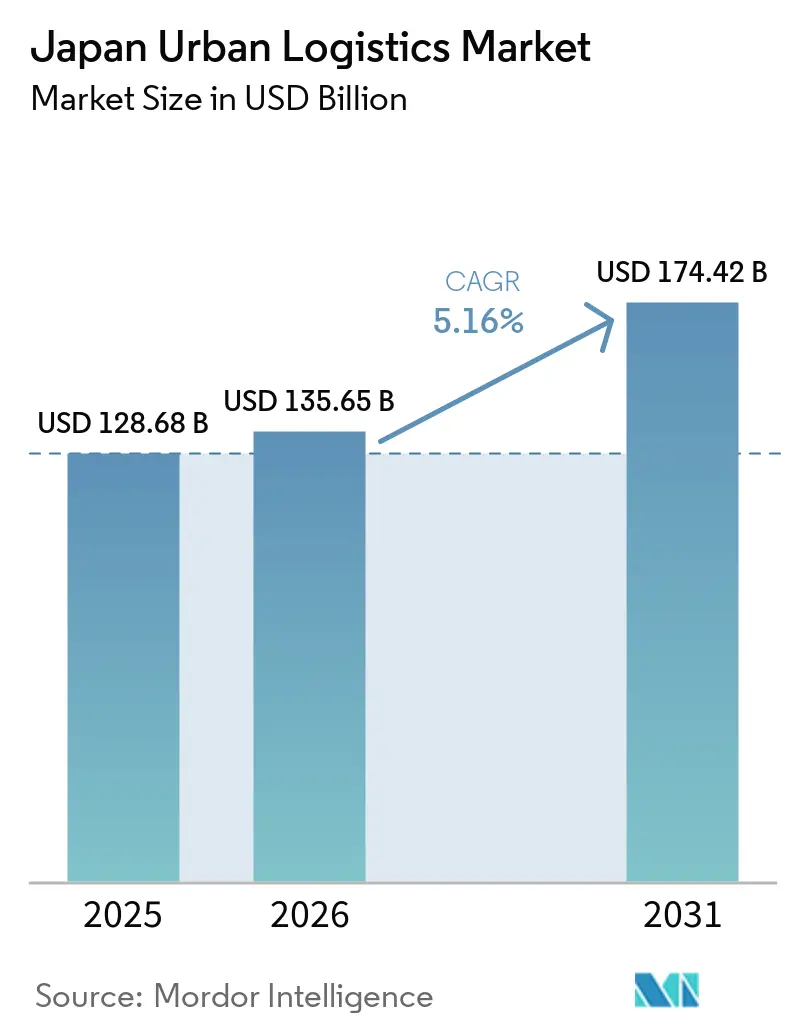
| Base Year Market Size (2025) | USD 128.68 Billion |
| Market Size (2026) | USD 135.65 Billion |
| Market Size (2031) | USD 174.42 Billion |
| Growth Rate (2026 - 2031) | 5.16 % |
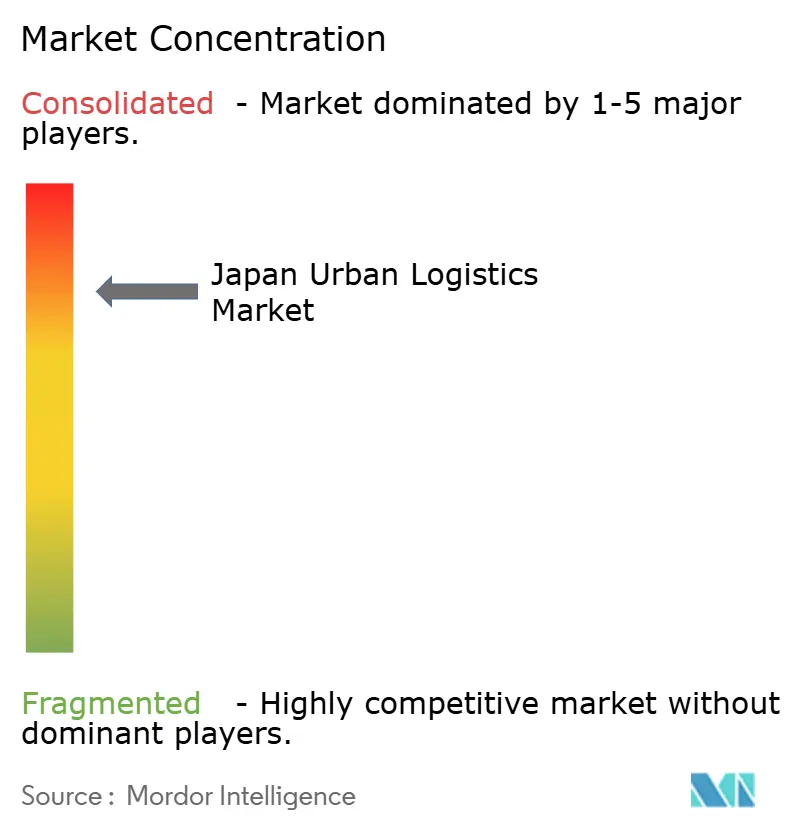
| Market Concentration | High |
Major Players *Disclaimer: Major Players sorted in no particular order Image © Mordor Intelligence. Reuse requires attribution under CC BY 4.0. | |
Japan Urban Logistics Market Analysis by Mordor Intelligence
The Japan urban logistics market size was valued at USD 128.68 billion in 2025 and is estimated to grow from USD 135.65 billion in 2026 to reach USD 174.42 billion by 2031, at a CAGR of 5.16% during the forecast period (2026-2031).
E-commerce demand, constrained driver availability, and public investment in logistics facilities are changing how urban distribution networks are designed. Operators are placing more value on fulfillment capacity, automation, and integrated hubs because conventional route expansion depends on labor that is increasingly scarce. Population aging also supports demand for healthcare and convenience deliveries that require more controlled handling than ordinary parcels. The Japan urban logistics market, therefore, offers opportunities for carriers that can combine dense urban coverage with specialized storage, compliance, and delivery capabilities. Competitive strategies increasingly center on connecting warehousing, sorting, and last-mile services rather than treating each activity as a separate operation.
Key Report Takeaways
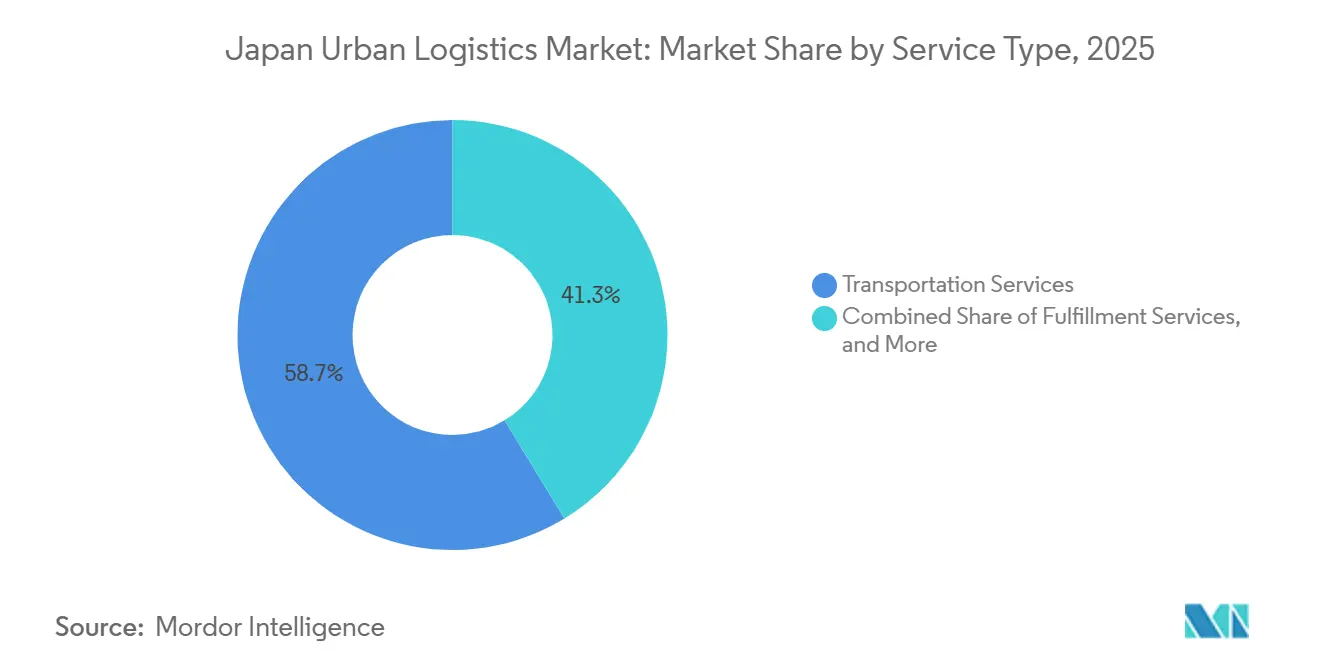
- By service type, transportation services held 58.72% of the Japan urban logistics market share in 2025, while fulfillment services are forecast to grow at a 7.08% CAGR through 2031.
- By delivery speed, standard delivery accounted for 74.11% of the Japan urban logistics market size in 2025, while instant and same-day delivery are forecast to grow at a 6.25% CAGR through 2031.
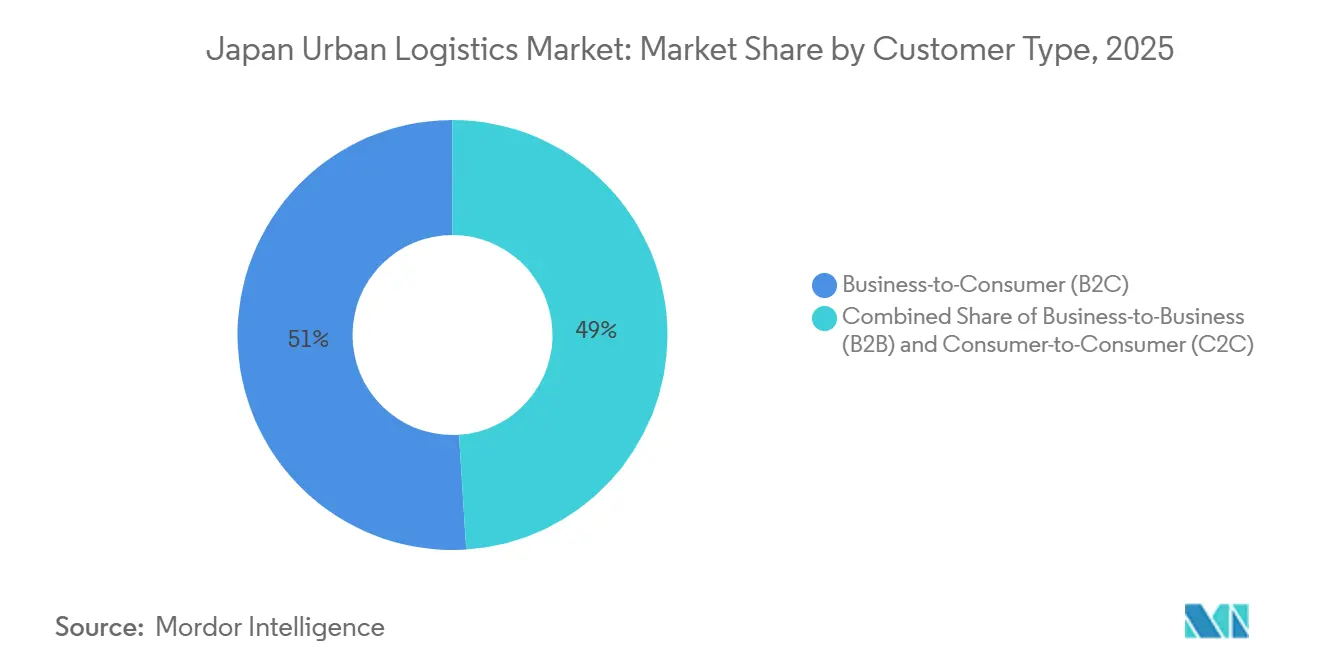
- By customer type, B2C logistics held 51.02% of the Japan urban logistics market share in 2025, while C2C logistics are forecast to grow at an 8.02% CAGR through 2031.
- By end-use industry, e-commerce and retail accounted for 39.00% of the Japan urban logistics market size in 2025, while healthcare and pharmaceuticals are forecast to grow at a 7.79% CAGR through 2031.
- By city, Tokyo held 17.47% of the revenue in 2025, while Fukuoka is forecast to grow at a 6.62% CAGR through 2031.
Note: Market size and forecast figures in this report are generated using Mordor Intelligence’s proprietary estimation framework, updated with the latest available data and insights as of January 2026.
Japan Urban Logistics Market Trends and Insights
Drivers Impact Analysis*
| Driver | (~) % Impact on CAGR Forecast | Geographic Relevance | Impact Timeline |
|---|---|---|---|
| E-Commerce and Omnichannel Order Growth | +1.8% | National, concentrated in Tokyo, Osaka, Nagoya, and Fukuoka | Medium term (2-4 years) |
| Labor-Saving Automation and Autonomous Delivery | +1.2% | Urban core, including Tokyo, Osaka, Yokohama, and Fukuoka | Medium term (2-4 years) |
| Government-Led Logistics Infrastructure Modernization | +0.8% | National, with priority at major logistics hubs | Long term (≥ 4 years) |
| Aging-Related Healthcare and Convenience Deliveries | +0.7% | National, with highest density in Tokyo, Osaka, Nagoya, and Sapporo | Long term (≥ 4 years) |
| Ship-from-Store and Neighborhood Fulfillment Density | +0.5% | Metropolitan zones, including Tokyo, Osaka, Nagoya, Fukuoka, and Yokohama | Short term (≤ 2 years) |
| Urban Residential Robot Porter and Locker Adoption | +0.4% | High-rise districts in Tokyo, Kawasaki, Yokohama, and Osaka | Short term (≤ 2 years) |
| Source: Mordor Intelligence | |||
E-Commerce and Omnichannel Order Growth
E-commerce and omnichannel retail are reshaping the Japan urban logistics market because inventories now sit closer to urban consumers. Dark stores and ship-from-store models shorten delivery distances and raise the need for rapid order processing. The change reduces the separation between retail inventory and distribution inventory in dense areas. Cross-border inbound e-commerce also requires bonded warehousing and customs processing at gateway locations. Fulfillment providers benefit when merchants outsource picking, packing, and shipping to manage greater order volumes and broader product ranges. These conditions favor operators that offer connected fulfillment and transportation services instead of parcel movement alone.
Labor-Saving Automation and Autonomous Delivery
The April 2024 overtime limit of labour law reforms has made labor-saving technology a practical requirement for the Japan urban logistics market. Carriers need to preserve service coverage while operating with fewer available driver hours. Yamato Transport began a condominium delivery-robot demonstration in Tokyo during August 2025, using a robot that could navigate elevators, auto-lock entrances, and attended or unattended deliveries[1]. The company targeted full-scale deployment by the end of 2026. Automation, route optimization, parcel lockers, and neighborhood fulfillment can reduce pressure on driver capacity. Operators with the capital to deploy these systems can create cost advantages over smaller carriers that cannot fund comparable upgrades.
Government-Led Logistics Infrastructure Modernization
Japan approved the Comprehensive Physical Distribution Policy Outline for FY2026 through FY2030 on March 31, 2026[2]. The policy places logistics sustainability and productivity among national priorities. This direction supports investment in connected hubs, digital operations, and more resilient freight networks. It also increases the importance of compliance capabilities for carriers and logistics facility operators. Modern facilities can combine transit access, storage, sorting, and delivery preparation within one network. The Japan urban logistics market may therefore reward organizations that can meet both operational and policy requirements as infrastructure investment expands.
Aging-Related Healthcare and Convenience Deliveries
People aged 65 and older represented around 30% of Japan's population in 2025. This demographic pattern supports regular demand for pharmaceutical, biologic, home-care, and convenience deliveries. These shipments often need temperature control, secure handover, and documented handling. TOHO HOLDINGS launched a patient home-delivery service for specialty pharmaceutical VYVDURA in May 2025 for patients who face difficulty collecting medicines[3]. Healthcare logistics can carry stronger service requirements than standard parcel delivery. Carriers that invest in compliant cold-chain capacity can address a delivery need that is likely to remain important as community-based care expands.
Restraints Impact Analysis*
| Restraint | (~) % Impact on CAGR Forecast | Geographic Relevance | Impact Timeline |
|---|---|---|---|
| Driver Shortages and Overtime Restrictions | -1% | National, most acute in Greater Tokyo, Osaka, and Nagoya corridors | Short term (≤ 2 years) |
| Rising Labor, Fuel, Real Estate, and Fleet Costs | -0.9% | National, most severe in Greater Tokyo and Greater Osaka corridors | Medium term (2-4 years) |
| Curb Access, Parking, and Dense-Urban Operating Constraints | -0.4% | Tokyo 23 wards, Osaka urban core, and Kyoto | Medium term (2-4 years) |
| Fragmented Returns and Delivery-Choice Economics | -0.3% | National, with greatest impact in e-commerce-dense metropolitan zones | Short term (≤ 2 years) |
| Source: Mordor Intelligence | |||
Driver Shortages and Overtime Restrictions
The 960-hour annual overtime cap introduced in Japan's labour law reform limits the driver hours previously used to sustain transport capacity. The restriction affects carriers across Japan and is especially relevant on the Greater Tokyo, Osaka, and Nagoya corridors. It changes both the cost structure and the delivery capacity available to shippers. Carriers cannot depend on extended working hours to absorb volume fluctuations as they did before the rule took effect. Collaborative loading, improved route design, and automation can help replace lost capacity. The Japan urban logistics market faces a continuing adjustment because compliance and service reliability need to be managed at the same time.
Rising Labor, Fuel, Real Estate, and Fleet Costs
Labor, fuel, urban real estate, and fleet investment costs are creating a combined burden for logistics providers. Higher operating costs can make it harder for mid-sized tenants to expand close to demand centers. Fleet electrification also requires vehicles and charging arrangements that many older depots were not designed to support. Small and medium-sized transport firms face particular difficulty because they need to fund several upgrades at once. Dense-city operations add pressure through access restrictions, parking limits, and more complex delivery timing. Returns management and customer delivery-choice expectations add another layer of cost where routes and parcel flows are less predictable.
*Our forecasts treat driver/restraint impacts as directional, not additive. The impact forecasts reflect baseline growth, mix effects, and variable interactions.
Segment Analysis
By Service Type: Transportation Supports Revenue While Fulfillment Changes Operating Priorities
Transportation services held 58.72% of the Japan urban logistics market share in 2025, making them the largest activity within the Japan urban logistics market. High population density creates frequent last-mile movements within compact delivery areas. Transportation remains essential because every physical order still requires movement between a facility and a customer or business site. Operators use route density to improve vehicle utilization and maintain coverage across crowded urban catchments. The segment also remains exposed to driver availability and overtime restrictions. These pressures increase the value of route planning, shared capacity, and more coordinated handoffs between facilities and delivery teams.
The Japan urban logistics market size for fulfillment services is projected to grow at a 7.08% CAGR through 2031. Merchants are turning to outsourced pick-pack-ship operations as product ranges, cross-border inventory, and returns become harder to manage internally. Warehousing and urban storage form the next layer of the delivery network by placing fast-moving stock closer to demand. Multi-story, city-proximate facilities can support e-commerce orders that require shorter delivery windows. Reverse logistics and value-added services also gain relevance when returned goods need inspection, restocking, or resale processing. This mix makes fulfillment capability more important for providers seeking margin beyond basic transportation.

By Delivery Speed: Standard Delivery Maintains Scale While Same-Day Service Raises Expectations
Standard delivery accounted for 74.11% of the Japan urban logistics market size in 2025, confirming that scheduled and batched routes remain the core of the Japan urban logistics market. Many B2B shipments and less time-sensitive consumer orders continue to move through planned delivery windows. Standard services help carriers consolidate parcels and control operating costs. They also provide a dependable option where customers do not need immediate fulfillment. This delivery format is likely to remain important even as faster services expand. Its scale gives established networks a broad base from which to develop more specialized offerings.
Instant and same-day delivery are projected to grow at a 6.25% CAGR through 2031. Growth is supported by neighborhood fulfillment, grocery orders, and consumers familiar with rapid availability on domestic e-commerce platforms. Next-day and scheduled delivery remain relevant where customers want timing flexibility without the cost of immediate service. The distinction between these speeds requires carriers to manage different route patterns and inventory positions. Providers that build micro-fulfillment capacity close to high-demand areas can serve rapid orders more effectively. The Japan urban logistics market is therefore moving toward a delivery mix that combines high-volume standard service with targeted fast-response capacity.
By Customer Type: B2C Provides Volume While C2C Requires More Flexible Networks
B2C logistics held 51.02% of the Japan urban logistics market share in 2025 and remained the largest customer segment. Urban e-commerce use and frequent household deliveries support this leading position. B2C networks depend on reliable neighborhood coverage, parcel handoff options, and practical unattended delivery arrangements. The segment benefits from established carrier routes that can serve many addresses in a compact area. It also faces pressure from consumer expectations for clear delivery windows and convenient returns. These requirements make network density and last-mile execution central to B2C performance.
C2C logistics is projected to grow at an 8.02% CAGR through 2031, the strongest rate among customer types. Peer-to-peer resale creates parcel patterns that differ from conventional retail shipments. These shipments can be lighter, more irregular, and dependent on anonymous shipping features. B2B logistics remains important but competes more directly through pricing discipline and route efficiency. C2C growth creates a need for systems that can process varied parcel sizes and intermittent sending behavior without losing service quality. The Japan urban logistics industry, therefore, needs to serve both predictable commercial flows and less regular person-to-person movements.
By End-Use Industry: E-Commerce Sets Volume While Healthcare Builds a Specialized Segment
E-commerce and retail held 39.00% of the Japan urban logistics market size in 2025, making it the largest end-use area. Platform expansion and inbound cross-border commerce support this demand. Retail flows require fast inventory availability, reliable order processing, and delivery options that fit dense urban neighborhoods. Bonded warehousing and import-clearing capabilities are particularly relevant for cross-border orders. Food and beverage delivery also needs neighborhood facilities with separate ambient, chilled, and frozen handling zones. These requirements can improve space use while reducing the time between order placement and delivery.
Healthcare and pharmaceuticals are projected to grow at a 7.79% CAGR through 2031. An aging population and more specialized home delivery needs support this performance. Healthcare shipments require carriers to meet stricter handling, temperature-control, and chain-of-custody expectations. Consumer electronics, fashion and apparel, automotive parts, industrial and manufacturing, and other end uses add different products and timing needs. Automotive parts logistics is also shaped by just-in-time delivery requirements and specialized components used by manufacturing networks.
Geography Analysis
Tokyo held 17.47% of of the Japan urban logistics market share in 2025, giving it the largest identified share of the Japan urban logistics market. Its high density creates substantial delivery frequency and makes the city a major setting for automation trials. Yamato's Tokyo condominium demonstration shows how residential delivery technology can be tested in dense locations. Tokyo also faces tight curb access, parking limits, and high-rise delivery complexity. These conditions encourage parcel lockers, building access systems, and internal delivery coordination. Kawasaki and Yokohama benefit from freight spillover from the Greater Tokyo corridor. Shared hubs in these cities can improve route utilization across the wider metropolitan area.
Osaka and Nagoya anchor key western and central corridors for the Japan urban logistics market. Osaka combines dense urban demand with pressure on logistics space and delivery access. Nagoya needs to support just-in-time automotive components alongside large parcel volumes. This requires operators to manage different temperature, size, and timing needs on connected routes. Kobe benefits from port-related flows that serve import-intensive activities. Kyoto presents a different operating setting because vehicle size and delivery windows are limited in historic areas. These constraints support the use of smaller vehicles, electric cargo bikes, and contactless delivery methods where conventional vehicle access is less practical.
Fukuoka is forecast to grow at a 6.62% CAGR through 2031, the fastest city rate in the Japan urban logistics market. Fukuoka is an important secondary-city location because it connects urban demand with Kyushu-wide distribution needs. Large-format logistics development can support longer regional distribution routes and growing local order volumes. Fukuoka also serves demand related to manufacturing and expanding business activity in the wider region. Sapporo depends on cold-chain flows connected with Hokkaido agricultural and fishery products. Its older population also supports regular healthcare and pharmaceutical deliveries. Other cities remain relevant because changing work patterns and population distribution create demand outside the largest metropolitan networks.
Competitive Landscape
The Japan urban logistics market is highly concentrated among leading operators, while the mid-tier remains fragmented. Domestic incumbents benefit from established route density and customer relationships in major urban areas. Global integrators have a stronger role in international express and cross-border e-commerce flows. Companies are pursuing integrated hubs, automation, smart lockers, and shared-capacity arrangements to manage the constraints on driver hours. These strategies connect warehousing, sorting, and last-mile activity more closely. They also make physical network quality and operational technology important competitive factors.
Yamato Transport opened a 119,607-square-meter integrated business solutions base in Koto-ku, Tokyo, in April 2026. The six-story site includes temperature-controlled areas, bonded warehousing, and distribution-processing capacity. The facility supports a network approach that combines several supply-chain functions at one location. Yamato has also indicated hub expansion in Shiga, Okayama, Kansai, and Tohoku. LOGISTEED has set out an ambition to become a leading global 3PL company through its LOGISTEED2027 plan[4]. These moves show the importance of scale, facility capability, and cross-border links in the Japan urban logistics market.
Japan Post announced plans in January 2026 to acquire a 14.9% stake in LOGISTEED for JPY 142.2 billion (USD 910.3 million), to strengthen warehousing and B2B logistics capabilities. FedEx expanded its collaboration with Japan Post in August 2026 to include U-Global Express shipments to Europe. The collaboration builds on shipping options that FedEx and Japan Post expanded for cross-border e-commerce in March 2026. Competitive opportunities remain in GDP-compliant pharmaceutical delivery and real-time C2C returns processing. Mid-tier carriers may need technology partnerships where they lack the capital for robotics, route optimization, or digital fleet systems. The Japan urban logistics market favors organizations that can combine specialized service with a practical urban network.
Japan Urban Logistics Industry Leaders
-
Yamato Transport Co., Ltd.
-
Sagawa Express Co., Ltd.
-
Japan Post Transport Co., Ltd.
-
NIPPON EXPRESS HOLDINGS, INC.
-
LOGISTEED, Ltd.
- *Disclaimer: Major Players sorted in no particular order
Recent Industry Developments
- August 2026: FedEx expanded its collaboration with Japan Post to include U-Global Express international shipments to Europe, adding to its existing North American coverage from March 2026. The partnership leverages FedEx's air-transportation and customs infrastructure alongside Japan Post's domestic acceptance network.
- April 2026: Yamato Transport opened one of its largest integrated business solutions bases in Shinonome, Koto-ku, Tokyo, spanning 119,607 square meters across a 6-story facility with temperature-controlled, bonded, and distribution-processing capabilities. The hub is the metropolitan anchor of the company's supply-chain transformation strategy.
- January 2026: Japan Post announced a plan to acquire a 14.9% stake in LOGISTEED from KKR for JPY 142.2 billion (USD 910.3 million), seeking expanded warehousing and B2B logistics capabilities to offset the structural decline in its postal business.
- October 2025: NIPPON EXPRESS HOLDINGS, INC. acquired a stake in CBcloud Co., Ltd., which operates PickGo, one of Japan's largest delivery platforms. PickGo connects shippers and delivery partners directly, with approximately 70,000 registered freelance delivery drivers.
Japan Urban Logistics Market Report Scope
| Transportation Services |
| Warehousing and Urban Storage Services |
| Fulfillment Services |
| Reverse Logistics Services |
| Value-Added Logistics (VAL) Services |
| Instant and Same-Day Delivery |
| Next-Day Delivery |
| Scheduled Delivery |
| Standard Delivery |
| Business-to-Business (B2B) |
| Business-to-Consumer (B2C) |
| Consumer-to-Consumer (C2C) |
| E-commerce and Retail |
| Food and Beverage |
| Healthcare and Pharmaceuticals |
| Consumer Electronics |
| Fashion and Apparel |
| Automotive Parts |
| Industrial and Manufacturing |
| Others |
| Tokyo |
| Yokohama |
| Osaka |
| Nagoya |
| Sapporo |
| Fukuoka |
| Kawasaki |
| Kobe |
| Kyoto |
| Rest of Cities |
| By Service Type | Transportation Services |
| Warehousing and Urban Storage Services | |
| Fulfillment Services | |
| Reverse Logistics Services | |
| Value-Added Logistics (VAL) Services | |
| By Delivery Speed | Instant and Same-Day Delivery |
| Next-Day Delivery | |
| Scheduled Delivery | |
| Standard Delivery | |
| By Customer Type | Business-to-Business (B2B) |
| Business-to-Consumer (B2C) | |
| Consumer-to-Consumer (C2C) | |
| By End-Use Industry | E-commerce and Retail |
| Food and Beverage | |
| Healthcare and Pharmaceuticals | |
| Consumer Electronics | |
| Fashion and Apparel | |
| Automotive Parts | |
| Industrial and Manufacturing | |
| Others | |
| By City | Tokyo |
| Yokohama | |
| Osaka | |
| Nagoya | |
| Sapporo | |
| Fukuoka | |
| Kawasaki | |
| Kobe | |
| Kyoto | |
| Rest of Cities |
Key Questions Answered in the Report
Which customer segment is expanding fastest?
C2C logistics is projected to grow at an 8.02% CAGR through 2031, supported by peer-to-peer resale.
What is driving demand for urban logistics services in Japan?
E-commerce, automation investment, neighborhood fulfillment density, and healthcare delivery needs are central drivers.
How large is Japan's urban logistics sector?
It is projected to reach USD 174.42 billion by 2031 from USD 135.65 billion in 2026, at a 5.16% CAGR.
Which service is growing fastest in Japan's urban logistics sector?
Fulfillment services are projected to grow at a 7.08% CAGR through 2031.
Why are delivery robots relevant in Japanese cities?
They can support residential deliveries where driver capacity and dense-building access create operational challenges.
Why is healthcare delivery important in Japan?
An older population increases demand for pharmaceutical and home-care deliveries that require controlled handling.