
Japan OTT Market Size and Share
Market Overview
| Study Period | 2020 - 2031 |
|---|---|
| Forecast Data Period | 2026 - 2031 |
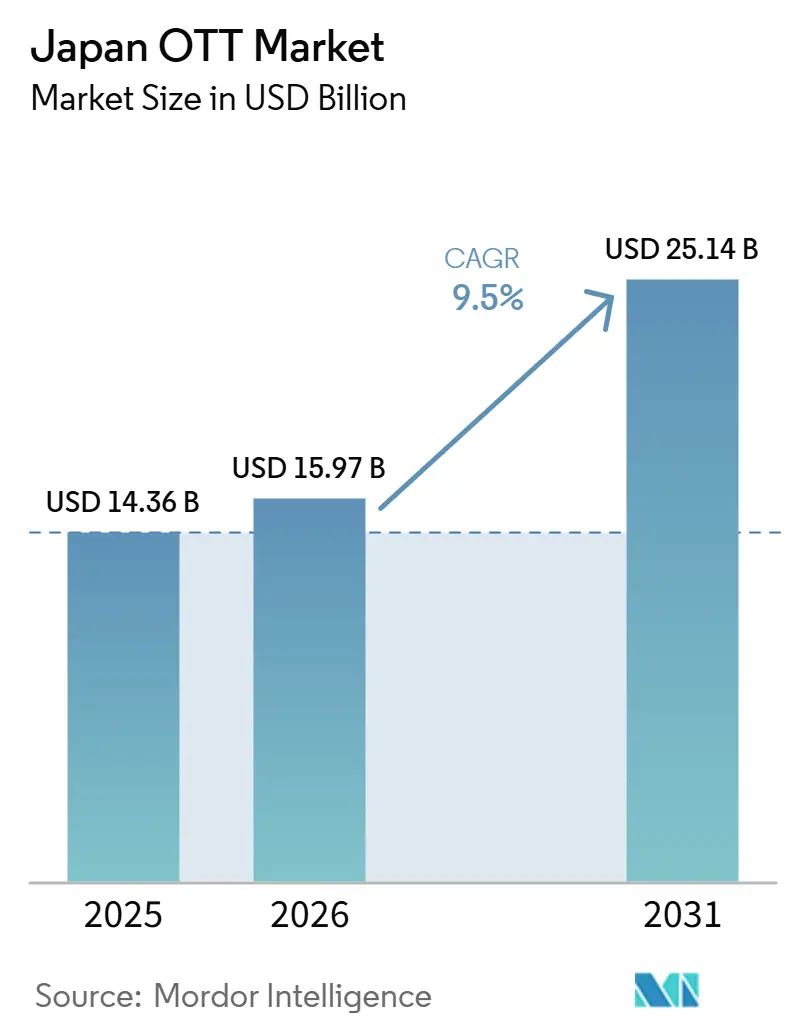
| Base Year Market Size (2025) | USD 14.36 Billion |
| Market Size (2026) | USD 15.97 Billion |
| Market Size (2031) | USD 25.14 Billion |
| Growth Rate (2026 - 2031) | 9.50 % |
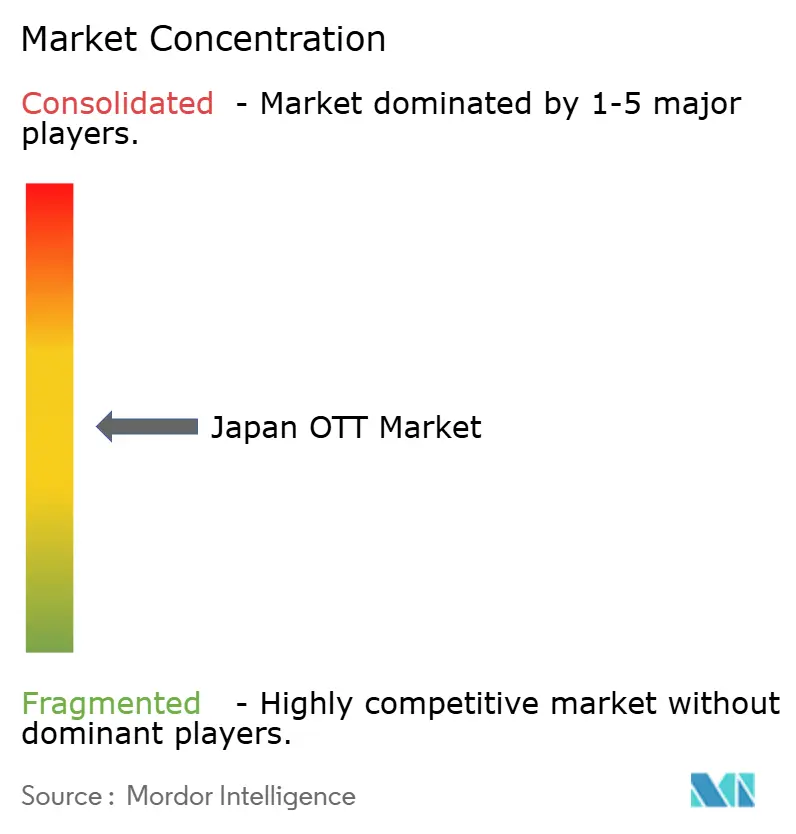
| Market Concentration | Medium |
Major Players *Disclaimer: Major Players sorted in no particular order Image © Mordor Intelligence. Reuse requires attribution under CC BY 4.0. | |
Japan OTT Market Analysis by Mordor Intelligence
The Japan OTT market size was USD 14.36 billion in 2025 and is forecast to reach USD 25.14 billion by 2031, advancing at a CAGR of 9.50% during 2026-2031. Reliable digital access gives the Japan OTT market a broad base for paid and advertising-supported viewing across households, mobile plans, and connected television screens. Internet use reached 87.0% of the population in August 2025, while smartphones were present in 91.8% of households. Services are shifting their focus from subscriber growth alone toward revenue per subscriber, advertising tiers, and wider use across several screens, which changes how operators weigh price, content, and distribution decisions. Local programming is central to platform positioning because Japanese-language content accounted for most viewing hours, while anime has become a global distribution asset. Competition is raising the value of telecommunications bundles, original programming, and live sports rights, but these same strategies increase costs and make it harder for smaller services to retain subscribers.
Key Report Takeaways
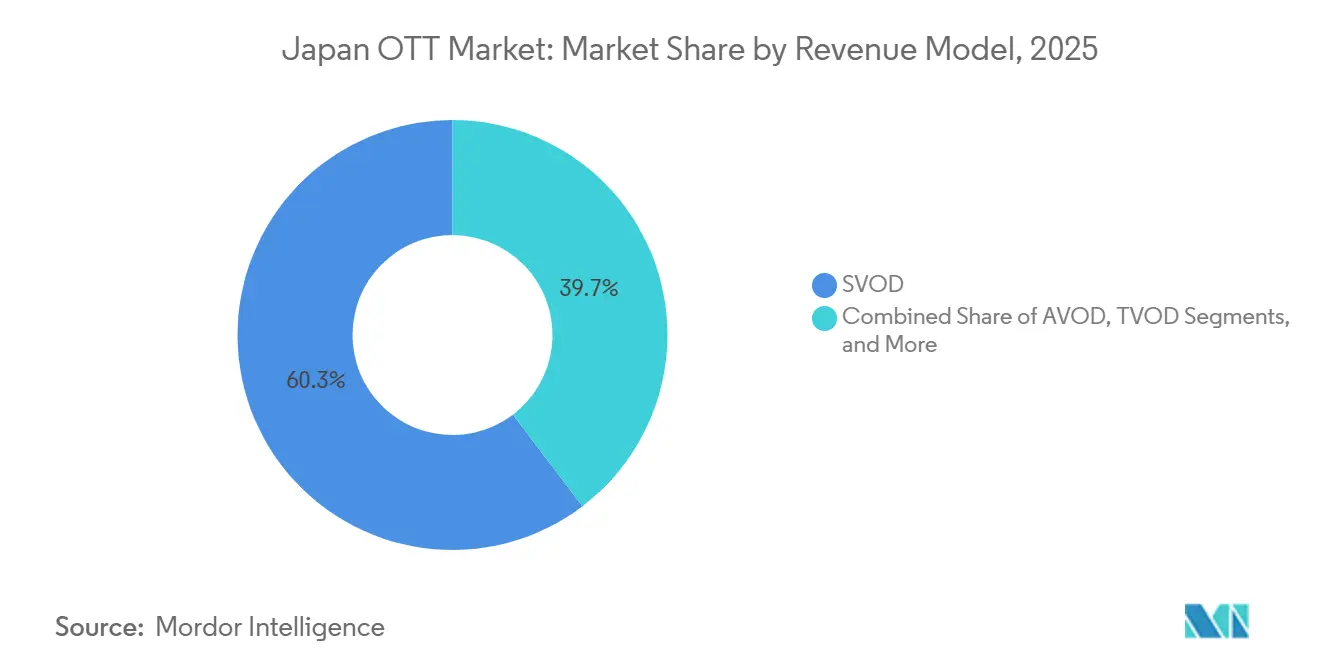
- By revenue model, SVOD held 60.33% of the Japan OTT market share in 2025, while hybrid subscription and advertising is projected to expand at a 10.06% CAGR through 2031.
- By device type, smart TVs accounted for 55.61% of revenue in 2025 and are projected to record a 10.11% CAGR through 2031.
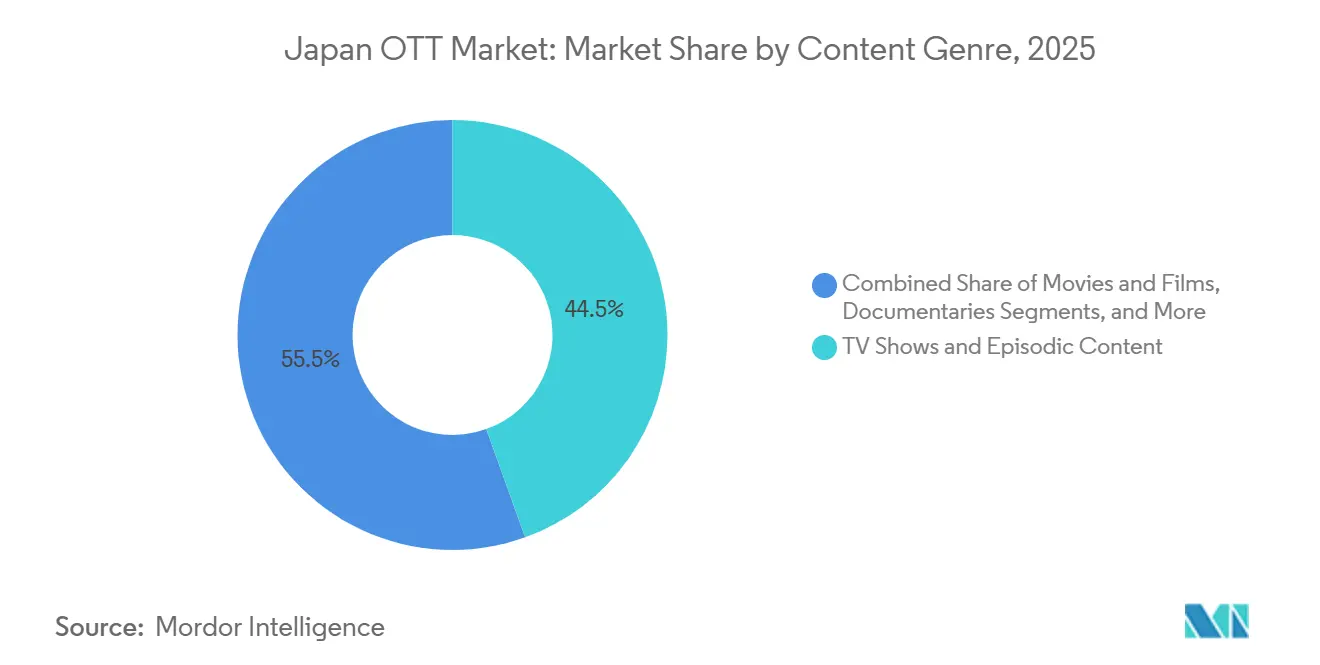
- By content genre, TV shows and episodic content held 44.50% of revenue in 2025, while documentaries are projected to grow at a 10.39% CAGR through 2031.
Note: Market size and forecast figures in this report are generated using Mordor Intelligence’s proprietary estimation framework, updated with the latest available data and insights as of January 2026.
Japan OTT Market Trends and Insights
Drivers Impact Analysis*
| Driver | (~) % Impact on CAGR Forecast | Geographic Relevance | Impact Timeline |
|---|---|---|---|
| Shift to Subscription and Ad-Supported Streaming Bundles | +2.2% | National, with concentration in Tokyo, Osaka, and Nagoya | Medium term (2-4 years) |
| Demand for Japanese Originals and Anime Exclusivity | +1.8% | Global demand for Japanese content, with domestic platform competition | Long term (≥ 4 years) |
| Telecom, Broadband, and Device Bundling | +1.5% | National, strongest in higher-ARPU mobile subscriber regions | Medium term (2-4 years) |
| Live Sports, Events, and Premium Broadcast Rights | +1.1% | National, with international reach for Japanese leagues and events | Medium term (2-4 years) |
| Hybrid Revenue Model Monetization | +0.8% | Platform-level shift with growing AVOD adoption in Japan | Short term (≤ 2 years) |
| Multi-Screen Smart TV and Mobile Viewing | +0.6% | National, led by broadband-dense prefectures and metropolitan areas | Short term (≤ 2 years) |
| Source: Mordor Intelligence | |||
Shift to Subscription and Ad-Supported Streaming Bundles
The movement from free-to-air television toward subscription and ad-supported services supports the Japan OTT market. Premium video subscriptions added 4 million net subscribers in 2025, reaching 67.9 million subscriptions when YouTube Premium is included.[1]Asia Video Industry Association, “Japan's Premium VOD Market Reaches Inflection Point: Scaling Reach, Deepening Engagement and Monetization,” Asia Video Industry Association, avia.org. Platforms have used advertising tiers to reach viewers who had resisted full subscription prices. Netflix offered its ad-supported standard plan at JPY 890 (USD 6) per month in 2025. The 2025 expansion also reflected higher revenue per subscriber as several platforms revised prices and households added more than 1 service, rather than relying only on people who had never used streaming before. This combination of broader access and stronger monetization supports continued spending across the Japan OTT market.
Demand for Japanese Originals and Anime Exclusivity
Japanese originals and anime have become necessary elements of service differentiation in the Japan OTT market. Netflix announced a strategic partnership with MAPPA in January 2026, covering collaboration from concept development through merchandise across multiple projects.[2]Netflix, “What's Next on Netflix From Japan: Expanding the Possibilities of Storytelling in 2026,” Netflix, media.netflix.com. Netflix also expanded its arrangement with Toho Studios to double its Japan production footprint and add large-scale soundstages. Japanese-title viewing on Netflix reached an all-time high in the second half of 2025, led by "Alice in Borderland" Season 3 and "Last Samurai Standing". Prime Video Japan secured the exclusive global premiere of the Tatsuki Fujimoto anthology anime "17-26" in November 2025. Studios are increasingly using streaming-first release windows to pursue overseas intellectual property income, which changes the balance of negotiating power between studios and platforms and gives global distribution a greater role in production decisions.
Telecom, Broadband, and Device Bundling
Telecommunications operators have made streaming benefits part of premium mobile plans, creating an important route to subscribers in the Japan OTT market. NTT DOCOMO began its Selectable Benefits program for Docomo MAX and Docomo Poikatsu MAX plans in February 2026, giving eligible customers access to up to 2 services from Lemino, d Anime Store, DAZN for Docomo, and NBA Docomo.[3]NTT DOCOMO, “NTT DOCOMO Activates Selectable Benefits for Docomo MAX and Docomo Poikatsu MAX Plans,” NTT DOCOMO, nttdocomo.com. KDDI expanded its Netflix relationship in December 2025, providing eligible au and UQ Mobile customers up to 5 months of Netflix's ad-supported standard plan at no additional charge. These arrangements use established mobile billing relationships to reduce the initial cost of acquiring subscribers and make it easier for consumers to try several services without a separate payment setup for each one. The government aims for 99.9% FTTH coverage by 2027, extending the infrastructure that supports bundled video services. Services without a major carrier relationship face a less favorable path to subscriber acquisition.
Live Sports, Events, and Premium Broadcast Rights
Live sports is an important means of standing apart and reducing cancellations in the Japan OTT market. DAZN acquired rights to show all 104 FIFA World Cup 2026 matches in Japan, including free live coverage of Japan national team fixtures. In March 2026, the service extended its Meiji Yasuda J-League rights through the 2032-33 season for J1, J2, and J3 matches. Netflix obtained exclusive rights in Japan for all 47 games of the 2026 World Baseball Classic, its first international live sports broadcast in the country. U-NEXT also expanded its sports offering through women's golf majors and the English Premier League through 2028. Scheduled sports viewing gives subscribers a reason to keep a service between scripted releases, making rights an important retention tool when households review recurring subscriptions and decide which services to retain.
Restraints Impact Analysis*
| Restraint | (~) % Impact on CAGR Forecast | Geographic Relevance | Impact Timeline |
|---|---|---|---|
| Content Acquisition and Original Programming Costs | -1.8% | Global platforms operating in Japan, especially SVOD leaders commissioning local originals | Medium term (2-4 years) |
| Churn From Multi-Platform Fragmentation | -1.2% | National, strongest for mid-tier and specialist services without bundles or sports rights | Short term (≤ 2 years) |
| Premium Sports Rights Inflation and Auction Pressure | -0.7% | National, with the greatest exposure for sports-focused services | Medium term (2-4 years) |
| Content Window and Distribution Rights Complexity | -0.4% | National, under the Broadcasting Act and MIC framework | Long term (≥ 4 years) |
| Source: Mordor Intelligence | |||
Content Acquisition and Original Programming Costs
Content cost inflation is a major constraint on profitability in the Japan OTT market. Netflix's expanded Toho Studios agreement shows the capital commitment required to build production capacity and secure a pipeline of local programming. WOWOW agreed in June 2026 to hold a 51% stake in a joint venture that will house NTT DOCOMO's Lemino business from October 1, 2026. Lemino recorded JPY 20,703 million in sales, (USD 138 million) at the stated 2025 average exchange rate, in the fiscal year ending March 2026. Multi-year sports agreements, anime co-productions, and simultaneous global release schedules add costs that are difficult to reduce once committed, because they require planning, production, promotion, and distribution resources over several release cycles. Smaller local services have lower budgets than global platforms, although local content remains important because Japanese-language programming accounted for 80% of streaming hours.
Churn From Multi-Platform Fragmentation
A large number of active services makes loyalty difficult to sustain across the Japan OTT market. Viewers can switch among global SVOD services, broadcaster-backed AVOD platforms, telecommunications services, sports specialists, and premium providers at low cost. TVer reached 44.7 million monthly unique browsers in January 2026, setting a second consecutive monthly record. Its free access provides an ongoing reference point against which subscription platforms must justify their prices. Television Asahi reported that digital advertising revenue related to TVer rose 37.2% year over year in fiscal year 2025. Services without carrier bundles, premium sports, or integrated intellectual property can face cancellations between major content releases, particularly when viewers can move quickly to a rival service with a newly released program or event.
*Our forecasts treat driver/restraint impacts as directional, not additive. The impact forecasts reflect baseline growth, mix effects, and variable interactions.
Segment Analysis
By Revenue Model: SVOD Retains Revenue Leadership While Hybrid Services Grow Faster
SVOD held 60.33% of the Japan OTT market share in 2025, confirming that paid access remained the leading revenue model. Netflix led premium video-on-demand revenue with 22% in 2025, while U-NEXT held 12%, supported by a bundle of streaming, manga, and exclusive sports. The Japan OTT market size for SVOD reflects established willingness to pay for a broad content library. Telecom distribution and Japanese originals have supported Netflix's position, while U-NEXT has used a more vertically integrated offer that joins video, reading, music, and selected sports rights in one consumer relationship. TVOD continues to serve viewers seeking recent theatrical releases and premium live events, where title-specific spending remains viable.
Hybrid subscription and advertising services are projected to expand at a 10.06% CAGR through 2031, the fastest rate among revenue models. Global services are adding lower-priced advertising tiers to established subscriber bases, while AVOD services are adding more connected TV inventory and self-service advertising tools. TVer's connected TV video plays reached 2.1 billion in January 2026. This model combines large-screen reach with digital advertising tools, giving advertisers a way to use television-style video placement alongside the targeting and reporting associated with digital media. Standalone AVOD also benefits from TVer's broad audience, including strong use among adults aged 20-34.



By Device Type: Smart TVs Extend Living-Room Viewing
Smart TVs accounted for 55.61% of device-based revenue in 2025 and are projected to grow at a 10.11% CAGR through 2031. This dual position makes smart TVs the central screen for the Japan OTT industry. Large-screen viewing supports longer sessions for drama, anime, sports, and catch-up programming, and it gives services a more prominent place within household entertainment routines than a short mobile viewing session can provide. TVer's connected TV video plays reached 2.1 billion in January 2026, nearly 40% of its monthly video views. The result shows that a service built around broadcast catch-up has also gained a substantial household television audience.
Smartphone and tablet viewing remains relevant during commutes in dense urban areas. These devices provide a practical channel for short sessions and viewing outside the home. Laptops and desktops retain a smaller, stable role for students and workplace users. Gaming consoles and smart displays add further points of access as apps spread across connected-home devices, which broadens the practical availability of content without changing the underlying subscription or advertising model. This multi-device pattern allows services in the Japan OTT market to reach the same household at different times of day.
By Content Genre: Episodic Programming Leads While Documentaries Gain Ground
TV shows and episodic content accounted for 44.50% of content genre revenue in 2025. Long-form Japanese dramas and anime series supported this lead, with viewer reach of 73% and 50%, respectively, in premium OTT services. Anime generated 26% of total category viewing hours, giving platforms a reason to seek studio partnerships and exclusive simulcast rights. The Japan OTT market size for episodic programming is supported by content that encourages recurring viewing, because audiences return for weekly episodes, new seasons, and continuing storylines that retain attention over longer periods. Movies and films remain relevant through TVOD release windows and catalog value within subscription libraries.
Documentaries are projected to grow at a 10.39% CAGR through 2031, the highest rate among content formats. DAZN and U-NEXT have commissioned sports documentaries, while NHK distribution windows and Netflix originals have broadened the factual content offer. Adults aged 20-34 form a fast-growing TVer audience and have engaged with documentary content on connected TV screens. This viewing behavior expands advertising-supported inventory alongside drama programming and gives services a factual format that can sit beside entertainment content without relying on the same release patterns. Variety, short-form content, and live programming also grow with AVOD services, where TVer's broad free catalog supports regular use.
Geography Analysis
Japan recorded 107 million internet users and an 87.0% internet penetration rate in August 2025. Smartphone ownership reached 91.8% of households during the same period. These measures give the Japan OTT market a wide national audience for video services. The government targets 99.9% FTTH coverage by 2027, and this expansion will extend high-quality connectivity to rural prefectures and support premium streaming beyond the largest cities, allowing providers to serve households that have not benefited equally from dense urban network deployment.
The Greater Tokyo Area, Greater Osaka, and Nagoya Metropolitan Area account for most premium subscription revenue because of higher household incomes, higher dual-income household penetration, and denser fiber availability. Rural audiences nevertheless showed strong engagement with streaming services. Miyazaki Prefecture ranked first for per-capita TVer viewing time for a second consecutive year in a November 2025 survey of 18,680 respondents. This pattern suggests that areas with fewer competing entertainment options can deliver more time spent viewing. Better fiber availability and carrier bundles can convert this engagement into greater revenue, while connected TV is becoming more important in rural homes, where large-screen viewing can take precedence over commuter mobile use.
Japanese anime reaches viewers in more than 190 countries through Netflix's distribution network. This global reach creates licensing income that can support domestic production spending. Korean drama reached 22% viewer reach and 8% of streaming hours in Japan's premium OTT services in 2025. U-NEXT is pursuing this demand through StudioMonowa with CJ ENM and TBS. Japan supports both free, advertising-funded viewing and paid subscriptions, with TVer reaching 44.7 million monthly users and premium services recording 67.9 million subscriptions.
Competitive Landscape
Netflix, Amazon Prime Video, and U-NEXT accounted for 50% of premium video-on-demand revenue in 2025. Netflix held 22% of category revenue, giving it leadership in the Japan OTT market. More than 20 active services still compete across global subscription platforms, broadcaster-backed advertising services, telecommunications offerings, sports specialists, and niche content providers. Netflix supports its position through mobile bundles and a growing network of anime studio partnerships, including its MAPPA partnership and expanded Toho Studios agreement, which strengthen the platform's access to Japanese productions. Localized content, gaming-related formats, and short-form programming remain areas where no single type of service has established a dominant approach, leaving room for operators that can match a clear audience need with an effective distribution relationship.
U-NEXT combines streaming, manga, music, and exclusive sports rights in a differentiated domestic offering, and in April 2026 U-NEXT Holdings, CJ ENM, and TBS Holdings formed StudioMonowa to develop and distribute Japanese and Korean drama intellectual property, with U-NEXT as the primary streaming service. TVer represents a different competitive model, using connected TV advertising inventory as a source of scale. Television Asahi reported 37.2% year-over-year growth in TVer-related digital advertising revenue in fiscal year 2025. This free option constrains subscription price increases because it gives users broad content access in exchange for advertising, making the value offered by paid services more closely dependent on exclusivity, convenience, and content depth. DAZN's long-term sports rights provide another form of differentiation by tying retention to scheduled events, which are less easily replaced by a catalog of on-demand titles when a season is underway.
Consolidation is moving through operational alliances rather than full acquisitions. WOWOW's June 2026 agreement gives it a 51% stake in the new Lemino joint venture, planned to take effect on October 1, 2026, while NTT DOCOMO retains 49%. NTT DOCOMO will acquire 2.75% of WOWOW through a third-party allotment with gross proceeds of JPY 841 million, (USD 5.6 million) at the stated 2025 average exchange rate, with the funds intended for Lemino content procurement and member marketing. CyberAgent's ABEMA and Alphabet's YouTube reinforce the importance of free viewing, while recommendation, ad insertion, and low-latency streaming technologies remain areas of platform investment that support discovery, advertising delivery, and live event quality.
Japan OTT Industry Leaders
Netflix, Inc.
Amazon.com, Inc.
U-NEXT Co., Ltd.
TVer, Inc.
Disney Entertainment
- *Disclaimer: Major Players sorted in no particular order

Recent Industry Developments
- June 2026: WOWOW Inc. and NTT DOCOMO entered a capital and business alliance on June 15, 2026, establishing a joint venture to operate Lemino, NTT DOCOMO's entertainment video streaming service. Under the structure, WOWOW will hold a 51% stake effective October 1, 2026, with NTT DOCOMO retaining 49%. DOCOMO will simultaneously acquire 2.75% of WOWOW's shares through a third-party allotment, with gross proceeds of JPY 841 million, (USD 5.6 million) at the stated 2025 average exchange rate, earmarked for Lemino content procurement and member marketing investment.
- June 2026: DAZN broadcast all 104 FIFA World Cup 2026 matches live in Japan, including free live coverage of all Japan national team fixtures, under rights secured in December 2025. The deal covered a 48-team tournament across the United States, Canada, and Mexico, positioning DAZN as Japan's exclusive live sports window for the event.
- April 2026: U-NEXT Holdings, CJ ENM, and TBS Holdings established StudioMonowa, a Korea-Japan content joint venture with initial capital of JPY 1,250 million, (USD 8.3 million) at the stated 2025 average exchange rate. CJ ENM holds 51%, TBS Holdings holds 40%, and U-NEXT holds 9%. The venture targets co-development and distribution of Japanese and Korean intellectual property dramas with U-NEXT as the primary streaming service.
- March 2026: DAZN extended its Meiji Yasuda J-League broadcasting rights through the 2032-33 season. The agreement covers all matches across J1, J2, and J3 divisions and reinforces DAZN's position as the only service offering all professional football divisions in Japan.


Japan OTT Market Report Scope
The Japan OTT (Over-the-Top) Market comprises digital media and entertainment services that deliver video content directly to consumers over the internet, bypassing traditional cable, satellite, and broadcast television distribution channels.
The Japan OTT Market Report is Segmented by Revenue Model (SVOD, AVOD, TVOD, and Hybrid Subscription and Ads), by Device Type (Smartphones and Tablets, Smart TVs, Laptops and Desktops, and Other Device Types), and by Content Genre (Movies and Films, TV Shows and Episodic Content, Documentaries, and Other Content Genres). The Market Forecasts are Provided in Terms of Value (USD).
| SVOD |
| AVOD |
| TVOD |
| Hybrid Subscription and Ads |
| Smartphones and Tablets |
| Smart TVs |
| Laptops and Desktops |
| Other Device Types |
| Movies and Films |
| TV Shows and Episodic Content |
| Documentaries |
| Other Content Genres |
| By Revenue Model | SVOD |
| AVOD | |
| TVOD | |
| Hybrid Subscription and Ads | |
| By Device Type | Smartphones and Tablets |
| Smart TVs | |
| Laptops and Desktops | |
| Other Device Types | |
| By Content Genre | Movies and Films |
| TV Shows and Episodic Content | |
| Documentaries | |
| Other Content Genres |


Key Questions Answered in the Report
What is the Japan OTT market size?
The Japan OTT market was valued at USD 14.36 billion in 2025 and is forecast to reach USD 25.14 billion by 2031 at a 9.50% CAGR. Growth is supported by paid subscriptions, advertising tiers, local programming, and wider digital access. The forecast also reflects the importance of carrier bundles, connected television adoption, and exclusive sports programming as services compete for retention across households that increasingly use more than one video platform throughout the forecast period.
Which revenue model leads streaming services in Japan?
SVOD led with 60.33% of revenue in 2025. Hybrid subscription and advertising services are projected to grow faster at a 10.06% CAGR through 2031, as platforms extend lower-cost viewing options to price-sensitive audiences.
Which device drives OTT viewing revenue in Japan?
Smart TVs held 55.61% of device-based revenue in 2025 and are projected to grow at a 10.11% CAGR through 2031. Their role reflects strong household demand for drama, anime, sports, and free catch-up viewing on larger screens.
What content format is most important for Japanese platforms?
TV shows and episodic content held 44.50% of genre revenue in 2025, supported by Japanese dramas and anime series. These formats encourage viewers to return for continuing stories, weekly episodes, and new seasons, giving platforms a durable reason to maintain steady investment in drama and anime catalog development.
Why are telecom bundles important for streaming services in Japan?
Carrier plans place services directly in existing billing relationships and reduce the cost of reaching new subscribers. They also make service trials simpler for consumers, which helps bundled platforms become part of a monthly mobile plan.
How do live sports affect streaming competition in Japan?
Long-term sports rights create scheduled viewing that can reduce cancellations between scripted content releases. Football, baseball, and major tournaments can keep members engaged across a season instead of only around occasional program launches.
Page last updated on:





