
Italy Commercial Greenhouse Market Size and Share
Market Overview
| Study Period | 2021 - 2031 |
|---|---|
| Forecast Data Period | 2026 - 2031 |
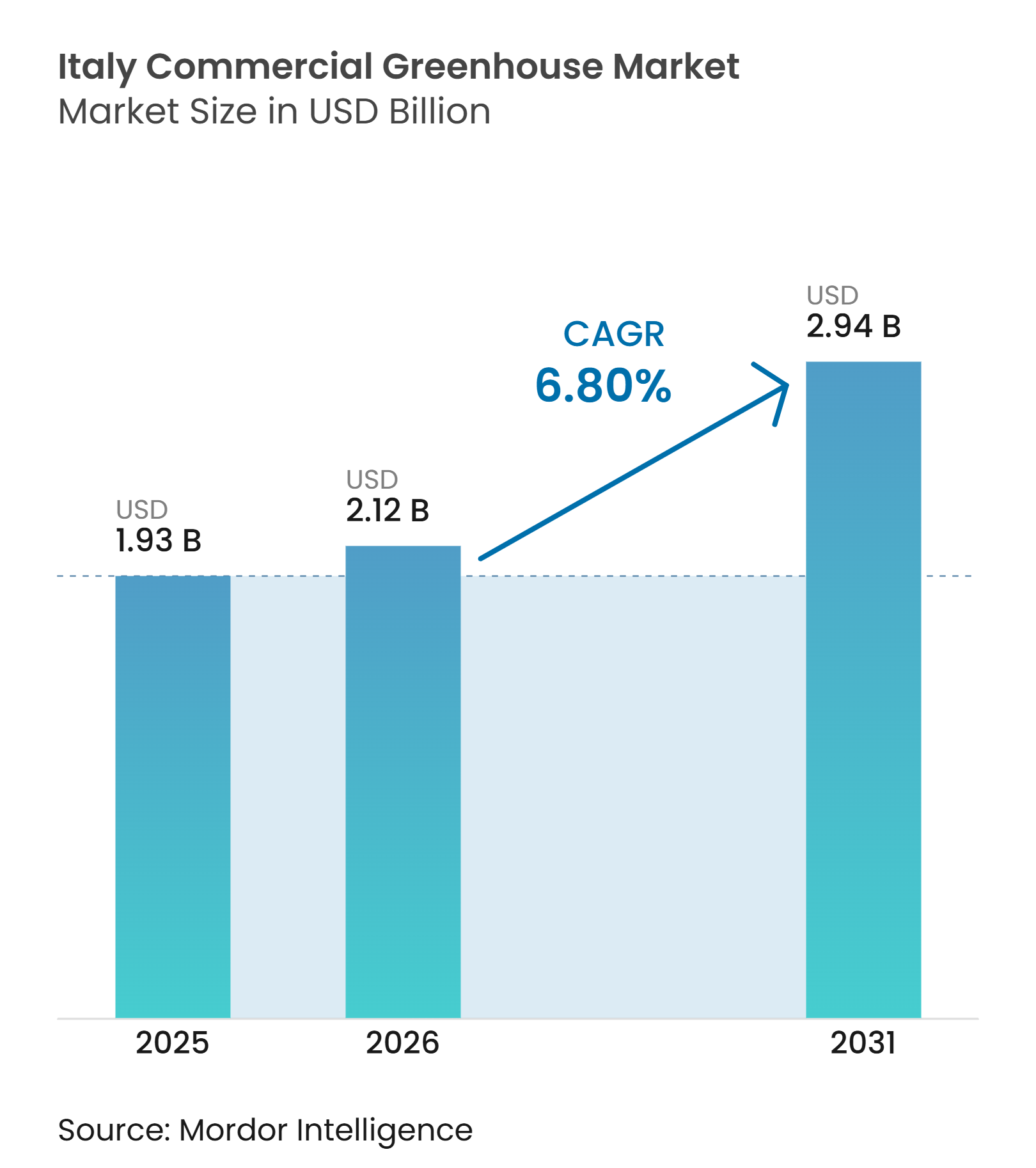
| Base Year Market Size (2025) | USD 1.93 Billion |
| Market Size (2026) | USD 2.12 Billion |
| Market Size (2031) | USD 2.94 Billion |
| Growth Rate (2026 - 2031) | 6.80 % |
| Market Concentration | Medium |
Major Players *Disclaimer: Major Players sorted in no particular order Image © Mordor Intelligence. Reuse requires attribution under CC BY 4.0. | |
Italy Commercial Greenhouse Market Analysis by Mordor Intelligence
The Italy commercial greenhouse market size was valued at USD 1.93 billion in 2025 and is forecast to grow from USD 2.12 billion in 2026 to reach USD 2.94 billion by 2031, growing at a CAGR of 6.80% from 2026 to 2031. The market is supported by investment in protected cultivation, more reliable produce supply, and energy systems that reduce operating exposure. Public programs are directing capital toward solar integration, irrigation, and greenhouse modernization, improving the case for larger projects. The market also benefits from premium horticultural production, where consistent quality and traceability support retail and export channels. Technology suppliers are responding with integrated climate, irrigation, lighting, and control systems rather than stand-alone equipment. Energy costs remain a material constraint, as heating and lighting requirements can affect the economics of high-specification facilities.
Key Report Takeaways
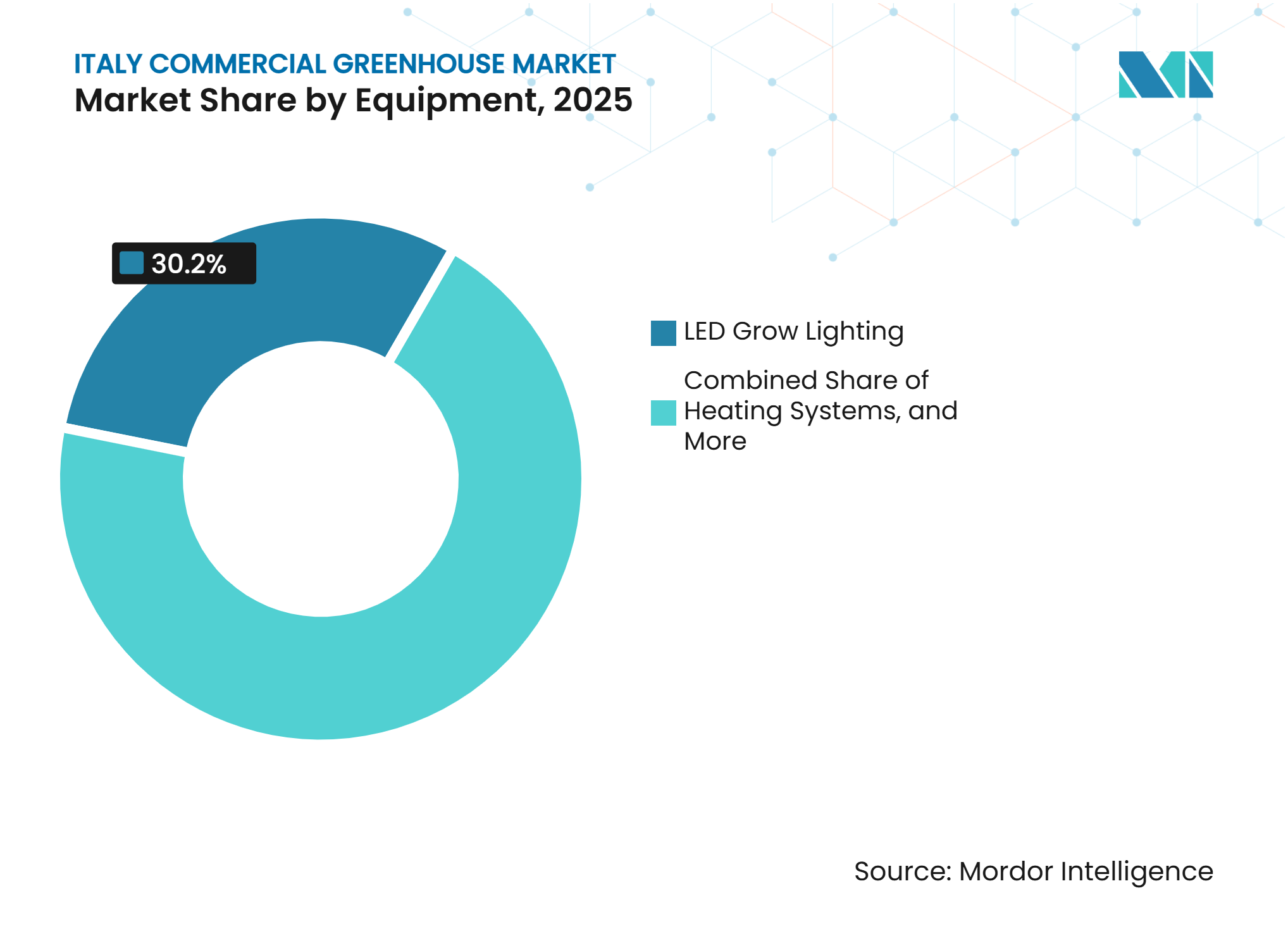
- By equipment, LED Grow Lighting accounted for 30.2% of the Italy commercial greenhouse market in 2025, while Climate Control and Automation Software is forecast to grow at a CAGR of 9.4% from 2026 to 2031.
- By crop type, Fruits and Vegetables accounted for 56% of the Italy commercial greenhouse market in 2025, while Herbs and Microgreens are forecast to grow at a CAGR of 8.7% from 2026 to 2031.
- By greenhouse type, Plastic-Film Greenhouses accounted for 61.2% of the Italy commercial greenhouse market in 2025, while Glass Greenhouses are forecast to grow at a CAGR of 7.9% from 2026 to 2031.
- By cultivation technology, Hydroponic accounted for 54.4% of the Italy commercial greenhouse market in 2025, while Hybrid and Vertical Integration Systems are forecast to grow at a CAGR of 8.6% from 2026 to 2031.
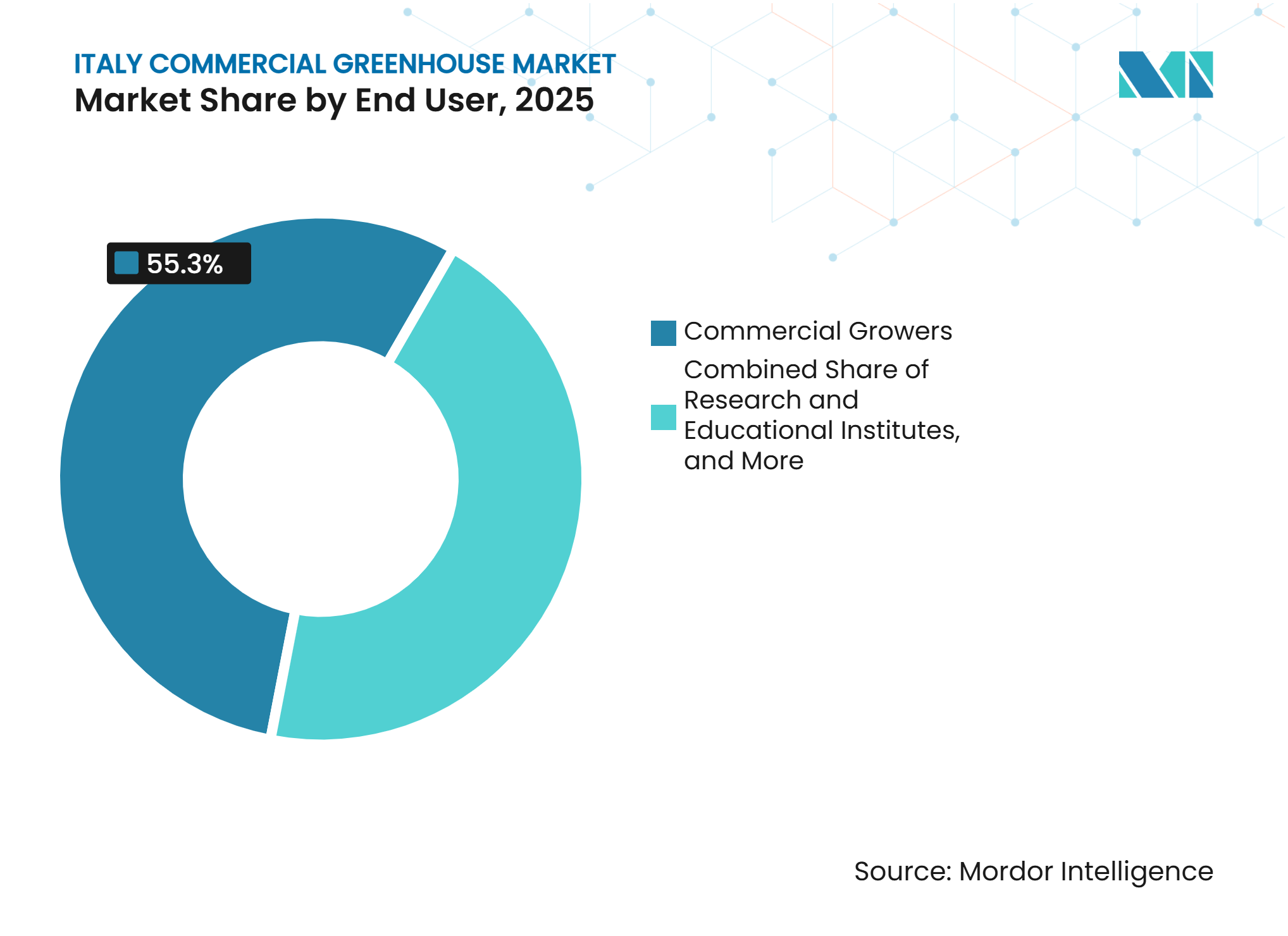
- By end user, Commercial Growers accounted for 55.3% of the Italy commercial greenhouse market in 2025, while Research and Educational Institutes are forecast to grow at a CAGR of 8.3% from 2026 to 2031.
Note: Market size and forecast figures in this report are generated using Mordor Intelligence’s proprietary estimation framework, updated with the latest available data and insights as of January 2026.
Market Trends and Insights
Drivers Impact Analysis of Italy Commercial Greenhouse Market*
| Driver | (~) % Impact on CAGR Forecast | Geographic Relevance | Impact Timeline |
|---|---|---|---|
| Year-Round Fresh Produce Demand | +1.5% | North and Central Italy, with spillover to South and Insular Italy | Short term (≤ 2 years) |
| Climate Resilience and Weather Volatility | +1.2% | South Italy, with secondary relevance in North Italy | Medium term (2-4 years) |
| LED, Sensors, and Automation Adoption | +1.0% | North Italy, especially Veneto and Lombardy, is expanding nationally | Medium term (2-4 years) |
| Food Security and Agricultural Modernization Support | +0.9% | National, with targeted gains in South Italy | Short term (≤ 2 years) |
| Retailer Shelf-Life and Residue Requirements | +0.7% | National, with greater compliance intensity in North and Central Italy | Medium term (2-4 years) |
| Waste-Heat, Geothermal, and Renewable-Energy Integration | +0.6% | Central and South Italy geothermal zones and North Italy industrial zones | Long term (≥ 4 years) |
| Source: Mordor Intelligence | |||
Year-Round Fresh Produce Demand
Italian retailers and foodservice operators require dependable supplies of local fresh produce throughout the year. This requirement reduces some of the commercial uncertainty associated with greenhouse investment compared with open-field production. The Italy commercial greenhouse market serves delivery schedules and packaging specifications that controlled-environment facilities can meet more consistently. Tomatoes, lettuce, zucchini, strawberries, and melons remain important crops for continuous replenishment programs. Large buyers increasingly assess suppliers on delivery reliability as well as crop quality. This shifts capital decisions toward facilities that can manage production conditions across seasons. Greenhouse production also helps growers maintain more predictable harvest cycles and supply volumes during periods of adverse weather. This reliability supports longer-term supply relationships with retailers and foodservice operators. As demand for consistent local produce increases, growers have greater incentives to invest in protected cultivation capacity.
Climate Resilience and Weather Volatility
Weather disruption has increased the value of protected cultivation for Italian growers. MASAF activated emergency support under EU Regulation 2024/2675 and allocated EUR 37.4 million (USD 40.8 million) for operators affected by climate-related agricultural losses[1]. Heat events in Campania and Apulia have made it harder to maintain crop quality in open fields. Northern facilities also use climate-control systems when ambient temperatures approach 40°C. The Italy commercial greenhouse market gives growers a route to manage weather exposure while maintaining more stable crop quality. Semi-closed and climate-controlled structures can support pricing that reflects retailers' value on consistent supply. Greenhouse operators can adjust temperature, humidity, ventilation, and irrigation in response to changing weather conditions. This helps reduce crop losses and maintain production schedules during periods of heat or other weather disruptions. As climate variability increases production risks, these capabilities can support continued investment in protected cultivation.
LED, Sensors, and Automation Adoption
Digital climate control, precision lighting, and automated fertigation are increasingly deployed as connected systems. LED installations designed for specific greenhouse layouts and crop profiles can reduce energy use by up to 45% compared with conventional high-pressure sodium lighting. Operators use connected lighting to capture crop response data for climate control decisions. This integrates lighting, humidity management, and yield planning into a single operating process. The Italy commercial greenhouse market is therefore moving toward systems that use data across several production functions. Suppliers that can connect equipment without creating extra operational burden are better placed to serve advanced growers. Automation also helps reduce reliance on manual monitoring and routine greenhouse tasks, particularly in larger commercial facilities. Real-time sensor data can enable growers to identify changes in growing conditions and adjust operating parameters more quickly. As technology costs become more manageable, these systems can support the modernization of existing greenhouses and the development of new automated facilities.
Food Security and Agricultural Modernization Support
Italy’s food security policy supports investment in agricultural energy and modernization projects. The Parco Agrisolare measures channels of EUR 2,350 million (USD 2,562 million) into agricultural energy infrastructure[2]. This funding reduces the effective cost of photovoltaic integration for eligible greenhouse operators. MASAF launched a third Parco Agrisolare call in August 2024, with EUR 250 million (USD 272.5 million) reserved for southern regions[3]. CAP 2023-2027 interventions can also co-finance operational programs for horticulture cooperatives. These measures improve the financial case for climate systems, irrigation equipment, and energy upgrades in the Italy commercial greenhouse market. Financial support can help growers offset the high upfront costs associated with greenhouse modernization and energy-efficient infrastructure. It can also encourage existing operators to upgrade older facilities rather than relying solely on new construction. Continued policy support therefore provides an additional incentive for the adoption of modern protected-cultivation technologies.
Restraints Impact Analysis of Italy Commercial Greenhouse Market*
| Restraint | (~) % Impact on CAGR Forecast | Geographic Relevance | Impact Timeline |
|---|---|---|---|
| High Upfront Capital and Long Payback Periods | -1.8% | National, with greater pressure on small and medium growers in South and Insular Italy | Short term (≤ 2 years) |
| Energy-Price Volatility and Heating Intensity | -1.3% | North Italy heated glass facilities, with secondary relevance in Central Italy | Medium term (2-4 years) |
| Multi-Vendor Interoperability Gaps | -0.7% | National, especially full-stack automation projects in North and Central Italy | Medium term (2-4 years) |
| Water Recirculation and Discharge Compliance | -0.5% | South and Insular Italy water-scarce areas, with secondary relevance in Central Italy | Long term (≥ 4 years) |
| Source: Mordor Intelligence | |||
High Upfront Capital and Long Payback Periods
Commercial greenhouse projects require capital investment in structures, climate systems, lighting, water management, and automation software. These requirements create a barrier for smaller operators that do not receive PNRR or CAP co-financing. High-specification soilless installations can have payback periods of 7 to 12 years without concessionary financing, which can delay new investment in lower-income agricultural districts. Operators that commit heavily to an initial project may have limited funds for subsequent equipment upgrades. Cooperative structures and shared packing facilities in Campania and Emilia-Romagna can partly reduce this burden by pooling capital and distribution costs. The financial burden is particularly significant when projects require multiple technology systems to be installed simultaneously. Uncertainty around energy prices, crop prices, and production volumes can further extend the time required to recover the initial investment. As a result, smaller growers may prefer incremental upgrades or lower-cost greenhouse technologies over fully automated facilities.
Energy-Price Volatility and Heating Intensity
Energy costs are a major variable expense for heated glasshouses in Veneto and Lombardy. Italian wholesale electricity benchmarks reached EUR 139/MWh (USD 150/MWh) in January 2025. Heating and lighting costs remain high through autumn and winter production cycles. High-specification semi-closed glass facilities can generate yield premiums, but they also carry greater energy exposure. Photovoltaic systems, biomethane, and energy management contracts can reduce part of this risk. However, the capital required for energy autonomy can add to the financing burden already associated with greenhouse construction. Energy-intensive operations can face margin pressure when electricity and heating prices increase during peak production periods. This can influence growers' decisions on greenhouse type, heating systems, and the scale of new projects. Operators may therefore prioritize energy-efficient technologies and renewable energy integration when upgrading existing facilities or developing new greenhouses.
*Our forecasts treat driver/restraint impacts as directional, not additive. The impact forecasts reflect baseline growth, mix effects, and variable interactions.
Italy Commercial Greenhouse Market Segment Analysis
By Equipment:
LED Grow Lighting Leads, While Climate Control and Automation Software Expands RapidlyLED Grow Lighting accounted for 30.2% of equipment revenue in 2025, making it the largest equipment category in the Italy commercial greenhouse market. Its position reflects the use of full-spectrum and dynamic light-recipe systems in commercial facilities across North and Central Italy. Custom LED systems are designed around greenhouse geometry and crop requirements. These installations can reduce energy use by up to 45% compared with conventional high-pressure sodium alternatives. Heating Systems, Irrigation and Fertigation Systems, and Screening and Shading Systems exhibit stable demand because facilities require them during project commissioning. They also generate replacement demand through established maintenance cycles. Structural equipment remains necessary in every new facility, regardless of its level of automation.
Climate Control and Automation Software is forecast to grow at a 9.4% CAGR from 2026 to 2031. Growth is supported by sensor networks, crop-management tools, and broader use of connected climate controls. This growth is linked to yield optimization tools, real-time sensors, and crop-modeling functions. Cooling and Ventilation Systems are also receiving more attention as summer heat reveals the limits of passive ventilation in dense facilities. Emilia-Romagna and Campania are important areas for this equipment need. Structural Components such as glazing, frames, and trusses continue to benefit from new capacity in South Italy. They also benefit when older film structures in northern clusters are replaced. The Italy commercial greenhouse industry is placing more value on equipment that improves control over production conditions. This favors suppliers that can support both installation and long-term system operation.



By Crop Type:
Fruits and Vegetables Lead, While Herbs and Microgreens Expand RapidlyFruits and Vegetables accounted for 56% of revenue in 2025 and remained the largest crop category in the Italy commercial greenhouse market. Tomatoes, lettuce, zucchini, strawberries, and melons form the commercial production base within this category. Protected structures are used to cultivate tomatoes and lettuce, and these crops also fit established retail and foodservice supply programs. Their production supports regular purchasing of greenhouse equipment and operating systems. The Italy commercial greenhouse market remains closely tied to the operational needs of high-volume produce growers.
Herbs and Microgreens are forecast to grow at an 8.7% CAGR from 2026 to 2031, supported by residue-free production for urban foodservice customers and health-focused retail buyers. Specialty herbs can be positioned as traceable convenience products when production conditions are documented. Flowers and Ornamentals remain established in Central Italy, where geothermal-heated facilities serve cut-flower and potted-plant production. Cannabis and Specialty Crops are emerging under Italy's framework for licensed medical cannabis cultivation in controlled conditions, with research and development activity in this area attracting pharmaceutical-adjacent agricultural operators. The Italy commercial greenhouse market must therefore balance yield, sales channels, and certification obligations when selecting crop portfolios.
By Greenhouse Type:
Plastic-Film Greenhouses Lead, While Glass Greenhouses Expand RapidlyPlastic-Film Greenhouses accounted for 61.2% of revenue in 2025 and remained the leading greenhouse type. Their large base reflects the use of lower-cost tunnel structures across South and Insular Italy. Mediterranean growing conditions and capital constraints have historically supported this form of protected cultivation. Plastic-film structures remain practical for growers that need lower initial investment. They also serve a large part of the lower-technology production tier. Rigid Polycarbonate Greenhouses occupy a middle position in the Italy commercial greenhouse market. Their UV-diffusing characteristics are useful for selected ornamental and leafy-green applications.
Glass Greenhouses is forecast to grow at a 7.9% CAGR from 2026 to 2031. Growth is supported by demand for higher levels of environmental control, longer operating cycles, and integration with automated climate and lighting systems. The category benefits from more consistent yields, thermal screening, and compatibility with high-intensity LED systems. Semi-closed glass structures can provide stronger control over the growing environment. They are therefore suited to growers seeking quality consistency and advanced automation. Hybrid and Semi-Closed Greenhouses are concentrated among larger commercial operators and international turnkey projects. New builds in North Italy increasingly use Venlo or semi-closed glass configurations. Plastic-film additions remain more concentrated in South Italy. This split will continue to shape regional technology intensity through the forecast period.
By Cultivation Technology:
Hydroponic Leads, While Hybrid and Vertical Integration Expand RapidlyHydroponic accounted for 54.4% of cultivation-technology revenue in 2025. Nutrient Film Technique, Deep Water Culture, and Drip Hydroponics support commercial tomato and cucumber production in Veneto, Emilia-Romagna, and Campania. The Italy commercial greenhouse market uses these systems where growers need controlled nutrient delivery and predictable production conditions. Hydroponic operations can also align with the water efficiency needs of larger facilities. PNRR AgriTech funding under MUR M4C2, Investment 1.4 has supported automated hydroponic installations at university campuses. These installations create pathways for technology transfer into commercial operations. Non-Hydroponic Soil and Substrate cultivation remains important in South Italy cooperative operations.
Hybrid and Vertical Integration are forecast to grow at an 8.6% CAGR from 2026 to 2031. The approach combines soilless methods, vertical layers, and automated nutrient delivery to increase productive use of available floor area. Transition costs continue to limit adoption among growers who lack access to concessionary financing. Marconi Vivai S.r.l. operates 60,000 square meters of heated and automated greenhouses. Floramiata S.r.l. Società Agricola uses geothermal heating for ornamental cultivation. These examples show that locally based operators can pursue efficient cultivation models without relying entirely on international platform suppliers. Closed-loop hydroponic systems also require nutrient-discharge monitoring, which links technology selection with compliance costs.
By End User:
Commercial Growers Lead, While Research and Educational Institutes Expand RapidlyCommercial Growers accounted for 55.3% of revenue in 2025 and formed the largest end-user group. These growers include large vegetable and ornamental producers operating independently or through cooperatives, supplying supermarket chains, export distributors, and foodservice contracts. Their scale makes them important purchasers of irrigation equipment, climate controls, and greenhouse structures. Campania and Sicily together represented more than 70% of Italy's protected production area in the supplied analysis. Commercial growers play a central role in equipment demand, as their facilities require regular investment and maintenance. The Italy commercial greenhouse market relies on these buyers for a large share of capital equipment activity.
Research and Educational Institutes are forecast to grow at an 8.3% CAGR from 2026 to 2031. PNRR AgriTech and EU Horizon funding are channeling investment in greenhouse infrastructure toward universities and agricultural research centers. Technologies tested in academic greenhouse settings typically move into commercial use within 3 to 5 years, making this segment relevant to the future direction of equipment adoption. Retail Garden Centers and Nurseries represent another end-user category, serving ornamental and bedding-plant customers through specialist retail channels. This group values reliability and performance over the lowest purchase price, providing suppliers with a service-intensive revenue channel beyond large commercial grower contracts.

Geography Analysis
North Italy accounted for 39% of revenue in 2025, making it in the largest geographic area in Italy commercial greenhouse market. Piedmont, Lombardy, Veneto, Emilia-Romagna, and Friuli-Venezia Giulia contain high-technology greenhouse clusters for vegetables and ornamentals. Verona has an established role in hydroponic production of tomatoes, strawberries, melons, and lettuce, supported by varietal testing programs described in the supplied analysis. Italian horticulture prices rose 6.6% in 2025. Northern growers make greater use of full-stack automation and LED systems. Larger cooperative structures also give these operators more purchasing capacity for integrated climate-control platforms.
South Italy is forecast to grow at a 7.6% CAGR through 2031. Growth is supported by sensor networks, crop-management tools, and broader use of connected climate controls. Campania, Apulia, Calabria, Basilicata, and Molise are receiving investment through PNRR subsidies and CAP co-financing. The August 2024 Parco Agrisolare call allocated EUR 250 million (USD 272.5 million) specifically to southern regions. Thermal and electrical energy represented 20% of total variable costs in this setting. ISTAT reported 1.8% growth in Southern Italy's agricultural value-added volume in 2025, the highest among Italy's macro-regions. These factors support modernization in a region that has historically received less capital investment.
Central Italy has geothermal resources and an established ornamental horticulture activity. Tuscany, Lazio, Marche, Umbria, and Abruzzo are relevant to this part of the Italy commercial greenhouse market. Floramiata's geothermal-heated operations demonstrate the potential for fossil-fuel-independent heating in ornamental plant production. Insular Italy includes Sicily and Sardinia, which operate under different conditions. Sicily has a broad base of plastic-film tunnels in lower-technology categories. Sardinia has a smaller greenhouse base and receives island-specific PNRR water-productivity support. Both regions have opportunities for greenhouse development linked to fresh-produce supply requirements and government-backed water-efficiency programs.
Competitive Landscape
Market Concentration
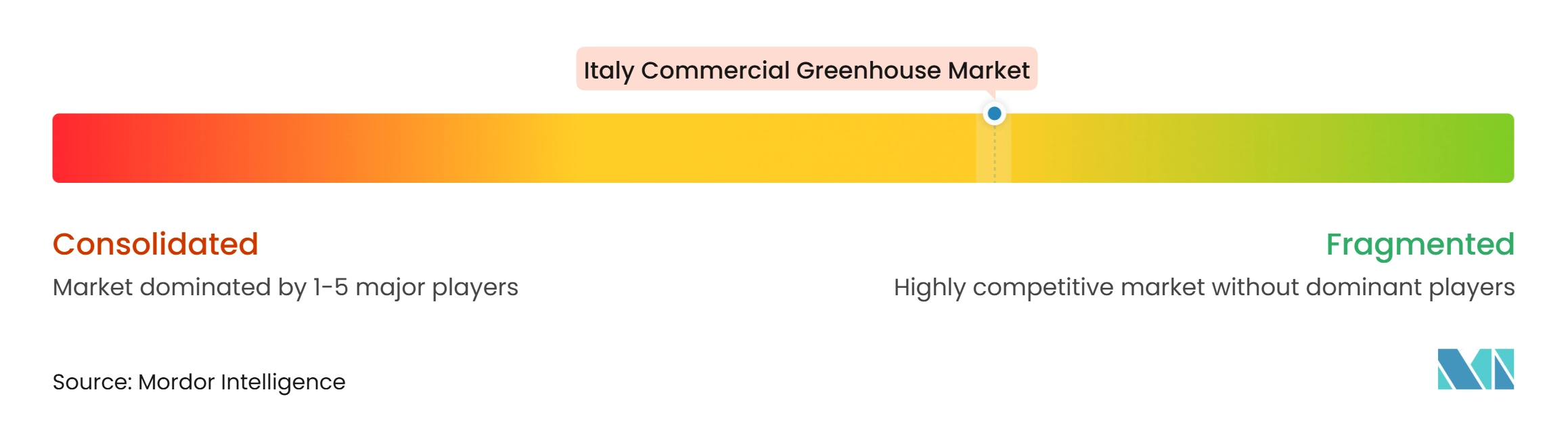
The Italy commercial greenhouse market is fragmented, with regional operators, grower cooperatives, specialist technology integrators, and international suppliers competing across different parts of the value chain. International suppliers participate through turnkey projects and technology licensing. Netafim Ltd., Priva Holding B.V., Certhon Build B.V., KUBO Greenhouse Projects B.V., Signify N.V., Hoogendoorn Growth Management B.V., and Argus Control Systems Ltd. provide products and systems relevant to advanced greenhouse facilities. International turnkey solutions can be too costly for these operations, while basic single-vendor equipment may not meet their operating needs.
Priva Holding B.V. and Signify N.V. have moved toward multi-year service agreements. This approach shifts part of the supplier relationship from equipment sales toward continuing service and support. Signify’s greenhouse lighting and control offering is positioned around LED and crop-management systems. Priva provides greenhouse automation systems for climate and process control. Hoogendoorn’s IIVO platform reflects ongoing development in climate control and sensor integration. These strategic moves align with demand for systems that help operators manage several production variables through connected tools.
Italy-based Marconi Vivai S.r.l. and Floramiata S.r.l. Società Agricola compete through vertically integrated production and energy-conscious operations. Ridder Drive Systems B.V. and AB Ludvig Svensson retain specialist positions in drive systems and climate screens, where technical performance and switching costs matter. Van der Hoeven Horticultural Projects B.V. and Dalsem B.V. compete for larger projects that require a single party to coordinate delivery. Palram Industries (1990) Ltd. serves the polycarbonate glazing segment with SUNTUF Plus and SUNLITE Plus panels for growers upgrading plastic-film tunnels. The market includes suppliers with different roles across structures, climate management, irrigation, lighting, and cultivation. Competition therefore depends on project capability, compatibility with existing equipment, operating support, and financing needs as much as on initial equipment price.
Italy Commercial Greenhouse Industry Leaders
-
Netafim Ltd. (Orbia Advance Corporation)
-
Richel Group S.A.
-
Certhon Build B.V. (DENSO Corporation)
-
KUBO Greenhouse Projects B.V. (KUBO Group B.V.)
-
Priva Holding B.V.
- *Disclaimer: Major Players sorted in no particular order
Italy Commercial Greenhouse Market Companies Covered in this Report
- Netafim Ltd. (Orbia Advance Corporation)
- Richel Group S.A.
- Certhon Build B.V. (DENSO Corporation)
- KUBO Greenhouse Projects B.V. (KUBO Group B.V.)
- Priva Holding B.V.
- Dalsem B.V. (COFRA Holding AG)
- Van der Hoeven Horticultural Projects B.V. (Arvesta NV)
- Ridder Drive Systems B.V. (Lanvi Group)
- AB Ludvig Svensson (Ludvigson Invest AB)
- Signify N.V.
- Hoogendoorn Growth Management B.V. (Batenburg Techniek N.V.)
- Palram Industries Ltd.
- Argus Control Systems Ltd.
- Marconi Vivai S.r.l.
- Floramiata S.r.l. Società Agricola
Recent Industry Developments in Italy Commercial Greenhouse Market
- September 2026: Fri-El Green House announced plans to expand its hydroponic greenhouse complex in Ostellato, Ferrara, from 31 hectares to 60 hectares through a deep geothermal project. The project includes four wells reaching 2.5 km depth, accessing water at 60°C to 80°C, and an underground thermal storage system at 350 meters. The system is designed to provide renewable heating and cooling and support energy self-sufficiency at the expanded greenhouse complex. he geothermal plant is currently in the authorization phase, with work scheduled to begin in mid-2027.
- June 2025: Fri-El Green House began installing a 16.8 MW ground-mounted photovoltaic system at its Ostellato greenhouse complex, adding to its existing 2.7 MW floating photovoltaic plant. The new system is designed to generate clean energy while collecting rainwater for greenhouse irrigation, supporting the operator’s energy efficiency and resource-management efforts.
- November 2024: Netafim Italia, a subsidiary of Netafim Ltd., acquired 100% of Tecnir S.r.l. in Faenza, strengthening its precision irrigation distribution network across Emilia-Romagna. The acquisition builds on the companies’ 10-year commercial partnership and expands Netafim Italia’s presence among Italian agricultural operators.
Italy Commercial Greenhouse Market Report Scope
The commercial greenhouse market refers to the cultivation of crops in enclosed or partially enclosed structures that provide controlled or modified growing conditions. The market includes greenhouse structures and associated equipment and systems used for commercial crop production.
The Italy Commercial Greenhouse Market Report is Segmented by Equipment (Heating Systems, Cooling and Ventilation Systems, LED Grow Lighting, Irrigation and Fertigation Systems, Climate Control and Automation Software, Screening and Shading Systems, and Structural Components), by Crop Type (Fruits and Vegetables, Flowers and Ornamentals, Herbs and Microgreens, and Cannabis and Specialty Crops), by Greenhouse Type (Glass Greenhouses, Plastic-Film Greenhouses, Rigid Polycarbonate Greenhouses, and Hybrid and Semi-Closed Greenhouses), by Cultivation Technology (Hydroponic, Non-Hydroponic Soil and Substrate, and Hybrid and Vertical Integration), and by End User (Commercial Growers, Research and Educational Institutes, and Retail Garden Centers and Nurseries). The Market Forecasts are Provided in Terms of Value (USD).
Segmentation Overview
| Heating Systems | |
| Cooling and Ventilation Systems | |
| LED Grow Lighting | |
| Irrigation and Fertigation Systems | |
| Climate Control and Automation Software | |
| Screening and Shading Systems | |
| Structural Components | Glazing Systems |
| Frames and Trusses |
| Fruits and Vegetables | Tomatoes |
| Cucumbers | |
| Lettuce and Leafy Greens | |
| Peppers | |
| Strawberries and Berries | |
| Flowers and Ornamentals | Cut Flowers |
| Potted Plants and Bedding Plants | |
| Herbs and Microgreens | |
| Cannabis and Specialty Crops | Medical Cannabis |
| Seedlings and Propagation Crops |
| Glass Greenhouses |
| Plastic-Film Greenhouses |
| Rigid Polycarbonate Greenhouses |
| Hybrid and Semi-Closed Greenhouses |
| Hydroponic | Nutrient Film Technique |
| Deep Water Culture | |
| Drip Hydroponics | |
| Non-Hydroponic Soil and Substrate | Soil-Based |
| Coco Coir and Rockwool Substrate | |
| Hybrid and Vertical Integration |
| Commercial Growers |
| Research and Educational Institutes |
| Retail Garden Centers and Nurseries |
| By Equipment | Heating Systems | |
| Cooling and Ventilation Systems | ||
| LED Grow Lighting | ||
| Irrigation and Fertigation Systems | ||
| Climate Control and Automation Software | ||
| Screening and Shading Systems | ||
| Structural Components | Glazing Systems | |
| Frames and Trusses | ||
| By Crop Type | Fruits and Vegetables | Tomatoes |
| Cucumbers | ||
| Lettuce and Leafy Greens | ||
| Peppers | ||
| Strawberries and Berries | ||
| Flowers and Ornamentals | Cut Flowers | |
| Potted Plants and Bedding Plants | ||
| Herbs and Microgreens | ||
| Cannabis and Specialty Crops | Medical Cannabis | |
| Seedlings and Propagation Crops | ||
| By Greenhouse Type | Glass Greenhouses | |
| Plastic-Film Greenhouses | ||
| Rigid Polycarbonate Greenhouses | ||
| Hybrid and Semi-Closed Greenhouses | ||
| By Cultivation Technology | Hydroponic | Nutrient Film Technique |
| Deep Water Culture | ||
| Drip Hydroponics | ||
| Non-Hydroponic Soil and Substrate | Soil-Based | |
| Coco Coir and Rockwool Substrate | ||
| Hybrid and Vertical Integration | ||
| By End User | Commercial Growers | |
| Research and Educational Institutes | ||
| Retail Garden Centers and Nurseries | ||
Key Questions Answered in the Report
What is the forecast value of the Italy commercial greenhouses by 2031?
The Italy commercial greenhouse market is forecast to reach USD 2.94 billion by 2031, from USD 2.12 billion in 2026, at a CAGR of 6.80% from 2026 to 2031.
Which equipment category is growing fastest in Italian commercial greenhouses?
Climate Control and Automation Software is forecast to grow at a CAGR of 9.4% from 2026 to 2031.
Which crop category leads protected cultivation revenue in Italy?
Fruits and Vegetables accounted for 56% of revenue in 2025, while Herbs and Microgreens is forecast to grow at a CAGR of 8.7% from 2026 to 2031.
Why are Italian greenhouse operators investing in energy systems?
Heating and lighting exposure is significant, and solar, geothermal, biomethane, and heat-recovery systems can improve energy cost stability. These systems can support heating, lighting, irrigation, and climate-management requirements at suitable sites.