
Italy CNG Vehicle Market Size and Share
Market Overview
| Study Period | 2019 - 2032 |
|---|---|
| Forecast Data Period | 2027 - 2032 |
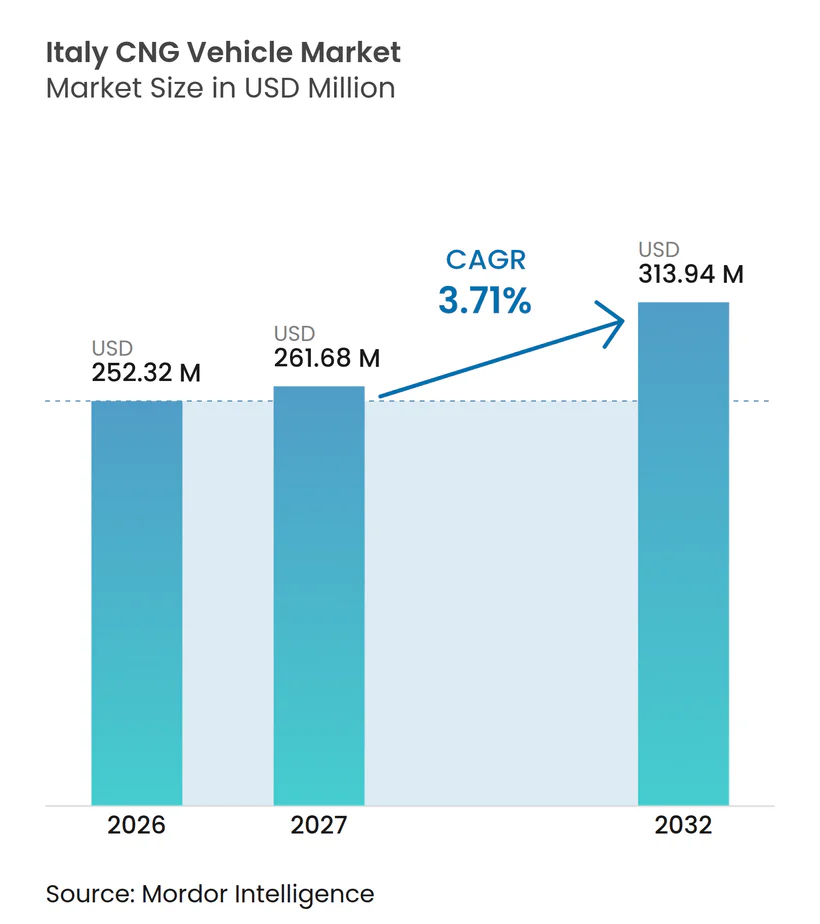
| Base Year Market Size (2026) | USD 252.32 Million |
| Market Size (2027) | USD 261.68 Million |
| Market Size (2032) | USD 313.94 Million |
| Growth Rate (2027 - 2032) | 3.71 % |
| Market Concentration | Medium |
Major Players *Disclaimer: Major Players sorted in no particular order Image © Mordor Intelligence. Reuse requires attribution under CC BY 4.0. | |
Italy CNG Vehicle Market Analysis by Mordor Intelligence
The Italy CNG vehicle market size was valued at USD 252.32 million in 2026 and is expected to grow from USD 261.68 million in 2027 to USD 313.94 million by 2032, at a CAGR of 3.71% during 2027-2032. The market is shifting away from broad private-car demand toward commercial fleets and public transport operators with predictable routes and high annual usage. Biomethane can be used in existing CNG vehicles and refueling equipment without hardware changes, thereby supporting the continued use of the installed network. Italy has a fleet of roughly 900,000 CNG vehicles and more than 1,500 public refueling points, giving fleet operators a broad operating base [1]. Government grants, municipal bus procurement, and investment in biomethane connections support the commercial case for the Italy CNG vehicle market. At the same time, fewer new passenger-car models and stronger battery-electric competition are reducing CNG's role in private mobility.
Key Report Takeaways
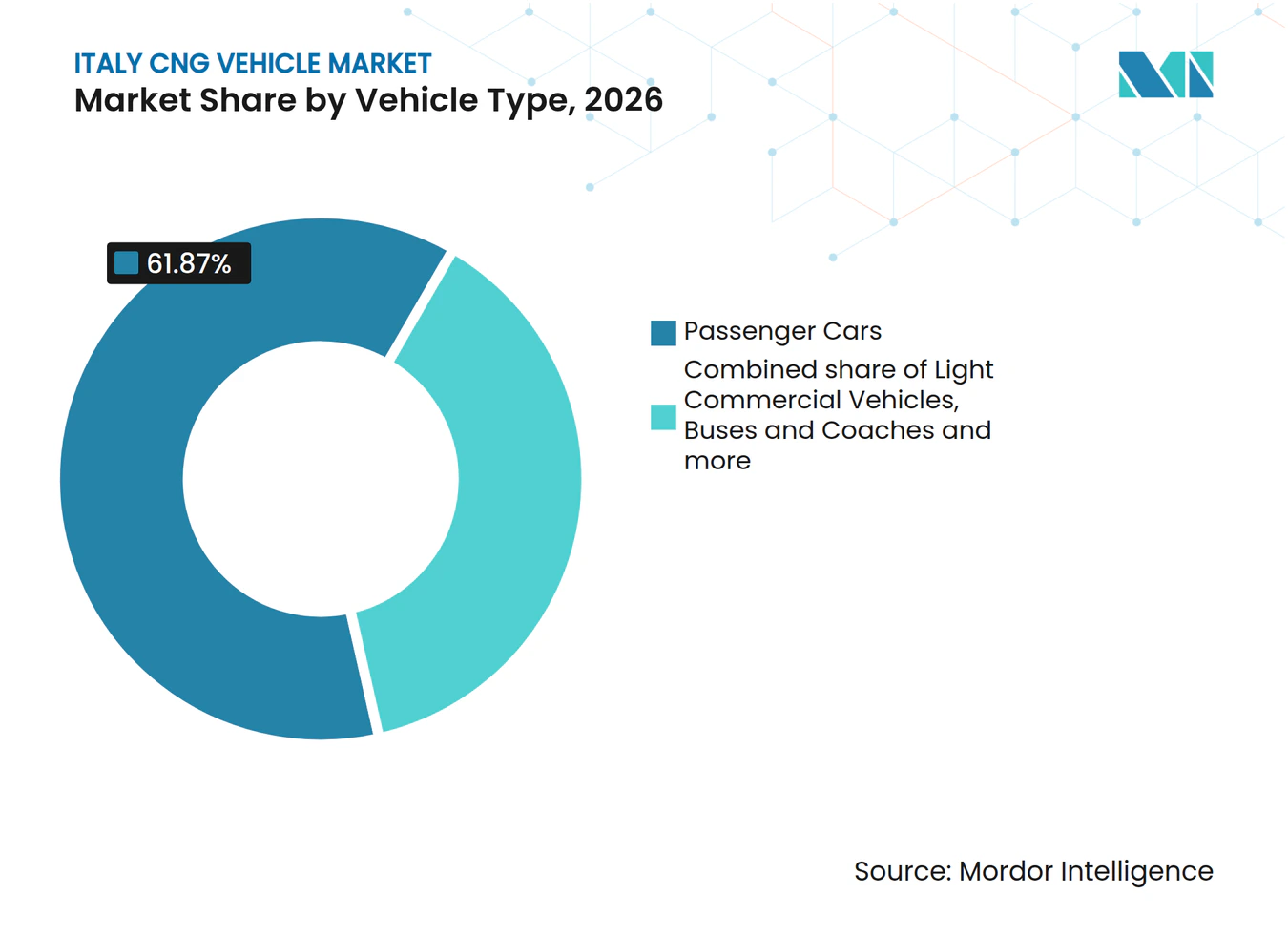
- By vehicle type, passenger cars held a 61.87% share in 2026, while buses and coaches are projected to grow at a 7.11% CAGR through 2032.
- By fitment type, OEM-fitted systems held a 76.12% share in 2026, while retrofitted and aftermarket systems are projected to grow at a 7.29% CAGR through 2032.
- By end-use application, private and personal use held a 48.18% share in 2026, while public transit authorities are projected to grow at a 7.32% CAGR through 2032.
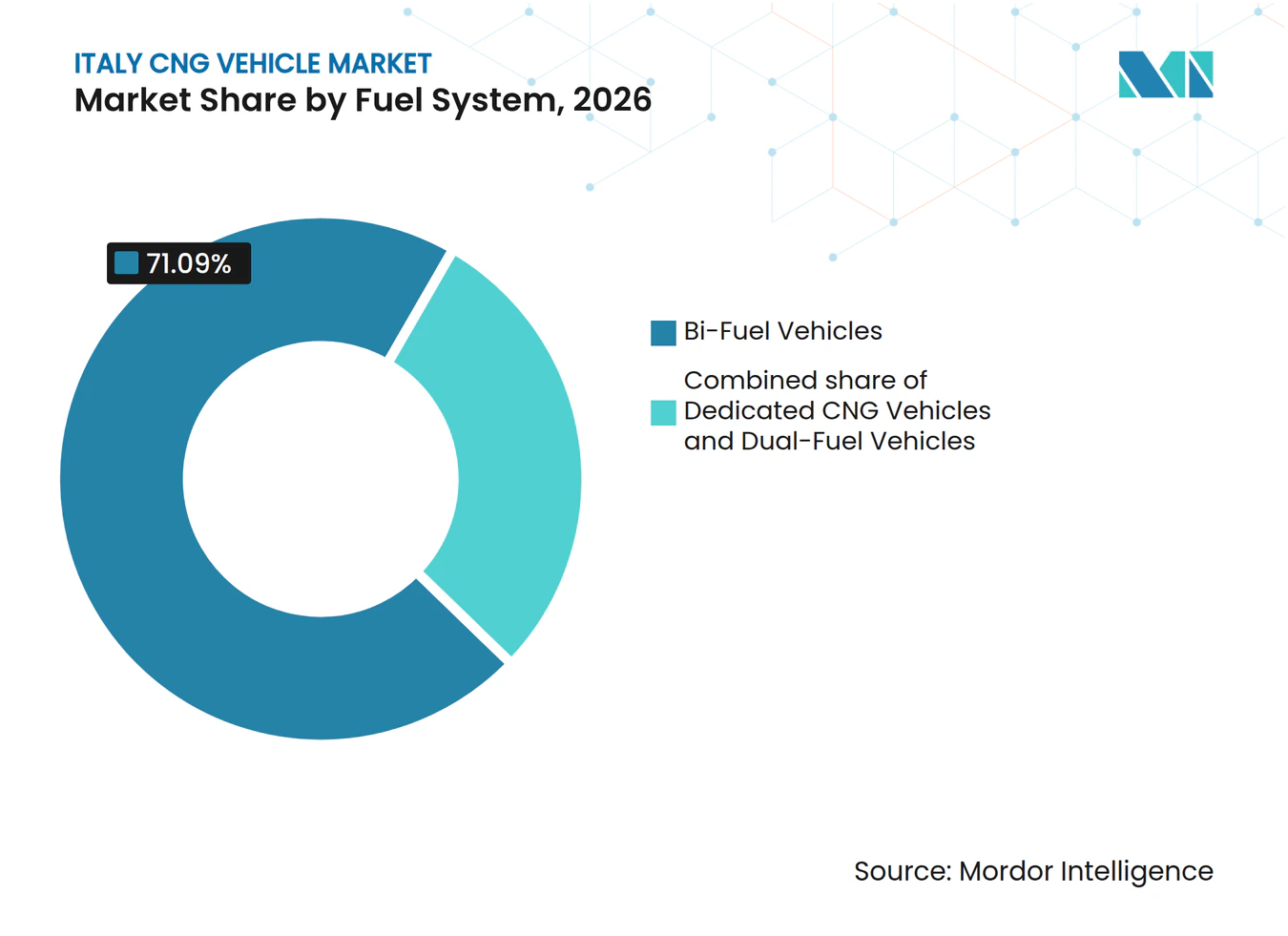
- By fuel system, bi-fuel vehicles held a 71.09% share in 2026, while dual-fuel vehicles are projected to grow at a 7.17% CAGR through 2032.
- By cylinder type, Type I all-metal cylinders held a 38.22% share in 2026, while Type IV polymer-liner composite cylinders are projected to grow at a 7.47% CAGR through 2032.
- By geography, Northern Italy held a 59.11% share in 2026, while Southern Italy is projected to grow at a 7.89% CAGR through 2032.
Note: Market numbers in this report are based on Mordor Intelligence's proprietary estimation framework, which combines nine months of actuals with Q4 projections for base year 2026.
Market Trends and Insights
Drivers Impact Analysis of Italy CNG Vehicle Market*
| Driver | (~) % Impact on CAGR Forecast | Geographic Relevance | Impact Timeline |
|---|---|---|---|
| Lower Total Cost of Ownership for High-Utilization Fleets | +0.8% | National, concentrated in Po Valley and Southern Italy logistics hubs | Medium term (2–4 years) |
| Dense and Mature CNG Refueling Infrastructure | +0.6% | National, strongest in Northern and Central Italy and expanding in the South | Short term (≤ 2 years) |
| Biomethane Compatibility With Existing CNG Vehicles and Stations | +0.6% | National, with early production gains in Northern Italy biomethane clusters | Long term (≥ 4 years) |
| Municipal Fleet Renewal and Public Transport Procurement | +0.5% | National, with early contract wins in Rome, Milan, Turin, Naples, and Treviso | Medium term (2–4 years) |
| CNG Range and Payload Advantages in Medium- and Heavy-Duty Operations | +0.4% | National, including cross-border EU freight corridors | Medium term (2–4 years) |
| Italy's Established CNG Conversion and Component Ecosystem | +0.3% | National, with manufacturing concentrated in Emilia-Romagna | Short term (≤ 2 years) |
| Source: Mordor Intelligence | |||
Lower Total Cost of Ownership for High-Utilization Fleets
Fleet economics remain a primary reason Italian logistics operators continue to use CNG in their vehicle replacement decisions. Higher diesel prices in recent years widened the fuel cost gap for operators driving long annual distances. Savings per kilometer can offset the purchase premium for a CNG truck within a few years for high-use fleets. A recent government decree provided grants for qualifying heavy vehicles and scrappage support for older pre-Euro VI vehicles. This structure favors operators replacing older trucks and can accelerate fleet renewal decisions. Biomethane use can also support fleet emissions reporting, which gives the Italy CNG vehicle market relevance beyond direct fuel savings.
Dense and Mature CNG Refueling Infrastructure
Italy's public CNG network supports routine fleet operations across major freight and transit routes. Public stations located on motorways provide long-haul carriers with a practical option for route planning without diesel backup. Greenture planned additional CNG, LNG, and hydrogen sites, with a significant portion already operational[2]. The expansion focuses on logistics centers and intercity corridors where coverage has been limited. Public access also complements depot refueling for buses, waste collection fleets, and regional freight operators. These conditions make infrastructure a near-term support factor for the Italy CNG vehicle market, particularly where electric charging capacity remains constrained.
Biomethane Compatibility With Existing CNG Vehicles and Stations
CNG vehicles, compressors, and onboard storage can use biomethane without modification. This allows operators to reduce the carbon intensity of fuel use without replacing vehicles or refueling assets. In July 2025, the European Investment Bank approved a EUR 264 million loan to Snam for biomethane infrastructure, including 240 km of new pipelines designed to transport 12,000 GWh of renewable energy annually[3]. Edison and Verdalia Bioenergy signed a 10-year agreement in June 2025 to supply 14 million cubic meters of biomethane annually from seven agricultural plants in the Brescia area. Long-term supply agreements give transport operators a clearer route to secure renewable gas volumes. The compatibility of existing equipment gives the Italy CNG vehicle market a practical transition path for fleets operating under long service contracts.
Municipal Fleet Renewal and Public Transport Procurement
Municipal buyers continue to select CNG buses where full electric deployment is limited by charging readiness or grid capacity. IVECO BUS received Lot 1 of the 2025 Consip framework tender for 80 Daily CNG minibuses, comprising 30 urban and 50 interurban vehicles. Multi-year public procurement provides more stable demand than private passenger-car registrations. It therefore gives the Italy CNG vehicle market a reliable source of demand in transit applications.
Restraints Impact Analysis of Italy CNG Vehicle Market*
| Restraint | (~) % Impact on CAGR Forecast | Geographic Relevance | Impact Timeline |
|---|---|---|---|
| Battery-Electric Competition in Passenger Cars and Urban Vans | -1.0% | National, most acute in Northern Italy and major urban centers | Short term (≤ 2 years) |
| Volatility of Natural Gas and Biomethane Fuel Economics | -0.7% | Global, with domestic exposure through Italy’s gas import dependency | Medium term (2–4 years) |
| Limited New CNG Model Availability in Light-Duty Vehicles | -0.5% | National, most acute in private passenger car demand | Short term (≤ 2 years) |
| Methane-Slip Compliance and Residual-Value Uncertainty | -0.4% | EU-wide, operationalized in Italy through Euro 7 on-board monitoring requirements | Long term (≥ 4 years) |
| Source: Mordor Intelligence | |||
Battery-Electric Competition in Passenger Cars and Urban Vans
Passenger cars and urban vans are shifting toward battery-electric models. Euro 7 (Regulation (EU) 2024/1257) applies to new M1 and N1 vehicle types from November 2026, raising compliance costs for combustion powertrains, including CNG. Italy registered a large number of new passenger cars in recent years, with battery-electric and plug-in hybrid vehicles accounting for growing shares. Monthly CNG passenger car registrations had fallen to very low levels by mid-decade as manufacturers withdrew models without replacements. This trend reduces replacement demand in the private-use segment of the Italy CNG vehicle market. However, it does not have the same effect on buses and heavy trucks, where range, payload, and charging time continue to influence fleet decisions.
Volatility of Natural Gas and Biomethane Fuel Economics
Higher, more volatile European gas prices have narrowed CNG's historic fuel-cost advantage. Italy's biomethane blending requirement is set to increase progressively toward a higher threshold by the end of the decade, adding cost pressure where renewable gas carries a premium. Federmetano reported that the obligation was already increasing station supply prices. Methane-slip monitoring and Euro 7 requirements also create uncertainty around residual values and compliance costs. New biomethane infrastructure may reduce the fuel premium as supply grows. Operators with long-term offtake agreements may have more predictable economics than fleets relying on spot station prices.
*Our forecasts treat driver/restraint impacts as directional, not additive. The impact forecasts reflect baseline growth, mix effects, and variable interactions.
Italy CNG Vehicle Market Segment Analysis
By Vehicle Type:
Commercial and Transit Fleets Drive Structural RebalancingPassenger cars accounted for 61.87% of the Italy CNG vehicle market in 2026, reflecting a large installed base from earlier factory-fitted model programs. That installed base still supports refueling demand, maintenance activity, and conversion services even though it no longer represents the direction of new-vehicle product planning. New CNG passenger-car registrations had fallen sharply from their 2020 peak and had dropped to very low monthly volumes by mid-2026. Passenger cars are still expected to grow at about 1.4% a year through 2032, as conversions of existing vehicles and continued use of the installed base partly offset the decline in new factory-fitted models. Light commercial vehicles still serve selected urban delivery routes that require low-emission-zone access, but battery-electric van launches are narrowing this role. Buses and coaches are forecast to grow at a 7.11% CAGR through 2032 because their daily routes, depot access, and public procurement model are better aligned with CNG operations.
Medium- and heavy-duty trucks present the strongest long-term commercial case among vehicle types, as their high mileage makes fuel consumption, range, and payload central operating concerns. IVECO documented an extended range on a single refill with an S-Way CNG truck equipped with the xCursor engine and a large-tank system. The test demonstrated that a CNG truck can cover long national routes without frequent refueling and can narrow the operating gap with diesel. Heavy vehicles are also more likely to rely on OEM-integrated systems as Euro 7 requirements become more stringent and fleet buyers seek documented compliance. Two- and three-wheelers remain a small niche, as electric scooters dominate urban use and major manufacturers offer few dedicated CNG powertrains.



By Fitment Type:
Retrofit Incentives Support Aftermarket DemandOEM-fitted systems accounted for 76.12% of the Italy CNG vehicle market in 2026, reflecting factory installations accumulated across passenger and commercial fleets during earlier production cycles. Fiat, Volkswagen Group, and IVECO previously supported dedicated CNG production programs for the Italian market, making factory fitment familiar to many buyers and repair networks. The withdrawal of passenger-car models now limits new OEM volume, especially in the part of the fleet once served by factory bi-fuel vehicles. Retrofitted and aftermarket systems are forecast to grow at a 7.29% CAGR through 2032, although this growth is concentrated in suitable existing vehicles rather than new light-duty production. The Ecobonus MIMIT program provides a fixed incentive amount for CNG or biomethane installations in eligible M1 passenger vehicles.
The retrofit incentive creates a selective source of demand even as factory production contracts, helping eligible owners retain vehicles with compatible engines. Westport Fuel Systems Italia and Landi Renzo signed an agreement to combine Landi Renzo's Green Transportation business with WFSI. The transaction, expected to close in the near term, will bring together two major suppliers across OEM, D-OEM, and installer channels at a time when scale and certified servicing are increasingly important. The combined organization may secure stronger development agreements, maintain broader installer support, and serve more fuel-system applications from a single platform. Smaller regional converters may face increased competition, although their local customer relationships and workshop coverage will remain relevant to aftermarket delivery.
By End-Use Application:
Transit Spending Outgrows Private UsePrivate and personal use accounted for 48.18% of the Italy CNG vehicle market in 2026, supported by Italy’s legacy base of privately owned CNG cars. This share is likely to diminish as older vehicles are retired and replacement demand shifts toward battery-electric models that receive greater manufacturer support. Taxi and ride-hailing fleets continue to use CNG in cities where fuel costs remain favorable, and drivers need flexibility during long daily shifts. Industrial and utility fleets retain demand in logistics, waste collection, and field service operations where routes are known in advance. These operators benefit from predictable distances, depot-based refueling, and a clearer link between annual mileage and the economic value of CNG.
Public transit authorities are forecast to grow at a 7.32% CAGR through 2032, the fastest rate among end-use applications. National and regional procurement systems use multi-year framework agreements that provide more stable demand than individual private vehicle purchases and provide suppliers with greater visibility into vehicle replacement cycles. IVECO’s Consip award for 80 Daily CNG minibuses illustrates how public procurement continues to support gas-fueled transit vehicles. Future Euro 7 on-board monitoring requirements will strengthen replacement pressure for older heavy vehicles and make proven fleet technologies important to public buyers. The transit portion of the Italy CNG vehicle market is therefore more resilient than private use because operators can plan refueling, maintenance, and vehicle replacement as a single system.
By Fuel System:
Bi-Fuel Flexibility Anchors the Installed BaseBi-fuel vehicles accounted for 71.09% of the Italy CNG vehicle market in 2026, and their leading position reflects the value drivers place on the ability to use both CNG and petrol. Historically uneven CNG coverage outside northern regions made this flexibility useful for personal travel, regional business journeys, and operators who could not always rely on a nearby gas station. Dedicated CNG vehicles are more common in buses and municipal fleets with assured depot refueling, where predictable access reduces the need for a second fuel system. These differences show that the installed base is shaped by operating conditions rather than a single preference across all vehicle users. Dual-fuel vehicles are forecast to grow at a 7.17% CAGR through 2032, led by medium- and heavy-duty trucking, where the fuel configuration has a different operating purpose.
Dual-fuel systems use diesel pilot ignition with natural gas, which can support strong power output in freight operations while allowing the gas share to change with relative fuel costs. This configuration is useful for truck operators who need diesel-like performance but want an option to reduce gasoil use on routes with dependable CNG or biomethane access. IVECO’s xCursor 13 is a mono-fuel CNG engine that delivers 500 hp and is designed for Euro 7 readiness. Higher-performance mono-fuel trucks may challenge dual-fuel solutions in some long-haul applications by reducing the historical trade-off between gas use and engine output. The resulting fuel-system mix reflects distinct needs in private transport, scheduled transit, and commercial freight, rather than a uniform move toward a single technical configuration.

By Cylinder Type:
Composite Cylinders Gain as Payload Needs RiseType I all-metal cylinders accounted for 38.22% of the Italy CNG vehicle market in 2026, supported by older passenger cars and light commercial vehicles fitted with steel tanks during the earlier CNG production peak. Type II cylinders offer some weight reduction at a lower premium than composite designs, placing them between basic steel storage and more advanced options. Type III and Type IV cylinders are more useful where lower weight can improve payload capacity, allow more fuel to be carried, or extend a vehicle's useful range. This matters most in commercial operations, where tank weight can affect both load capacity and route planning. Type IV polymer-liner composite cylinders are projected to grow at a 7.47% CAGR through 2032, the fastest rate among cylinder types.
Demand for Type IV tanks is linked to longer-range trucks and buses that require higher onboard gas capacity without a proportional increase in vehicle weight. IVECO's Type IV-compatible tank packages provide a combined storage capacity that represents a notable increase over the previous generation. Transit authorities can specify lighter tanks to improve passenger capacity, while freight fleets can use the weight savings to maintain payload economics. ISO and ECE standards provide the certification framework for CNG cylinders used in Italy, giving fleet operators a basis for specifying approved storage systems. Higher carbon fiber input costs can pressure prices, but range and payload gains continue to support composite adoption among high-use fleets.
Geography Analysis
Northern Italy accounted for 59.11% in 2026. Piedmont, Lombardy, Veneto, and Emilia-Romagna combine dense refueling coverage with Italy’s most active logistics corridors. Emilia-Romagna also hosts conversion and component companies such as Landi Renzo and Lovato Gas. Trentino-Alto Adige and Friuli-Venezia Giulia support cross-border freight traffic toward Austria, Germany, and Slovenia. Investment in biomethane supply and refueling upgrades reinforces the region’s position.
Central Italy maintains a stable role across Tuscany, Lazio, Umbria, and Marche. Its demand comes from urban transit, intercity freight, tourism-related travel, and regional service fleets. Rome is a focal point for public transport demand and refueling expansion in Lazio. Transport authorities participate in national framework arrangements for urban and interurban CNG buses.
Southern Italy is forecast to grow at a 7.89% CAGR through 2032, the fastest regional rate in the Italy CNG vehicle market. The growth starts from a smaller base because public CNG coverage has historically been less dense. Campania, Puglia, Calabria, Abruzzo, Basilicata, and Molise have commercial fleets that could benefit from wider station access. New investment in refueling infrastructure can reduce the need for diesel fallback on regional routes.
The Islands, Sicily and Sardinia, have a separate operating profile because grid connection and refueling constraints remain more material, particularly in Sardinia, which has no natural gas transmission network.
Competitive Landscape
Market Concentration
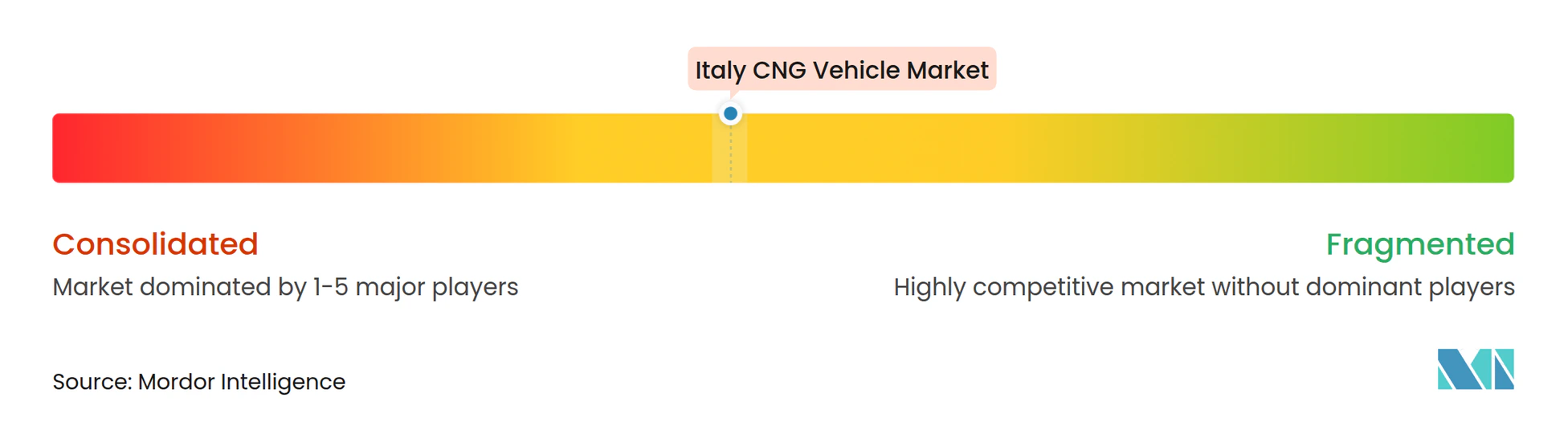
The Italy CNG vehicle market is moderately concentrated in commercial vehicle manufacturing and fuel-system supply. IVECO holds the strongest position in buses, medium-duty trucks, and heavy-duty trucks, which underpin current market growth. The xCursor engine has been documented as Euro 7-ready and has delivered over 1,000 kilometers on a single refill in a recent test. IVECO BUS further strengthened its position in public transit through a Consip award for a fleet of CNG minibuses.
Stellantis and Volkswagen Group previously held significant positions in the passenger CNG vehicle segment through the Fiat Natural Power and Golf TGI platforms. Both have reduced new-model investment as these products approach the end of life. Daimler Truck Holding, Volvo Group, and TRATON compete in the heavy truck segment but have not matched IVECO's relationships with Italian fleet operators. Hexagon Composites holds a strategic position in the Type IV cylinder supply market. Patents and technical certification requirements create barriers to entry in premium storage systems.
Westport Fuel Systems Italia, now owned by Heliaca Investments, agreed in April 2026 to take over Landi Renzo's Green Transportation business, with Landi Renzo retaining a 15% stake. The combination is expected to strengthen the group's ability to serve OEMs, D-OEMs, and retrofit installers. Suppliers see opportunities in depot refueling and Bio-CNG station upgrades, particularly in Southern Italy. The Ecobonus MIMIT program creates an additional opening for certified conversion kits in eligible passenger vehicles.
Italy CNG Vehicle Industry Leaders
-
IVECO Group N.V.
-
Stellantis N.V.
-
Landi Renzo S.p.A.
-
Daimler Truck Holding AG
-
Westport Fuel Systems Italia S.r.l.
- *Disclaimer: Major Players sorted in no particular order
Italy CNG Vehicle Market Companies Covered in this Report
- IVECO Group N.V.
- Stellantis N.V.
- Volkswagen AG
- Renault Group
- Daimler Truck Holding AG
- Volvo Group
- TRATON SE
- Otokar Otomotiv ve Savunma Sanayi A.S.
- CAF S.A.
- Industria Italiana Autobus S.p.A.
- Landi Renzo S.p.A.
- Westport Fuel Systems Italia S.r.l.
- Lovato Gas S.p.A.
- Hexagon Composites ASA
Recent Industry Developments in Italy CNG Vehicle Market
- September 2026: OG Clean Fuels acquired 11 bio-CNG fueling stations in Italy, expanding its European network.
- July 2026: Italy's Ministry of Enterprises and Made in Italy opened bookings for a retrofit incentive of EUR 800 for installing CNG or biomethane systems on Euro 3 or newer M1 passenger cars.
- April 2026: Westport Fuel Systems Italia agreed to take over Landi Renzo's Green Transportation business, with Landi Renzo retaining a 15% stake in the combined group.
- October 2025: IVECO BUS was awarded a 2025 Consip tender lot to supply 80 Daily CNG minibuses, including 30 urban and 50 interurban vehicles.
Italy CNG Vehicle Market Report Scope
The Italy CNG Vehicle Market Report is Segmented by Vehicle Type (Passenger Cars, Light Commercial Vehicles, Buses and Coaches, Medium- and Heavy-Duty Trucks, and Two- and Three-Wheelers), Fitment Type (OEM-Fitted and Retrofitted/Aftermarket), End-Use Application (Private and Personal Use, Taxi and Ride-Hailing Fleets, and More), Fuel System (Dedicated CNG Vehicles, Bi-Fuel Vehicles, and Dual-Fuel Vehicles), Cylinder Type (Type I, Type II, and More), and Geography (Northern Italy, Central Italy, Southern Italy, and Islands). The Market Forecasts are Provided in Terms of Value (USD) and Volume (Units).
Segmentation Overview
| Passenger Cars |
| Light Commercial Vehicles |
| Buses and Coaches |
| Medium- and Heavy-Duty Trucks |
| Two- and Three-Wheelers |
| OEM-Fitted |
| Retrofitted/Aftermarket |
| Private and Personal Use |
| Taxi and Ride-Hailing Fleets |
| Public Transit Authorities |
| Industrial and Utility Fleets |
| Dedicated CNG Vehicles |
| Bi-Fuel Vehicles |
| Dual-Fuel Vehicles |
| Type I, All-Metal |
| Type II, Metal Hoop-Wrapped |
| Type III, Full Composite |
| Type IV, Polymer-Liner Composite |
| Passenger Cars | OEM-Fitted |
| Retrofitted/Aftermarket | |
| Light Commercial Vehicles | OEM-Fitted |
| Retrofitted/Aftermarket | |
| Buses and Coaches | OEM-Fitted |
| Retrofitted/Aftermarket | |
| Medium- and Heavy-Duty Trucks | OEM-Fitted |
| Retrofitted/Aftermarket | |
| Two- and Three-Wheelers | OEM-Fitted |
| Retrofitted/Aftermarket |
| Northern Italy | Piedmont |
| Lombardy | |
| Veneto | |
| Emilia-Romagna | |
| Trentino-Alto Adige | |
| Friuli-Venezia Giulia | |
| Central Italy | Tuscany |
| Lazio | |
| Umbria | |
| Marche | |
| Southern Italy | Campania |
| Puglia | |
| Calabria | |
| Abruzzo | |
| Basilicata | |
| Molise | |
| Islands | Sicily |
| Sardinia |
| Vehicle Type | Passenger Cars | |
| Light Commercial Vehicles | ||
| Buses and Coaches | ||
| Medium- and Heavy-Duty Trucks | ||
| Two- and Three-Wheelers | ||
| Fitment Type | OEM-Fitted | |
| Retrofitted/Aftermarket | ||
| End-Use Application | Private and Personal Use | |
| Taxi and Ride-Hailing Fleets | ||
| Public Transit Authorities | ||
| Industrial and Utility Fleets | ||
| Fuel System | Dedicated CNG Vehicles | |
| Bi-Fuel Vehicles | ||
| Dual-Fuel Vehicles | ||
| Cylinder Type | Type I, All-Metal | |
| Type II, Metal Hoop-Wrapped | ||
| Type III, Full Composite | ||
| Type IV, Polymer-Liner Composite | ||
| Cross-Segmentation by Vehicle Type and Fitment Type | Passenger Cars | OEM-Fitted |
| Retrofitted/Aftermarket | ||
| Light Commercial Vehicles | OEM-Fitted | |
| Retrofitted/Aftermarket | ||
| Buses and Coaches | OEM-Fitted | |
| Retrofitted/Aftermarket | ||
| Medium- and Heavy-Duty Trucks | OEM-Fitted | |
| Retrofitted/Aftermarket | ||
| Two- and Three-Wheelers | OEM-Fitted | |
| Retrofitted/Aftermarket | ||
| Geography | Northern Italy | Piedmont |
| Lombardy | ||
| Veneto | ||
| Emilia-Romagna | ||
| Trentino-Alto Adige | ||
| Friuli-Venezia Giulia | ||
| Central Italy | Tuscany | |
| Lazio | ||
| Umbria | ||
| Marche | ||
| Southern Italy | Campania | |
| Puglia | ||
| Calabria | ||
| Abruzzo | ||
| Basilicata | ||
| Molise | ||
| Islands | Sicily | |
| Sardinia | ||
Key Questions Answered in the Report
What is the projected value of the Italy CNG vehicle market by 2032?
The Italy CNG vehicle market is forecast to reach USD 313.94 million by 2032, expanding at a 3.71% CAGR from 2027 to 2032.
Which vehicle category is growing fastest in the Italy CNG vehicle market?
Buses and coaches are forecast to expand at a 7.11% CAGR through 2032, supported by municipal procurement and depot-based operations.
Which part of Italy is expected to grow fastest for CNG vehicles?
Southern Italy is forecast to grow at a 7.89% CAGR through 2032, as refueling coverage expands from a smaller installed base.
Can existing CNG vehicles use biomethane?
Yes. Existing CNG vehicles and refueling systems can use biomethane without hardware modifications, supporting a lower-carbon fuel pathway.