
Market Overview
| Study Period | 2020 - 2031 |
|---|---|
| Forecast Data Period | 2026 - 2031 |
| Historical Data Period | 2020 - 2024 |
| Growth Rate | 11.58 % |
Major Players *Disclaimer: Major Players sorted in no particular order Image © Mordor Intelligence. Reuse requires attribution under CC BY 4.0. | |
Italy Aesthetic Devices Market Analysis by Mordor Intelligence
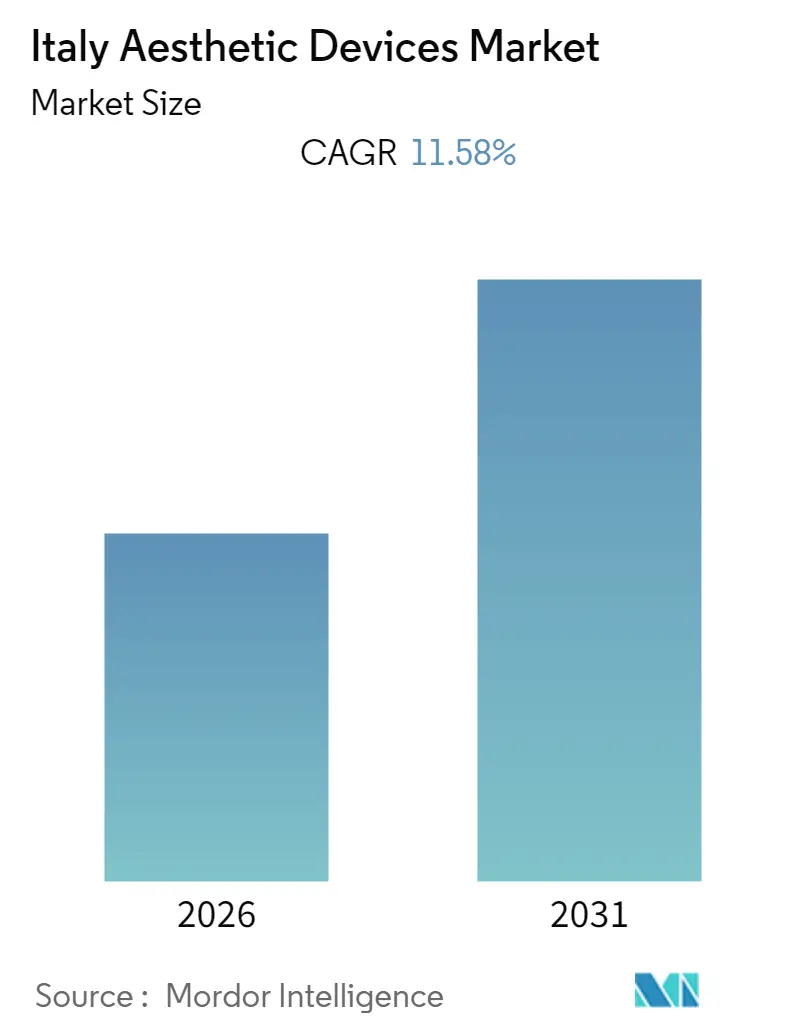
The Italy Aesthetic Devices Market size is expected to register a CAGR of 11.58% during the forecast period (2026-2031).
The cosmetic and aesthetic device manufacturers had to shut down the production and supply units due to the lockdown, that was imposed at the beginning of the COVID-19 outbreak. For instance, according to an article published by the European Journal of Dermatology, in May 2021, titled 'The impact of COVID-19 pandemic on dermatologic practice: Italian survey', it has been observed that 58% of routine clinical dermatological activity was reduced in Italy. Thus, COVID-19 significantly impacted the growth rate of the market over the pandemic phase.
Certain factors that are propelling the market growth are the rising number of aesthetic procedures in Italy and technological advancement in aesthetic devices. For instance, according to an article published by Plastic Reconstructive and Regenerative Surgery, in June 2022, titled 'National Breast Implant Registry in Italy. Competent authority perspective to improve patients' safety', it has been observed that 61.5% of the reconstructive procedures were performed in Italy between 25th March 2019 and the 31st August 2021. Additionally, as per the International Society of Aesthetic Plastic Surgery survey on Aesthetic/Cosmetic procedures in 2020, it has been found that about 245,400 surgical procedures and 585,468 non-surgical procedures were performed in Italy in 2020. Also, from the same source, under the face and head surgical segment 37,956 eyelid surgery procedures, 22,452 rhinoplasties, and 17,736 fat graftings (face) procedures were performed, in Italy, in 2020. Furthermore, from the same source, the most common surgical procedure performed in Italy, in 2020, was 39,276 breast augmentations.
The concern of people about their appearance is gradually on a rise, in the country. Thus, there is an increase in the number of cosmetic surgeries performed, annually. Although the rate of increase is not much high, the fact remains that people are getting more concerned with their appearance, especially with the increasing standard of living.
In addition, the rising geriatric and obese population coupled with rising awareness about aesthetic procedures among the population is also contributing to the market growth. For instance, according to the 2022 statistics published by the United Nations Population Fund, in Italy, a large proportion of the living population is aged 15-64 and accounts for 64% in 2022. In addition, as per the same source, 24% of the population is aged 65 years and above in 2022. Additionally, as per the 2022 statistics published by World Obesity, 12.9% of men and 10.7% of women were obese in Italy, in 2020. Thus, the rising geriatric population and obese population are expected to increase the demand for aesthetic procedures such as facelifting, anti-aging procedures, and liposuction, respectively, which is further expected to boost the demand for aesthetic devices in the country, thereby propelling the market growth.
Thus, owing to the abovementioned factors, the market is expected to project growth over the forecast period.However, the social stigma and ethical concerns, and poor reimbursement scenarios are expected to restrain the market growth over the forecast period.
Note: Market size and forecast figures in this report are generated using Mordor Intelligence’s proprietary estimation framework, updated with the latest available data and insights as of 2026.
Italy Aesthetic Devices Market Trends and Insights
Botulinum Toxin Segment is Expected to Show a High Growth Rate During the Forecast period
Botulinum toxin is a neurotoxic protein that is produced by the bacterium Clostridium botulinum. The injections of botulinum toxin tend to block the nerve signals to the muscle in which it is injected. As the muscle is not able to contract without a signal, it results in diminishing or decreasing unwanted facial wrinkles or appearance. As a result, highly diluted concentrations of botulinum toxin are used for cosmetic and non-cosmetic purposes, such as for the treatment of frown lines between the eyebrows, dystonia, chronic migraine, and other purposes.
The botulinum toxin subsegment by the non-energy-based aesthetic device is showing a growth rate and is expected to grow during the forecast period owing to the rise in demand for minimally invasive cosmetic methods and a higher number of beauty-conscious populations.
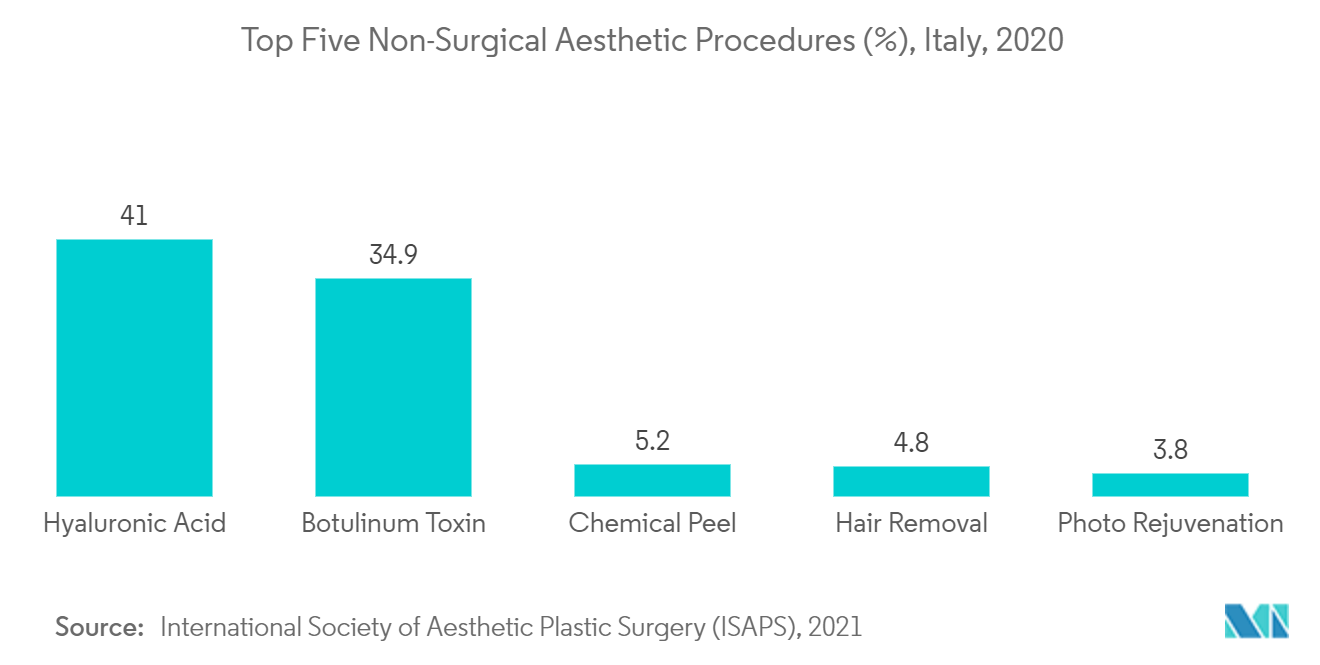
According to the International Society of Aesthetic Plastic Surgery (ISAPS) survey on Aesthetic/Cosmetic procedures in 2020, among all the non-surgical cosmetic procedures performed in Italy, 204,084 procedures were of Botulinum toxin. The ISAPS performed an international survey on cosmetic procedures in 2020 and according to the data, common cosmetic procedures per age group were botulinum toxin procedures. Thus, the increasing adoption of botulinum toxin procedures for the treatment of facial wrinkles, frown lines, and others is expected to increase the demand for aesthetic devices in the country, thereby boosting market growth.
Thus, owing to the aforementioned factors, the market is expected to grow significantly during the forecast period.
Competitive Landscape
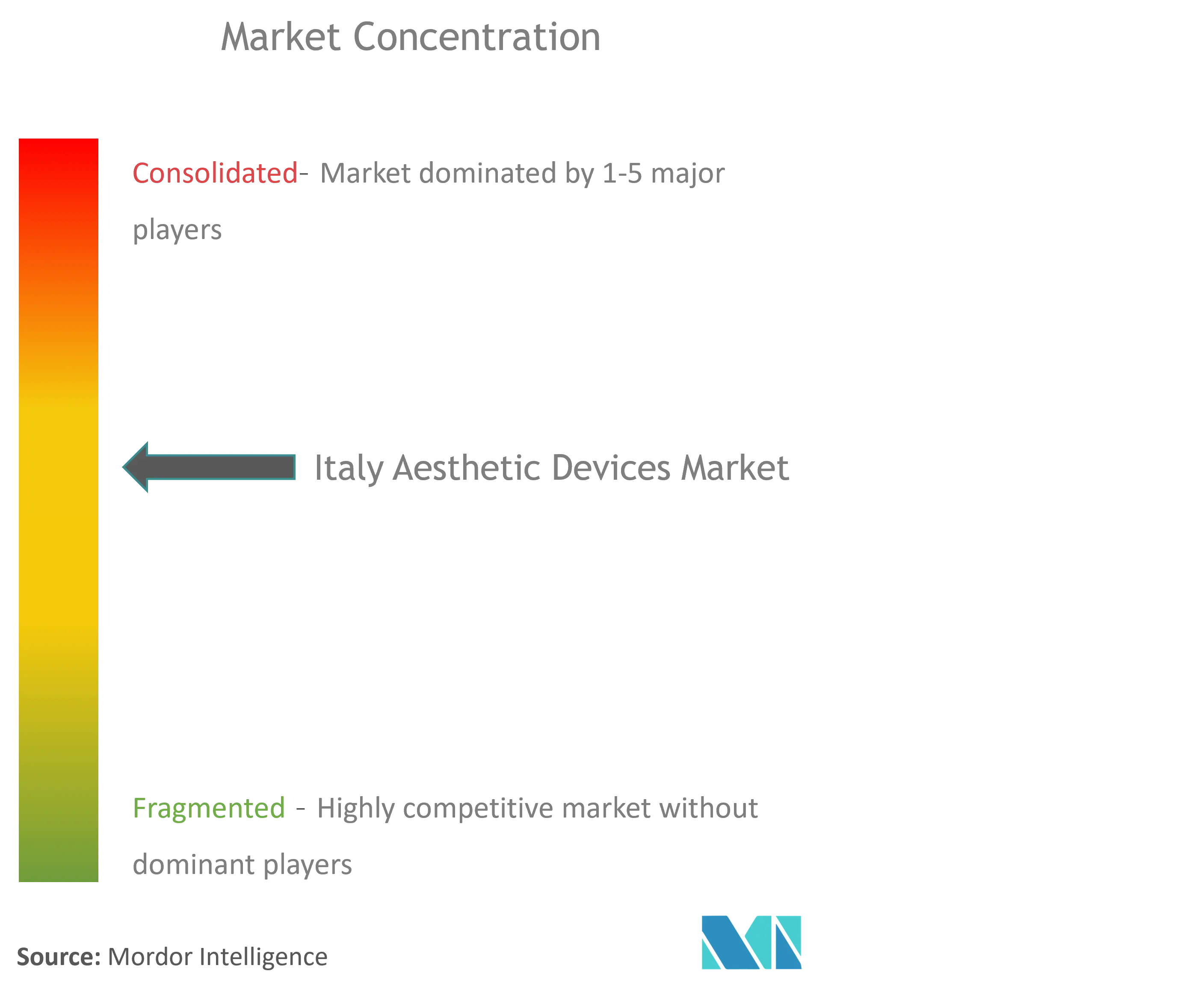
The medical aesthetic devices market is highly competitive and consists of a number of significant players. Companies, like AbbVie, Inc (Allergan Inc.), Alma Lasers, Cutera Inc., El.En. (Asclepion Laser Technologies), Hologic Inc., Lumenis Inc., Sciton Inc., Syneron Medical Ltd, and Venus Concept, among others, hold a substantial market share in the Italian aesthetic devices market.
Italy Aesthetic Devices Industry Leaders
-
Lumenis Inc.
-
Alma Lasers
-
AbbVie Inc.
-
El.En. (Asclepion Laser Technologies)
-
Hologic Inc.
- *Disclaimer: Major Players sorted in no particular order
Market Opportunities and Future Outlook
Italy continues to show strong interest in minimally invasive, clinic-delivered aesthetics where patient throughput and predictable outcomes drive purchasing. ISAPS data indicate 585,468 non-surgical procedures in Italy in 2020, including 204,084 botulinum toxin procedures, underscoring demand for injectables and related practice infrastructure such as consumables management, training, and workflow standardization to sustain volumes.
On the device side, multi-application energy platforms and software-led differentiation create whitespace for vendors that can offer protocol libraries and patient-specific planning. Confindustria Dispositivi Medici in 2026 PRI communications notes an average 22% increase in production costs tied to energy, logistics, and geopolitical factors, reinforcing the appeal of platforms with high utilization and service coverage. AI-enabled treatment planning and image-based decision support are emerging as differentiators, but EU MDR requirements and evolving EU AI Act obligations for applicable software gate commercialization, making compliance-ready offerings and local post-market support practical differentiators.
Recent Industry Developments
- June 2026: A leading Italian hospital network signed a multi-year procurement agreement for energy-based dermal systems, including service, training, and ongoing support. The contract expands access to advanced laser and energy-based platforms across multiple facilities, signaling a shift toward bundled equipment and service-centric purchasing.
- May 2026: Italian regulator updates EU MDR conformity expectations for aesthetic devices and introduces new post-market surveillance guidelines aligned with EU AI Act obligations for applicable software. Clinics and distributors must demonstrate compliance readiness and local post-market support as part of market access.
- September 2025: AbbVie (Allergan Aesthetics) expanded SKINVIVE by JUVEDERM into Italy as part of a broader roll-out across 35 markets. The move broadened the injectable offering available to Italian aesthetic practices and intensified branded competition in hyaluronic acid based treatments.
Research Methodology Framework and Report Scope
Market Definition and Coverage
This market covers the sales value of aesthetic devices used in Italy for cosmetic procedures across clinical and at-home use, covering both energy-based systems and non-energy-based devices that support aesthetic treatments.
Scope exclusions: We exclude procedure service revenues, clinic fees, consumables sold as drugs, and purely cosmetic products that are not regulated as devices.
Segmentation Overview
- Type of Device
- Energy-based Aesthetic Device
- Laser-based Aesthetic Device
- Light-based Aesthetic Device
- Ultrasound Aesthetic Device
- Others
- Non-energy-based Aesthetic Device
- Botulinum Toxin
- Dermal Fillers and Aesthetic Threads
- Implants
- Others
- Energy-based Aesthetic Device
- By Application
- Skin Resurfacing and Tightening
- Hair Removal
- Breast Augmentation
- Other Applications
- By End-user
- Hospital
- Home Settings
- Other End-users
Data Sources, Market Sizing, and Validation
Desk Research
Desk work started by mapping the addressable patient and procedure pool in Italy, then linking that pool to where devices are actually installed and used. Public references were used to set the backdrop and sanity-check the model, including Italian Ministry of Health publications, Eurostat demographic series, OECD health statistics, ISS health data, and peer-reviewed clinical journals that discuss procedure adoption and outcomes.
We also reviewed manufacturer public materials such as annual reports, investor presentations, product brochures, and credible press coverage to understand device categories, replacement cycles, and the direction of pricing. For hard-to-compare company financial splits and patent activity signals, we used paid subscriptions focused on company financials and patent databases. This helped confirm innovation intensity and category focus. These desk research sources are illustrative, and other public and paid references were also used for data collection, validation, and clarification.
Primary Interviews and Surveys
Primary inputs were collected through expert interviews and structured surveys with device distributors, clinic operators, dermatology and plastic surgery stakeholders, and service engineers who see purchasing and utilization patterns. Because device pricing and usage can shift with treatment popularity, these conversations were used to verify assumptions on the installed base, average device utilization, and typical replacement timing, and then to pressure-test the desk-built demand indicators.
Distribution of primary research fieldwork respondents
| Company type | Respondent position |
|---|---|
| Top tier: 32% | CXOs: 13% |
| Mid tier: 50% | Functional/Unit leaders: 34% |
| Smaller Players: 18% | Managers: 53% |
Market-Sizing & Forecasting
Sizing was built using a combined top-down and bottom-up approach, where a top-down demand pool was reconstructed from procedure volumes and treatment penetration, then checked against supply-side signals before finalizing totals. To keep the model practical, we used a limited set of repeatable inputs and made every assumption traceable to a source or an interview note.
Key inputs that shaped the market totals included the share of aesthetic procedures done with device support, device utilization rates by major application (such as hair removal and skin resurfacing), the estimated installed base in clinics versus home settings, typical replacement cycles, and average selling price bands by device class. Where direct counts were missing, gaps were handled by using proxy indicators like facility counts and procedure mix, followed by conservative ranges that were narrowed through primary feedback.
For the forecast, scenario analysis was used so growth could be tied to a few clear drivers rather than a single straight-line rate. Procedure adoption trends, consumer spending pressure, and expected price movement were varied across scenarios, then aligned to what practitioners and distributors described as realistic over the next few years.
Data Validation & Update Cycle
Totals were validated through triangulation across independent signals, and large variances were reviewed until the drivers were clearly explained. Our analysts ran cross-checks such as implied devices per facility, implied revenue per installed unit, and year-over-year jumps by device type, then compared these back to expert feedback.
Before sign-off, the model and assumptions go through multiple review steps, and follow-up calls are triggered when a number sits outside a reasonable range for utilization, pricing, or adoption. The report is refreshed annually, and interim updates are made when material events affect demand, pricing, or availability. Right before delivery, we do a fresh pass so the final output reflects the latest inputs available.
Mordor Intelligence's Italy Aesthetic Devices Market Sizing Compared With Other Published Estimates
Published market sizes for Italy aesthetic devices can look different because the market boundary is not always drawn the same way, and the input variables are not always checked against real purchasing behavior. Differences also come from the year used as the base, the currency timing, and whether values are reported at manufacturer selling price or at a later point in the channel.
The table shows a wide spread mainly because some sources narrow the scope to only lasers, while others expand the scope into service revenue for aesthetic treatments. In Mordor Intelligence's model, the count is limited to device sales across energy-based and non-energy-based categories used for aesthetic procedures in Italy, with procedure fees and non-device cosmetics kept out.
Benchmark comparison
| Source | Market Size | Gaps in Research Methodology |
|---|---|---|
| Mordor Intelligence | USD 0.00 M (2024) | |
| Trade Dataset A | USD 90.50 M (2024) | This estimate is limited to aesthetic lasers and related light-based applications, so it omits non-energy-based categories and other device types used in the broader aesthetic device mix. |
| Industry Publisher B | USD 2828.22 M (2024) | This estimate reflects medical aesthetics services revenue, where procedure fees and provider income are included, which inflates totals versus a device-sales-only definition. |
When the scope is aligned, the gap reduces quickly, and the remaining difference is usually explained by pricing level assumptions and how utilization and replacement are translated into annual demand. By keeping the steps simple and the inputs easy to audit, the estimate stays tied to measurable procedure and installed-base signals rather than mixed revenue pools.
Key Questions Answered in the Report
What is the current Italy Aesthetic Devices Market size?
The Italy Aesthetic Devices Market is projected to register a CAGR of 11.58% during the forecast period (2026-2031)
Who are the key players in Italy Aesthetic Devices Market?
Lumenis Inc., Alma Lasers, AbbVie Inc., El.En. (Asclepion Laser Technologies) and Hologic Inc. are the major companies operating in the Italy Aesthetic Devices Market.
What years does this Italy Aesthetic Devices Market cover?
The report covers the Italy Aesthetic Devices Market historical market size for years: 2019, 2020, 2021, 2022, 2023 and 2024. The report also forecasts the Italy Aesthetic Devices Market size for years: 2025, 2026, 2027, 2028, 2029 and 2030.