
IT Hardware Lifecycle Management Market Size and Share
Market Overview
| Study Period | 2020 - 2031 |
|---|---|
| Market Size (2026) | USD 0.47 Billion |
| Market Size (2031) | USD 0.61 Billion |
| Growth Rate (2026 - 2031) | 5.34 % |
| Fastest Growing Market | Asia Pacific |
| Largest Market | North America |
| Market Concentration | Medium |
Major Players *Disclaimer: Major Players sorted in no particular order Image © Mordor Intelligence. Reuse requires attribution under CC BY 4.0. | |
IT Hardware Lifecycle Management Market Analysis by Mordor Intelligence
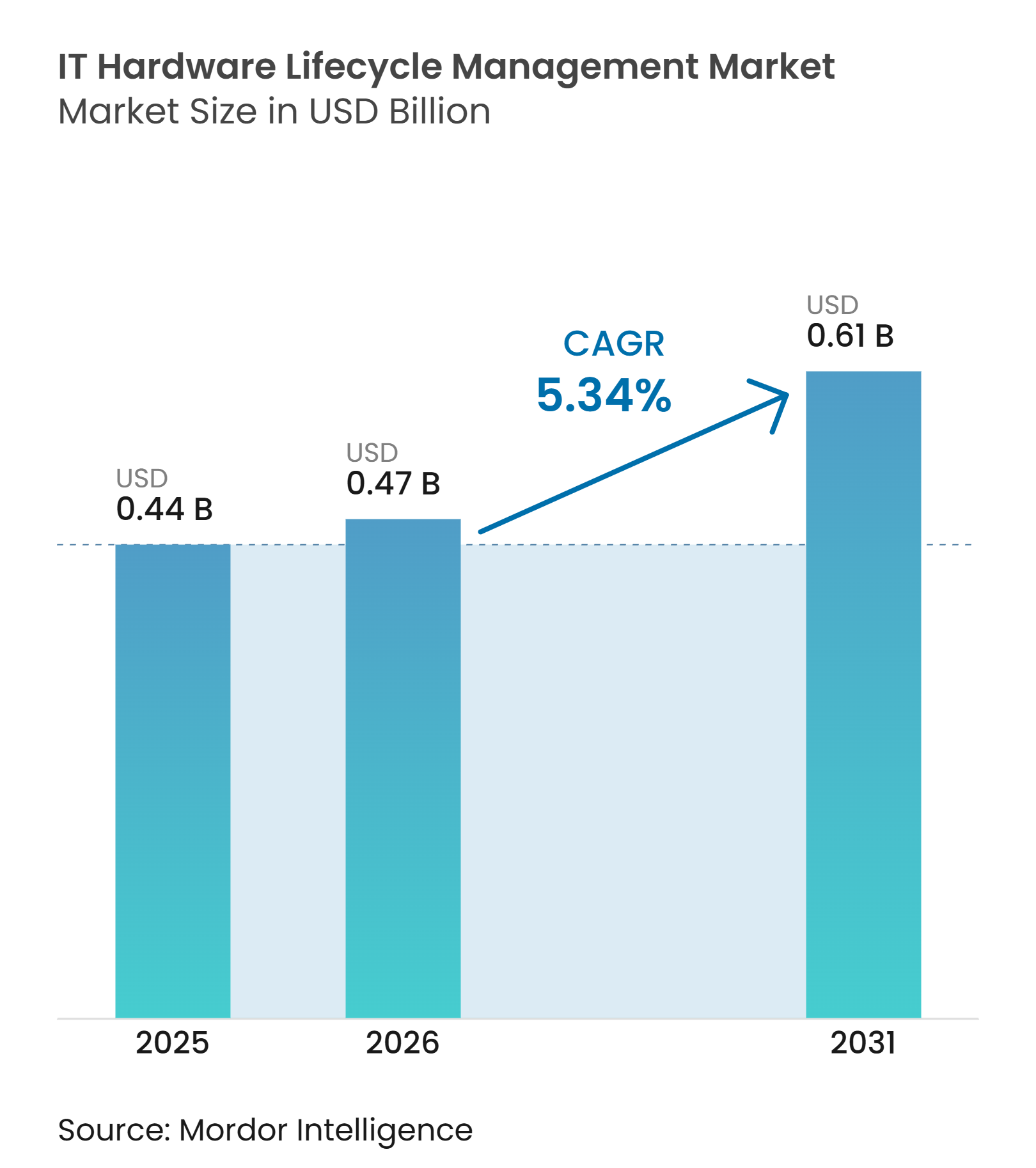
The IT Hardware Lifecycle Management Market size is expected to increase from USD 0.44 billion in 2025 to USD 0.47 billion in 2026 and reach USD 0.61 billion by 2031, growing at a CAGR of 5.34% over 2026-2031. Enterprises are redirecting capital budgets toward subscription-based device-as-a-service models, stretching asset life but lowering up-front hardware revenue. Stricter global e-waste regulations are compelling original equipment manufacturers and integrators to formalize take-back programs, which raises the strategic value of certified reverse logistics. Rapid AI workload growth is shortening data-center refresh cycles, creating a steady stream of high-value server assets for secondary markets. Together, these forces pivot the IT hardware lifecycle management market toward service-centric growth, commodity-recovery optimization, and compliance-driven differentiation.
Key Report Takeaways
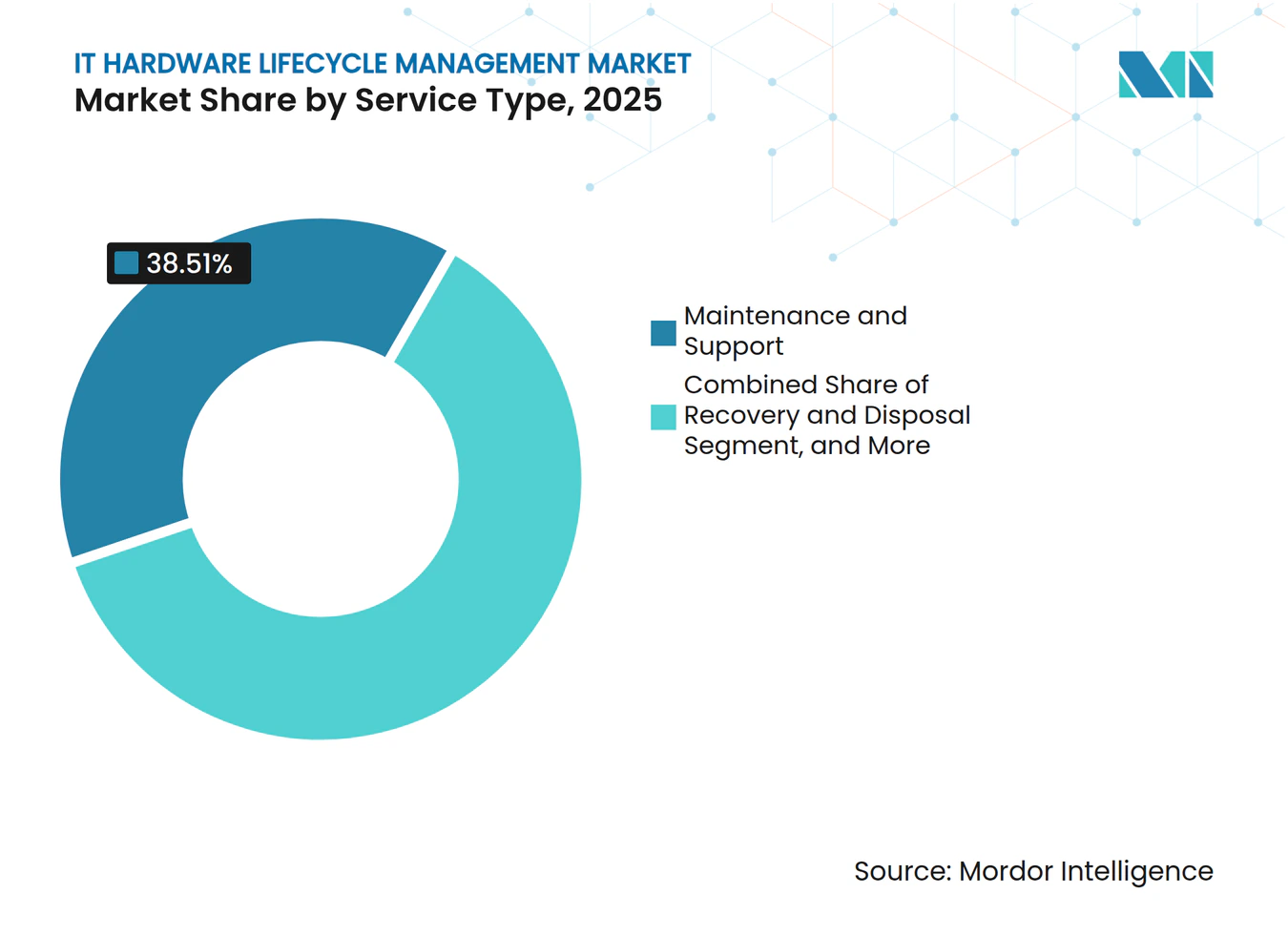
- By service type, maintenance and support led with 38.51% of the IT hardware lifecycle management market size in 2025; recovery and disposal is expanding at a 5.66% CAGR through 2031.
- By hardware type, desktop and laptop systems accounted for 34.01% of the IT hardware lifecycle management market share in 2025, whereas mobile devices are growing fastest at 5.47% through 2031.
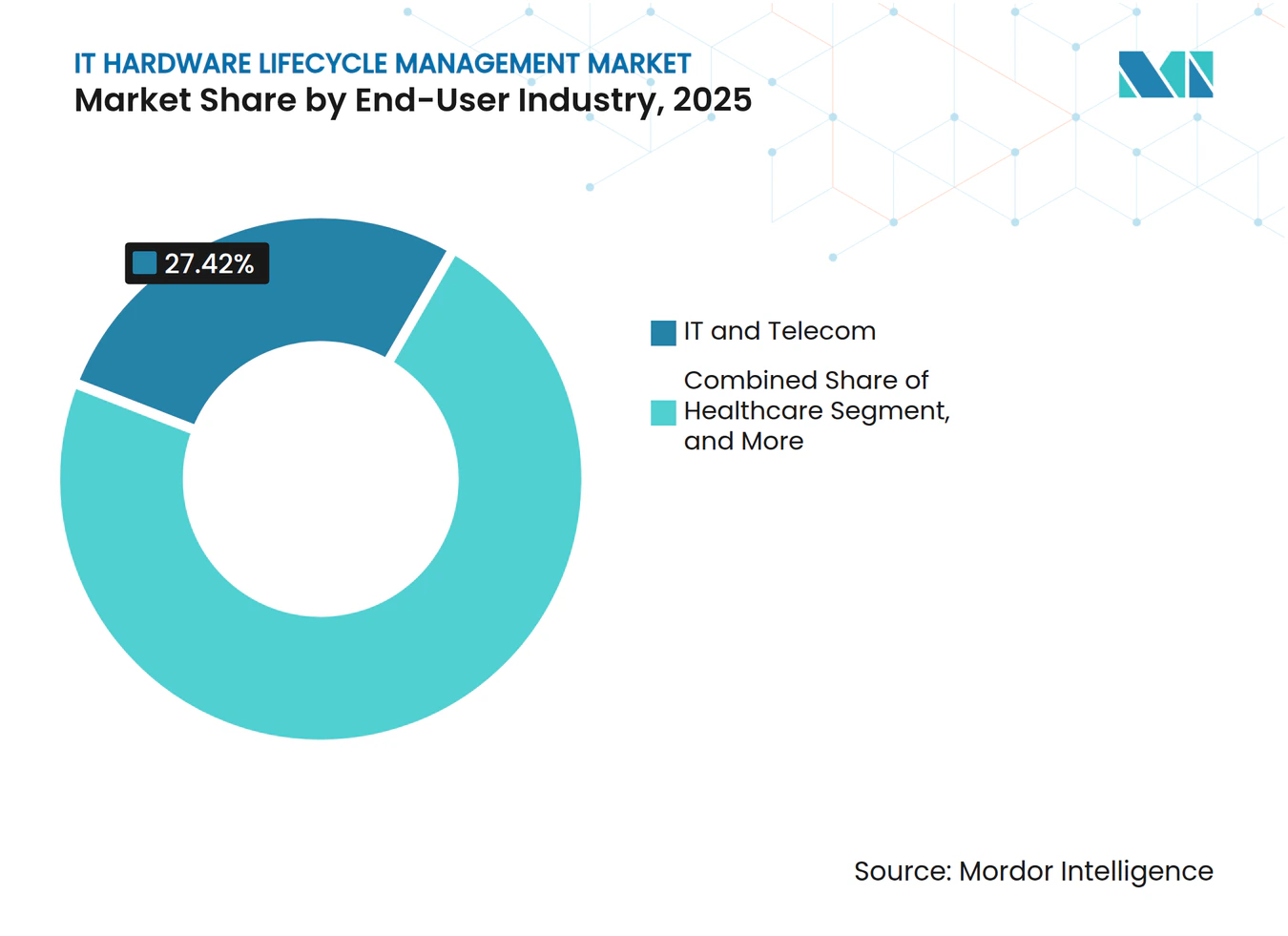
- By end-user industry, IT and telecom accounted for 27.42% of the IT hardware lifecycle management market revenue in 2025, but healthcare is rising at a 5.76% CAGR through 2031.
- By enterprise size, large companies accounted for 71.22% of revenue in the IT hardware lifecycle management market in 2025, yet small and medium enterprises are set to grow at 5.89% annually through 2031.
- By geography, North America held 28.23% of the IT hardware lifecycle management market share in 2025, while Asia-Pacific is projected to advance at an 5.83% CAGR to 2031.
Note: Market size and forecast figures in this report are generated using Mordor Intelligence’s proprietary estimation framework, updated with the latest available data and insights as of 2026.
Market Trends and Insights
Drivers Impact Analysis of IT Hardware Lifecycle Management Market*
| Driver | (~) % Impact on CAGR Forecast | Geographic Relevance | Impact Timeline |
|---|---|---|---|
| Growing Device Density per Employee | +1.2% | Global, pronounced in North America and Europe | Medium term (2-4 years) |
| Increasing Regulatory Pressure on E-Waste Recovery | +1.5% | Europe and North America core, Asia-Pacific gaining | Long term (≥ 4 years) |
| Shift Toward OPEX-Based IT Procurement Models | +1.8% | Global, led by North America and Western Europe | Medium term (2-4 years) |
| Rapid Refresh Cycles in Data-Center Hardware | +0.9% | North America and Asia-Pacific hyperscale hubs | Short term (≤ 2 years) |
| Supply-Chain Localization Incentives in Emerging Markets | +0.6% | Asia-Pacific, Middle East and South America | Long term (≥ 4 years) |
| OEM Buy-Back Programs Expanding to Mid-Market | +0.4% | North America and Europe, early Asia-Pacific pilots | Medium term (2-4 years) |
| Source: Mordor Intelligence | |||
Growing Device Density Per Employee
Hybrid work has lifted the average enterprise-managed endpoint count above three per employee, comprising a desktop, laptop, and smartphone. A 2025 BizTech Magazine survey found a 40% spike in help-desk tickets tied to provisioning and decommissioning within firms managing more than 10,000 endpoints. Bring-your-own-device policies deepen heterogeneity, pushing lifecycle vendors to craft flexible trade-in programs. Mobile-device-management software is embedding asset-tracking modules that trigger retirement workflows automatically, yet many enterprises still rely on manual spreadsheets. Financial services and healthcare face added audit burdens that require a verifiable certificate for each device wiped, accelerating outsourcing to certified providers.
Increasing Regulatory Pressure On E-Waste Recovery
Directive 2024/884 in the European Union tightened extended producer responsibility rules in early 2025, obligating manufacturers to underwrite collection and recycling even for legacy products.[1] In April 2025, the United Kingdom raised collection targets and fines under its revised WEEE regulations.[2] Similar bills are advancing in Asia-Pacific and the Middle East, producing a patchwork that multinational firms must navigate. OEMs now partner with certified recyclers holding Sustainable Electronics Recycling International credentials to avoid penalties. Advanced shredding lines capable of extracting rare-earth elements are converting a compliance cost into a revenue stream when commodity prices rebound.
Shift Toward OPEX-Based IT Procurement Models
Chief financial officers prefer operating-expense flexibility, accelerating the adoption of device-as-a-service platforms such as Hewlett Packard Enterprise GreenLake, Lenovo TruScale, and Dell APEX. The bundles include hardware, software, maintenance, and certified end-of-life recovery for a monthly fee, transferring residual-value risk to vendors. ServiceNow, in 2025, added workflow automation that cues refresh cycles based on real-time performance telemetry rather than fixed depreciation schedules. Unisys launched a Device Subscription Service in early 2026 that marries zero-trust security with automated patching, targeting regulated verticals.[3] Small and medium enterprises benefit most because the model avoids large capital outlays.
Rapid Refresh Cycles In Data-Center Hardware
AI and machine-learning workloads are shrinking server life to 18-24 months as firms swap general-purpose CPUs for GPU or ASIC accelerators. Bain and Company expects AI-oriented data-center investment to top USD 200 billion annually by 2027. Dell’Oro Group noted that hyperscale operators deployed more AI hardware in 1H 2025 than in all of 2024. Retired servers still suit ERP or database tasks in cost-sensitive regions, creating a vibrant secondary channel. Yet older gear containing DDR3 memory yields lower scrap value, challenging recyclers to balance refurbishment versus shredding economics.
Restraints Impact Analysis of IT Hardware Lifecycle Management Market*
| Restraint | (~) % Impact on CAGR Forecast | Geographic Relevance | Impact Timeline |
|---|---|---|---|
| Data-Erasure Security Concerns in Secondary Markets | -0.8% | Global, highest in North America and Europe | Medium term (2-4 years) |
| High Up-Front Investment for Automated Disposal Facilities | -0.5% | Global, acute in capital-scarce emerging markets | Long term (≥ 4 years) |
| Fragmented Vendor Ecosystem in Developing Regions | -0.3% | Asia-Pacific, Middle East, Africa and South America | Long term (≥ 4 years) |
| Commodity Price Volatility Impacting Refurb Revenues | -0.4% | Global, sharper where exports dominate | Short term (≤ 2 years) |
| Source: Mordor Intelligence | |||
Data-Erasure Security Concerns In Secondary Markets
NIST Special Publication 800-88 Revision 2, released September 2025, deprecated simple overwrite techniques in favor of cryptographic erase for solid-state drives and mandated shredding where verification is impossible.[4] Healthcare breaches averaged USD 10.93 million in 2024, intensifying aversion to resale channels. Many refurbishers still issue paper certificates, creating a trust deficit that pushes risk-averse buyers toward physical destruction despite environmental costs. Chain-of-custody blockchains are emerging but remain rare, widening the gap between theoretical residual value and realized recovery revenue.
High Up-Front Investment for Automated Disposal Facilities
Industrial shredders, optical sorters and fume-extraction systems can demand more than USD 10 million before a single device is processed. Smaller firms struggle to secure financing because bankers view recycling returns as commodity-price dependent. Sims Lifecycle Services, aided by scale, achieved zero-landfill across its North American network in March 2026, signaling how capital intensity favors incumbents. Emerging markets face power-grid and spare-parts constraints that prolong payback periods, steering volumes into informal channels devoid of data-security controls.
*Our forecasts treat driver/restraint impacts as directional, not additive. The impact forecasts reflect baseline growth, mix effects, and variable interactions.
IT Hardware Lifecycle Management Market Segment Analysis
By Service Type:
Recovery Gains Momentum Over Legacy SupportMaintenance and support accounted for 38.51% of the IT hardware lifecycle management market size in 2025, driven by the continued demand for extended warranties on desktops and laptops. In contrast, recovery and disposal services are projected to grow at a strong 5.66% CAGR through 2031, nearly double the overall market growth rate. This surge is fueled by increasing environmental regulations and corporate sustainability initiatives, which are pushing organizations toward formalized end-of-life management processes. Procurement services are also expanding steadily as subscription-based renewals replace traditional one-time capital purchases. However, deployment and integration services are experiencing margin pressures due to the growing adoption of automation technologies.
The rapid growth of recovery and disposal services is closely tied to extended producer responsibility (EPR) regulations, which require manufacturers to bear the costs of product take-back and recycling. This has led to strategic partnerships with third-party reverse logistics providers. For instance, Cisco’s Technology Refresh program, which offers trade-in credits, demonstrates how vendors are capturing upgrade revenue while ensuring proper asset disposition. Meanwhile, maintenance and support services are facing declining margins as hardware reliability improves and workloads increasingly migrate to cloud environments.



By Hardware Type:
Mobile Devices Accelerate Share CaptureDesktop and laptop units contributed 34.01% of the IT hardware lifecycle management market share in 2025, a legacy of entrenched enterprise refresh cycles. However, mobile devices are projected to compound at 5.47% annually through 2031, the fastest among hardware types. Server and storage lifecycles bifurcate as hyperscale refresh cycles accelerate while enterprise servers linger, and networking equipment gains from edge-computing rollouts.
Bring-your-own-device and rugged tablet adoption in healthcare and logistics fuel mobile expansion. Mobile-device-management suites now embed lifecycle triggers that flag underperforming or out-of-support units, ensuring a predictable stream of trade-ins. Hyperscale AI refreshes every 18 months, injecting large server batches into secondary channels even as traditional enterprises stretch server life beyond four years, tempering new sales but buoying recovery revenue. Peripherals are steadily upgrading to USB-C and energy-efficient displays, increasingly bundled into device-as-a-service contracts that smooth vendor revenue.
By End-User Industry:
Healthcare Sets The PaceThe IT and telecom sector accounted for 27.42% of total revenue in 2025, driven by the growing need to manage complex, multivendor environments with unified lifecycle management solutions. This sector's focus on seamless integration and efficient management of diverse hardware and software assets highlights its critical role in the market. As IT and telecom companies continue to scale operations and adopt advanced technologies, the demand for robust lifecycle management solutions is projected to grow steadily. Additionally, the sector's emphasis on minimizing downtime and optimizing asset utilization further fuels the adoption of these solutions.
The healthcare segment is advancing at a CAGR of 5.76%. Medical devices often store sensitive patient data in embedded storage, necessitating specialized sanitization processes that many in-house teams lack the expertise to handle. This has led hospitals and healthcare providers to increasingly rely on certified vendors for secure data disposal and hardware lifecycle management. In the banking, financial services, and insurance (BFSI) sector, firms are piloting blockchain-based asset registries to comply with stringent data-residency regulations, thereby ensuring transparency and security.

By Enterprise Size:
SMEs Embrace Managed ServicesLarge enterprises accounted for 71.22% of the IT hardware lifecycle management market size in 2025, driven by their extensive global operations and the need to manage thousands of endpoints efficiently. However, small and medium enterprises are projected to grow at a compound annual growth rate (CAGR) of 5.89% through 2031. This growth is attributed to the increasing adoption of managed service providers (MSPs) that offer bundled solutions, including hardware procurement, support services, and certified disposal, all packaged into predictable operating expense models.
For SMEs, the shift toward cloud migration has reduced the demand for on-premises servers, allowing budgets to be reallocated toward endpoint devices secured through device-as-a-service (DaaS) models. Original Equipment Manufacturers (OEMs) are now extending trade-in credits, which were previously exclusive to large enterprises, to mid-market businesses. This trend is evident in recent offerings from companies such as Cisco, Dell, and Hewlett-Packard Enterprise. Meanwhile, large enterprises are adopting a hybrid strategy by maintaining direct negotiations with OEMs for critical infrastructure while outsourcing the management of commodity endpoints. This approach enables them to optimize costs and streamline administrative processes effectively.
Geography Analysis
North America IT Hardware Lifecycle Management Market
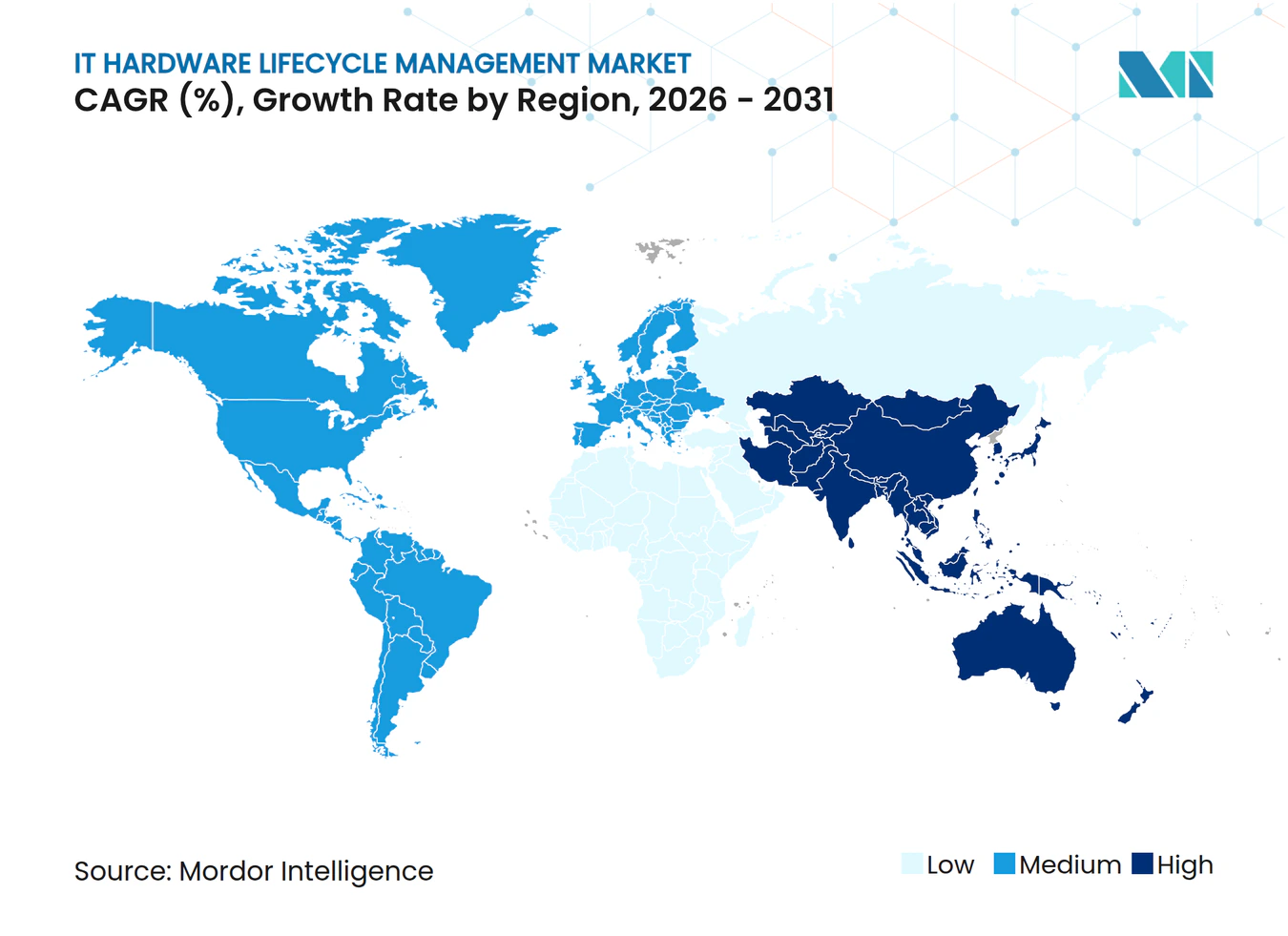
North America accounted for 28.23% of the revenue in 2025, driven by a combination of mature IT infrastructures, strict Environmental Protection Agency (EPA) regulations on e-waste, and a high concentration of hyperscale data centers. In the United States, distributors like TD SYNNEX have been acquiring asset-disposition specialists to provide comprehensive lifecycle management solutions. Meanwhile, Canada benefits from provincial regulations that closely align with U.S. federal standards, creating a seamless cross-border operational environment that favors vendors with extensive continental processing networks.
APAC IT Hardware Lifecycle Management Market
The Asia-Pacific region is projected to be the fastest-growing market, with an anticipated compound annual growth rate (CAGR) of 5.83% through 2031. According to IDC, regional IT spending is expected to reach USD 647 billion by 2026, with computer equipment experiencing a year-over-year growth of 13.7%. China’s localization policies continue to favor domestic integrators, while India’s ongoing public-sector digitization initiatives present significant opportunities for multinational companies. Additionally, Southeast Asian countries like Indonesia and Vietnam are offering tax incentives to encourage the establishment of local recycling facilities. However, fragmented regulatory frameworks in the region pose challenges for cross-border logistics. In Japan, aging IT infrastructure generates consistent disposition volumes, although cultural tendencies toward thriftiness extend the lifecycle of assets compared to Western markets.
EMEA and South America IT Hardware Lifecycle Management Market
Europe benefits significantly from the European Union’s Circular Economy Action Plan and Directive 2024/884, which enforce stringent collection targets and impose penalties for non-compliance. These regulations ensure steady demand for certified recyclers, with funding often provided by original equipment manufacturers (OEMs). In the United Kingdom, post-Brexit regulatory changes implemented in April 2025 have heightened compliance requirements, increasing the risks for firms that fail to meet the new standards. South America and the Middle East are emerging markets with considerable potential. In Brazil, efforts to formalize e-waste management channels are gaining traction, while Gulf nations are leveraging smart-city investments to drive localized growth. In Africa, informal recycling sectors currently handle approximately 80% of electronic waste. However, pilot programs in South Africa demonstrate that certified refurbishment initiatives can significantly reduce environmental impact and create employment opportunities, potentially serving as a model for future policy harmonization across the continent.
Competitive Landscape
Market Concentration
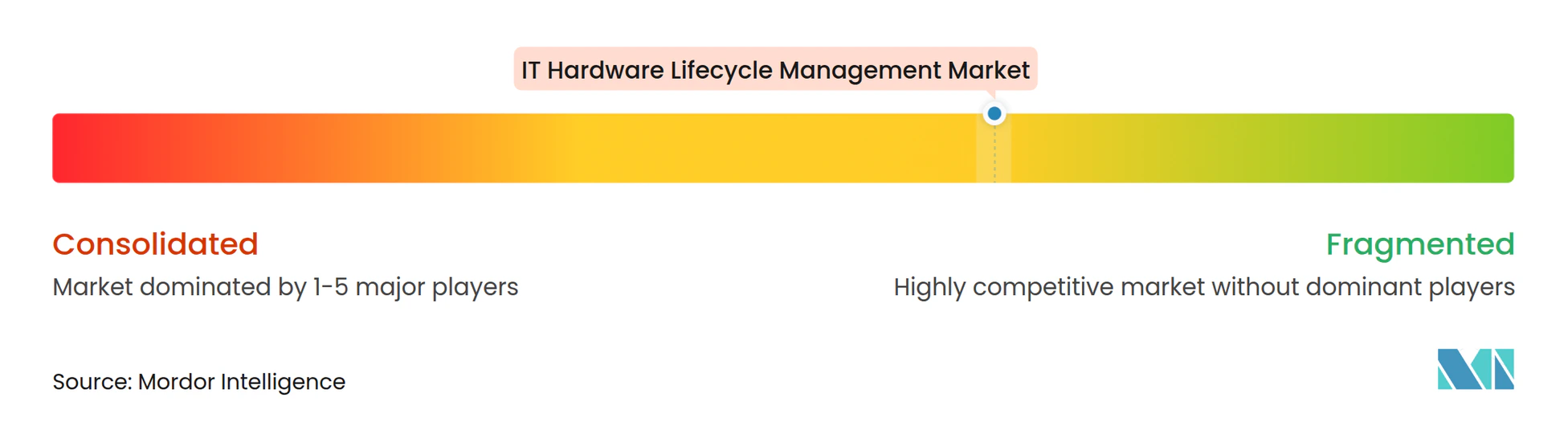
The IT hardware lifecycle management market is moderately fragmented, as the processes of procurement, deployment, maintenance, and recovery demand specialized expertise and certifications. Leading distributors such as Arrow Electronics, TD SYNNEX, and Ingram Micro leverage their robust vendor partnerships and expansive logistics capabilities to diversify into certified asset-disposition services. This strategic expansion addresses the increasing market need for secure, compliant, and environmentally sustainable hardware management solutions. Additionally, these companies are focusing on enhancing their service portfolios to include advanced technologies like blockchain for asset tracking and AI-driven analytics to optimize lifecycle processes, further solidifying their competitive position in the market.
Specialized players, including Iron Mountain, Sims Lifecycle Services, and Curvature, focus on secure data sanitization and commodity recovery, setting themselves apart through advanced compliance certifications and optimized recovery yields. Iron Mountain, for instance, expanded its processing capabilities with the acquisition of Wisetek in September 2024 and Regency Technologies in January 2024. Similarly, Sage’s acquisition of Cascade Asset Management in February 2025 enhanced its expertise in the healthcare sector, while Paladin’s USD 70 million purchase of ICT in April 2026 highlighted investor interest in regulated industries, particularly those requiring stringent compliance measures.
Innovative disruptors are leveraging blockchain technology to establish transparent chain-of-custody records, while major incumbents are exploring robotic disassembly lines and machine-vision sorting to improve efficiency. Quantum’s acquisition of 2NDGEAR in January 2026 targeted the niche market of networking equipment refurbishment, while CTL’s acquisition of 3R Technology in April 2025 strengthened its position in the education sector. Overall, the ongoing consolidation within the industry underscores the importance of scale in reverse logistics and certified data destruction, which have become critical competitive advantages in the evolving IT hardware lifecycle management market.
IT Hardware Lifecycle Management Industry Leaders
-
Dell Technologies Inc.
-
Hewlett Packard Enterprise Company
-
Lenovo Group Limited
-
Cisco Systems Inc.
-
International Business Machines Corporation
- *Disclaimer: Major Players sorted in no particular order
IT Hardware Lifecycle Management Market Companies Covered in this Report
- Dell Technologies Inc.
- Hewlett Packard Enterprise Company
- Lenovo Group Limited
- Cisco Systems Inc.
- International Business Machines Corporation
- Arrow Electronics, Inc.
- TD SYNNEX Corporation
- Ingram Micro Inc.
- Curvature, Inc.
- Park Place Technologies, LLC
- Iron Mountain Incorporated
- Sims Lifecycle Services, Inc.
- Flex Ltd.
- Compu-Com Systems, Inc.
- Atea ASA
- Computacenter plc
- Insight Enterprises, Inc.
- Softcat plc
- CDW Corporation
- Econocom Group SE
- Re-tek (UK) Ltd.
Recent Industry Developments in IT Hardware Lifecycle Management Market
- April 2026: Paladin acquired ICT for USD 70 million, expanding regulated-industry coverage and certified processing capacity.
- March 2026: Sims Lifecycle Services earned Sustainable Electronics Recycling International Champion status after achieving zero-landfill across North America.
- January 2026: Quantum acquired 2NDGEAR to deepen refurbished networking-equipment offerings.
- September 2025: Tailwind Capital acquired DMD Systems Recovery, signaling private-equity interest in lifecycle firms.
Global IT Hardware Lifecycle Management Market Report Scope
The IT Hardware Lifecycle Management Market encompasses solutions and services designed to manage the entire lifecycle of physical IT assets from procurement and deployment to maintenance, upgrades, and end-of-life disposal. These offerings include capabilities such as asset tracking, performance monitoring, refresh planning, and IT asset disposition (ITAD). The market enables organizations to optimize hardware utilization, ensure compliance with regulatory and security standards, and minimize the total cost of ownership. Typically, these services are delivered through integrated IT asset management (ITAM) and IT service management (ITSM) platforms.
The IT Hardware Lifecycle Management Market is Segmented by Service Type (Procurement, Deployment and Integration, Maintenance and Support, and Recovery and Disposal), Hardware Type (Desktop and Laptop, Server and Storage, Networking Equipment, Mobile Devices, and Peripherals), End-User Industry (BFSI, IT and Telecom, Healthcare, Government and Public Sector, Manufacturing, Retail and E-Commerce, Education, and Rest of Industries), Enterprise Size (Large Enterprises, and Small and Medium Enterprises), and Geography (North America, South America, Europe, Asia-Pacific, Middle East, and Africa). The Market Forecasts are Provided in Terms of Value (USD).
Segmentation Overview
| Procurement |
| Deployment and Integration |
| Maintenance and Support |
| Recovery and Disposal |
| Desktop and Laptop |
| Server and Storage |
| Networking Equipment |
| Mobile Devices |
| Peripherals |
| BFSI |
| IT and Telecom |
| Healthcare |
| Government and Public Sector |
| Manufacturing |
| Retail and E-Commerce |
| Education |
| Rest of Industries |
| Large Enterprises |
| Small and Medium Enterprises |
| North America | United States |
| Canada | |
| Mexico | |
| South America | Brazil |
| Argentina | |
| Rest of South America | |
| Europe | Germany |
| United Kingdom | |
| France | |
| Russia | |
| Rest of Europe | |
| Asia-Pacific | China |
| Japan | |
| India | |
| South Korea | |
| Rest of Asia Pacific | |
| Middle East | Saudi Arabia |
| United Arab Emirates | |
| Rest of Middle East | |
| Africa | South Africa |
| Nigeria | |
| Rest of Africa |
| By Service Type | Procurement | |
| Deployment and Integration | ||
| Maintenance and Support | ||
| Recovery and Disposal | ||
| By Hardware Type | Desktop and Laptop | |
| Server and Storage | ||
| Networking Equipment | ||
| Mobile Devices | ||
| Peripherals | ||
| By End User Industry | BFSI | |
| IT and Telecom | ||
| Healthcare | ||
| Government and Public Sector | ||
| Manufacturing | ||
| Retail and E-Commerce | ||
| Education | ||
| Rest of Industries | ||
| By Enterprise Size | Large Enterprises | |
| Small and Medium Enterprises | ||
| By Geography | North America | United States |
| Canada | ||
| Mexico | ||
| South America | Brazil | |
| Argentina | ||
| Rest of South America | ||
| Europe | Germany | |
| United Kingdom | ||
| France | ||
| Russia | ||
| Rest of Europe | ||
| Asia-Pacific | China | |
| Japan | ||
| India | ||
| South Korea | ||
| Rest of Asia Pacific | ||
| Middle East | Saudi Arabia | |
| United Arab Emirates | ||
| Rest of Middle East | ||
| Africa | South Africa | |
| Nigeria | ||
| Rest of Africa | ||
Key Questions Answered in the Report
How large is the IT hardware lifecycle management market in 2026?
The IT hardware lifecycle management market size is projected at USD 0.47 billion for 2026.
What is the forecast CAGR for IT hardware lifecycle management to 2031?
The sector is expected to grow at a 5.7% CAGR between 2026 and 2031.
Which region will grow fastest through 2031?
Asia-Pacific is forecast to expand at an 5.83% CAGR, outpacing all other regions.
Which service segment is seeing the highest growth?
Recovery and disposal services are advancing at a 5.66% CAGR through 2031.
Why is healthcare demand accelerating?
Stringent data-erasure mandates under HIPAA and the upgrade of imaging workstations are pushing healthcare spending at a 5.76% CAGR.
How are SMEs benefiting from lifecycle services?
Managed-service providers bundle procurement, support and certified disposal into subscription models, enabling SMEs to avoid large capital outlays while meeting compliance needs.