
IT Hardware Subscription and Device-as-a-Service (DaaS) Market Size and Share
Market Overview
| Study Period | 2020 - 2031 |
|---|---|
| Market Size (2026) | USD 17.67 Billion |
| Market Size (2031) | USD 48.15 Billion |
| Growth Rate (2026 - 2031) | 22.20 % |
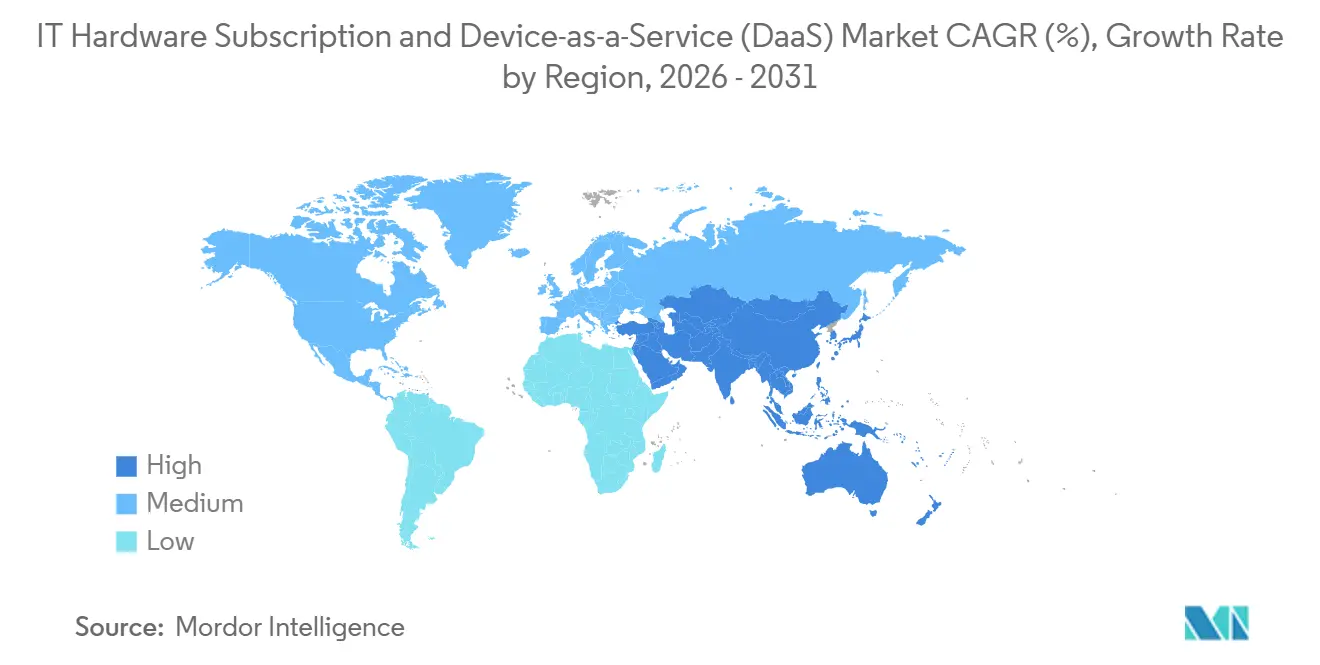
| Fastest Growing Market | Asia Pacific |
| Largest Market | North America |
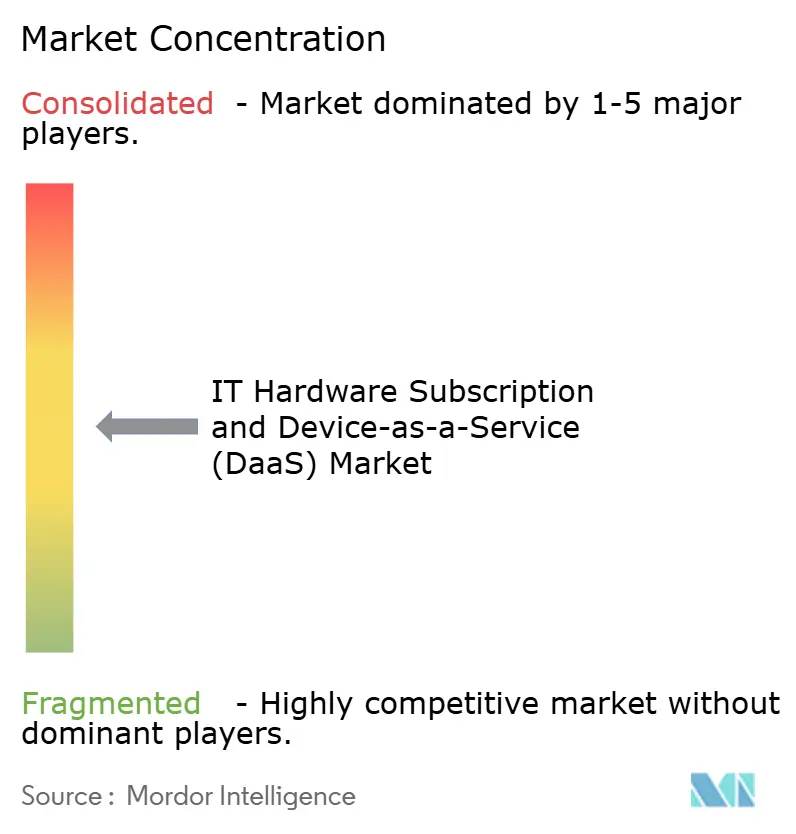
| Market Concentration | Medium |
Major Players *Disclaimer: Major Players sorted in no particular order Image © Mordor Intelligence. Reuse requires attribution under CC BY 4.0. | |
IT Hardware Subscription and Device-as-a-Service (DaaS) Market Analysis by Mordor Intelligence
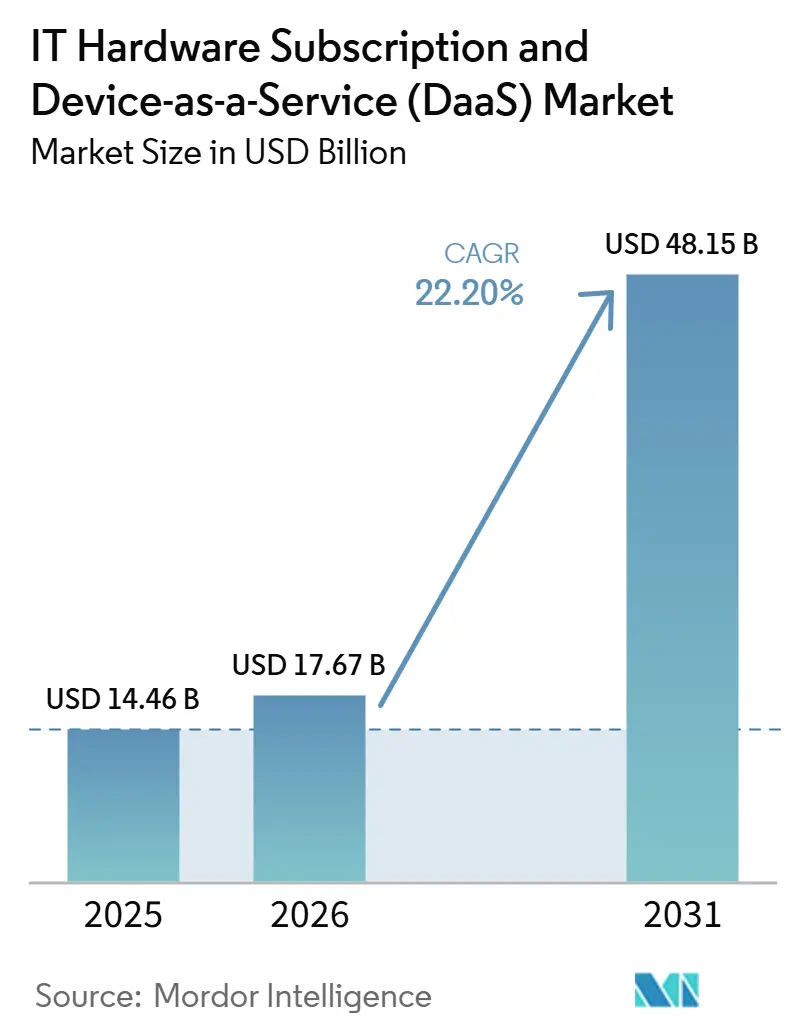
The IT hardware subscription and device-as-a-service market size is expected to increase from USD 14.46 billion in 2025 to USD 17.67 billion in 2026 and reach USD 48.15 billion by 2031, growing at a CAGR of 22.2% over 2026-2031. Escalating hybrid-work adoption, accelerating refresh cycles triggered by security mandates, and a CFO-level pivot toward operating expense treatment are reshaping enterprise hardware strategies. Subscription models deliver immediate cash-flow relief, unlock AI-driven predictive maintenance that lengthens usable life by roughly one-quarter, and transfer regulatory exposure for secure disposal to specialized vendors. As 5G edge deployments proliferate, enterprises increasingly finance ruggedized smartphones and gateways on flexible contracts rather than absorb large, upfront capital costs, fueling demand across both mature and emerging regions. Competitive intensity is amplifying as incumbent PC brands defend share against managed-service specialists and hyperscale cloud providers that market vendor-agnostic fleet orchestration platforms.
Key Report Takeaways
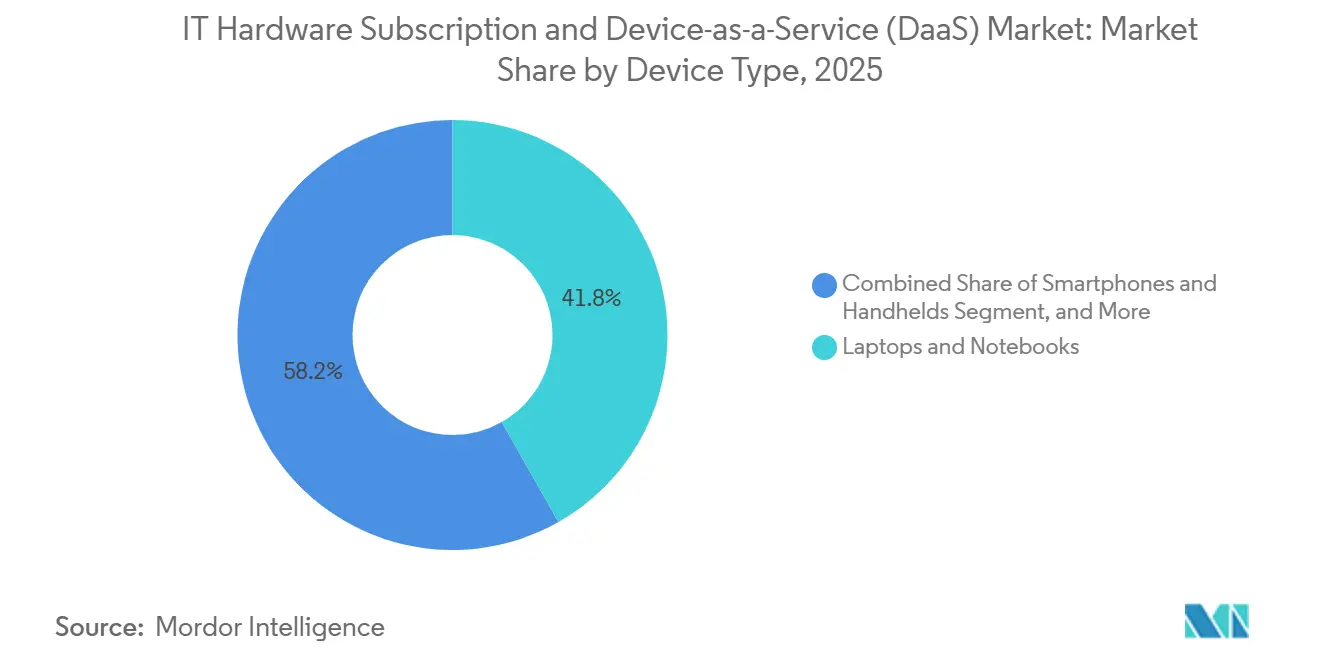
- By device type, laptops and notebooks accounted for 41.8% of the IT Hardware Subscription and Device-as-a-Service (DaaS) market in 2025, while smartphones and handhelds are projected to advance at a 24.8% CAGR through 2031.
- By service type, full lifecycle management services captured 37.2% of the IT Hardware Subscription and Device-as-a-Service (DaaS) market in the 2025 revenue pool and are forecast to expand at a 25.6% CAGR to 2031.
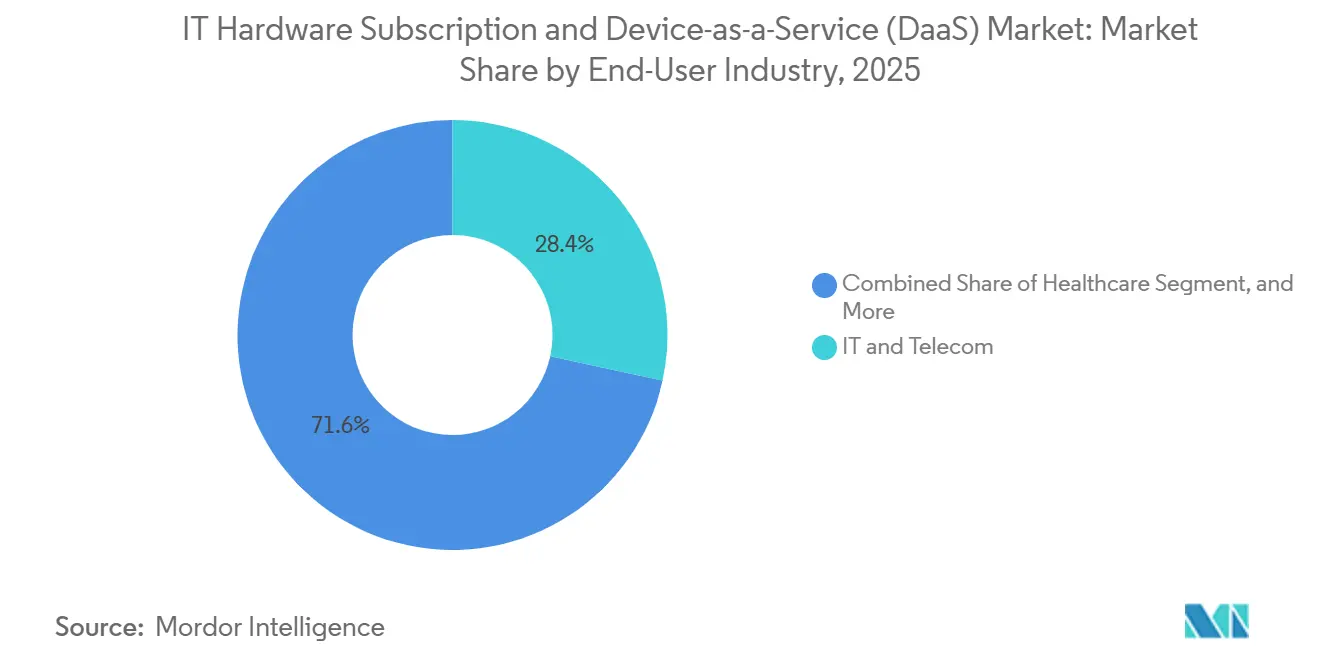
- By end-user industry, IT and telecom led with 28.4% of the IT Hardware Subscription and Device-as-a-Service (DaaS) market in 2025 revenue; healthcare represents the fastest-growing vertical at a 24.0% CAGR through 2031.
- By organization size, large enterprises accounted for 63.9% of IT Hardware Subscription and Device-as-a-Service (DaaS) market spending in 2025, whereas small and medium enterprises are poised to grow at a 23.6% CAGR over the same horizon.
- By geography, North America commanded 34.7% of revenue of the IT Hardware Subscription and Device-as-a-Service (DaaS) market in 2025 and Asia-Pacific is projected to at a 24.2% CAGR to 2031.
Note: Market size and forecast figures in this report are generated using Mordor Intelligence’s proprietary estimation framework, updated with the latest available data and insights as of January 2026.
Market Trends and Insights
Drivers Impact Analysis of IT Hardware Subscription and Device-as-a-Service (DaaS) Market*
| Driver | (~) % Impact on CAGR Forecast | Geographic Relevance | Impact Timeline |
|---|---|---|---|
| Surge in Hybrid Work Adoption | +6.5% | Global, especially North America and Europe | Medium term (2-4 years) |
| Preference for OPEX-Based IT Budgets | +5.2% | Global, high in North America and Asia-Pacific | Long term (≥4 years) |
| Security-Driven Rapid Refresh Cycles | +4.8% | Global, strongest in regulated sectors | Short term (≤2 years) |
| Expansion of 5G-Edge Devices | +3.1% | Asia-Pacific core, spill-over worldwide | Medium term (2-4 years) |
| AI-Driven Predictive Maintenance | +2.1% | North America and Europe, emerging Asia-Pacific | Long term (≥4 years) |
| Carbon-Neutral Subscription Bundles | +0.6% | Europe and North America | Long term (≥4 years) |
| Source: Mordor Intelligence | |||
Surge in Hybrid Work Adoption
Hybrid work has shifted from contingency to norm, with 96% of organizations embedding distributed policies by 2025. More than half of the United States' knowledge workers now operate remotely at least once per week, driving persistent demand for rapid device shipping, imaging, and retrieval. Device-as-a-service platforms automate these workflows, reducing the average onboarding time from days to hours. Gartner projects managed device lifecycle penetration will climb to 70% by 2028, underscoring how permanent the model has become. Firms that cling to capital-ownership models face rising IT labor overhead and longer response times, handicapping talent attraction in an era where seamless remote technology is the baseline.
Preference for OPEX-Based IT Budgets
Volatile macro conditions have prompted finance chiefs to favor predictable monthly outlays. A Q1 2026 survey showed 68% of CFOs expect IT costs to rise, but are reluctant to approve large capital allotments. Subscription contracts convert lumpy purchases into smooth expenses, quickening approval cycles and improving cash flow visibility. Capgemini research indicates that on-demand technology’s share of total IT budgets should climb from 29% in 2025 to 41% by 2027. Smaller firms benefit most, sidestepping credit constraints while refreshing hardware more frequently without multi-quarter capital reviews.
Security-Driven Rapid Refresh Cycles
Remote devices experience greater exposure to phishing and malware, reducing the average laptop lifespan to 3.2 years versus 4.1 years in office settings. NIST Special Publication 800-213 and ISO 27001 Annex A 7.9 require organizations to use firmware capable of secure key storage and to guarantee certified data wipe on retirement.[1]NIST, “Special Publication 800-213: IoT Device Cybersecurity Guidance,” nist.gov DaaS vendors incorporate these workflows by default, ensuring Defense Logistics Agency-grade sanitization and traceability. In BFSI and healthcare, subscription models effectively outsource audit risk to providers with dedicated compliance teams, freeing internal staff for strategic security tasks.
Expansion of 5G-Edge Devices
Worldwide edge spend hit USD 232 billion in 2024, widening use cases for rugged tablets, gateways, and sensors. Upfront hardware costs often stall pilots, yet subscription terms let enterprises scale gradually as ROI becomes evident. Verizon’s 5G edge footprint illustrates the latency gains that will be available once devices are widely deployed.[2]Verizon, “5G Edge Platform Expansion,” verizon.comModular, pay-as-you-grow contracts have gained significant traction in industries such as manufacturing, logistics, and smart retail. These industries often require tailored solutions to address the unique demands of their specific workloads. The flexibility of these contracts allows businesses to scale their operations efficiently, aligning costs with actual usage and minimizing unnecessary expenditures.
Restraints Impact Analysis of IT Hardware Subscription and Device-as-a-Service (DaaS) Market*
| Restraint | (~) % Impact on CAGR Forecast | Geographic Relevance | Impact Timeline |
|---|---|---|---|
| Data Sovereignty Concerns | -2.3% | Europe, China, India | Short term (≤2 years) |
| Vendor Lock-In Anxiety | -1.8% | Global, strong in North America and Europe | Medium term (2-4 years) |
| Inflation-Driven Cost Volatility | -1.5% | Global, higher in emerging economies | Short term (≤2 years) |
| Limited Partner Ecosystems | -1.2% | Latin America, Africa, Southeast Asia | Long term (≥4 years) |
| Source: Mordor Intelligence | |||
Data Sovereignty Concerns
Laws such as India’s Digital Personal Data Protection Act and the European Union’s GDPR mandate that certain user telemetry and credentials remain inside national borders.[3]Government of India, “Digital Personal Data Protection Act,” meity.gov.inDaaS vendors must maintain regional data centers, which increases costs and delays rollout schedules. Multinational corporations face significant challenges when providers fail to deliver unified platforms that operate seamlessly across all jurisdictions. This lack of integration often results in fragmented management systems, leading to inefficiencies and operational complexities. Additionally, the increased compliance requirements in heavily regulated markets contribute to higher administrative costs.
Vendor Lock-In Anxiety
Enterprises fear proprietary consoles that hinder device mixing. A 2025 Lansweeper study found that multi-vendor estates experience integration headaches when management tools are hard-wired to a specific brand. Buyers increasingly demand open APIs and cross-vendor compatibility, pressuring hardware OEMs to loosen ecosystem control or risk renewal churn. Service providers that prioritize vendor-agnostic orchestration are positioned to gain a competitive edge, as neutrality increasingly becomes a critical factor in purchasing decisions. By offering solutions that seamlessly integrate with multiple platforms, these providers can address the diverse needs of businesses operating across various jurisdictions.
*Our forecasts treat driver/restraint impacts as directional, not additive. The impact forecasts reflect baseline growth, mix effects, and variable interactions.
IT Hardware Subscription and Device-as-a-Service (DaaS) Market Segment Analysis
By Device Type:
Smartphones Accelerate as Edge Computing ProliferatesThe laptops cohort accounted for 41.8% of 2025 revenue, underscoring its role as the default productivity anchor in the IT hardware subscription and device-as-a-service market. However, smartphones and handhelds are expected to post a 24.8% CAGR to 2031, reflecting expanding 5G field applications and ruggedized use cases in logistics and retail. Rugged handhelds equipped with scanners and RFID readers are displacing legacy PDAs as enterprises seek unified mobility stacks managed through a single console. Tablets maintain traction in education and bedside clinical workflows, though limited enterprise software compatibility curbs broader uptake. Desktops and workstations persist in engineering, design, and trading floors where high compute density and multi-monitor arrays remain essential.
Peripherals and accessories, while a smaller slice of the IT hardware subscription and device-as-a-service market, are now bundled into most contracts. HP’s 2025 refurbished-peripheral expansion shows enterprises will accept remanufactured monitors and docks to hit sustainability targets.[4]HP, “Certified Refurbished Program Expansion,” hp.comDevice preferences are fragmenting along vertical lines. Developers favor high-end laptops, healthcare leans on antimicrobial tablets, and retail pushes rugged smartphones. Providers that allow mid-term swaps and support mixed fleets will capture disproportionate growth as buyers fine-tune configurations to emerging workflow demands.



By Service Type:
Full Lifecycle Management Dominates as Complexity RisesFull lifecycle management services represented 37.2% of 2025 revenue and are on pace for a 25.6% CAGR, the fastest within the IT hardware subscription and device-as-a-service market size. Contracts covering procurement, deployment, monitoring, repair, refresh, and certified disposal deliver single-vendor accountability. A 2026 Forrester study quantified savings at up to EUR 1,000 (USD 1,130) per device plus 6.5 hours of IT labor across a three-year term. Hardware-only subscriptions remain popular in government contexts where agencies keep imaging and security tasks in-house. Hybrid bundles that include operating system licenses and endpoint security resonate with SMEs needing turnkey support.
Environmental, social, and governance disclosure is steering buyers toward offerings such as Lenovo’s TruScale DaaS for Sustainability, which embeds CO₂ tracking dashboards and carbon offsets. Hardware plus managed service tiers now package AI-driven analytics that forecast component failures, further reducing downtime. Service selection is becoming a proxy for IT maturity. Early adopters delegate the end-to-end lifecycle, whereas sophisticated enterprises cherry-pick discrete modules that complement internal skill sets.
By End-User Industry:
Healthcare Surges with Telehealth ExpansionIT and telecom captured 28.4% of 2025 revenue thanks to inherent device churn and early adoption of subscription economics. Healthcare, however, is forecast to grow at a 24.0% CAGR, making it the most dynamic slice of the IT hardware subscription and device-as-a-service market. Ninety-three percent of healthcare firms suffered a cyberattack in 2024, prompting aggressive refresh cycles and demand for HIPAA-compliant remote-wipe capabilities.[5]HIMSS, “Healthcare Cybersecurity Survey 2024,” himss.org Subscription contracts bundle encryption, audit-grade chain-of-custody, and antimicrobial chassis options, justifying premium per-device pricing.
BFSI follows closely, driven by stringent audit frameworks such as PCI-DSS and Sarbanes-Oxley that require verifiable asset logs. Education values seasonal scalability, fleet ramp for September enrollments, and taper in May without stranding capital. Government entities, constrained by procurement statutes, gravitate toward predictable multiyear contracts even as data-residency clauses limit vendor choice. Retail and manufacturing are moving beyond pilot to scale rugged edge devices, leveraging the flexibility of pay-as-you-grow contracts to match volatile demand.
By Organization Size:
SMEs Close the Technology GapLarge enterprises controlled 63.9% of 2025 spend within the IT hardware subscription and device-as-a-service market, leveraging global standardization and volume discounts. These organizations often manage tens of thousands of endpoints, making centralized, automated provisioning essential. CFO surveys confirm a shift toward operating expense models, freeing capital for transformation programs. SMEs, though smaller in absolute dollars, are forecast to expand at a 23.6% CAGR, aided by self-service portals and zero-upfront terms.
For smaller firms, bundled help-desk, security, and software licensing removes the need for on-staff specialists. Capgemini counts SMEs at the vanguard of on-demand technology budget growth, moving from 29% to 41% allocation inside just two years. Obstacles remain: minimum seat counts and limited bargaining power can inflate per-device rates, but competitive entrants now tailor micro-tier plans that allow monthly adjustment down to a single unit, widening addressable demand.
Geography Analysis
North America IT Hardware Subscription and Device-as-a-Service (DaaS) Market
North America accounted for 34.7% of the total revenue in the IT hardware subscription and device-as-a-service market in 2025. Enterprises in the United States, particularly in the technology, finance, and healthcare sectors, spearheaded large-scale deployments to support hybrid work models and comply with stringent compliance requirements. A 2026 survey revealed that 58% of US knowledge workers worked remotely at least one day per week, driving sustained demand for efficient device provisioning. Similarly, Canada followed this trend, with the education and public sectors adopting flexible, seasonal fleet solutions. Regional service providers are increasingly differentiating themselves by offering AI-driven support systems that predict hardware failures and automatically dispatch replacement parts, reflecting a maturing and competitive market landscape.
Europe and Russia IT Hardware Subscription and Device-as-a-Service (DaaS) Market
In Europe, market growth is driven by right-to-repair regulations, circular economy initiatives, and ambitious carbon-reduction goals. Key markets such as Germany, the United Kingdom, and France are leading adoption, often requiring carbon-neutral hardware and detailed chain-of-custody documentation. Lenovo’s carbon-tracking portal has gained traction in the region, while GDPR compliance necessitates localized data centers, increasing operational costs for vendors. Meanwhile, Russia faces significant constraints due to sanctions limiting access to Western hardware imports, redirecting demand to domestic manufacturers with less advanced device-as-a-service capabilities.
APAC, South America and MEA IT Hardware Subscription and Device-as-a-Service (DaaS) Market
The Asia-Pacific region is emerging as the fastest-growing market, projected to achieve a 24.2% CAGR through 2031 in the IT hardware subscription and device-as-a-service segment. China’s preference for domestic suppliers poses challenges for foreign companies, although substantial investments in digital government initiatives are expanding the overall market opportunity. In India, the introduction of data-protection laws complicates cross-border data flows but simultaneously benefits regional providers that comply with local hosting requirements. Japan and South Korea are leveraging their advanced 5G infrastructure to support latency-sensitive edge workloads, financed through subscription-based models. In South America, Brazil leads the market, although currency fluctuations present pricing challenges. Meanwhile, in the Middle East, smart-city projects in Saudi Arabia and the United Arab Emirates are driving demand for high-value, multi-device contracts. Africa remains in the early stages of adoption, but smartphone-centric subscription models in countries like Kenya and Nigeria highlight potential growth opportunities as mobile broadband infrastructure continues to expand.

Competitive Landscape
Leading original equipment manufacturers (OEMs) such as HP, Dell Technologies, and Lenovo continue to dominate the IT hardware subscription and device-as-a-service market by capitalizing on their extensive manufacturing capabilities, well-established logistics networks, and comprehensive global support systems. These companies maintain a strong position in the upper tier of the market; however, the competitive landscape is evolving as pure-play managed service providers and cloud hyperscalers gain market share. These emerging players are introducing vendor-neutral platforms that enable the management of multi-brand hardware fleets, challenging the traditional dominance of OEMs. For example, HP’s 2025 integration with Microsoft Intune demonstrates a strategic effort by incumbents to enhance software integration, address concerns over vendor lock-in, and promote predictive support services. Similarly, IBM’s 2026 launch of AI-driven predictive maintenance modules highlights the increasing importance of advanced analytics and artificial intelligence as key differentiators, shifting the competitive focus away from hardware-centric advantages.
Vertical market specialization is becoming a significant growth strategy for providers aiming to capture high-margin opportunities. Companies with deep expertise in specific industries, such as healthcare or manufacturing, are able to offer tailored solutions that address unique sector requirements, including regulatory compliance and ruggedized hardware needs. These specialized offerings allow providers to command premium pricing and differentiate themselves in a competitive market. Additionally, sustainability has emerged as a critical factor in securing contracts, particularly in Europe, where carbon-tracking dashboards and other environmentally focused features are increasingly becoming standard requirements in competitive bids. Meanwhile, small and medium-sized enterprises (SMEs) represent a growing market segment for disruptors that can deliver simplified, consumer-like experiences. These include flexible monthly billing options, no minimum contract commitments, and intuitive self-service portals areas where traditional OEMs have historically struggled to meet customer expectations.
The IT hardware subscription and device-as-a-service market is increasingly bifurcating into two distinct segments: large-scale horizontal players and niche providers specializing in vertical markets or SME-focused solutions. Competitive success in this evolving market is no longer solely determined by cost efficiency or hardware specifications. Instead, it hinges on factors such as the breadth of integration capabilities, the sophistication of analytics and artificial intelligence offerings, and the ability to meet stringent environmental, social, and governance (ESG) reporting standards. Providers that can adapt to these shifting priorities are well-positioned to capture market share and drive growth in this dynamic industry.
IT Hardware Subscription and Device-as-a-Service (DaaS) Industry Leaders
HP Inc.
Dell Technologies Inc.
Lenovo Group Limited
Apple Inc.
Acer Inc.
- *Disclaimer: Major Players sorted in no particular order
IT Hardware Subscription and Device-as-a-Service (DaaS) Market Companies Covered in this Report
- HP Inc.
- Dell Technologies Inc.
- Lenovo Group Limited
- Apple Inc.
- Acer Inc.
- ASUSTeK Computer Inc.
- Samsung Electronics Co., Ltd.
- Microsoft Corporation
- Fujitsu Limited
- Panasonic Holdings Corporation
- Dynabook Inc.
- Toshiba Corporation
- LG Electronics Inc.
- Huawei Technologies Co., Ltd.
- Xiaomi Corporation
- Getac Technology Corporation
- Compal Electronics, Inc.
- Wistron Corporation
- Inventec Corporation
- Pegatron Corporation

Recent Industry Developments in IT Hardware Subscription and Device-as-a-Service (DaaS) Market
- February 2026: HP Inc. rolled out Device Registration Service for Microsoft Intune, automating corporate-owned device enrollment and cutting provisioning effort by an estimated 40%.
- January 2026: IBM debuted AI-driven predictive maintenance at Think 2026, claiming a 35-45% reduction in downtime and a 20-25% increase in life for managed assets.
- August 2025: Lenovo launched TruScale DaaS for Sustainability, integrating CO₂ tracking and refurbished device options to cut IT costs by up to 35%.
- April 2025: HP expanded its Certified Refurbished program across four European nations, adding remanufactured laptops, desktops, and peripherals to eligible subscription catalogs.


Global IT Hardware Subscription and Device-as-a-Service (DaaS) Market Report Scope
The IT Hardware Subscription and Device-as-a-Service (DaaS) Market represents a consumption-based approach where organizations acquire IT hardware such as laptops, desktops, and mobile devices through subscription or pay-as-you-go models instead of upfront purchases. This model integrates hardware with lifecycle services, including deployment, monitoring, maintenance, security, and end-of-life management. It allows enterprises to transition from capital expenditure (CapEx) to operational expenditure (OpEx) while ensuring regular device upgrades and scalability. Typically, OEMs and managed service providers deliver these solutions as part of broader Hardware-as-a-Service (HaaS) offerings.
The IT Hardware Subscription and Device-as-a-Service Market Report is Segmented by Device Type (Laptops and Notebooks, Desktops and Workstations, Tablets, Smartphones and Handhelds, and Peripherals and Accessories), Service Type (Hardware-Only Subscription, Hardware plus Software Support, Hardware plus Managed Services, and Full Lifecycle Management Services), End-User Industry (IT and Telecom, Banking, Financial Services and Insurance, Healthcare, Education, Government and Public Sector, Retail and E-Commerce, Manufacturing, and Rest of End User Industries), Organization Size (Large Enterprises, Small and Medium Enterprises), and Geography (North America, South America, Europe, Asia-Pacific, Middle East, and Africa). The Market Forecasts are Provided in Terms of Value (USD).
| Laptops and Notebooks |
| Desktops and Workstations |
| Tablets |
| Smartphones and Handhelds |
| Peripherals and Accessories |
| Hardware-Only Subscription |
| Hardware plus Software Support |
| Hardware plus Managed Services |
| Full Lifecycle Management Services |
| IT and Telecom |
| Banking, Financial Services and Insurance |
| Healthcare |
| Education |
| Government and Public Sector |
| Retail and E-Commerce |
| Manufacturing |
| Rest of End User Industries |
| Large Enterprises |
| Small and Medium Enterprises |
| North America | United States |
| Canada | |
| Mexico | |
| South America | Brazil |
| Argentina | |
| Rest of South America | |
| Europe | Germany |
| United Kingdom | |
| France | |
| Russia | |
| Rest of Europe | |
| Asia-Pacific | China |
| Japan | |
| India | |
| South Korea | |
| Rest of Asia-Pacific | |
| Middle East | Saudi Arabia |
| United Arab Emirates | |
| Rest of Middle East | |
| Africa | South Africa |
| Nigeria | |
| Rest of Africa |
| By Device Type | Laptops and Notebooks | |
| Desktops and Workstations | ||
| Tablets | ||
| Smartphones and Handhelds | ||
| Peripherals and Accessories | ||
| By Service Type | Hardware-Only Subscription | |
| Hardware plus Software Support | ||
| Hardware plus Managed Services | ||
| Full Lifecycle Management Services | ||
| By End User Industry | IT and Telecom | |
| Banking, Financial Services and Insurance | ||
| Healthcare | ||
| Education | ||
| Government and Public Sector | ||
| Retail and E-Commerce | ||
| Manufacturing | ||
| Rest of End User Industries | ||
| By Organization Size | Large Enterprises | |
| Small and Medium Enterprises | ||
| By Geography | North America | United States |
| Canada | ||
| Mexico | ||
| South America | Brazil | |
| Argentina | ||
| Rest of South America | ||
| Europe | Germany | |
| United Kingdom | ||
| France | ||
| Russia | ||
| Rest of Europe | ||
| Asia-Pacific | China | |
| Japan | ||
| India | ||
| South Korea | ||
| Rest of Asia-Pacific | ||
| Middle East | Saudi Arabia | |
| United Arab Emirates | ||
| Rest of Middle East | ||
| Africa | South Africa | |
| Nigeria | ||
| Rest of Africa | ||


Key Questions Answered in the Report
How large is the IT Hardware Subscription and Device-as-a-Service (DaaS) Market in 2026?
The IT Hardware Subscription and Device-as-a-Service (DaaS) market size is projected at USD 14.46 billion for 2026.
Which device category is growing fastest under subscription contracts?
Smartphones and handhelds lead with a forecast 24.8% CAGR, driven by 5G-enabled edge workloads and rugged field deployments.
Why are healthcare organizations accelerating adoption of device-as-a-service?
Telehealth growth and stringent cybersecurity demands push frequent refreshes, making HIPAA-ready DaaS bundles cost-effective and compliant.
How do full lifecycle management services differ from hardware-only subscriptions?
Lifecycle contracts include deployment, monitoring, repair, and certified disposal, shifting operational burden and compliance risk to the provider, whereas hardware-only models merely change capex into opex.
What is the main restraint slowing global rollouts?
Divergent data sovereignty laws force providers to build localized infrastructure, increasing cost and fragmenting global management capabilities.
Are small and medium enterprises significant adopters?
Yes, SMEs are projected to post a 23.6% CAGR through 2031 thanks to zero-upfront pricing, bundled support, and the ability to scale fleets monthly.
Page last updated on:





