
IRAC 30 Insecticides Market Size and Share
Market Overview
| Study Period | 2021 - 2031 |
|---|---|
| Market Size (2026) | USD 650.09 Million |
| Market Size (2031) | USD 878.21 Million |
| Growth Rate (2026 - 2031) | 6.20 % |
| Fastest Growing Market | Asia-Pacific |
| Largest Market | North America |
| Market Concentration | Medium |
Major Players *Disclaimer: Major Players sorted in no particular order Image © Mordor Intelligence. Reuse requires attribution under CC BY 4.0. | |
IRAC 30 Insecticides Market Analysis by Mordor Intelligence
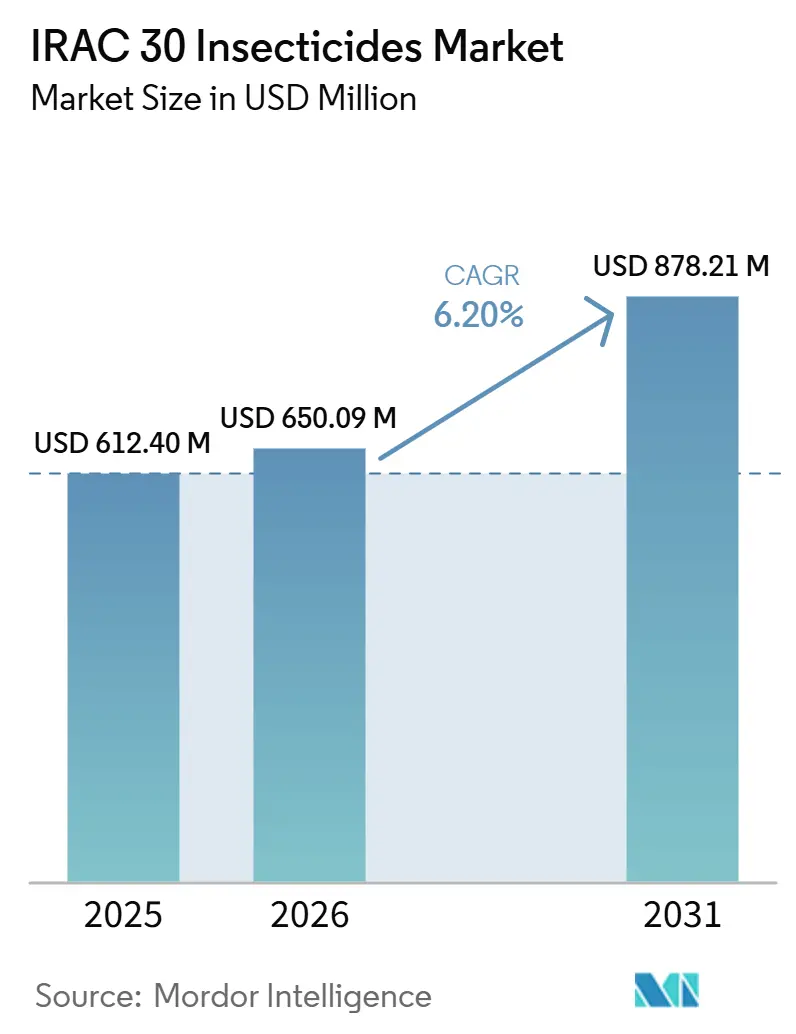
The IRAC 30 Insecticides Market size is projected to grow from USD 612.40 million in 2025 to USD 650.09 million in 2026 and is forecast to reach USD 878.21 million by 2031 at 6.20% CAGR over 2026-2031. IRAC Group 30 places gamma-aminobutyric acid (GABA)-gated chloride channel allosteric modulators into two chemical subgroups namely meta-diamides such as broflanilide and cyproflanilide, and isoxazolines such as fluxametamide and isocycloseram. This makes the IRAC 30 insecticides market one of the newest commercial chemistry classes in crop protection. This mode of action uses a distinct binding site on the insect GABA receptor, which is why the IRAC 30 insecticides are used in resistance rotation programs with no known cross-resistance to older groups such as cyclodienes, organophosphates, and pyrethroids. That differentiation helps the IRAC 30 insecticides market maintain demand even as growers review input costs more carefully, because these products support both immediate pest control and longer rotation planning. Competition remains tight because a small number of innovator companies control the currently commercially active ingredients, while recent registrations by Syngenta Group Co., Ltd. and long-standing commercialization rights held by BASF SE and Mitsui Chemicals, Inc. continue to shape market access across major crop systems.
Key Report Takeaways
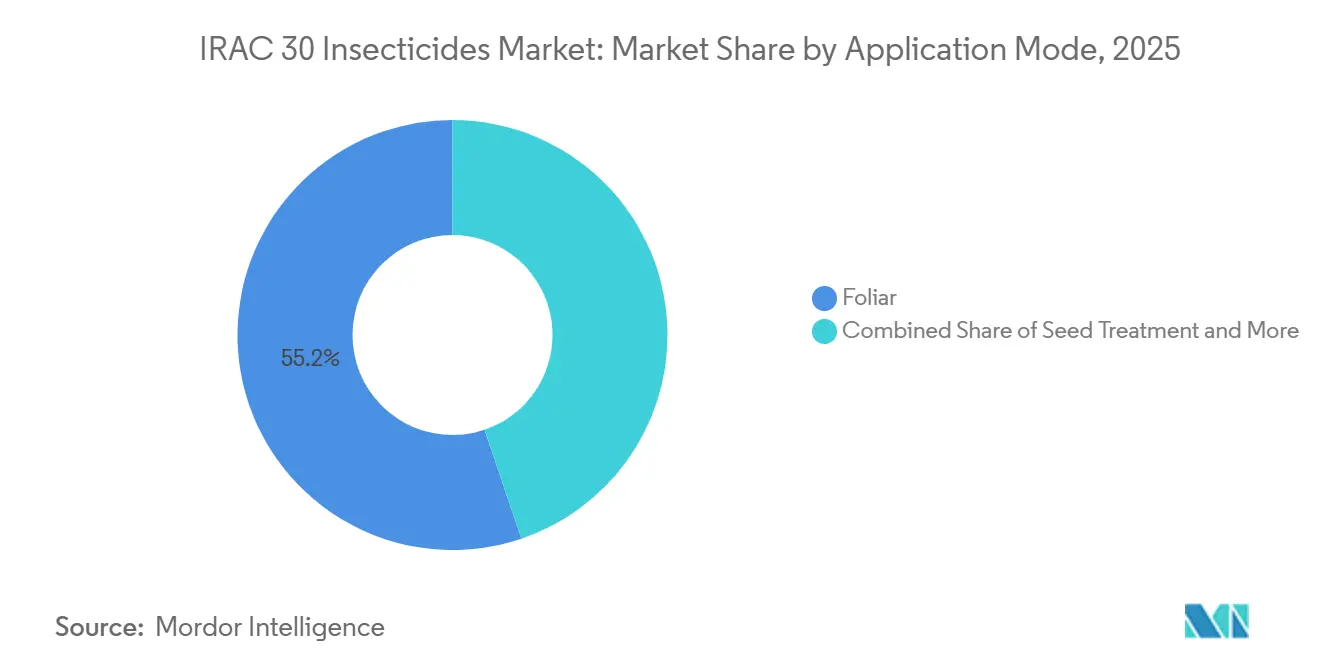
- By application mode, foliar was the largest segment, accounting for 55.2% of the IRAC 30 insecticides market share in 2025, while seed treatment is forecast to grow at a CAGR of 6.8% from 2026 to 2031, making it the fastest-growing segment.
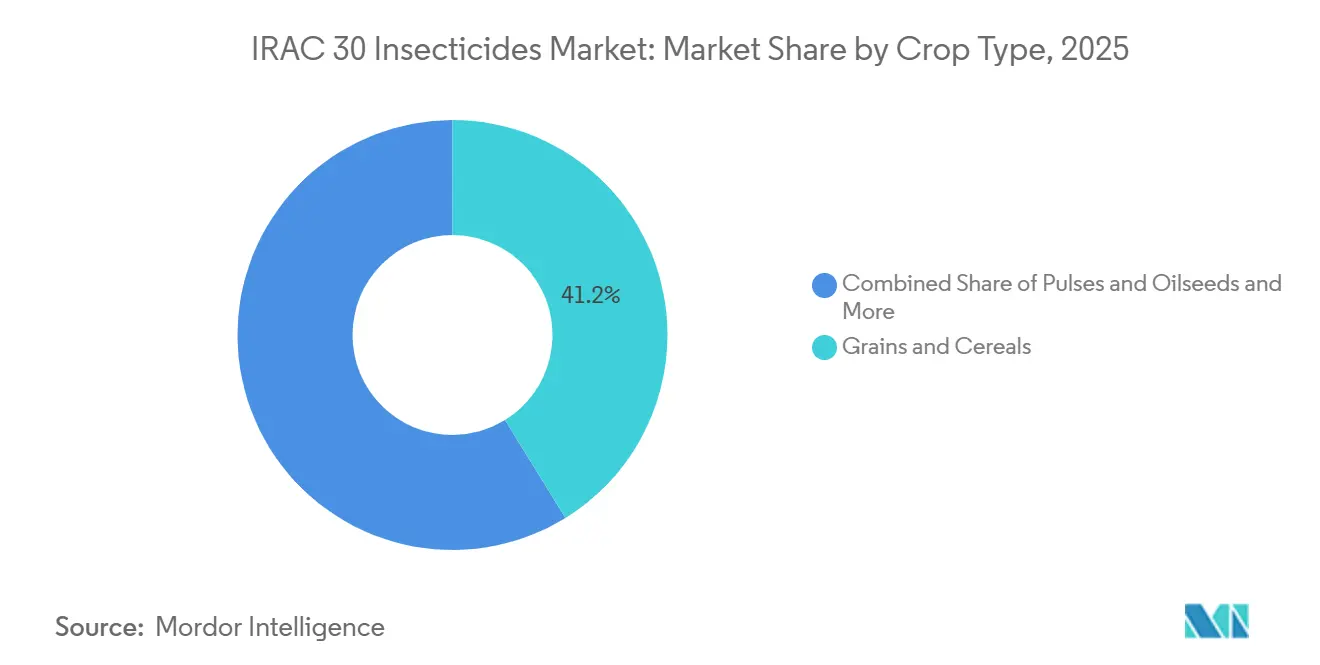
- By crop type, grains and cereals were the largest segment, accounting for a 41.2% share of the IRAC 30 insecticides market size in 2025, while pulses and oilseeds are forecast to grow at a CAGR of 6.6% from 2026 to 2031, making them the fastest-growing segment.
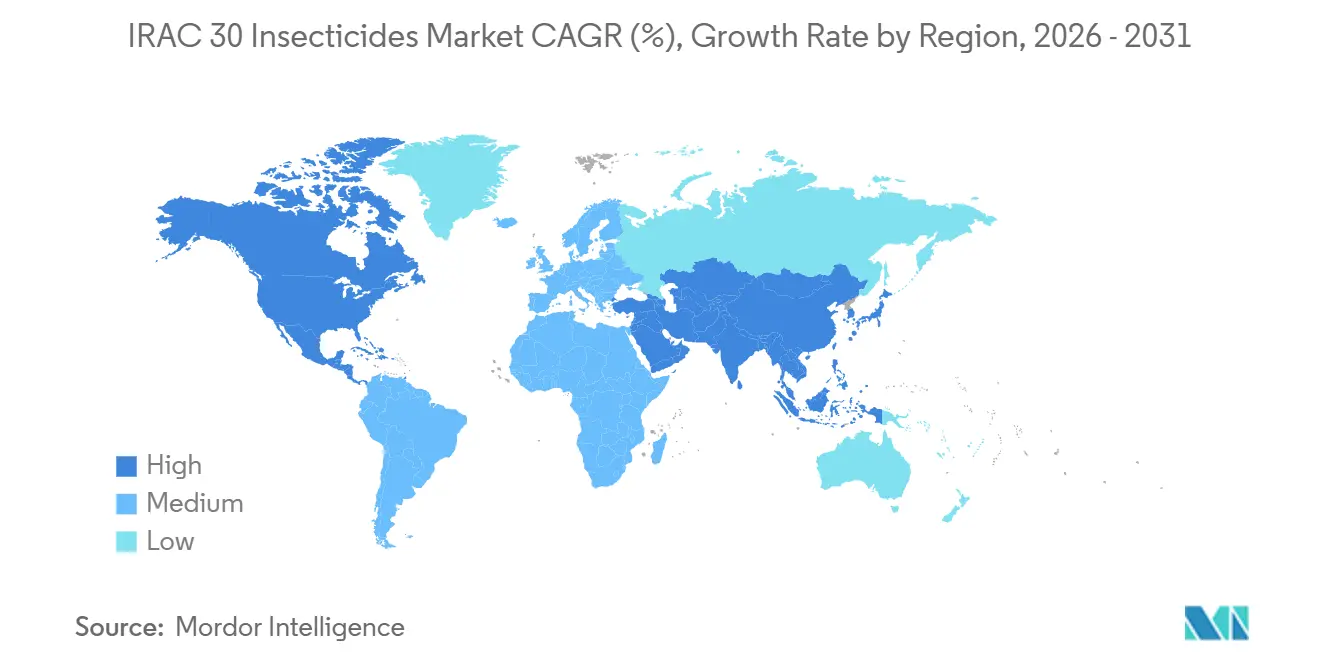
- By geography, North America was the largest region, accounting for a 37.6% share in 2025, while Asia-Pacific is forecast to grow at a CAGR of 6.7% from 2026 to 2031, making it the fastest-growing region.
Note: Market size and forecast figures in this report are generated using Mordor Intelligence’s proprietary estimation framework, updated with the latest available data and insights as of January 2026.
Market Trends and Insights
Drivers Impact Analysis of IRAC 30 Insecticides Market*
| Driver | (~) % Impact on CAGR Forecast | Geographic Relevance | Impact Timeline |
|---|---|---|---|
| Rising need for resistance-management chemistry | +2.5% | Global | Medium term (2-4 years) |
| Tightening active-ingredient re-registration timelines | +1.2% | North America and Europe | Medium term (2-4 years) |
| Expansion of high-value seed treatment programs | +0.8% | North America and Asia-Pacific | Long term (≥ 4 years) |
| Precision application enabling lower dose economics | +0.5% | Global | Long term (≥ 4 years) |
| Residual efficacy premium for novel modes of action | +0.7% | North America, Europe, and Asia-Pacific | Short term (≤ 2 years) |
| Digital pest forecasting improving spray timing | +0.4% | North America and Europe | Long term (≥ 4 years) |
| Source: Mordor Intelligence | |||
Rising Need for Resistance-Management Chemistry
Documented resistance to pyrethroid, organophosphate, and diamide insecticides in major pests is pushing growers and agronomists to seek options with a different mode of action, which directly supports the IRAC 30 insecticides market. Group 30 compounds fit that need because meta-diamides and isoxazolines act on a novel allosteric site on the GABA receptor rather than the binding sites used by older insecticide groups. Research published in 2025 showed no cross-resistance in chlorantraniliprole-resistant Chilo suppressalis populations to cyproflanilide, and the study also reported low realized heritability, suggesting a lower intrinsic resistance risk. That evidence helps the IRAC 30 insecticides market move from a backup rotation role into a planned field-season role in crops where pest pressure is already reducing the usefulness of older products. The IRAC 30 insecticides market also benefits because there were no documented field resistance cases for Group 30 in the cited guidance, which keeps its resistance-management value high while the class is still early in its commercial life.
Tightening Active-Ingredient Re-registration Timelines
The IRAC 30 insecticides market is gaining support from the slower, stricter review cycle now affecting many older insecticide actives in Europe and North America. The AIR 6 renewal program in Europe covers substances with approvals expiring between March 2025 and December 2028, which means several established chemistries are moving through another full review stage[1]Source: European Commission Food Safety Directorate, “AIR 6 Renewal Programme Applications Overview,” European Commission, food.ec.europa.eu. CropLife International also reported a backlog of pesticide renewals in April 2025, and that creates a practical advantage for newer chemistry classes with more recent approval timelines. In the United States, the recent approvals of broflanilide and isocycloseram leave these products further from the present re-registration pressure than many older competitors, which supports a longer commercial runway for the IRAC 30 insecticides market. That longer runway matters because companies can justify broader registration work, stewardship spending, and channel development when the product's regulatory life is still in an earlier phase.
Expansion of High-Value Seed Treatment Programs
The expansion of high-value seed treatment programs is creating significant growth opportunities for the IRAC 30 insecticides market, particularly in cereals, oilseeds, and other high-value row crops where protecting early plant establishment is critical. As seed treatment becomes an integral component of integrated pest management (IPM), growers are increasingly adopting insecticide-treated seeds to safeguard crops against soil-dwelling pests during the vulnerable germination and seedling stages while reducing the need for multiple foliar insecticide applications. Syngenta Group Co., Ltd. reported that Equento, which contains isocycloseram, achieved up to 97% wireworm kill in spring wheat field trials, giving the IRAC 30 insecticides market a strong performance story in early-season control[2]Source: Syngenta Thrive, “Protect Cereals from Wireworm Pressure With Equento Seed Treatment,” Syngenta Thrive, syngentathrive.com. The increasing cultivation of high-value crops, rising adoption of premium treated seeds, and demand for insecticides with novel modes of action are further strengthening the incorporation of IRAC Group 30 active ingredients into commercial seed treatment programs. As regulatory scrutiny and resistance concerns continue to limit reliance on conventional chemistries such as neonicotinoids, seed companies and growers are increasingly integrating IRAC Group 30 insecticides into preventive crop protection strategies, supporting sustained market growth.
Precision Application Enabling Lower Dose Economics
The increasing adoption of precision agriculture technologies is improving the economic viability of IRAC Group 30 insecticides by enabling highly targeted applications that maximize efficacy while reducing overall insecticide consumption. Technologies such as GPS-guided sprayers, drone-based pest monitoring, variable-rate application systems, and AI-enabled pest detection allow growers to identify localized pest hotspots and apply insecticides only where economically justified. This site-specific approach minimizes unnecessary chemical use, lowers application costs, and enhances return on investment for premium insecticide products. The benefits are particularly significant for IRAC Group 30 insecticides, whose novel mode of action and premium pricing make application efficiency a key purchasing consideration. Precision application ensures that growers achieve effective control of economically important pests while reducing product wastage, minimizing off-target exposure, and supporting resistance management through more judicious insecticide use. As digital agriculture platforms become more widely adopted across commercial farming operations, the integration of IRAC Group 30 insecticides into precision pest management programs is anticipated to strengthen, further improving dose efficiency, operational economics, and the overall value proposition of these products.
Restraints Impact Analysis of IRAC 30 Insecticides Market*
| Restraint | (~) % Impact on CAGR Forecast | Geographic Relevance | Impact Timeline |
|---|---|---|---|
| Residue compliance pressure in export crops | -1.5% | Global, concentrated in European export markets | Medium term (2-4 years) |
| Resistance cross-over risk from overused modes of action | -0.8% | Global | Long term (≥ 4 years) |
| Biocontrol substitution in protected cultivation | -0.7% | Europe and North America | Medium term (2-4 years) |
| Stewardship burden for new chemistry launches | -0.9% | Global | Short term (≤ 2 years) |
| Source: Mordor Intelligence | |||
Residue Compliance Pressure in Export Crops
Residue compliance remains a significant restraint for the IRAC 30 insecticides market, as newly launched actives often need time to move through import tolerance and residue alignment processes across trading partners. The Minnesota Department of Agriculture reviewed isocycloseram in January 2026 and added it to its water quality monitoring program because the active ingredient is classified as a per- and polyfluoroalkyl substance (PFAS) under Minnesota law. That decision did not block use, but it added another layer of attention that can shape how quickly label expansion moves in regulatory-forward areas. The IRAC 30 insecticides market is more exposed in export crops because growers and exporters need confidence that residue standards are aligned in both origin and destination markets before large programs are built around a newer chemistry. This makes adoption slower in trade-sensitive crop systems, even when field performance is strong, because commercial risk falls on the entire shipment rather than the individual field.
Resistance Cross-Over Risk from Overused Modes of Action
The IRAC 30 insecticides market has no cited cross-resistance to older chemistry classes, but that advantage depends on disciplined use rather than repeated reliance on the same mode of action. IRAC stewardship guidance for Group 30 already assumes this risk and requires rotation planning, application limits, and sensitivity monitoring to prevent overuse early in its commercial life. If growers treat Group 30 as a stand-alone answer rather than one part of a rotation, the IRAC 30 insecticides market could lose some of the very differentiation that is driving demand today. This restraint matters most in crops with repeated pest generations, where pressure to keep using the same effective product can rise quickly once field results are positive. The commercial effect is gradual rather than immediate, but it is important because resistance-management value is one of the main reasons growers are paying attention to this chemistry class in the first place.
*Our forecasts treat driver/restraint impacts as directional, not additive. The impact forecasts reflect baseline growth, mix effects, and variable interactions.
IRAC 30 Insecticides Market Segment Analysis
By Application Mode:
Foliar Dominates While Seed Treatment AcceleratesFoliar was the largest application mode, accounting for 55.2% of the IRAC 30 insecticides market share in 2025, reflecting its broad use in vegetables, cotton, tree fruit, and pulses, where quick knockdown and residual activity both matter. University of Maryland Extension noted that new isocycloseram foliar products are being positioned for pests such as diamondback moth, tarnished plant bug, and Colorado potato beetle, which supports the commercial weight of foliar programs in the IRAC 30 insecticides market. Foliar use also remains the most visible route for introducing Group 30 chemistry into high-value crop systems because growers can compare its performance directly with older chemistry classes in the same season. BASF SE presents broflanilide as active across multiple life stages, which helps explain why foliar programs still hold the largest position in the IRAC 30 insecticides market. Soil treatment, chemigation, and fumigation remain smaller because fewer Group 30 formulations are currently established in those formats.
Seed treatment is the fastest application mode, and the IRAC 30 insecticides market size for seed treatment is projected to expand at a 6.8% CAGR through 2031. The growth case is strongest in cereals and row crops, where wireworm pressure can damage crop establishment before growers have a chance to respond in-season. Syngenta Group Co., Ltd. reported up to 97% wireworm kill for Equento in spring wheat trials, which gives the IRAC 30 insecticides market a strong adoption argument in early-season protection. Precision placement also improves the economics of premium seed treatment programs, while the extension of isocycloseram into turf through Atexzo shows that the IRAC 30 insecticides market is beginning to build beyond its first core field-crop uses.



By Crop Type:
Cereals Anchor the Base While Pulses and Oilseeds Drive GrowthGrains and cereals was the largest crop type and held 41.2% share in 2025, which shows how strongly the IRAC 30 insecticides market is tied to planting-stage insect management in wheat, barley, corn, and related systems. The United States Environmental Protection Agency (EPA) finalized registration in November 2025 for small grain cereals for both seed treatment and foliar use, reinforcing cereals as the first large commercial base for isocycloseram in the IRAC 30 insecticides market. Fruits and vegetables remain the next major use area because foliar products can target key pests in Brassica crops, potatoes, onions, tree fruit, and citrus. Commercial crops, turf, and ornamental uses add a smaller but strategically useful demand, broadening the chemistry class's use window across seasons and end uses. This gives the IRAC 30 insecticides industry a stable base in broad-acre crops while still allowing higher-value uses to support pricing.
Pulses and oilseeds are the fastest-growing crop segment, and the IRAC 30 insecticides market size for pulses and oilseeds is projected to expand at a 6.6% CAGR through 2031. The growth path comes from canola expansion in Canada and the northern United States Plains, and from stronger legume intensity in parts of South Asia where lepidopteran pressure supports foliar demand. The 2025 Journal of Integrative Agriculture study on cyproflanilide also supports long-term use in rotation programs because it reported no cross-resistance in chlorantraniliprole-resistant Chilo suppressalis populations. Syngenta Group Co., Ltd. positioned Opello and Equento for corn, cereals, and pulses in the United States, which shows that the fastest crop segment is already being supported with named commercial products rather than only pipeline discussion.
Geography Analysis
North America IRAC 30 Insecticides Market
North America was the largest regional segment, accounting for 37.6% of the IRAC 30 insecticides market share in 2025. This position reflects the cereal and specialty crop base of the United States, the strong role of seed treatment in Canada, and the commercial push created by the Environmental Protection Agency (EPA) final registration of 10 isocycloseram products in November 2025. Canada adds meaningful demand through canola and spring wheat rotations where growers need early-season wireworm control and a chemistry option that differs from neonicotinoid-heavy programs. Within the United States, the Corn Belt supports seed treatment demand, while cotton and vegetable corridors in the Southeast and Southwest support foliar uptake. Mexico remains an adjacent opportunity for the IRAC 30 insecticides market because its export-oriented vegetable sector aligns with the pest profile already targeted by Group 30 foliar products.
APAC IRAC 30 Insecticides Market
Asia-Pacific is the fastest region, and the IRAC 30 insecticides market size in Asia-Pacific is projected to expand at a 6.7% CAGR through 2031. The region offers scale in rice, vegetables, and cotton, which creates steady demand for new chemistry where pest pressure is high, and rotation options matter. CropLife Japan reported that Japan’s insecticide shipment value rose 5.3% in the 2025 agricultural year, and broflanilide products are already being marketed there by Mitsui Chemicals Crop and Life Solutions, Inc. under the BROFREYA brand. PI Industries Limited also markets BROFREYA in India, which shows that the IRAC 30 insecticides market is already moving through established domestic distribution channels in South Asia.
EMEA and South America IRAC 30 Insecticides Market
Europe remains important because strong resistance-management practices and the continuing review of older active ingredients are creating room for newer chemistry classes in vegetables and cereals. South America is gaining relevance as soybean and cotton growers look for additional rotation tools in export agriculture, although residue alignment will remain important before the IRAC 30 insecticides market scales faster there. Middle East and Africa is still earlier in development, but the 2025 World Health Organization prequalification of broflanilide wettable powder for vector control raises the visibility of the chemistry across public health channels. That broader visibility may help future agricultural registration pathways in parts of sub-Saharan Africa where awareness of the active ingredient is still developing.

Competitive Landscape
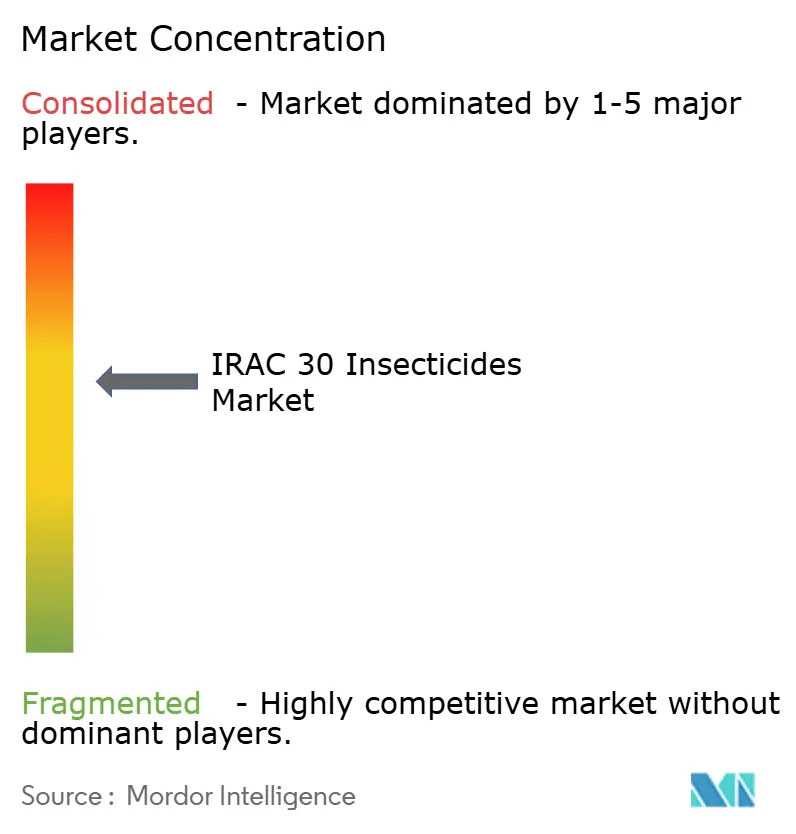
The IRAC 30 insecticides market is moderately concentrated in 2025, with 5 originating companies accounting for the currently commercial or advanced Group 30 molecules listed in the source material. Those companies are BASF SE, Syngenta Group Co., Ltd., FMC Corporation, Bayer AG, and Corteva, Inc. This structure means the IRAC 30 insecticides market has a narrow innovation base, even though formulation, channel access, and country-level product expansion can be broader. BASF SE holds principal commercialization rights for broflanilide in Western markets under its arrangement with Mitsui Chemicals, Inc., while Mitsui Chemicals, Inc. retains the main role in Japan and Asia. That division of rights keeps the market organized around a small set of technology owners rather than a wide field of fully independent competitors.
Syngenta Group Co., Ltd. made the most visible market-opening move when the Environmental Protection Agency (EPA) granted final registration for 10 isocycloseram products in November 2025 across foliar, seed treatment, turf, ornamental, and indoor pest management uses. The company had already prepared the channel with brand announcements for Incipio, Vertento, and Zivalgo in April 2025, followed by Opello and Equento in February 2025, which shows a sequenced commercialization plan rather than a single launch event. BASF SE and Mitsui Chemicals, Inc. made an earlier strategic move by aligning commercialization rights around broflanilide, which helped the chemistry enter Western and Asian crop systems under coordinated ownership. Mitsui Chemicals Crop and Life Solutions, Inc. also gained a separate visibility boost in 2025 when the World Health Organization prequalification program adopted a specification for broflanilide wettable powder for vector control[3]Source: World Health Organization Prequalification Programme, “Broflanilide WP Specification,” World Health Organization, who.int.
Technology integration is becoming a practical differentiator in the IRAC 30 insecticides market because digital crop tools improve timing, targeting, and stewardship around premium chemistry. Syngenta Group Co., Ltd. is also expanding the class into professional turf through Atexzo, broadening the revenue base beyond row crops and vegetables. At the same time, stewardship rules remain a structural part of competition because registrants need sensitivity monitoring and rotation guidance before scale expansion is responsible. The result is a market where molecule ownership is tight, commercialization is selective, and competitive advantage comes from registration reach, agronomic support, and the ability to preserve efficacy over time.
IRAC 30 Insecticides Industry Leaders
FMC Corporation
Syngenta Group Co., Ltd.
BASF SE
Bayer AG
Corteva, Inc.
- *Disclaimer: Major Players sorted in no particular order
IRAC 30 Insecticides Market Companies Covered in this Report
- FMC Corporation
- Syngenta Group Co., Ltd.
- BASF SE
- Bayer AG
- Corteva, Inc.
- Helm Agro US, Inc.
- UPL Limited
- Sumitomo Chemical Co., Ltd.
- Nufarm Limited
- Rotam Global AgroSciences Ltd.
- Mitsui Chemicals, Inc.
- ISAGRO S.p.A.
- PI Industries Limited
- Gharda Chemicals Limited
- Arysta LifeScience

Recent Industry Developments in IRAC 30 Insecticides Market
- March 2026: Syngenta Group Co., Ltd. launched WeevilTrak Plus featuring Atexzo (isocycloseram, IRAC Group 30) for annual bluegrass weevil management in professional turf applications in the United States. The product delivers broad-spectrum control of adults and all larval stages with no known cross-resistance to other chemistries, extending the Group 30 commercial platform into a high-value professional turf segment where resistance to older Group 1 and Group 3 products is well documented
- February 2026: Insecticide Resistance Action Committee (IRAC) published Mode of Action Classification Version 11.5, maintaining Group 30 with updated entries for broflanilide, fluxametamide, isocycloseram, and cyproflanilide, and revised resistance-management guidance for formulators, registrants, and regulatory authorities.
- February 2025: Syngenta Group Co., Ltd. launched two new seed treatment and early-season insecticide products, Opello and Equento, containing isocycloseram for the management of wireworm, seedcorn maggot, and early-season lepidopterans in corn, cereals, and pulses in the United States.


Global IRAC 30 Insecticides Market Report Scope
Insecticides are chemical or biological substances specifically formulated to kill, repel, or control insects. They are widely utilized in agriculture to protect crops and prevent the spread of insect-borne diseases. Chemigation, foliar, fumigation, seed treatment, and soil treatment are covered as segments by application mode. Commercial crops, fruits and vegetables, grains and cereals, pulses and oilseeds, and turf and ornamentals are covered as crop-type segments. North America, Europe, Asia-Pacific, South America, Middle East, and Africa are the regions covered.
| Chemigation |
| Foliar |
| Fumigation |
| Seed Treatment |
| Soil Treatment |
| Commercial Crops |
| Fruits and Vegetables |
| Grains and Cereals |
| Pulses and Oilseeds |
| Turf and Ornamental |
| North America | United States |
| Canada | |
| Mexico | |
| Rest of North America | |
| South America | Brazil |
| Argentina | |
| Rest of South America | |
| Europe | Germany |
| United Kingdom | |
| France | |
| Italy | |
| Spain | |
| Russia | |
| Rest of Europe | |
| Asia-Pacific | China |
| India | |
| Japan | |
| South Korea | |
| Australia and New Zealand | |
| Rest of Asia-Pacific | |
| Middle East | Saudi Arabia |
| United Arab Emirates | |
| Rest of Middle East | |
| Africa | South Africa |
| Egypt | |
| Rest of Africa |
| Application Mode | Chemigation | |
| Foliar | ||
| Fumigation | ||
| Seed Treatment | ||
| Soil Treatment | ||
| Crop Type | Commercial Crops | |
| Fruits and Vegetables | ||
| Grains and Cereals | ||
| Pulses and Oilseeds | ||
| Turf and Ornamental | ||
| Geography | North America | United States |
| Canada | ||
| Mexico | ||
| Rest of North America | ||
| South America | Brazil | |
| Argentina | ||
| Rest of South America | ||
| Europe | Germany | |
| United Kingdom | ||
| France | ||
| Italy | ||
| Spain | ||
| Russia | ||
| Rest of Europe | ||
| Asia-Pacific | China | |
| India | ||
| Japan | ||
| South Korea | ||
| Australia and New Zealand | ||
| Rest of Asia-Pacific | ||
| Middle East | Saudi Arabia | |
| United Arab Emirates | ||
| Rest of Middle East | ||
| Africa | South Africa | |
| Egypt | ||
| Rest of Africa | ||


Key Questions Answered in the Report
What is market size forecasted in IRAC 30 insecticides through 2031?
Growth is mainly tied to resistance-management demand, newer approval timelines than older chemistries, and stronger seed treatment use in cereals and row crops. The market is projected to rise from USD 650.09 million in 2026 to USD 878.21 million by 2031 at a 6.20% CAGR.
Which application mode leads current demand?
Foliar is the largest application mode with 55.2% share in 2025, supported by broad use in vegetables, cotton, and tree fruit where fast knockdown and residual activity are both important.
Which crop segment is expanding the fastest?
Pulses and oilseeds is the fastest crop segment and is projected to grow at a 6.6% CAGR through 2031, supported by canola acreage growth and stronger legume intensity in parts of South Asia.
Why is North America the largest regional market?
North America held 37.6% share in 2025 because of its cereal and specialty crop base, established seed treatment demand, and the Environmental Protection Agency (EPA) registration of 10 isocycloseram products in 2025.
Page last updated on:





