
Interior Car Accessories Market Size and Share
Market Overview
| Study Period | 2020 - 2032 |
|---|---|
| Market Size (2027) | USD 46.99 Billion |
| Market Size (2032) | USD 63.21 Billion |
| Growth Rate (2027 - 2032) | 6.11 % |
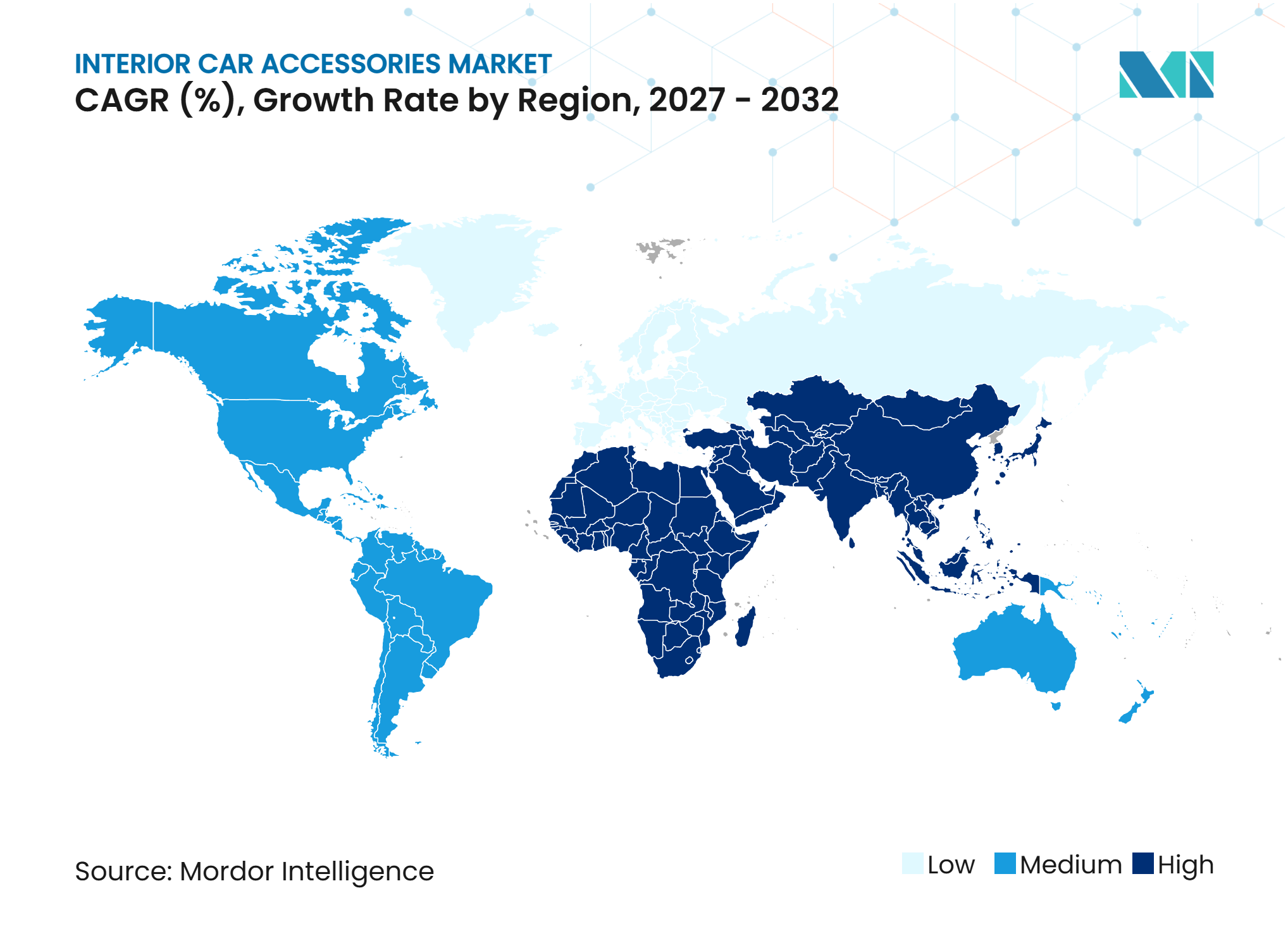
| Fastest Growing Market | Asia-Pacific |
| Largest Market | Asia-Pacific |
| Market Concentration | Low |
Major Players *Disclaimer: Major Players sorted in no particular order Image © Mordor Intelligence. Reuse requires attribution under CC BY 4.0. | |
Interior Car Accessories Market Analysis by Mordor Intelligence
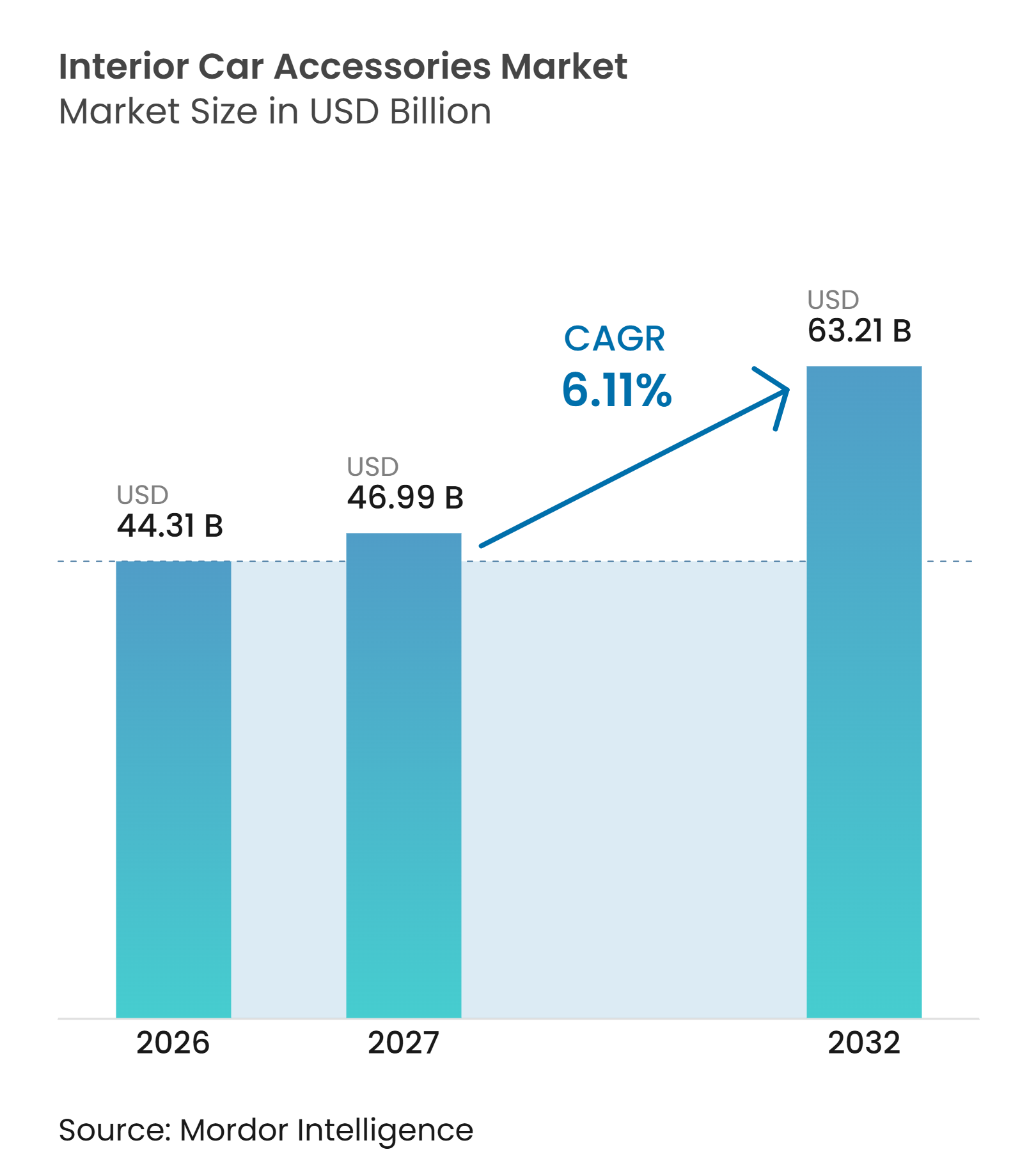
The Interior Car Accessories Market size is projected to expand from USD 44.31 billion in 2026 to USD 46.99 billion in 2027, and to USD 63.21 billion by 2032, registering a CAGR of 6.11% between 2027 and 2032. The interior car accessories market is supported by longer vehicle ownership, which increases the need to replace worn cabin products and add features that older vehicles did not receive at purchase. Demand is also shifting toward products that improve comfort, organization, charging, and in-cabin connectivity. The aftermarket remains important because it serves vehicles throughout their ownership life, rather than only at the point of sale. Electronic products create a larger value opportunity, while familiar categories such as floor mats, seat covers, sunshades, and fragrances continue to support repeat demand. Competition is strongest where products are easy to copy, while suppliers with fitment data, product testing, and established dealer or online distribution hold a clearer position.
Key Report Takeaways
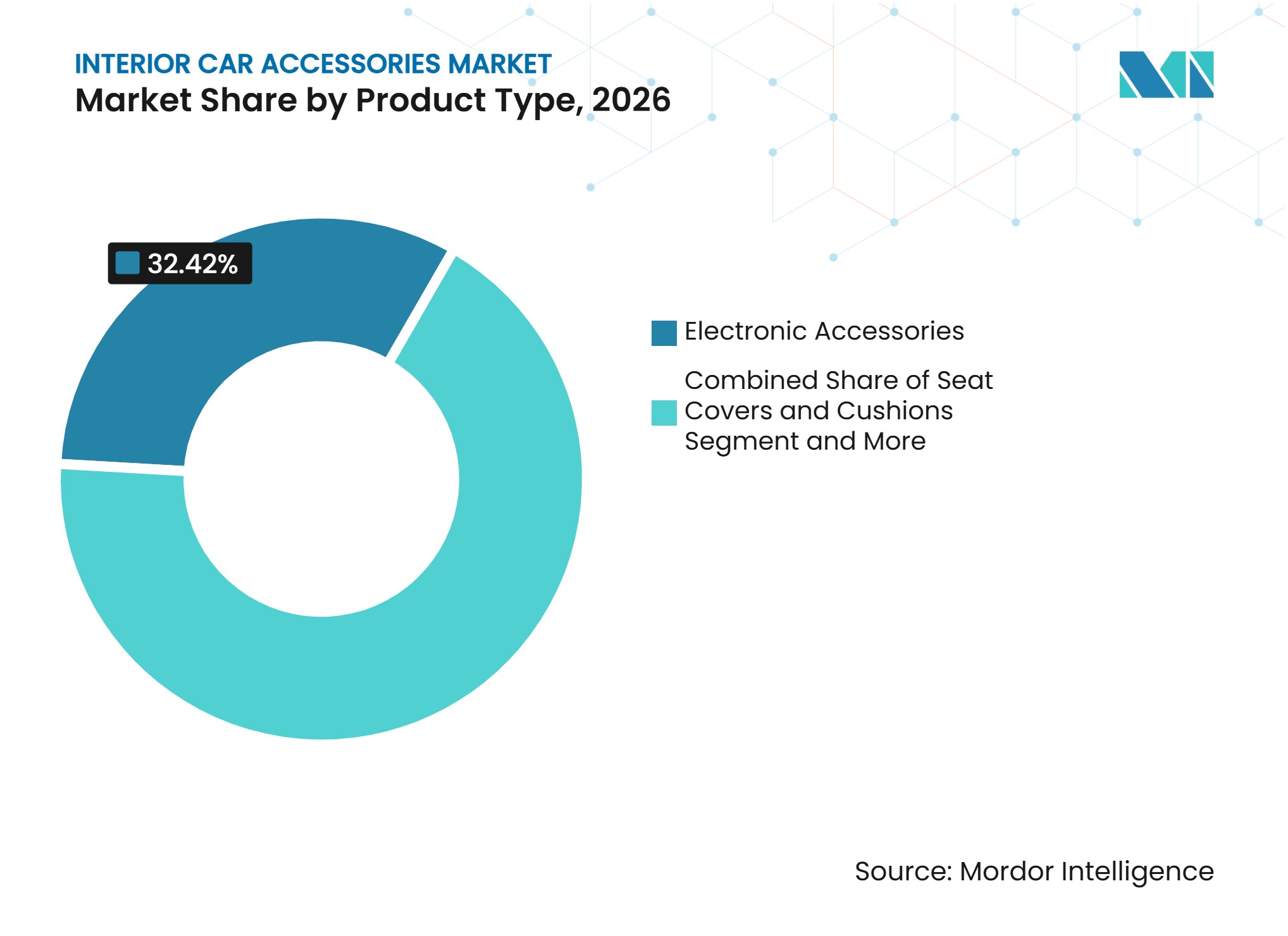
- By product type, electronic accessories held 32.42% of the interior car accessories market share in 2026 and are forecast to grow at an 8.37% CAGR through 2032.
- By vehicle type, passenger cars held 76.35% of revenue in 2026, while commercial vehicles are forecast to grow at a 7.24% CAGR through 2032.
- By sales channel, aftermarket held 59.27% of revenue in 2026 and is forecast to grow at a 6.18% CAGR through 2032.
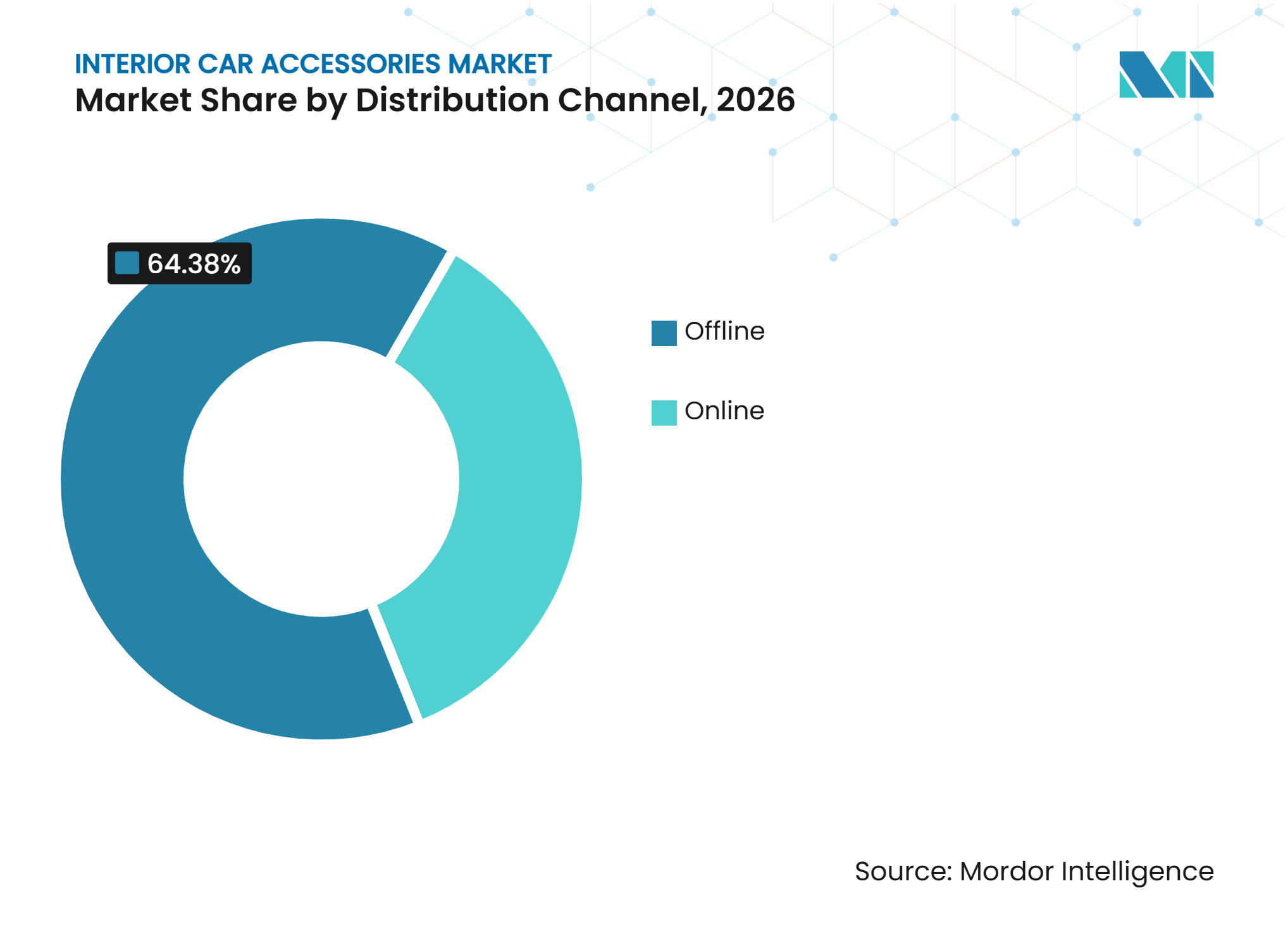
- By distribution channel, offline held 64.38% of aftermarket distribution in 2026, while online is forecast to grow at a 9.26% CAGR through 2032.
- By price range, mid-range products held 47.26% of revenue in 2026, while premium products are forecast to grow at an 8.43% CAGR through 2032.
- By geography, Asia-Pacific held 37.58% of revenue in 2026 and is forecast to grow at a 6.52% CAGR through 2032.
Note: Market numbers in this report are based on Mordor Intelligence's proprietary estimation framework, which combines nine months of actuals with Q4 projections for base year 2026.
Market Trends and Insights
Drivers Impact Analysis of Interior Car Accessories Market*
| Driver | (~) % Impact on CAGR Forecast | Geographic Relevance | Impact Timeline |
|---|---|---|---|
| Growing Demand for Cabin Personalization and Comfort Upgrades | +1.8% | Global, with strongest relevance in Asia-Pacific and North America | Short term (≤ 2 years) |
| Rising Adoption of Connected Interior Electronics and Smart Charging Accessories | +1.6% | Asia-Pacific, North America, Europe, and Middle East and Africa | Medium term (2-4 years) |
| Longer Vehicle Ownership and Expanding Used-Vehicle Parc | +1.5% | North America and Europe, with growing relevance in Asia-Pacific | Medium term (2-4 years) |
| Expansion of E-commerce and Vehicle-Specific Digital Fitment Tools | +1% | Global, with faster adoption in Asia-Pacific and North America | Short term (≤ 2 years) |
| Rising Demand for Sustainable and Easy-to-Clean Interior Materials | +0.5% | Europe, North America, and premium Asia-Pacific segments | Medium term (2-4 years) |
| Accessory Bundling Through OEM and Dealer Channels | +0.3% | North America, Europe, Japan, and South Korea | Long term (≥ 4 years) |
| Source: Mordor Intelligence | |||
Growing Demand for Cabin Personalization and Comfort Upgrades
Personalization has become a broader purchase consideration across vehicle price levels. Buyers increasingly look for products that make the cabin easier to use and more comfortable during daily travel. Seat cushions, steering wheel covers, organizers, lighting products, and floor protection can meet this need without a major vehicle modification. This supports the interior car accessories market because many of these purchases can occur after the original vehicle sale. U.S. consumers spent USD 52.65 billion on vehicle accessorizing and modification in 2024, and the Specialty Equipment Market Association expected the category to continue growing in 2025. The available product mix allows a buyer to address a specific need, such as improved seat protection or more convenient storage, without replacing other cabin components. It also allows retailers to offer basic products alongside higher-quality options, helping consumers upgrade in stages. The available product mix allows suppliers to serve both practical buyers and consumers seeking a more distinctive cabin.
Rising Adoption of Connected Interior Electronics and Smart Charging Accessories
Electronic accessories are gaining relevance as consumers expect convenient access to navigation, charging, displays, and connected services. Dash cameras, wireless charging pads, phone mounts, and infotainment upgrades are common entry points for vehicles that lack newer factory features. Garmin reported that its consolidated revenue grew 12% to USD 1.8 billion in the third quarter of 2025, supported by domain-controller shipments to automakers[1]. This activity shows how connected cabin technology is moving closer to original equipment systems. It also raises the importance of compatibility, electrical reliability, cybersecurity, and software support. Consumers may select simpler accessories first, then add other connected products as their needs change, which gives suppliers several points of contact during ownership. Product instructions and clear information on vehicle compatibility are especially important where an accessory has to work with charging ports, displays, or electrical systems. The interior car accessories market benefits, as aftermarket products offer useful upgrades without requiring a full factory-level system change.
Longer Vehicle Ownership and Expanding Used-Vehicle Parc
Longer ownership periods increase the addressable base for replacements and upgrades. Older vehicles may require fresh floor protection, seat covers, organizers, lighting, or electronics that are better suited to current consumer expectations. This pattern gives the interior car accessories market a demand base that does not depend solely on new-vehicle production. The 2015 to 2019 vehicle cohort is especially relevant because vehicles in this age range can enter more frequent maintenance and refresh cycles. The joint Auto Care Association and MEMA report stated that aftermarket e-commerce, including major online platforms, is projected to grow at a 6.7% annualized rate through 2030. A vehicle can need a practical replacement after wear, while another owner may simply want a product that better fits current travel, family, or work needs. This gives the category a combination of planned replacement purchases and more discretionary upgrades. Suppliers that offer clear fitment information can convert this growing installed base into repeat purchases.
Expansion of E-commerce and Vehicle-Specific Digital Fitment Tools
Online purchasing makes product availability wider for customers outside major retail centers. Vehicle-specific fitment tools can help a buyer filter products by year, make, model, and trim before ordering. This reduces uncertainty for products such as floor mats, seat covers, dashboard trim, and charging accessories. SEMA reported that Amazon’s automotive category generated USD 24 billion in revenue in the 12 months through September 2026 and that the specialty-equipment sector had reached a 48% online sales share. Better fitment data can reduce returns and improve the economics of direct-to-consumer selling. Clear images, product dimensions, installation guidance, and accurate vehicle filters can make online purchasing more practical for buyers who would otherwise rely on a physical store. These tools are particularly useful for precision-fit products where an incorrect order can delay installation or require a return. The interior car accessories market therefore has room for brands that combine strong product content, vehicle data, and reliable delivery.
Restraints Impact Analysis of Interior Car Accessories Market*
| Restraint | (~) % Impact on CAGR Forecast | Geographic Relevance | Impact Timeline |
|---|---|---|---|
| Factory-Integrated Infotainment and Charging Reduce Retrofit Opportunity | -0.9% | North America, Europe, and premium Asia-Pacific segments | Medium term (2–4 years) |
| High Prices and Rapid Obsolescence of Electronic Accessories | -0.4% | Global, with highest exposure in economy and mid-range segments | Short term (≤ 2 years) |
| Fitment, Airbag, Visibility, and Electrical-Safety Liability | -0.6% | Global, particularly North America and Europe, where vehicle safety requirements and compatibility concerns can limit accessory adoption | Medium term (2–4 years) |
| Volatile Polymer, Textile, Foam, and Electronic-Component Costs | -0.5% | Global, with greater exposure in price-sensitive markets and import-dependent supply chains | Short to medium term (1–4 years) |
| Source: Mordor Intelligence | |||
Factory-Integrated Infotainment and Charging Reduce Retrofit Opportunity
Factory-installed displays, wireless charging, and connected functions can reduce the need for standalone retrofit electronics. The effect is strongest in newer premium vehicles and electric vehicle lines with integrated cockpit systems. Some buyers may choose factory software upgrades instead of a physical accessory. This narrows the opportunity for basic navigation products and certain audio upgrades. The restraint does not apply equally across the interior car accessories market because many older vehicles still lack these functions. Suppliers can respond by focusing on products that work with factory systems, such as mounting solutions, cable management, cabin lighting, and vehicle-specific storage.
High Prices and Rapid Obsolescence of Electronic Accessories
Electronic products can lose appeal quickly when charging standards, camera quality, displays, and connected functions change. Customers may delay a purchase if they expect a newer version to offer meaningful improvements shortly afterward. Higher prices can be a particular concern in the economy and mid-range tiers. The challenge is greater when an accessory must connect to the vehicle electrical system or handle personal data. Product testing, clear warranty terms, and software support can reduce hesitation. Suppliers in the interior car accessories market must balance feature upgrades with products that remain useful for several years.
*Our forecasts treat driver/restraint impacts as directional, not additive. The impact forecasts reflect baseline growth, mix effects, and variable interactions.
Interior Car Accessories Market Segment Analysis
By Product Type:
Electronic Accessories Lead While Core Cabin Products Support Repeat DemandElectronic accessories accounted for 32.42% of category revenue in 2026 and are forecast to grow at an 8.37% CAGR through 2032. The segment benefits from demand for charging, phone integration, cameras, displays, and practical connected features. It also serves owners of vehicles that did not include these systems when new. Dash cameras, infotainment head units, wireless charging pads, and phone mounts are common purchase categories. Compatibility remains central because buyers want products that fit their vehicle and work reliably with existing cabin systems. Garmin’s Unified Cabin 2025 presented a domain controller with multiple displays, per-seat personalization, and ultra-wideband connectivity. This illustrates the higher level of integration that is shaping premium cabin electronics. Certification and product quality can therefore differentiate established suppliers from low-cost alternatives.
Seat covers, cushions, floor mats and liners, consoles and organizers, steering wheel covers, sunshades, fragrances, and dashboard products remain important to the category. These products meet routine needs for protection, cleaning, comfort, storage, and cabin appearance. They are often purchased more than once during vehicle ownership because they wear out or are replaced when the vehicle is sold. Climate conditions can increase the relevance of sunshades, mats, and easy-to-clean seat protection. Interior lighting can also add a functional or aesthetic upgrade without requiring a full cabin redesign. A 2025 scientific article identified ambient lighting as an important design element in the development of automotive interiors[2]. The broad product set helps the interior car accessories market serve both routine replacement needs and discretionary upgrades.



By Vehicle Type:
Passenger Cars Lead While Commercial Vehicles Gain DemandPassenger cars held 76.35% of category revenue in 2026. Their scale reflects the size of the passenger fleet and the personal nature of most cabin purchases. Owners of passenger cars often select products based on comfort, cleanliness, family use, appearance, and mobile-device convenience. SUVs and crossovers can create additional demand for organizers, floor liners, seat protection, and rear-seat products because of their larger interiors and active-use positioning. Replacement cycles also matter because a change in vehicle owner can prompt a cabin refresh. The large passenger-car base gives suppliers room to offer both universal and vehicle-specific designs. It also supports an extensive range of price points, from basic protection products to connected electronics.
Commercial vehicles are forecast to grow at a 7.24% CAGR through 2032. Fleet operators can use cabin products to improve driver comfort, manage devices, protect surfaces, and support day-to-day work. Ergonomic cushions, durable mats, organizers, charging equipment, and lighting can be relevant in vehicles used for long hours. Fleet modernization and last-mile delivery can support this demand. The purchase decision is often more practical than in passenger cars, with durability and simple replacement carrying greater weight. The interior car accessories industry can address this need with easy-to-clean materials, consistent fitment, and products that can be installed at scale. The growing commercial segment also creates opportunities for suppliers that can serve fleet buyers through distributors or direct contracts.
By Sales Channel:
Aftermarket Leads Across the Ownership CycleThe aftermarket accounted for 59.27% of category revenue in 2026 and is projected to grow at a 6.18% CAGR through 2032. Its main advantage is that it serves consumers well after a vehicle has left the dealership. Buyers can replace worn products, correct a missing feature, or change the cabin to meet new needs. The channel also offers a much wider range of designs and prices than many factory programs. This is particularly useful for older vehicles and used vehicles, where a complete cabin refresh can improve usability and perceived value. Online marketplaces, specialty stores, installers, and auto-parts retailers all contribute to aftermarket reach. The channel is likely to remain relevant as consumers keep vehicles longer and look for vehicle-specific upgrades.
OEM and dealer channels play different roles in the interior car accessories market. They can provide products designed for a specific vehicle and installed either before delivery or during service. This route can be attractive for buyers who value warranty clarity, confirmed fit, and one-stop purchasing. It can also support premium electronics and factory-aligned accessories that require more technical integration. HARMAN’s work on connected vehicle architectures shows why established vehicle relationships can be valuable for higher-complexity cabin technology[3]. However, factory integration can limit some retrofit opportunities. Suppliers with both dealer-program access and a strong aftermarket offer can reach buyers at more points in the ownership cycle.
By Distribution Channel:
Offline Retains Trust While Online Grows FasterOffline distribution accounted for 64.38% of aftermarket sales in 2026. Physical stores and installers remain important where customers want help with fitment, installation, or product comparison. This is especially relevant for custom mats, seat covers, electronics, and accessories that require electrical connections. Store staff can also create cross-selling opportunities between protection, comfort, and organization products. Offline outlets can support returns and immediate replacement when a customer needs a product quickly. The model remains useful for buyers who are less comfortable ordering vehicle-specific items online. For suppliers, retail relationships continue to provide visibility and practical customer support.
Online distribution is forecast to grow at a 9.26% CAGR through 2032. It gives consumers access to a wider product selection and makes it easier to compare models, materials, and prices. Vehicle-specific filters are important because they can reduce uncertainty before purchase. RealTruck also expanded its physical retail presence through a Store-in-Store rollout across Rack Attack locations, showing that online-led brands can still benefit from in-person touchpoints. The interior car accessories market is therefore moving toward a blended model rather than a simple shift from stores to websites.

By Price Range:
Mid-Range Products Lead While Premium Products Expand FasterMid-range products held 47.26% of category revenue in 2026. This tier appeals to consumers who want a visible improvement in fit, material quality, or features without the cost of premium products. It includes many widely purchased items, such as branded mats, seat cushions, organizers, charging products, and fragrance systems. The segment benefits from its broad customer base across new and used vehicles. Buyers often see mid-range products as a practical way to improve comfort or protect resale value. Brands in this tier must maintain quality while remaining accessible. Strong retail coverage and clear product information are important because buyers compare alternatives closely.
Premium products are forecast to grow at an 8.43% CAGR through 2032. The segment benefits from demand for advanced electronics, tailored fit, higher-grade materials, and more integrated cabin features. Garmin’s Unified Cabin 2025 demonstrates the type of connected, personalized functionality that can support premium pricing. Premium floor protection, tailored seat covers, and advanced lighting can also serve customers who want durability and a more finished appearance. This tier faces higher customer expectations for warranty, reliability, and installation. The interior car accessories market size for premium products can grow when suppliers make the value of better materials, fitment, and functionality clear. Lower-priced products remain necessary, but counterfeits and inconsistent quality can make brand trust more important in this segment.
Geography Analysis
Asia-Pacific held 37.58% of regional revenue in 2026 and is forecast to grow at a 6.52% CAGR through 2032. The region combines large vehicle populations with growing interest in connected features, cabin comfort, and vehicle personalization. China is particularly relevant because its expanding vehicle base supports future demand for replacements and upgrades. Markets across the region also include buyers at varied price points, which supports both basic protection products and premium electronics. Japan and South Korea have strong consumer familiarity with connected cabin technologies. India and Southeast Asian countries add demand for practical, climate-relevant products such as mats, seat protection, organizers, and sunshades. The region’s broad vehicle base gives suppliers opportunities to adapt fitment, materials, and price tiers by country.
North America has a deep aftermarket base because many owners retain vehicles for longer periods. This supports ongoing demand for products that refresh, protect, or improve the cabin after the original vehicle purchase. The region also has a well-developed mix of specialty retail, installers, dealer programs, and online channels. Digital retail is important, but physical stores remain useful for products that require installation support or for which customers want to assess materials in person. Vehicle-specific fitment and dependable fulfillment are central to the customer experience. The interior car accessories market in North America can benefit from products that balance convenience, durability, and clear compatibility information.
Europe has a mature vehicle base and a strong focus on product safety, materials, and sustainability. These conditions favor products with credible fitment, material quality, and transparent compliance information. Recycled-content mats and other circular-material concepts may be relevant to European buyers and vehicle makers. South America, the Middle East, and Africa represent smaller but growing areas of the global interior car accessories market. Climate, road conditions, new-vehicle activity, and the availability of retail networks influence product demand across these regions. Suppliers can improve their position by tailoring materials and product ranges to local use conditions.
Competitive Landscape
Market Concentration
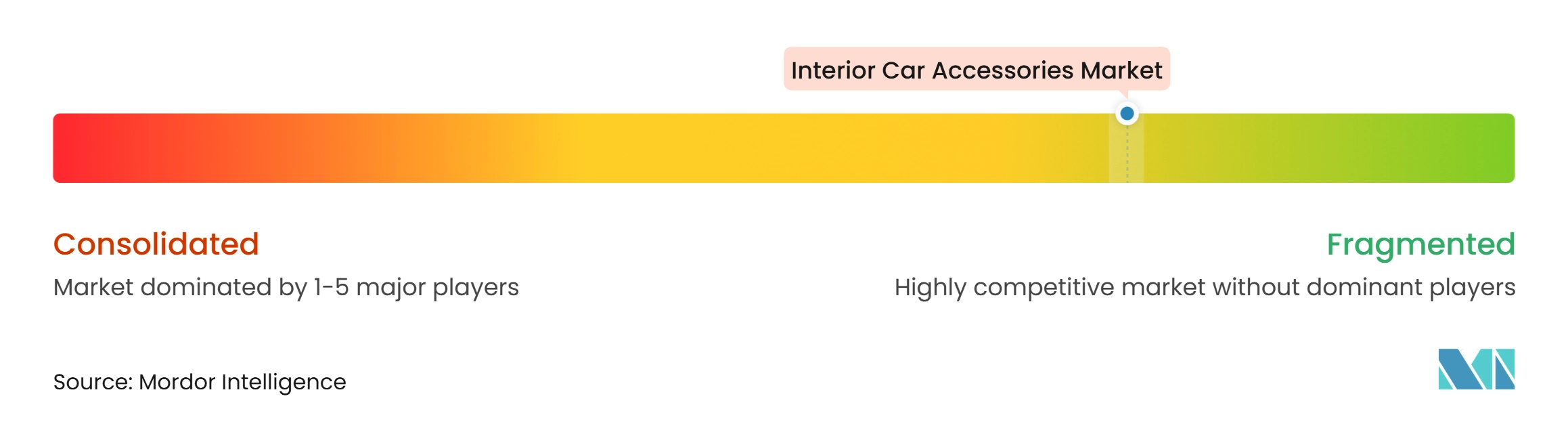
The interior car accessories market is fragmented across the full range of product categories. Commodity-oriented products, including basic floor mats, seat covers, sunshades, and fragrances, face strong price competition from private labels and regional suppliers. Electronics and connected cabin accessories have a more concentrated supplier group because they require software, electrical engineering, and vehicle integration capabilities. HARMAN, Garmin, Pioneer, and Visteon are relevant in connected cabin electronics, while specialized brands compete in protection, comfort, and organization products. Companies differentiate through fitment range, materials, product reliability, brand recognition, and access to retail or dealer channels. A supplier that can combine product breadth with accurate vehicle data has an advantage in a category where fit mistakes can lead to returns. This creates room for both established manufacturers and focused aftermarket specialists.
HARMAN’s February 2025 presentation of Ready Aware, Ready Connect, and Ready Vision QVUE showed its focus on connected automotive products and satellite-enabled communications. Garmin launched the Tread 2 Overland and SxS Edition navigators in June 2025, expanding its premium aftermarket electronics offerings for specialty vehicles. RealTruck acquired Vehicle Accessories Group in March 2025, expanding its manufacturing capability and product portfolio across truck, Jeep, and off-road categories. These moves show that major companies are adding technology, products, and distribution capacity rather than relying on a single accessory category. The approach can increase purchasing power, broaden retail reach, and create more opportunities for cross-selling. It also raises the bar for smaller firms that lack direct digital relationships or technical resources.
The competitive opportunity is not limited to high-technology products. Vehicle-specific noninvasive products can appeal to owners of newer vehicles who do not want to alter factory systems. Products that withstand heat, are easy to clean, or use recoverable materials can also address clear customer needs. The Volkswagen Atlas mono-material PET floor mat example demonstrates a route toward more circular automotive interior materials. Brands can also build loyalty through reliable fitment tools, clear installation guidance, and responsive warranty support. The interior car accessories industry remains open to new brands, but sustained scale requires dependable supply, product quality, and a distribution model that reaches consumers where they purchase. Larger firms are likely to continue extending their portfolios, while specialized suppliers can compete through category focus and local product knowledge.
Interior Car Accessories Industry Leaders
-
MacNeil Automotive Products Limited
-
3M Company
-
Covercraft Industries, LLC
-
RealTruck, Inc.
-
Harman International
- *Disclaimer: Major Players sorted in no particular order
Interior Car Accessories Market Companies Covered in this Report
- MacNeil Automotive Products Limited
- Covercraft Industries, LLC
- Pecca Group Berhad
- RealTruck, Inc.
- 3M
- Harman International
- Pioneer Corporation
- Garmin Ltd.
- MOMO Srl
- Car Mate Mfg. Co., Ltd.
- Classic Soft Trim, Inc.
- Grupo Antolin-Irausa, S.A.
- OMP Racing (Sabelt Group)
- Visteon Corporation
- Gentex Corporation
- Robert Bosch GmbH
- DENSO Corporation
- Meguiar's
- OEDRO
Recent Industry Developments in Interior Car Accessories Market
- September 2026: OEDRO expanded its vehicle-specific interior accessory range with floor mats for Chevrolet Silverado and GMC Sierra models and under-seat storage solutions for Ford F-150 and Super Duty trucks. The products emphasize vehicle-specific fitment, interior protection, and storage optimization.
- June 2026: Meguiar’s introduced its 2026 Quik Solutions kits, including an all-weather floor-mat cleaning kit, carpet and cloth cleaning kit, and leather-care kit. The products combine cleaning tools and interior-care formulations for easier maintenance of vehicle interiors.
Global Interior Car Accessories Market Report Scope
The Interior Car Accessories Market is segmented by product type, vehicle type, sales channel, distribution channel, price range, and geography. By product type, the market is segmented into seat covers and cushions; floor mats and liners; dashboard accessories and dash kits; consoles and organizers; steering wheel covers and gear knobs; electronic accessories; interior lighting; sunshades; fragrances; central locking and security; and others. By vehicle type, the market is segmented into passenger cars and commercial vehicles. By sales channel, the market is segmented into OEM and aftermarket. By distribution channel, the market is segmented into online and offline. By price range, the market is segmented into economy, mid-range, and premium. By geography, the market is segmented into North America (United States, Canada, and Mexico), Europe (Germany, United Kingdom, France, Italy, Spain, Russia, and the rest of Europe), Asia-Pacific (China, India, Japan, South Korea, Australia, Indonesia, and the rest of Asia-Pacific), South America (Brazil, Argentina, Colombia, and the rest of South America), and the Middle East and Africa (Saudi Arabia, United Arab Emirates, Turkey, South Africa, Egypt, and the rest of the Middle East and Africa).
Segmentation Overview
| Seat Covers and Cushions |
| Floor Mats and Liners |
| Dashboard Accessories and Dash Kits |
| Consoles and Organizers |
| Steering Wheel Covers and Gear Knobs |
| Electronic Accessories |
| Interior Lighting |
| Sunshades |
| Fragrances |
| Central Locking and Security |
| Others |
| Passenger Cars |
| Commercial Vehicles |
| Original Equipment Manufacturer (OEM) |
| Aftermarket |
| Online |
| Offline |
| Economy |
| Mid-Range |
| Premium |
| North America | United States |
| Canada | |
| Rest of North America | |
| Europe | Germany |
| United Kingdom | |
| France | |
| Italy | |
| Spain | |
| Russia | |
| Rest of Europe | |
| Asia-Pacific | China |
| India | |
| Japan | |
| South Korea | |
| Australia | |
| Indonesia | |
| Rest of Asia-Pacific | |
| South America | Brazil |
| Argentina | |
| Colombia | |
| Rest of South America | |
| Middle East and Africa | Saudi Arabia |
| United Arab Emirates | |
| Turkey | |
| South Africa | |
| Egypt | |
| Rest of Middle East and Africa |
| By Product Type | Seat Covers and Cushions | |
| Floor Mats and Liners | ||
| Dashboard Accessories and Dash Kits | ||
| Consoles and Organizers | ||
| Steering Wheel Covers and Gear Knobs | ||
| Electronic Accessories | ||
| Interior Lighting | ||
| Sunshades | ||
| Fragrances | ||
| Central Locking and Security | ||
| Others | ||
| By Vehicle Type | Passenger Cars | |
| Commercial Vehicles | ||
| By Sales Channel | Original Equipment Manufacturer (OEM) | |
| Aftermarket | ||
| By Distribution Channel | Online | |
| Offline | ||
| By Price Range | Economy | |
| Mid-Range | ||
| Premium | ||
| By Geography | North America | United States |
| Canada | ||
| Rest of North America | ||
| Europe | Germany | |
| United Kingdom | ||
| France | ||
| Italy | ||
| Spain | ||
| Russia | ||
| Rest of Europe | ||
| Asia-Pacific | China | |
| India | ||
| Japan | ||
| South Korea | ||
| Australia | ||
| Indonesia | ||
| Rest of Asia-Pacific | ||
| South America | Brazil | |
| Argentina | ||
| Colombia | ||
| Rest of South America | ||
| Middle East and Africa | Saudi Arabia | |
| United Arab Emirates | ||
| Turkey | ||
| South Africa | ||
| Egypt | ||
| Rest of Middle East and Africa | ||
Key Questions Answered in the Report
What is the projected value of the interior car accessories market by 2032?
The interior car accessories market is projected to reach USD 63.21 billion by 2032, rising from USD 46.99 billion in 2027 at a 6.11% CAGR.
Which product category leads interior car accessories sales?
Electronic accessories lead with a 32.42% share in 2026 and are also projected to grow at an 8.37% CAGR through 2032. This part of the interior car accessories market includes products that support charging, displays, cameras, phone integration, and practical connected functions. Products must offer reliable fit, clear installation information, and useful features to retain customer interest.
Which region has the strongest outlook for interior car accessories?
Asia-Pacific leads with 37.58% share in 2026 and is projected to grow at a 6.52% CAGR through 2032. The interior car accessories market in the region benefits from large vehicle populations, varied consumer price points, and rising interest in cabin comfort and connected features. Suppliers need to adapt fitment, material choices, and pricing to local vehicle use and customer preferences.
What are the main constraints on electronic cabin accessories?
Factory-integrated features can reduce retrofit demand, while rapid product updates and higher prices can delay purchases. Suppliers can respond with products that work alongside existing vehicle systems and with clear compatibility, warranty, and support information that reduces customer uncertainty. A clear value proposition is important when buyers can choose between an aftermarket upgrade and an original equipment option.