
Industrial Solvents Market Size and Share
Market Overview
| Study Period | 2022 - 2032 |
|---|---|
| Market Size (2027) | USD 38.25 Billion |
| Market Size (2032) | USD 49.47 Billion |
| Growth Rate (2027 - 2032) | 5.28 % |
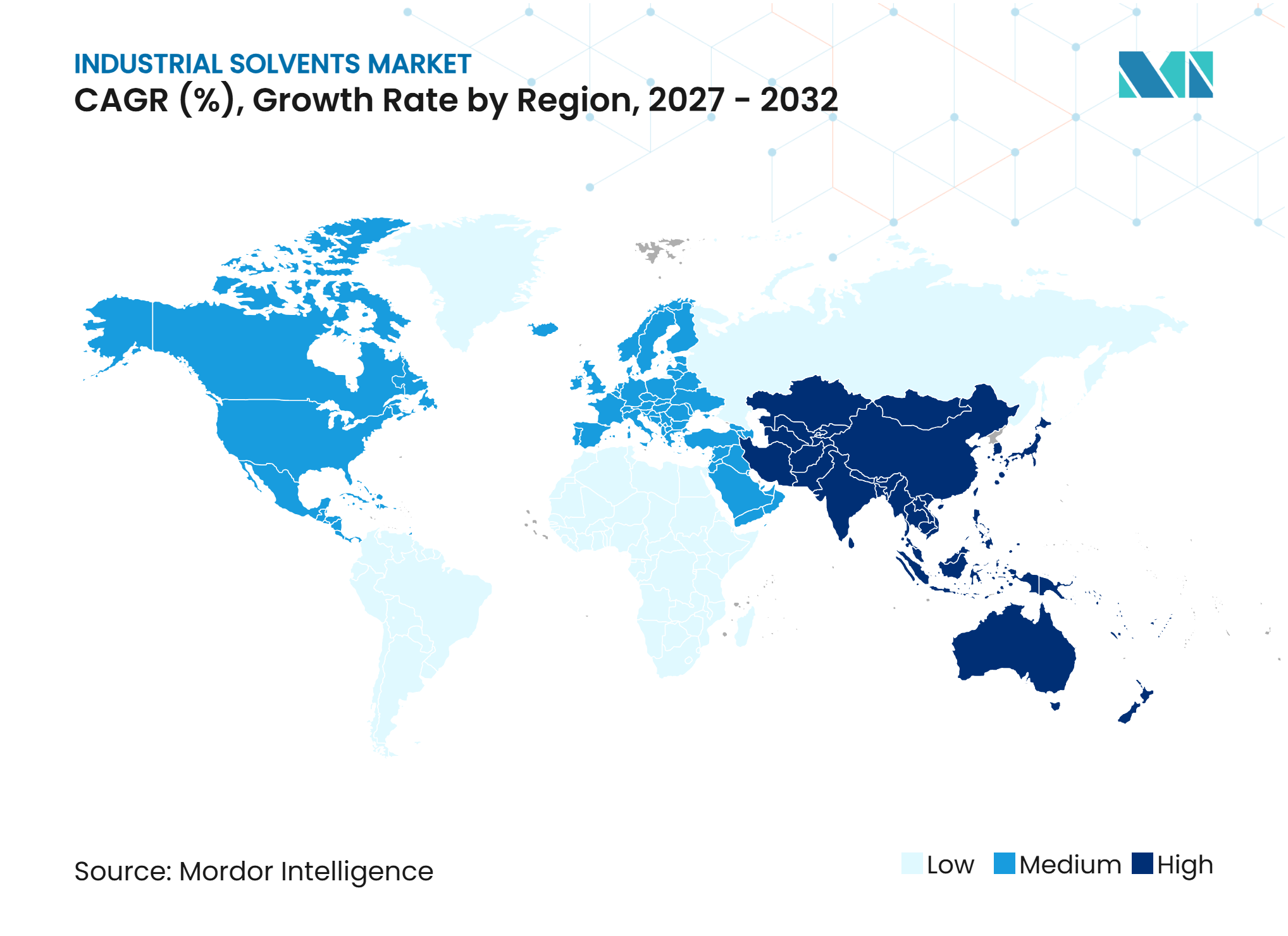
| Fastest Growing Market | Asia-Pacific |
| Largest Market | Asia-Pacific |
| Market Concentration | Low |
Major Players *Disclaimer: Major Players sorted in no particular order Image © Mordor Intelligence. Reuse requires attribution under CC BY 4.0. | |
Industrial Solvents Market Analysis by Mordor Intelligence
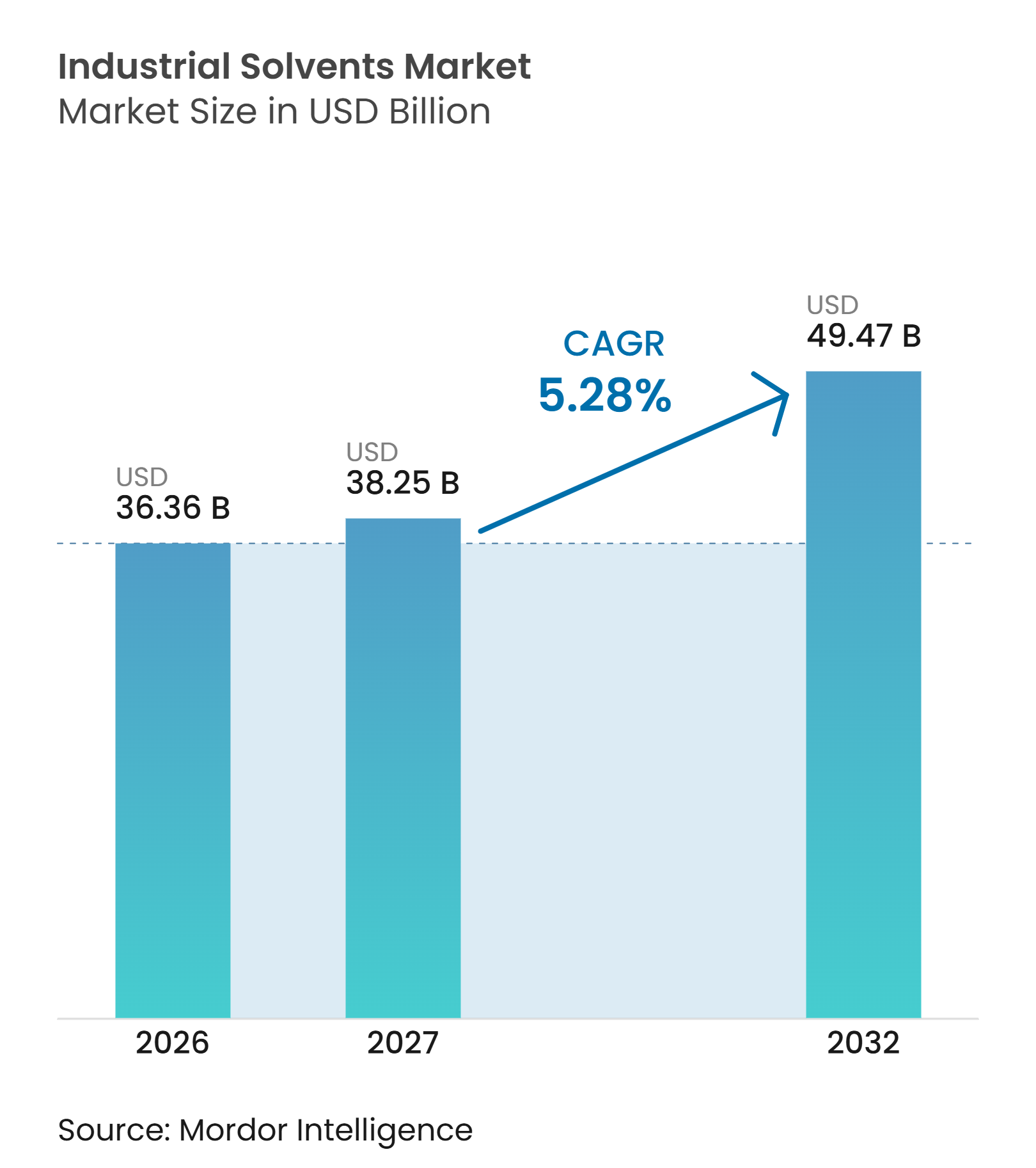
The Industrial Solvents Market size was valued at USD 36.36 billion in 2026 and is estimated to grow from USD 38.25 billion in 2027 to reach USD 49.47 billion by 2032, at a CAGR of 5.28% during the forecast period (2027-2032). The industrial solvents market is supported by stable demand from coatings, construction activity, and pharmaceutical manufacturing. Regulatory limits on volatile organic compounds are changing the product mix toward oxygenated grades and lower-toxicity alternatives. Integrated producers are reviewing commodity assets in Europe while directing capital toward specialty materials, circular recovery, and higher-purity products. This shift gives suppliers with qualified grades, regional production, and reliable feedstock access a stronger position in the industrial solvents market.
Key Report Takeaways
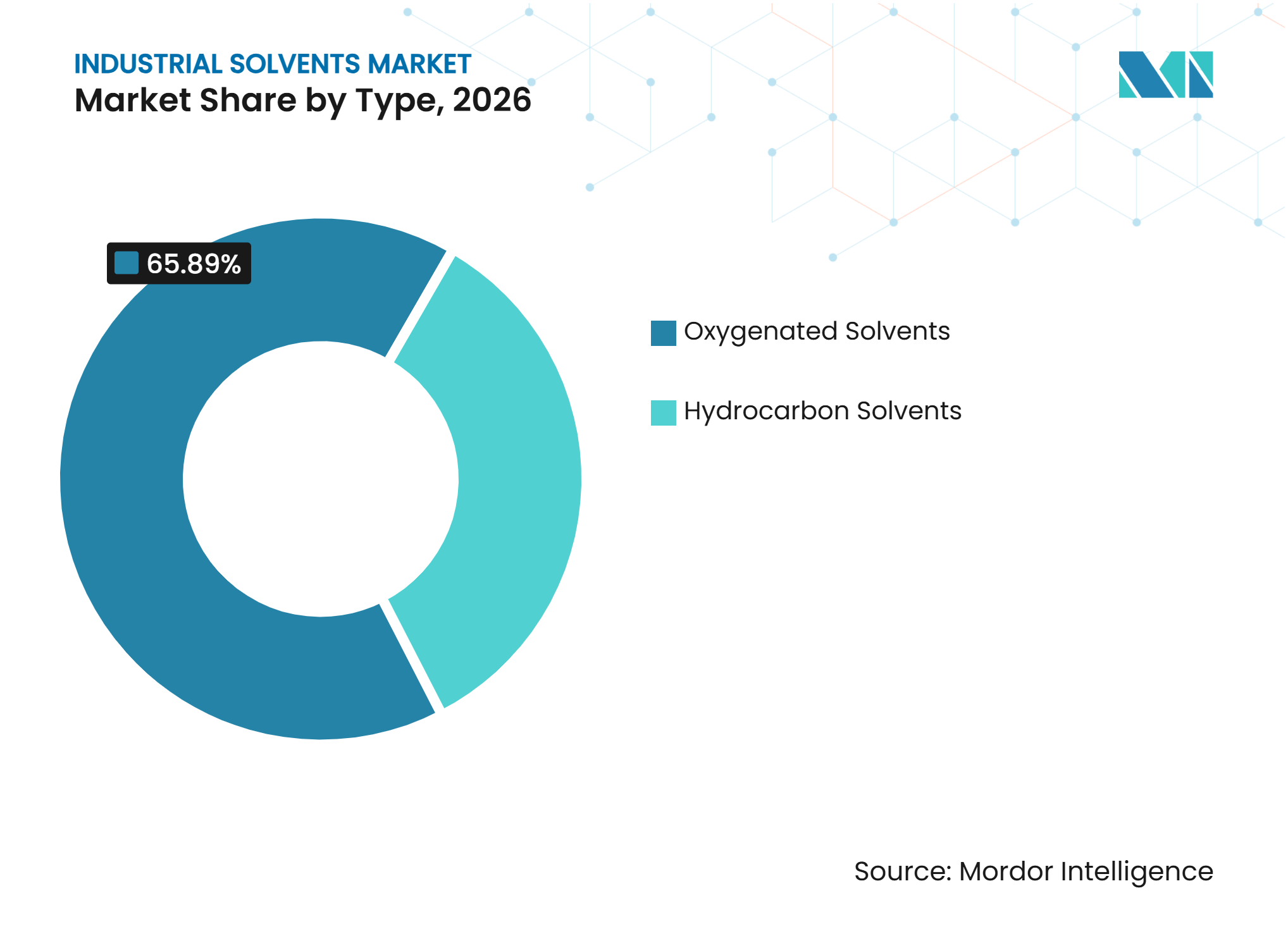
- By type, oxygenated solvents held 65.89% of the industrial solvents market share in 2026 and are projected to advance at a 5.98% CAGR through 2032.
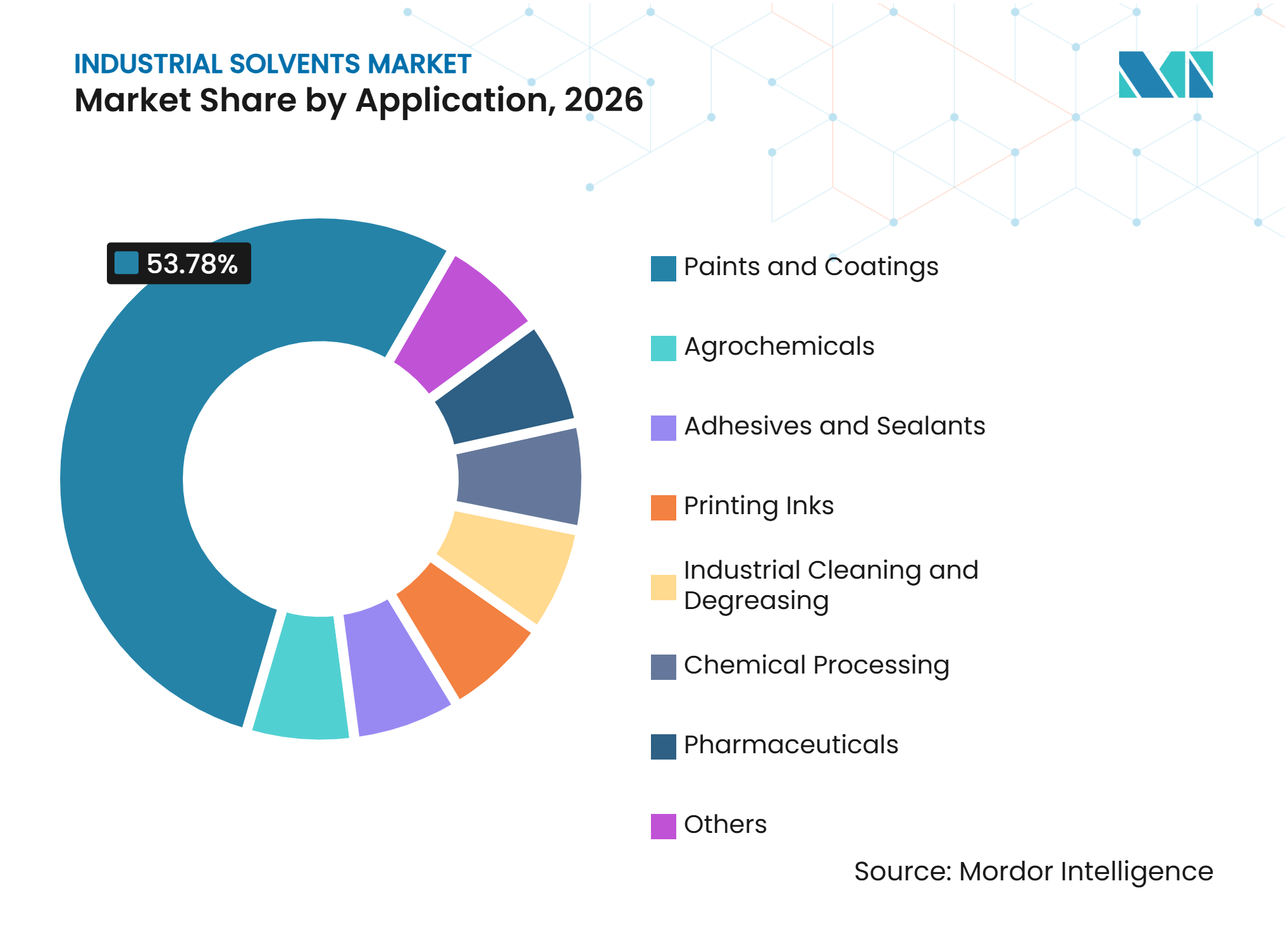
- By application, paints and coatings held 53.78% of the industrial solvents market share in 2026, while pharmaceuticals are projected to advance at a 6.42% CAGR through 2032.
- By geography, Asia-Pacific held 42.45% of the industrial solvents market share in 2026 and is projected to advance at a 6.31% CAGR through 2032.
Note: Market numbers in this report are based on Mordor Intelligence's proprietary estimation framework, which combines nine months of actuals with Q4 projections for base year 2026.
Market Trends and Insights
Drivers Impact Analysis of Industrial Solvents Market*
| Driver | (~) % Impact on CAGR Forecast | Geographic Relevance | Impact Timeline |
|---|---|---|---|
| Surging Demand from Paints and Coatings | +1.9% | Global, with intensity in Asia-Pacific, South America, and MEA | Short term (≤ 2 years) |
| Accelerating Pharmaceutical Manufacturing in Emerging Asia-Pacific Clusters | +1.4% | Asia-Pacific core (India, China, South Korea), spillover to MEA | Medium term (2-4 years) |
| Tightening VOC Caps Encouraging Solvent Substitution | +1.0% | North America and EU primary; APAC and MEA secondary | Medium term (2-4 years) |
| Increasing Demand for Clean Manufacturing and High-Performance Industrial Cleaning | +0.7% | North America and EU primary; APAC growing rapidly | Medium term (2-4 years) |
| AI-Enabled Closed-Loop Solvent Recovery | +0.4% | Global, with early adoption in North America, EU, and Japan | Long term (≥ 4 years) |
| Source: Mordor Intelligence | |||
Surging Demand from Paints and Coatings
Paints and coatings depend on solvents for protective coatings, automotive original equipment manufacturer topcoats, and high-build industrial finishes. Waterborne reformulation has advanced, but some coating systems still require solvent-based carriers to meet film-performance requirements. Eastman Chemical Company increased prices for several oxo products in February 2025, including n-propyl alcohol and glycol ether grades in North America and Latin America. This pricing action reflected continuing demand for oxygenated solvent grades in demanding coating applications. The industrial solvents market therefore retains a large and stable coatings demand base even as individual formulations evolve.
Accelerating Pharmaceutical Manufacturing in Emerging Asia-Pacific Clusters
Pharmaceuticals require high-purity solvents for active pharmaceutical ingredient manufacturing and for controlled synthesis processes. Producers that can meet traceability and quality requirements are better placed than suppliers of undifferentiated commodity grades. Recovered pharmaceutical solvents also create a parallel demand pool when recovery systems can preserve purity and meet process specifications. Process Analytical Technology (PAT) has been used to support high solvent recovery in active pharmaceutical ingredient production. This combination of new capacity and tighter quality control supports demand for qualified solvents across the industrial solvents market.
Tightening VOC Caps Encouraging Solvent Substitution
Volatile organic compound (VOC) controls are encouraging formulators to replace some conventional hydrocarbon solvents with oxygenated and bio-based alternatives. The U.S. Environmental Protection Agency finalized amendments to the National Volatile Organic Compound Emission Standards for Aerosol Coatings in January 2025[1]. A subsequent interim final rule extended the final compliance date to January 17, 2027. These requirements give coating manufacturers a reason to reassess reactivity and exposure profiles in their formulations. Glycol ethers and esters can help meet performance needs in lower-VOC systems. Regulatory change is therefore influencing grade selection as well as the broader industrial solvents market product mix.
Increasing Demand for Clean Manufacturing and High-Performance Industrial Cleaning
Precision cleaning applications require closely controlled solvent purity and consistent processing performance. Semiconductor fabrication, aerospace maintenance, and medical device production are important end uses for these grades. Eastman Chemical Company identified its EastaPure electronic-grade isopropyl alcohol offering in its 2024 annual filing. Huntsman International LLC expanded its Performance Products site in Conroe, Texas, in 2025 to serve semiconductor customers. Suppliers compete in these applications through qualification, traceability, and reliable delivery rather than through price alone. This raises the importance of specialty applications in the industrial solvents market.
Restraints Impact Analysis of Industrial Solvents Market*
| Restraint | (~) % Impact on CAGR Forecast | Geographic Relevance | Impact Timeline |
|---|---|---|---|
| Petrochemical Feedstock Volatility and Margin Pressure | -1.1% | Global, with acute exposure in Europe and Asia-Pacific | Short term (≤ 2 years) |
| Environmental, Occupational Safety, and VOC Compliance Costs | -0.7% | North America and EU primary; APAC growing | Medium term (2-4 years) |
| High Cost of Bio-Based Solvents in High-Specification Formulations | -0.4% | North America and EU primary; APAC and MEA slower to adopt | Long term (≥ 4 years) |
| Source: Mordor Intelligence | |||
Petrochemical Feedstock Volatility and Margin Pressure
Feedstock volatility affects the cost of naphtha-derived aromatics, alcohols, and glycol chains. It can reduce margins when solvent selling prices do not move in line with raw-material costs. LyondellBasell Industries Holdings B.V. reported a USD 738 million net loss for 2025 and reduced 2026 capital expenditure to USD 1.2 billion. European capacity reductions can further change regional availability for solvent intermediates. BASF noted that its Zhanjiang Verbund site in China brings integrated production into service, including material relevant to oxygenated solvent feedstocks. The industrial solvents market remains exposed to this uneven regional supply and cost environment.
Environmental, Occupational Safety, and VOC Compliance Costs
Compliance spending can be significant for producers operating across several jurisdictions. The U.S. Environmental Protection Agency extended deadlines under its rules for perchloroethylene and carbon tetrachloride[2]. Facilities may need air-monitoring equipment, exposure-control plans, and worker-protection programs. These requirements can add fixed costs before a product reaches commercial scale. Smaller suppliers may face greater difficulty absorbing these costs across many product lines. The resulting burden can constrain operating flexibility in the industrial solvents market.
*Our forecasts treat driver/restraint impacts as directional, not additive. The impact forecasts reflect baseline growth, mix effects, and variable interactions.
Industrial Solvents Market Segment Analysis
By Type:
Oxygenated Solvents Lead Both Scale and GrowthOxygenated solvents held a 65.89% share in 2026, representing the leading type in the industrial solvents market. Their position reflects use across coatings, chemical processing, industrial cleaning, and pharmaceutical applications. Alcohols such as n-butanol and 2-ethylhexanol are important inputs for coating resins and plasticizers. Glycol ethers are widely used as carriers in lower-VOC architectural and industrial coatings. Ketones, including methyl ethyl ketone, remain relevant where high solvency strength is required.
Hydrocarbon solvents retain a significant role where lower cost and strong solvency performance remain important. Printing inks, chemical processing, and industrial cleaning continue to use aromatic and aliphatic grades. Aromatic grades face substitution pressure where benzene and toluene restrictions are stricter. Aliphatic grades remain relevant where their odor, flammability, and formulation properties are appropriate. Shell plc closed its methyl ethyl ketone unit at Pernis in April 2025 and arranged supply continuity with Exxon Mobil Corporation.


By Application:
Paints and Coatings Lead Revenue, While Pharmaceuticals ExpandPaints and coatings held a 53.78% share in 2026, while pharmaceuticals are projected to advance at a 6.42% CAGR through 2032. Coatings retain broad demand across construction, automotive, and industrial maintenance activities. Pharmaceutical production requires high-purity solvents and controlled processing for active pharmaceutical ingredient manufacture. The International Council for Harmonisation (ICH) Q3C guideline strengthens attention to residual solvent control and material quality. Process Analytical Technology can support real-time process control and high recovery yields in solvent-intensive pharmaceutical processes.
Adhesives and sealants use solvents in packaging, automotive assembly, and construction bonding. Printing inks continue to use ethyl acetate and isopropanol in flexible packaging production. Industrial cleaning and degreasing are gaining importance where customers require high-purity grades. Chemical processing uses solvents as reaction media, extraction agents, and product-isolation materials. Agrochemical formulations use oxygenated solvents as carriers and co-formulants.


Geography Analysis
Asia-Pacific: Dual Engine of Size and Speed
Asia-Pacific held a 42.45% share in 2026 and is projected to advance at a 6.31% CAGR through 2032. Construction coatings, automotive production, electronics manufacturing, and pharmaceutical production support demand across the region. India and China provide large bases for chemical processing and active pharmaceutical ingredient manufacturing, while high-purity applications encourage investment in quality control and traceability. BASF started production at its Zhanjiang Verbund site in 2025, including C4 oxo alcohols, monoethylene glycol, and acrylic monomers.
North America: Restructuring Toward High-Value Applications
North America is shifting toward specialized applications that need documented performance and controlled grades. The U.S. Environmental Protection Agency is restricting some uses of legacy halogenated solvents under Toxic Substances Control Act Section 6(a) rules. Eastman Chemical Company expanded TamiSolve NxG distribution through ChemPoint in the United States and Canada during 2025. The product addresses replacement demand in coatings, inks, electronics, and agrochemical formulations. Compliance factors and performance requirements are shaping procurement decisions.
Europe, South America, and Middle East and Africa: Diverging Trajectories
Europe is facing pressure on commodity solvent production from energy costs and carbon-related obligations. Syensqo and Shell Chemicals Europe announced a low-carbon ethylene oxide collaboration in 2025. South America continues to draw demand from agribusiness-linked chemical processing and construction coatings. Middle East and Africa benefit from petrochemical feedstocks and export infrastructure. These differences require companies to balance regional production costs, regulation, and local end-use demand.
Competitive Landscape
Market Concentration
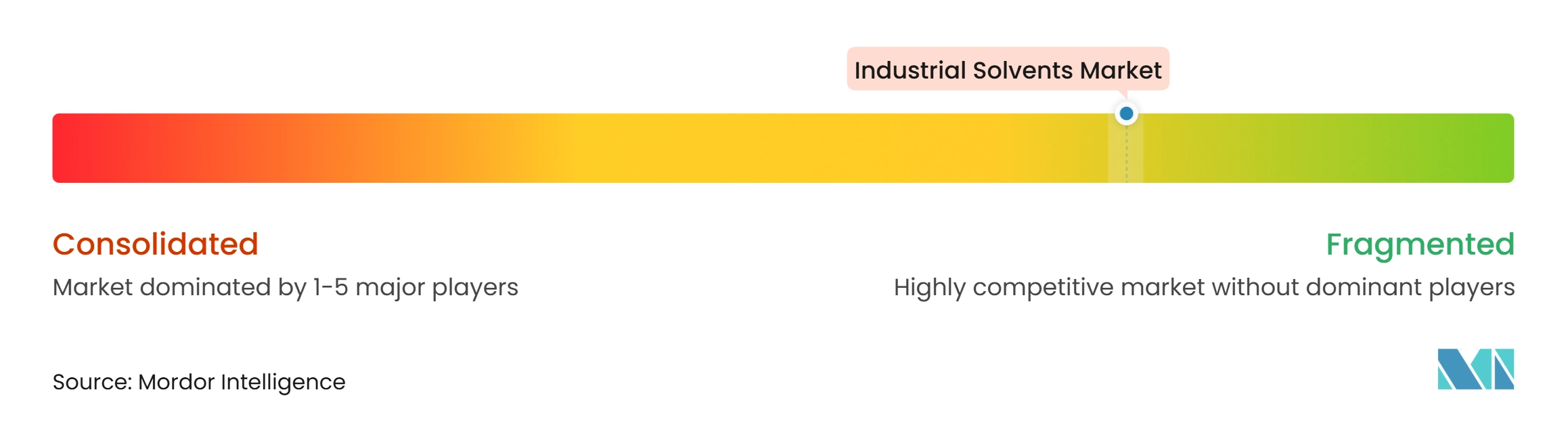
The industrial solvents market is highly fragmented, with top players including BASF, Dow, Exxon Mobil Corporation, LyondellBasell Industries Holdings B.V., and INEOS. Commodity products favor feedstock access, operating scale, and logistics. Specialty applications place greater weight on qualification, traceability, and technical support.
BASF commissioned its first products at the Zhanjiang Verbund site during 2025, adding C4 oxo alcohol and monoethylene glycol capacity. Eastman Chemical Company expanded its TamiSolve NxG distribution partnership with ChemPoint in 2025. Arkema started a 15-metric-ton-per-year Forane 1233zd unit at Calvert City, Kentucky, during 2025. These actions show continued investment in integrated capacity, alternative products, and higher-value applications.
Circular recovery and process control are becoming more relevant to competitive differentiation. Pharmaceutical-grade recovered solvents can reduce material loss when purity is maintained. Process Analytical Technology can monitor solvent recovery and quality in pharmaceutical settings. Bio-based alternatives may gain use where performance and price are suitable for an application. Companies with scale in core products and application-specific technical capability have stronger options across the industrial solvents market.
Industrial Solvents Industry Leaders
-
BASF
-
Dow
-
Exxon Mobil Corporation
-
LyondellBasell Industries Holdings B.V.
-
INEOS
- *Disclaimer: Major Players sorted in no particular order
Industrial Solvents Market Companies Covered in this Report
- Arkema
- BASF
- Celanese Corporation
- Dow
- Eastman Chemical Company
- Exxon Mobil Corporation
- Honeywell International Inc.
- Huntsman International LLC
- INEOS
- LyondellBasell Industries Holdings B.V.
- Mitsubishi Chemical Group Corporation
- SABIC
- Sasol
- Shell plc
- Solvay
Recent Industry Developments in Industrial Solvents Market
- October 2026: Adperma, a wholly owned subsidiary of Haldia Petrochemicals Ltd. (HPL), inaugurated its integrated phenol and acetone complex at Haldia, West Bengal, with commercial production scheduled for December 2026. The facility has a designed annual capacity of 345,000 tonnes of phenol and 215,000 tonnes of acetone, adding to the domestic supply of acetone, an important industrial solvent used in paints, coatings, adhesives, pharmaceuticals, and specialty chemicals.
- September 2026: Balaji Amines Limited commenced commercial production at its upgraded acetonitrile plant at Unit III, Chincholi MIDC, Solapur, India, increasing installed capacity to 1,440 tonnes per month. The expansion strengthened domestic and export availability of acetonitrile, which is used as an industrial solvent in pharmaceutical, pesticide, battery, and chemical applications.
Global Industrial Solvents Market Report Scope
Industrial solvents are chemical substances used to dissolve, dilute, disperse, or extract other materials during industrial manufacturing and processing operations. They include oxygenated and hydrocarbon-based compounds with varying solvency, volatility, and chemical properties. These solvents are widely used in paints and coatings, adhesives, printing inks, industrial cleaning, chemical processing, pharmaceuticals, and agrochemical manufacturing.
The Industrial Solvents Market is segmented by type, application, and geography. By type, the market is segmented into oxygenated solvents (alcohols, glycols, ketones, ethers, and glycol esters) and hydrocarbon solvents (aromatic hydrocarbon solvents, aliphatic hydrocarbon solvents, and others). By application, the market is segmented into paints and coatings, adhesives and sealants, printing inks, industrial cleaning and degreasing, chemical processing, pharmaceuticals, agrochemicals, and others. The report also covers the market size and forecasts for industrial solvents in 15 countries across major regions. For each segment, the market sizing and forecasts have been done on the basis of value (USD).
Segmentation Overview
| Oxygenated Solvents | Alcohols |
| Glycols | |
| Ketones | |
| Ethers | |
| Glycol Esters | |
| Hydrocarbon Solvents | Aromatic Hydrocarbon Solvents |
| Aliphatic Hydrocarbon Solvents | |
| Others |
| Paints and Coatings |
| Adhesives and Sealants |
| Printing Inks |
| Industrial Cleaning and Degreasing |
| Chemical Processing |
| Pharmaceuticals |
| Agrochemicals |
| Others |
| Asia-Pacific | China |
| India | |
| Japan | |
| South Korea | |
| ASEAN Countries | |
| Rest of Asia-Pacific | |
| North America | United States |
| Canada | |
| Mexico | |
| Europe | Germany |
| United Kingdom | |
| France | |
| Italy | |
| NORDIC Countries | |
| Rest of Europe | |
| South America | Brazil |
| Argentina | |
| Rest of South America | |
| Middle East and Africa | Saudi Arabia |
| South Africa | |
| Rest of Middle East and Africa |
| By Type | Oxygenated Solvents | Alcohols |
| Glycols | ||
| Ketones | ||
| Ethers | ||
| Glycol Esters | ||
| Hydrocarbon Solvents | Aromatic Hydrocarbon Solvents | |
| Aliphatic Hydrocarbon Solvents | ||
| Others | ||
| By Application | Paints and Coatings | |
| Adhesives and Sealants | ||
| Printing Inks | ||
| Industrial Cleaning and Degreasing | ||
| Chemical Processing | ||
| Pharmaceuticals | ||
| Agrochemicals | ||
| Others | ||
| By Geography | Asia-Pacific | China |
| India | ||
| Japan | ||
| South Korea | ||
| ASEAN Countries | ||
| Rest of Asia-Pacific | ||
| North America | United States | |
| Canada | ||
| Mexico | ||
| Europe | Germany | |
| United Kingdom | ||
| France | ||
| Italy | ||
| NORDIC Countries | ||
| Rest of Europe | ||
| South America | Brazil | |
| Argentina | ||
| Rest of South America | ||
| Middle East and Africa | Saudi Arabia | |
| South Africa | ||
| Rest of Middle East and Africa | ||
Key Questions Answered in the Report
What is the size of the industrial solvents market?
The industrial solvents market size was valued at USD 36.36 billion in 2026 and is estimated to grow from USD 38.25 billion in 2027 to reach USD 49.47 billion by 2032, at a CAGR of 5.28% during the forecast period (2027-2032).
Which application held the largest share in 2026?
Paints and coatings held a 53.78% share in 2026.
Which type held the largest share in 2026?
Oxygenated solvents held a 65.89% share in 2026.
Which application is expected to grow fastest through 2032?
Pharmaceuticals are projected to advance at a 6.42% CAGR through 2032.