
Industrial Imaging System Integration Market Size and Share
Market Overview
| Study Period | 2020 - 2031 |
|---|---|
| Market Size (2026) | USD 1.72 Billion |
| Market Size (2031) | USD 2.72 Billion |
| Growth Rate (2026 - 2031) | 9.60 % |
| Fastest Growing Market | Asia-Pacific |
| Largest Market | North America |
| Market Concentration | Medium |
Major Players *Disclaimer: Major Players sorted in no particular order Image © Mordor Intelligence. Reuse requires attribution under CC BY 4.0. | |
Industrial Imaging System Integration Market Analysis by Mordor Intelligence
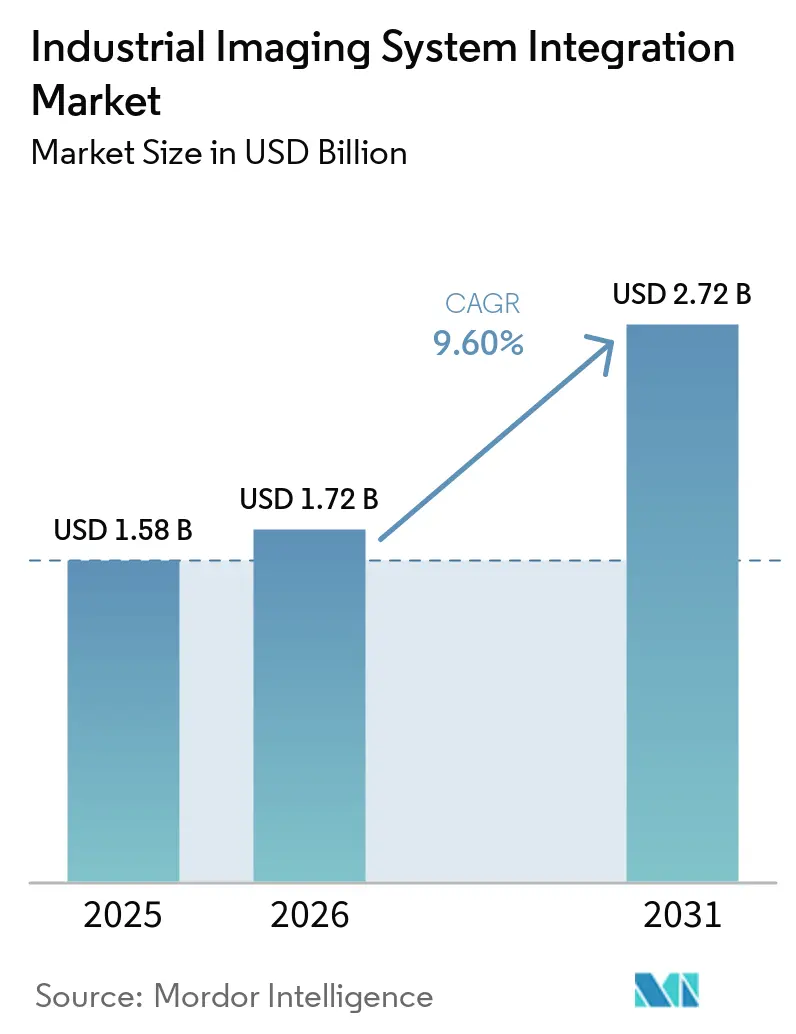
The Industrial Imaging System Integration Market size is expected to increase from USD 1.58 billion in 2025 to USD 1.72 billion in 2026 and reach USD 2.72 billion by 2031, growing at a CAGR of 9.60% over 2026-2031.
The industrial imaging system integration market is supported by manufacturers that are moving from sample-based checks to full inline inspection. This change reflects zero-defect commitments, recall exposure, and stricter supplier quality requirements. Edge AI processors also allow image decisions to occur on the production line without external PCs or cloud routing. The industrial imaging system integration market therefore places greater value on system design, software models, validation, and ongoing support than on camera supply alone. Traceable inspection records are becoming more important in regulated supply chains, creating opportunities for service models that continue after equipment commissioning.
Key Report Takeaways
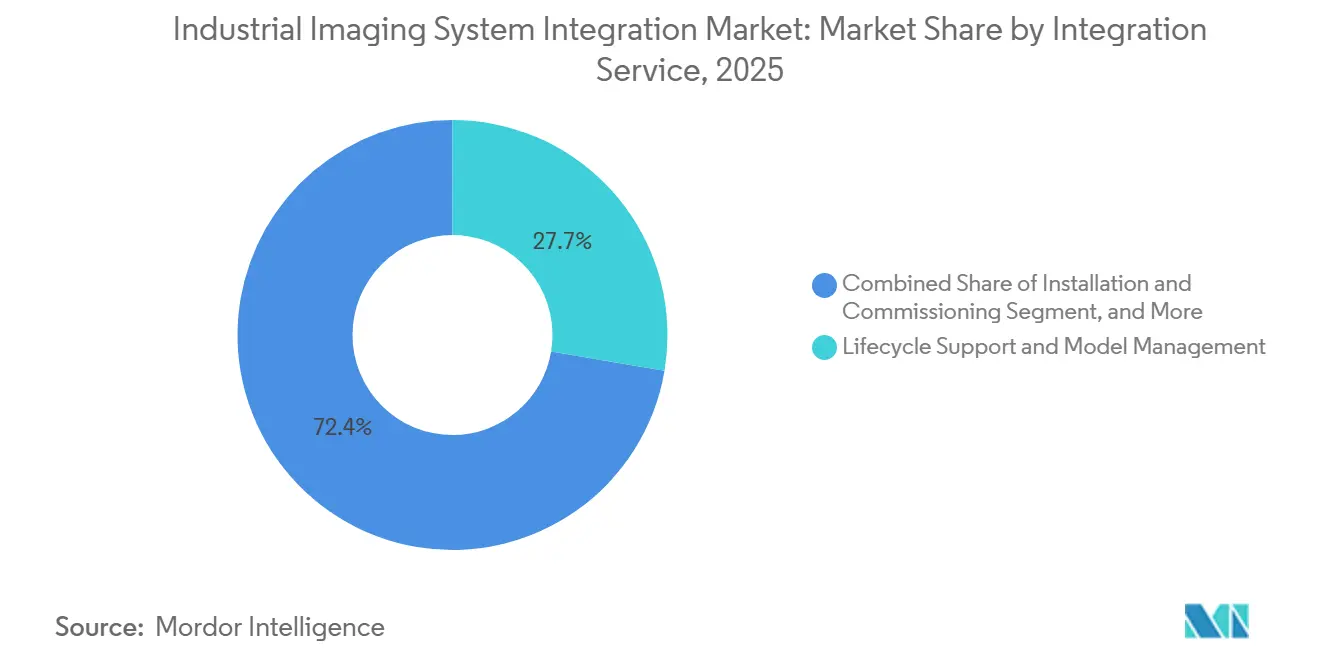
- By integration service, Lifecycle Support and Model Management held 27.65% share in 2025, while System Design and Feasibility Testing is projected to expand at a 10.22% CAGR through 2031.
- By imaging technology, 2D Imaging accounted for 61.21% of the industrial imaging system integration market share in 2025, while Hyperspectral and Multispectral Imaging is projected to expand at a 12.34% CAGR through 2031.
- By application, Quality Assurance and Inspection held 33.67% share in 2025, while Predictive Maintenance and Process Monitoring is projected to expand at an 11.76% CAGR through 2031.
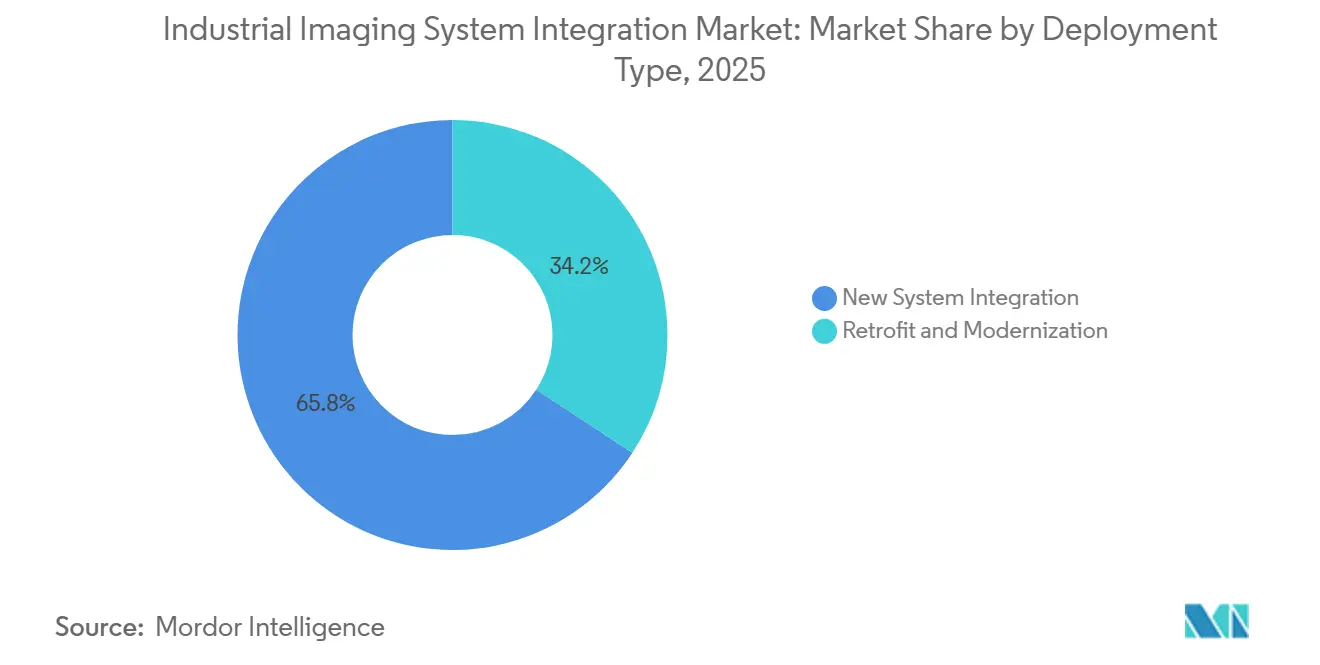
- By deployment type, New System Integration held 65.78% share in 2025, while Retrofit and Modernization is projected to expand at an 11.21% CAGR through 2031.
- By end-user industry, Automotive and Automotive Components held 24.97% share in 2025, while Electronics and Semiconductor is projected to expand at a 12.34% CAGR through 2031.
- By geography, North America held 31.72% share in 2025, while Asia-Pacific is projected to expand at an 11.78% CAGR through 2031.
Note: Market size and forecast figures in this report are generated using Mordor Intelligence’s proprietary estimation framework, updated with the latest available data and insights as of January 2026.
Global Industrial Imaging System Integration Market Trends and Insights
Drivers Impact Analysis*
| Driver | (~) % Impact on CAGR Forecast | Geographic Relevance | Impact Timeline |
|---|---|---|---|
| Rising Demand for Zero-Defect Manufacturing | +2.5% | Global, with concentrated intensity in North America and Europe | Short term (≤ 2 years) |
| AI-Enabled Inline Inspection and Edge Inference | +2.0% | Global, with highest near-term adoption in North America and Asia-Pacific | Short term (≤ 2 years) |
| Expansion of Vision-Guided Robotics | +1.7% | Global, concentrated in automotive and electronics hubs in Europe and Asia-Pacific | Medium term (2-4 years) |
| Traceability and Compliance Requirements | +1.2% | North America and Europe core, with spillover to Asia-Pacific, Middle East and Africa supply chains | Short term (≤ 2 years) |
| Brownfield Vision Retrofits for Existing Lines | +0.9% | Global, prioritized in mature industrial economies with a large installed base | Medium term (2-4 years) |
| Vision Data Feeds for Digital Twins and Production Intelligence | +0.6% | North America and Europe, early stage in Asia-Pacific | Long term (≥ 4 years) |
| Source: Mordor Intelligence | |||
Rising Demand for Zero-Defect Manufacturing
Automotive and electronics producers are replacing downstream sampling with 100% inline visual monitoring. Warranty exposure, recall costs, and supplier scorecards have increased the cost of a defect that reaches the customer. A missed defect on a premium EV trim panel can create customer penalties that exceed the cost of the inspection cycle. Cognex reported in its first-quarter 2026 results that migration from rule-based systems to AI vision was most active in packaging, automotive, and electronics accounts. Better surface-defect models can also reveal defects that were not captured in past scrap data. The industrial imaging system integration market gains further demand when these findings expand the scope of lifecycle support and model management.
AI-Enabled Inline Inspection and Edge Inference
Embedded processors are reducing the latency and bandwidth burden of sending images to external servers. Cognex launched the In-Sight 3900 in May 2026 on Qualcomm Dragonwing platforms, with up to 25 MP resolution and processing that is up to 4 times faster than the preceding generation. Cognex also launched the In-Sight 6900 controller in April 2026 on NVIDIA Jetson technology with 157 TOPS of AI compute. The controller supports parallel high-resolution models and configurations that use 10-20 training images. These developments shorten implementation work for some applications and shift competition toward model quality and lifecycle management. The industrial imaging system integration market benefits as edge inference becomes a more standard system architecture.
Expansion of Vision-Guided Robotics
Machine vision is increasingly the feedback layer for collaborative and flexible robotic cells. A vision upgrade in these settings requires coordination of image timing, robot path triggers, and safety interlocks. This creates a broader scope for integration providers than a stand-alone camera installation. Advantech launched the AIR-055 in July 2026, combining 100 TOPS performance, more than 20 I/O interfaces, and GigE Vision compatibility for multisensor robot-vision systems.[1]Advantech Co., Ltd., “Advantech AIR-055 Compact Multimodal Vision AI Inference System Powered by Qualcomm Dragonwing IQ9,” Advantech, advantech.com Qualitas Technologies targets flexible robot-vision installations for Indian Tier 1 and Tier 2 automotive suppliers. The industrial imaging system integration market is supported by positioning, guidance, and process-monitoring programs that require closed visual feedback in real time.
Traceability and Compliance Requirements
United States and European requirements are making product traceability more enforceable during audits. The FDA published draft guidance in February 2026 for FSMA Section 204(d), which requires covered entities to provide Key Data Elements for Critical Tracking Events within 24 hours of an FDA request.[2]U.S. Food and Drug Administration, “Questions and Answers About Requirements for Additional Traceability Records for Certain Foods,” Federal Register, govinfo.gov The proposed compliance date is July 20, 2028. Digital Product Passport requirements in Europe also increase the need for persistent product records in batteries and textiles. In pharmaceutical settings, EU GMP Annex 22 requires version control and audit trails for AI inspection models used in GxP environments. These requirements extend validation work beyond commissioning and provide a stable demand for the industrial imaging system integration market.
Restraints Impact Analysis*
| Restraint | (~) % Impact on CAGR Forecast | Geographic Relevance | Impact Timeline |
|---|---|---|---|
| High Upfront Integration and Validation Costs | -1.3% | Global, most acute for SMEs in developing markets | Short term (≤ 2 years) |
| Shortage of Vision-System Integration Talent | -0.8% | Global, structural in North America and Europe, with a growing constraint in Asia-Pacific | Medium term (2-4 years) |
| Interoperability and Legacy-Equipment Constraints | -0.6% | Concentrated in mature industrial economies with diverse installed equipment | Medium term (2-4 years) |
| Cybersecurity Exposure of Connected Vision Assets | -0.4% | Global, most pronounced in critical-infrastructure manufacturing sectors | Long term (≥ 4 years) |
| Source: Mordor Intelligence | |||
High Upfront Integration and Validation Costs
A full integration project can include cameras, lighting, cabling, software licenses, PLC interfaces, and qualification work. These costs can exceed several years of projected quality savings for a mid-sized manufacturer. The burden is particularly high in pharmaceutical and medical device settings that need documented installation, operational, and performance qualification. Smaller manufacturers often lack validation engineers and cannot spread fixed compliance costs across many lines. Modular and pre-validated systems can reduce the site-specific work required. The industrial imaging system integration market remains constrained where capital approval cycles delay these investments.
Shortage of Vision-System Integration Talent
Vision integration requires knowledge of optics, AI models, industrial communications, and production processes. This combination is difficult to find within a single engineering role. The shortage limits the speed at which projects can move from design into commissioning. Misconfigured network zones and poorly validated models can create operational and cybersecurity risks. Rockwell Automation released VisionStream in July 2026 to allow quality personnel to train inspection models from production data. Complex multicamera projects and regulated validation work still depend on experienced specialists, limiting completed installations in the industrial imaging system integration market.
*Our forecasts treat driver/restraint impacts as directional, not additive. The impact forecasts reflect baseline growth, mix effects, and variable interactions.
Segment Analysis
By Integration Service: Lifecycle Services Anchor Revenue as AI Design Spend Surges
Lifecycle Support and Model Management held 27.65% of the industrial imaging system integration market size in 2025. The installed base requires model retraining as product mixes, line conditions, and compliance expectations change. This service provides continuity after the initial equipment installation. It also supports enterprise customers that manage visual inspection programs across multiple sites. Installation and Commissioning remains necessary to connect cameras, lighting, and production controls. Validation and Qualification earns premium rates in pharmaceutical and aerospace work because customers require formal records.
System Design and Feasibility Testing is projected to expand at a 10.22% CAGR through 2031. AI inspection programs need feasibility testing against real defects before a manufacturer commits capital. This work adds time to early project stages when compared with rule-based designs. Cognex made OneVision generally available in May 2026 following a beta program that involved more than 100 manufacturers. The platform centralizes model development and deployment while inspections run locally on the line. These capabilities increase the importance of support services across the industrial imaging system integration industry.



By Imaging Technology: 2D Imaging Leads, Spectral Imaging Opens Chemical-Level Applications
2D Imaging accounted for 61.21% share in 2025. Its position reflects lower costs, established software, and broad use in labels, surfaces, and barcode verification. Area-scan and line-scan systems serve applications across most end-user categories. 2D systems are also familiar to manufacturers that are modernizing existing operations. This installed familiarity supports continued integration work. 3D Imaging remains important for automotive body structures and precision-machined components.
Hyperspectral and Multispectral Imaging is projected to expand at a 12.34% CAGR through 2031. Falling hardware costs and more mature tools are supporting use on production lines. These systems can identify material characteristics that standard RGB cameras cannot distinguish. Food and pharmaceutical producers use this capability to assess adulteration, coating variation, and foreign objects. A 2025 study found that hyperspectral imaging with chemometrics supported pharmaceutical blending homogeneity monitoring. Thermal and X-ray systems also support non-destructive inspection of composites and critical aerospace components in the industrial imaging system integration industry.
By Application: Quality Inspection Leads, Predictive Maintenance Changes System Value
Quality Assurance and Inspection held 33.67% share in 2025. It remains the foundation of the industrial imaging system integration market because every end-user category needs defect detection. These systems verify products before they leave a process or move into a downstream stage. Identification and Traceability applications also benefit from food and automotive compliance requirements. Measurement and gauging continue to support metrology in precision machining and medical devices. Positioning and guidance are strengthened by robot-assisted assembly operations.
Predictive Maintenance and Process Monitoring is projected to expand at an 11.76% CAGR through 2031. This application connects visual information with process historians and digital twin environments. The approach changes the system from a final quality gate into a source of continuing production data. A 2026 study of multilayer digital twins reported that integrated edge vision and time-series modeling reduced unplanned downtime by more than 40% in electromechanical manufacturing settings.[3]Authors Not Listed, “Digital Twin Production Lines A Perspective on Intelligent Sensing, Prediction, and Cognitive Manufacturing,” TICPS, icck.org Persistent data pipelines create recurring work for model updates and system support. This application broadens the commercial role of the industrial imaging system integration market.
By Deployment Type: New Systems Lead, While Brownfield Retrofits Gain Ground
New System Integration held 65.78% share in 2025. Greenfield projects in North America and Asia-Pacific have required full vision integration from initial design. Semiconductor fabrication and EV battery facilities need coordinated cameras, lighting, controls, and data connections. New lines also allow manufacturers to specify systems without older protocol constraints. These projects support larger and longer integration contracts. The industrial imaging system integration market benefits when new facilities purchase complete scopes rather than equipment additions.
Retrofit and Modernization is projected to expand at an 11.21% CAGR through 2031. Existing plants need digitized production records for energy, quality, and sustainability reporting. Brownfield projects often require links between PROFINET, EtherNet/IP, Modbus, and modern vision software. This work can slow implementation because older equipment differs across sites. Rockwell Automation released VisionLink in July 2026 to connect existing third-party FTP-enabled cameras to FactoryTalk VisionAI. Modular adapters and no-code tools are reducing integration friction for retrofit providers.
By End-User Industry: Automotive Leads Volume, Semiconductor Demand Advances Fastest
Automotive and Automotive Components held 24.97% share in 2025. IATF 16949 requirements and EV powertrain complexity support ongoing inspection investment. Body-in-white and battery module lines are demanding applications for 3D and AI vision systems. Supplier scorecards further reinforce the need for inspection controls. Food and Beverage, Pharmaceuticals, and Life Sciences also require traceable production records. Aerospace and Defense relies on non-destructive inspection for composites and safety-critical components.
Electronics and Semiconductor is projected to expand at a 12.34% CAGR through 2031. Advanced chip packaging for AI inference demand is increasing the inspection needs. The segment requires high-speed systems because inspection cycles are measured in milliseconds. ViTrox showcased AI-driven manufacturing intelligence tools for semiconductor and electronics packaging in April 2026. Malaysia also granted ViTrox a 5+5-year income tax exemption for the development and production of AI-related technologies. Logistics and warehousing remain an important adjacent area, where barcode and parcel-geometry vision supports throughput management in the industrial imaging system integration market.
Geography Analysis
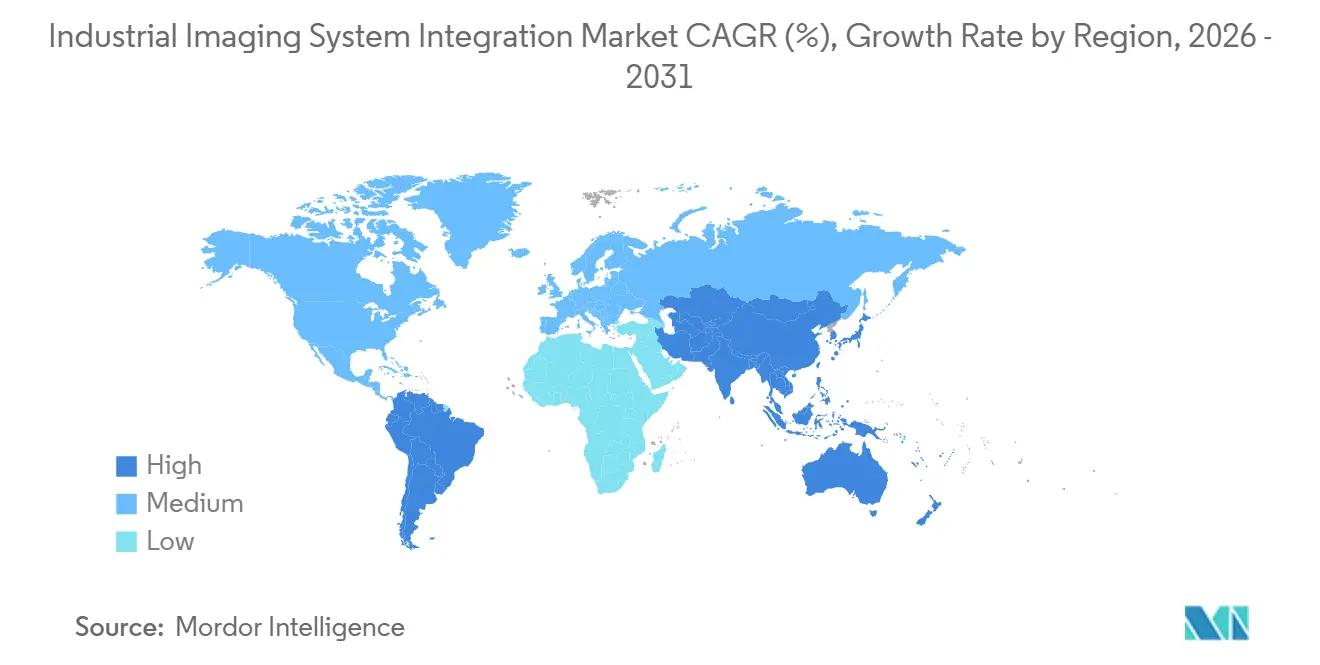
North America held 31.72% of the industrial imaging system integration market share in 2025. The region has a high concentration of automotive, pharmaceutical, and defense manufacturing. Semiconductor capacity investment in Arizona, Ohio, and Texas supports full-scope integration contracts. Reshoring programs also increase the need for new domestic EV battery and chip facilities. FDA food traceability and pharmaceutical record requirements support a recurring renewal cycle for inspection systems.
Europe has strong demand in Germany, Italy, and France, where precision and specialty manufacturing remain important. Procurement requirements increasingly cover AI governance, product traceability, and cybersecurity. IEC 62443 compliance has become more relevant for smart cameras and embedded AI systems in high-compliance accounts. Digital Product Passports create additional requirements in battery, textile, and electronics manufacturing. These programs require product information to be recorded from the point of production and support the industrial imaging system integration market.
Asia-Pacific is projected to expand at an 11.78% CAGR through 2031. China, South Korea, Japan, and Taiwan support semiconductor inspection demand, while Malaysia and Vietnam are adding advanced packaging capacity. South Korean demand centers on DRAM and 3D NAND inspection at Samsung Electronics and SK Hynix. Japan is both a major buyer and supplier of precision inspection equipment. India is an early-stage opportunity, where automotive and pharmaceutical customers are using regional integrators. South America, the Middle East, and Africa remain smaller markets, with demand linked to automotive, food processing, petrochemicals, and aerospace maintenance.

Competitive Landscape
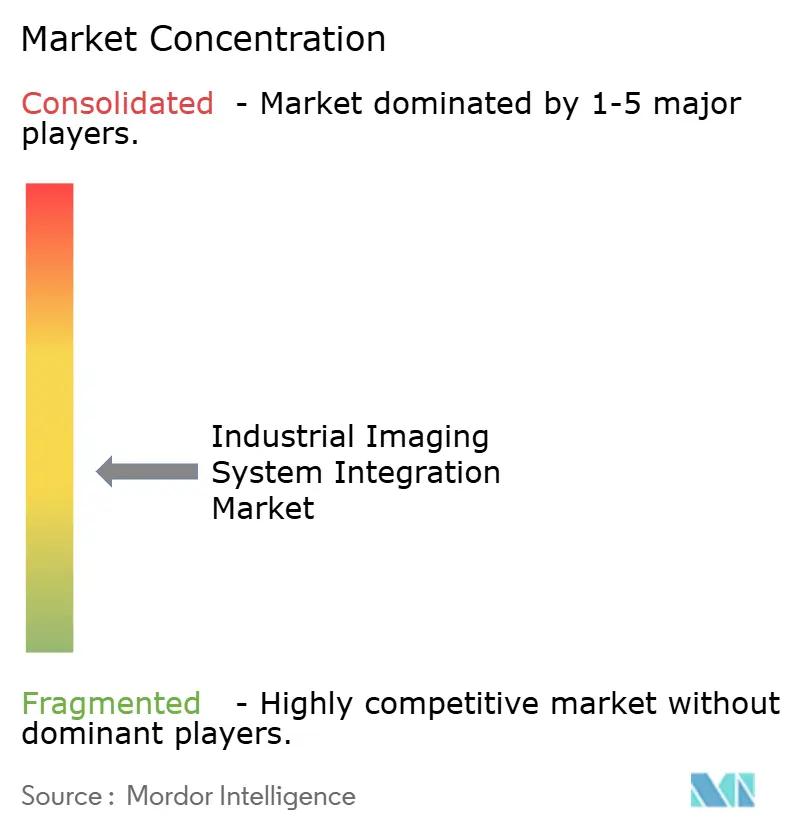
The industrial imaging system integration market is moderately fragmented. Cognex, Keyence, Teledyne, and SICK compete through platform breadth and AI software capabilities. Regional integrators and specialist hardware suppliers compete through local service and application knowledge. No provider has a decisive position across all integration service tiers. Cognex is using edge AI hardware and cloud-to-edge model management to link product sales with software and service revenue. This approach responds to customers who need centralized controls across multiple facilities.
Teledyne announced an agreement in August 2026 to acquire Varex Imaging for USD 1.1 billion. The transaction would add X-ray tubes, photon-counting detectors, and flat-panel detectors to Teledyne’s digital imaging portfolio. The acquisition is expected to be completed in early 2027, subject to regulatory approvals. Cognex introduced the In-Sight 6900 and In-Sight 3900 in April and May 2026 to broaden its embedded edge AI offering. SICK introduced AI Blob Finder Nova in April 2026 through its Nova 2.15 platform. The launch uses instance segmentation for variable-product inspection without requiring a separate software environment.
Low-code AI configuration, cybersecurity frameworks for connected operational technology, and multisite lifecycle services remain areas with room for differentiation. MVTec supports a software-led model that can create customer relationships independent of camera hardware choices. ViTrox and HIKROBOT focus on regional service density in semiconductor and electronics accounts across Asia-Pacific. Advantech’s AIR-055 offers a platform-agnostic system for multisensor vision inference. This type of platform can reduce differentiation based only on hardware integration. Providers with established AI models and lifecycle services are better positioned to protect their role in the industrial imaging system integration market.
Industrial Imaging System Integration Industry Leaders
Cognex Corporation
Keyence Corporation
Teledyne Technologies Incorporated
Basler AG
Allied Vision Technologies GmbH
- *Disclaimer: Major Players sorted in no particular order

Recent Industry Developments
- August 2026: Teledyne Technologies and Varex Imaging Corporation announced a definitive agreement for Teledyne to acquire all outstanding Varex shares for USD 18.90 per share in cash, in a transaction valued at USD 1.1 billion. The deal adds X-ray tubes, photon-counting detectors, and flat-panel detectors for industrial and medical OEM imaging customers to Teledyne's existing digital imaging portfolio, with completion anticipated in early 2027 subject to regulatory approvals.
- May 2026: Cognex Corporation launched the In-Sight 3900 Vision System, a fully integrated PC-free embedded AI vision system powered by Qualcomm Dragonwing platforms. The system delivers up to 25 MP imaging resolution and processes up to 4 times faster than its predecessor generation, enabling deterministic inspection at full production-line speed across packaging, automotive, electronics, and consumer goods applications.
- March 2026: Teledyne e2v introduced the Perciva 5D camera, an occlusion-free 3D vision solution operating at under 5 W and 230 grams, designed for collaborative and humanoid robots and 3D industrial process monitoring. The camera supports GenDC/GenTL integration with leading machine vision software platforms and was presented at Embedded World in Nuremberg.
- June 2025: Cognex Corporation introduced OneVision in beta as a cloud-based AI vision development platform available on In-Sight 3800 and 8900 systems, with general availability on additional products announced for early 2026.


Global Industrial Imaging System Integration Market Report Scope
Industrial Imaging System Integration refers to the comprehensive process of combining advanced hardware such as specialized cameras, illumination sources, and sensors with robust image processing software and automation machinery into a unified, high-performance network. Harmonizing these disparate technologies, it enables automated visual inspection, real-time quality control, and data-driven decision-making across modern manufacturing and processing environments.
The Industrial Imaging System Integration Market Report is Segmented by Integration Service (System Design and Feasibility Testing, Installation and Commissioning, Validation and Qualification, Lifecycle Support and Model Management, and Other Integration Services), Imaging Technology (2D Imaging, 3D Imaging, Hyperspectral and Multispectral Imaging, and Other Imaging Technologies), Applications (Quality Assurance and Inspection, Measurement and Gauging, Identification and Traceability, Positioning and Guidance, Predictive Maintenance and Process Monitoring, and Other Applications), Deployment Type (New System Integration and Retrofit and Modernization), End-User Industry (Automotive and Automotive Components, Electronics and Semiconductor, Food and Beverage, Pharmaceuticals and Life Sciences, Industrial Manufacturing, Packaging, Aerospace and Defense, Logistics and Warehousing, and Other End-User Industries), Geography (North America, Europe, Asia-Pacific, Middle East, and Africa). The Market Forecasts are Provided in Terms of Value (USD).
| System Design and Feasibility Testing |
| Installation and Commissioning |
| Validation and Qualification |
| Lifecycle Support and Model Management |
| Other Integration Services |
| 2D Imaging |
| 3D Imaging |
| Hyperspectral and Multispectral Imaging |
| Other Imaging Technologies |
| Quality Assurance and Inspection |
| Measurement and Gauging |
| Identification and Traceability |
| Positioning and Guidance |
| Predictive Maintenance and Process Monitoring |
| Other Applications |
| New System Integration |
| Retrofit and Modernization |
| Automotive and Automotive Components |
| Electronics and Semiconductor |
| Food and Beverage |
| Pharmaceuticals and Life Sciences |
| Industrial Manufacturing |
| Packaging |
| Aerospace and Defense |
| Logistics and Warehousing |
| Other End-User Industries |
| North America | United States |
| Canada | |
| Mexico | |
| South America | Brazil |
| Argentina | |
| Rest of South America | |
| Europe | Germany |
| United Kingdom | |
| France | |
| Italy | |
| Spain | |
| Rest of Europe | |
| Asia-Pacific | China |
| Japan | |
| India | |
| South Korea | |
| ASEAN | |
| Rest of Asia-Pacific | |
| Middle East | Saudi Arabia |
| United Arab Emirates | |
| Rest of the Middle East | |
| Africa | South Africa |
| Rest of Africa |
| By Integration Service | System Design and Feasibility Testing | |
| Installation and Commissioning | ||
| Validation and Qualification | ||
| Lifecycle Support and Model Management | ||
| Other Integration Services | ||
| By Imaging Technology | 2D Imaging | |
| 3D Imaging | ||
| Hyperspectral and Multispectral Imaging | ||
| Other Imaging Technologies | ||
| By Application | Quality Assurance and Inspection | |
| Measurement and Gauging | ||
| Identification and Traceability | ||
| Positioning and Guidance | ||
| Predictive Maintenance and Process Monitoring | ||
| Other Applications | ||
| By Deployment Type | New System Integration | |
| Retrofit and Modernization | ||
| By End-User Industry | Automotive and Automotive Components | |
| Electronics and Semiconductor | ||
| Food and Beverage | ||
| Pharmaceuticals and Life Sciences | ||
| Industrial Manufacturing | ||
| Packaging | ||
| Aerospace and Defense | ||
| Logistics and Warehousing | ||
| Other End-User Industries | ||
| By Geography | North America | United States |
| Canada | ||
| Mexico | ||
| South America | Brazil | |
| Argentina | ||
| Rest of South America | ||
| Europe | Germany | |
| United Kingdom | ||
| France | ||
| Italy | ||
| Spain | ||
| Rest of Europe | ||
| Asia-Pacific | China | |
| Japan | ||
| India | ||
| South Korea | ||
| ASEAN | ||
| Rest of Asia-Pacific | ||
| Middle East | Saudi Arabia | |
| United Arab Emirates | ||
| Rest of the Middle East | ||
| Africa | South Africa | |
| Rest of Africa | ||


Key Questions Answered in the Report
What is the industrial imaging system integration market size?
The industrial imaging system integration market size is USD 1.72 billion in 2026 and is forecast to reach USD 2.72 billion by 2031 at a 9.60% CAGR.
What is driving adoption of industrial imaging system integration?
Zero-defect manufacturing, edge AI inspection, robot guidance, and traceability requirements are increasing demand for integrated vision systems.
Which imaging technology has the largest role in production inspection?
2D Imaging held 61.21% share in 2025 because it is widely used for labels, surfaces, barcode reading, and routine quality checks.
Which application is advancing fastest through 2031?
Predictive Maintenance and Process Monitoring is projected to expand at an 11.76% CAGR as manufacturers connect visual data with production intelligence systems.
Which region is projected to advance fastest?
Asia-Pacific is projected to expand at an 11.78% CAGR through 2031, supported by semiconductor and advanced packaging capacity.
Why are retrofit projects becoming more important?
Retrofit and Modernization is projected to expand at an 11.21% CAGR because existing plants need connected quality and production records without complete replacement of installed equipment.
Page last updated on:





