
Industrial Cleaning Solvents Market Size and Share
Market Overview
| Study Period | 2022 - 2032 |
|---|---|
| Market Size (2027) | USD 1.59 Billion |
| Market Size (2032) | USD 2.02 Billion |
| Growth Rate (2027 - 2032) | 4.84 % |
| Fastest Growing Market | Asia-Pacific |
| Largest Market | Asia-Pacific |
| Market Concentration | Low |
Major Players *Disclaimer: Major Players sorted in no particular order Image © Mordor Intelligence. Reuse requires attribution under CC BY 4.0. | |
Industrial Cleaning Solvents Market Analysis by Mordor Intelligence
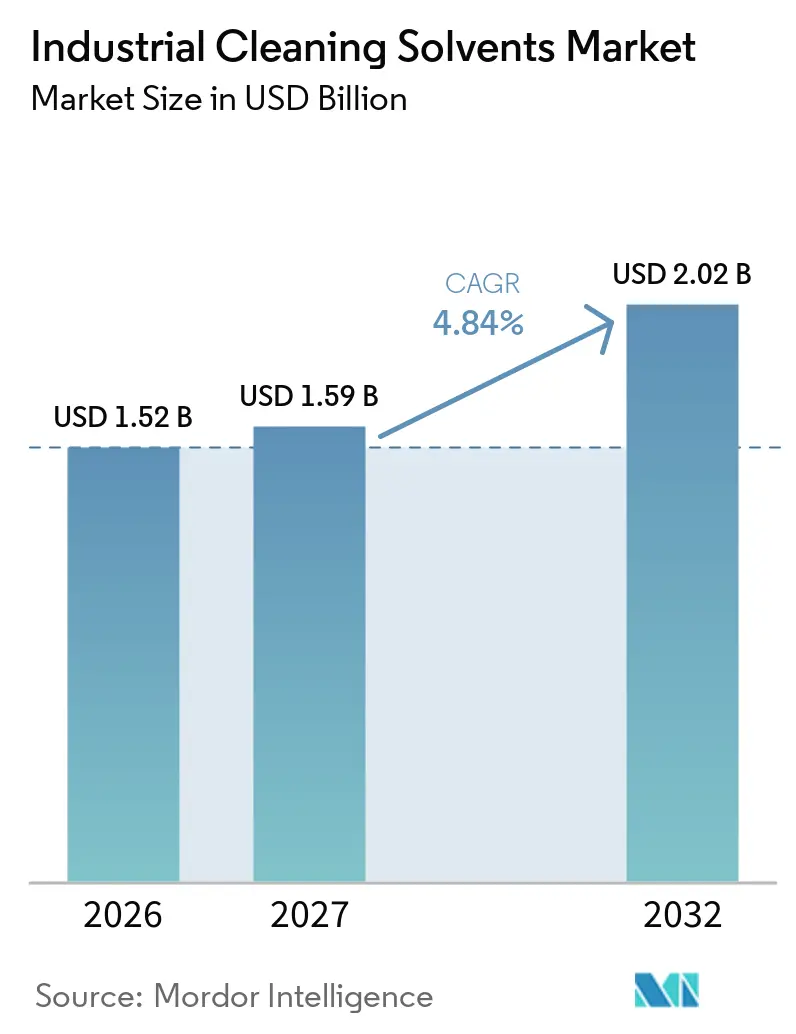
The Industrial Cleaning Solvents Market size was valued at USD 1.52 billion in 2026 and is estimated to grow from USD 1.59 billion in 2027 to reach USD 2.02 billion by 2032, at a CAGR of 4.84% during the forecast period (2027-2032). Manufacturing standards are making validated surface cleanliness a necessary condition in regulated production environments, especially where a production line must demonstrate that its cleaning method is repeatable, documented, and suitable for the material being made. These requirements make solvent selection part of a wider quality process because operators must consider cleaning performance, worker handling, waste treatment, equipment compatibility, and evidence for auditors at the same time. Demand is strongest where residue control, traceability, and documented cleaning processes affect product approval and operational safety, including facilities that make implants, diagnostic equipment, pharmaceutical products, wafer-based electronic components, and processed food. In these settings, a supplier’s ability to provide a consistent grade and technical documents can be as important as its ability to provide a material with the required solvency power. Healthcare and semiconductor production support demand for high-purity formulations, while food processing supports the use of disinfectants and controlled cleaning systems. Healthcare combines hospital disinfection, surgical instrument processing, medical-device production, and pharmaceutical equipment cleaning, which creates several distinct buying situations within one end-use category. Semiconductor manufacturing requires stringent residue control through wafer processing and equipment maintenance, while food plants use scheduled cleaning cycles to maintain hygiene and protect food-contact surfaces. The industrial cleaning solvents market also faces a shift away from restricted halogenated chemistries, which favors suppliers that can support reformulation and customer validation. A change in chemistry can require tests of materials compatibility, cleaning effectiveness, residue levels, worker protection, and operating conditions, which makes the transition more demanding than an ordinary material substitution. Suppliers with established application knowledge, regulatory documentation, and dependable distribution are better placed to help customers manage this process. Cost pressure from petroleum-derived feedstocks and lengthy qualification procedures should keep growth steady rather than rapid. Hydrocarbon price movements affect a large part of the product base, while fixed-term purchasing arrangements can delay the transfer of higher input costs to customers.
Key Report Takeaways
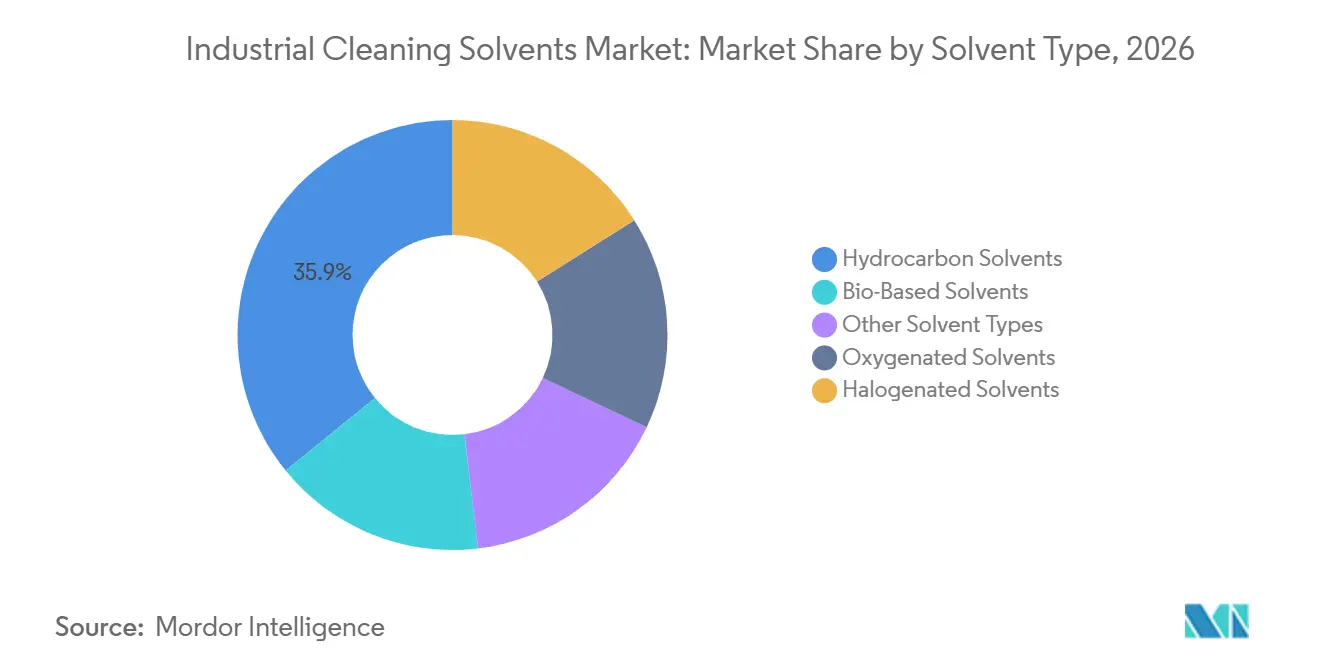
- By solvent type, hydrocarbon solvents held 35.86% of the industrial cleaning solvents market share in 2026, while bio-based solvents are forecast to advance at a 5.17% CAGR through 2032.
- By formulation, ready-to-use solutions held 44.07% of the industrial cleaning solvents market share in 2026, while concentrates are forecast to advance at a 5.34% CAGR through 2032.
- By application, general and medical device cleaning held 31.73% of the industrial cleaning solvents market share in 2026, while disinfectants are forecast to advance at a 5.63% CAGR through 2032.
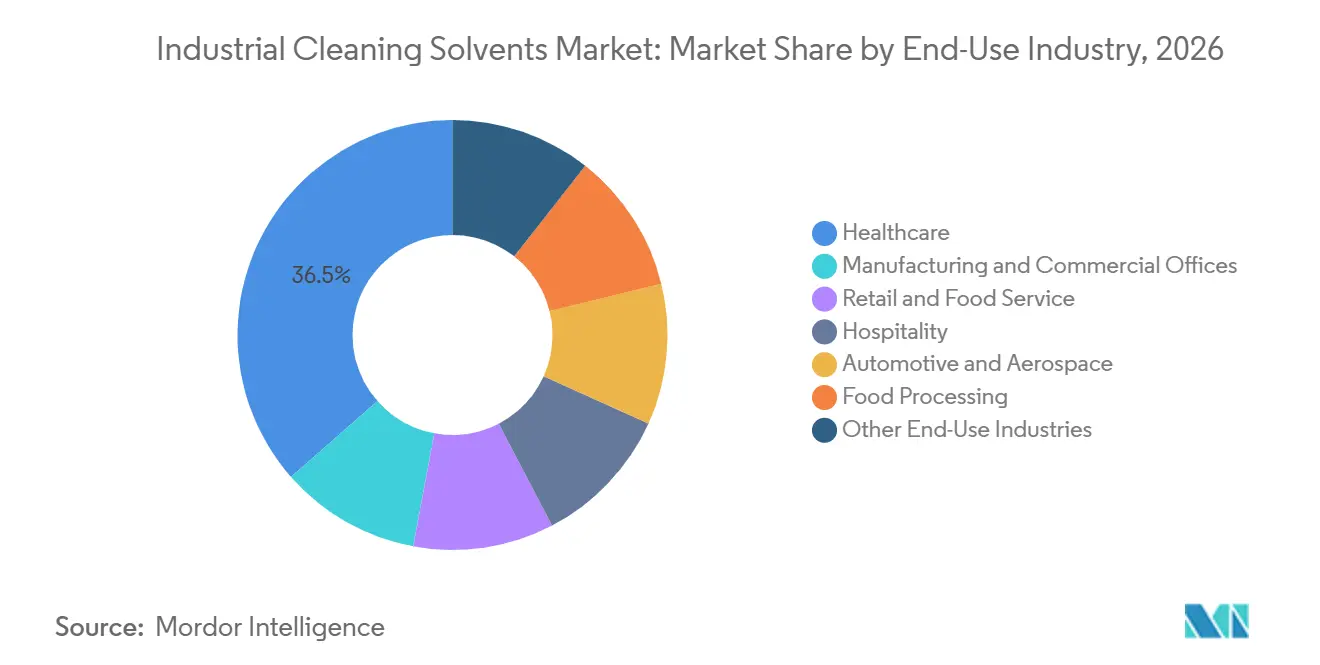
- By end-use industry, healthcare held 36.48% of the industrial cleaning solvents market share in 2026 and is forecast to advance at a 5.91% CAGR through 2032.
- By geography, Asia-Pacific held 39.15% of the industrial cleaning solvents market share in 2026 and is forecast to advance at a 5.76% CAGR through 2032.
Note: Market numbers in this report are based on Mordor Intelligence's proprietary estimation framework, which combines nine months of actuals with Q4 projections for base year 2026.
Market Trends and Insights
Drivers Impact Analysis of Industrial Cleaning Solvents Market*
| Driver | (~) % Impact on CAGR Forecast | Geographic Relevance | Impact Timeline |
|---|---|---|---|
| Expansion of Precision Manufacturing and Medical-Device Production | +1.5% | Global, with intensity in North America, Europe, and APAC core (China, Japan, South Korea) | Medium term (2–4 years) |
| Semiconductor and Electronics Cleanroom Build-Out | +1.2% | APAC core, spillover to North America (Arizona, Texas fabs) and Southeast Asia | Medium term (2–4 years) |
| Tightening Hygiene and Food-Safety Protocols | +0.9% | Global; early gains in North America, EU, ASEAN food manufacturing corridors | Short term (≤ 2 years) |
| Shift to Automated, Low-Residue Cleaning Cycles | +0.7% | North America & EU; early-mover APAC (Japan, South Korea, China) | Medium term (2–4 years) |
| Solvent Recycling and Closed-Loop Recovery Adoption | +0.5% | North America, EU, APAC industrial clusters; spillover to MEA refinery hubs | Long term (≥ 4 years) |
| Source: Mordor Intelligence | |||
Expansion of Precision Manufacturing and Medical-Device Production
Medical device production requires cleaning solvents that meet exact surface cleanliness and safety requirements. Surface residues can affect implant safety, regulatory approval, and product liability, which makes qualified cleaning procedures important. The January 2025 restrictions on trichloroethylene increased the need to assess alternative chemistries for many uses, including limited medical device parts-cleaning applications. This change supports demand for modified alcohols, oxygenated solvents, and fluorine-free precision fluids that can meet cytotoxicity requirements. The industrial cleaning solvents market benefits when manufacturers need to update a validated cleaning process rather than simply change a purchased material. Specialty suppliers can compete on documentation, testing support, and consistency as well as on solvent performance.
Semiconductor and Electronics Cleanroom Build-Out
Semiconductor fabrication uses high-purity solvents to remove residues at several wafer-processing stages. Exxon Mobil Corporation announced in March 2025 that it would invest USD 100 million in a Baton Rouge, Louisiana, upgrade to make 99.999% pure isopropyl alcohol for United States chip manufacturers, with production expected to begin in 2027. The project indicates that domestic high-purity chemical supply is becoming part of the broader semiconductor manufacturing build-out. Ultra-high-purity grades need dedicated production, handling, and quality-control systems. These requirements separate semiconductor-grade products from standard industrial solvents and can support higher-value demand in the industrial cleaning solvents market. Dedicated lines also make supply reliability a key procurement concern for fab operators.
Tightening Hygiene and Food-Safety Protocols
Food safety rules raise expectations for cleaning food-contact surfaces, processing equipment, and production lines. Canada’s Biocides Regulations took effect in May 2025 and established a framework for surface disinfectants and sanitizers, with specified transition periods for market authorization[1]. Clean-in-Place systems increasingly use controlled cleaning cycles with accurate dosing in food manufacturing. This favors concentrated products where operators can manage chemical use through automated dilution equipment. Disinfectants are projected to grow at a 5.63% CAGR through 2032 as hygiene procedures remain important in healthcare and food operations. The industrial cleaning solvents market also gains from contract pharmaceutical manufacturing, where validated cleaning between product changeovers is necessary.
Shift to Automated, Low-Residue Cleaning Cycles and Solvent Recycling
Automated parts washing and vapor degreasing are replacing some manual, batch-based cleaning procedures. These systems favor solvents with narrow boiling ranges, strong solvency, and practical recovery characteristics. Pero AG presented its Scope module in August 2025, describing sensor-based monitoring of cleaning medium conditions and energy reductions of up to 59% in applicable operating conditions. On-site recycling can lower solvent use and reduce waste-management needs where collection and separation systems are suitable. Research published in 2025 found that hybrid membrane-distillation recovery could reduce isopropanol dehydration energy requirements by 63%. This supports longer-term adoption of closed-loop recovery in the industrial cleaning solvents market, particularly where feedstock costs are high.
Restraints Impact Analysis of Industrial Cleaning Solvents Market*
| Restraint | (~) % Impact on CAGR Forecast | Geographic Relevance | Impact Timeline |
|---|---|---|---|
| VOC, Halogenated-Solvent, and Worker-Exposure Restrictions | -0.9% | North America & EU; spillover to APAC with REACH harmonization | Short term (≤ 2 years) |
| Raw-Material Price and Supply Volatility | -0.6% | Global; highest exposure in hydrocarbon-dependent manufacturers in Europe and APAC | Medium term (2–4 years) |
| Qualification Delays for Safer Substitutes | -0.3% | Global, most acute in regulated end-use industries (Healthcare, Semiconductor) | Long term (≥ 4 years) |
| Source: Mordor Intelligence | |||
VOC, Halogenated-Solvent, and Worker-Exposure Restrictions
Restrictions on volatile organic compounds and halogenated solvents increase compliance costs for solvent producers and users. Replacing a legacy solvent may require changes to equipment, materials, flash-point controls, air handling, and operating procedures. The European Chemicals Agency published an updated per- and polyfluoroalkyl substances restriction proposal in 2025 that included solvents and catalysts within the broader proposal[2]. Requalification can take 12 to 24 months in medical device and semiconductor processes because cleaning performance and product compatibility must be demonstrated. This delay can limit immediate substitution even when a safer alternative is available. The industrial cleaning solvents market, therefore, rewards suppliers that provide technical evidence and reliable transition support.
Raw-Material Price and Supply Volatility
Hydrocarbon solvents are linked to petroleum refining streams, which expose suppliers to crude oil, naphtha, energy, and logistics costs. Hydrocarbon solvents held 35.86% of the industrial cleaning solvents market share in 2026, so this exposure reaches a large part of the product base. Buyers in healthcare and food processing can have fixed-term procurement agreements that limit their ability to accept sudden price increases. Formulators may then face margin pressure between spot input costs and contracted customer prices. European capacity rationalization can also affect the availability of certain hydrocarbon grades. Shortages of approved grades can delay production in pharmaceutical and semiconductor facilities because a replacement source may need a new validation process.
*Our forecasts treat driver/restraint impacts as directional, not additive. The impact forecasts reflect baseline growth, mix effects, and variable interactions.
Industrial Cleaning Solvents Market Segment Analysis
By Solvent Type:
Hydrocarbon Solvents Remain Established While Bio-Based Solvents Gain GroundHydrocarbon solvents held 35.86% of the industrial cleaning solvents market share in 2026. They are widely used in metal degreasing, automotive maintenance, and general industrial cleaning because they provide strong solvency at a familiar cost structure. Their established place in routine cleaning means that customers also understand their handling requirements, equipment settings, and normal purchasing channels. Established supply networks and compatibility with installed equipment slow their replacement. Oxygenated solvents serve precision applications where residue control is important. Halogenated types face greater regulatory pressure as restrictions on legacy chemistries take effect. The industrial cleaning solvents market remains dependent on hydrocarbon products for applications that prioritize operating familiarity and volume availability.
Bio-based solvents are projected to advance at a 5.17% CAGR through 2032. Renewable feedstocks, lower toxicity profiles, and environmental procurement requirements support their adoption in institutional and healthcare cleaning. Their use expands when a buyer needs an alternative to a restricted material without sacrificing cleaning performance. Buyers still review drying behavior, material compatibility, residue performance, and available supply before moving an established process to a bio-based product. The segment still needs to meet price, supply, and process-compatibility requirements in industrial settings. Eastman Chemical Company and ChemPoint announced an October 2025 distribution partnership for TamiSolve NxG solvents in the United States and Canada. The partnership shows how suppliers are positioning performance alternatives for coatings, cleaners, electronics, and agrochemical formulations.

By Formulation:
Ready-to-Use Solutions Lead While Concentrates Improve Operating EconomicsReady-to-use solutions held 44.07% of the industrial cleaning solvents market share in 2026. Healthcare facilities, food-service operations, and institutional cleaning contractors use these products to avoid dilution errors and simplify chemical handling. Fixed formulations also help users maintain product documentation in regulated settings. They are particularly useful when staff turnover, varied sites, or short cleaning windows make accurate manual mixing less practical. Closed-system formulations support applications where exposure control is important, including cleanroom and pharmaceutical work. Semi-aqueous formulations can support precision parts cleaning that requires sequential solvent and water rinses. These use cases sustain demand for ready-to-use products across the industrial cleaning solvents market.
Concentrates are projected to advance at a 5.34% CAGR through 2032. Industrial buyers use them to reduce shipping weight, packaging needs, and storage requirements. Automated dilution systems can help operators apply concentrates at a controlled strength. This model can work best where plants have predictable cleaning schedules and suitable systems for dispensing the product. Henkel AG & Co. KGaA launched Bonderite C-AD 20202 in February 2026 for low-temperature industrial dip degreasing at 35-40 °C instead of conventional 60-65 °C processes. The product example shows how concentrate suppliers can address energy use and emissions requirements alongside cleaning performance. Ready-to-use solutions and concentrates, therefore, serve distinct purchasing priorities rather than identical applications.
By Application:
General and Medical Device Cleaning Supports Scale, While Disinfectants Lead GrowthGeneral and medical device cleaning held 31.73% of the industrial cleaning solvents market share in 2026. The segment uses defined cleaning stages for surgical instruments, implants, and diagnostic devices. Those stages can include pre-cleaning, precision degreasing, and residue validation. Each stage needs solvent grades that meet the applicable process requirements. A change in the cleaning sequence can affect the evidence a producer needs to retain for product quality and process control. Commercial laundry and food cleaners provide a stable demand that is tied to routine hygiene requirements.
Disinfectants are projected to advance at a 5.63% CAGR through 2032. Higher cleaning frequency and more formal documentation requirements support this application in food processing and healthcare. Canada’s regulatory framework for disinfectants and sanitizers reinforces the importance of authorized products for food-contact uses. Procedures are becoming more formal because buyers need confidence that the selected product supports their cleaning protocol and recordkeeping needs. Pharmaceutical contract manufacturers also require cleaning cycles between product changeovers. This creates a specialized need for validated solvent-based disinfection procedures. The industrial cleaning solvents market can gain where customers value process control and traceable cleaning records over the lowest product price.
By End-Use Industry:
Healthcare Anchors Both Share and GrowthHealthcare held 36.48% of the industrial cleaning solvents market share in 2026. Hospitals, medical device plants, pharmaceutical facilities, and laboratories each use cleaning materials under different safety and quality requirements. Surgical instrument processing and medical device manufacturing need strong residue control. Pharmaceutical equipment cleaning requires validated procedures that protect product integrity. Laboratories also need dependable cleaning of equipment and surfaces where cross-contamination can compromise routine work. These conditions increase the importance of solvent consistency and supplier documentation.
Healthcare is projected to advance at a 5.91% CAGR through 2032. Demand includes surface disinfection, device processing, medical-device production, and pharmaceutical equipment cleaning. Regulatory requirements associated with the United States Food and Drug Administration, CE Mark, and International Organization for Standardization 13485 systems influence purchasing decisions. These requirements can favor suppliers able to maintain lot consistency and provide records that fit a customer’s quality system. Manufacturing, commercial offices, retail and food service, hospitality, and food processing remain more price-sensitive sources of demand. Food processing also uses Clean-in-Place cycles that combine solvent, caustic, and acid stages. Automotive and aerospace require qualified cleaning chemistries for components where performance and safety standards limit substitution.
Geography Analysis
APAC and ASEAN Industrial Cleaning Solvents Market
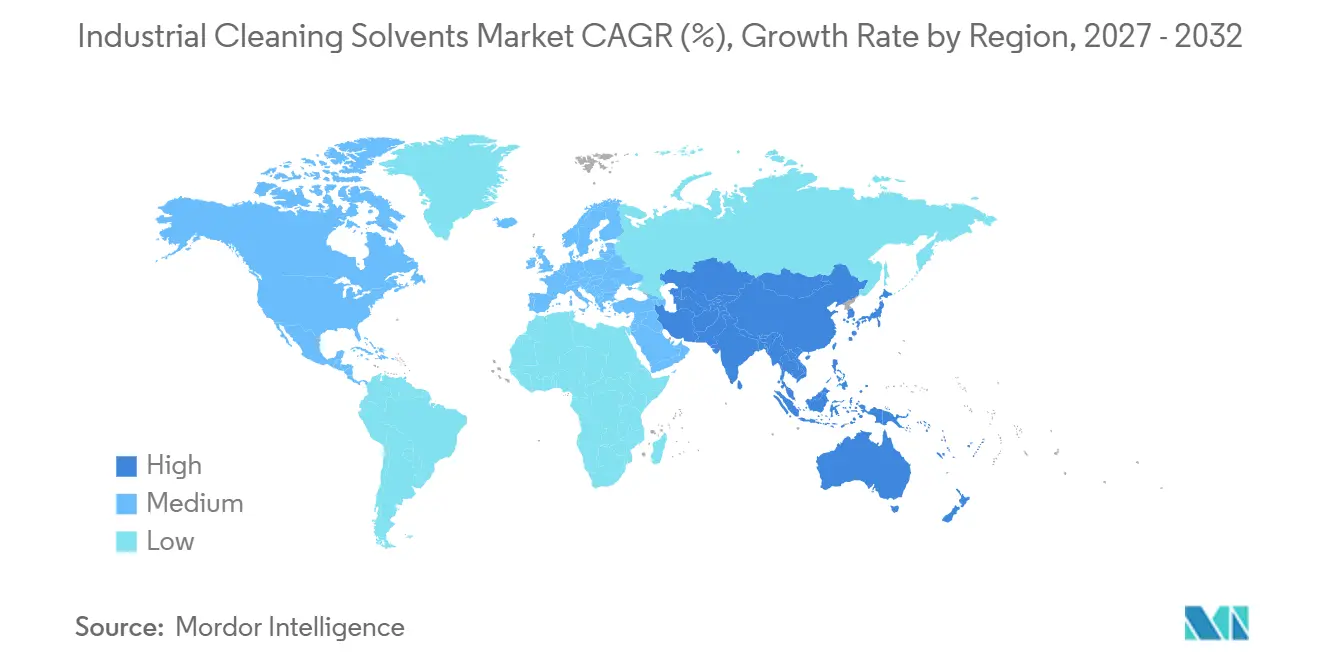
Asia-Pacific held 39.15% of the industrial cleaning solvents market share in 2026 and is projected to advance at a 5.76% CAGR through 2032. China, India, Japan, and South Korea support demand through manufacturing, electronics, pharmaceutical production, and healthcare investment. China has the largest country-level demand in the region because of its broad manufacturing base. India supports specialized demand from pharmaceutical and automotive production. Japan and South Korea contribute to high-purity demand from semiconductor and electronics operations. The industrial cleaning solvents market in the Association of Southeast Asian Nations (ASEAN) countries also benefits as electronics and automotive assembly expand.
APAC and North America Industrial Cleaning Solvents Market
Solvay expanded electronic-grade hydrogen peroxide output at its Zhenjiang facility in China in September 2025, doubling annual capacity for semiconductor-cleaning applications. The investment reflects the importance of Asia-Pacific as both a demand center and a supply base for high-purity cleaning chemicals. North America supports the market through semiconductor manufacturing investment in the United States. New fabs require solvents for wafer cleaning, photolithography residue removal, and equipment maintenance. Exxon Mobil Corporation’s Baton Rouge project provides a domestic supply response to this requirement. Restrictions on trichloroethylene, perchloroethylene, and carbon tetrachloride also create a need for reformulated cleaning processes in the region.
EMEA and South America Industrial Cleaning Solvents Market
Europe has a strong demand for lower-volatile organic compound (VOC) and bio-based cleaning chemistry because of the Registration, Evaluation, Authorisation and Restriction of Chemicals (REACH) framework, the European Green Deal, and environmental procurement programs. Germany, the United Kingdom, France, Italy, and Nordic countries are important demand centers for automotive, pharmaceutical, food-processing, and specialty chemical operations. The 2025 European Chemicals Agency proposal indicates continued scrutiny of per- and polyfluoroalkyl substances in relevant industrial uses. South America has a developing demand for specialty chemicals and industrial production. Solvay announced a USD 12 million investment in its Peróxidos do Brasil joint venture plant in Chile in June 2025. The demand in the Middle East and Africa is supported by manufacturing development, pharmaceutical production, mining, and the broader adoption of industrial hygiene standards.
Competitive Landscape
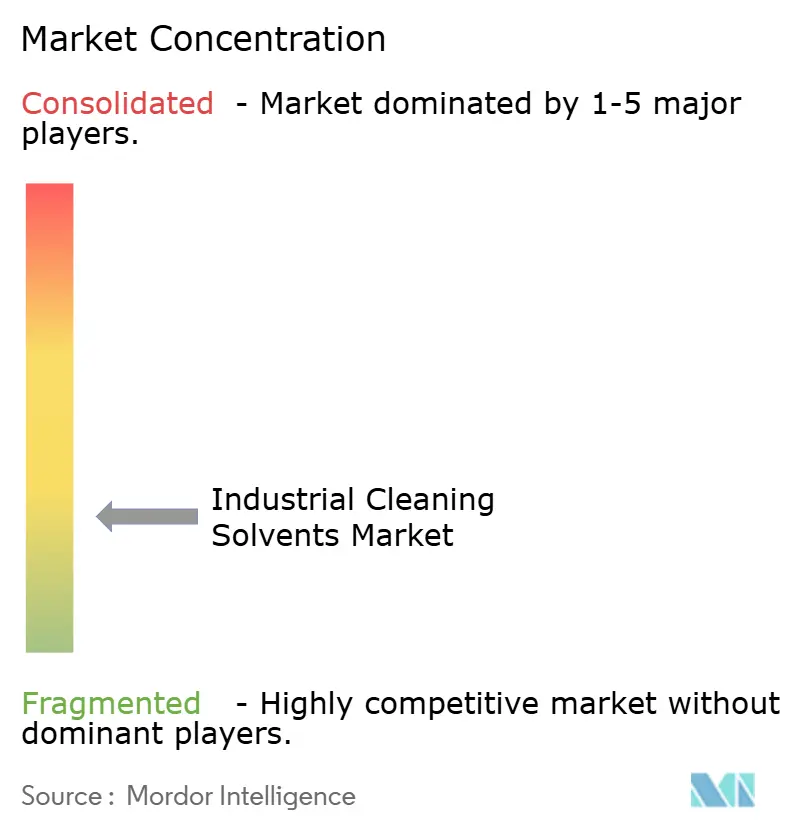
The industrial cleaning solvents market is highly fragmented, with the top five players including Shell plc, Eastman Chemical Company, LyondellBasell Industries Holdings B.V., Ashland, and BASF. Integrated producers can use their feedstock positions, production scale, and distribution networks to compete in hydrocarbon and other commodity solvent categories. Specialty suppliers focus more on performance-grade formulations, regulatory readiness, and application-specific technical support. Customer requirements for validated alternatives to restricted solvents can favor companies that can provide technical documentation and consistent quality. The competitive field is therefore based on more than unit price.
Semiconductor-grade purity and bio-based feedstocks form demanding areas of competition. Production of ultra-high-purity materials requires process controls and capital investment that can limit new entry. Suppliers increasingly combine chemical supply with application engineering, waste handling, and compliance documentation. This approach can reduce customer switching because the supplier becomes part of the operating process. Evonik Industries AG signed an exclusive United States distribution agreement with Sea-Land Chemical Company in March 2025 for cleaning solutions. The agreement expanded access to Evonik Industries AG cleaning additives and surfactants across the United States.
Environmental product credentials can also influence supplier selection in regulated end uses. International Organization for Standardization (ISO) 9001 and International Organization for Standardization 14001 certifications are baseline requirements for many quality-conscious customers. United States Environmental Protection Agency (EPA) Safer Choice and European Union Ecolabel programs can differentiate portfolios that meet their criteria. Eastman Chemical Company’s partnership with ChemPoint supports the distribution of a lower-toxicity alternative to N-methyl-2-pyrrolidone and N-ethyl-2-pyrrolidone in North America. Solvay’s capacity expansion in China addresses demand for electronic-grade hydrogen peroxide in semiconductor-related applications. These moves show how availability, distribution reach, and process-specific performance shape competition in the industrial cleaning solvents market.
Industrial Cleaning Solvents Industry Leaders
-
Shell plc
-
Eastman Chemical Company
-
LyondellBasell Industries Holdings B.V.
-
Ashland
-
BASF
- *Disclaimer: Major Players sorted in no particular order
Industrial Cleaning Solvents Market Companies Covered in this Report
- Arkema
- Ashland
- BASF
- Celanese Corporation
- Dow
- Eastman Chemical Company
- Evonik Industries AG
- Exxon Mobil Corporation
- Honeywell International Inc.
- Innospec
- LyondellBasell Industries Holdings B.V.
- Sasol
- Shell plc
- Solvay
- Stepan Company
Recent Industry Developments in Industrial Cleaning Solvents Market
- July 2026: NOROO Holdings announced that its NAUSOL range of bio-based solvents, including NAUSOL EHA, NAUSOL CRC-1, and NAUSOL D-Cleaner Plus, received United States Department of Agriculture BioPreferred certification, confirming 100% bio-based content. The development supports the industrial cleaning solvents market by expanding bio-based alternatives for high-performance cleaning in industrial and semiconductor manufacturing applications.
- April 2026: CBG Biotech introduced the SolvTrue S700C solvent recycler for recovering low-boiling-point engineered solvents, including fluorinated solvents used in aerospace, electronics, and medical-device manufacturing. The launch supports the industrial cleaning solvents market by enabling onsite solvent recovery, reuse, and improved management of solvent costs and availability.
Global Industrial Cleaning Solvents Market Report Scope
Industrial cleaning solvents are chemical substances used to dissolve, remove, or loosen oils, grease, residues, and other contaminants from equipment and surfaces. They support cleaning processes across industrial and commercial environments while meeting specific requirements for cleaning efficiency, material compatibility, and operational safety.
The Industrial Cleaning Solvents Market is segmented by solvent type, formulation, application, end-use industry, and geography. By solvent type, the market is segmented into hydrocarbon solvents, oxygenated solvents, bio-based solvents, halogenated solvents, and other solvent types. By formulation, the market is segmented into ready-to-use solutions, concentrates, semi-aqueous formulations, and closed-system formulations. By application, the market is segmented into general and medical device cleaning, metal cleaners, disinfectants, commercial laundry, food cleaners, and other applications. By end-use industry, the market is segmented into healthcare, manufacturing and commercial offices, retail and food service, hospitality, automotive and aerospace, food processing, and other end-use industries. The report also covers the market size and forecasts for industrial cleaning solvents across 15 countries. For each segment, the market sizing and forecasts have been done on the basis of value (USD).
Segmentation Overview
| Hydrocarbon Solvents |
| Oxygenated Solvents |
| Bio-Based Solvents |
| Halogenated Solvents |
| Other Solvent Types |
| Ready-to-Use Solutions |
| Concentrates |
| Semi-Aqueous Formulations |
| Closed-System Formulations |
| General and Medical Device Cleaning |
| Metal Cleaners |
| Disinfectants |
| Commercial Laundry |
| Food Cleaners |
| Other Applications |
| Healthcare |
| Manufacturing and Commercial Offices |
| Retail and Food Service |
| Hospitality |
| Automotive and Aerospace |
| Food Processing |
| Other End-Use Industries |
| Asia-Pacific | China |
| India | |
| Japan | |
| South Korea | |
| ASEAN Countries | |
| Rest of Asia-Pacific | |
| North America | United States |
| Canada | |
| Mexico | |
| Europe | Germany |
| United Kingdom | |
| France | |
| Italy | |
| NORDIC Countries | |
| Rest of Europe | |
| South America | Brazil |
| Argentina | |
| Rest of South America | |
| Middle East and Africa | Saudi Arabia |
| South Africa | |
| Rest of Middle East and Africa |
| By Solvent Type | Hydrocarbon Solvents | |
| Oxygenated Solvents | ||
| Bio-Based Solvents | ||
| Halogenated Solvents | ||
| Other Solvent Types | ||
| By Formulation | Ready-to-Use Solutions | |
| Concentrates | ||
| Semi-Aqueous Formulations | ||
| Closed-System Formulations | ||
| By Application | General and Medical Device Cleaning | |
| Metal Cleaners | ||
| Disinfectants | ||
| Commercial Laundry | ||
| Food Cleaners | ||
| Other Applications | ||
| By End-Use Industry | Healthcare | |
| Manufacturing and Commercial Offices | ||
| Retail and Food Service | ||
| Hospitality | ||
| Automotive and Aerospace | ||
| Food Processing | ||
| Other End-Use Industries | ||
| By Geography | Asia-Pacific | China |
| India | ||
| Japan | ||
| South Korea | ||
| ASEAN Countries | ||
| Rest of Asia-Pacific | ||
| North America | United States | |
| Canada | ||
| Mexico | ||
| Europe | Germany | |
| United Kingdom | ||
| France | ||
| Italy | ||
| NORDIC Countries | ||
| Rest of Europe | ||
| South America | Brazil | |
| Argentina | ||
| Rest of South America | ||
| Middle East and Africa | Saudi Arabia | |
| South Africa | ||
| Rest of Middle East and Africa | ||
Key Questions Answered in the Report
What is the size of the industrial cleaning solvents market?
The industrial cleaning solvents market size was valued at USD 1.52 billion in 2026 and is estimated to grow from USD 1.59 billion in 2027 to reach USD 2.02 billion by 2032, at a CAGR of 4.84% during the forecast period (2027-2032).
Which solvent type held the largest share in 2026?
Hydrocarbon solvents held a 35.86% share in 2026 because of their established use in general industrial cleaning, metal degreasing, and automotive maintenance.
Which formulation is projected to advance fastest through 2032?
Concentrates are projected to advance at a 5.34% CAGR through 2032, supported by lower logistics needs and automated dilution systems.
Which application is expected to grow fastest through 2032?
Disinfectants are projected to advance at a 5.63% CAGR through 2032 as food safety and healthcare hygiene requirements strengthen.