
Multi-Camera Industrial Inspection Systems Market Size and Share
Market Overview
| Study Period | 2020 - 2031 |
|---|---|
| Market Size (2026) | USD 285.62 Million |
| Market Size (2031) | USD 475.07 Million |
| Growth Rate (2026 - 2031) | 10.71 % |
| Fastest Growing Market | Asia-Pacific |
| Largest Market | Asia-Pacific |
| Market Concentration | Medium |
Major Players *Disclaimer: Major Players sorted in no particular order Image © Mordor Intelligence. Reuse requires attribution under CC BY 4.0. | |
Multi-Camera Industrial Inspection Systems Market Analysis by Mordor Intelligence
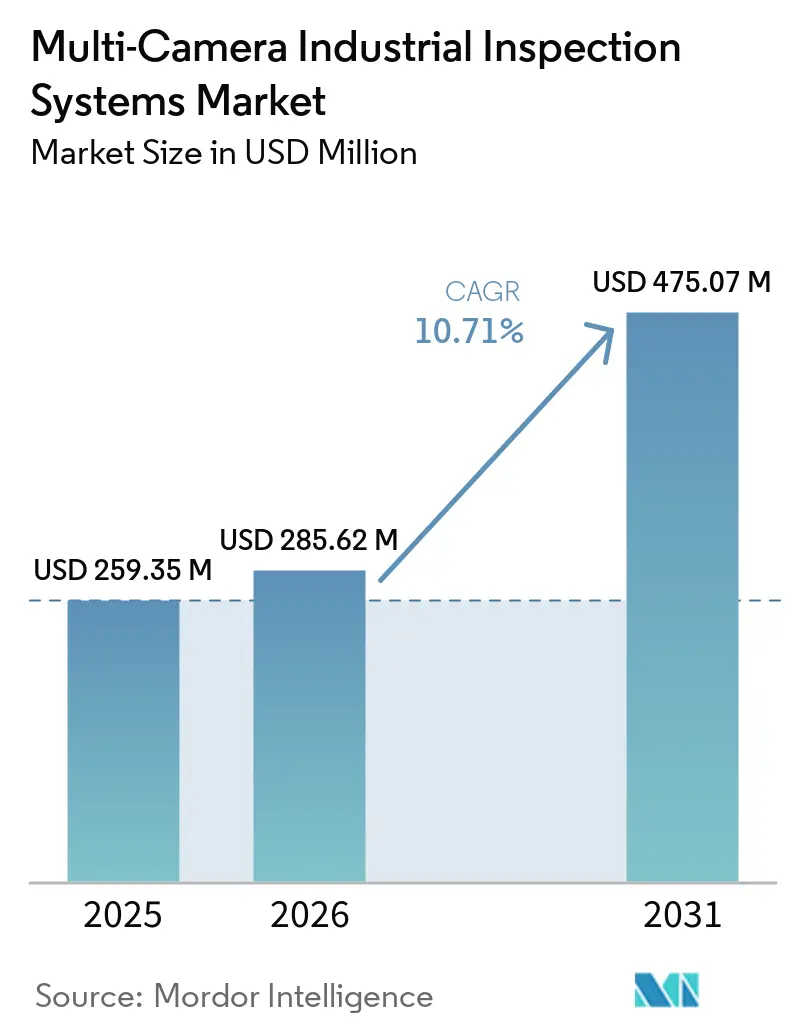
The Multi-Camera Industrial Inspection Systems Market size is projected to expand from USD 259.35 million in 2025 to USD 285.62 million in 2026, and to USD 475.07 million by 2031, registering a CAGR of 10.71% between 2026 and 2031. Tighter quality requirements in automotive, semiconductor, and regulated manufacturing supply chains support demand. Manufacturers are using synchronized camera coverage to identify defects before products leave the line. Investment also follows wider use of vision-guided robotics and connected factory systems. Vendors are pairing cameras and optics with software that can improve inspection models without replacing installed hardware. This approach creates opportunities in production environments that need repeatable inspection across complex surfaces and assemblies.
Key Report Takeaways
- By offering, hardware held 62.13% of the revenue share in 2025, while software is forecast to grow at a 12.27% CAGR through 2031.
- By system type, 2D multi-camera inspection systems held 59.78% of the Multi-Camera Industrial Inspection Systems Market revenue share in 2025, while 3D systems are forecast to grow at a 13.21% CAGR through 2031.
- By deployment mode, in-line inspection held 64.76% of revenue in 2025, while robotic inspection is forecast to grow at a 13.11% CAGR through 2031.
- By application, product, and surface inspection accounted for 28.90% of the Multi-Camera Industrial Inspection Systems Market size in 2025, while assembly verification and error proofing are forecast to grow at a 12.21% CAGR through 2031.
- By end-user industry, automotive and electric vehicles held 33.21% of revenue in 2025, while electronics and semiconductors are forecast to grow at a 12.55% CAGR through 2031.
- By geography, Asia-Pacific held 35.49% of the Multi-Camera Industrial Inspection Systems Market revenue share in 2025 and is forecast to grow at an 11.54% CAGR through 2031.
Note: Market size and forecast figures in this report are generated using Mordor Intelligence’s proprietary estimation framework, updated with the latest available data and insights as of January 2026.
Global Multi-Camera Industrial Inspection Systems Market Trends and Insights
Drivers Impact Analysis*
| Driver | (~) % Impact on CAGR Forecast | Geographic Relevance | Impact Timeline |
|---|---|---|---|
| Zero-Defect Manufacturing and Escaped Defect Costs | +2.8% | Global | Short term (≤ 2 years) |
| Industry 4.0 and Vision-Guided Robotics Adoption | +2.4% | Global, Asia-Pacific core, spillover to Middle East and Africa | Medium term (2-4 years) |
| Labor Shortages and Consistent High-Speed Inspection | +1.9% | North America and Europe | Short term (≤ 2 years) |
| EV Battery and Advanced Electronics Geometry Complexity | +1.4% | Asia-Pacific core, spillover to North America and Europe | Medium term (2-4 years) |
| Traceability in Food, Pharmaceutical, and Medical Production | +1.2% | North America and Europe, Asia-Pacific growing | Medium term (2-4 years) |
| Retroactive Image-Database Inspection for Recall Avoidance | +0.8% | Global, early gains in automotive and food | Long term (≥ 4 years) |
| Source: Mordor Intelligence | |||
Zero-Defect Manufacturing and Rising Cost of Escaped Defects
Manufacturers face greater financial exposure when defects pass inspection and reach customers. Quality-related costs can equal 15% to 20% of annual sales at typical manufacturers, while world-class operations reduce that level to less than 5%.[1]American Society for Quality, “Cost of Quality,” American Society for Quality, asq.org. The 1-10-100 principle favors detection early in the production process because repair after shipment requires far more effort. This makes multi-view inspection relevant where defects can occur on more than 1 surface. The Multi-Camera Industrial Inspection Systems Market benefits when suppliers must prove that each part meets specified requirements. Automotive and medical production are especially sensitive to quality escapes because the consequences can extend beyond rework costs. Camera arrays reduce gaps around curved, recessed, or partially hidden features and retain images for review of rejected parts. Demand can therefore reach beyond large manufacturers as supplier quality standards move through supply chains.
Industry 4.0, Smart-Factory, and Vision-Guided Robotics Adoption
Industry data reported 542,000 industrial robot installations during 2024, 4,664,000 operational industrial robots worldwide, and preliminary 2025 installations of 621,000 units.[2]International Federation of Robotics, “World Robotics 2025 Industrial Robots,” Presseportal, presseportal.de. New robotic cells often need machine vision for positioning, guidance, or inspection. Multi-camera systems are useful where parts vary in shape or need inspection from several directions. The systems also create production images for process monitoring. For the Multi-Camera Industrial Inspection Systems Market, robotics expands the use of vision beyond fixed conveyor lines. Distributed cameras can collect data from several points, while software enables operators to update inspection logic across several factory locations. This supports the stated 12.27% growth outlook for software and encourages centralized model development tools.
Labor Shortages and Demand for Consistent High-Speed Inspection
Labor constraints increase the value of inspection methods that apply the same criteria across every shift. It was reported that 70% of surveyed U.S. manufacturing quality leaders experienced labor shortages in 2025, and 88% of those respondents said shortages affected product or service quality.[3]ETQ and Censuswide, “Annual ETQ Pulse of Quality in Manufacturing Survey Reveals Widespread Labor Shortage Continues in 2025,” PR Newswire, prnewswire.com. A multi-camera system can maintain inspection coverage without fatigue-related variation. This is useful where manual inspection cannot keep pace with production. The Multi-Camera Industrial Inspection Systems Market is supported by demand for consistent decisions at high throughput. Images collected along the line can serve as a labeled record for later model improvement. The benefit is strongest where inspection rules are stable, and production volume justifies automation.
EV Battery and Advanced-Electronics Geometry Complexity Requiring Multi-View Coverage
Battery modules and advanced semiconductor packages have curved, recessed, or multi-directional surfaces that are difficult to evaluate with a single camera. Research demonstrated millimeter-level 3D defect mapping on battery modules using dual-view geometry and neural depth inference. Multi-camera configurations combine images from calibrated positions to create depth information. This supports checks for geometry and visible surface conditions. The Multi-Camera Industrial Inspection Systems Market has a clear use case in tasks that require volumetric verification. Onto Innovation introduced Dragonfly G5 in March 2026 with 150-nm sensitivity and more than 3x the throughput of its predecessor. These requirements support the stated 13.21% growth outlook for 3D systems.
Restraints Impact Analysis*
| Restraint | (~) % Impact on CAGR Forecast | Geographic Relevance | Impact Timeline |
|---|---|---|---|
| High Upfront Cost and Extended Payback for Multi-Camera Cells | -1.3% | Global, most acute in South America and Middle East and Africa | Short term (≤ 2 years) |
| Shortage of Machine-Vision Integration and Calibration Skills | -1.0% | North America and Europe | Short term (≤ 2 years) |
| Calibration Drift and Camera-Synchronization Failure | -0.7% | Global | Medium term (2-4 years) |
| Image Data Governance, Cybersecurity, and Model Change Control | -0.6% | Europe and North America | Medium term (2-4 years) |
| Source: Mordor Intelligence | |||
High Upfront Cost and Extended Payback for Multi-Camera Cells
Multi-camera cells require cameras, lighting, optics, frame grabbers, calibration fixtures, and integration work. This creates a larger initial commitment than a basic single-camera installation. The cost can delay adoption where facilities have limited automation budgets or management expects a short payback period. The Multi-Camera Industrial Inspection Systems Market faces a barrier when a facility cannot support the full system and integration cost. This is particularly relevant for manufacturers with 50 to 500 employees, who may lack machine vision experience. Financing and implementation capacity are less developed in some South American, Middle East and African markets. Cloud-to-edge arrangements can lower repeated engineering work across several plants, but they do not eliminate the need for cameras, calibration, and local commissioning.
Shortage of Machine-Vision Integration and Calibration Skills
Multi-camera inspection needs expertise in camera geometry, lighting, calibration methods, and software configuration. Industry reports indicated that machine learning and AI were the most difficult specialties to hire among respondents reporting hiring difficulty. The shortage can lengthen installation schedules and lead manufacturers to limit the scope of a deployment. This is particularly relevant in North America and Europe. The Multi-Camera Industrial Inspection Systems Market presents both a service opportunity and an adoption constraint. Vendors can provide integration, calibration, training, and maintenance under service agreements. Customers without these resources may postpone projects or choose simpler inspection options. Dependable local support and simpler model setup are therefore relevant purchasing factors.
*Our forecasts treat driver/restraint impacts as directional, not additive. The impact forecasts reflect baseline growth, mix effects, and variable interactions.
Segment Analysis
By Offering: Hardware Provides the Installed Base While Software Expands Value
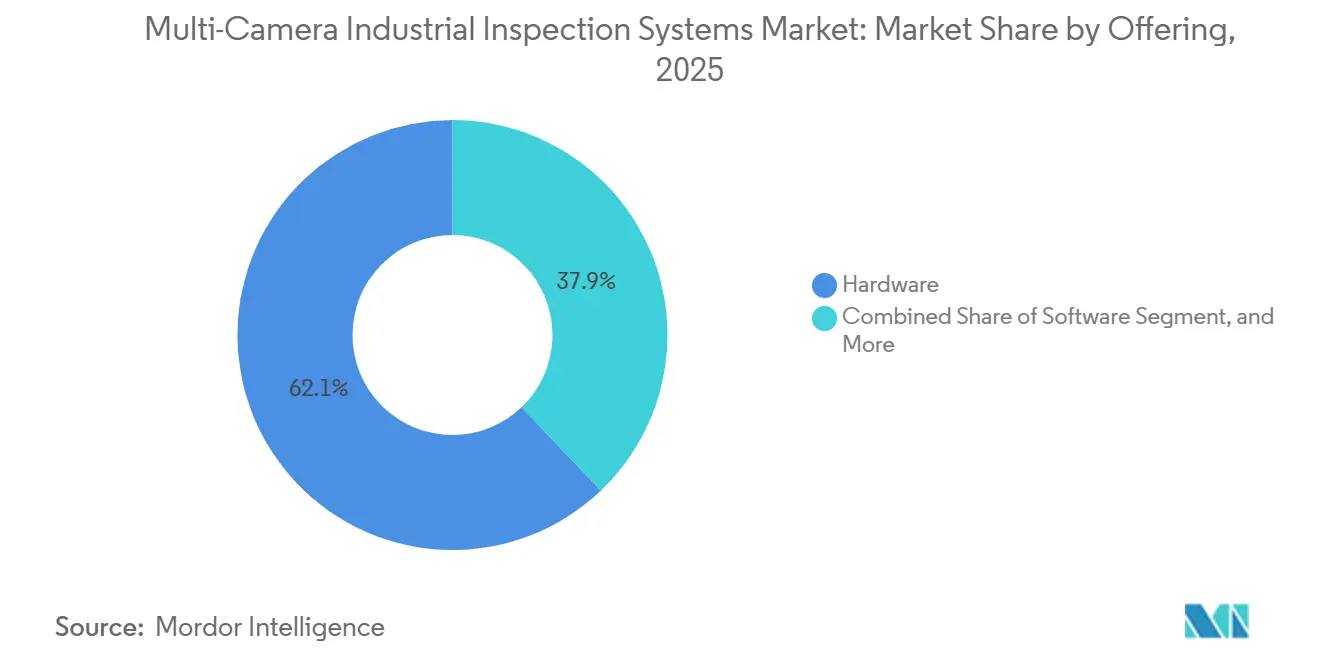
Hardware held 62.13% of the Multi-Camera Industrial Inspection Systems Market share in 2025. Cameras, lighting, lenses, optics, frame grabbers, and image processors provide the foundation for each inspection cell. A calibrated camera array is generally upgraded rather than removed as inspection algorithms change. This creates a durable installed base for component suppliers. Hardware demand also rises when a manufacturer adds coverage to another line or site.
Software is forecast to grow at a 12.27% CAGR through 2031. Image processing, AI algorithms, and analytics extend the useful life of installed camera systems. Cognex made OneVision generally available in May 2026 after more than 100 customers used the platform. Services remain relevant because integration and maintenance needs rise with system complexity. Software and services allow continued vendor engagement after the equipment sale.



By System Type: 2D Systems Retain the Base While 3D Systems Address Geometry
2D multi-camera inspection systems held 59.78% of revenue in 2025. They are used on automotive and electronics lines where texture, color, surface condition, and planar dimensions are core criteria. Their installed base reflects long use on high-volume production lines. Hikrobot introduced 8K and 16K true-color line-scan cameras in 2026 for PCB inspection, with 5-micron precision. These capabilities keep 2D systems relevant where depth measurement is not required.
3D multi-camera inspection systems are forecast to grow at a 13.21% CAGR through 2031. They support battery module checks, weld measurement, and semiconductor packaging metrology. Teledyne DALSA launched its Linea HS2 8k camera in June 2026 with a maximum line rate of 1 MHz and 5-micron resolution.[4]Teledyne DALSA, “Teledyne Launches Linea HS2 8k Camera for Ultra-High-Speed Imaging in Low-Light Conditions,” Vision Systems Design, vision-systems.com. Hybrid systems combine 2D and 3D acquisition in 1 cell. They suit applications where appearance and geometry are checked together.
By Deployment Mode: In-Line Systems Lead Volume While Robotic Cells Add Flexibility
In-line inspection held 64.76% of revenue in 2025. It is suited to lines where defects must be identified immediately, and production volume is high. Fixed arrays are common where part geometry and conveyor speed remain stable. Semiconductor fabrication, beverage bottling, and automotive stamping are representative uses. In-line inspection can remove failed parts without adding a separate inspection step. This reduces the need for work-in-process buffers. It also gives manufacturers a consistent point for capturing inspection images.
Robotic inspection is forecast to grow at a 13.11% CAGR through 2031. Robotic arms can reposition multi-camera payloads around large or irregular assemblies. This expands coverage for battery trays, aerospace panels, and industrial weld structures. The Multi-Camera Industrial Inspection Systems Market can therefore serve applications that fixed arrays cannot reach effectively. Offline inspection remains useful for incoming inspection, metrology, and failure analysis. Smaller, more power-efficient CMOS sensors also enable the placement of several cameras on robotic arms. The deployment choice depends on throughput, part variation, and the geometry that must be inspected.
By Application: Product and Surface Inspection Leads While Assembly Verification Rises
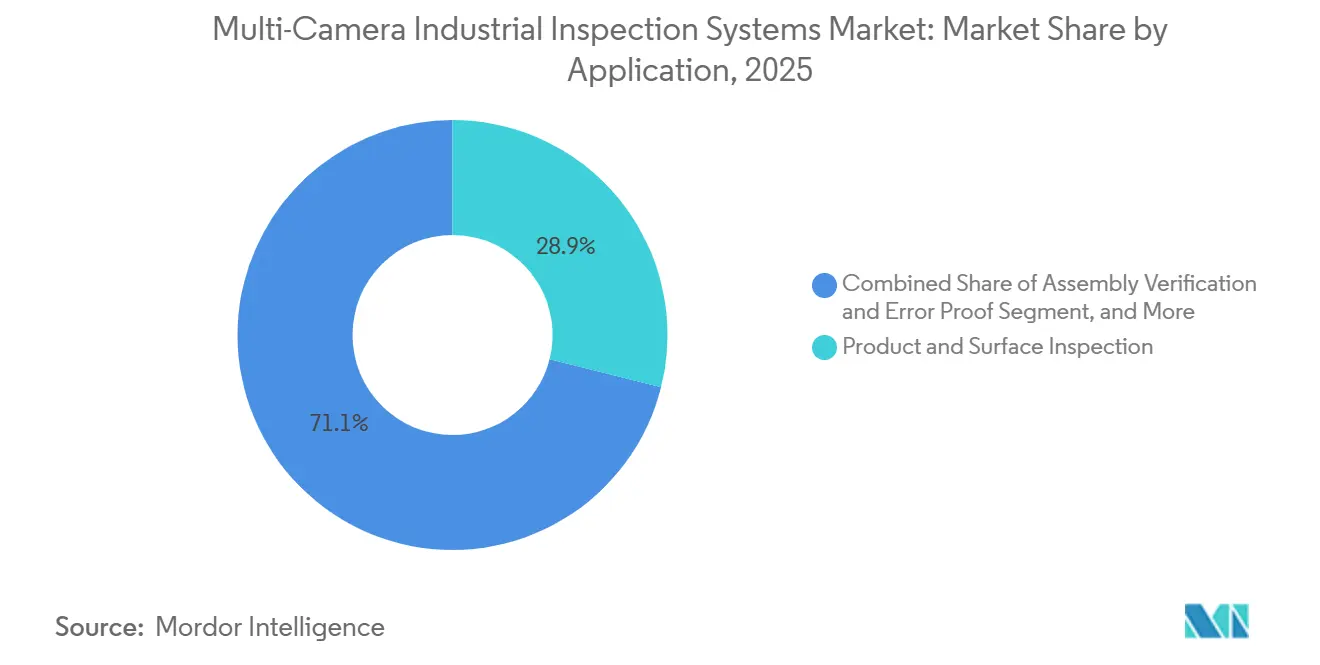
Product and surface inspection accounted for 28.90% of the Multi-Camera Industrial Inspection Systems Market size in 2025. It covers scratches, porosity, coating variation, and dimensional deviations on manufactured products. Multiple viewpoints help capture defect-bearing surfaces in one pass. This application is used across many discrete manufacturing settings. It gives production teams visible evidence for pass-or-fail decisions. Quality control and assurance remain core applications because they establish the basic inspection gate. Measurement and dimensioning are also important for precision manufacturing processes.
Assembly verification and error proofing are forecast to grow at a 12.21% CAGR through 2031. It addresses components such as connectors, welds, fasteners, and labels that must be present and correctly positioned. The application is useful on mixed-model assembly lines with frequent product variation. The FDA food traceability rule requires covered entities to maintain specific records and to provide information within 24 hours upon request. That requirement supports image-linked verification on food packaging and labeling lines. Inspection systems can provide records that help production teams review whether the required steps were performed.
By End-User Industry: Automotive and EV Leads While Electronics and Semiconductors Accelerate
Automotive and electric vehicles held 33.21% of revenue in 2025. The sector has long used machine vision for welding, painted surfaces, stamped parts, and powertrain measurement. Electric vehicle production adds battery inspection, module housing weld checks, and tray geometry control. These tasks can require multi-camera 3D coverage. The sector’s established automation base supports continued deployment of inspection systems. It also requires reliable performance at high line speeds. This leaves automotive and electric vehicles as the largest end-user category in the Multi-Camera Industrial Inspection Systems Market.
Electronics and semiconductors are forecast to grow at a 12.55% CAGR through 2031. Advanced packaging and memory applications need high sensitivity and controlled inspection conditions. The Dragonfly G5 launch showed demand for systems that address both 2D and 3D macro defects in semiconductor packaging. Food and beverage, pharmaceutical, and medical device producers also need traceability and documented quality procedures. Metals and materials producers use surface inspection on continuous casting and rolling lines. These end users support demand for calibration and model update services during the system lifecycle.
Geography Analysis
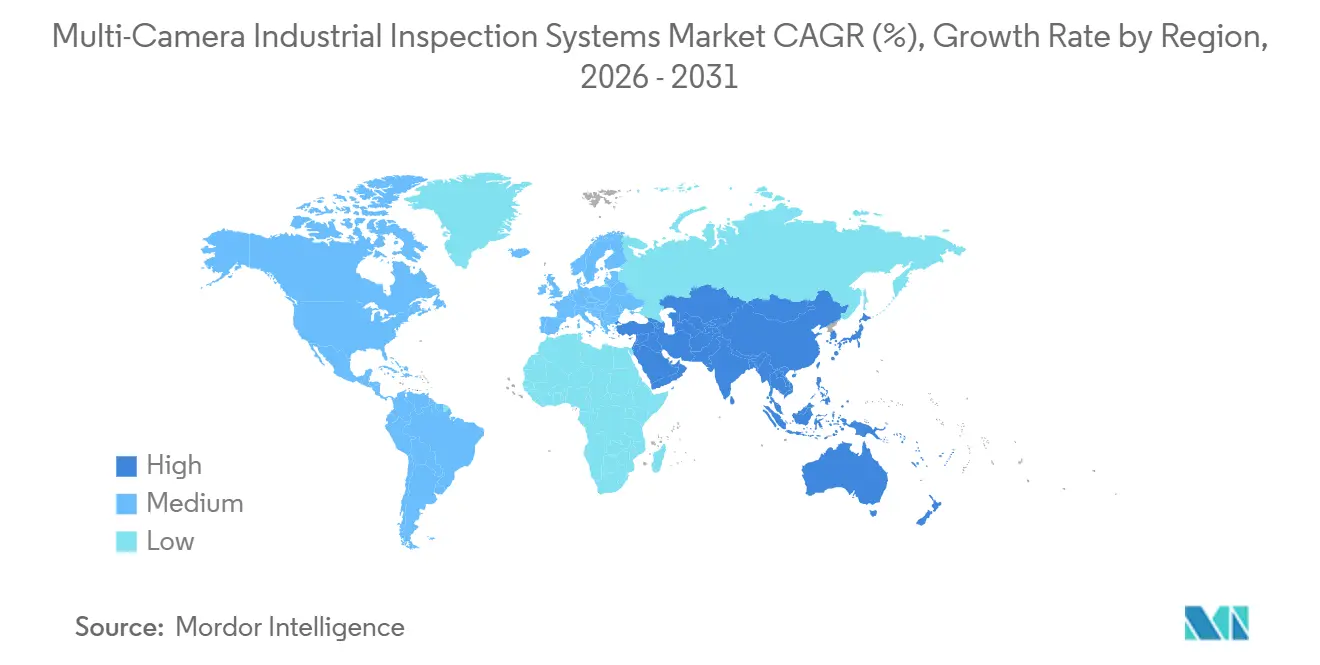
Asia-Pacific accounted for 35.49% of revenue in 2025 and is forecast to grow at an 11.54% CAGR through 2031. The region combines high manufacturing density with major production of automotive, electronics, and semiconductor products. China’s Ministry of Industry and Information Technology issued its AI+ICT Innovation Development Implementation Plan for 2026 to 2028 in June 2026. The plan identifies industrial visual inspection as a priority application area. Japan remains important in the development of high-resolution sensors and cameras. South Korea’s semiconductor memory and display facilities require demanding line-scan vision configurations.
India is expanding electronics and automotive assembly capacity, which supports greenfield inspection installations. The Multi-Camera Industrial Inspection Systems Market benefits when new production lines incorporate automated inspection from the start. Food traceability requirements and investments in industrial automation support North America. U.S. robot installations increased 11% to 38,000 units in 2025, according to preliminary data. Europe remains an important market for the installed base of automated manufacturing. Germany has strong automotive production and is also managing cybersecurity requirements for connected industrial products.
South America, the Middle East, and Africa offer expansion potential but face implementation constraints. Brazil’s adoption is concentrated in food processing and automotive plants. Saudi Arabia and the United Arab Emirates are adding automated inspection to new manufacturing facilities. South African deployments are concentrated in food-export processing and in some pharmaceutical facilities. These markets often face a gap between customer quality expectations and available finance or specialist skills. Vendors that simplify commissioning and provide service support are better positioned to address this.

Competitive Landscape
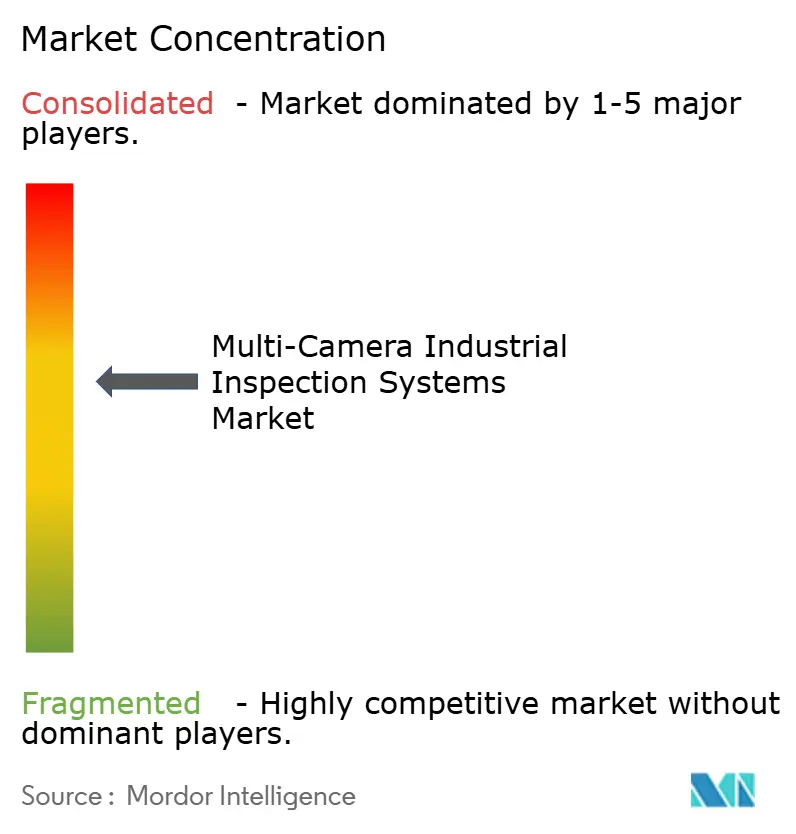
The Multi-Camera Industrial Inspection Systems Market is moderately consolidated among Cognex Corporation, KEYENCE Corporation, Teledyne DALSA, and Basler AG. These suppliers compete through camera performance, software capability, system integration, and support. Chinese providers are adding competitive pressure in industrial camera hardware. Incumbents are responding by connecting hardware with centralized AI development and deployment tools. This model can create repeat software engagement and increase customer switching costs. Competition is therefore moving beyond camera specifications alone.
Basler AG and Orbbec announced an industrial 3D vision technology partnership in March 2026. The partnership introduced the Basler Stereo mini system for autonomous mobile robot navigation, obstacle detection, and multi-camera perception tasks. Advantech also partnered with Basler in April 2026 on a GMSL-based multi-camera vision and robotics computing platform. These moves show how suppliers are extending multi-camera capability through partnerships. They also reduce the need to develop every component internally.
Cognex introduced the In-Sight 6900 Vision Controller in April 2026 with NVIDIA Jetson technology and 157 TOPS of AI performance. Panasonic Connect launched the Bead Eye M edition in June 2026 for welding appearance inspection using a 3D sensor and AI technology. Specialist suppliers also focus on particular inspection problems and industry settings. The remaining opportunity includes mid-market facilities that lack established multi-camera systems. Products that reduce setup complexity can help vendors reach customers affected by skills shortages and budget limits.
Multi-Camera Industrial Inspection Systems Industry Leaders
Cognex Corporation
KEYENCE CORPORATION
Teledyne DALSA, Inc.
Basler AG
Omron Corporation
- *Disclaimer: Major Players sorted in no particular order

Recent Industry Developments
- August 2026: MENOU released MENOU-AiF, a multi-angle AI autofocus imaging system that pairs a collaborative robot with an AI-driven autofocus camera. The system replicates angular verification actions used by human inspectors on complex-shape products. The MENOU inspection AI platform has been adopted by 200+ manufacturing companies in automotive, medical devices, food, and consumer goods. The release addressed the limited coverage of single-angle cameras on curved and recessed surfaces.
- July 2026: Cognex reported record second-quarter 2026 revenue of USD 291 million for the quarter ended July 5, 2026. This was a 17% year-over-year increase from USD 249 million in Q2 2025. Operating income doubled year-over-year to USD 86 million. Adjusted EBITDA margin reached 32.2%. The results reflected the company’s hardware and AI software model.
- June 2026: Teledyne DALSA launched the Linea HS2 8k backside-illuminated TDI camera on June 16, 2026. The camera delivers a maximum line rate of 1 MHz at 5-micron resolution. It is intended for ultra-high-speed imaging in low-light conditions. Teledyne DALSA positioned the product for semiconductor wafer, battery, and advanced packaging inspection.
- June 2026: Panasonic Connect launched Bead Eye M edition on June 15, 2026. The welding appearance inspection solution combines a 3D sensor with AI technology. Panasonic stated that it reduces setup engineering effort by 90% compared with conventional rule-based systems. The product targets automotive and industrial welding inspection lines in Asia.


Global Multi-Camera Industrial Inspection Systems Market Report Scope
The Multi-Camera Industrial Inspection Systems Market refers to advanced automated setups that utilize two or more synchronized cameras to capture comprehensive visual data of manufactured products. These systems incorporate specialized lighting, optics, and AI-powered software to perform in-line, off-line, or robotic inspections for defect detection, assembly verification, and precise measurement. They are primarily deployed across automotive, electronics, pharmaceutical, and metals industries to ensure high-quality standards, reduce waste, and improve manufacturing efficiency.
The Multi-Camera Industrial Inspection Systems Market Report is Segmented by Offering (Hardware (Cameras, Lighting Equipment, Lenses and Optics, Frame Grabbers and Image Processors, and Other Hardware), Software (Image Processing Software, Machine Learning and AI Algorithms, Data Visualization and Analytics Platforms, and Other Software), and Services (System Integration and Maintenance and Support)), System Type (2D Multi-Camera Inspection Systems, 3D Multi-Camera Inspection Systems, and Hybrid Multi-Camera Inspection Systems), Deployment Mode (In-Line Inspection, Off-Line Inspection, and Robotic Inspection), Application (Quality Control and Assurance, Product and Surface Inspection, Assembly Verification and Error Proofing, Measurement and Dimensioning, and Other Applications), End-User Industry (Automotive and Electric Vehicles, Electronics and Semiconductors, Food and Beverage, Pharmaceuticals and Medical Devices, Metals and Materials, and Other End-User Industries), and Geography (North America, South America, Europe, Asia-Pacific, and Middle East and Africa). The Market Forecasts are Provided in Terms of Value (USD).
| Hardware | Cameras |
| Lighting Equipment | |
| Lenses and Optics | |
| Frame Grabbers and Image Processors | |
| Other Hardware | |
| Software | Image Processing Software |
| Machine Learning and AI Algorithms | |
| Data Visualization and Analytics Platforms | |
| Other Software | |
| Services | System Integration |
| Maintenance and Support |
| 2D Multi-Camera Inspection Systems |
| 3D Multi-Camera Inspection Systems |
| Hybrid Multi-Camera Inspection Systems |
| In-Line Inspection |
| Off-Line Inspection |
| Robotic Inspection |
| Quality Control and Assurance |
| Product and Surface Inspection |
| Assembly Verification and Error Proofing |
| Measurement and Dimensioning |
| Other Applications |
| Automotive and Electric Vehicles |
| Electronics and Semiconductors |
| Food and Beverage |
| Pharmaceuticals and Medical Devices |
| Metals and Materials |
| Other End-User Industries |
| North America | United States | |
| Canada | ||
| Mexico | ||
| South America | Brazil | |
| Argentina | ||
| Rest of South America | ||
| Europe | Germany | |
| United Kingdom | ||
| France | ||
| Italy | ||
| Spain | ||
| Rest of Europe | ||
| Asia-Pacific | China | |
| Japan | ||
| India | ||
| South Korea | ||
| Rest of Asia-Pacific | ||
| Middle East and Africa | Middle East | Saudi Arabia |
| United Arab Emirates | ||
| Rest of the Middle East | ||
| Africa | South Africa | |
| Rest of Africa | ||
| By Offering | Hardware | Cameras | |
| Lighting Equipment | |||
| Lenses and Optics | |||
| Frame Grabbers and Image Processors | |||
| Other Hardware | |||
| Software | Image Processing Software | ||
| Machine Learning and AI Algorithms | |||
| Data Visualization and Analytics Platforms | |||
| Other Software | |||
| Services | System Integration | ||
| Maintenance and Support | |||
| By System Type | 2D Multi-Camera Inspection Systems | ||
| 3D Multi-Camera Inspection Systems | |||
| Hybrid Multi-Camera Inspection Systems | |||
| By Deployment Mode | In-Line Inspection | ||
| Off-Line Inspection | |||
| Robotic Inspection | |||
| By Application | Quality Control and Assurance | ||
| Product and Surface Inspection | |||
| Assembly Verification and Error Proofing | |||
| Measurement and Dimensioning | |||
| Other Applications | |||
| By End-User Industry | Automotive and Electric Vehicles | ||
| Electronics and Semiconductors | |||
| Food and Beverage | |||
| Pharmaceuticals and Medical Devices | |||
| Metals and Materials | |||
| Other End-User Industries | |||
| By Geography | North America | United States | |
| Canada | |||
| Mexico | |||
| South America | Brazil | ||
| Argentina | |||
| Rest of South America | |||
| Europe | Germany | ||
| United Kingdom | |||
| France | |||
| Italy | |||
| Spain | |||
| Rest of Europe | |||
| Asia-Pacific | China | ||
| Japan | |||
| India | |||
| South Korea | |||
| Rest of Asia-Pacific | |||
| Middle East and Africa | Middle East | Saudi Arabia | |
| United Arab Emirates | |||
| Rest of the Middle East | |||
| Africa | South Africa | ||
| Rest of Africa | |||


Key Questions Answered in the Report
What is the 2026 size of the Multi-Camera Industrial Inspection Systems Market?
The Multi-Camera Industrial Inspection Systems Market is projected to be USD 285.62 million in 2026 and reach USD 475.07 million by 2031 at a 10.71% CAGR.
Which offering leads demand for multi-camera inspection systems?
Hardware led with 62.13% of revenue in 2025, while software is forecast to grow at a 12.27% CAGR through 2031.
Why are 3D multi-camera systems growing faster than 2D systems?
3D systems address geometry checks in battery, welding, and semiconductor applications and are forecast to grow at a 13.21% CAGR.
Which deployment mode is expanding fastest?
Robotic inspection is forecast to grow at a 13.11% CAGR because it can inspect large and irregular parts from different positions.
Which end-user sector has the highest growth outlook?
Electronics and semiconductors are forecast to grow at a 12.55% CAGR through 2031, supported by advanced packaging inspection needs.
Which region leads adoption of multi-camera inspection systems?
Asia-Pacific held 35.49% of revenue in 2025 and is forecast to grow at an 11.54% CAGR through 2031.
Page last updated on:





