
Indonesia Transportation Infrastructure Construction Market Size and Share
Market Overview
| Study Period | 2021 - 2032 |
|---|---|
| Forecast Data Period | 2027 - 2032 |
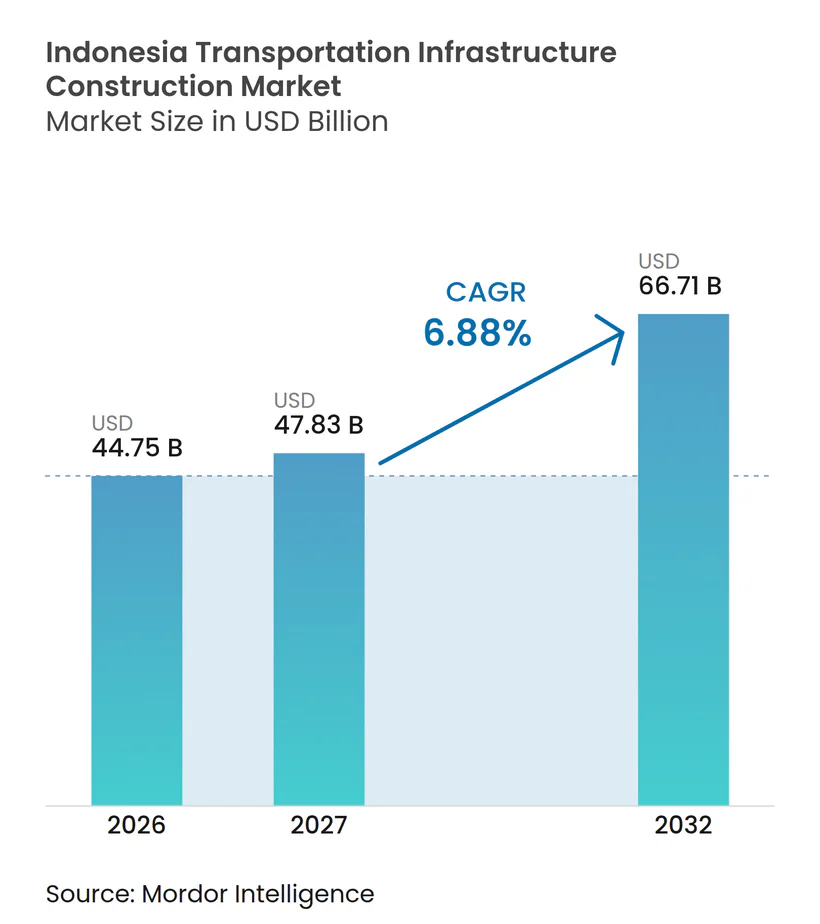
| Base Year Market Size (2026) | USD 44.75 Billion |
| Market Size (2027) | USD 47.83 Billion |
| Market Size (2032) | USD 66.71 Billion |
| Growth Rate (2027 - 2032) | 6.88 % |
| Market Concentration | Medium |
Major Players *Disclaimer: Major Players sorted in no particular order Image © Mordor Intelligence. Reuse requires attribution under CC BY 4.0. | |
Indonesia Transportation Infrastructure Construction Market Analysis by Mordor Intelligence
The Indonesia Transportation Infrastructure Construction Market size was valued at USD 44.75 billion in 2026 and is estimated to grow from USD 47.83 billion in 2027 to reach USD 66.71 billion by 2032, at a CAGR of 6.88% during the forecast period (2027-2032).
Infrastructure remains a policy priority under the Asta Cita agenda, which links transport investment with food security, industrial development, and inter-island access. The Ministry of Public Works has a 2026 budget of USD 7.27 billion after a USD 2.92 billion restoration, which supports the continuation of national infrastructure programs. The Indonesia transportation infrastructure construction market is also moving toward a broader mix of public funding, concessions, multilateral finance, and industrial investment. This matters because projects with private or development-finance support can progress where direct budget funding is limited. The Indonesia transportation infrastructure construction market therefore offers the strongest openings for contractors that can work across complex financing structures, specialized freight assets, and projects outside Java.
Key Report Takeaways
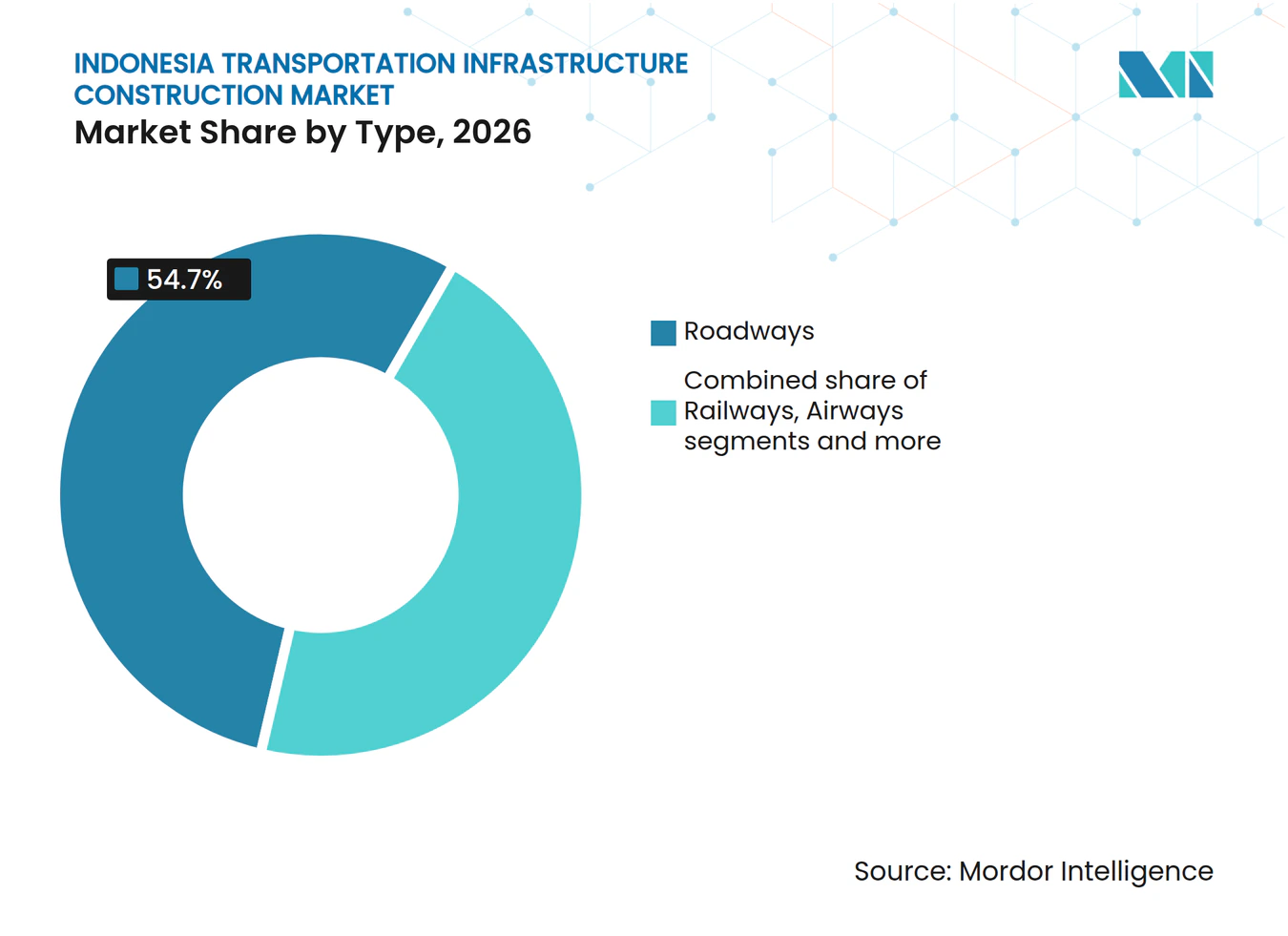
- By type, roadways held 54.7% of the Indonesia transportation infrastructure construction market share in 2026, while railways are forecast to grow at a CAGR of 7.77% through 2032.
- By construction type, new construction accounted for 67.8% of the Indonesia transportation infrastructure construction market size in 2026, while renovation is forecast to grow at a CAGR of 7.51% through 2032.
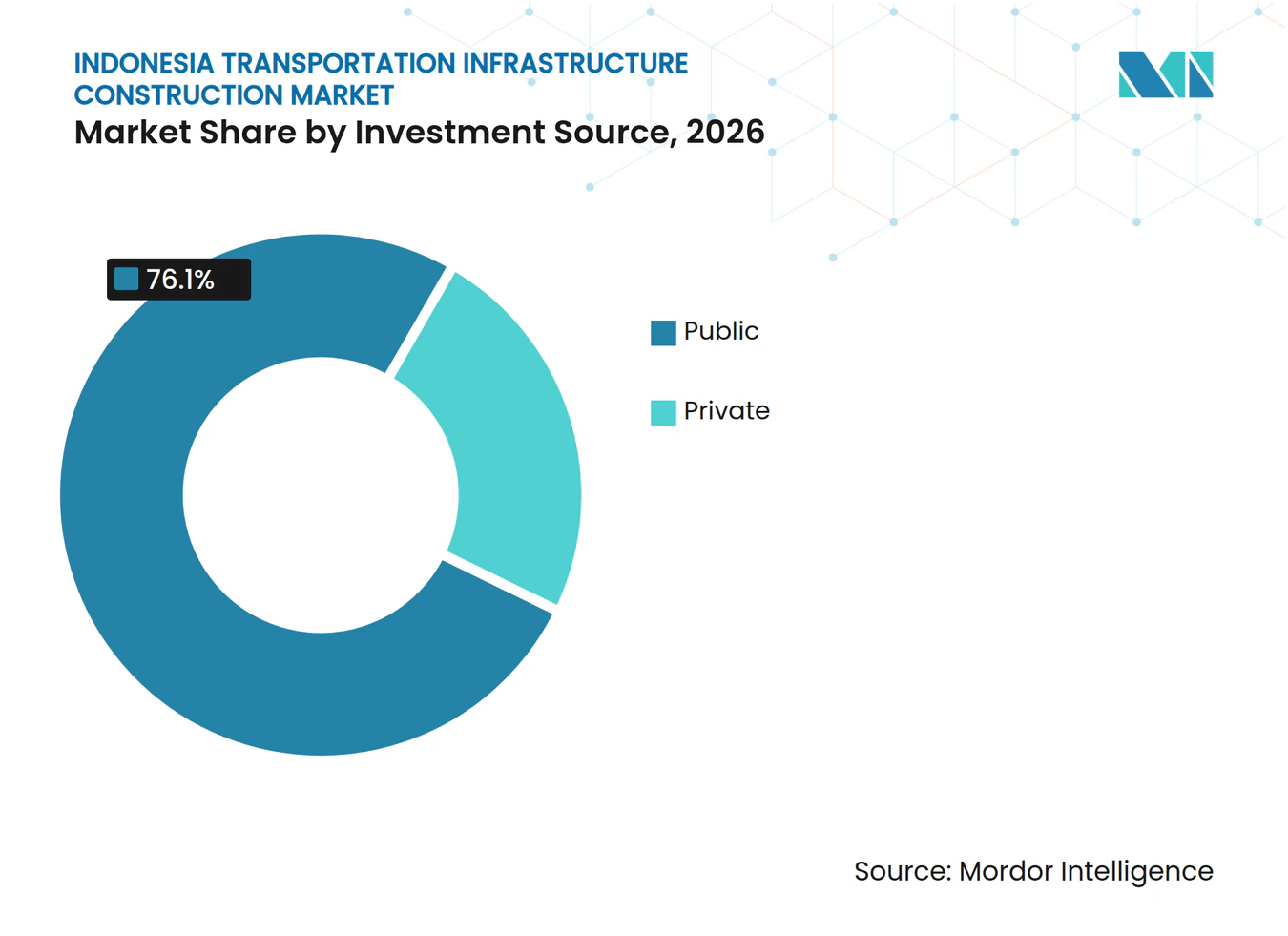
- By investment source, public investment held 76.1% of the Indonesia transportation infrastructure construction market share in 2026, while private investment is forecast to grow at a CAGR of 7.45% through 2032.
- By key region, Java accounted for 52.3% of the Indonesia transportation infrastructure construction market size in 2026, while the rest of Indonesia is forecast to grow at a CAGR of 6.42% through 2032.
Note: Market numbers in this report are based on Mordor Intelligence's proprietary estimation framework, which combines nine months of actuals with Q4 projections for base year 2026.
Market Trends and Insights
Drivers Impact Analysis of Indonesia Transportation Infrastructure Construction Market*
| Drivers | (~) % Impact on CAGR Forecast | Geographic Relevance | Impact Timeline |
|---|---|---|---|
| Toll road expansion and new intercity connections | +1.4% | Java, Sumatra, Bali | Short term (≤ 2 years) |
| Railway modernization and urban mass transit | +1.2% | Java, Sumatra, Sulawesi | Medium term (2-4 years) |
| Port capacity expansion and maritime upgrades | +0.9% | Java, Sulawesi, Kalimantan, Eastern Indonesia | Medium term (2-4 years) |
| Industrial estates and mineral downstreaming freight links | +0.8% | Sulawesi, North Maluku, Kalimantan, North Sumatra | Long term (≥ 4 years) |
| Airport modernization | +0.7% | Jakarta, Bali, Surabaya, Makassar | Medium term (2-4 years) |
| Nusantara transport network development | +0.6% | East Kalimantan and the Balikpapan-Samarinda corridor | Long term (≥ 4 years) |
| Source: Mordor Intelligence | |||
Toll Road Expansion Programs are Reorienting Construction Demand Toward Off-Java Corridors
The Indonesia transportation infrastructure construction market is supported by a toll road pipeline that is increasingly tied to industrial logistics and intercity movement. The Ministry of Public Works targets 308.7 kilometers of new toll roads to become operational in 2026 across 9 sections, including links toward Probolinggo and the Nusantara Capital City corridor[1]. The 2025 to 2029 plan includes 2,461 kilometers of new toll roads with USD 44.5 billion in planned investment, with the largest part of the pipeline located in Java[2]. A further 19 toll road projects with USD 25.1 billion in combined investment are under tender through the government-business cooperation framework in 2026. The shift increases the need for consortiums that can combine construction delivery with financing and concession capabilities. It also gives private participants a larger role in high-investment corridors while public spending continues to support shorter and more conventional links.
Railway Modernization and Urban Mass Transit Investments Are Driving a New Wave of Rail Construction Activity
Railways are the fastest-growing type in the Indonesia transportation infrastructure construction market, with a 7.77% forecast CAGR through 2032. The President approved the procurement of 30 electric multiple-unit trainsets for the Jakarta, Bogor, Depok, Tangerang, and Bekasi commuter network at USD 307 million, showing the level of capital being directed to urban rail[3]. Germany’s development bank KfW is providing USD 256 million for the first phase of the Surabaya Regional Railway Line, which will electrify and double-track the Surabaya-Sidoarjo corridor. The government has stated that building and reactivating 14,000 kilometers of rail outside Java would require USD 4 billion each year for 20 years. This gap points to a greater role for bilateral, multilateral, and private funding, each of which affects procurement rules, technical requirements, and delivery schedules. Contractors with civil, electrical, and systems expertise are better placed to participate as construction moves beyond a single-city focus.
Port Capacity Expansion and Maritime Infrastructure Upgrades are Generating Multi-Cluster Construction Demand
Port development is widening the geographic base of the Indonesia transportation infrastructure construction market. Patimban Port began first-phase container terminal operations in January 2026 with a capacity of 250,000 twenty-foot equivalent units and aims to reach 800,000 units by December through equipment and yard additions. At Tanjung Priok, the Kalibaru expansion includes 6 kilometers of breakwater, 374 hectares of reclamation, and 4 container terminals that will add 5 to 6 million twenty-foot equivalent units of annual capacity. PT Pelabuhan Indonesia is seeking partners for port and industrial assets at Kuala Tanjung, Makassar New Port, and Kijing Port, extending activity into locations serving mineral and bulk cargo flows. Presidential Instruction No. 14 of 2025 also requires coordinated airport and port development in food-estate areas, increasing the need for remote logistics assets. The combination of hub expansion and regional connectivity is creating work across marine engineering, dredging, terminal systems, and access roads.
Industrial Estate Development and Mineral Downstreaming Are Creating a New Category of Freight Infrastructure Demand
Mineral processing estates are creating a specialized source of work for the Indonesia transportation infrastructure construction market. Indonesia Morowali Industrial Park in Central Sulawesi has 53 tenants linked to nickel processing for stainless steel and electric vehicle battery supply chains, which has increased pressure on surrounding roads, ports, and logistics facilities. A 2025 peer-reviewed study of 139 nickel mines found that sea transport costs strongly influence site economics in Indonesia’s archipelagic geography. PT Pelabuhan Indonesia and PT Indo Konstruksi Mineral signed an agreement in August 2026 to develop nickel loading and unloading facilities at Kendari Port in Southeast Sulawesi. These projects require construction firms to coordinate ports, access roads, storage, and processing-site logistics rather than deliver a single public asset. The work favors companies with private terminal experience and an ability to meet industrial customers’ timing requirements.
Restraints Impact Analysis of Indonesia Transportation Infrastructure Construction Market*
| Restraints | (~) % Impact on CAGR Forecast | Geographic Relevance | Impact Timeline |
|---|---|---|---|
| Fiscal consolidation and budget reprioritization | -1.0% | National, especially off-Java projects with weaker revenue bases | Short term (≤ 2 years) |
| Land acquisition and compensation complexity | -0.8% | National, especially Java peri-urban corridors and Sumatra routes | Short term (≤ 2 years) |
| Difficult terrain and dispersed geography | -0.6% | Papua, Maluku, Nusa Tenggara, mountainous Sumatra and Kalimantan | Long term (≥ 4 years) |
| Imported specialized equipment dependency | -0.4% | Indonesia, with concentration in port and rail projects | Medium term (2-4 years) |
| Source: Mordor Intelligence | |||
Fiscal Consolidation and Budget Reprioritization are Compressing Near-Term Construction Pipelines
Funding capacity remains a practical constraint for the Indonesia transportation infrastructure construction market. The government’s infrastructure agenda requires a funding mix that extends beyond direct budget allocations, which is why concession and partnership arrangements are becoming more material to project delivery. The 2026 Nusantara Capital City budget is USD 387 million, compared with USD 797 million in 2025, which reduces immediate activity on the most visible regional development program. The Ministry of Public Works budget restoration provides support, but it does not eliminate the need to prioritize projects. Contractors that depend on direct public funding are more exposed to changes in project sequencing, budget releases, and the readiness of enabling works. Firms that can operate under concession, development-finance, or government-guarantee structures have more options when direct appropriations are constrained.
Complex Land Acquisition and Compensation Procedures are A Structurally Embedded Timeline Risk
Land acquisition remains a recurring source of delay in Indonesia's transportation infrastructure construction market. The Organization for Economic Co-operation and Development notes that Indonesia’s legal and regulatory setting continues to present barriers to quality infrastructure investment, including land-related processes. A 2025 engineering study found that a 16-month acquisition delay extended actual project duration by 454 days and increased cost by USD 460,000, equal to a 2.304% overrun on the original contract value. The United States Department of State also identifies land acquisition delays and different land-value views as material barriers to project execution. Delays are especially difficult for fixed-price contractors because work can be slowed while teams and equipment remain committed. Early route preparation, transparent compensation, and clearer title resolution are therefore important to keeping projects on schedule.
*Our forecasts treat driver/restraint impacts as directional, not additive. The impact forecasts reflect baseline growth, mix effects, and variable interactions.
Indonesia Transportation Infrastructure Construction Market Segment Analysis
By Type:
Roadways Lead While Railways Gain from ElectrificationRoadways held 54.7% of the Indonesia transportation infrastructure construction market in 2026, supported by toll road concessions and national road programs. The Ministry of Public Works assigned 1,507 kilometers of national highway preservation and 194.75 kilometers of new national road construction within its 2026 program. This base provides the deepest pipeline and the most established contractor pool for road construction. It also supports suppliers of aggregates, paving materials, precast components, bridges, traffic systems, and roadway safety equipment. Toll road packages increasingly require a financing partner as well as a construction contractor.
Railways are forecast to grow at a CAGR of 7.77% from 2027 to 2032, the fastest rate among infrastructure types. The segment spans mass-transit structures, stations, intercity electrification, bridges, track laying, maintenance facilities, signaling interfaces, and power systems. PT Kereta Api Indonesia reported group investment of more than USD 896 million across fleet and infrastructure in 2026. The company and PT PLN began a railway electrification program in May 2026 on routes serving Cikampek, Sukabumi, and Cilegon. Ports, inland waterways, and airport upgrades also require specialized engineering, creating a broader need for contractors that can manage technical interfaces and operate around existing transport activity.



By Construction Type:
New Construction Retains Scale While Renovation Grows FasterNew construction accounted for 67.8% of the Indonesia transportation infrastructure construction market size in 2026. The share reflects continuing demand for expressways, rail additions, port terminals, airport capacity, and supporting utility connections. The 2026 to 2027 project list includes the Jakarta East-West Mass Rapid Transit Line Phase 1, Bekasi double-double track work, and the Bogor-Serpong via Parung toll road. New-build programs require large civil engineering teams, detailed site preparation, and early procurement of materials. They give contractors more scope to plan delivery methods before operations begin.
Renovation is forecast to advance at a CAGR of 7.51% through 2032. Runway overlays, terminal renewals, rail reactivation, and rehabilitation of earlier transport assets support the segment. I Gusti Ngurah Rai International Airport began a 10-month runway overlay project in July 2025, with work scheduled at night to protect normal airport operations. PT PP secured a USD 73 million contract in August 2026 to revitalize Terminal 1A at Soekarno-Hatta International Airport. As this part of the Indonesia transportation infrastructure construction market grows, rehabilitation experience, safe staging, and operational coordination become more important.
By Investment Source:
Public Funding Provides the Base While Private Funding Gains GroundPublic investment accounted for 76.1% of the Indonesia transportation infrastructure construction market share in 2026. It is channeled through the national budget, state-owned enterprise participation, ministry programs for rail and port assets, and public preparation for concession projects. The national government allocated USD 10.4 billion for infrastructure construction in 2026. Public spending is particularly important to projects with wider social or regional-connectivity objectives that lack immediate commercial returns. The timing of public procurement remains a major influence on contractor utilization and project starts.
Private investment is forecast to grow at a CAGR of 7.45% from 2027 to 2032. Revised government-business cooperation rules place more responsibility for construction financing on toll road concession holders. The Bogor-Serpong via Parung road is an early example, with a 40-year concession held by a group led by PT Jasa Marga, PT Adhi Karya, PT Hutama Karya Infrastruktur, and PT Persada Utama Infra. The World Bank and Agence Française de Développement are also supporting urban mass-transit development in Mebidang and Cekungan Bandung, with completion targeted for mid-2027. Participants in the Indonesia transportation infrastructure construction industry need financing partners, clear risk allocation, lender-compliance capacity, and construction capability.

Geography Analysis
Java accounted for 52.3% of the Indonesia transportation infrastructure construction market in 2026. The region combines the country’s most concentrated economic activity with the deepest pool of construction firms and funding partners. It has 10 active government-business cooperation toll road projects under construction. It also has continuing work on Jakarta rapid transit, light rail, airport terminals, and port access. The scale of these programs gives Java a stable project base across all major types of transport infrastructure.
Sumatra is the next major construction area, with demand tied to the Trans-Sumatra Toll Road and port development. Tanjung Carat Port in South Sumatra reached the conditional subscription share agreement stage in August 2026, ahead of a planned September groundbreaking. Land-title issues in plantation and mining areas can lengthen work on individual road sections. Kalimantan has become strategically important because the Nusantara Capital City program requires roads and internal transport systems. Chinese consortium investment in integrated transport systems has been valued at USD 1.66 billion through public-private partnership arrangements.
Nickel-processing estates and the freight links shape Sulawesi's needs in Morowali, Konawe, and Kendari. Makassar New Port and Anggrek Port are adding regional logistics capacity, with Anggrek Port 65% complete in mid-2026 and valued at USD 86 million. The rest of Indonesia is the fastest-growing geography, with a 6.42% CAGR forecast to 2032. Its airport and port projects are closely connected with food-estate development and regional access.
Competitive Landscape
Market Concentration
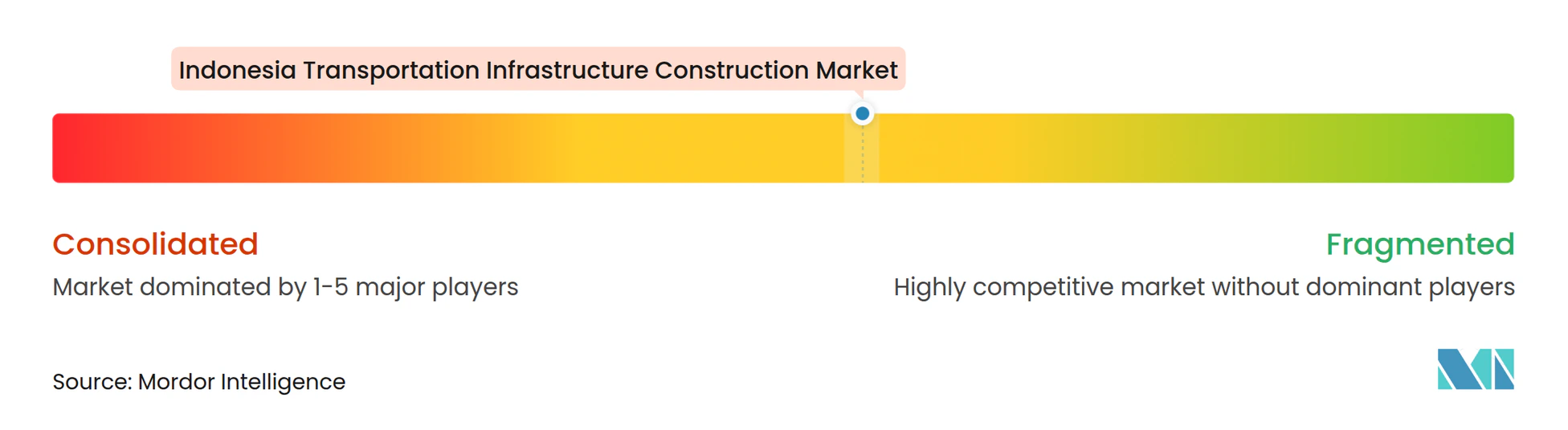
The Indonesia transportation infrastructure construction market is moderately concentrated among state-owned construction enterprises. Seven BUMN Karya companies have historically held a large share of contracts for toll roads, railways, ports, and airports. Danantara Indonesia is directing a plan to consolidate these companies into fewer holding structures by the end of 2026. The process includes balance-sheet repair, debt reduction, and reviews of asset values. It may temporarily limit the appetite of some state contractors for new awards while they manage existing obligations.
This period creates openings for private contractors and foreign partners on specialized packages. Toll road projects increasingly use groups that combine state-owned builders, PT Jasa Marga affiliates, and private investors. Port and rail work can draw Japanese, Chinese, and European firms where technical systems and financing requirements are demanding. PT Kereta Api Indonesia and PT Industri Kereta Api entered a partnership for 192 new commuter-line cars valued at USD 235 million, showing the growing role of domestic manufacturing in rail procurement. Equipment, systems, and manufacturing partners now influence project delivery as much as civil works providers.
Specialized rehabilitation and integrated transport solutions are areas with lower direct competition than standard road construction. Contractors that can design, build, finance, and operate freight assets are particularly relevant to mineral corridors outside Java. Environmental approval is also important for port and coastal reclamation work under Indonesia’s environmental impact assessment framework. PT Pelabuhan Indonesia’s agreement with PT Indo Konstruksi Mineral at Kendari Port is an example of a project tied directly to industrial freight demand. The Indonesia transportation infrastructure construction market has state-owned leaders with high contract volumes, while private contractors, joint ventures, and specialist suppliers remain meaningful across project types.
Indonesia Transportation Infrastructure Construction Industry Leaders
-
PT Hutama Karya (Persero)
-
PT Waskita Karya (Persero) Tbk
-
PT Wijaya Karya (Persero) Tbk
-
PT Pembangunan Perumahan (Persero) Tbk
-
PT Adhi Karya (Persero) Tbk
- *Disclaimer: Major Players sorted in no particular order
Indonesia Transportation Infrastructure Construction Market Companies Covered in this Report
- PT Hutama Karya (Persero)
- PT Waskita Karya (Persero) Tbk
- PT Wijaya Karya (Persero) Tbk
- PT Pembangunan Perumahan (Persero) Tbk
- PT Adhi Karya (Persero) Tbk
- PT Jasa Marga (Persero) Tbk
- PT Brantas Abipraya (Persero)
- PT Nindya Karya
- PT PP Presisi Tbk
- PT Wijaya Karya Beton Tbk
- PT Nusantara Infrastructure Tbk
- PT Kereta Api Indonesia (Persero)
- PT Len Railway Systems
- PT MRT Jakarta (Perseroda)
- PT Pelabuhan Indonesia (Persero)
- PT Indonesia Infrastructure Finance
- PT Sarana Multi Infrastruktur (Persero)
- PT Penjaminan Infrastruktur Indonesia (Persero)
- PT Sinohydro Indonesia
- PT Kajima Indonesia
Recent Industry Developments in Indonesia Transportation Infrastructure Construction Market
- August 2026: PT Pelabuhan Indonesia (Persero) (Pelindo) and PT Indo Konstruksi Mineral (IKM) signed a cooperation agreement to develop nickel ore loading and unloading infrastructure at Kendari Port, Southeast Sulawesi, establishing a commercial-scale minerals logistics hub that directly supports the national nickel downstreaming program.
- August 2026: PT PP (Persero) Tbk (PTPP) secured a USD 73 million contract to revitalize Terminal 1A at Jakarta's Soekarno-Hatta International Airport. Construction began on August 21, 2026, and is expected to take 365 days to complete. The project aims to increase the terminal's annual passenger handling capacity from 5.7 million to 10 million.
- May 2026: PT Kereta Api Indonesia (KAI) and PT PLN (Perusahaan Listrik Negara) broke ground on a nationwide railway electrification program, commencing with routes from Jakarta to Cikampek (West Java), Sukabumi (West Java), and Cilegon (Banten), underpinned by a business-to-business agreement signed in October 2025.
Indonesia Transportation Infrastructure Construction Market Report Scope
Segmentation Overview
| Roadways |
| Railways |
| Airways |
| Ports & Inland Waterways |
| New Construction |
| Renovation |
| Public |
| Private |
| Java |
| Sumatra |
| Kalimantan |
| Sulawesi |
| Rest of Indonesia |
| By Type | Roadways |
| Railways | |
| Airways | |
| Ports & Inland Waterways | |
| By Construction Type | New Construction |
| Renovation | |
| By Investment Source | Public |
| Private | |
| By Key Region | Java |
| Sumatra | |
| Kalimantan | |
| Sulawesi | |
| Rest of Indonesia |
Key Questions Answered in the Report
What is the 2026 value of Indonesia transportation infrastructure construction?
The sector is valued at USD 44.75 billion in 2026 and is forecast to reach USD 66.71 billion by 2032.
What is the forecast growth rate through 2032?
Construction activity is forecast to grow at a CAGR of 6.88% from 2027 to 2032.
Which transport type has the largest share in Indonesia?
Roadways lead with a 54.7% share in 2026, supported by toll road and national-road programs.
Which segment is expected to grow the fastest?
Railways are expected to expand at a 7.77% CAGR through 2032, supported by electrification and urban rail projects.
Why is private funding becoming more important for transport projects?
Private investment is forecast to grow at 7.45% because concessions and partnership structures require more private financing.
Which geography is growing fastest?
The rest of Indonesia is forecast to grow at a 6.42% CAGR through 2032, supported by food-estate logistics and regional connectivity projects.