
Indonesia Full-Truck-Load (FTL) Market Size and Share
Market Overview
| Study Period | 2021 - 2031 |
|---|---|
| Forecast Data Period | 2026 - 2031 |
| Base Year Market Size (2025) | USD 43.20 Billion |
| Market Size (2026) | USD 46.02 Billion |
| Market Size (2031) | USD 60.51 Billion |
| Growth Rate (2026 - 2031) | 5.62 % |
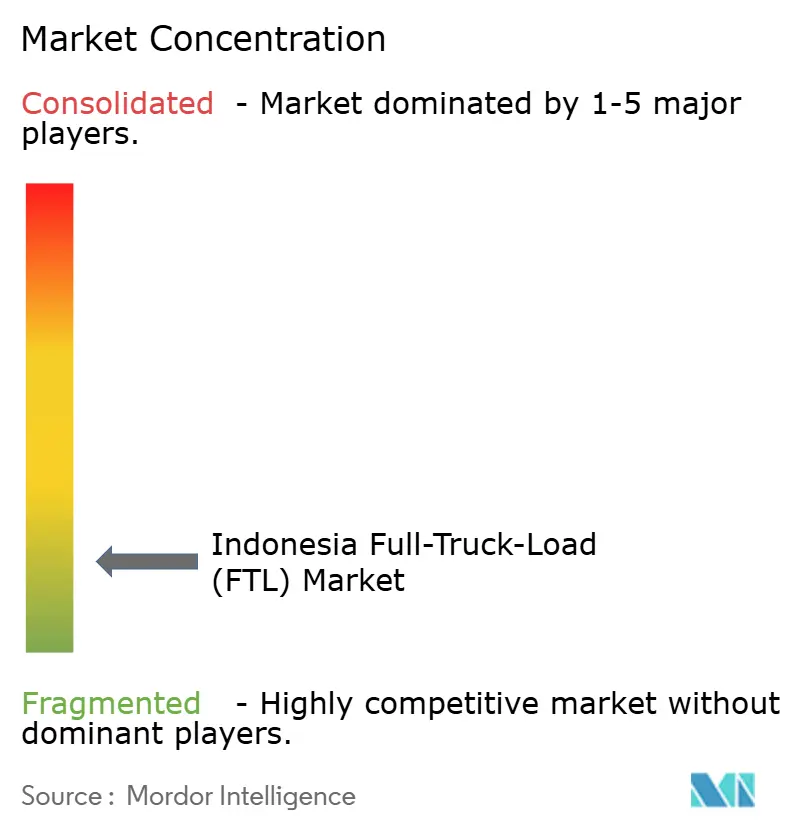
| Market Concentration | Low |
Major Players *Disclaimer: Major Players sorted in no particular order Image © Mordor Intelligence. Reuse requires attribution under CC BY 4.0. | |
Indonesia Full-Truck-Load (FTL) Market Analysis by Mordor Intelligence
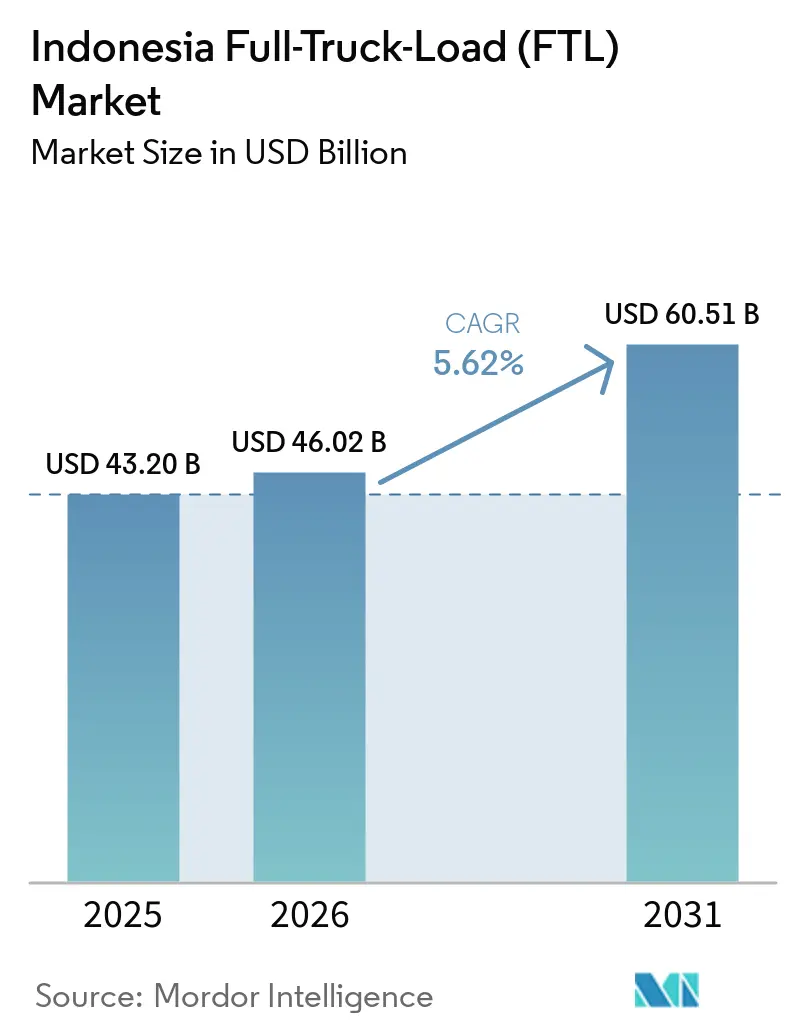
The Indonesia full-truck-load (FTL) market size was valued at USD 43.20 billion in 2025, and is estimated to grow from USD 46.02 billion in 2026 to reach USD 60.51 billion by 2031, at a CAGR of 5.62% during the forecast period (2026-2031).
Road freight remains central to domestic logistics, while the country’s island geography keeps dedicated truck movements important for moving freight between ports, industrial sites, and distribution centers. The National Logistics Ecosystem has reduced repeated documentation and improved the movement of cargo through major gateways, which supports higher truck utilization on connected routes.[1]World Customs Organization, “National Logistics Ecosystem, Indonesia’s Holistic Approach to Connecting Public Services,” WCO News, wcoomd.org Demand is also moving beyond Java as mining processing, retail distribution, and industrial investment create more consistent freight flows in other regions. Operators are competing through route coverage, cold-chain capability, digital freight matching, and better coordination with port and warehouse systems. The Indonesia full-truck-load (FTL) market has room for specialized providers where standard dry freight service is less suitable, particularly on mining, pharmaceutical, and inter-island routes.
Key Report Takeaways
- By destination, domestic freight held 62.89% of the Indonesia full-truck-load (FTL) market share in 2025, while international freight is forecast to grow at a 6.65% CAGR through 2031.
- By temperature control, dry freight accounted for 81.36% of the Indonesia full-truck-load (FTL) market size in 2025, while reefer freight is forecast to grow at a 7.39% CAGR through 2031.
- By haul length, long-haul freight held 73.89% of the Indonesia full-truck-load (FTL) market share in 2025, while local haul is forecast to grow at a 7.62% CAGR through 2031.
- By end-user industry, wholesale and retail trade accounted for 34.24% of the Indonesia full-truck-load (FTL) market size in 2025, while manufacturing is forecast to grow at a 7.58% CAGR through 2031.
- By region, Java held 32.53% of revenue in 2025, while Sulawesi is forecast to grow at an 8.33% CAGR through 2031.
Note: Market size and forecast figures in this report are generated using Mordor Intelligence’s proprietary estimation framework, updated with the latest available data and insights as of January 2026.
Indonesia Full-Truck-Load (FTL) Market Trends and Insights
Drivers Impact Analysis*
| Driver | (~) % Impact on CAGR Forecast | Geographic Relevance | Impact Timeline |
|---|---|---|---|
| National Logistics Ecosystem and Faster Door-to-Port Processing | +1.2% | National, with the strongest concentration at Java and Sumatra ports | Short term (≤ 2 years) |
| E-Commerce, Modern Retail, and Direct Distribution Expansion | +1% | Java, with spillover into secondary cities in Sumatra and Kalimantan | Medium term (2-4 years) |
| Toll-Road and Industrial-Corridor Connectivity Improvements | +0.9% | Java and Sumatra, including Jambi-Rengat and Probolinggo-Situbondo | Medium term (2-4 years) |
| Domestic Pharmaceutical and Biologics Cold-Chain Scaling | +0.6% | National, centered on Jakarta, Surabaya, and Bandung | Medium term (2-4 years) |
| Sulawesi Nickel-to-Battery Manufacturing Corridors | +0.5% | Sulawesi, with feeder demand in Maluku and Halmahera | Long term (≥ 4 years) |
| Digital Backhaul Matching and Higher Truck Utilization | +0.4% | National, particularly Java long-haul and Sumatra inter-city routes | Short term (≤ 2 years) |
| Source: Mordor Intelligence | |||
National Logistics Ecosystem and Faster Door-to-Port Processing
Indonesia’s National Logistics Ecosystem has changed the way cargo moves between port systems and road carriers. The program streamlines documentation and gives carriers a clearer view of cargo release activity. Its single-submission process reduces repeated submissions for vessel clearance, goods clearance, and licensing. QR-code authorization at autogates can also reduce manual checks that delay truck departures. The Indonesia full-truck-load (FTL) market benefits when operators can schedule trucks around more reliable gate-out times and use digital backhaul matching to limit empty trips.
E-Commerce, Modern Retail, and Direct Distribution Expansion
E-commerce, modern retail, and direct distribution are increasing the need for scheduled freight between factories, regional hubs, and stores. Manufacturers are increasingly sending full loads to distribution centers rather than relying on several layers of wholesale handling. This approach gives shippers more control over delivery timing and can increase the frequency of dedicated truck lanes. Toll-road expansion supports this shift by lowering travel times on established routes and improving access to industrial corridors. The Ministry of Public Works and Public Housing planned 2,461 km of toll-road development for 2025-2029, including 1,306 km in Java and 1,112 km in Sumatra.[2]Indonesia Manufacturing Center, “Indonesia Cold Chain Infrastructure Summit 2025,” Ministry of Industry, imc.kemenperin.go.id The Indonesia full-truck-load (FTL) market is likely to gain the most where new road capacity connects manufacturing clusters, logistics nodes, and large consumption centers.
Domestic Pharmaceutical and Biologics Cold-Chain Scaling
Pharmaceutical distribution rules are creating more demand for temperature-controlled transport. BPOM Regulation No. 20 of 2025 updated the Good Distribution Practices standards for temperature-sensitive pharmaceuticals. The Ministry of Health began construction of a National Pharmaceutical Installation in Tangerang in early 2026, after presenting Indonesia’s pharmaceutical supply chain to delegations from 30 countries in September 2025.[3]Indonesia Ministry of Health, “Kemenkes Tunjukkan Inovasi Rantai Pasok Kesehatan Indonesia di Hadapan 30 Negara,” Directorate General of Pharmaceuticals and Medical Devices, farmalkes.kemkes.go.idThe Indonesia Cold Chain Infrastructure Summit in 2025 identified cold-chain integration with the National Logistics Ecosystem as a national priority. These measures raise the importance of validated transport, temperature monitoring, and reliable handling at transfer points. The Indonesia full-truck-load (FTL) market, therefore, offers a clearer opening for carriers that can provide compliant reefer equipment and documented operating procedures.
Sulawesi Nickel-to-Battery Manufacturing Corridors
Sulawesi is creating another source of specialized demand through nickel processing and battery supply-chain investment. The Merdeka Battery Materials HPAL project in Indonesia's Morowali Industrial Park was planned with USD 1.8 billion of investment and 90,000 tons of annual mixed hydroxide precipitate capacity. Vale Indonesia’s Morowali project reached an equipment milestone in July 2026 when key autoclave equipment arrived in Sambalagi. These projects require the movement of ore, acid, chemicals, and processed materials under specialized loading and safety requirements. Their freight needs are more stable than spot shipments because they are linked to processing operations and construction schedules. The Indonesia full-truck-load (FTL) market can benefit where operators have equipment, trained staff, and route knowledge suited to these freight categories.
Restraints Impact Analysis*
| Restraint | (~) % Impact on CAGR Forecast | Geographic Relevance | Impact Timeline |
|---|---|---|---|
| Port Gate-Out Congestion and Unpredictable Dwell Time | -1% | National, most severe at Tanjung Priok, Tanjung Perak, and Belawan | Short term (≤ 2 years) |
| Zero Over Dimension Over Loading Compliance Cost | -0.8% | National, with priority enforcement on Java toll roads and Sumatra corridors | Medium term (2-4 years) |
| Cargo Theft and Corridor-Specific Security Premiums | -0.5% | Java, Sumatra, and Kalimantan inter-city routes | Short term (≤ 2 years) |
| Inter-Island Handoffs and Sparse Reefer-Service Infrastructure | -0.3% | Eastern Indonesia, including Sulawesi, Maluku, Papua, and Bali-Nusa Tenggara | Long term (≥ 4 years) |
| Source: Mordor Intelligence | |||
Port Gate-Out Congestion and Unpredictable Dwell Time
Port delays remain a direct constraint on truck productivity at Indonesia’s main container gateways. Indonesia’s Directorate General of Customs and Excise reported that nearly 10,000 containers were in longstay status at Tanjung Priok during 2025, and 3,100 documents were pending during the peak of the congestion. Reported dwell time at Tanjung Priok was 6-7 days, compared with the port authority’s 3-4 day target. A truck waiting for an uncertain release window can lose a full day that would otherwise be available for a productive trip. Cargo security on selected corridors and at warehouses also requires monitoring, driver controls, and secure parking, adding cost and operating requirements for high-value freight.
Zero Over Dimension Over Loading Compliance Cost
The Zero Over Dimension Over Loading program requires many operators to reconsider fleet specifications and payload practices. Between January and April 2025, the Motor Vehicle Weighing Implementation Unit inspected 752,000 vehicles, of which 129,887 exceeded legal load limits. Annual road-preservation expenditure linked to ODOL-related damage totaled IDR 41 trillion (USD 2.45 billion). Operators using overloaded vehicles may need to modify trailers or invest in compliant multi-axle equipment, which can pressure margins and reduce the legal tonnage moved by the same fleet size. Full enforcement is targeted for 2027, while a limited pilot is scheduled for mining and construction corridors by the end of 2026. Inter-island reefer services also face limited plug-in points and cold storage at pioneer ports, making continuous temperature-controlled transport harder across Sulawesi, Maluku, Papua, and Bali-Nusa Tenggara.
*Our forecasts treat driver/restraint impacts as directional, not additive. The impact forecasts reflect baseline growth, mix effects, and variable interactions.
Segment Analysis
By Destination: Domestic Freight Commands the Network, International FTL Accelerates
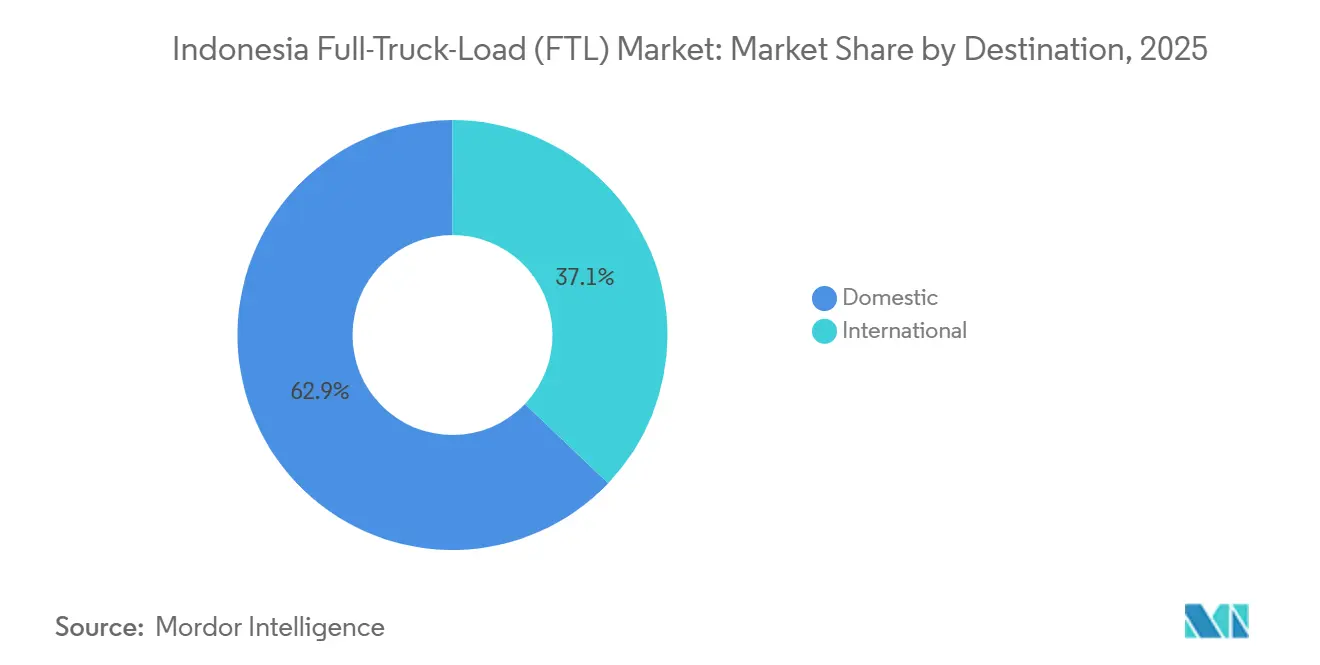
Domestic freight accounted for 62.89% of Indonesia full-truck-load (FTL) market share in 2025. Intra-island distribution and consumer demand across Java, Sumatra, and Sulawesi support this scale. Grocery replenishment, modern retail cycles, and manufacturing supply chains create regular full-load movements on routes such as Jakarta-Surabaya, Medan-Palembang, and Makassar-Palu. These established lanes give carriers frequent loading opportunities and allow shippers to control delivery timing more closely than mixed-load arrangements. Domestic service remains the operating base for many providers because it combines recurring demand with familiar route conditions.
International freight is the fastest-growing destination segment, with a projected 6.65% CAGR through 2031. Export-oriented manufacturers in Java use bonded truck lanes to reach Patimban and Tanjung Priok, while cross-border e-commerce fulfillment needs efficient movement to bonded logistics centers. The National Logistics Ecosystem can simplify documentation for these movements. DHL stated that Indonesia is among the top 30 countries for trade growth in speed and scale over the following 5 years. The Indonesia full-truck-load (FTL) market gains when bonded transport, port access, and manufacturer scheduling work as a coordinated system.



By Temperature Control: Dry Segment Dominates, Reefer Capacity Becomes a Strategic Differentiator
Dry freight held 81.36% of Indonesia full-truck-load (FTL) market size in 2025. Coal, palm oil, cement, packaged goods, and other bulk cargoes account for much of this demand. Standard dry operations face intense rate competition, so fuel efficiency, driver productivity, and reliable scheduling are important on high-density routes. The large dry base provides steady volumes but limited differentiation on mature corridors. Carriers must maintain dependable capacity while controlling costs in order to protect returns.
Reefer freight is the fastest-growing temperature-control segment, with a projected 7.39% CAGR through 2031. Pharmaceutical requirements, modern food retail, and aquaculture distribution from Sulawesi and East Java are supporting this growth. Electrical plug-in points and cold storage are not consistently available on inter-island routes. Operators with reefer fleets, monitoring systems, and compatible port processes can serve a more specialized customer set. The Indonesia full-truck-load (FTL) industry has a higher barrier to entry in reefer operations than in standard dry freight.
By Haul Length: Long-Haul Bulk Flows Anchor Revenue, Local Short-Haul Reshapes Distribution Economics
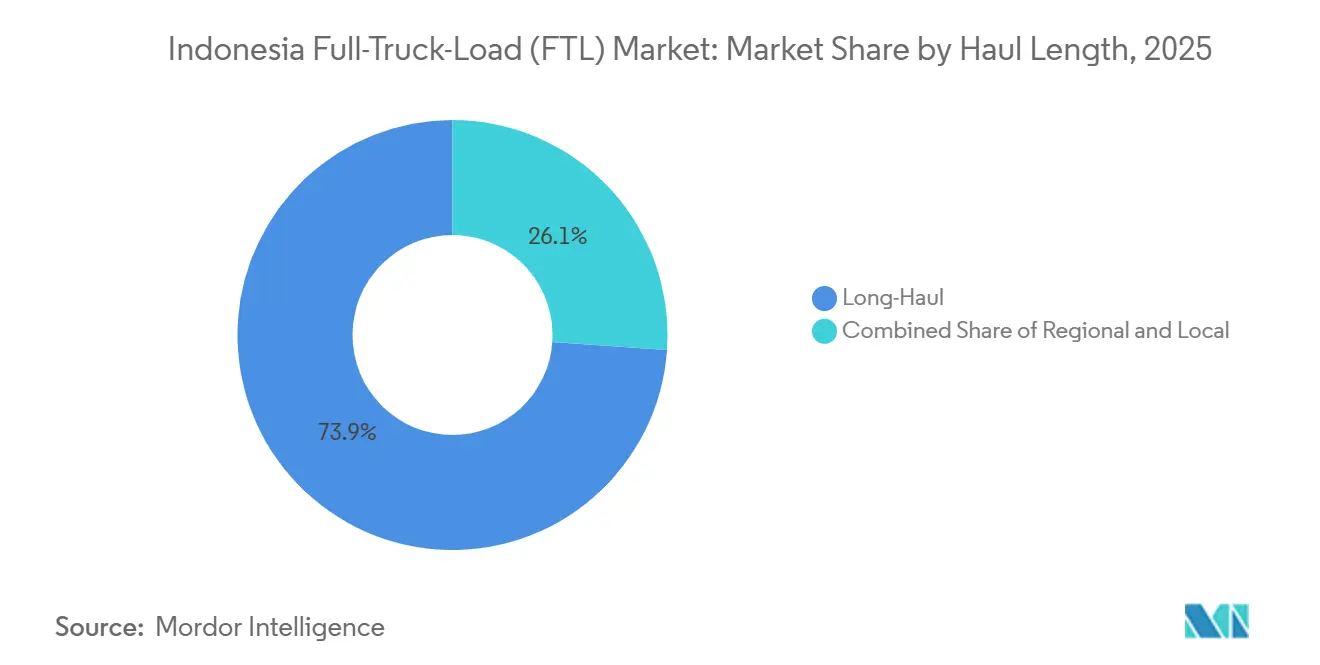
Long-haul freight held 73.89% of Indonesia full-truck-load (FTL) market share in 2025. Inter-provincial movements of palm oil, coal, and nickel ore support this scale. These loads are linked to extraction output, processing activity, and refinery throughput, rather than short-term changes in household demand. Operators need dependable maintenance, driver planning, and access to fuel and rest facilities on these routes. The segment remains important to Indonesia full-truck-load (FTL) market because it carries the country’s major commodity flows.
Local haul is the fastest-growing length segment, with a projected 7.62% CAGR through 2031. Urban fulfillment hubs in Jabodetabek, Surabaya, and Medan create more short-radius full-load lanes for e-commerce and fast-moving consumer goods distributors. These shippers move inventory between facilities rather than directly to consumers, creating frequent transfers between hub tiers. Terminal Teluk Lamong handled its first multimodal export shipment in 2025 through a rail-then-truck sequence from Semarang to Surabaya. Local trucks are increasingly part of multimodal distribution, not only standalone urban transport.
By End-User Industry: Retail Trade Holds Largest Share, Manufacturing Drives Fastest Growth
Wholesale and retail trade accounted for 34.24% of Indonesia full-truck-load (FTL) market revenue in 2025. Regional distribution centers help suppliers serve a large network of traditional trade outlets, while regular restocking creates predictable demand for dedicated truck movements. Agriculture, fishing, and forestry generate recurring freight from producing regions. Construction and oil and gas create high-value movements that often follow project activity. This retail base gives Indonesia full-truck-load (FTL) market a broad demand foundation across large cities and smaller regional centers.
Manufacturing is the fastest-growing end-user segment, with a projected 7.58% CAGR through 2031. Automotive hubs in Karawang, electronics clusters in Batam, and battery processing in Morowali require frequent deliveries under tighter schedules. The CATL-led consortium began a USD 6 billion integrated battery project in 2025 that covered mining, processing, cell manufacturing, and recycling. Mining and quarrying also maintain high tonnage in Kalimantan and Sulawesi, where alternatives can be limited. The Indonesia full-truck-load (FTL) industry serves these customers best when it can meet handling, documentation, and delivery requirements consistently.
Geography Analysis
Java held 32.53% of Indonesia full-truck-load (FTL) market revenue in 2025. Karawang, Bekasi, and Cikarang generate freight from automotive, consumer goods, and pharmaceutical manufacturing, while Jabodetabek and the Bandung-Surabaya corridor remain major domestic lanes. Dense customer locations support regular scheduling and higher truck utilization. Sumatra is the second-largest regional base because of palm oil, fisheries exports, and expanding modern trade in Medan, Palembang, and Pekanbaru. The Trans-Sumatra Toll Road had 1,046 km of operational highway across 15 sections in 2025, supporting faster north-south freight movement.
Sulawesi is the fastest-growing geography, with an 8.33% CAGR through 2031. The region’s Indonesia full-truck-load (FTL) market size is supported by processing activity in Morowali and Pomalaa. Laterite ore, sulfuric acid, mixed hydroxide precipitate, and industrial chemicals require more specialized handling and safety controls than standard coal movements. Kalimantan remains important for coal mining and new industrial investment linked to the Nusantara capital relocation project. Road quality on feeder routes to mining concessions continues to add cost for operators in both established and emerging corridors.
Bali and Nusa Tenggara serve tourism supply chains, consumer goods imports, and fresh-food distribution to resorts. Inter-island complexity supports higher freight rates, while Papua and Maluku depend on combinations of trucking, feeder vessels, and ro-ro services. Planned ro-ro connections could create more road-freight demand at port-adjacent distribution nodes, but dependable transfer infrastructure remains necessary for scale.
Competitive Landscape
The Indonesia full-truck-load (FTL) market is highly fragmented, with no single operator dominant across all routes and haul types. Domestic integrators with trucking assets compete alongside Japanese joint-venture logistics providers and global third-party logistics companies. Java’s manufacturing corridors attract the broadest overlap in service coverage, while outer-island routes remain more fragmented and can command higher prices. DHL has more than 4,000 employees and 180 facilities in Indonesia across DHL Express, DHL Global Forwarding, and DHL Supply Chain. The Indonesia full-truck-load (FTL) market rewards route coverage, dependable execution, and the ability to serve freight needs that standard providers cannot easily handle.
Digital freight matching is changing the competition on established corridors. Platforms with verified transport management systems give cargo owners visibility into spot and contracted capacity. Kargo Technologies operates an AI-enabled transport management system connected to more than 40,000 trucks. The company closed a bridge financing round of up to USD 7 million in late 2025 and targets 2,500 electric vehicles in service by the end of 2026. These moves show how platform operators can compete through equipment use, route data, and cost control rather than fleet ownership alone.
Specialized freight offers a clearer path to differentiation, as shown by DSV’s 2026 Healthcare Logistics Excellence Workshop for more than 60 pharmaceutical manufacturers and life sciences distributors focused on GDP-compliant cold-chain operations. DHL Express opened a 10,000 square meter Surabaya Gateway in December 2025 with investment of more than EUR 9 million (USD 10.59 million).[4]DHL Group, “DHL Commits to Helping Indonesia Expand Its Fast-Growing Sectors and Aid Its Rise as a Global Trade Hub,” DHL Group, dhl.com Vale Indonesia progressed its Morowali project in July 2026, strengthening the case for heavy-haul services in Sulawesi. The Indonesia full-truck-load (FTL) market has stronger pricing potential in pharmaceutical, cold-chain, hazardous-material, and mining-corridor transport than in standard dry routes.
Indonesia Full-Truck-Load (FTL) Industry Leaders
PT Seino Indomobil Logistics
Waresix
Puninar Logistics
Deliveree Indonesia
PT Siba Surya
- *Disclaimer: Major Players sorted in no particular order

Recent Industry Developments
- August 2026: The Asian Infrastructure Investment Bank approved a USD 1.15 billion toll road financing package, with AIIB contributing USD 941 million, for the Jambi-Rengat section, Phase 1 of the Trans-Sumatra Toll Road, a strategic project prioritized under Indonesia's RPJMN 2025-2029. When operational, this 67.45 km section is expected to cut the Sp. Ness-Merlung travel time from 2 hours 15 minutes to 45 minutes, materially reducing FTL transit cost on one of Sumatra's most congested freight routes.
- July 2026: PT Vale Indonesia's Indonesia Growth Project Morowali reached a construction milestone when the key autoclave equipment for its HPAL nickel processing facility arrived in Sambalagi, Morowali, Central Sulawesi, in July 2026, marking substantial progress toward commissioning a low-carbon nickel plant that would supply mixed hydroxide precipitate for EV battery production, adding sustained heavy-haul FTL demand to the Morowali corridor.
- December 2025: DHL Express inaugurated its Surabaya Gateway facility, a 10,000 square meter purpose-built processing center backed by more than EUR 9 million (USD 10.59 million) in investment, to strengthen logistics connectivity across East Java and adjacent regions, to support growing demand in e-commerce, life sciences, and new energy sectors.
- February 2025: Merdeka Battery Materials signed an agreement to build a USD 1.8 billion HPAL plant at the Indonesia Morowali Industrial Park in Central Sulawesi, operated by PT Sulawesi Nickel Cobalt (SLNC), with an annual production capacity of 90,000 tons of mixed hydroxide precipitate. Construction began in January 2025 with a mid-2026 operations target, anchoring long-duration specialized FTL demand on the Morowali corridor.


Indonesia Full-Truck-Load (FTL) Market Report Scope
| Domestic |
| International |
| Dry |
| Reefer |
| Long-Haul (More than 500 miles) |
| Regional (100–500 miles) |
| Local (Less than 100 miles) |
| Agriculture |
| Fishing and Forestry |
| Construction |
| Manufacturing |
| Oil and Gas |
| Mining and Quarrying |
| Wholesale and Retail Trade |
| Others |
| Java (Jakarta & BOD) |
| Sumatra |
| Kalimantan |
| Sulawesi |
| Bali and Nusa Tenggara |
| Papua Region and Maluku Islands |
| By Destination | Domestic |
| International | |
| By Temperature Control | Dry |
| Reefer | |
| By Haul Length | Long-Haul (More than 500 miles) |
| Regional (100–500 miles) | |
| Local (Less than 100 miles) | |
| By End-User Industry | Agriculture |
| Fishing and Forestry | |
| Construction | |
| Manufacturing | |
| Oil and Gas | |
| Mining and Quarrying | |
| Wholesale and Retail Trade | |
| Others | |
| By Region | Java (Jakarta & BOD) |
| Sumatra | |
| Kalimantan | |
| Sulawesi | |
| Bali and Nusa Tenggara | |
| Papua Region and Maluku Islands |


Key Questions Answered in the Report
What is the projected value of Indonesia full-truck-load freight in 2031?
The Indonesia full-truck-load (FTL) market is forecast to reach USD 60.51 billion by 2031, registering at a 5.62% CAGR from 2026.
Which destination segment leads dedicated truck freight in Indonesia?
Domestic freight led with 62.89% revenue share in 2025, supported by intra-island retail and manufacturing distribution.
Which temperature-control service is growing fastest?
Reefer freight is forecast to grow at a 7.39% CAGR through 2031, driven by pharmaceutical compliance, food retail, and aquaculture distribution.
Why is Sulawesi important for truck freight providers?
Sulawesi is forecast to grow at an 8.33% CAGR through 2031 as nickel processing creates specialized demand for ore, chemicals, and processed materials.
How does Zero ODOL affect transport operators in Indonesia?
Operators may need compliant trailers or multi-axle equipment, and full enforcement is targeted for 2027 after a 2026 pilot.
Where are the strongest specialized service opportunities?
Pharmaceutical cold-chain distribution, Eastern Indonesia reefer routes, and Sulawesi mining corridors offer more specialized requirements than standard dry freight.
Page last updated on:


 Your data is secure and never sold or shared.


