
India POS Terminals Market Analysis by Mordor Intelligence
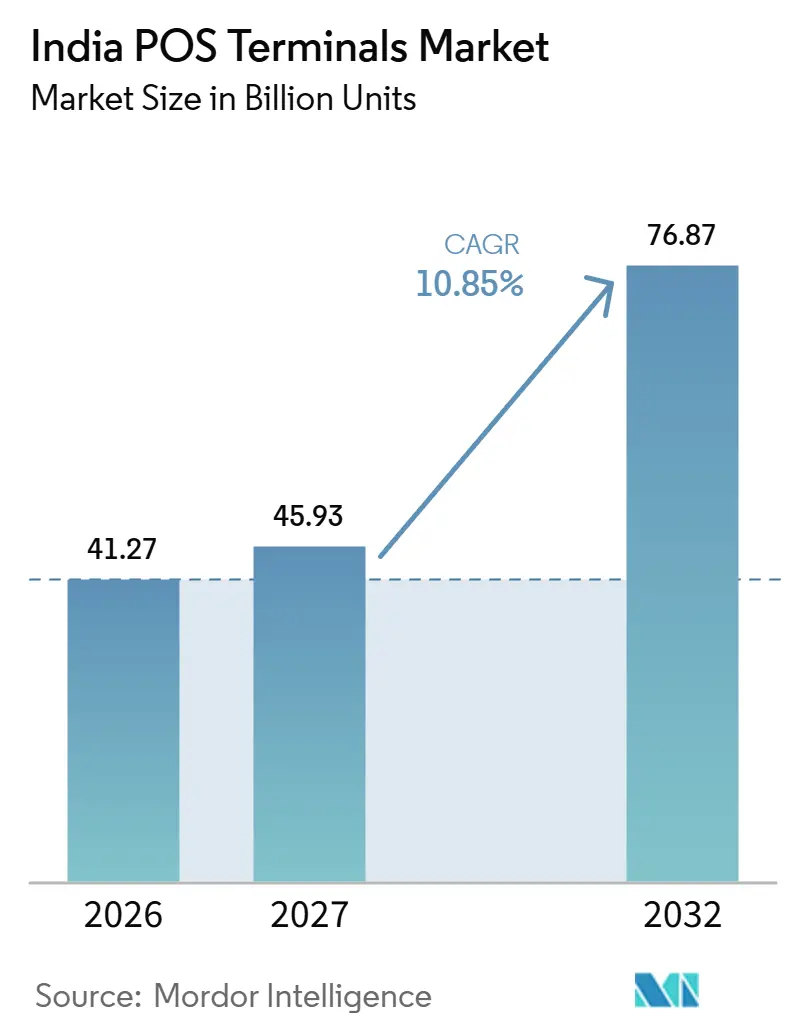
The India POS terminals market size is expected to increase from 41.27 billion units in 2026 to 45.93 billion units in 2027 and reach 76.87 billion units by 2032, growing at a CAGR of 10.85% over 2027-2032.
In India, a broader credit-card base strengthens demand for physical acceptance where merchants need payment options beyond basic QR collection. Multifunction terminals can connect card and installment acceptance with the same payment endpoint, giving hardware a role alongside code-based collection. Retail expansion and institutional payment needs add deployment opportunities, while small-merchant transaction economics limit the revenue available to support devices. Suppliers can respond through integrated acceptance and continuing service, making growth depend on useful merchant placement and sustainable support rather than equipment distribution alone.
Key Report Takeaways
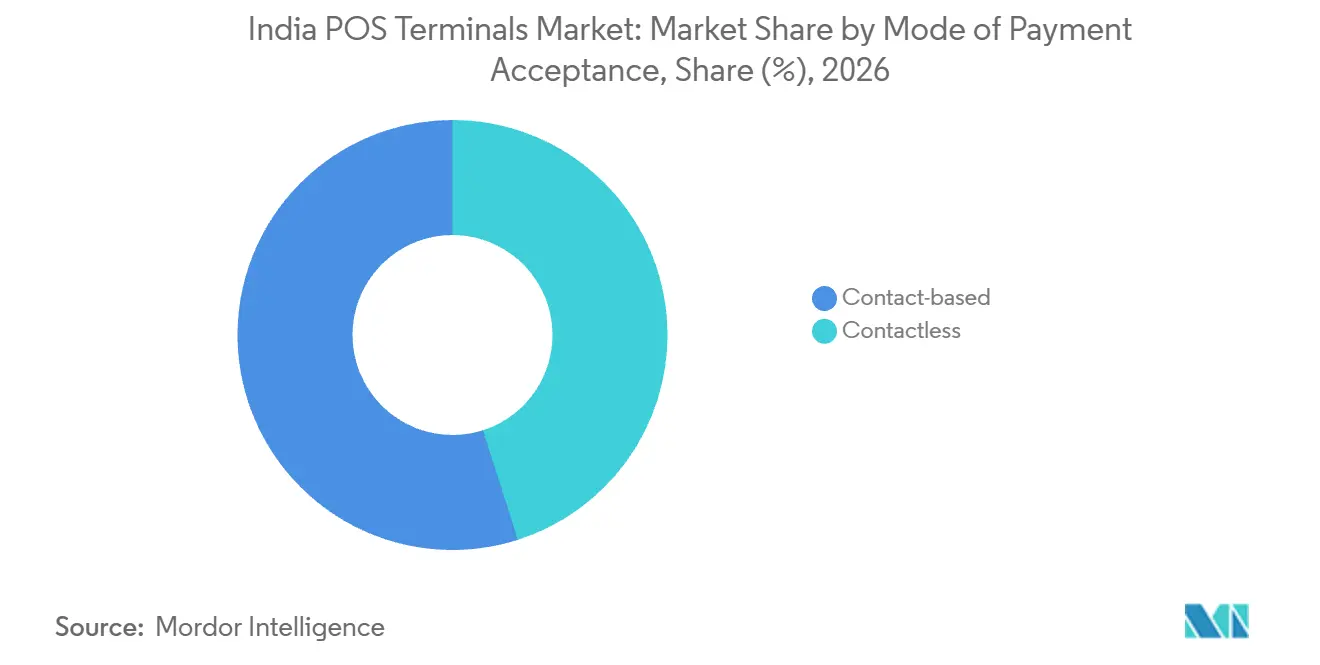
- By payment acceptance mode, contact-based terminals held a 54.92% share of the India POS terminals market size in 2026, while contactless is forecast to grow fastest at an 11.95% CAGR over 2027-2032.
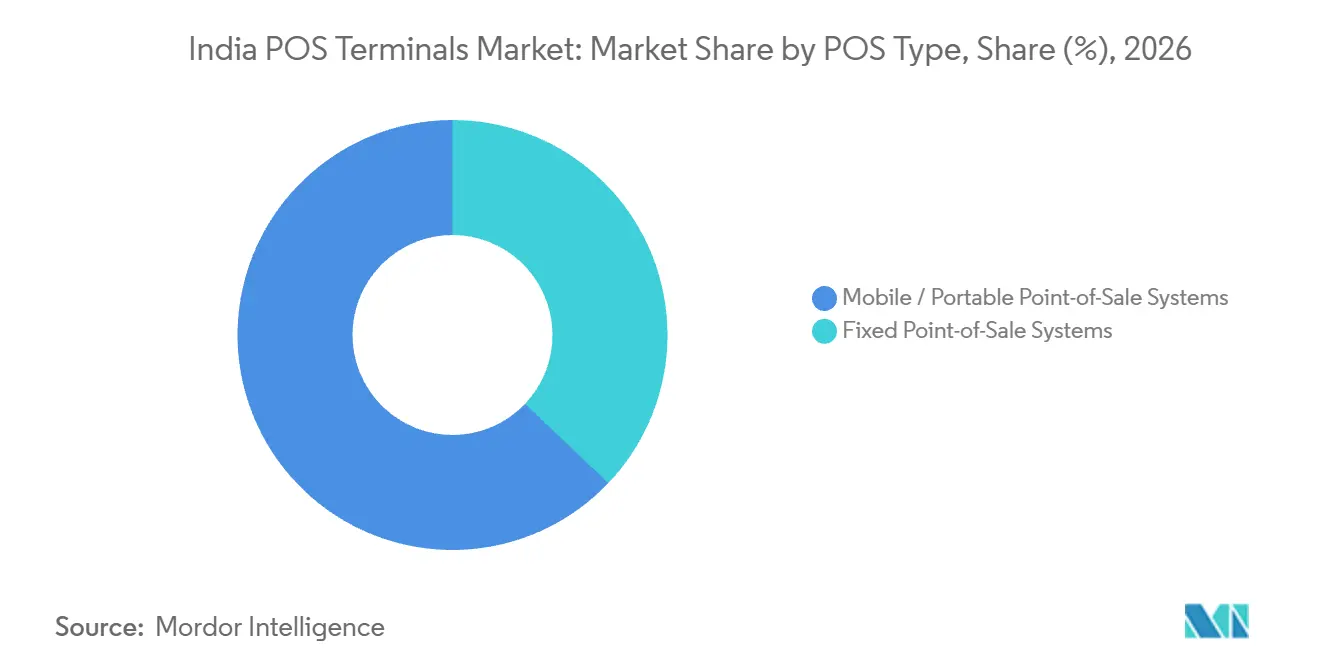
- For POS type, mobile and portable systems had a 62.91% India POS terminals market share in 2026 and are projected to be the fastest-growing segment at a 12.2% CAGR over 2027-2032.
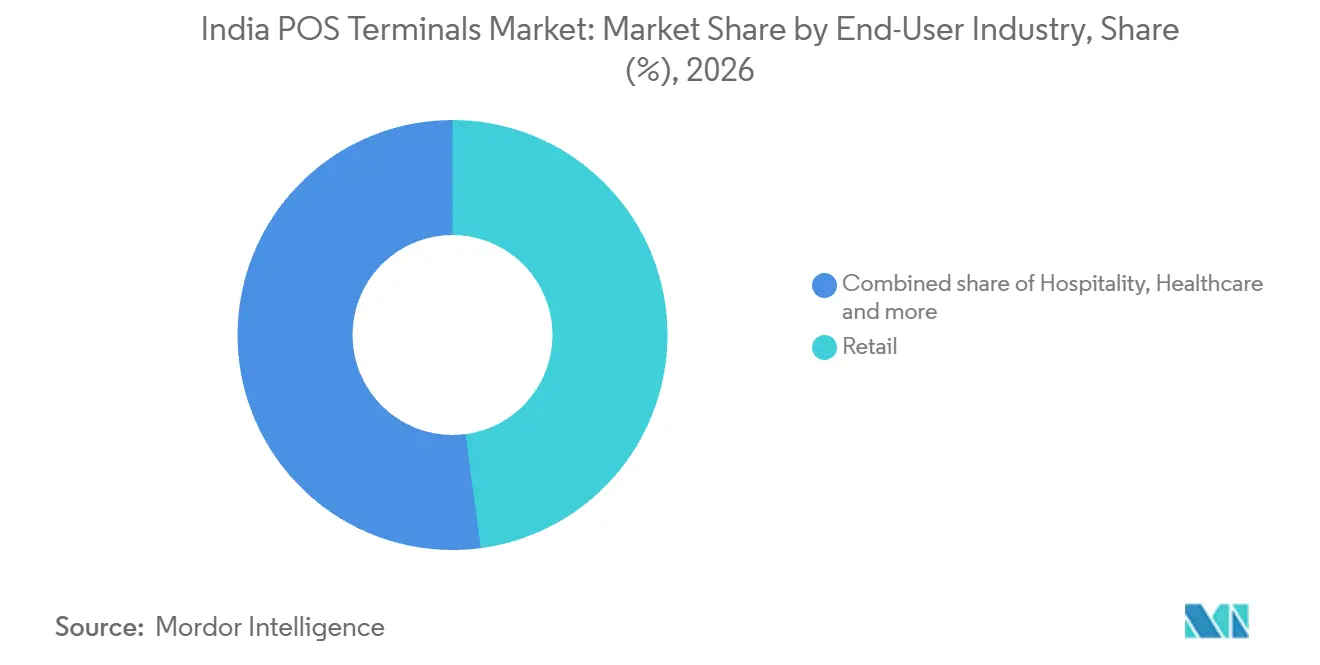
- Across end-user industries, retail accounted for 47.9% of installed terminal stock in 2026, and healthcare is expected to grow fastest at a 12.6% CAGR over 2027-2032.
Note: Market numbers in this report are based on Mordor Intelligence's proprietary estimation framework, which combines nine months of actuals with Q4 projections for base year 2026.
Market Trends and Insights
Drivers Impact Analysis of India POS Terminals Market*
| Driver | (~) % Impact on CAGR Forecast | Geographic Relevance | Impact Timeline |
|---|---|---|---|
| PIDF subsidies accelerated Tier-3-Tier-6 roll-outs | +2.5% | Nationwide | Short term (≤ 2 years) |
| Surging credit-card base (>100 mn) lifts card-swipe volumes | +4.1% | Nationwide | Long term (≥ 4 years) |
| Omni-payment Android POS (cards + UPI + BNPL in one device) | +4.5% | Nationwide | Medium term (2-4 years) |
| GST e-invoice compliance driving real-time POS upgrades | +1.8% | Nationwide | Medium term (2-4 years) |
| Smart-mall boom in Tier-2/3 cities raises fixed-POS demand | +1.6% | Gokul Road in Hubballi | Long term (≥ 4 years) |
| Advanced analytics/AI add-ons boosting retailer ROI | +0.9% | Nationwide | Long term (≥ 4 years) |
| Source: Mordor Intelligence | |||
PIDF subsidies accelerated Tier-3-Tier-6 roll-outs
Subsidized deployment lowered the initial expansion hurdle for payment acceptance beyond major urban centers. During FY2024-25, the Reserve Bank of India (RBI) said Payments Infrastructure Development Fund (PIDF) subsidies aided digital-payment growth by subsidizing acceptance-infrastructure availability, especially in Tier 3-6 centers. By November 30, 2025, the Department of Financial Services reported 841,018 physical payment devices deployed through PIDF in Tier 5-6 centers. The scheme's stated term ended December 31, 2025, making its established footprint the relevant foundation for subsequent terminal opportunities. These were installed physical acceptance devices, giving acquirers an equipped merchant base rather than an unserved prospect pool. Follow-on demand at those locations depends on whether transaction activity justifies keeping equipment active after the initial deployment support.
Surging credit-card base (>100 mn) lifts card-swipe volumes
India had 124.05 million credit cards outstanding in August 2026, compared with 112.34 million in August 2025. Credit-card transactions at POS terminals in India totaled 2.868 billion in 2025, up 23% year over year.[1] These separate measures strengthen the commercial case for physical acceptance by showing both a large card base and rising credit-card transaction volume at terminals. Higher transaction throughput can improve the case for funding a terminal at locations that attract card spending. For acquiring banks, targeting those locations links deployment to a measurable payment need and limits exposure to devices with insufficient card use.
Omni-payment Android POS (cards + UPI + BNPL in one device)
In April 2025, The Economic Times described Indian POS terminals processing card, buy-now-pay-later, and UPI payments. This combination can make a physical device relevant to merchants whose acceptance needs extend beyond a single payment channel. The article also attributed terminals' continued relevance to consumer preference for card payments on large-ticket purchases and banks' push to issue credit cards. For Android-based terminal strategies, the demand opportunity depends on turning that breadth into a practical acceptance offer at the merchant location. A seller of large-ticket items has a reason to keep a physical terminal that accepts cards alongside UPI, because those are the purchases customers prefer to pay for by card.
GST e-invoice compliance driving real-time POS upgrades
Invoice compliance can make billing-system integration more valuable for businesses within the specified reporting scope. The Government of India lowered the GST e-invoice turnover threshold under Notification 13/2020-Central Tax, effective August 1, 2023, for its specified taxpayer and invoice scope. GST e-invoice reporting covers GST invoices, credit notes, and debit notes for B2B, SEZ, export, and deemed-export supplies. For taxpayers with internal IT teams, large transaction volumes, and a need for real-time e-invoice generation, IRIS IRP offers optional direct API integration. The resulting compliance workload centers on covered businesses' B2B and export invoice reporting, including the associated credit and debit notes.
Restraints Impact Analysis of India POS Terminals Market*
| Restraint | (~) % Impact on CAGR Forecast | Geographic Relevance | Impact Timeline |
|---|---|---|---|
| Zero-MDR low-value UPI erodes small-merchant economics | -1.8% | Nationwide | Long term (≥ 4 years) |
| QR-code ubiquity dampens new POS demand | -1.6% | Nationwide | Long term (≥ 4 years) |
| High total-cost-of-ownership for micro-merchants | -0.6% | Nationwide | Medium term (2-4 years) |
| RBI PA-Physical directions raise compliance cost | -0.5% | Nationwide | Short term (≤ 2 years) |
| Source: Mordor Intelligence | |||
Zero-MDR low-value UPI erodes small-merchant economics
Zero-MDR acceptance limits the revenue pool available to support device-based services for small merchants. From October 15, 2026, qualifying P2PM small merchants receiving low monthly UPI QR receipts directly into their accounts retained exemption from MDR, including on individual payments above the standard threshold.[3] In its September 2026 FAQ, the Department of Financial Services said only well-capitalized technology conglomerates could sustain long-term operating losses under zero-MDR UPI processing. For a provider considering physical terminals at those merchants, payment processing alone can offer a weak basis for recovering equipment and service costs. Unless the terminal supplies monetizable functions beyond exempt UPI flows, its provider faces the continuing expense of supporting a physical device with limited transaction-fee income.
QR-code ubiquity dampens new POS demand
Low-cost QR acceptance weakens the case for adding a physical terminal when it meets a merchant's immediate payment need. India had 731.4 million UPI QR codes in December 2025, compared with 633.4 million in December 2024. Worldline's 2025 review described low-cost QR acceptance expanding while merchants maintained POS where card spending justified the device economics. For a merchant adequately served by QR, postponing a terminal can preserve payment access while avoiding another physical asset. Suppliers face a narrower conversion opportunity, with a new installation dependent on a payment need that the merchant's QR-only acceptance leaves unresolved.
*Our forecasts treat driver/restraint impacts as directional, not additive. The impact forecasts reflect baseline growth, mix effects, and variable interactions.
India POS Terminals Market Segment Analysis
By Mode of Payment Acceptance:
Contact Capability Supports Acceptance ContinuityContact-based terminals accounted for a 54.92% share of the India POS terminals market size in 2026, making them the largest segment. Because the share measures installed stock, renewal can sustain a large contact-based footprint even when the format chosen for an entirely new location differs. Replacing a card-contact device at an equipped merchant preserves an existing acceptance point rather than creating a new one, so renewal demand does not depend on finding an additional merchant. The supplier's commercial task is to retain the installed account through its next replacement decision, while judging new-location opportunities separately.
Contactless is the fastest-growing segment, with a projected CAGR of 11.95% over 2027-2032. PhonePe and Mastercard launched smartphone contactless payments on September 29, 2025, with a phased rollout for eligible Mastercard cardholders. The feature requires an NFC-enabled Android phone and a merchant terminal with NFC functionality. By allowing an eligible phone to become the payment instrument, this arrangement can expand the ways an existing contactless endpoint is used. New placements become commercially compelling where eligible mobile-payment use encounters an absence of NFC-capable merchant equipment.

By POS Type:
Portability Makes Concurrent Collection Points Commercially ImportantMobile and portable point-of-sale systems represented a 62.91% India POS terminals market share in 2026 and are the largest and fastest-growing segment, with a projected CAGR of 12.2% over 2027-2032. Portability lets the payment point move with the service interaction instead of tying card acceptance to one counter. Where service is completed away from a desk, that design can bring collection to the customer rather than redirecting the customer to pay. The segment's appeal lies in extending collection within an existing operation, which gives suppliers an opportunity beyond new-store installations.
Portable acceptance changes the unit requirement when a merchant serves customers at several collection points. One movable terminal can cover positions used at different times, while overlapping collections can require separate devices for simultaneous payments. Fixed point-of-sale systems suit buyers whose checkout remains concentrated at a permanent counter. For a merchant combining counter service with collection elsewhere, portable units can supplement the fixed checkout instead of replacing its full equipment base.
By End-User Industry:
Chain Rollouts and Institutional Collections Shape DeploymentRetail was the largest segment, accounting for 47.9% of installed terminal stock in 2026. Reliance Retail opened 1,564 stores in FY2025-26, taking its total store count to 20,160. Its broader retail ecosystem spans physical stores, digital commerce, and distribution platforms. A large retailer's store expansion can create repeated acceptance decisions across the same business, giving terminal providers a route to location-by-location deployment. Winning a chain-level specification can turn successive store openings into repeated deployments at new payment points, linking the supplier's opportunity to the retailer's rollout program.
Healthcare is the fastest-growing segment, with a projected CAGR of 12.6% over 2027-2032. In April 2025, Kerala's Health Minister reported a first phase equipping 313 government hospitals with digital payment systems. POS devices for that phase were procured through State Bank of India and Canara Bank. At that announcement, efforts to extend the system to the remaining hospitals were described as underway. Equipment supply through banks can organize a first-phase hospital order, but completing wider coverage is a separate delivery task.
Geography Analysis
Western and southern metros present several retail settings for physical acceptance, with commercial-space activity across Mumbai, Bengaluru, and Hyderabad. In Q3 2026, retail leasing totaled 0.45 million square feet in Hyderabad, 0.35 million square feet in Mumbai, and 0.24 million square feet in Bengaluru. For a terminal provider pursuing merchant openings, this geographic spread can support a deployment approach repeated across separate metropolitan territories. Local deployment execution matters more than one national sales territory, because each city's retail-location activity has to be matched with merchants actually opening for business.
Delhi NCR was the largest retail leasing market in Q3 2026, at 0.55 million square feet, ahead of Hyderabad, Mumbai, and Bengaluru. This leading leasing position identifies a substantial northern pool of potential retail locations for acceptance providers, subject to those premises opening for business. For a provider entering that channel, leased premises offer a way to identify prospective merchant locations for physical card acceptance before fixing the scale of a terminal deployment. Where those premises become operational, early engagement can align a terminal offer with the merchant's initial choice of payment locations, concentrating the sales opportunity around store opening.
Punjab illustrates a different acceptance route through municipal collections, extending the commercial setting beyond private retail premises. On July 24, 2025, the Municipal Corporation Phagwara launched a POS-based property-tax collection system in collaboration with Federal Bank. Residents could make on-the-spot property-tax payments using debit or credit cards through the terminals. A municipal deployment of this type can bring a defined public collection function and a banking partner into the same physical acceptance arrangement. The relevant commercial unit is the collection workflow shared by the civic body and its bank partner, creating an institutional route distinct from individual shop deployment.
Regulatory Framework and Outlook
The table compares selected jurisdictions from the perspective of physical-terminal providers that also operate payment aggregation. The Bureau of Indian Standards lists POS terminals under its Compulsory Registration Scheme against IS 13252 (Part 1):2010. RBI's 2025 Payment Aggregator Directions require aggregators, including those handling physical POS transactions, to obtain annual system and cybersecurity audits from CERT-In-empanelled auditors. Aggregators must submit the audit reports to RBI within its prescribed timelines.
Regulatory Table of India POS Terminals Market
| Decision factor | India | Punjab |
|---|---|---|
| Primary authority | Bureau of Indian Standards; Reserve Bank of India | Bureau of Indian Standards; Reserve Bank of India, under the national frameworks |
| Key instruments or direction | Compulsory Registration Scheme, IS 13252 (Part 1):2010; Payment Aggregator Directions, 2025 | National POS registration framework and Payment Aggregator Directions, 2025 |
| Commercial effect | Product-registration reference plus annual aggregator audits and reporting | The national device framework and aggregator audit duties apply to operations in Punjab |
| Current policy attractiveness | Medium | Medium |
| Future direction of policy attractiveness | No change | No change |
| Source: Mordor Intelligence | ||
The BIS POS listing dates to May 13, 2015, while the aggregator audit duty has applied since September 15, 2025. The Ministry of Electronics and Information Technology permits concurrent use of IS 13252 (Part 1):2010 and IS/IEC 62368 (Part 1):2023 through November 1, 2028, with the older standard withdrawn afterward. The medium ratings reflect the balance between an established route to market and continuing compliance work in India and Punjab. The defined migration window allows staged adoption of the replacement standard, while continuing registration and audit obligations support a No change attractiveness judgment for both jurisdictions.
Value Chain Stages
The value chain compares terminal provision, merchant deployment, and ongoing fleet support as distinct sources of supplier earnings. Verifone supplies mobile POS devices in India, while Pine Labs offers its Touch Android terminal with several payment-acceptance functions. Merchant access adds a separate commercial layer, with Indian Bank offering rental and one-time purchase models after enrollment and validation. These arrangements make the route from equipment selection to an active merchant location as important as the device itself.
Value Chain Analysis Table of India POS Terminals Market
| Primary activity | Key participants | Value capture | Bottleneck | Resilience response |
|---|---|---|---|---|
| Terminal provision | Device suppliers such as Verifone and Pine Labs | Equipment sales | Device selection limits available acceptance functions | Match terminal capabilities to the intended payment mix |
| Merchant enrollment and deployment | Merchant acquirers such as HDFC Bank and Indian Bank | Acquiring commissions; terminal rentals or purchase payments | Incomplete merchant validation before dispatch | Validate merchant records before scheduling terminal dispatch |
| Fleet management and servicing | Fleet managers such as Hitachi Payment Services; bank service providers such as HDFC Bank | Recurring management and servicing revenue | Physical repair coverage can constrain service continuity | Combine fleet oversight with repair coverage suited to the deployment area |
| Source: Mordor Intelligence | ||||
Hitachi Payment Services reported 3.2 million POS devices under management as of May 2026, illustrating the scale of the support layer.[2] HDFC Bank gives POS servicing turnaround of 2 working days in its top 30 cities and 4 working days beyond them. For a distributed merchant network, that service distinction makes local support capacity part of the economics of keeping terminals usable.
Competitive Landscape
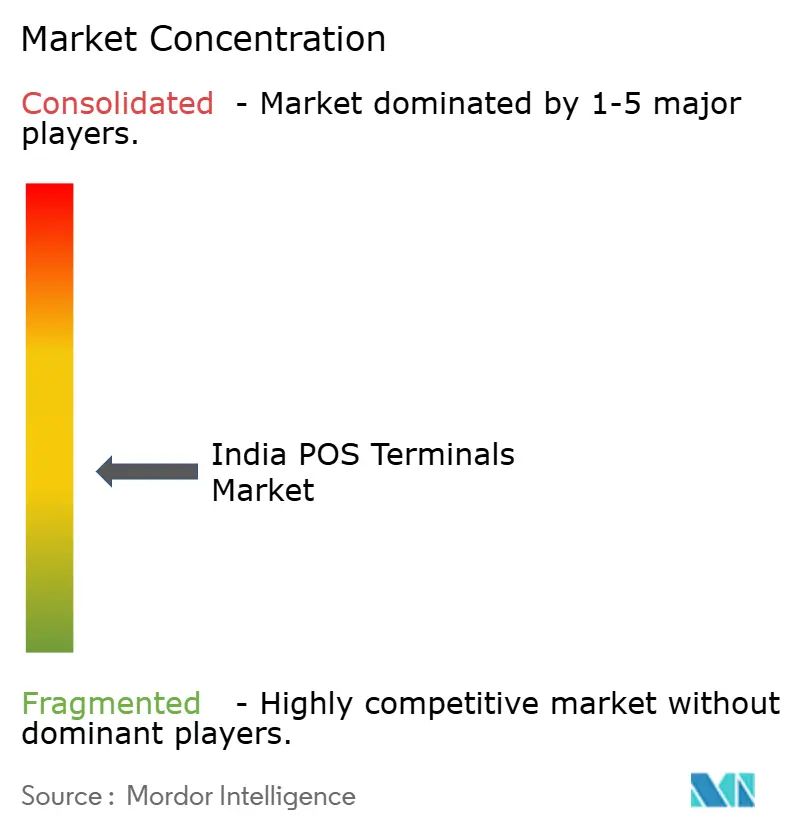
Competition is dispersed across terminal suppliers and payment aggregators, with Pine Labs Limited offering POS machines and payment terminals. One 97 Communications Limited (Paytm) offers POS devices accepting debit and credit cards, Paytm Wallet, net banking, and UPI. BillDesk acquired Worldline India's merchant-acquiring infrastructure, including POS terminals, through a sale completed on August 3, 2026. Mswipe Technologies Private Limited supplies POS terminals supporting dynamic QR, NFC payments, and card-dip acceptance. Innoviti Technologies Private Limited is authorized to aggregate physical in-store payments, adding a service role to a field in which device capabilities and merchant access both matter.
Paytm's merchant-payment business connects a recurring customer relationship with its acceptance-device offer. At the company level, Paytm reported 15.1 million merchant subscriptions in the quarter ended March 31, 2026, including 2.7 million net additions year over year. This merchant-payment subscription base gives recurring service relationships commercial importance alongside the initial provision of equipment. A challenger offering only hardware competes with a provider that can approach an existing subscriber for subsequent device and service needs, making access to the merchant account valuable beyond the first equipment sale.
Worldline and BillDesk also entered a long-term technology and software pact for BillDesk to continue using Worldline payment software. This preserves a separate technology relationship alongside the transfer of operating ownership, making software continuity part of the competitive direction. BillDesk agreed on February 25, 2026 to combine its online payment aggregation network with Worldline India's merchant-acquiring infrastructure, aiming at an integrated platform across online, in-store, and bank-level payments. At announcement, the transaction was subject to regulatory approvals and closing conditions. Terminal suppliers face a rival whose platform is designed to span online and in-store payments.
India POS Terminals Industry Leaders
-
Pine Labs Limited
-
One 97 Communications Limited (Paytm)
-
Worldline India Private Limited
-
Mswipe Technologies Private Limited
-
Innoviti Technologies Private Limited
- *Disclaimer: Major Players sorted in no particular order
India POS Terminals Market Companies Covered in this Report
- Pine Labs Limited
- One 97 Communications Limited (Paytm)
- Worldline India Private Limited
- Mswipe Technologies Private Limited
- Innoviti Technologies Private Limited
- Razorpay Payments Private Limited (Ezetap)
- Verifone India Sales Private Limited
- Ingenico International India Private Limited
- SBI Payment Services Private Limited
- HDFC Bank Limited
- ICICI Bank Limited
- Axis Bank Limited
- RBL Bank Limited
- Kotak Mahindra Bank Limited
- Union Bank of India
- BharatPe (Resilient Innovations Private Limited)
- PhonePe Limited
- First Data (India) Private Limited
- Hitachi Payment Services Private Limited
- PayU Payments Private Limited
Key Opportunities for Market Participants
The opportunities compare merchant conversion, portable acceptance, and bundled distribution as different routes to additional physical terminal deployment. India's installed POS terminal base expanded during 2025. Worldline characterized acceptance as QR-first for mass use, with POS terminals complementing QR for higher-value transactions. Together, these premises favor targeted additions where a physical device expands the payment options available at a merchant location.
Market Opportunities Table of India POS Terminals Market
| Opportunity | Why now | Buyer / lead segment | Recommended play | Main barrier | Likely beneficiaries |
|---|---|---|---|---|---|
| Add card acceptance at QR-first locations | Higher-value POS use complements QR acceptance | Merchants serving higher-value purchases | Deploy a physical card terminal where QR alone leaves a payment need | Enough incremental card activity to sustain the device | Card-terminal suppliers and merchant acquirers |
| Portable acceptance at additional collection points | Physical acceptance infrastructure expanded in 2025 | Merchants adding payment locations away from a fixed counter | Place portable terminals at collection points with a defined payment flow | Keeping dispersed devices active and supported | Portable-terminal providers and deployment partners |
| Bank-bundled terminal provision | Broader physical acceptance creates a larger deployment channel | Acquiring banks and payment service providers | Bundle terminal placement with acquiring and continuing device support | Recovering equipment and support costs from merchant activity | Terminal suppliers and acquiring-service providers |
| Source: Mordor Intelligence | |||||
The central opening is selective physical acceptance alongside QR, with a clear reason for each additional deployed device. A merchant conversion succeeds commercially when the terminal enables payments that its existing acceptance arrangement does not adequately serve. Distribution and support then determine whether that additional capability can be delivered across more locations without undermining the provider's deployment economics.
Recent Industry Developments in India POS Terminals Market
- Sep 2026: On September 24, PhonePe announced plans to deploy more than 5 million payment devices, including SmartSpeakers and POS devices, over 12 months, with approximately half of the mixed total targeted to rural India.
- Aug 2026: Worldline completed the sale of its Indian payment activities to BillDesk, including the merchant-acquiring business covering POS terminals, and entered a long-term pact for BillDesk to continue using Worldline payment software.
- Jan 2026: The Reserve Bank of India authorized Innoviti Technologies to operate as a payment aggregator for online and physical in-store transactions.
India POS Terminals Market Report Scope and Research Methodology
Market Definition and Coverage
The India POS terminals market measures the installed stock of physical payment acceptance terminals deployed at merchant locations in India. Each terminal is classified by its supported contact-based or contactless acceptance mode, fixed or mobile/portable form, and the end-user industry where it is deployed.
Scope exclusions: Pure software-only POS applications, QR code stickers without a terminal device, payment gateway services that do not require a POS terminal, separately sold terminal parts and maintenance services, and POS terminal installations outside India are excluded.
Segments Covered in This Report
- By Mode of Payment Acceptance
- Contact-based
- Contactless
- By POS Type
- Fixed Point-of-Sale Systems
- Mobile / Portable Point-of-Sale Systems
- By End-User Industry
- Retail
- Hospitality
- Healthcare
- Transportation and Logistics
- Other End-user Industries
Data Sources, Market Sizing, and Validation
Desk Research
Public sources such as the Reserve Bank of India payment-system indicators provide recurring counts of POS terminals and contextual card and QR measures, while the central bank's Payments Infrastructure Development Fund releases describe subsidized physical-device deployment and eligible locations. The Department of Financial Services annual report adds scheme-level deployment evidence, and Worldline's India Digital Payment Report offers an independent view of terminal and QR acceptance trends. These sources help distinguish installed terminal signals from broader payment touch points and transaction activity.
Company filings, investor materials, annual reports and reputable business press can supplement these public series with product launches, deployment plans, channel arrangements and replacement signals when the statements are specific to India. These named sources are illustrative rather than exhaustive, and further sources inform collection, validation and clarification.
Primary Interviews and Surveys
Primary research would seek views from India-focused terminal suppliers, acquiring banks, payment service providers, deployment and servicing partners, and merchant-side payment or operations leaders across retail, hospitality, healthcare and transport. Respondents would be asked to check the secondary evidence on active deployments, device retirement and replacement, terminal format, acceptance capability and end-user mix, while unresolved gaps would be tested through follow-up questions and reconciled against RBI and channel evidence before the model is updated.
Distribution of primary research fieldwork respondents
| Company type | Respondent position | Region |
|---|---|---|
| Top tier: 35% | CXOs: 20% | |
| Mid tier: 45% | Functional/Unit leaders: 35% | |
| Smaller Players: 20% | Managers: 45% |
Market-Sizing & Forecasting
The model starts with a top-down estimate of India's installed physical terminal stock, using the prior-year base and adjusting it for new placements and device retirements. RBI payment-system indicators supply the national reference series for terminal counts and for card and QR activity. Card-present activity, merchant onboarding and PIDF deployment indicate placement demand, while contactless and mobile-terminal adoption, retail and service-location expansion, and replacement timing help explain changes in device mix. Scenario analysis carries these indicators through the forecast period, and evidence on deployments by acceptance mode, fixed or portable form, and end-user setting is used to build segment shares. Selective bottom-up checks compare disclosed supplier or acquiring-channel roll-outs and sampled active-terminal counts with the national stock. Primary respondents can challenge the direction and timing of each variable forecast, and any missing roll-out or retirement detail is handled with a documented range rather than treated as a confirmed count.
Data Validation & Update Cycle
Analysts triangulate the stock estimate against RBI series, payment-network and channel indicators, public deployment disclosures and respondent checks, then investigate any abrupt change or material difference between independent signals before sign-off. A mismatch in active-device definitions, geography, or replacement timing triggers source review and targeted re-contact of relevant India respondents, with corrections recorded against the affected input. The series is refreshed annually, reviewed between cycles when a material policy or deployment event changes the outlook, and subjected to a fresh source and arithmetic pass before delivery.
Mordor Intelligence's India Pos Terminals Market Size Measured Against Other Published Estimates
Published estimates for India's POS terminal market diverge because the sources measure terminal counts in different years and under different definitions, while the report counts physical devices in the installed stock. Mordor Intelligence's baseline measures the installed unit stock, while Industry Research Firm A counts POS terminals in India through FY2025 and Industry Research Firm B publishes a cumulative-installation forecast ending in FY2026.
Key Gap Drivers are the timing and construction of those unit counts. Industry Research Firm A's prospectus-sourced series shows India's terminal count increasing through FY2025, so its earlier stock measure is below a later-year installed base after further placements. Industry Research Firm B's older forecast defines the market as cumulative terminal installations across suppliers and channels, including rented and inactive devices, and projects continued additions but a slowing growth rate. That forecast vintage and decelerating path yield a lower accumulated count than a later estimate that reflects continued deployment.
Benchmark comparison
| Source | Market Size | Gaps in Research Methodology |
|---|---|---|
| Mordor Intelligence | 45.93 billion units (2027) | |
| Industry Research Firm A | 11.1 million units (FY2025) | Its older fiscal-year stock and documented multi-year expansion leave a smaller accumulated base than the later measurement. |
| Industry Research Firm B | 7.89 million units (FY2026 estimate) | The older forecast vintage projects a decelerating installation trajectory, placing its cumulative stock below a later update that reflects continued terminal additions. |
The comparisons place the external estimates at earlier points in India's terminal rollout, and the forecast from the older research vintage also carries a slower additions path. Their role is to show how measurement year and forecast vintage shape the reported unit count, while the FY2025 terminal series provides the nearer observed-stock reference.
Key Questions Answered in the Report
What is the India POS terminals market size and growth outlook?
The installed base is forecast to rise from 45.93 billion units in 2027 to 76.87 billion units by 2032, at a CAGR of 10.85% over 2027-2032.
What drives demand for physical POS terminals in India?
A larger credit-card base and combined payment functions support adoption. India had 124.05 million credit cards outstanding in August 2026.
Which POS terminal format leads installed units in India?
Mobile and portable point-of-sale systems held 62.91% of installed units in 2026 and are forecast to grow fastest at a CAGR of 12.2% over 2027-2032.
Which companies compete in India's POS terminal industry?
Participants include Pine Labs Limited, One 97 Communications Limited (Paytm), BillDesk, Mswipe Technologies Private Limited, and Innoviti Technologies Private Limited. BillDesk acquired Worldline's Indian payment activities in August 2026.
What limits additional POS terminal deployment in India?
Low-cost QR acceptance and limited fee income on exempt UPI flows constrain deployment economics. India had 731.4 million UPI QR codes in December 2025.
How do terminal deployment settings differ across Indian regions?
Retail activity informs opportunities in Mumbai, Bengaluru, Hyderabad, and Delhi NCR. In Punjab, Phagwara launched POS-based property-tax collection with Federal Bank in July 2025.