
India Modern Methods Of Construction Market Size and Share
Market Overview
| Study Period | 2021 - 2032 |
|---|---|
| Forecast Data Period | 2027 - 2032 |
| Base Year Market Size (2026) | USD 16.32 Billion |
| Market Size (2027) | USD 17.76 Billion |
| Market Size (2032) | USD 27.45 Billion |
| Growth Rate (2027 - 2032) | 9.10 % |
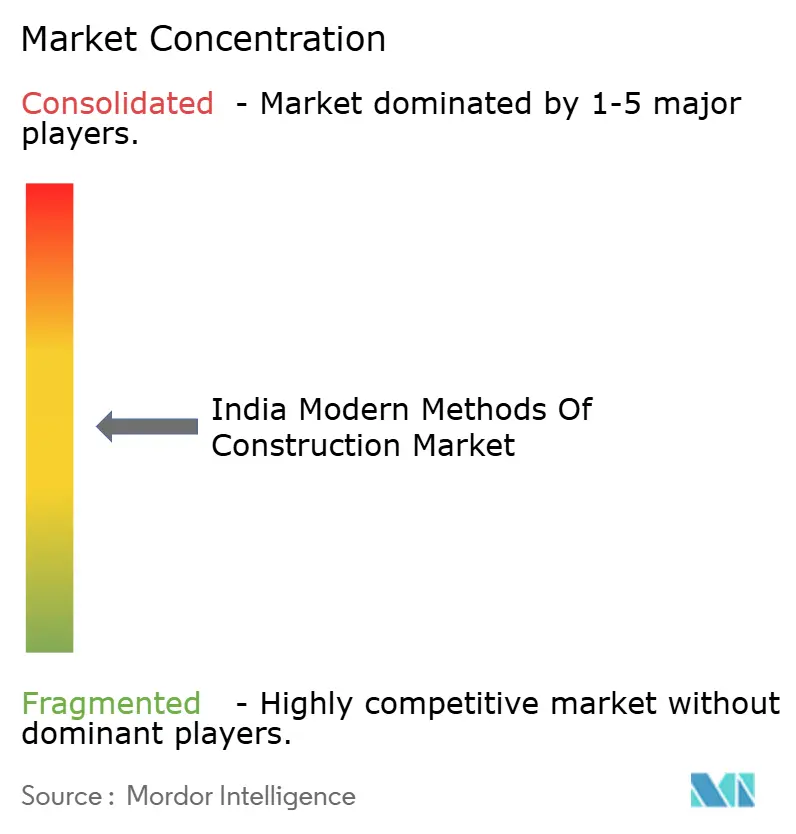
| Market Concentration | Medium |
Major Players *Disclaimer: Major Players sorted in no particular order Image © Mordor Intelligence. Reuse requires attribution under CC BY 4.0. | |
India Modern Methods Of Construction Market Analysis by Mordor Intelligence
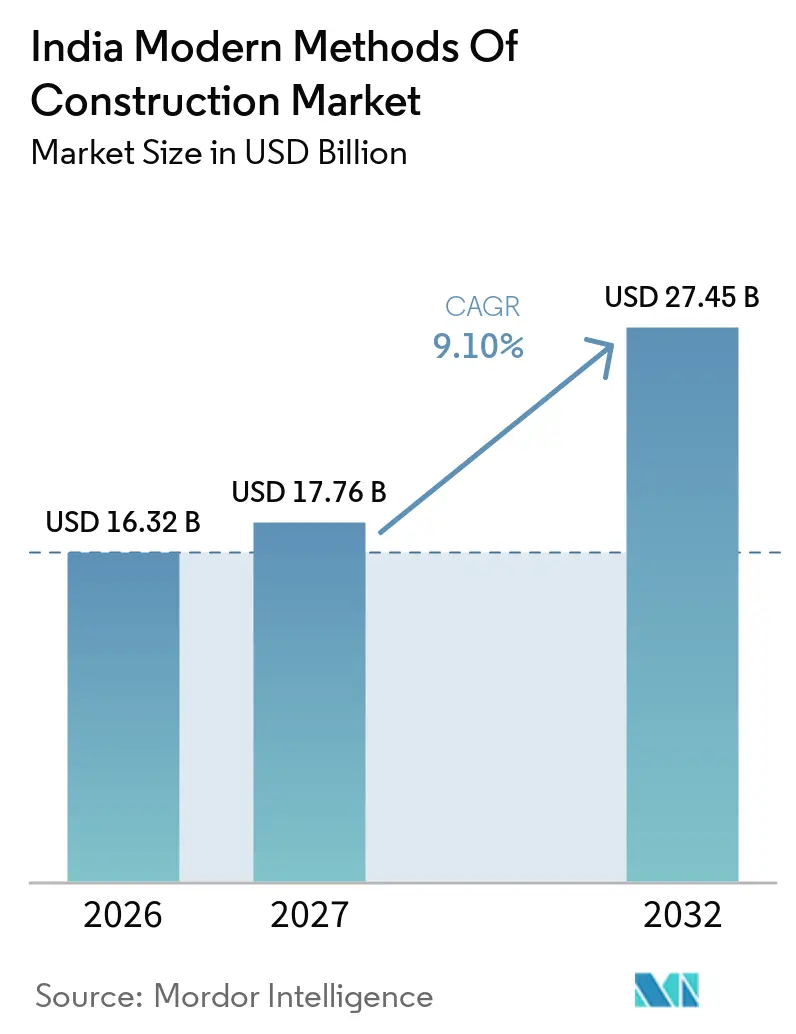
The India Modern Methods Of Construction Market size is projected to be USD 16.32 billion in 2026, USD 17.76 billion in 2027, and reach USD 27.45 billion by 2032, growing at a CAGR of 9.10% from 2027 to 2032.
India's modern methods of construction market demand is supported by the need to deliver urban housing faster, manage a shortage of skilled site workers, and complete industrial facilities on schedule. Government housing programs give suppliers a visible project pipeline, while data centers, warehouses, and offices create demand for systems that reduce site work. This favors manufacturers that can combine factory output with dependable installation and transport planning. Approval processes, local regulations, and heavy-lift logistics still limit the use of larger modules outside major corridors. The India modern methods of construction market therefore offers the strongest opportunities where schedule certainty and repeatable designs matter more than conventional site methods.
Key Report Takeaways
- By construction type, prefabricated & modular construction held 98.70% of the India modern methods of construction market share in 2026, while 3D construction is forecast to grow at a 31.80% CAGR through 2032.
- By material type, concrete accounted for 41% of the India modern methods of construction market size in 2026, while timber is projected to expand at a 9.70% CAGR through 2032.
- By application, residential held a 52.10% revenue share in 2026, while commercial is forecast to advance at a 9.26% CAGR through 2032.
- By geography, rest of India held a 36.10% revenue share in 2026, while Bengaluru is forecast to grow at a 9.88% CAGR through 2032.
Note: Market numbers in this report are based on Mordor Intelligence's proprietary estimation framework, which combines nine months of actuals with Q4 projections for base year 2026.
India Modern Methods Of Construction Market Trends and Insights
Drivers Impact Analysis*
| Drivers | (~) % Impact on CAGR Forecast | Geographic Relevance | Impact Timeline |
|---|---|---|---|
| Urban Housing and Rental-Housing Shortages | +5.8% | National, concentrated in Mumbai, Delhi NCR, Bengaluru, Hyderabad, and Chennai. | Short term (≤ 2 years) |
| Government Affordable-Housing and Infrastructure Programs | +4.2% | National, with early gains in Uttar Pradesh, Maharashtra, and Tamil Nadu | Short term (≤ 2 years) |
| Rapid Expansion of Industrial, Data-Center, and Logistics Assets | +3.1% | Mumbai, Bengaluru, Hyderabad, Chennai, Delhi NCR, Pune, and Visakhapatnam | Medium term (2-4 years) |
| Skilled-Labor Shortages and Schedule Compression | +2.4% | National, acute in South and West India construction corridors | Medium term (2-4 years) |
| Growing Adoption of BIM, DfMA, and Precast Systems | +1.6% | National, concentrated in metro project corridors | Long term (≥ 4 years) |
| Demand for Cost-Controlled Construction in Tier-2 and Tier-3 Cities | +1.0% | National, with early gains in Lucknow, Surat, Indore, Raipur, and Coimbatore | Medium term (2-4 years) |
| Source: Mordor Intelligence | |||
Urban Housing and Rental-Housing Shortages
India’s shortage of affordable urban homes gives India's modern construction market a large volume case. The supply-to-demand ratio across 8 major cities declined from 1.05 in 2019 to 0.36 in 2025, which indicates a persistent gap between available homes and demand. UN-Habitat places the existing affordable urban housing shortage at 9.6 million units and expects cumulative demand to reach 30 million units by 2030[1]; Mumbai’s price-to-income ratio of 14.3 shows why many median-income households cannot access formal ownership. Factory production can shorten building cycles by 30% to 50%, which makes it relevant for projects operating under public delivery targets. The India modern methods of construction market benefits when housing providers need consistent delivery across repetitive unit designs.
Government Affordable-Housing and Infrastructure Programs
Government procurement is a central source of demand for India's modern methods of construction market. Under the combined PMAY-U and PMAY-U 2.0 programs, more than 1.25 crore homes have been sanctioned, and more than 1 crore homes have been completed and delivered as of August 2026[2]. PMAY-U 2.0, launched in September 2024, seeks to support 1 crore additional beneficiaries by 2029. Its Technology Innovation Grant and the Housing Technology Challenge India have placed precast and 3D printing systems within formal housing delivery programs. The government has also approved demonstration housing projects in Chhattisgarh, Puducherry, and Rajasthan to show cost-effective construction technologies. These programs encourage contractors to use repeatable systems when project schedules and quality checks are closely monitored.
Rapid Expansion of Industrial, Data-Center, and Logistics Assets
Data centers, warehouses, and industrial facilities create repeat business for pre-engineered and modular suppliers. TCS HyperVault secured 264 acres in Hyderabad for a data center campus with a capacity of up to 1 GW, illustrating the scale of shell construction now required for digital infrastructure. CtrlS Datacenters also announced a joint venture with CPP Investments to develop hyperscale campuses across India. Steel-frame pre-engineered buildings are used where clear spans and short construction windows are necessary. Factory-cut steel members, precast components, and bolted assembly can reduce weather-related site delays. The India modern methods of construction market can benefit when data center and logistics projects require predictable handover dates.
Skilled-Labor Shortages and Schedule Compression
A shortage of skilled workers is increasing the value of controlled factory work in India's modern methods of construction market. India’s construction sector faces a shortage of 2 million skilled workers, including carpenters, electricians, plumbers, masons, and formwork specialists. The Project Management Institute projects that India will need 395,000 additional construction project professionals by 2035[3]. Limited access to trained trades can extend project schedules and increase the chance of rework when less experienced workers replace specialists. Off-site systems move more work into a managed production environment and reduce the number of skilled activities required at a project site. L&T has linked labor cost and skill scarcity to a global modularization opportunity of USD 100 billion to USD 150 billion over 5 years.
Restraints Impact Analysis*
| Restraints | (~) % Impact on CAGR Forecast | Geographic Relevance | Impact Timeline |
|---|---|---|---|
| Fragmented State-Level Approval and Building-Code Systems | -2.8% | National, most acute in Maharashtra, Uttar Pradesh, and smaller municipal jurisdictions | Medium term (2-4 years) |
| Limited Heavy-Module Transport and Crane Infrastructure | -1.9% | National, most severe in Tier 2 and Tier 3 corridors outside National Highway networks | Long term (≥ 4 years) |
| Low Factory Utilization Risk Outside Major Corridors | -1.2% | National, particularly affecting Tier 3 and semi-urban project pipelines | Long term (≥ 4 years) |
| Buyer Preference for Conventional On-Site Construction | -0.8% | National, most entrenched in retail residential projects and Tier 2 markets | Short term (≤ 2 years) |
| Source: Mordor Intelligence | |||
Fragmented State-Level Approval and Building Code Systems
Different approval systems add cost and uncertainty to India's modern methods of construction market. The National Building Standard, notified in April 2026, leaves the application of several fire safety and structural provisions to state and municipal authorities. The Confederation of Indian Industry has identified fragmented approvals and procedural delays as important barriers to construction schedules. Some jurisdictions provide digital clearance systems, while others require engagement with several authorities over months. Standard module designs often need local revisions when building bylaws or fire interpretations differ. The Building Materials and Technology Promotion Council’s performance appraisal process can validate new technologies, but it does not create a single approval route across the country.
Limited Heavy-Module Transport and Crane Infrastructure
Road and lifting limitations restrict the use of large volumetric modules beyond major urban corridors. A 2026 field study of a 72-metric-ton over-dimensional cargo movement identified truss bridges, ghat sections, railway crossings, and narrow urban approaches as important constraints. Delays in permits, incomplete route surveys, and weak last-mile roads can increase the cost of moving oversized loads across state borders. The availability of high-capacity crawlers and mobile cranes is also lower outside Tier 1 cities. Manufacturers often respond by designing smaller units that fit axle-load limits and can be moved by standard trucks. This approach supports wider deployment, but it reduces design flexibility for projects that would otherwise use larger modules.
*Our forecasts treat driver/restraint impacts as directional, not additive. The impact forecasts reflect baseline growth, mix effects, and variable interactions.
Segment Analysis
By Construction Type: Prefabricated & Modular Construction Holds the Largest Position
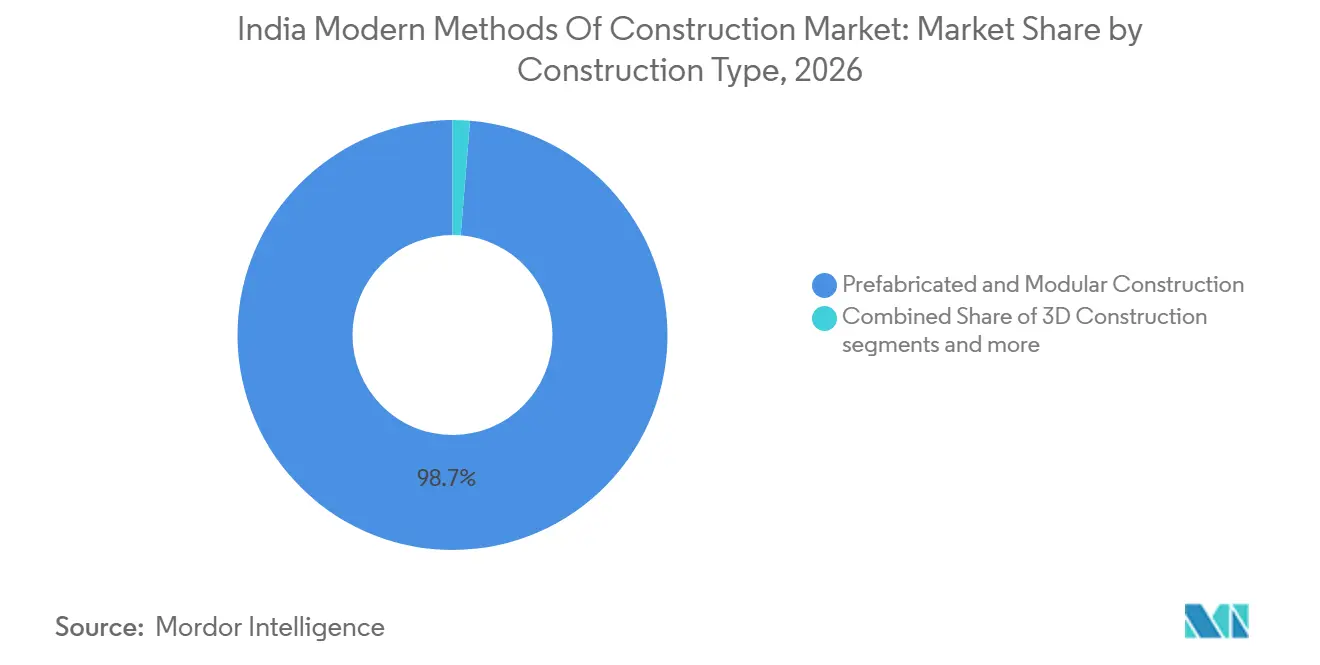
Prefabricated & modular construction held a 98.70% share in 2026. This established segment includes panelized systems, volumetric modules, and hybrid configurations used in housing, light commercial buildings, and institutional facilities. Light gauge steel panels, structural insulated panels, and timber-frame panels support projects that need a fast enclosure and consistent detailing. Precast concrete, steel-framed, and timber-framed volumetric units are used for repetitive buildings such as staff housing, student accommodation, and hotels. Hybrid systems retain a conventional structural frame while shifting panels and fit-out work into factories.
The Ministry of Housing and Urban Affairs has approved demonstration housing projects in Chhattisgarh, Puducherry, and Rajasthan under PMAY-U 2.0, which supports verified construction methods in public housing. EPACK Prefab Technologies reported 45% revenue growth in its prefab business in the financial year 2026, reaching INR 15,253 million, equivalent to USD 182 million in supplied material. 3D construction is the fastest-growing construction type, with a 31.80% CAGR projected through 2032. Demonstration projects planned for Goa, Nagpur, and Thiruvananthapuram are intended to move 3D concrete printing beyond pilots. Andhra Pradesh has also launched a PMAY-G pilot for 177 3D-printed homes in Guntur district, with CSIR-CBRI support and an outlay of INR 13.9 crore, equivalent to USD 1.7 million in the supplied material.

By Material Type: Concrete Leads While Timber Grows Faster
Concrete held a 41% share in 2026. Precast slabs, columns, beams, and wall panels are widely used in metro rail, flyover, and mass-housing projects. Tunnel formwork remains common in large residential programs with repeated floor plates and standardized layouts. Concrete benefits from established supply chains and thermal properties that suit multiple Indian climate zones. Metal ranks second because structural steel and light gauge steel frame systems serve the established pre-engineered building segment.
Glass and other materials are used in curtain walls, façades, autoclaved aerated concrete panels, and specialty applications. Kirby Building Systems began work on a fourth Tamil Nadu facility in September 2026 with a capacity of 100,000 metric tons per year, bringing planned national capacity to 400,000 metric tons. Timber is the fastest-growing material, with a forecast 9.71% CAGR through 2032. India’s first mass-timber residence in Goa used 11 glue-laminated timber portal frames that were prefabricated in New Delhi. The PRAMAAN certification program and research on engineered bamboo panels could reduce sourcing and supply constraints over time.
By Application: Residential Work Supports the Largest Volume
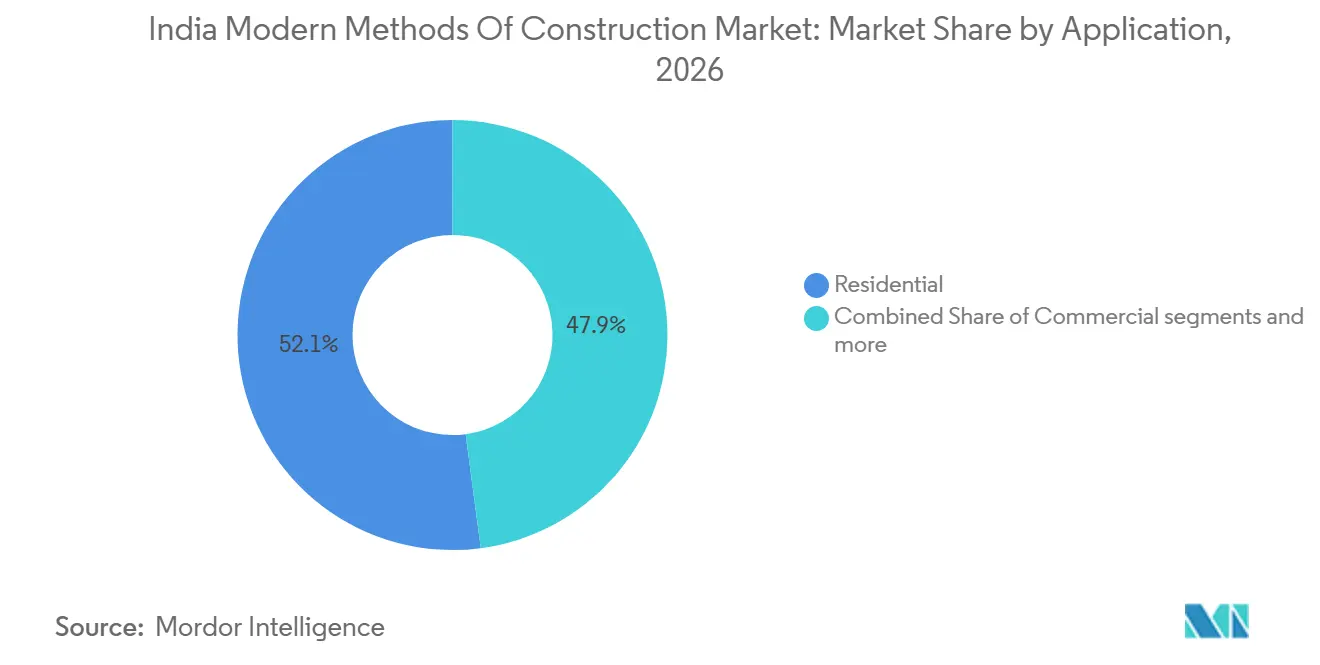
Residential applications accounted for a 52.10% share in 2026. Government housing programs provide a substantial pipeline for precast, formwork, and other off-site methods. Combined PMAY-U programs had sanctioned 1.27 crore homes and completed 99.07 lakh homes through July 2026. Precast components can reduce floor-cycle times to 3 to 12 days, compared with 12 to 20 days for conventional casting. That time saving helps developers meet delivery commitments under the Real Estate Regulatory Authority framework.
L&T secured a July 2026 order to build 26 Mumbai residential towers, each rising to 120 meters, using large-wall panel precast technology from a captive facility. Commercial is the fastest-growing application, with a projected CAGR of 9.26% through 2032. Office demand, data center construction, and factory investment support this outlook. Commercial projects also use modular mechanical, electrical, and plumbing assemblies, fit-out pods, and pre-engineered shells. These components help project teams coordinate installation sequences and reduce on-site work in technically complex facilities.
Geography Analysis
Bengaluru is the fastest-growing geographic segment, with a 9.88% CAGR projected through 2032. Its office, data center, and electronics manufacturing activity supports demand for rapid shell delivery. Project teams in these corridors need repeatable components that fit demanding schedules and defined technical specifications. Mumbai Metropolitan Region benefits from high-rise redevelopment, logistics parks around Bhiwandi, and data centers in Navi Mumbai. Delhi NCR also supports factory-built construction through manufacturing, warehousing, and affordable housing activity in Uttar Pradesh.
Hyderabad and Pune are important secondary growth centers. TCS HyperVault secured 264 acres in Hyderabad for an artificial intelligence data center campus of up to 1 GW and an investment of up to INR 70,000 crore, equivalent to USD 8.3 billion in the supplied material. Pune is supported by automotive and engineering manufacturing, where pre-engineered buildings serve industrial sheds and related facilities. Chennai draws on automotive production and data center activity. Kolkata and Ahmedabad contribute through public housing and pharmaceutical manufacturing, respectively.
The rest of India held a 36.10% share in 2026. Cities such as Lucknow, Nagpur, Raipur, and Indore receive structured affordable housing investment. The Union Budget proposal for City Economic Regions provides INR 5,000 crore (USD 593 million) per region to support the development of Tier 2 and Tier 3 cities. Light panelized systems suit these markets where transport and lifting capacity remain limited.
Competitive Landscape
The India modern methods of construction market has a moderately concentrated top tier and a fragmented group of regional specialists. Large integrated suppliers combine engineering, factory capacity, and site execution to compete for public and institutional contracts. Regional prefab specialists compete through local response times and familiarity with project conditions. Kirby Building Systems and Interarch Building Solutions lead parts of the pre-engineered building segment. Kirby began development of a fourth Tamil Nadu plant in September 2026, adding 100,000 metric tons of annual capacity and lifting planned capacity to 400,000 metric tons.
EPACK Prefab expands through sandwich panel capacity and geographic reach. It began commercial production at its Mambattu brownfield expansion in April 2026, increasing pre-engineered building capacity to 147,122 metric tons per year. L&T uses its Kattupalli facility near Chennai to serve complex modular work. The company completed fabrication and delivery of 110 modules weighing 64,000 metric tons for Project CERES in September 2026. This experience shows we can offer integrated fabrication and construction services for domestic projects.
Domestic 3D concrete printing remains at an early stage, with MiCoB, Simpliforge Creations, and Tvasta Manufacturing Solutions among firms completing field projects. Public demonstration projects can help establish performance records for this method. Volumetric modular construction for hospitality, student housing, and healthcare remains less developed than conventional prefab systems. Pennar Industries reported an India pre-engineered building order book of INR 1,008 crore (USD 119.5 million) in the first quarter of the financial year 2027. They opened a Raebareli plant to serve North India.
India Modern Methods Of Construction Industry Leaders
-
Larsen & Toubro Limited
-
Tata Projects Limited
-
B. G. Shirke Construction Technology Pvt. Ltd.
-
Kirby Building Systems and Structures India Private Limited
-
KEF Infra
- *Disclaimer: Major Players sorted in no particular order
Recent Industry Developments
- September 2026: Kirby Building Systems & Structures India Pvt. Ltd. broke ground on its fourth manufacturing facility in Manapparai, Tamil Nadu, with an annual production capacity of 100,000 MTPA, raising the company's total Indian capacity to 400,000 MTPA upon commissioning in mid-2027. The investment strengthens Kirby's position in Southern India, a region capturing over half the country's industrial leasing activity. The new facility adds local capacity for industrial sheds, warehouse buildings, and related steel structures.
- September 2026: TCS HyperVault secured 264 acres in Hyderabad for an artificial intelligence data center campus of up to 1 GW capacity, with an investment of up to INR 70,000 crore (USD 8.3 billion) by HyperVault and its partners. The project is expected to generate several thousand construction-related jobs and substantial modular steel and precast shell demand in Telangana. The scale of the campus highlights the role of digital infrastructure in India's modern methods of construction market.
- September 2026: Andhra Pradesh Government, in partnership with CSIR-CBRI and the Ministry of Rural Development, launched a pilot to construct 177 houses using 3D concrete printing in Guntur district under PMAY-G. The project has an outlay of INR 13.93 crore, equivalent to USD 1.7 million in the supplied material. It is the first government-funded rural housing pilot using 3D concrete printing in India.
India Modern Methods Of Construction Market Report Scope
| Prefabricated & Modular Construction | Panelized Systems | Structural Insulated Panels (SIPs) |
| Timber/Wood Frame Panels | ||
| Light Gauge Steel (LGS) Panels | ||
| Others | ||
| Volumetric Modules | Steel-Framed Volumetric Modules | |
| Timber-Framed Volumetric Modules | ||
| Concrete (Precast/Monolithic) Volumetric Modules | ||
| Others | ||
| Hybrid Modular Construction | ||
| 3D Construction | Extrusion Method | |
| Power Bonding Method | ||
| Others | ||
| Other Construction Methods | ||
| Concrete |
| Glass |
| Metal |
| Timber |
| Other Material Type |
| Residential |
| Commercial |
| Other Application (Industrial, Institutional, Energy and Utilities, Infrastructure) |
| Mumbai Metropolitan Region |
| Delhi NCR |
| Pune |
| Bengaluru |
| Hyderabad |
| Chennai |
| Kolkata |
| Ahmedabad |
| Rest of India |
| By Construction Type | Prefabricated & Modular Construction | Panelized Systems | Structural Insulated Panels (SIPs) |
| Timber/Wood Frame Panels | |||
| Light Gauge Steel (LGS) Panels | |||
| Others | |||
| Volumetric Modules | Steel-Framed Volumetric Modules | ||
| Timber-Framed Volumetric Modules | |||
| Concrete (Precast/Monolithic) Volumetric Modules | |||
| Others | |||
| Hybrid Modular Construction | |||
| 3D Construction | Extrusion Method | ||
| Power Bonding Method | |||
| Others | |||
| Other Construction Methods | |||
| By Material Type | Concrete | ||
| Glass | |||
| Metal | |||
| Timber | |||
| Other Material Type | |||
| By Application | Residential | ||
| Commercial | |||
| Other Application (Industrial, Institutional, Energy and Utilities, Infrastructure) | |||
| By Cities | Mumbai Metropolitan Region | ||
| Delhi NCR | |||
| Pune | |||
| Bengaluru | |||
| Hyderabad | |||
| Chennai | |||
| Kolkata | |||
| Ahmedabad | |||
| Rest of India | |||
Key Questions Answered in the Report
What is the projected value of India's modern methods of construction sector by 2032?
The India Modern Methods Of Construction Market size is projected to be USD 16.32 billion in 2026, USD 17.76 billion in 2027, and reach USD 27.45 billion by 2032, growing at a CAGR of 9.10% from 2027 to 2032.
Which construction method has the largest position in India?
Prefabricated and modular construction held a 98.70% share in 2026 because it includes established panelized, volumetric, and hybrid systems. It is used where repeated designs, faster assembly, and more controlled factory production are needed. These formats allow suppliers to deliver factory-made elements without requiring every project to use a fully volumetric system.
What is driving adoption of factory-built systems in India?
Affordable housing delivery, skilled labor shortages, and the need to finish logistics, data center, and industrial facilities on schedule are key factors. Government-backed housing programs also provide a large pipeline that supports wider supplier investment and technology adoption. The delivery model is particularly relevant when a developer needs consistency across many units, floors, or standardized building components.
Which material is growing fastest for off-site building methods?
Timber is forecast to grow at a 9.71% CAGR through 2032, although concrete retained the largest 2026 share at 41%. Timbers position reflects interest in engineered wood for premium and institutional work, while concrete remains better established in mass housing and infrastructure. The difference shows that material selection depends on project scale, supply availability, construction methods, and required building performance.
Which application leads demand for modern construction methods?
Residential construction led with a 52.10% share in 2026, while commercial applications are forecast to grow at a 9.26% CAGR. Public housing programs, high-rise redevelopment, offices, data centers, and modular building services all support demand across these uses. Residential volume remains closely tied to public delivery programs, while commercial growth is supported by companies that require faster asset completion.
Which city is expected to grow fastest for modern construction methods?
Bengaluru is forecast to grow at a 9.88% CAGR through 2032, supported by office, data center, and electronics manufacturing projects. The India modern methods of construction market in the city benefits from demand for predictable project delivery and factory-made structural components. This activity is concentrated in corridors where commercial development, technology facilities, and supporting industrial construction are all expanding.