
India Fresh Herbs Market Size and Share
Market Overview
| Study Period | 2021 - 2031 |
|---|---|
| Forecast Data Period | 2026 - 2031 |
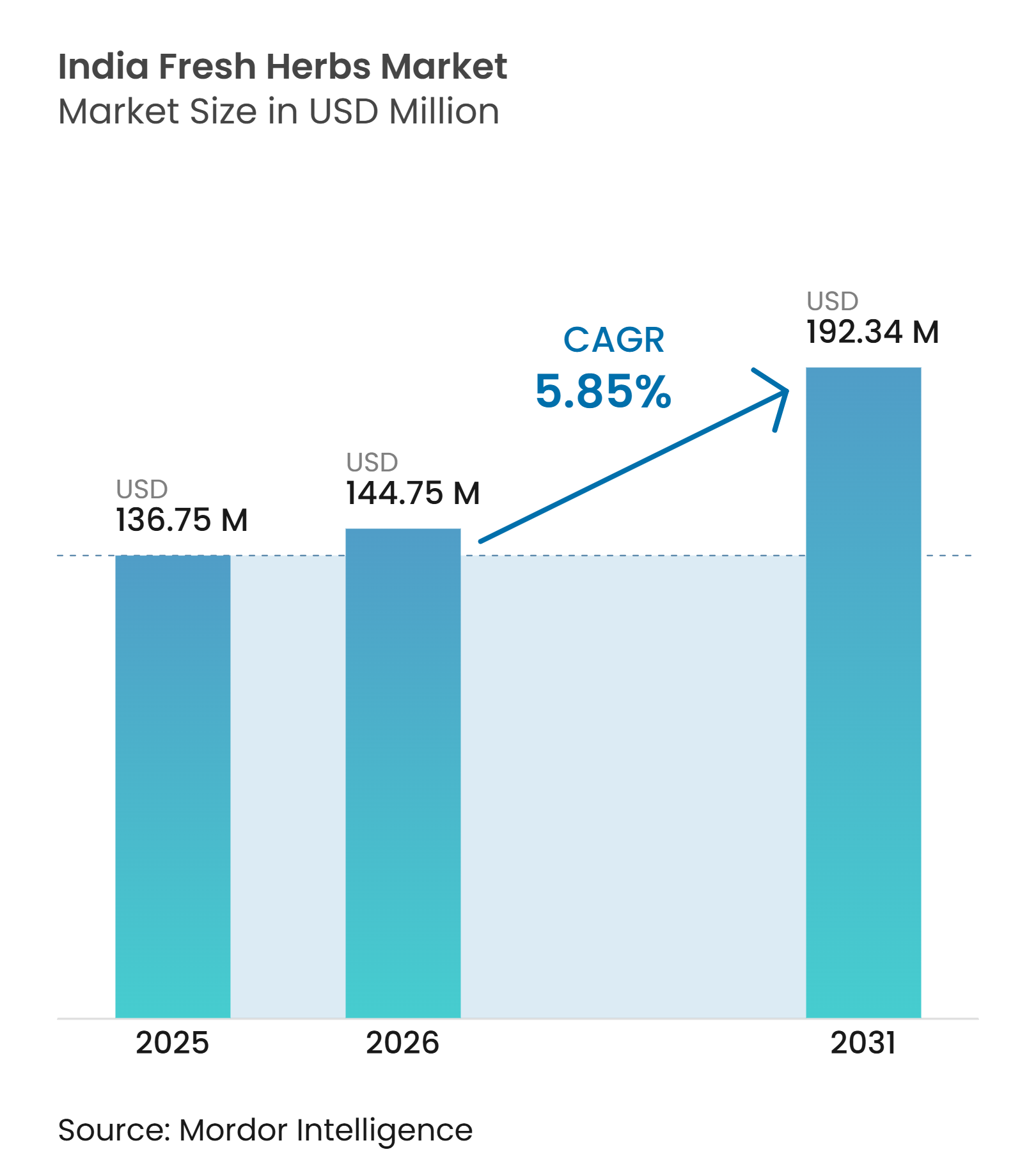
| Base Year Market Size (2025) | USD 136.75 Million |
| Market Size (2026) | USD 144.75 Million |
| Market Size (2031) | USD 192.34 Million |
| Growth Rate (2026 - 2031) | 5.85 % |
| Market Concentration | Low |
Major Players *Disclaimer: Major Players sorted in no particular order Image © Mordor Intelligence. Reuse requires attribution under CC BY 4.0. | |
India Fresh Herbs Market Analysis by Mordor Intelligence
The India fresh herbs market was valued at USD 136.75 million in 2025 and is forecast to grow from USD 144.75 million in 2026 to USD 192.34 million by 2031, at a CAGR of 5.85% during the forecast period (2026–2031). The market is shifting from loose, unbranded sales toward packaged, traceable products, particularly in metropolitan and Tier 1 cities. Organized grocery retail, online fresh-produce platforms, foodservice operators, and premium hospitality buyers are driving demand for reliable supply and consistent product quality. Controlled-environment agriculture (CEA) is gaining relevance due to its ability to support year-round production and residue-compliant output close to demand centers. Producers that integrate cultivation, packing, cold-chain handling, and direct retail distribution are better positioned to access premium channels. Key constraints for the market include post-harvest waste, uneven first-mile cold-chain coverage, high capital requirements, and limited willingness to pay outside major cities.
Key Report Takeaways
- By product type, basil was the largest segment and held 41.8% of the India fresh herbs market share in 2025, while mint is the fastest-growing segment and is forecast to expand at a 7.2% CAGR between 2026 and 2031.
- By category, conventional was the largest segment and held 86.0% of the India fresh herbs market size in 2025, while organic is the fastest-growing segment and is forecast to expand at a 10.5% CAGR between 2026 and 2031.
- By cultivation method, open-field cultivation was the largest segment and held 78.0% of the market share in 2025, while hydroponic cultivation is the fastest-growing segment and is forecast to expand at a 15.0% CAGR between 2026 and 2031.
- By end user, food retail was the largest segment and held 48.5% of the market share in 2025, while foodservice is the fastest-growing segment and is forecast to expand at an 8.2% CAGR between 2026 and 2031.
Note: Market size and forecast figures in this report are generated using Mordor Intelligence’s proprietary estimation framework, updated with the latest available data and insights as of January 2026.
Market Trends and Insights
Drivers Impact Analysis of India Fresh Herbs Market*
| Driver | (~) % Impact on CAGR Forecast | Geographic Relevance | Impact Timeline |
|---|---|---|---|
| Rising Organized Retail and Online Fresh-Produce Access | +1.5% | National, with early gains in Bengaluru, Mumbai, Pune, and Chennai | Short term (≤ 2 years) |
| Growth of Foodservice, Cloud Kitchens and International Cuisine | +1.3% | National, concentrated in metropolitan and Tier 1 cities | Short term (≤ 2 years) |
| Premiumization of Organic, Living and Specialty Herbs | +0.9% | National, led by metropolitan urban centers | Medium term (2-4 years) |
| Expansion of Controlled-Environment Herb Production | +0.8% | Karnataka, Maharashtra, and Gujarat | Medium term (2-4 years) |
| Demand Forecasting Through Farm-to-Home Platforms | +0.4% | National, concentrated in Bengaluru, Hyderabad, and Delhi National Capital Region (NCR) | Medium term (2-4 years) |
| Residue-Free and Year-Round Supply for Premium Hospitality Buyers | +0.3% | National, concentrated in Bengaluru, Mumbai, and Delhi NCR | Long term (≥ 4 years) |
| Source: Mordor Intelligence | |||
Rising Organized Retail and Online Fresh-Produce Access
Demand for organic and specialty fresh herbs in India is supported by the expansion of certified organic production, government-backed certification, and growing access to organized domestic and export markets. The Agricultural and Processed Food Products Export Development Authority (APEDA) reported that India had 2.25 million hectares of organically certified farm area in 2024–25, with certified organic farm production reaching 4.39 million metric tons[1]. The certified output includes medicinal and aromatic plants, spices and condiments, fruits, and vegetables, providing relevant production and certification infrastructure for specialty herb suppliers. Government support also strengthens the supply base. In December 2025, the Ministry of Agriculture and Farmers Welfare reported that the Paramparagat Krishi Vikas Yojana (PKVY) provides INR 31,500 per hectare over three years, including support for organic inputs and marketing, with 49,100 hectares covered in Karnataka under the scheme as of October 2025. For fresh herbs, these developments support differentiation through organic certification, traceability, and specialized varieties, while expanding certified supply can improve availability through organized retail and export channels. As the category develops, producers need to combine certification with consistent quality, efficient production, reliable year-round supply, and appropriate packaging rather than relying solely on an organic price premium.
Growth of Foodservice, Cloud Kitchens and International Cuisine
Growth in foodservice, cloud kitchens, and international cuisine is strengthening demand for fresh herbs that can be supplied in consistent quality, quantities, and delivery schedules. Restaurants, hotels, institutional foodservice operators, quick-service restaurants, and cloud kitchens increasingly use herbs such as basil, cilantro, mint, and parsley across Indian, Italian, Thai, and other international cuisines. The expansion of organized foodservice also supports demand for pre-washed, portioned, and packaged herbs that can be incorporated into standardized menus and high-volume kitchen operations. This shift makes reliable sourcing, consistent specifications, and efficient cold-chain handling increasingly important for suppliers serving the India fresh herbs market. This also encourages suppliers to develop longer-term relationships with foodservice buyers, where predictable replenishment and year-round availability are important for maintaining menu consistency.
Premiumization of Organic, Living and Specialty Herbs
Premiumization of organic, living, and specialty herbs is supported by growing consumer interest in healthier and more differentiated fresh-produce options, particularly among urban consumers. A 2024–25 study commissioned by the Agricultural and Processed Food Products Export Development Authority (APEDA) found that 66% of surveyed consumers looked for an organic-authenticity indicator such as a logo or certification on packaging, while more than half said the benefits of organic products justified their higher price. The study also found that 79% of respondents were willing to increase their share of organic products in future grocery purchases[2]. This creates opportunities for certified organic, residue-free, living, and specialty herbs in metropolitan retail and foodservice channels, where traceability, production methods, freshness, and product differentiation can support premium positioning. India’s certified organic sector also continues to expand, as APEDA reported 4.39 million metric tons of organic farm production under NPOP in 2024–25, providing a broader supply base for certified products.
Expansion of Controlled-Environment Herb Production
Expansion of controlled-environment herb production is strengthening the supply base for fresh herbs by enabling more predictable, year-round cultivation with tighter control over water, nutrients, and growing conditions. NITI Aayog’s Frontier Tech Repository highlights Krop AI’s AI-enabled hydroponic systems, which are used to grow crops including basil and parsley and have demonstrated a 95% reduction in water use and a 50% reduction in operating costs compared with conventional farming. The platform also uses container-based systems that can be deployed by small and medium-sized agri-entrepreneurs, supporting the development of localized production models. In addition, NITI Aayog reported in July 2026 that Brio Hydroponics had completed more than 150 hydroponic projects and launched a large hydroponic park in Gujarat, indicating that controlled-environment production is moving beyond isolated pilot farms toward larger commercial infrastructure. These developments support the expansion of domestic, technology-enabled herb production and can improve the availability and consistency of premium herbs such as basil, parsley, and other leafy crops in the India fresh herbs market.
Restraints Impact Analysis of India Fresh Herbs Market*
| Restraint | (~) % Impact on CAGR Forecast | Geographic Relevance | Impact Timeline |
|---|---|---|---|
| Short Shelf Life and Post-Harvest Waste | -1.5% | National, acute in Uttar Pradesh, Bihar, Odisha, Madhya Pradesh, and Rajasthan | Short term (≤ 2 years) |
| Fragmented Farm-Level Quality and Cold-Chain Execution | -1.0% | National, most severe in non-metropolitan procurement zones | Medium term (2-4 years) |
| High Unit Economics of Protected Cultivation | -0.7% | Karnataka, Maharashtra, and Gujarat | Medium term (2-4 years) |
| Limited Consumer Willingness to Pay Beyond Metro Markets | -0.4% | Nagpur, Jaipur, Indore, Coimbatore, Madurai; rural belts of Uttar Pradesh, Bihar, and Rajasthan | Long term (≥ 4 years) |
| Source: Mordor Intelligence | |||
Short Shelf Life and Post-Harvest Waste
Fresh herbs have a short commercially viable shelf life, making pre-cooling, appropriate packaging, and temperature-controlled transportation important after harvest. This creates a particular challenge in India, where fragmented production and multiple supply-chain handoffs can increase the risk of quality deterioration before products reach retail and foodservice buyers. Government investment is expanding cold-chain capacity, but infrastructure remains uneven. The Ministry of Food Processing Industries (MoFPI) reported 397 approved Integrated Cold Chain and Value Addition Infrastructure projects under the Pradhan Mantri Kisan SAMPADA Yojana (PMKSY), of which 286 had been completed, as of February 2025. These completed projects had created 25.39 lakh metric tons of preservation capacity[3]. The continued expansion of cold-chain infrastructure indicates progress in reducing post-harvest losses, but smaller herb suppliers may still face difficulty accessing efficient pre-cooling, storage, and refrigerated distribution networks. Consequently, short shelf life and post-harvest deterioration can increase wastage, reduce supplier margins, and make it more difficult to maintain the consistent weekly deliveries required by organized retail and foodservice customers in the India fresh herbs market.
Fragmented Farm-Level Quality and Cold-Chain Execution
Fragmented farm-level production and uneven cold-chain execution can limit the ability of Indian fresh-herb suppliers to meet the standardized quality and delivery requirements of organized retail and foodservice channels. According to a 2025 study published in the International Journal of Agriculture Extension and Social Development, more than 85% of India’s farming population operated small and marginal holdings, highlighting the fragmented structure of agricultural production. Such fragmentation can make access to standardized grading, packing, and refrigerated first-mile transportation more difficult, potentially resulting in variation in leaf size, moisture levels, packaging quality, and delivered volumes. Modern retail and foodservice buyers require consistent specifications, traceability, and scheduled replenishment, while informal farm-gate handling can increase deterioration before herbs enter the formal supply chain. This creates an additional burden for smaller growers that lack dedicated pack-house and logistics infrastructure, increasing rejection and wastage risks and making access to higher-value organized channels more difficult in the India fresh herbs market.
*Our forecasts treat driver/restraint impacts as directional, not additive. The impact forecasts reflect baseline growth, mix effects, and variable interactions.
India Fresh Herbs Market Segment Analysis
By Product Type:
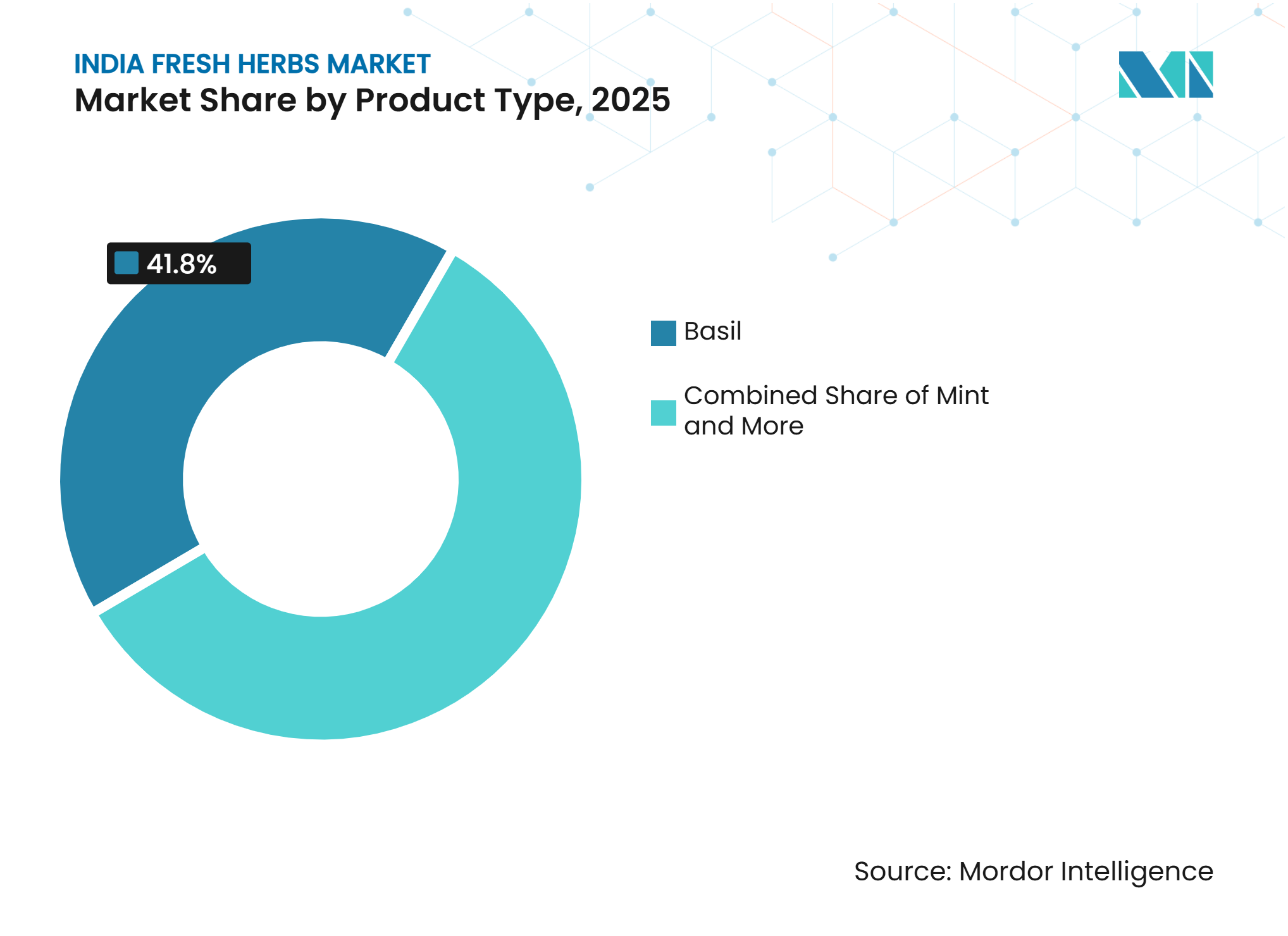
Basil Leads Value, Mint Has the Fastest GrowthBasil accounted for 41.8% of the India fresh herbs market share in 2025, making it the largest product type. Its leading position is supported by demand from modern retail, cloud kitchens, restaurants, and Italian and Mediterranean cuisines, where basil is increasingly supplied in standardized retail packs and foodservice formats. Fresh cilantro and coriander also remain important products because of their established role in Indian household cooking, while parsley, chives, oregano, rosemary, thyme, and other specialty herbs serve growing premium hospitality and organized-retail applications. This broad product base allows suppliers to serve both high-volume culinary demand and higher-value specialty channels.
Mint is the fastest-growing product type, forecast to expand at a 7.2% CAGR between 2026 and 2031. Its growth is supported by applications extending beyond traditional culinary use, including beverages, health drinks, nutraceutical products, and Ayurvedic preparations. Growing demand from foodservice and modern retail is also creating opportunities for standardized, packaged mint, while its use across beverages and prepared foods provides multiple demand channels. The wider adoption of traceable and branded fresh herbs can further support premium positioning, although suppliers need to manage freshness, packaging, and consistent year-round availability because mint remains a highly perishable product.



By Category:
Conventional Supply Leads, Organic Herbs Gain ValueConventional accounted for 86.0% of the India fresh herbs market share in 2025, making it the largest category. Their leading position is supported by the established scale of open-field cultivation, broader availability, and lower production and certification requirements compared with organic supply. Organic herbs account for the remaining share and are increasingly gaining value in premium urban retail and foodservice channels, where consumers place greater emphasis on health, environmental considerations, traceability, and production practices. According to a 2025 study published in Sustainability, health concerns and environmental consciousness were key factors influencing organic food purchase decisions among Indian millennials in Karnataka, while income was associated with willingness to pay a premium. These factors support continued demand for differentiated organic herbs in metropolitan markets, although certification and production requirements can limit the pace at which conventional growers convert to organic production.
Organic is the fastest-growing category, forecast to expand at a 10.5% CAGR between 2026 and 2031. Growth is supported by increasing consumer interest in certified and traceable produce, particularly among higher-income urban consumers with greater access to organized retail. Certification under India's National Programme for Organic Production (NPOP) provides a recognized framework for organic claims, while consistent production and documentation can help suppliers meet the requirements of premium retail and foodservice buyers. The higher growth rate therefore reflects increasing value placed on certified supply, even as conventional herbs continue to account for the majority of market volume.
By Cultivation Method:
Open Fields Lead, Hydroponics Expands FastestOpen-field cultivation accounted for 78.0% of the India fresh herbs market share in 2025, making it the largest cultivation method. Its leading position is supported by lower capital requirements, established production practices, and suitability for large-scale cultivation of widely consumed herbs such as cilantro and mint. Greenhouse cultivation accounted for 10% of the market and provides an intermediate production model by offering greater environmental control than open fields without the full infrastructure requirements of more intensive systems. Open-field production therefore remains the primary supply base, particularly for growers serving conventional retail and wholesale channels.
Hydroponic cultivation is the fastest-growing cultivation method, forecast to expand at a 15.0% CAGR between 2026 and 2031. Its growth is supported by demand for more consistent, residue-controlled, and year-round herb production for organized retail and foodservice buyers. According to AgroSpectrum India (2025), Brio Hydroponics launched its Vexotics fresh-produce brand in December 2025, with products linked to retail channels including Reliance Fresh and BigBasket. This illustrates how hydroponic operators are increasingly combining controlled cultivation with branded retail distribution. Aeroponic and vertical indoor systems also provide alternatives for specialty herbs where controlled growing conditions and proximity to premium urban demand can support their higher operating requirements.
By End User:
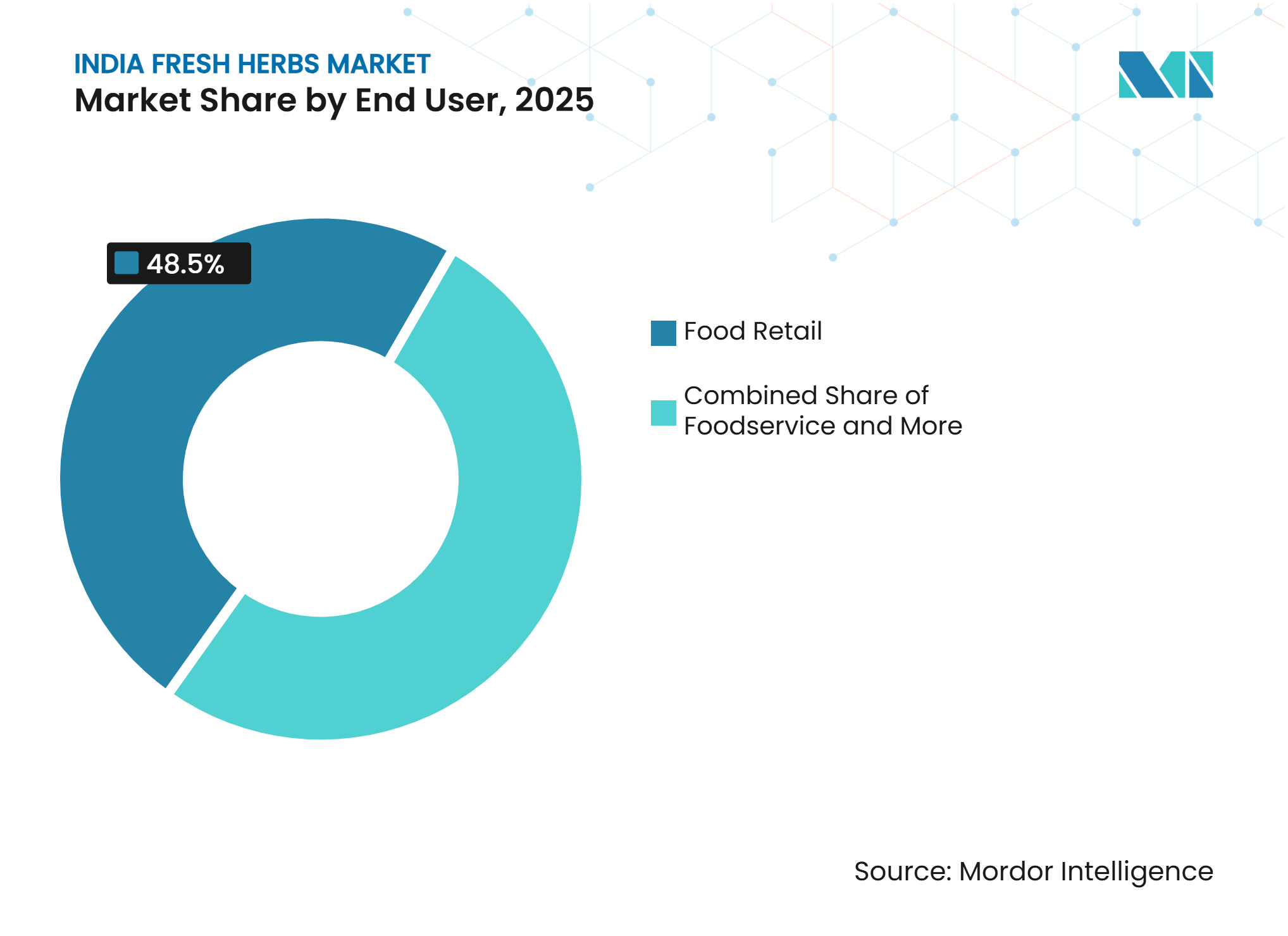
Food Retail Leads, Foodservice Has the Fastest GrowthFood retail accounted for 48.5% of the India fresh herbs market share in 2025, making it the largest end-user segment. Its leading position is supported by supermarkets, hypermarkets, modern grocery stores, and quick-commerce platforms, where fresh herbs are increasingly sold as standardized, branded, and packaged products. Cold-chain infrastructure and improved distribution allow retailers to offer herbs in formats such as pre-washed packs and portioned products, while established household demand for cilantro, mint, basil, and parsley provides a broad consumer base. Foodservice, food processing, and nutraceutical applications complement retail demand by creating additional channels for fresh and processed herb products.
Foodservice is the fastest-growing end-user segment, forecast to expand at an 8.2% CAGR between 2026 and 2031. Growth is supported by expanding restaurants, cloud kitchens, hotels, catering businesses, and international cuisine formats, which require regular replenishment of herbs in consistent quantities and quality. Foodservice operators also increasingly depend on standardized ingredients to maintain menu consistency across locations, supporting demand for reliable suppliers with appropriate handling and delivery capabilities. Food processing and nutraceutical applications provide additional growth opportunities through products such as ready-to-cook meals, chutneys, herbal beverages, and botanical formulations, encouraging suppliers to diversify beyond household retail while maintaining traceability and post-harvest quality.

Geography Analysis
Karnataka remains an important growth center for India’s fresh herbs market, supported by Bengaluru’s concentration of premium hospitality buyers, organized retail chains, and AI-enabled hydroponic producers. Bengaluru supports this growth through its concentration of premium hospitality operators, organized retail chains, cloud kitchens, and controlled-environment agriculture producers. The state also benefits from its proximity to a broader southern production and consumption cluster that includes Tamil Nadu, Telangana, and Andhra Pradesh. According to The Hindu BusinessLine (2026), Panama Hydro-X announced an INR 214 crore (USD 24.6 million) investment in AI-enabled hydroponic farming in Moodbidri, Karnataka, with the first commercial harvest targeted for June 2027. These investments, combined with urban demand and agricultural research capabilities, support Karnataka's expanding role in the India fresh herbs market.
Maharashtra benefits from the large consumption centers of Mumbai and Pune, where organized retail, cloud kitchens, restaurants, and premium hospitality operators create demand for consistent fresh-herb supply. According to The Tribune in 2026, the United States International Development Finance Corporation (DFC) deployed an initial INR 90 crore (USD 10.3 million) investment in Nutrifresh Farm Tech in April 2026, supporting controlled-environment agriculture infrastructure near Pune. Gujarat combines agricultural production with emerging controlled-environment and branded retail activity, while Tamil Nadu benefits from Chennai's organized retail and foodservice base. These states therefore provide different combinations of production capacity, urban demand, and controlled-environment investment within the India fresh herbs market.
Across the states, supply-chain execution remains an important factor because organized buyers require consistent grades, standardized packaging, residue compliance, traceability, and timely delivery. This creates opportunities for growers and suppliers with coordinated collection, pack-house, and cold-chain systems that can connect farm-level production with metropolitan markets. Premium herb demand remains concentrated around major urban centers, while expansion into wider markets depends on affordability, distribution infrastructure, and the ability to maintain product quality during transportation. Geographic growth in the India fresh herbs market will therefore depend not only on cultivation capacity but also on the efficiency with which regional production networks connect growers with quality-conscious retail and foodservice buyers.
Competitive Landscape
Market Concentration
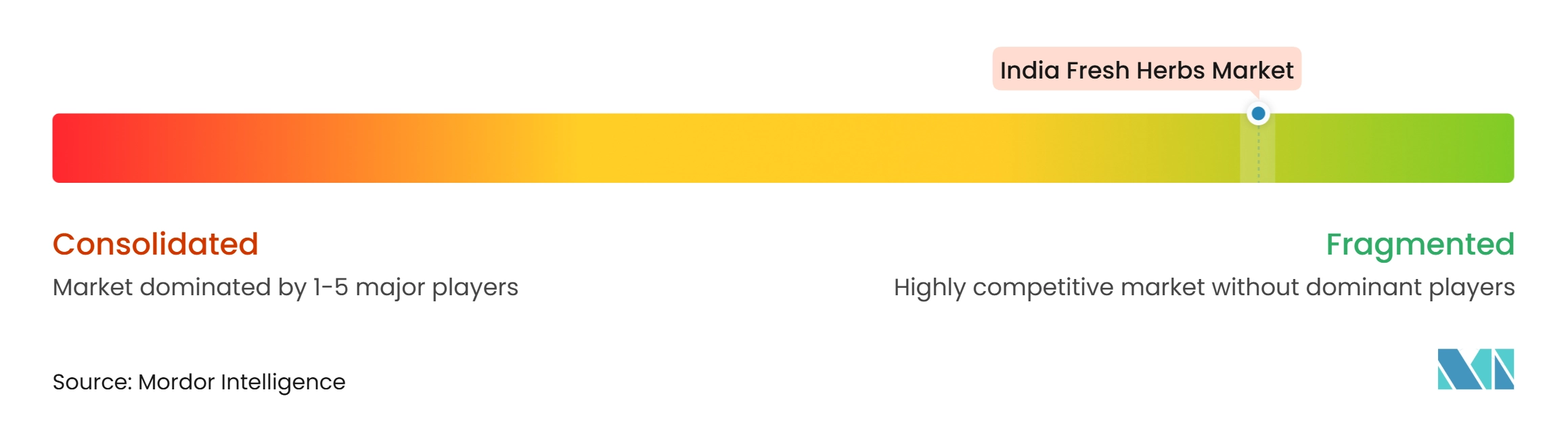
The India fresh herbs market is highly fragmented, with Namdhari Agro-Fresh Private Limited, GreenTokri Farms Private Limited, Bhoomi Crop Ventures Private Limited, Green Earth Fresh Produce Private Limited, and Simply Fresh Private Limited representing major players in 2025. Competition is spread across conventional cultivation, hydroponic production, branded fresh-produce retail, and integrated farm-to-market supply models. Namdhari Agro-Fresh Private Limited operates across cultivation, pack-house processing, and fresh-produce distribution, while GreenTokri Farms Private Limited, Bhoomi Crop Ventures Private Limited, and Simply Fresh Private Limited compete through controlled cultivation and premium fresh-produce offerings. Green Earth Fresh Produce Private Limited also participates in organized fresh-produce supply, while smaller growers, aggregators, and regional distributors account for a substantial share of supply. The fragmented structure makes cultivation scale, product consistency, post-harvest handling, and access to organized retail and foodservice customers important areas of competition.
Competitive differentiation is increasingly shifting toward year-round availability, residue-controlled production, traceability, packaging, and supply-chain reliability. Hydroponic and controlled-environment producers can differentiate through more consistent production conditions and predictable output, while integrated growers can combine cultivation with grading, packing, and distribution. Namdhari Agro-Fresh Private Limited's integrated operating model illustrates the importance of connecting production with downstream handling and retail distribution. GreenTokri Farms Private Limited, Bhoomi Crop Ventures Private Limited, and Simply Fresh Private Limited compete through premium and technology-enabled production models, while vertical-farming operators such as Triton Foodworks and UrbanKisaan focus on supplying differentiated produce to urban consumers. These approaches indicate that competition extends beyond crop production, with demand forecasting, cold-chain execution, quality consistency, and direct relationships with organized buyers becoming increasingly important.
The market also provides opportunities for players that can aggregate fragmented production and provide standardized, traceable supply to premium accounts. High-end hotels, international restaurant chains, organized retailers, and foodservice operators require consistent grades, regular deliveries, and documented cultivation and handling practices, creating opportunities for companies with integrated farm-to-market capabilities. Handpickd's expansion of its farm-direct fresh-produce model demonstrates the potential for demand aggregation and coordinated distribution in India's perishable-produce supply chain. Players can further differentiate through modified-atmosphere packaging, organic certification under the National Programme for Organic Production (NPOP), and technology-enabled inventory and delivery management. Consequently, competitive positioning in the India fresh herbs market is increasingly determined by a company's ability to combine reliable cultivation with post-harvest handling, traceability, packaging, and access to recurring urban demand rather than by production capacity alone.
India Fresh Herbs Industry Leaders
-
Namdhari Agro-Fresh Private Limited (Namdhari Seeds Private Limited)
-
GreenTokri Farms Private Limited
-
Bhoomi Crop Ventures Private Limited
-
Green Earth Fresh Produce Pvt. Ltd.
-
Simply Fresh Private Limited (Precision Farming Asia Pte. Ltd.)
- *Disclaimer: Major Players sorted in no particular order
India Fresh Herbs Market Companies Covered in this Report
- Namdhari Agro-Fresh Private Limited (Namdhari Seeds Private Limited)
- GreenTokri Farms Private Limited
- Bhoomi Crop Ventures Private Limited
- Green Earth Fresh Produce Private Limited
- Simply Fresh Private Limited (Precision Farming Asia Pte. Ltd.)
- Triton Foodworks Private Limited
- Brio Retails Private Limited
- UrbanKisaan Farms Private Limited (UrbanKisaan Inc.)
- Nisarg Nirman Agro Products Private Limited
- Geo-Fresh Organic Private Limited
- Suminter India Organics Private Limited
Recent Industry Developments in India Fresh Herbs Market
- August 2026: GD Goenka Group’s Goenka Fresh entered into a five-year collaboration with Roseate Hotels & Resorts to supply organically and hydroponically cultivated produce to its hotels in Delhi. The supply includes fresh herbs and leafy greens, with deliveries planned two to three times per week to Roseate House, Aerocity and The Roseate New Delhi, and an extension planned to the group's upcoming Jewar Airport property.
- December 2025: Howrah Krishi Vigyan Kendra, under ICAR-ATARI, launched a low-cost hydroponic production system designed for soilless cultivation of leafy vegetables and other high-value crops.
- December 2025: Brio Group launched Vexotics, an agri-retail brand offering fresh herbs, leafy greens, microgreens, and vine vegetables through online and offline channels. The brand partnered with Reliance Fresh and BigBasket and opened a flagship store in Bopal, Ahmedabad. Brio also announced plans to expand Vexotics to 100 stores across India by March 2027, creating a branded retail channel for hydroponically produced fresh herbs.
India Fresh Herbs Market Report Scope
Fresh herbs refer to edible leafy or tender plant parts that are harvested and sold in their fresh, unprocessed state for culinary, foodservice, and food-processing applications. They are primarily used to add flavor, aroma, color, and garnish to foods rather than as a primary source of calories.
The India Fresh Herbs Market Report is Segmented by Product Type (Basil, Cilantro/Coriander, Mint, and More), by Category (Conventional and Organic), by Cultivation Method (Open-Field Cultivation, Greenhouse Cultivation, and More), and by End User (Foodservice, Food Retail, and More). The Market Forecasts are Provided in Terms of Value (USD).
Segmentation Overview
| Basil |
| Cilantro/Coriander |
| Mint |
| Parsley |
| Chives |
| Oregano |
| Rosemary |
| Thyme |
| Sage |
| Dill |
| Other Fresh Herbs |
| Conventional |
| Organic |
| Open-Field Cultivation |
| Greenhouse Cultivation |
| Hydroponic Cultivation |
| Aeroponic Cultivation |
| Vertical Indoor Cultivation |
| Foodservice |
| Food Retail |
| Food Processing |
| Pharmaceutical and Nutraceutical |
| Other |
| By Product Type | Basil |
| Cilantro/Coriander | |
| Mint | |
| Parsley | |
| Chives | |
| Oregano | |
| Rosemary | |
| Thyme | |
| Sage | |
| Dill | |
| Other Fresh Herbs | |
| By Category | Conventional |
| Organic | |
| By Cultivation Method | Open-Field Cultivation |
| Greenhouse Cultivation | |
| Hydroponic Cultivation | |
| Aeroponic Cultivation | |
| Vertical Indoor Cultivation | |
| By End User | Foodservice |
| Food Retail | |
| Food Processing | |
| Pharmaceutical and Nutraceutical | |
| Other |
Key Questions Answered in the Report
What is the valuation of fresh herbs in India?
The market is valued at USD 144.75 million in 2026 and is forecast to reach USD 192.34 million by 2031 at a 5.85% CAGR.
Which product leads fresh-herb sales in India?
Basil led product sales with a 41.8% share in 2025, while mint is forecast to record the fastest product CAGR at 7.2% between 2026 and 2031.
Which end user is growing fastest for fresh herbs in India?
Foodservice is forecast to grow at an 8.2% CAGR between 2026 and 2031, supported by cloud kitchens and broader international cuisine menus.
What are the main barriers to fresh-herb suppliers?
Short shelf life, post-harvest waste, fragmented farm-level quality, high protected-cultivation costs, and lower price acceptance outside metropolitan areas are the main barriers.