
India Commercial Greenhouse Market Size and Share
Market Overview
| Study Period | 2021 - 2031 |
|---|---|
| Forecast Data Period | 2026 - 2031 |
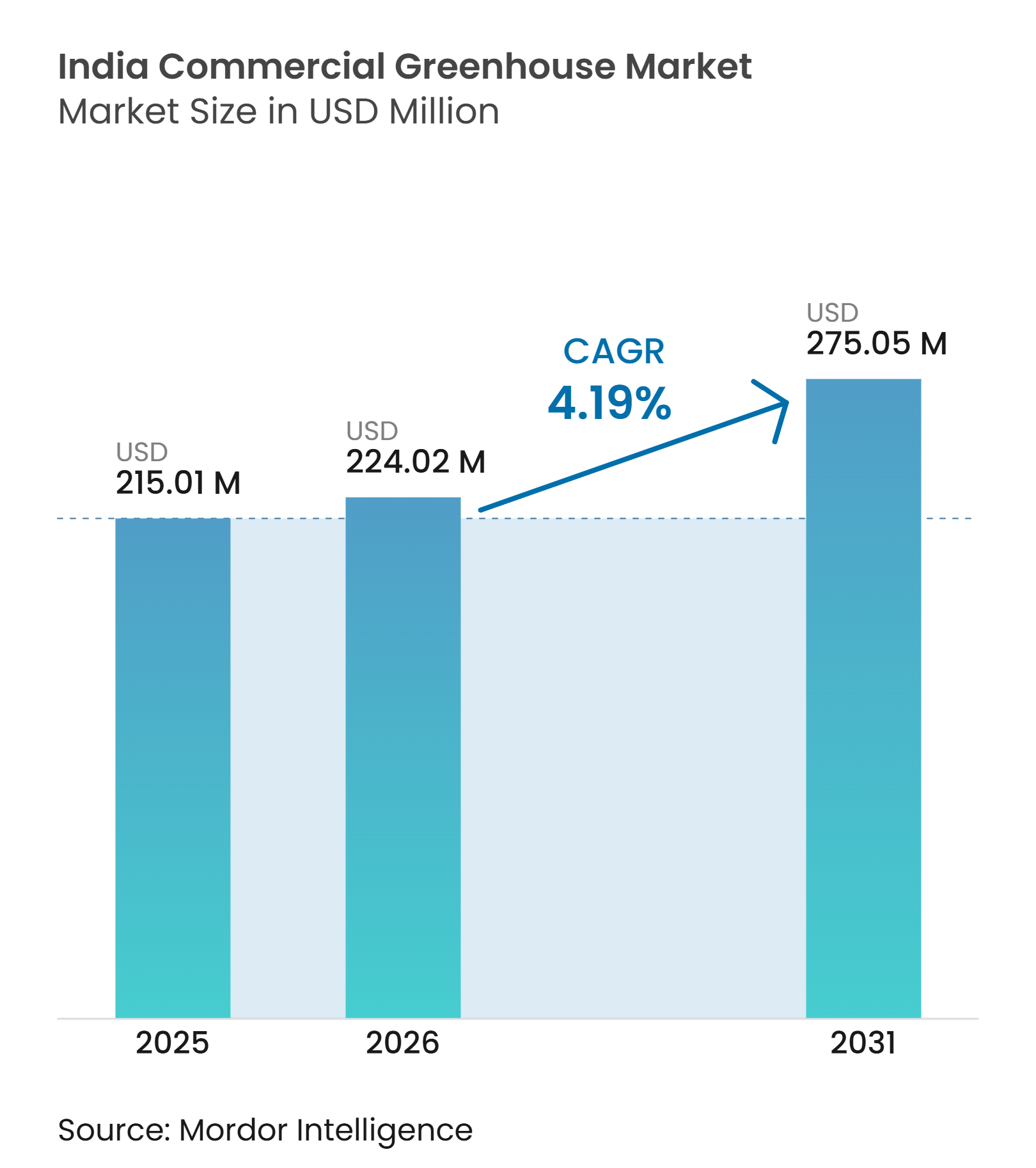
| Base Year Market Size (2025) | USD 215.01 Million |
| Market Size (2026) | USD 224.02 Million |
| Market Size (2031) | USD 275.05 Million |
| Growth Rate (2026 - 2031) | 4.19 % |
| Market Concentration | Medium |
Major Players *Disclaimer: Major Players sorted in no particular order Image © Mordor Intelligence. Reuse requires attribution under CC BY 4.0. | |
India Commercial Greenhouse Market Analysis by Mordor Intelligence
The India commercial greenhouse market size was valued at USD 215.01 million in 2025 and is estimated to grow from USD 224.02 million in 2026 to reach USD 275.05 million by 2031, at a CAGR of 4.19% during the forecast period (2026 - 2031). Growth is supported by demand for reliable supplies of vegetables, fruit, herbs, and flowers across retail, food service, and export channels. Water constraints and weather variability are making controlled cultivation more relevant in major horticulture states. Multi-month buyer contracts are improving sales visibility before growers commit capital to new projects. Lower-cost sensors and mobile crop tools are expanding access to precision irrigation and climate monitoring. As a result, the India commercial greenhouse market is moving toward projects that combine reliable crop output, documented food safety, and practical operational support.
Key Report Takeaways
- By equipment type, irrigation and fertigation systems accounted for 31% of the India commercial greenhouse market share in 2025, while climate control and automation software is forecast to grow at a CAGR of 6.7% from 2026 to 2031.
- By crop type, fruits and vegetables accounted for 56% of the India commercial greenhouse market size in 2025 and are forecast to grow at a CAGR of 6.2% from 2026 to 2031.
- By greenhouse type, plastic-film greenhouses accounted for 62% of the market share in 2025, while hybrid and semi-closed greenhouses are forecast to grow at a CAGR of 6.1% from 2026 to 2031.
- By cultivation technology, non-hydroponic soil and substrate systems accounted for 51% of the market share in 2025, while hydroponic systems are forecast to grow at a CAGR of 7.3% from 2026 to 2031.
- By end user, commercial growers accounted for 72% of the market share in 2025, while research and educational institutes are forecast to grow at a CAGR of 6.5% from 2026 to 2031.
Note: Market size and forecast figures in this report are generated using Mordor Intelligence’s proprietary estimation framework, updated with the latest available data and insights as of January 2026.
Market Trends and Insights
Drivers Impact Analysis of India Commercial Greenhouse Market*
| Driver | (~) % Impact on CAGR Forecast | Geographic Relevance | Impact Timeline |
|---|---|---|---|
| Government Support for Protected Cultivation and Bankable Project Finance | +1% | India-wide, with highest deployment in North, West, and South India | Short term (≤ 2 years) |
| Year-Round Supply Demand from Organized Retail, Quick Commerce, and HoReCa | +0.8% | Metro-linked farms in Maharashtra, Karnataka, Delhi NCR, and Telangana | Medium term (2-4 years) |
| Water Scarcity and Higher Value Per Unit of Cultivated Area | +0.7% | Maharashtra, Gujarat, Rajasthan, Telangana, and Karnataka | Long term (≥ 4 years) |
| Climate Volatility and Demand for Production Resilience | +0.6% | North India, West India, and high-rainfall zones | Medium term (2-4 years) |
| Localized IoT, Fertigation, and Crop-Stage Advisory Adoption | +0.4% | Karnataka, Maharashtra, Telangana, and Gujarat | Medium term (2-4 years) |
| Premium Crop Diversification into Berries, Colored Capsicum, Herbs, and Floriculture | +0.3% | Maharashtra, Karnataka, Himachal Pradesh, Haryana, and Uttar Pradesh | Medium term (2-4 years) |
| Source: Mordor Intelligence | |||
Government Support for Protected Cultivation and Bankable Project Finance
The Mission for Integrated Development of Horticulture supports protected-cultivation projects through credit-linked, back-ended subsidies. Under the 2025 guidelines, eligible fan-and-pad systems can receive assistance of up to 50% of the structure cost for areas of up to 4,000 square meters per beneficiary. The guidelines also cover naturally ventilated polyhouses using tubular, wooden, and bamboo structures. For hydroponics and aeroponics, assistance is set at 50% of the cost, based on a cost norm of INR 350 per square meter (USD 4.1 per square meter), for areas of up to 1,000 square meters. Sensor-based fertigation automation systems are also eligible for 50% assistance, subject to an assessed cost of INR 4 lakh (USD 4,760) per unit[1]. These provisions reduce the upfront capital burden for growers and improve the financial viability of protected-cultivation projects. By supporting investment in structures, soilless cultivation systems, and automation technologies, government assistance can encourage growers to adopt higher-control production systems and support the expansion and modernization of the India commercial greenhouse market.
Year-Round Supply Demand from Organized Retail, Quick Commerce, and HoReCa
Year-round demand from organized buyers now constitutes a structural pull factor for the India commercial greenhouse market, replacing spot-market fluctuations with contracted production volumes that improve demand visibility and support project investment decisions. Quick commerce platforms have rapidly expanded their fresh produce categories, creating consistent procurement needs for sorted, consistent-grade vegetables and herbs that open-field supply chains cannot reliably meet across all seasons. Premium hotel, restaurant, and cafeteria buyers increasingly specify residue-free, traceable produce as a baseline requirement, creating stronger opportunities for certified controlled-environment operations. The second-order implication is that buyer concentration among large-format retailers and delivery platforms is functionally raising the minimum agronomic standard for commercially viable greenhouse operations, creating a de facto quality filter that benefits capitalized producers with established food-safety documentation.
Water Scarcity and Higher Value Per Unit of Cultivated Area
A 2024 study published in the Indian Journal of Agricultural Economics found that drip irrigation reduced water consumption by 39% to 55% and increased crop productivity by 33% to 41% compared with flood irrigation across five horticultural crops in Tamil Nadu- brinjal, tomato, banana, watermelon, and mango. The study also found drip irrigation to be economically viable without subsidies, while subsidies further improved profitability[2]. Protected cultivation systems with integrated recirculating fertigation go further, enabling substantially higher water savings and allowing multi-crop annual cycles on the same footprint, a critical advantage where fresh-water access is structurally constrained. As of 2023–24, micro-irrigation coverage in India reached 16.73 million hectares, with Rajasthan, Maharashtra, Karnataka, Andhra Pradesh, Gujarat, and Tamil Nadu accounting for 78% of total adoption[3]. The geographic overlap with active greenhouse investment corridors is significant and reinforces the commercial rationale for enclosed cultivation in water-stressed states. In those states, protected cultivation's per-unit-area productivity advantage for crops such as colored capsicum, cherry tomatoes, and strawberries which can improve the commercial viability of greenhouse operations, particularly for well-managed farms.
Climate Volatility and Demand for Production Resilience
Unpredictable monsoon onset, extended heat events, and unseasonal rainfall are creating recurring production gaps for open-field horticulture in India, increasing the need for controlled production environments. A 2025 article published in Indian Farming by researchers from the ICAR-Indian Institute of Vegetable Research highlighted drought, high temperatures, floods, and unseasonal rainfall as key climate-related challenges for vegetable production and emphasized the importance of climate-resilient production approaches. Protected cultivation can help reduce exposure to these conditions by providing greater control over the crop-growing environment and supporting more consistent production.
South India, particularly Karnataka and Telangana, has adopted fan-and-pad technology for high-value crops, where elevated summer temperatures can limit the effectiveness of natural ventilation, while North India's sharper seasonal temperature variations increase the need for both heating and cooling infrastructure for year-round production. Recurring climate-related production losses can encourage growers to reassess the economics of protected cultivation, supporting demand for greenhouse structures, climate-control systems, and other technologies that improve production resilience.
Restraints Impact Analysis of India Commercial Greenhouse Market*
| Restraint | (~) % Impact on CAGR Forecast | Geographic Relevance | Impact Timeline |
|---|---|---|---|
| Subsidy Dependence and Eligibility Changes | -0.3% | India-wide, with highest sensitivity among smaller and first-time growers | Short term (≤ 2 years) |
| Construction-Cost Inflation and Polyfilm Replacement Cycles | -0.2% | India-wide | Medium term (2-4 years) |
| Weak Price Premiums and Inconsistent Buyer Contracts | -0.1% | Metro supply chains and export-linked farms | Medium term (2-4 years) |
| Agronomy Execution Risk After Investment | -0.1% | India-wide, with highest exposure among first-time growers | Medium term (2-4 years) |
| Source: Mordor Intelligence | |||
Subsidy Dependence and Eligibility Changes
The India commercial greenhouse sector's structural dependence on government disbursements creates systemic sensitivity to policy adjustments. The Mission for Integrated Development of Horticulture (MIDH) guidelines were revised in 2025, with updated provisions covering cost norms, eligible interventions, and newer protected-cultivation technologies. These changes can affect the level of government assistance available for greenhouse projects and alter the amount of capital that project sponsors need to arrange. For projects already in the planning or approval stage, changes in guidelines can create uncertainty around eligibility, documentation, and implementation timelines. The broader structural risk is that project economics modeled at prevailing subsidy rates can become less predictable when guidelines are revised between the planning and implementation stages. This dependence on policy support can particularly affect first-time growers, for whom changes in admissible assistance may increase upfront capital requirements and delay investment decisions.
Construction-Cost Inflation and Polyfilm Replacement Cycles
Steel, aluminum, and galvanized pipe prices, the primary materials for greenhouse frame construction, have faced upward cost pressure from global commodity cycles and domestic input inflation, raising per-square-meter capital costs for new greenhouse installations. The polyfilm covering, the single largest recurring cost for plastic-film greenhouse operators, typically requires full replacement every three to five years. This replacement cycle often occurs before a structure reaches the cumulative production volumes needed to recoup the original capital investment. When construction cost inflation and replacement cycles coincide with compressed produce price premiums, the effective payback period for a greenhouse project extends significantly beyond the pro forma projections used to justify the original investment decision. Growers in inland high-radiation states such as Rajasthan, Gujarat, and parts of Maharashtra incur additional active cooling energy costs, which add to operational fixed-cost burdens. This compounds the impact of capital-side price pressure and makes cash-flow management more demanding across the first three to four production years.
*Our forecasts treat driver/restraint impacts as directional, not additive. The impact forecasts reflect baseline growth, mix effects, and variable interactions.
India Commercial Greenhouse Market Segment Analysis
By Equipment Type:
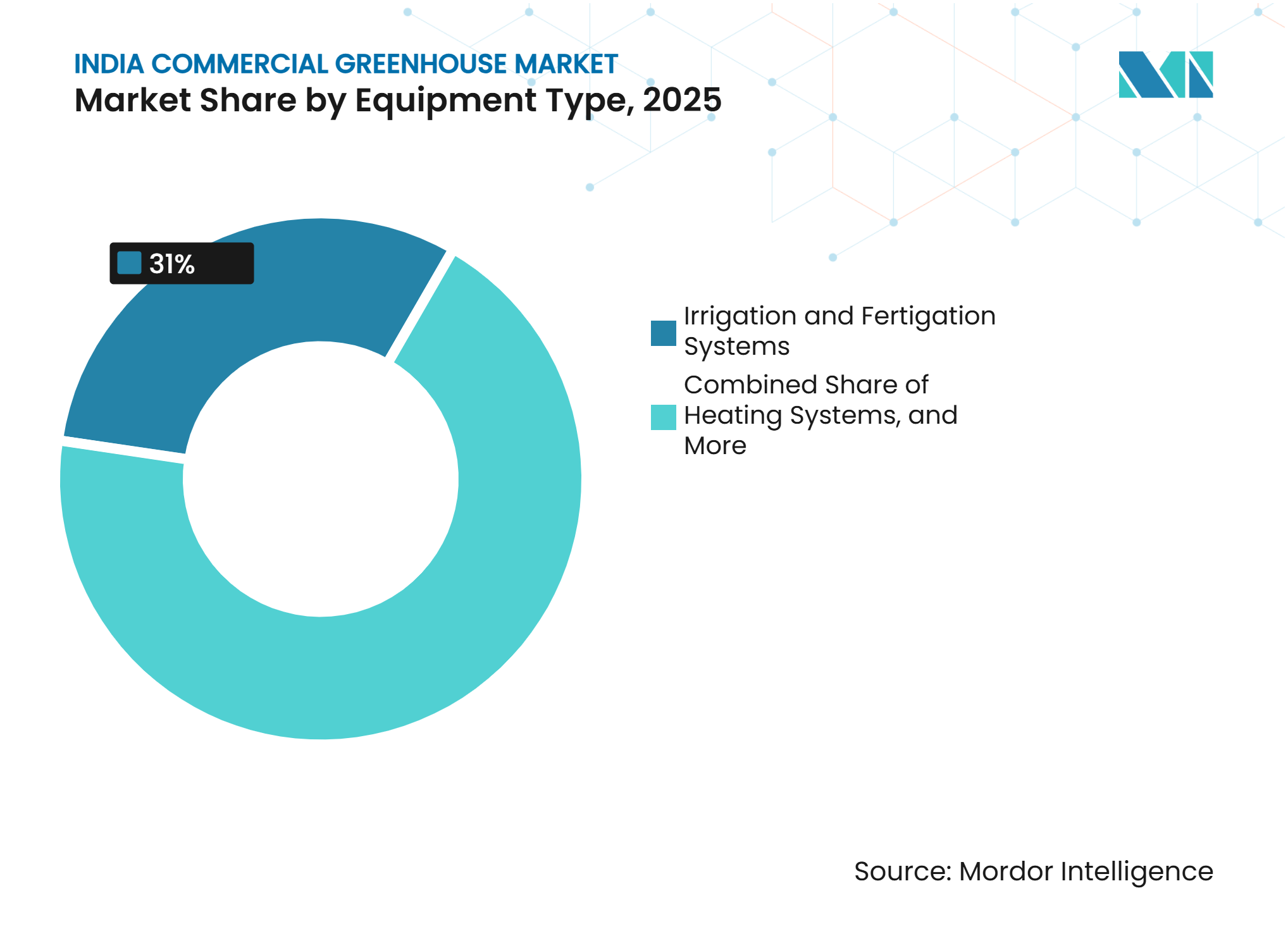
Irrigation and Fertigation Systems Lead, While Climate Control and Automation Software Records the Fastest GrowthIrrigation and Fertigation Systems accounted for 31% of the India commercial greenhouse market in 2025, making them the largest equipment category. These systems remain central to water and nutrient management, with recirculating drip systems supporting efficient water use and crop nutrition. Structural Components represented the second-largest investment category, while subsidy standards for materials are gradually improving frame and covering specifications.
Climate Control and Automation Software is forecast to grow at a CAGR of 6.7% from 2026 to 2031, making it the fastest-growing equipment category. Local IoT controllers and mobile platforms support microclimate monitoring, fertigation scheduling, and disease-risk alerts at single-acre operations. The growth of software also aligns with the wider adoption of Cooling and Ventilation Systems in South and West India, where active climate control supports viable crop cycles under challenging summer conditions. LED Grow Lighting is gaining use in nurseries, leafy greens, and hydroponic berry systems, with Signify's June 2026 elite configuration reaching an efficacy of 4.2 micromoles per joule. Screening and Shading Systems provide heat control, insect exclusion, and light management across crop types. Overall, equipment adoption in the India commercial greenhouse market is shifting toward integrated packages tailored to crop requirements, location, and daily operating conditions.



By Crop Type:
Fruits and Vegetables Lead and Record the Fastest GrowthFruits and Vegetables accounted for 56% of the India commercial greenhouse market in 2025 and are forecast to grow at a CAGR of 6.2% from 2026 to 2031, making it the largest and fastest-growing crop type. Tomatoes, cucumbers, and colored capsicum remain key greenhouse crops, supported by demand for consistent year-round production. APEDA reported that greenhouse capsicum exports from southern states rose 3% in the 2025 marketing year. Traceability and phytosanitary requirements further increase the need for consistent crop-handling and input-recordkeeping.
Within Fruits and Vegetables, Strawberries and Berries are gaining traction as demand for premium year-round fresh fruit supports interest from organized retail and food-service buyers. Their cultivation requires careful temperature, water, and quality control, supporting the adoption of controlled greenhouse environments. Flowers and Ornamentals serve domestic metro demand and export channels in the Middle East and Southeast Asia through cut flowers, potted plants, and bedding plants. Herbs and Microgreens serve HoReCa and premium retail buyers seeking basil, coriander, fenugreek, and specialty microgreens. Cannabis and Specialty Crops remain early-stage categories, while medical cannabis commercialization depends on regulatory pathways that are not yet fully established. Overall, demand for consistent, high-quality produce and crop diversification is supporting the expansion of commercial greenhouse cultivation in India.
By Greenhouse Type:
Plastic-film Greenhouses Lead, While Hybrid and Semi-closed Greenhouses Record the Fastest GrowthPlastic-film Greenhouses accounted for 62% of the India commercial greenhouse market share in 2025, supported by their lower construction cost and broad domestic availability. They remain the predominant greenhouse structure among growers, particularly where affordability and ease of installation are important. Glass greenhouses remain a premium early-stage option linked to export-oriented horticulture and high-value crop production. Rigid Polycarbonate Greenhouses offer stronger thermal insulation than polyfilm at a lower initial cost than glass and are used in seed propagation, research installations, and premium floriculture projects.
Hybrid and Semi-closed Greenhouses are forecast to grow at a CAGR of 6.1% from 2026 to 2031, making them the fastest-growing greenhouse type. Experienced growers are gradually moving from naturally ventilated polyhouses toward designs with active cooling, automated shading, recirculating water management, and stronger frames. This transition requires additional investment in fan-and-pad systems and motorized screen controls, indicating a gradual upgrade cycle rather than rapid replacement of existing polyfilm structures. Kryzen Biotech Private Limited offers naturally ventilated, fan-and-pad, and polycarbonate structures from its 10-acre production campus. The India commercial greenhouse market has scope for turnkey providers that can standardize the transition from basic polyfilm structures to higher-control systems.
By Cultivation Technology:
Non-hydroponic Soil and Substrate Systems Lead, While Hydroponics Records the Fastest GrowthNon-hydroponic Soil and Substrate Systems held 51% of the cultivation-technology segment in 2025. Their lead reflects lower capital requirements, familiar soil-based practices, and crop compatibility. Coco coir and rockwool can help growers move from soil-based methods toward soilless production. Hydroponic Systems are forecast to grow at a 7.3% CAGR from 2026 to 2031, the highest rate in this segmentation. Nutrient Film Technique and Deep Water Culture support commercial production of leafy greens, herbs, and berries.
Hydroponic adoption is creating demand for nutrient concentrates, pH and EC controls, inert substrates, and UV sterilization equipment. Eeki Foods Private Limited completed 88 acres of controlled environment aeroponic capacity in Rajasthan in 2025 and renewed Global GAP and international ISO certifications. Drip Hydroponics and Nutrient Film Technique lead adoption, while INHYDRO and Agrifirst offer design, installation, and agronomy support. Deep Water Culture remains more prevalent in research and early commercial projects, and Hybrid and Vertical Integration approaches enable multiple cultivation systems within a facility. The India commercial greenhouse market can support specialized inputs and services as soilless production expands.
By End User:
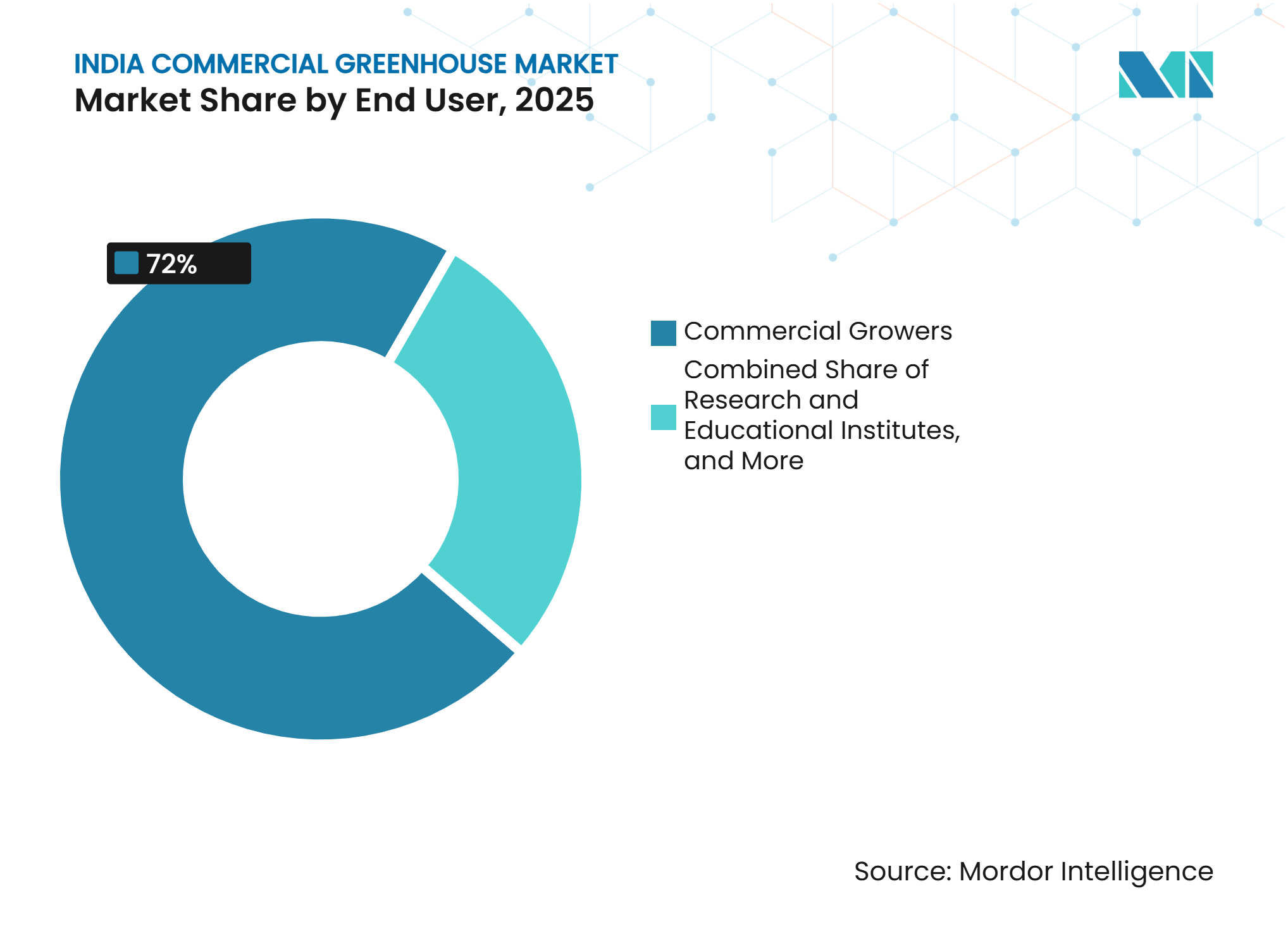
Commercial Growers Lead, While Research and Educational Institutes Record the Fastest GrowthCommercial Growers accounted for 72% of the India commercial greenhouse market share in 2025, making them the largest end-user segment and the main source of revenue demand and project investment. Mid-scale fan-and-pad operators produce colored capsicum and cherry tomatoes for metro retail and HoReCa buyers with lower technology overhead. Eeki Foods Private Limited uses aeroponic technology and IoT-controlled growing environments across multi-state farm clusters.
Research and Educational Institutes are forecast to grow at a 6.5% CAGR from 2026 to 2031, making them the fastest-growing end-user segment. The Indian Council of Agricultural Research and state agricultural universities are supporting controlled-environment research, hydroponic variety trials, and crop-adaptation programs. This growth supports demand for precision in substrates, advanced sensors, and reproducible climate protocols. Retail Garden Centers and Nurseries buy ornamental plants, propagation seedlings, and containerized planting material, while organized retail landscaping, urban green-space programs, and institutional planting projects support recurring demand. Research systems support applied crop work and plant-physiology studies, while commercial farms require dependable output for buyers. The India commercial greenhouse market can grow through both commercial production and research that improves crop adaptation.

Geography Analysis
South India leads the India commercial greenhouse market in terms of technology adoption and installed base. Karnataka and Telangana have a high concentration of fan-and-pad polyhouse projects for colored capsicum, cherry tomatoes, and exotic herbs. Their proximity to Bengaluru and Hyderabad supports access to metro retail and quick-commerce networks. Higher summer temperatures have encouraged the adoption of advanced cooling and management systems. Tamil Nadu benefits from established drip-irrigation infrastructure, available horticulture labor, and agribusiness ecosystems that support market expansion.
West India represents the largest investment concentration by project number. Maharashtra, Gujarat, and Rajasthan combine water scarcity with access to organized retail demand in Mumbai, Pune, and Ahmedabad. Maharashtra's Pune region and northern districts have tomato, cucumber, and leafy-green polyhouse operations that serve urban consumption and export aggregation. Gujarat is emerging as a corridor for hydroponic scale-up and commercial soilless projects, while Rajasthan has attracted aeroponic and controlled-environment operators seeking to manage extreme temperatures. These conditions support continued investment in technologies that improve resource efficiency and production control.
North India represents another significant greenhouse cultivation area, with Delhi NCR supporting leafy greens, herbs, and exotic vegetables, while Punjab and Haryana contribute to berry and flower cultivation for domestic and export supply chains. In contrast, East and Northeast India have lower greenhouse penetration due to logistics constraints, limited agronomic support, and a larger subsistence cultivation base. However, the higher central government contribution under MIDH for North Eastern and Himalayan states can improve the project cost structure and support greater adoption of protected cultivation in these regions. Overall, greenhouse adoption remains concentrated in regions with strong horticultural production, urban market access, water or climate constraints, and supporting infrastructure, while government assistance provides a pathway for expansion in regions with lower protected-cultivation penetration.
Competitive Landscape
Market Concentration
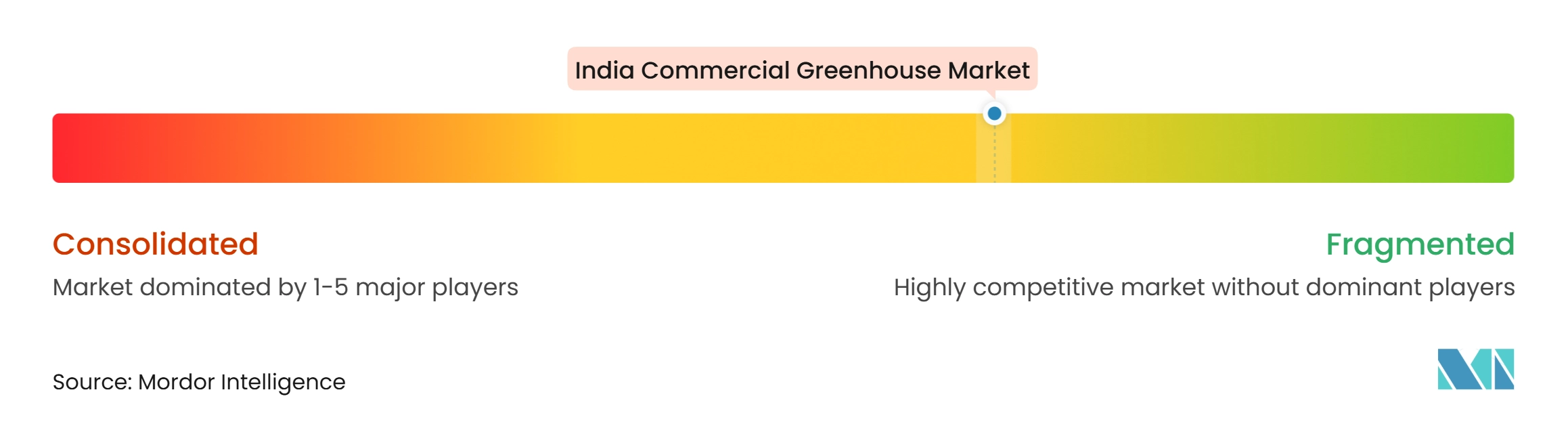
The India commercial greenhouse market remains moderately fragmented, with regional builders, component suppliers, and specialist agritech operators serving a diverse grower base. Netafim Limited offers irrigation, fertigation, climate control, and greenhouse project design. Jain Irrigation Systems Limited operates more than 4,000 distribution points. Agriplast Tech India Private Limited offers Ginegar-certified greenhouse films, shade nets, insect nets, and hydroponic systems.
Leading suppliers compete through turnkey project delivery, subsidy support, fertigation, and IoT-enabled services. Affordable medium-technology packages remain an underserved area for growers transitioning from basic polyhouses to hybrid structures. Working capital, agronomy services, and traceable supply chain solutions are additional gaps for growers serving organized buyers. Eeki Foods Private Limited combines proprietary growing systems with direct buyer relationships and holds patents for polymer growing chambers and IoT monitoring systems.
Priva Holding B.V. introduced the NutriOne Stand Alone fertigation system at HortiConnect India 2025 in Bangalore. Signify expanded its Philips GreenPower LED toplighting force portfolio in June 2026 with 2 configurations for different investment and energy-efficiency needs. The India commercial greenhouse market is increasingly competing on technology, service capabilities, and supply chain execution in addition to greenhouse structure costs.
India Commercial Greenhouse Industry Leaders
-
Netafim Limited (Orbia Advance Corporation, S.A.B. de C.V.)
-
Jain Irrigation Systems Limited
-
Agriplast Tech India Private Limited
-
IG Aatreyas Private Limited (IG International and Aatreyas Agro)
-
INHYDRO
- *Disclaimer: Major Players sorted in no particular order
India Commercial Greenhouse Market Companies Covered in this Report
- Netafim Limited (Orbia Advance Corporation, S.A.B. de C.V.)
- Jain Irrigation Systems Limited
- Agriplast Tech India Private Limited
- IG Aatreyas Private Limited (IG International and Aatreyas Agro)
- INHYDRO
- Kryzen Biotech Private Limited
- Agrifirst
- Eeki Foods Private Limited
- Priva Holding B.V.
- Signify N.V.
- Hindustan Agri Business Private Limited
- Agro Dome Projects LLP
- Saveer Biotech Limited
- Agrolt Solutions Private Limited
- Vatshal Green Environment
Recent Industry Developments in India Commercial Greenhouse Market
- June 2026: Signify N.V. expanded the Philips GreenPower LED toplighting force portfolio with two new solutions, toplighting force performance and toplighting force elite. The performance version is designed for growers seeking a lower initial investment, while the elite version focuses on long-term lighting efficiency, with efficacy of up to 4.2 µmol/J and features including dimming, dynamic light steering, and energy optimization.
- September 2025: Priva Holding B.V. introduced its NutriOne Stand Alone system at HortiConnect India 2025 in Bangalore. The system combines irrigation and fertigation in one solution, delivering water and nutrients directly to plant roots. It can operate as a stand-alone system or connect with Priva Compass for an automated fertigation strategy, with up to four dosing channels and mainline capacities ranging from 3 to 120 m³/h.
- 2025: Eeki Foods Private Limited completed 88 acres across the Mangal and Lakheri phases in Rajasthan and secured international ISO certifications and Global GAP renewals. The company also reported that its G-III Gen Growing Chambers, piloted in 2025, use patented precision aeroponic technology and are being rolled out at scale in 2026.
India Commercial Greenhouse Market Report Scope
The commercial greenhouse market refers to the cultivation of crops in enclosed or partially enclosed structures that provide controlled or modified growing conditions. The market includes greenhouse structures and associated equipment and systems used for commercial crop production.
The India Commercial Greenhouse Market is Segmented by Equipment Type (Heating Systems, Cooling and Ventilation Systems, LED Grow Lighting, Irrigation and Fertigation Systems, Climate Control and Automation Software, Screening and Shading Systems, and Structural Components), by Crop Type (Fruits and Vegetables, Flowers and Ornamentals, Herbs and Microgreens, and Cannabis and Specialty Crops), by Greenhouse Type (Glass Greenhouses, Plastic-film Greenhouses, Rigid Polycarbonate Greenhouses, and Hybrid and Semi-closed Greenhouses), by Cultivation Technology (Hydroponic, Non-hydroponic Soil and Substrate, and Hybrid and Vertical Integration), and by End User (Commercial Growers, Research and Educational Institutes, and Retail Garden Centers and Nurseries). The Market Forecasts are Provided in Terms of Value (USD).
Segmentation Overview
| Heating Systems | |
| Cooling and Ventilation Systems | |
| LED Grow Lighting | |
| Irrigation and Fertigation Systems | |
| Climate Control and Automation Software | |
| Screening and Shading Systems | |
| Structural Components | Glazing Systems |
| Frames and Trusses |
| Fruits and Vegetables | Tomatoes |
| Cucumbers | |
| Lettuce and Leafy Greens | |
| Peppers | |
| Strawberries and Berries | |
| Flowers and Ornamentals | Cut Flowers |
| Potted Plants and Bedding Plants | |
| Herbs and Microgreens | |
| Cannabis and Specialty Crops | Medical Cannabis |
| Seedlings and Propagation Crops |
| Glass Greenhouses |
| Plastic-film Greenhouses |
| Rigid Polycarbonate Greenhouses |
| Hybrid and Semi-closed Greenhouses |
| Hydroponic | Nutrient Film Technique |
| Deep Water Culture | |
| Drip Hydroponics | |
| Non-hydroponic Soil and Substrate | Soil-based |
| Coco Coir and Rockwool Substrate | |
| Hybrid and Vertical Integration |
| Commercial Growers |
| Research and Educational Institutes |
| Retail Garden Centers and Nurseries |
| By Equipment Type | Heating Systems | |
| Cooling and Ventilation Systems | ||
| LED Grow Lighting | ||
| Irrigation and Fertigation Systems | ||
| Climate Control and Automation Software | ||
| Screening and Shading Systems | ||
| Structural Components | Glazing Systems | |
| Frames and Trusses | ||
| By Crop Type | Fruits and Vegetables | Tomatoes |
| Cucumbers | ||
| Lettuce and Leafy Greens | ||
| Peppers | ||
| Strawberries and Berries | ||
| Flowers and Ornamentals | Cut Flowers | |
| Potted Plants and Bedding Plants | ||
| Herbs and Microgreens | ||
| Cannabis and Specialty Crops | Medical Cannabis | |
| Seedlings and Propagation Crops | ||
| By Greenhouse Type | Glass Greenhouses | |
| Plastic-film Greenhouses | ||
| Rigid Polycarbonate Greenhouses | ||
| Hybrid and Semi-closed Greenhouses | ||
| By Cultivation Technology | Hydroponic | Nutrient Film Technique |
| Deep Water Culture | ||
| Drip Hydroponics | ||
| Non-hydroponic Soil and Substrate | Soil-based | |
| Coco Coir and Rockwool Substrate | ||
| Hybrid and Vertical Integration | ||
| By End User | Commercial Growers | |
| Research and Educational Institutes | ||
| Retail Garden Centers and Nurseries | ||
Key Questions Answered in the Report
What is the size of the India commercial greenhouse market?
The India commercial greenhouse market was valued at USD 215.01 million in 2025 and is projected to reach USD 275.05 million by 2031 at a 4.19% CAGR.
Which equipment category is growing fastest in commercial greenhouses in India?
Climate Control and Automation Software is projected to expand at a 6.7% CAGR from 2026 to 2031.
Why is hydroponics gaining interest among Indian growers?
The Hydroponic Systems segment is forecast to grow at a CAGR of 7.3% from 2026 to 2031, as it supports controlled cultivation of leafy greens, herbs, and berries.
Which regions are important for protected cultivation in India?
South India leads in technology adoption and installed greenhouse base, while West India has the largest concentration of investment by project number.