India Cafes And Bars Market Size and Share
Market Overview
| Study Period | 2021 - 2031 |
|---|---|
| Forecast Data Period | 2026 - 2031 |
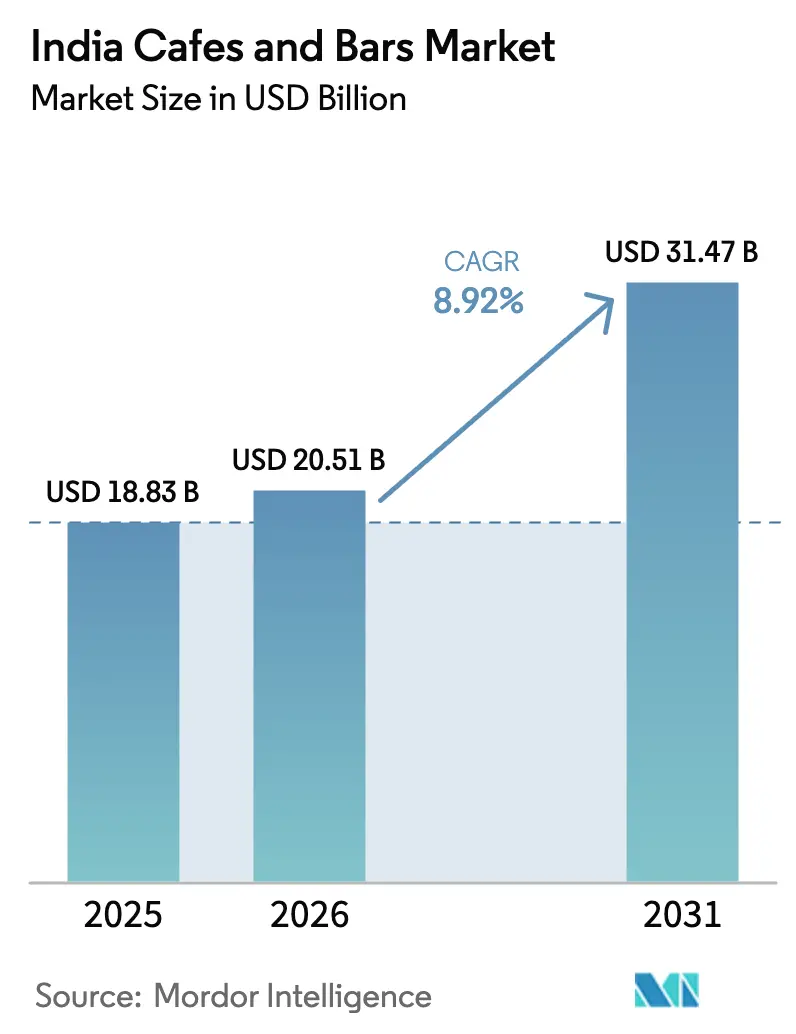
| Base Year Market Size (2025) | USD 18.83 Billion |
| Market Size (2026) | USD 20.51 Billion |
| Market Size (2031) | USD 31.47 Billion |
| Growth Rate (2026 - 2031) | 8.92 % |
| Market Concentration | Medium |
Major Players
*Disclaimer: Major Players sorted in no particular order Image © Mordor Intelligence. Reuse requires attribution under CC BY 4.0. |
|
India Cafes And Bars Market Analysis by Mordor Intelligence
The India cafes and bars market size was valued at USD 18.83 billion in 2025 and estimated to grow from USD 20.51 billion in 2026 to reach USD 31.47 billion by 2031, at a CAGR of 8.92% during the forecast period (2026-2031). Rapid urbanization, rising disposable incomes, and the fusion of traditional tea culture with global coffee trends are expanding the addressable customer base. Digital payments now cover 87% of urban outlets, trimming checkout friction and boosting repeat purchasing. Government incentives for food processing, together with specialty-grade sourcing initiatives, have stabilized upstream costs and strengthened supply continuity for premium beverages. Independent operators continue to flourish on the back of cultural authenticity and agile menu innovation, even as chains accelerate store roll-outs in tier-2 and tier-3 cities. Regulatory reforms that standardize food safety and liquor compliance favor organized players and should nudge consolidation within the India cafes and bars market over the next five years.
Key Report Takeaways
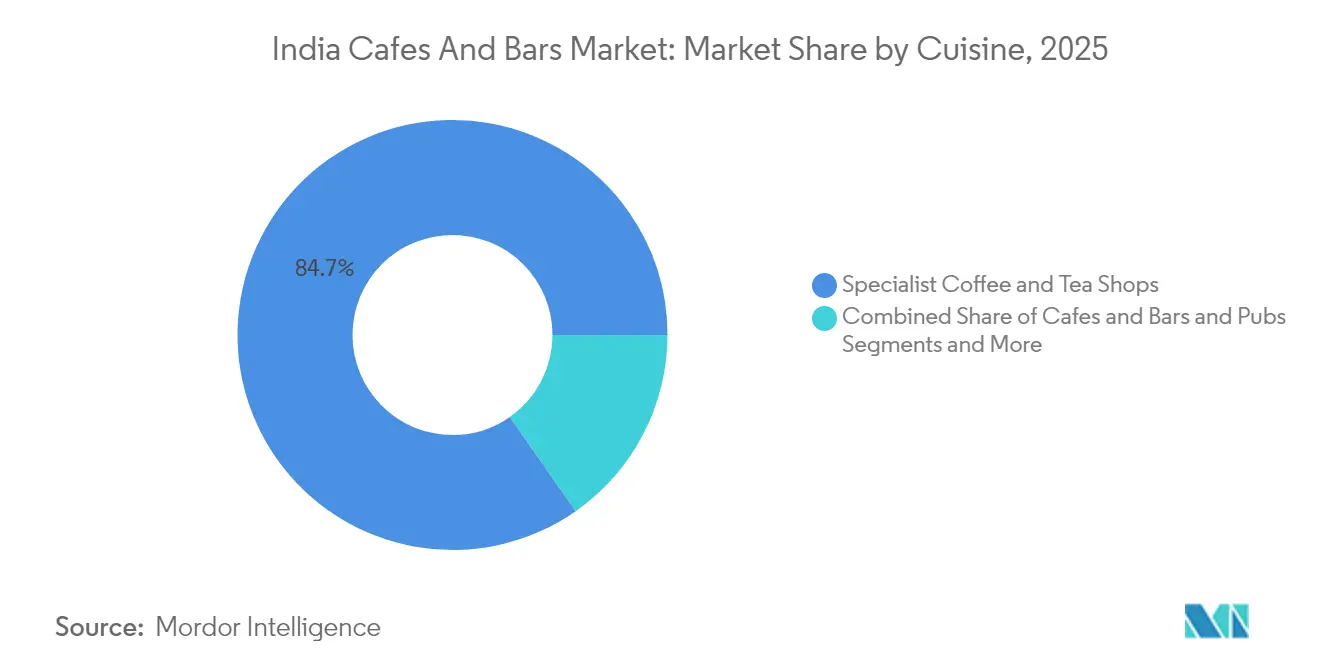
- By cuisine, specialist coffee and tea shops captured 84.72% of the India cafes and bars market share in 2025 while the cafés sub-segment is projected to advance at an 11.15% CAGR to 2031.
- By outlet type, independent outlets held 76.05% of the India cafes and bars market share in 2025; chained outlets show the fastest growth at a 11.72% CAGR through 2031.
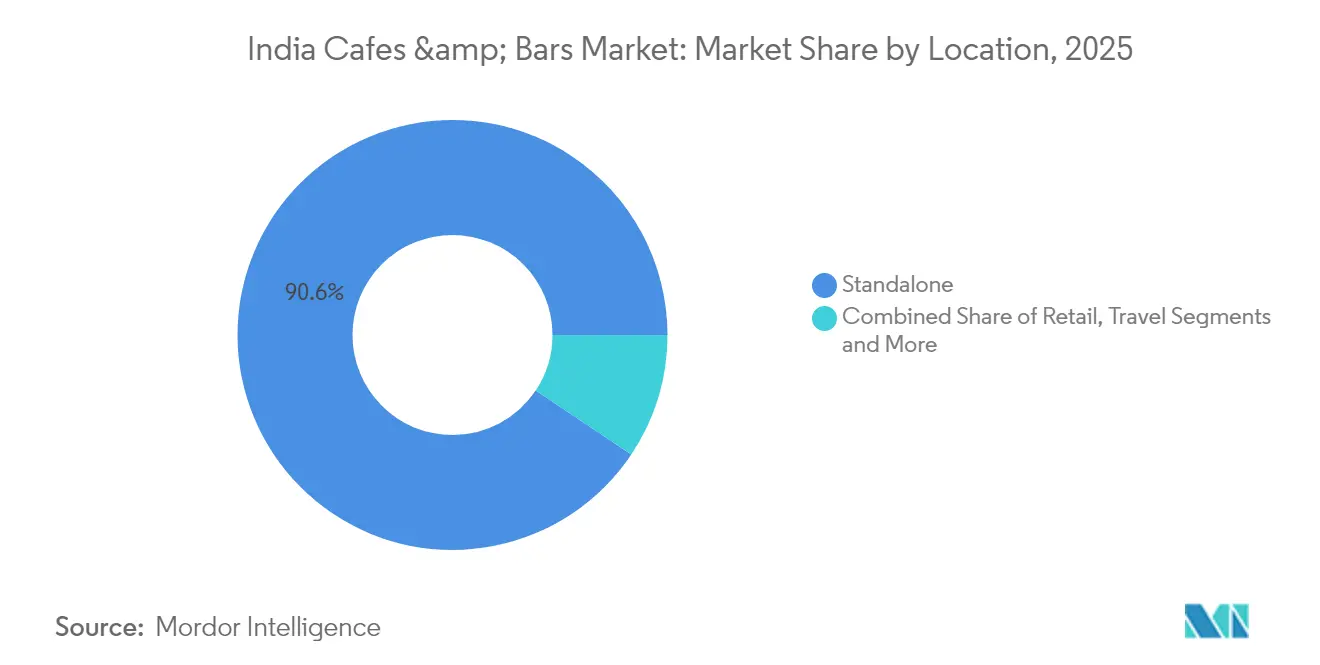
- By location, standalone venues accounted for 90.63% of the India cafes and bars market size in 2025, whereas travel-site outlets are forecast to grow at a 12.24% CAGR up to 2031.
- By service type, dine-in led with 47.68% revenue in 2025, but delivery services are poised for a 12.05% CAGR during the forecast window.
Note: Market size and forecast figures in this report are generated using Mordor Intelligence’s proprietary estimation framework, updated with the latest available data and insights as of 2026.
India Cafes And Bars Market Trends and Insights
Drivers Impact Analysis*
| Driver | (~) % Impact on CAGR Forecast | Geographic Relevance | Impact Timeline |
|---|---|---|---|
| Rising consumer preference for premium coffee, tea, and specialty beverages | +2.1% | National, with early gains in Mumbai, Delhi, Bangalore | Medium term (2-4 years) |
| Growth of independent cafes focusing on unique, high-quality coffee and cultural experiences | +1.8% | Tier-1 cities expanding to Tier-2, particularly Pune, Hyderabad, Chennai | Long term (≥ 4 years) |
| Increasing inclination toward social and after-work gatherings | +1.4% | Metropolitan areas, emerging in co-working hubs | Short term (≤ 2 years) |
| Expansion of international and domestic café and bar chains into Tier II and III cities | +2.2% | National expansion from urban cores to emerging markets | Medium term (2-4 years) |
| Surging demand for low-calorie, low-alcohol, and non-alcoholic beverages | +1.3% | Health-conscious urban demographics across major cities | Long term (≥ 4 years) |
| Adoption of digital ordering, contactless payments, and integration with food delivery platforms | +1.6% | Urban centers with high smartphone penetration | Short term (≤ 2 years) |
| Source: Mordor Intelligence | |||


Rising consumer preference for premium coffee, tea, and specialty beverages
India's coffee landscape is transforming as consumers increasingly embrace premium coffee and specialty beverages, reflecting the country's integration into global coffee culture while retaining its unique local identity. Specialty roasters, such as Third Wave Coffee, are actively driving this shift by expanding to over 90 outlets across six cities and leveraging direct estate sourcing and artisanal processing techniques to capture market share. This growing preference for premium coffee has led to a 23% year-on-year increase in average order values within the specialty coffee segment. Consumers now willingly spend INR 200-400 (USD 2.4-4.8) on single-origin beverages, a notable rise compared to the INR 80-120 (USD 1.0-1.4) spent on traditional coffee options. Supporting this premiumization trend, the Coffee Board of India has introduced a 10-year roadmap aiming for a market size of USD 3.2 billion by 2028, with a strong emphasis on specialty processing and value addition to sustain this growth trajectory [1]Source: Coffee Board of India, "India's 10-Year Coffee Growth Plan", www.indiacoffee.org.
Growth of independent cafes focusing on unique, high-quality coffee and cultural experiences
The growth of independent cafes in India is significantly driving the cafes and bars market by offering a unique blend of high-quality coffee and cultural experiences. These cafes emphasize specialty coffee, artisanal brews, and carefully sourced beans, appealing to consumers who increasingly view coffee not just as a beverage but as a lifestyle choice. Urbanization, rising disposable incomes, and exposure to global coffee culture have fueled this trend, particularly among younger generations who seek premium and authentic coffee experiences. Independent cafes often combine quality coffee with inviting atmospheres that serve as social and work hubs, distinguishing themselves from mass coffee chains. This trend is part of a broader transformation of India’s coffee culture, where specialty coffee now accounts for substantial market growth, attracting both local devotees and international brands while fostering a distinctive Indian coffee identity.
Increasing inclination toward social and after-work gatherings
The increasing inclination toward social and after-work gatherings is a key market driver of the India Cafes and Bars Market. Cafes are evolving beyond just serving coffee to becoming vibrant social hubs where people gather to unwind, network, and socialize after work. This shift is fueled by changing urban lifestyles, rising disposable incomes, and a younger demographic that values experiences over mere consumption. Cafes now offer immersive atmospheres with modern aesthetics, live music, and community events that encourage social interaction. Trends like alcohol-free coffee parties or "morning raves" illustrate how cafes blend wellness with social energy, attracting health-conscious consumers who prefer vibrant, alcohol-free social scenes. These social spaces contribute to longer consumer visits, higher engagement, and greater brand loyalty, transforming cafes into essential urban gathering spots for cultural exchange and relaxation.
Expansion of international and domestic café and bar chains, including entry into Tier II and III cities
India's cafe landscape is undergoing a significant transformation as chains actively expand into smaller cities. Tata Starbucks is driving this shift with its ambitious plan to increase its store count from 390 to 1,000 by 2028. Notably, 60% of these new outlets will target tier-2 and tier-3 cities, reflecting the company's strong confidence in the growing purchasing power and advancing infrastructure of these emerging markets. This expansion strategy is further supported by the rapid development of logistics networks and the widespread adoption of digital payment systems. For instance, UPI transaction volumes in tier-2 cities have surged by an impressive 45% year-over-year in October 2024 compared to October 2023. highlighting the increasing digital readiness of these regions [2]Source: Ministry of Finance, "UPI: Revolutionizing Digital Payments in India", www.pib.gov.in. To ensure success in these smaller markets, chains are actively localizing their menus and adjusting pricing strategies. They typically reduce average selling prices by 20-30% to cater to the price sensitivity of these markets. Despite these reductions, companies are maintaining their margin targets by implementing operational efficiency improvements. This dual approach of adapting to local preferences and optimizing operations positions chains to capitalize on the untapped potential of India's smaller cities, setting the stage for long-term growth in the cafe market.
Restraints Impact Analysis*
| Restraint | (~) % Impact on CAGR Forecast | Geographic Relevance | Impact Timeline |
|---|---|---|---|
| High operational costs, especially rent and labor, in metropolitan areas | -1.2% | Mumbai, Delhi NCR, Bangalore prime locations | Short term (≤ 2 years) |
| Regulatory challenges including complex licensing, alcohol laws, and zoning restrictions | -0.9% | State-specific variations, particularly Maharashtra, Delhi | Medium term (2-4 years) |
| Shifting consumer preferences requiring constant innovation and investment | -1.1% | Urban markets with high competition density | Long term (≥ 4 years) |
| Difficulty for small and medium players to compete with large established brands | -0.8% | Tier-1 cities with high brand concentration | Medium term (2-4 years) |
| Source: Mordor Intelligence | |||
High operational costs, especially rent and labor, in metropolitan areas
High operational costs, particularly rent and labor, present a significant restraint for the India Cafes and Bars Market, especially in metropolitan areas. Rent expenses in prime urban locations can be substantial, often constituting a major portion of monthly fixed costs, with leases rarely adjustable downward even during periods of low sales. Similarly, labor costs are considerable due to the need for skilled staff, including chefs, baristas, service crew, and management, with monthly salaries running from tens of thousands to lakhs of rupees depending on the role and market standards. These high fixed and variable costs can squeeze profit margins, making it challenging for cafes and bars to maintain financial sustainability without strong revenue volumes or premium pricing strategies. Managing these costs efficiently remains crucial for operators aiming to thrive in competitive metro markets.
Regulatory challenges including complex licensing, alcohol laws, and zoning restrictions
Multi-location operators actively face significant challenges and incur substantial compliance costs due to the fragmented structure of alcohol licensing, food safety regulations, and zoning restrictions across different states. These challenges become more pronounced as recent excise policy changes in key states introduce additional uncertainty. For instance, Haryana increased bar license fees by 25%, directly impacting the operational budgets of businesses, while Delhi implemented stricter compliance requirements for establishments serving alcohol, adding to the administrative workload [3]Source: Haryana Excise Policy 2024-2025, "EXCISE POLICY FOR THE YEAR 2024-25", www. haryanatax.gov.in. FSSAI's three-tier licensing system, while aimed at providing regulatory clarity, requires businesses to adhere to varying documentation and compliance procedures based on their annual turnover thresholds. This system creates a considerable administrative burden, particularly for businesses experiencing rapid growth, as they must allocate additional resources to meet these requirements. Chains expanding across state boundaries encounter even greater difficulties. Each jurisdiction enforces its own distinct set of regulations for alcohol service, food safety protocols, and operational permits.
*Our forecasts treat driver/restraint impacts as directional, not additive. The impact forecasts reflect baseline growth, mix effects, and variable interactions.
Segment Analysis
By Cuisine: Specialty Coffee Drives Market Evolution
Specialist coffee and tea shops hold the dominant position in India’s cafés and bars market, capturing an estimated 84.72% market share in 2025. This segment’s strength lies in India’s established tea culture and the growing appreciation for artisanal coffee among younger consumers. Brands such as Chaayos, Tea Trails, Blue Tokai, and Third Wave Coffee Roasters have pioneered niche concepts by blending traditional Indian flavors with premium global beverage trends. Their success is rooted in offering high-quality ingredients, distinctive brewing methods, and cozy atmospheres that encourage repeat visits. The emphasis on sustainability, ethical sourcing, and personalization continues to enhance consumer loyalty, making specialist beverage outlets integral to India’s social landscape.
In contrast, the cafés segment represents the fastest-growing category in the Indian cafés and bars industry, projected to expand at a robust 11.15% compound annual growth rate through 2031. This surge is encouraged by rapid urbanization, evolving lifestyles, and increased disposable income among young professionals and students. The café landscape is shifting toward multifunctional concepts, where coworking, socializing, and casual dining intersect. Themed cafés and locally inspired venues are gaining momentum as consumers seek immersive, Instagram-worthy experiences that go beyond mere beverage consumption. Independent cafés are experimenting with fusion menus and premium brews, while international chains like Starbucks and Tim Hortons are fueling competitive innovation.


By Outlet: Independent Innovation Versus Chain Efficiency
Independent outlets are the predominant force in India’s cafés and bars market, commanding approximately 76.05% market share in 2025. This dominance showcases the sector’s highly entrepreneurial nature, where local owners shape diverse formats, menus, and ambiences tailored to regional preferences and rapidly evolving consumer tastes. Independent cafés and bars flourish particularly in metropolitan areas such as Mumbai, Delhi, Bengaluru, and Hyderabad, often introducing innovative beverage concepts, personalized service, and unique experiences that resonate with a broad clientele. The adaptability and authenticity of independent establishments make them resilient to shifting trends, especially as they capitalize on consumers’ desire for individuality and connection to local culture. These outlets also benefit from word-of-mouth marketing, community engagement, and flexible business models that allow quick pivots in response to demand.
Conversely, chained outlets are emerging as the fastest-growing segment in the market, registering a strong compound annual growth rate of 11.72% as national and international brands accelerate geographic expansion. Leveraging structured operational systems, access to significant capital, and established brand reputations, chains such as Starbucks, Barista, and Tim Hortons are quickly scaling their presence across Tier-I and Tier-II cities. Chained cafés and bars offer standardized quality, loyalty programs, and digitally enabled customer experiences, allowing them to attract an expanding aspirational urban middle class. The ability to negotiate prime locations and benefit from economies of scale provides chains with an efficient and profitable growth model. Their entry into travel hubs, malls, and business districts highlights the pivot toward convenience and lifestyle-driven consumption.
By Location: Standalone Dominance Faces Transit Hub Growth
Standalone outlets dominate India’s cafés and bars market, representing approximately 90.63% of total market share in 2025. This overwhelming presence highlights the country’s deeply ingrained preference for locally accessible, neighborhood-based cafés and bars that cater to both casual and regular patrons. Most standalone establishments are small to mid-sized businesses, often positioned in residential zones, commercial areas, or high-street markets, offering strong community engagement and a familiar social environment. Their resilience is underpinned by flexible business models, quick adaptability to local tastes, and affordability that appeals to a broad demographic. Moreover, standalone cafés and bars remain vital in India’s informal dining landscape, with their presence spanning both traditional tea stalls and modern specialty coffee houses.
In contrast, travel-based café and bar outlets are experiencing rapid expansion, projected to grow at an impressive 12.24% compound annual rate through 2031. This growth is propelled by the modernization of airports, railway stations, and metro hubs, which are becoming lucrative destinations for organized food and beverage formats. As passenger footfall rises, operators such as Café Coffee Day, Starbucks, and Costa Coffee are intensifying their presence in travel terminals to capture on-the-go consumers seeking premium and convenient options. The ongoing transformation of India’s air travel infrastructure, coupled with the expansion of domestic tourism, has created sustained demand for branded café concepts in transit spaces. Increasing digital integration, such as app-based pre-ordering and loyalty systems, further enhances the customer experience, driving repeat sales.
By Service Type: Delivery Integration Reshapes Revenue Models
Dine-in service remains the dominant format in India’s cafés and bars market, holding a 47.68% share in 2025. This segment reflects the cultural importance of in-person social interactions and experiential dining, which continue to define India’s café and bar environments. Consumers increasingly view these venues as social spaces for leisure, meetings, and community engagement, rather than merely consumption points for food and beverages. The dine-in model benefits from the country’s growing youth population, expanding middle class, and preference for ambiance-driven experiences that blend culinary quality with atmosphere. Many cafés and bars are investing in improved interiors, live entertainment, and specialty menu innovations to strengthen customer retention and enhance dwell time.
The delivery service, meanwhile, represents the market’s fastest-growing segment, projected to expand at a 12.05% compound annual growth rate through 2031. This rapid rise is driven by increasing consumer adoption of digital platforms, smartphone penetration, and the convenience of home-based dining. Integration with major food delivery services such as Swiggy and Zomato has allowed cafés and bars to extend their reach beyond physical footfall, catering to time-constrained urban consumers. Delivery-focused models have also become key revenue stabilizers during off-peak hours or seasonal slowdowns, particularly for specialty beverages and ready-to-drink options. Many brands are redesigning packaging and menu offerings to preserve the quality and visual appeal of products during delivery.
Geography Analysis
The India cafés and bars market exhibits strong geographic diversity, with metropolitan cities driving the majority of revenue share. Urban centers such as Mumbai, Delhi NCR, Bengaluru, and Chennai account for the highest market concentration due to dense populations, elevated disposable incomes, and a strong inclination toward socializing over food and beverages. Mumbai remains a hub for premium cafés and bars, while Delhi NCR leads in scale with both organized and independent outlets catering to varied consumer lifestyles. In the south, Bengaluru and Hyderabad showcase dynamic café cultures centered on artisanal coffee and wellness-oriented offerings, reflecting a blend of comfort and innovation.
Northern India exhibits robust growth supported by an expanding middle-class consumer base in Tier-I and Tier-II cities like Lucknow and Chandigarh, where specialty coffee houses and lounge bars are increasingly popular. Western India, led by Maharashtra and Gujarat, benefits from its commercial hubs and tourism inflows that sustain both high-end and mid-priced establishments. Meanwhile, southern states contribute significantly through youth-driven café trends and the penetration of pan-India coffee chains such as Tata Starbucks and Barista. The region’s tech workforce in cities like Bengaluru and Hyderabad particularly fuels weekday footfall and weekend leisure traffic.
Eastern and northeastern regions, though smaller markets, are witnessing emerging café and bar cultures driven by rising urbanization and disposable incomes in cities like Kolkata, Guwahati, and Bhubaneswar. Tier-II and Tier-III towns across India are expected to record the fastest growth, supported by rapid retail infrastructure expansion and increased exposure to café culture through tourism and digital platforms. This shift indicates a decentralization of the café and bar experience, expanding beyond metros into regional cities that increasingly serve as commercial and cultural hubs for younger, aspirational populations.
Competitive Landscape
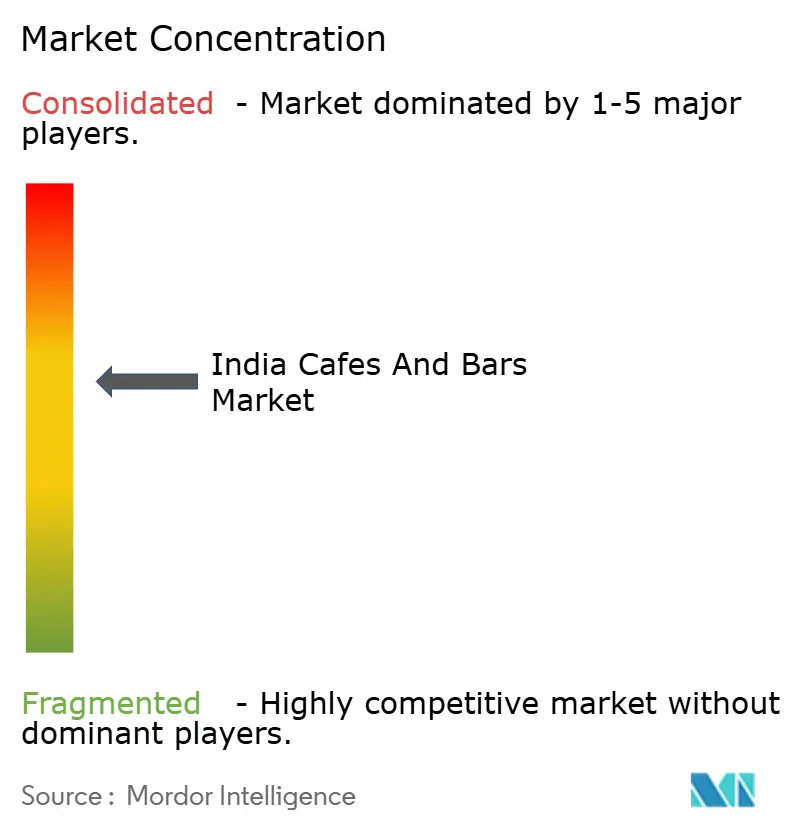
The Indian cafes and bars market demonstrates moderate fragmentation, with a concentration score of 6 out of 10. This level of fragmentation fosters a competitive environment where both established chains and innovative independent players coexist. Prominent brands like Tata Starbucks leverage their premium positioning and systematic expansion strategies to capture market share, while niche players such as Blue Tokai focus on artisanal coffee offerings and direct estate sourcing to differentiate themselves. This diversity in strategic approaches highlights the dynamic nature of the market, allowing multiple business models to thrive simultaneously.
The competitive intensity within the market varies significantly depending on the location and segment. Metropolitan areas exhibit higher levels of consolidation, with major chains dominating the landscape due to their ability to cater to urban consumers' preferences for premium experiences and convenience. In contrast, tier-2 and tier-3 cities remain largely fragmented, with independent operators holding a significant share. These operators often rely on their deep understanding of local tastes and cultural nuances to maintain their competitive edge, creating a unique market dynamic in these regions.
Furthermore, the presence of regional specialists adds another layer of competition, particularly in non-metropolitan areas. These specialists often combine local expertise with innovative offerings to attract a loyal customer base. The interplay between large chains, independent operators, and regional players ensures that the Indian cafes and bars market remains vibrant and diverse, with opportunities for growth across various segments and geographies. This competitive landscape underscores the importance of tailored strategies to succeed in this evolving market.
India Cafes And Bars Industry Leaders
-
Barista Coffee Company Limited
-
Graviss Foods Private Limited
-
Tata Starbucks Private Limited
-
Coffee Day Enterprises Limited
-
Jubilant FoodWorks Ltd
- *Disclaimer: Major Players sorted in no particular order

Recent Industry Developments
- July 2025: Third Wave Coffee unveiled 11 new cafes in Delhi, Hyderabad, Chennai, Mumbai, and Mysuru on a single day. These openings brought the brand's total to 165 cafes spanning 12 cities, showcasing its stronghold in both emerging and established markets.
- March 2025: Chai Kings received a Rs 24 crore investment to expand their tea-centric cafe concept across North India. The initiative focused on integrating traditional chai culture with a modern presentation and ambiance, aiming to cater to a broader audience.
- January 2024: Tata Starbucks Private Limited aims to operate 1,000 stores in India by 2028, equating to a new store opening every three days. The strategy emphasizes training local partners, enhancing customer experiences at new stores, and globally promoting Indian-origin coffee to Starbucks patrons.


India Cafes And Bars Market Report Scope
Bars & Pubs, Cafes, Juice/Smoothie/Desserts Bars, Specialist Coffee & Tea Shops are covered as segments by Cuisine. Chained Outlets, Independent Outlets are covered as segments by Outlet. Leisure, Lodging, Retail, Standalone, Travel are covered as segments by Location.| Bars and Pubs |
| Cafes |
| Juice/Smoothie/Dessert Bars |
| Specialist Coffee and Tea Shops |
| Chained Outlets |
| Independent Outlets |
| Leisure |
| Lodging |
| Retail |
| Standalone |
| Travel |
| Dine-in |
| Takeaway |
| Delivery |
| By Cuisine | Bars and Pubs |
| Cafes | |
| Juice/Smoothie/Dessert Bars | |
| Specialist Coffee and Tea Shops | |
| By Outlet | Chained Outlets |
| Independent Outlets | |
| By Location | Leisure |
| Lodging | |
| Retail | |
| Standalone | |
| Travel | |
| By Service Type | Dine-in |
| Takeaway | |
| Delivery |


Market Definition
- FULL-SERVICE RESTAURANTS - A foodservice establishment where customers are seated at a table, give their order to a server and are served food at a table.
- QUICK SERVICE RESTAURANTS - A foodservice establishment that provides customers convenience, speed, and food offerings at lower prices. Customers usually help themselves and carry their own food to their tables.
- CAFES & BARS - A type of foodservice business that include bars and pubs that are licensed to serve alcoholic drinks for consumption, cafes that serve refreshments and light food items, as well as specialty tea and coffee shops, dessert bars, smoothie bars, and juice bars.
- CLOUD KITCHEN - A foodservice business that utilizes a commercial kitchen for the purpose of preparing food for delivery or takeout only, with no dine-in customers.
| Keyword | Definition |
|---|---|
| Albacore Tuna | It is one of the smallest species of tuna found in the six distinct stocks known globally in the Atlantic, Pacific, and Indian oceans, as well as the Mediterranean Sea. |
| Angus beef | It is beef derived from a specific breed of cattle indigenous to Scotland. It requires certification from the American Angus Association to receive the "Certified Angus Beef" quality mark. |
| Asian cuisine | It includes full-service offerings in restaurants that serve cuisines from cultures such as Chinese, Indian, Korean, Japanese, Bengali, Southeast Asian, etc. |
| Average Order Value | It is the average value of all orders made by the customers at a foodservice establishment. |
| Bacon | It is salted or smoked meat that comes from the back or sides of a pig. |
| Bars & Pubs | It is a drinking establishment that is licensed to serve alcoholic drinks for consumption on the premises. |
| Black Angus | It is beef derived from a black-hided breed of cows that don't have horns. |
| BRC | British Retail Consortium |
| Burger | It is a sandwich consisting of one or more cooked beef patties, placed inside a sliced bread roll or bun roll. |
| Café | It is a foodservice establishment serving various refreshments (mainly coffee) and light meals. |
| Cafes & Bars | It is a type of foodservice business that include bars and pubs that are licensed to serve alcoholic drinks for consumption, cafes that serve refreshments and light food items, as well as specialty tea and coffee shops, dessert bars, smoothie bars, and juice bars. |
| Cappuccino | It is an Italian coffee drink that is traditionally prepared with equal parts double espresso, steamed milk, and steamed milk foam. |
| CFIA | Canadian Food Inspection Agency |
| Chained Outlet | It refers to a foodservice establishment that shares brands, operates in several locations, has central management, and standardized business practices. |
| Chicken Tender | It refers to chicken meat prepared from the pectoralis minor muscles of a chicken bird. |
| Cloud Kitchen | It is a foodservice business that utilizes a commercial kitchen for the purpose of preparing food for delivery or takeout only, with no dine-in customers. |
| Cocktail | It is an alcoholic mixed drink made with either a single spirit or a combination of spirits, mixed with other ingredients such as juices, flavored syrups, tonic water, shrubs, and bitters. |
| Edamame | It is a Japanese dish prepared with soybeans (harvested before they ripen or harden) and cooked in its pod. |
| EFSA | European Food Safety Authority |
| ERS | Economic Research Service of the USDA |
| Espresso | It is a concentrated form of coffee, served in shots. |
| European cuisine | It includes full-service offerings in restaurants that serve cuisines from cultures such as Italian, French, German, English, Dutch, Danish, etc. |
| FDA | Food and Drug Administration |
| Fillet Mignon | It is a cut of meat taken from the smaller end of the tenderloin. |
| Flank Steak | It is a cut of beef steak taken from the flank, which lies forward of the rear quarter of a cow. |
| Foodservice | It refers to the part of the food industry which includes businesses, institutions, and companies which prepare meals outside the home. It includes restaurants, school and hospital cafeterias, catering operations, and many other formats. |
| Franks | Also known as frankfurter or Würstchen, it is a type of highly seasoned smoked sausage popular in Austria and Germany. |
| FSANZ | Food Standards Australia New Zealand |
| FSIS | Food Safety and Inspection Service |
| FSSAI | Food Safety and Standards Authority of India |
| Full service restaurant | It refers to a foodservice establishment where customers are seated at a table, give their order to a server, and are served food at a table. |
| Ghost Kitchen | It refers to a cloud kitchen. |
| GLA | Gross Leasable Area |
| Gluten | It is a family of proteins found in grains, including wheat, rye, spelt, and barley. |
| Grain-fed beef | It is beef derived from cattle that have been fed a diet supplemented with soy and corn and other additives. Grain-fed cows can also be given antibiotics and growth hormones to fatten them up more quickly. |
| Grass-fed beef | It is beef derived from cattle that have only been fed grass as feed. |
| Ham | It refers to the pork meat taken from the leg of a pig. |
| HoReCa | Hotels, Restaurants and Cafes |
| Independent Outlet | It refers to a foodservice establishment that operates with a single outlet or is structured as a small chain with no more than three locations. |
| Juice | It is a drink made from the extraction or pressing of the natural liquid contained in fruit and vegetables. |
| Latin American | It includes full-service offerings in restaurants that serve cuisines from cultures such as Mexican, Brazilian, Argentinian, Colombian, etc. |
| Latte | It is a milk-based coffee that is made up of one or two shots of espresso, steamed milk, and a thin layer of frothed milk. |
| Leisure | It refers to foodservice offered as a part of a recreation business, such as sports arenas, zoos, movie theaters, and museums. |
| Lodging | It refers to foodservice offerings at hotels, motels, guesthouses, holiday homes, etc. |
| Macchiato | It is an espresso coffee drink with a small amount of milk, usually foamed. |
| Meat-based cuisines | This inlcudes food items like fried chicken, steak, ribs, etc. where meat is the primary ingredient for the dish. |
| Middle Eastern cuisine | It includes full-service offerings in restaurants that serve cuisines from cultures such as Arabic, Lebanese, Iranian, Israeli, etc. |
| Mocktail | It is an non-alcoholic mixed drink. |
| Mortadella | It is a large Italian sausage or luncheon meat made of finely hashed or ground heat-cured pork, which incorporates at least 15% small cubes of pork fat. |
| North American | It includes full-service offerings in restaurants that serve cuisines from cultures such as American, Canadian, Caribbean, etc. |
| Pastrami | It refers to a highly seasoned smoked beef, typically served in thin slices. |
| PDO | Protected Designation of Origin: It is the name of a geographical region or specific area that is recognized by official rules to produce certain foods with special characteristics related to location. |
| Pepperoni | It is an American variety of spicy salami made from cured meat. |
| Pizza | It is a dish made typically of flattened bread dough spread with a savory mixture usually including tomatoes and cheese and often other toppings and baked. |
| Primal cuts | It refers to the major sections of the carcass. |
| Quick service restaurant | It refers to a foodservice establishment that provides customers convenience, speed, and food offerings at lower prices. Customers usually help themselves and carry their own food to their tables. |
| Retail | It refers to a foodservice outlet inside a mall. shopping complex or a commercial real estate building, where there are other businesses operating as well. |
| Salami | It is a cured sausage consisting of fermented and air-dried meat. |
| Saturated fat | It is a type of fat in which the fatty acid chains have all single bonds. It is generally considered unhealthy. |
| Sausage | It is a meat product made of finely chopped and seasoned meat, which may be fresh, smoked, or pickled and which is then usually stuffed into a casing. |
| Scallop | It is an edible shellfish that is a mollusk with a ribbed shell in two parts. |
| Seitan | It is a plant-based meat substitute made out of wheat gluten. |
| Self-service kiosk | It refers to a self-order point-of-sale (POS) system through which customers place and pay for their own orders at kiosks, enabling totally contactless and frictionless service. |
| Smoothie | It is a beverage made by placing all the ingredients in a container and processing them together, without removing the pulp. |
| Specialty coffee & tea shops | It refers to a foodservice establishment that serves only various types of tea or coffee. |
| Standalone | It refers to a restaurants that have an independent infrastructure setup and not connected to any other business. |
| Sushi | It is a Japanese dish of prepared vinegared rice, usually with some sugar and salt, accompanied by a variety of ingredients, such as seafood—often raw—and vegetables. |
| Travel | It refers to foodservice offerings such as airplane food, dining on long-distance trains, and foodservice on cruise ships. |
| Virtual Kitchen | It refers to a cloud kitchen. |
| Wagyu Beef | It is beef derived from any of four strains of a breed of black or red Japanese cattle that are valued for their highly marbled meat. |

Research Methodology
Mordor Intelligence follows a four-step methodology in all our reports.
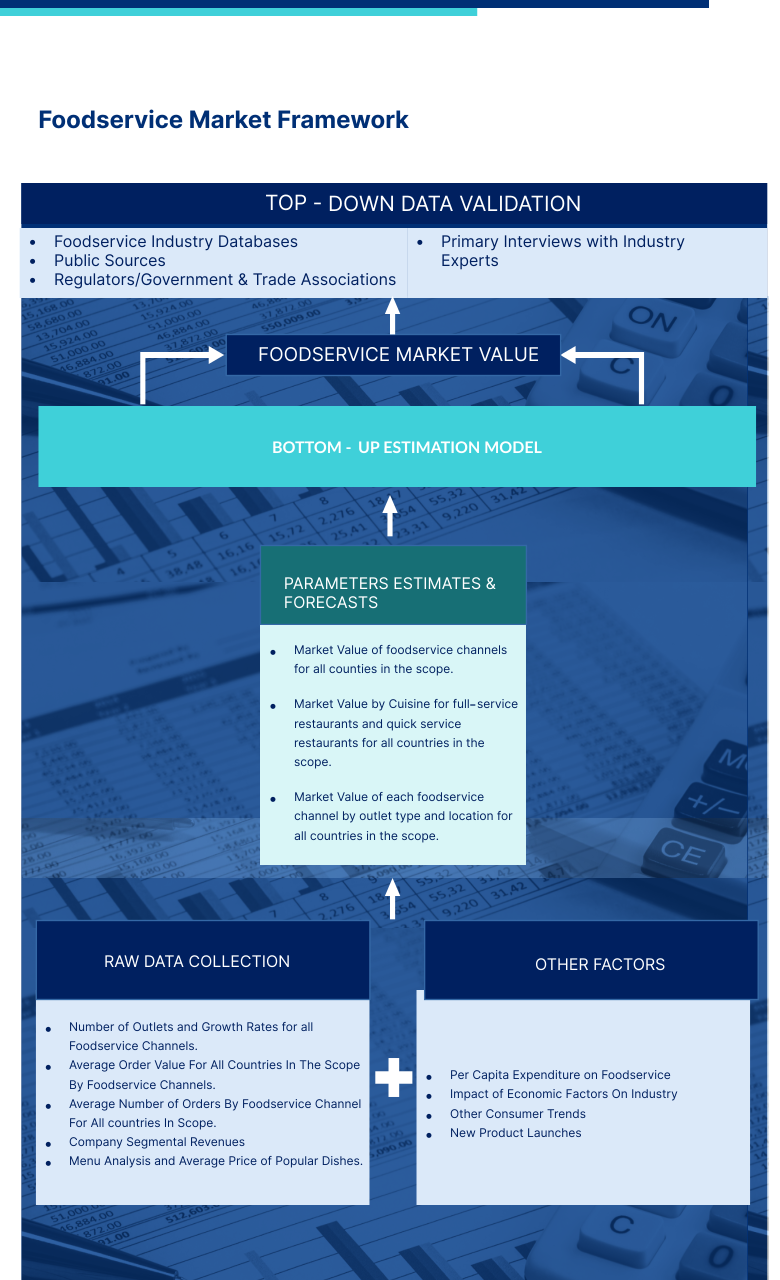
- Step-1: Identify Key Variables: In order to build a robust forecasting methodology, the variables and factors identified in Step 1 are tested against available historical market numbers. Through an iterative process, the variables required for the market forecast are set, and the model is built on the basis of these variables.
- Step-2: Build a Market Model: Market size estimations for the forecast years are in nominal terms. Inflation is considered for average order value, and it is forecasted as per predicted inflation rates in the countries.
- Step-3: Validate and Finalize: In this important step, all market numbers, variables, and analyst calls are validated through an extensive network of primary research experts from the market studied. The respondents are selected across levels and functions to generate a holistic picture of the market studied.
- Step-4: Research Outputs: Syndicated Reports, Custom Consulting Assignments, Databases & Subscription Platforms