
Market Overview
| Study Period | 2020 - 2031 |
|---|---|
| Forecast Data Period | 2026 - 2031 |
| Historical Data Period | 2020 - 2024 |
| Growth Rate | 6.45 % |
Major Players *Disclaimer: Major Players sorted in no particular order Image © Mordor Intelligence. Reuse requires attribution under CC BY 4.0. | |
India Artificial Organs And Bionics Market Analysis by Mordor Intelligence
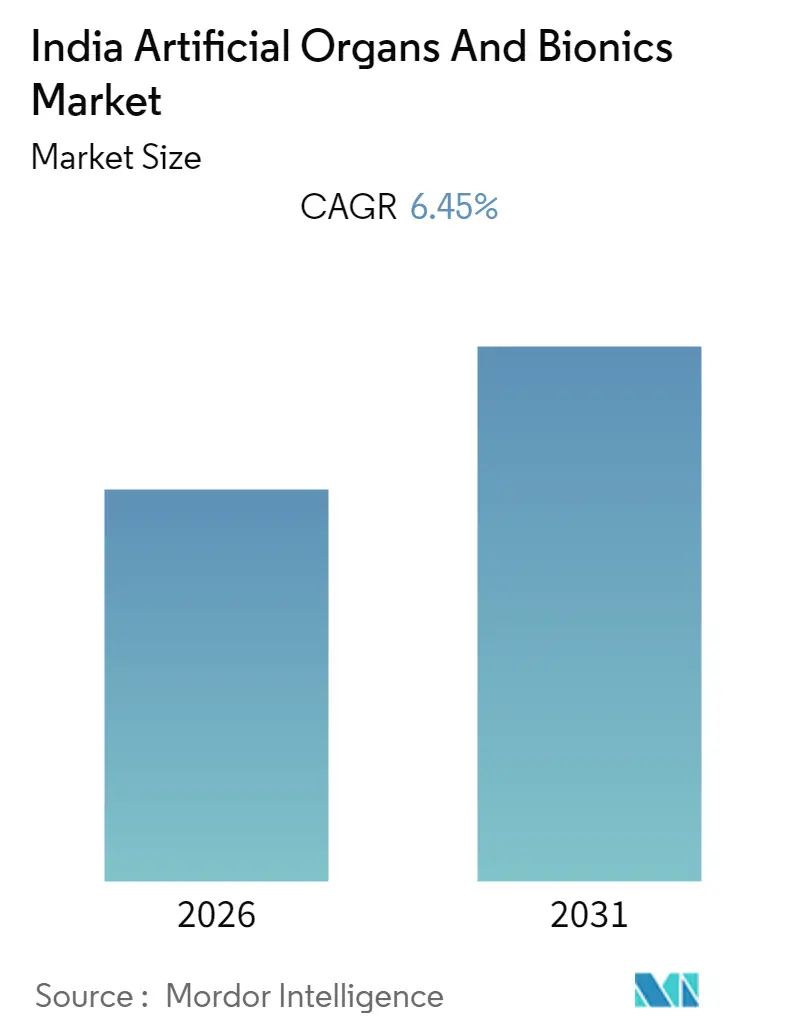
The India Artificial Organs and Bionics Market size is expected to register a CAGR of 6.45% during the forecast period.
The ongoing Covid-19 pandemic impacted the studied market significantly. During the initial phase of the pandemic due to the lockdowns and shutdowns, the market was impacted adversely. The number of transplants decreased during the initial phase of the pandemic. However, the adoption of cardiac bionics increased owing to the increasing cases of cardiovascular diseases in India. For instance, as per the article 'A case of post-COVID-19 mucormycosis with permanent pacemaker posted for functional endoscopic sinus surgery: Anaesthetic challenges' published in October 2021, the researchers of Maharashtra, India successfully managed a patient with post-COVID-19 mucormycosis with a permanent pacemaker in-situ posted for functional endoscopic sinus surgery (FESS) under general anesthesia. Such adoptions increased during the pandemic. Thus, the pandemic is expected to have a considerable impact on the market studied.
Factors such as the rising incidence of organ failures, scarcity of organ donors, and technological advancements are anticipated to drive market growth over the forecast period. For instance, as per the article 'Organ donation in India - There is light at the end of the tunnel' published in April 2022, it is estimated that almost 5 lakh Indians face organ failure every year, and yet less than 2%-3% of them receive a life-saving transplant. This burden of organ failure is anticipated to create opportunities for artificial organs and the bionics market in India. Thus, this is anticipated to drive artificial organs and bionics market growth in India over the forecast period.
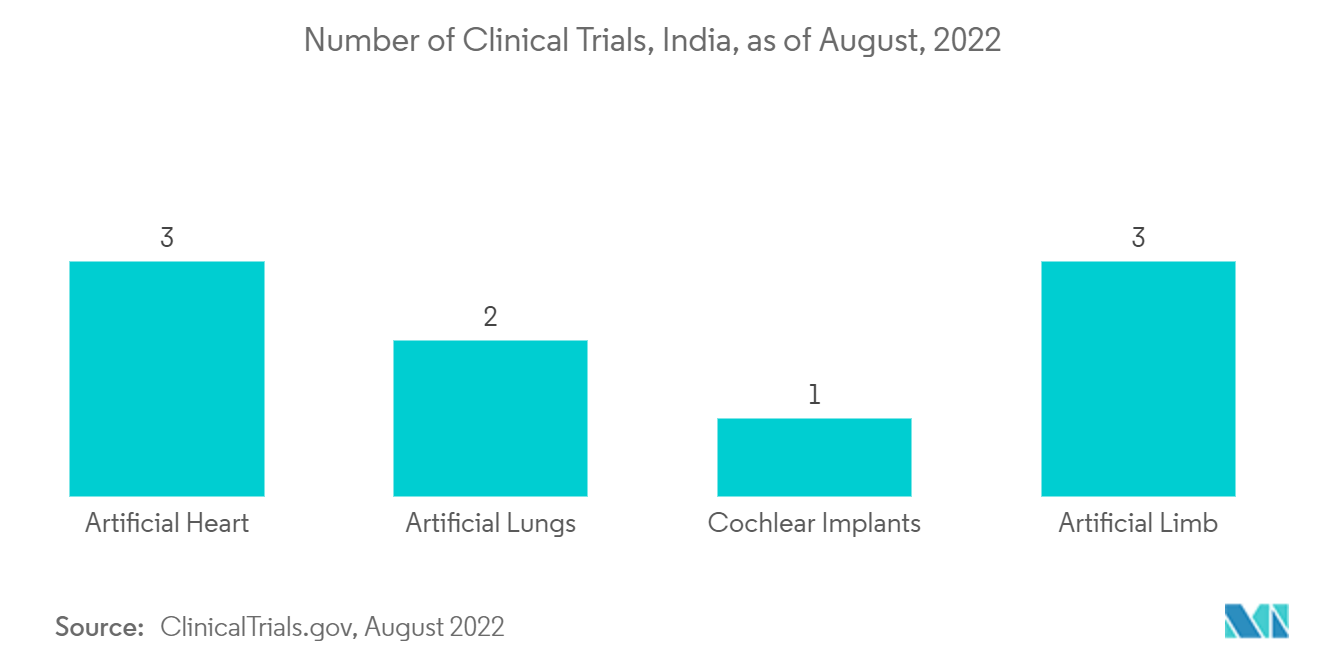
Moreover, the adoption of artificial organs is increasing in the country. For instance, in October 2021, Kerala's first artificial heart implantation was done successfully on a 61-year-old woman, and the device implanted on her was HeartMate 2 (a second-generation ventricular assist device). Thus, such adoption and developments are anticipated to fuel market growth in the country.
Therefore, owing to the aforesaid factors the market studied is expected to witness growth over the forecast period. However, strict regulations on the products are expected to hinder market growth over the studied period.
Note: Market size and forecast figures in this report are generated using Mordor Intelligence’s proprietary estimation framework, updated with the latest available data and insights as of 2026.
India Artificial Organs And Bionics Market Trends and Insights
Artificial Kidney Segment is Expected to Show Growth Over the Forecast Period
A wearable artificial kidney is a wearable dialysis machine. An individual with end-stage renal disease may use a wearable artificial kidney on a daily or even continuous basis. The increasing incidence and prevalence of renal failures in India are expected to drive the segment growth.
Kidney failure has become a burden in the country recently. As per the data published by Medindia in June 2022, almost 66% of kidney failure occurs due to hypertension or diabetes and there are nearly 7.85 million people suffering from chronic kidney failure in India. Additionally, as per the source mentioned above the incidence of kidney failure (or chronic kidney disease) has doubled over the past decade in the country. This shows a disease burden in the country. Thus, is expected to create demand for the adoption of artificial kidneys for patient survival, fueling the segment towards growth.
Furthermore, the article 'The future of the artificial kidney' published in October 2021 stated that in India, diabetes mellitus and hypertension are the main causes of chronic kidney disease and end-stage renal disease (ESRD), which is on the rise. In India, hemodialysis is the most widely used renal replacement therapy (RRT). Additionally, the source mentioned above also stated that the field of the artificial kidney is seeing exciting new advances that are frequently parallel and connected. Thus, owing to the rise in ESRD coupled with the adoption of artificial kidneys in India and technological advancements, the segment is predicted to witness growth over the forecast period.
Therefore, owing to the aforesaid factors the segment is expected to witness growth over the forecast period.


Competitive Landscape
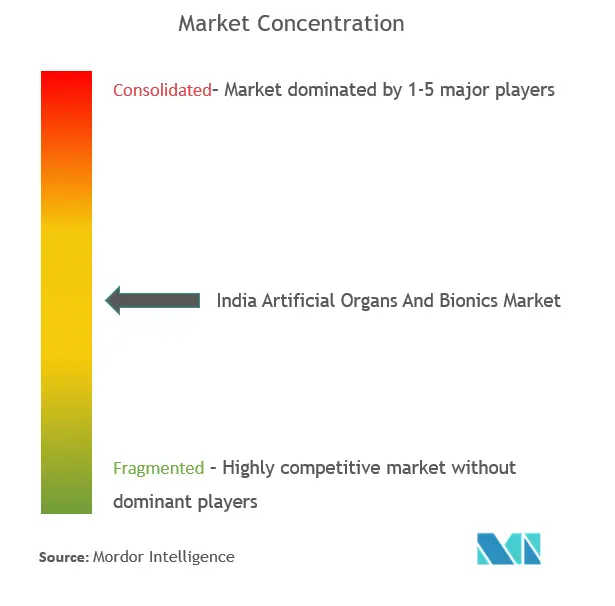
The market for artificial organs and bionics in India is moderately competitive. The major players in India's artificial organs and bionics market are Abiomed, Asahi Kasei Medical Co. Ltd, Baxter, Boston Scientific Corporation, Ekso Bionics Holdings Inc., Getinge AB, Medtronic, and Ossur, among others.
India Artificial Organs And Bionics Industry Leaders
Boston Scientific Corporation
Ossur
Medtronic
Baxter
Abiomed
- *Disclaimer: Major Players sorted in no particular order

Market Opportunities and Future Outlook
Policy-backed manufacturing and evidence-generation support is creating more headroom for implantable devices and adjacent bionics categories included in this market. In June 2026, the Department of Pharmaceuticals relaunched two sub-schemes under the Scheme for Strengthening of Medical Device Industry (SMDI): the Marginal Investment Scheme (up to INR 10 crore subsidy for manufacturing) and the Medical Device Clinical Studies Support Scheme (up to INR 5 crore subsidy for clinical studies). This improves the business case for localized production and for generating India-based clinical data for higher-risk device categories.
Companies supplying implants are also working around demand-side initiatives tied to patient safety and device lifecycle management. In May 2026, the Government of India outlined plans for a national registry to track implantable medical devices and patients, with the goal of improving traceability for recalls and procurement accountability. The government also discussed prioritizing 8-10 high-value medical devices for accelerated indigenous production (in consultation with industry bodies such as AiMeD), which creates an execution pathway for firms with India-ready portfolios and for suppliers looking to move beyond import-dependent finished-device models.
Recent Industry Developments
- June 2026: Medtronic introduced PulseSelect pulsed field ablation (PFA) technology in India for atrial fibrillation treatment. The launch expands access to a newer cardiac electrophysiology platform and supports demand for specialized consumables, mapping workflows, and physician training linked to cardiac bionics care pathways.
- October 2025: Medtronic launched Avalus Ultra bioprosthesis surgical aortic heart valves in India. This broadened the companys structural heart offering in-country and supported hospitals expanding surgical valve therapy options for patients with advanced cardiac disease.
- April 2024: Medtronic launched its Adaptive Deep Brain Stimulation (aDBS) system in India for Parkinsons disease patients. Bringing an advanced neuromodulation platform to the local market increases the installed base of high-end implantable neurostimulation systems and supports therapy adoption through clinician familiarity and follow-on service support.


Research Methodology Framework and Report Scope
Market Definition and Coverage
This market captures the value of artificial organs and bionic implants used in India to replace or improve body functions, including implantable devices and the related system components that are sold for clinical use.
Scope exclusions: We exclude research-stage prototypes, non-medical consumer wearables, and services such as surgery fees and long-term rehabilitation that sit outside device revenues.
Segmentation Overview
- By Artificial Organ
- Artificial Heart
- Artificial Kidney
- Artificial Lungs
- Cochlear Implants
- Other Organ Types
- By Bionics
- Vision Bionics
- Ear Bionics
- Orthopedic Bionic
- Cardiac Bionics
Data Sources, Market Sizing, and Validation
Desk Research
Desk research was used to set the medical device context and to build the starting demand pool for India. We referenced public healthcare statistics and macro signals to understand procedure load, patient access, and import reliance for high value implants. Those indicators were then translated into sizing drivers.
Sources included, for example, Ministry of Health and Family Welfare publications, CDSCO and other Indian regulatory notifications, National Health Accounts style releases, customs and trade statistics from official portals, and peer-reviewed clinical journals on implant outcomes and adoption. We also reviewed company annual reports, investor presentations, reputable press coverage, and a paid subscription focused on company financials and news to cross-check shipment trends and portfolio exposure. This list is not exhaustive, and many other sources were used for data collection, validation, and research clarification.
Primary Interviews and Surveys
Primary work focused on validating which devices are actually used in routine care and how pricing changes across public and private channels. Interviews and surveys covered clinicians, hospital procurement teams, distributors, and device-focused executives across major Indian metros and emerging state hubs. Findings were then used to close gaps from desk inputs.
Pricing ladders, replacement cycles, and the share of imported versus locally assembled products were tested. This helped us tighten assumptions and avoid over-counting between related device categories.
Distribution of primary research fieldwork respondents
| Company type | Respondent position |
|---|---|
| Top tier: 29% | CXOs: 16% |
| Mid tier: 51% | Functional/Unit leaders: 27% |
| Smaller Players: 20% | Managers: 57% |
Market-Sizing & Forecasting
Sizing was built using a top-down approach where India procedure and patient signals were converted into an addressable implant demand pool, followed by pricing normalization to reach market value. To keep the numbers realistic, selective bottom-up checks were added using sampled ASP times volume by device type, distributor channel feedback, and supplier exposure estimates to adjust totals.
Inputs that mattered most included cochlear implant and cardiovascular intervention volumes, dialysis and renal therapy utilization as a proxy for kidney replacement needs, hospital bed and specialty center expansion, import dependence for high-end implants, and observed price bands across public tenders versus private hospitals. Where bottom-up pieces were incomplete, gaps were handled by using conservative penetration ranges that were agreed with interviewees and then stress-tested across states and care settings.
Forecasting used scenario analysis, because adoption is influenced by reimbursement decisions, clinical capacity, and affordability. Growth cases were shaped using expert views on patient awareness, surgeon availability, and expected price erosion from local manufacturing and tender-based purchasing.
Data Validation & Update Cycle
Model outputs were checked against independent signals such as trade movement for implantable devices, announced capacity additions in specialty hospitals, and major regulatory or reimbursement changes. When a variance showed up, assumptions were reopened, outliers were traced back to the input, and experts were re-contacted if the gap could not be explained with documented sources.
Before sign-off, the work goes through multi-step analyst reviews that include logic checks, unit consistency checks, and year-on-year reasonability checks at total and device-group levels. Reports are refreshed annually, with interim updates when material events occur, and a final pre-delivery review is done so clients receive the latest updated view.
Mordor Intelligence's India Artificial Organs Bionic Implants Market Estimate Compared With Other Published Estimates
Published numbers for this market often do not match because each publisher draws the lines differently on what counts as a device sale versus a broader care ecosystem. Differences also come from the chosen base year, how import pricing is converted into realized selling prices, and whether adoption is modeled from procedures or a higher growth assumption.
The main gap comes from mixing device revenues with therapy services and adjacent durable equipment. Mordor Intelligence counts only implantable artificial organ and bionic device revenues sold into Indian care settings, and pricing is validated using hospital and channel checks. Some estimates also apply aggressive penetration ramps without reconciling them to specialist capacity and referral patterns, which can push near-term totals higher.
Benchmark comparison
| Source | Market Size | Gaps in Research Methodology |
|---|---|---|
| Mordor Intelligence | USD 0.00 M (2024) | |
| Global Consultancy A | USD 581.00 M (2024) | Likely includes a wider basket that can blend device revenues with supporting equipment and care services, and it uses a higher adoption trajectory that is not anchored to procedure-linked demand checks. |
| Industry Publisher B | USD 590.60 M (2024) | May treat the market as a broader technology bucket, which can pull in enabling components and non-implant categories, and it can apply uniform pricing without separating tender-driven public pricing from private channel pricing. |
Overall, the spread is mainly explained by what is counted and how adoption is tied back to real clinical throughput. By keeping the model traceable to procedure signals, channel pricing, and realistic penetration ranges, the estimate stays easier to reproduce and simpler to update when new demand or pricing evidence appears.


Key Questions Answered in the Report
What is the current India Artificial Organs and Bionics Market size?
The India Artificial Organs and Bionics Market is projected to register a CAGR of 6.45% during the forecast period (2026-2031)
Who are the key players in India Artificial Organs and Bionics Market?
Boston Scientific Corporation, Ossur, Medtronic, Baxter and Abiomed are the major companies operating in the India Artificial Organs and Bionics Market.
What years does this India Artificial Organs and Bionics Market cover?
The report covers the India Artificial Organs and Bionics Market historical market size for years: 2019, 2020, 2021, 2022, 2023, 2024 and 2025. The report also forecasts the India Artificial Organs and Bionics Market size for years: 2026, 2027, 2028, 2029, 2030 and 2031.
Page last updated on:





