
In-App Messaging Software Market Size and Share
Market Overview
| Study Period | 2020 - 2031 |
|---|---|
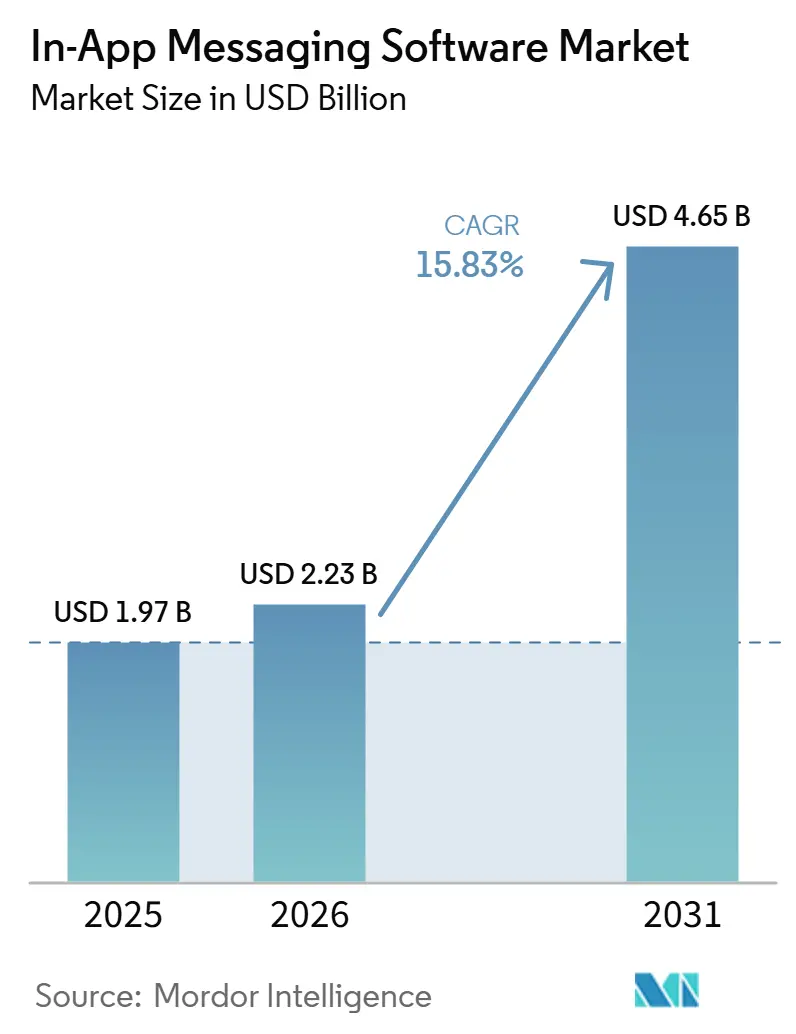
| Market Size (2026) | USD 2.23 Billion |
| Market Size (2031) | USD 4.65 Billion |
| Growth Rate (2026 - 2031) | 15.83 % |
| Fastest Growing Market | Asia-Pacific |
| Largest Market | North America |
| Market Concentration | Medium |
Major Players *Disclaimer: Major Players sorted in no particular order Image © Mordor Intelligence. Reuse requires attribution under CC BY 4.0. | |
In-App Messaging Software Market Analysis by Mordor Intelligence
The in-app messaging software market size was valued at USD 1.97 billion in 2025 and is estimated to grow from USD 2.23 billion in 2026 to reach USD 4.65 billion by 2031, at a CAGR of 15.83% during the forecast period (2026-2031). The in-app messaging software market is benefiting as enterprises shift spending from paid retargeting channels to communications that leverage first-party behavioral data during active app sessions. Browser and mobile platform privacy changes have reduced the reach of third-party tracking, increasing the value of customer interactions within owned applications. AI-based decisioning and cross-channel journey management are extending the role of these platforms beyond basic alerts. Vendors are responding by combining personalization, analytics, and automation in broader customer engagement suites. Data governance, consent management, and the ability to limit irrelevant messages will remain important factors in the in-app messaging software market.
Key Report Takeaways
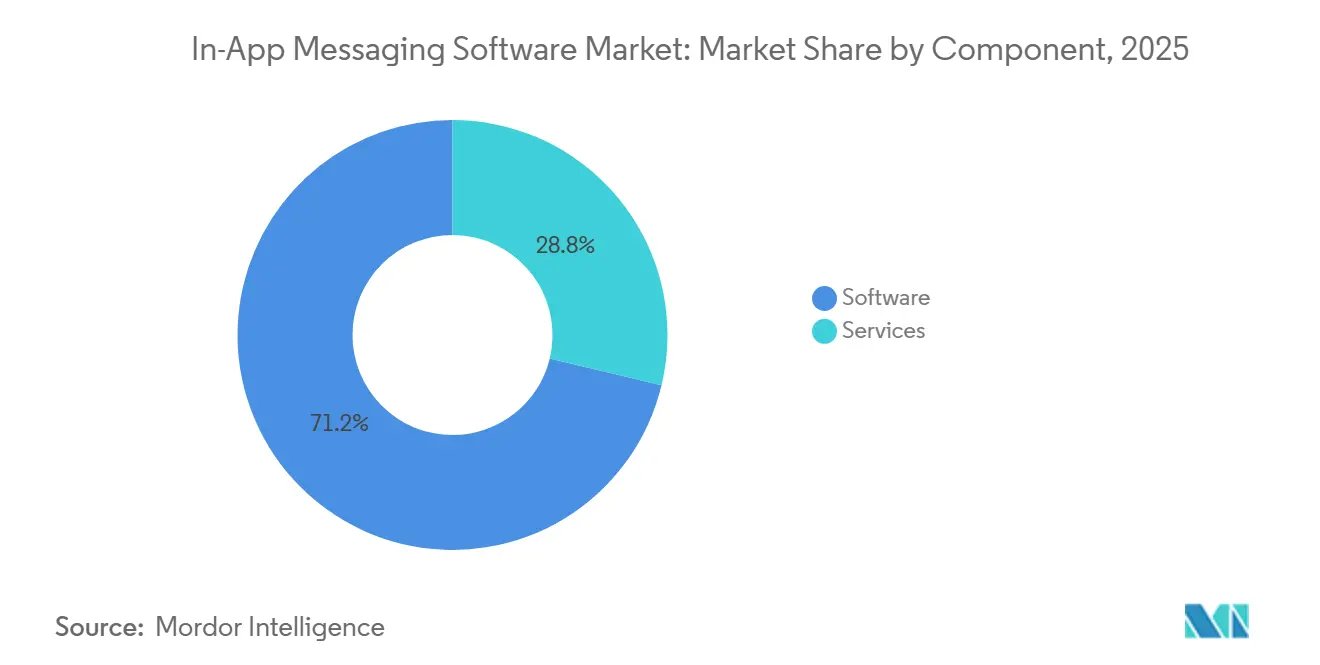
- By component, software held 71.24% of the in-app messaging software market share in 2025, while services are projected to expand at a 18.82% CAGR through 2031.
- By deployment mode, cloud accounted for 68.41% of the in-app messaging software market share in 2025, while hybrid deployment is projected to grow at a 17.69% CAGR through 2031.
- By enterprise size, large enterprises accounted for 64.83% of revenue share in 2025, while SMEs are projected to record the highest CAGR of 19.43% through 2031.
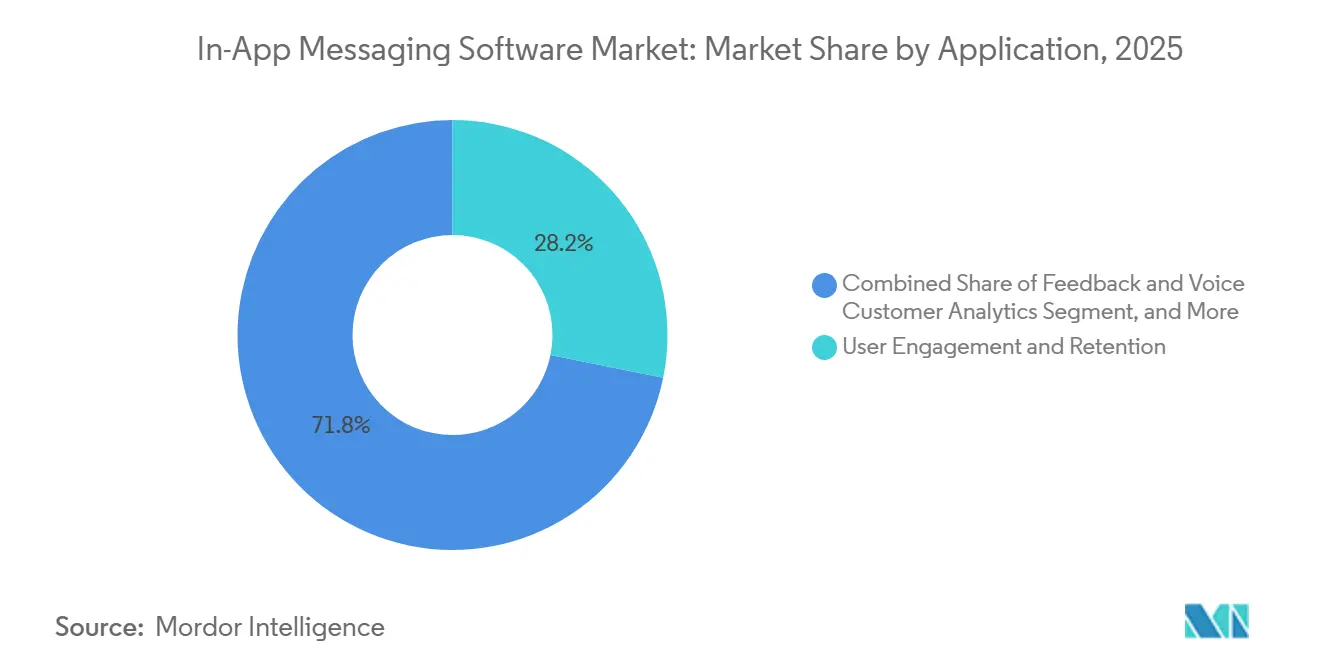
- By application, user engagement and retention accounted for 28.19% of the market share in 2025, while feedback and voice-of-customer analytics are projected to grow at a 20.24% CAGR through 2031.
- By end user, retail and e-commerce held a 24.36% share of the in-app messaging software market in 2025, while healthcare and life sciences are projected to grow at a 18.91% CAGR through 2031.
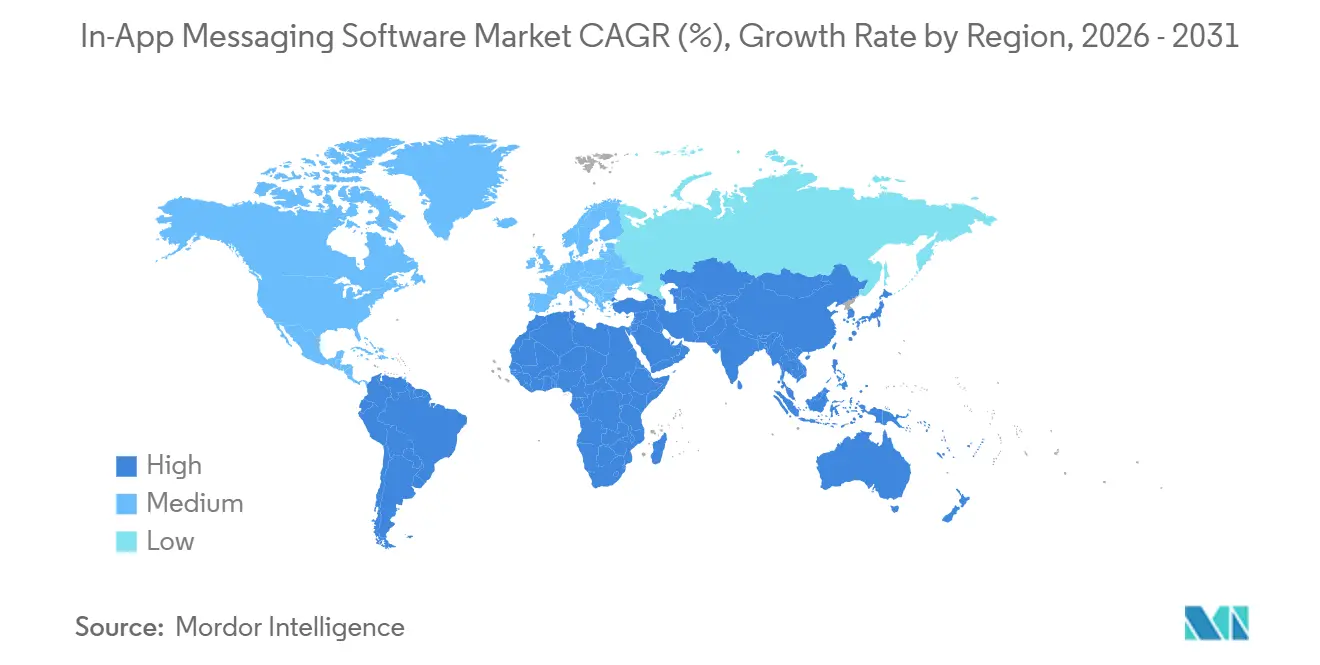
- By geography, North America held 34.62% share in 2025, while Asia-Pacific is projected to expand at a 19.18% CAGR through 2031.
Note: Market size and forecast figures in this report are generated using Mordor Intelligence’s proprietary estimation framework, updated with the latest available data and insights as of January 2026.
Market Trends and Insights
Drivers Impact Analysis of In-App Messaging Software Market*
| Driver | (~) % Impact on CAGR Forecast | Geographic Relevance | Impact Timeline |
|---|---|---|---|
| Omnichannel Customer Experience Imperative | +3.9% | Global | Short term (≤ 2 years) |
| AI-Powered Personalization and Optimization | +3.5% | Global, led by North America and Europe | Medium term (2-4 years) |
| Mobile-First and App-Centric Business Models | +2.7% | Asia-Pacific core, spill-over to Middle East and Africa | Short term (≤ 2 years) |
| Real-Time In-Session Decisioning for Revenue and Retention | +2.2% | North America and EU | Medium term (2-4 years) |
| First-Party Data Strategy and Privacy Compliance | +1.6% | EU and North America | Medium term (2-4 years) |
| Embedded Messaging as a Lower-Cost Alternative to Paid Re-Engagement | +1.2% | Global | Long term (≥ 4 years) |
| Source: Mordor Intelligence | |||
Omnichannel Customer Experience Imperative
Enterprises increasingly use in-app messages as part of a continuous customer interaction rather than as a separate notification channel.[1]Zendesk, “CX Trends 2026,” Zendesk, zendesk.com In 2026, Zendesk reported that 81% of consumers viewed AI as integral to modern service. Its research also found that 76% of Asia-Pacific consumers preferred providers that continued a conversation across text, image, and voice without requiring customers to repeat information. This requirement favors platforms that retain context across applications and other customer channels. Infobip stated that its analysis covered 628 billion mobile-channel interactions in 2025 and found stronger retention outcomes among brands using 4 or more engagement channels with in-app messaging as the final conversion channel. The in-app messaging software market, therefore, gives broader journey-management vendors an advantage over standalone notification providers.
AI-Powered Personalization and Optimization
AI capabilities have become central to message timing, content selection, and audience decisions in the in-app messaging software market. MoEngage reported that journey-based in-app messages achieved an average conversion rate of 44.17% in its 2026 benchmark study of more than 1,350 consumer brands.[2]MoEngage, “Resilience Redefined: The 2026 Customer Engagement Benchmarks,” MoEngage, moengage.com The same study reported that non-personalized broadcast messages could have opt-out rates up to 25 times higher than behaviorally triggered alternatives. These results make behavioral relevance more important than higher message volume. MoEngage acquired Aampe in June 2026 to add per-user agentic decisioning to its platform. Providers that can make individual decisions while keeping those decisions understandable to customers may be better placed to retain enterprise accounts.
Mobile-First and App-Centric Business Models
Mobile applications have become important revenue and service channels for retail, financial services, healthcare, and media organizations. This gives the in-app messaging software market access to users while they are already engaged with an application. OneSignal reported that in-app message volume was growing 3-4 times faster year over year than other mobile channels in 2026.[3]OneSignal, “The 2026 State of Customer Engagement Report,” OneSignal, onesignal.com The report also found that 46.39% of marketers had not implemented meaningful personalization for this channel. MoEngage reported a 46.99% conversion rate for journey-based in-app messages in retail applications. The remaining personalization gap underscores demand for tools that can serve multilingual, mobile-first businesses in Asia-Pacific, the Middle East, and Africa.
Real-Time In-Session Decisioning for Revenue and Retention
Real-time responses to customer behavior are an important differentiator in the in-app messaging software market. A platform can respond to cart abandonment, feature hesitation, or a possible subscription downgrade while the customer is still in the application. MoEngage updated its platform in March 2026 to extend real-time campaign eligibility reevaluation to in-app and on-site messages. The update allowed campaign content to reflect an active session without requiring a restart of the application. OneSignal found that 48% of marketers reported that AI inbox filters affected delivery for push and external channels. In-session delivery can avoid these external delivery constraints and make current behavioral information more useful than older audience lists.
Restraints Impact Analysis of In-App Messaging Software Market*
| Restraint | (~) % Impact on CAGR Forecast | Geographic Relevance | Impact Timeline |
|---|---|---|---|
| Data Privacy, Consent, and Security Exposure | -1.8% | EU, North America, Australia | Short term (≤ 2 years) |
| Integration Complexity Across Legacy and Fragmented App Stacks | -1.2% | Global, acute in Asia-Pacific and Middle East and Africa | Medium term (2-4 years) |
| In-App Notification Fatigue and Attention Saturation | -0.8% | Global | Short term (≤ 2 years) |
| SDK Release Dependency and App-Store Governance Risk | -0.5% | Global | Medium term (2-4 years) |
| Source: Mordor Intelligence | |||
Data Privacy, Consent, and Security Exposure
Privacy and consent requirements can lengthen platform evaluation and deployment processes in the in-app messaging software market. France's data protection authority published a 98-page mobile application privacy framework in September 2024 and began a focused mobile-app enforcement campaign in 2025.[4]Commission Nationale de l’Informatique et des Libertés, “Mobile Applications,” CNIL, cnil.fr These developments place closer attention on SDK-level data collection and explicit consent. Google Play policies, effective January 28, 2026, require affirmative user consent for in-app data collection under its Digital Markets Act compliance obligations. Healthcare buyers also require auditable consent controls and appropriate contractual arrangements. Vendors with established privacy controls can reduce buyer concerns, while smaller providers may face longer procurement cycles.
Integration Complexity Across Legacy and Fragmented App Stacks
In-app messaging deployments need SDK integration, version management, and connections with customer relationship, data, and analytics systems. These requirements create recurring work across iOS and Android release cycles. Large organizations may also have on-premises data systems that were not designed for application programming interface (API)- based connections. This complexity can delay the benefits expected from a new messaging platform. It also encourages buyers to favor vendors with prebuilt connectors for major customer relationship management and customer data platforms. The issue is more pronounced in environments where enterprise application landscapes are varied and mobile engineering resources are limited. A successful implementation must align data definitions, customer permissions, and event tracking before messages can be made relevant. Inconsistent records can produce unsuitable messages or prevent a valid customer action from triggering a response. Integration quality is therefore a practical measure of the value a platform delivers.
*Our forecasts treat driver/restraint impacts as directional, not additive. The impact forecasts reflect baseline growth, mix effects, and variable interactions.
In-App Messaging Software Market Segment Analysis
By Component:
Software Leads Revenue While Services ExpandSoftware held 71.24% of the in-app messaging software market share in 2025. The position reflected the recurring-revenue model of platforms embedded through software development kits. Behavioral data, workflows, and message templates can become closely tied to the platform over time. Replacing a provider may require data migration, application testing, and changes to campaign operations. These factors strengthen renewal incentives for established software vendors. Braze introduced Creative Studio in April 2026, with integrations with Figma and Canva. The release showed how vendors are incorporating work that might otherwise require outside services into their platforms.
Services are projected to grow at a 18.82% CAGR through 2031. This growth comes from the need for implementation assistance, model governance, testing, and integration across customer systems. AI-led campaigns require organizations to review how decisions are made and how customer data is used. Services can help teams design the required controls and measure campaign outcomes. They can also assist customers w dedicated mobile engineering teams. Software providers may use services to deepen client relationships after the original implementation. The in-app messaging software market can therefore retain a software-led revenue structure while services address the operational demands of advanced deployments. Service partners can also help define campaign rules, user permissions, and escalation paths before automated messages are activated. Their role becomes more relevant when organizations need consistent practices across marketing, product, support, and compliance teams. Providers that offer both software and implementation support may be able to reduce the time needed for customers to move from a pilot to regular use.


By Deployment Mode:
Cloud Retains Scale While Hybrid Gains DemandCloud deployment accounted for 68.41% of the in-app messaging software market share in 2025. Digital-native companies favor cloud tools because they can scale computing resources and connect behavioral data with messaging workflows. Cloud delivery also supports rapid campaign changes and continuous model updates. These capabilities are useful for applications that need to respond during an active customer session. The installed base of cloud deployments supports vendor subscription revenue and broadens access for smaller buyers. Cloud remains appropriate where data residency and security requirements can be met through the provider's architecture. Its large share indicates that ease of deployment still matters for many customers. Cloud tools can also give distributed teams a shared view of campaign performance and customer response data. This is useful for organizations that manage several applications or operate across multiple countries. The model remains attractive when vendors can demonstrate reliable security, availability, and data handling controls.
Hybrid deployment is projected to grow at a 17.69% CAGR through 2031. Banking, insurance, and healthcare users often need greater control over personally identifiable information and regional data residency. At the same time, they need cloud-based computing for AI-enabled personalization. Braze added EU-region Google Cloud hosting for its Decisioning Studio in April 2026. This move reflected the need to keep customer data within European boundaries while continuing to support decisioning services. On-premise deployments remain relevant for government and defense settings that use isolated environments. However, hybrid architectures offer a path for regulated users who want data control without giving up cloud capabilities. This approach can allow sensitive records to remain within a chosen environment while selected data supports centralized analysis. It may also help organizations apply different controls to different data types. The higher growth rate shows that architecture decisions are increasingly linked to legal, operational, and customer trust requirements. Buyers must consider where data is stored, who can access it, and how information is moved between systems. These decisions can affect both the timetable for implementation and the range of messaging functions available. Hybrid deployment is therefore a business and governance choice as well as a technical one.
By Enterprise Size:
Large Enterprises Hold Revenue While SMEs Grow FasterLarge enterprises accounted for 64.83% of the in-app messaging software market size in 2025. Their share reflects high message volumes, multiyear contracts, and broad customer data environments. These buyers often require security certifications, formal service-level agreements, and regional data availability. Established vendors are more likely to meet these requirements across multiple business units. Procurement and information technology reviews can be lengthy, which favors providers with proven implementation records. Large organizations also have resources to integrate messaging with customer relationship management, analytics, and product systems. This helps explain why large enterprises continue to represent most current revenue. Their global operations may also require message programs that work across different languages, regulations, and application versions. A single platform can offer governance for these programs while allowing regional teams to tailor content. As a result, the value of a contract can extend beyond basic message delivery.
SMEs are projected to grow at a 19.43% CAGR through 2031. No-code configuration, prebuilt journey templates, and active-user pricing have reduced adoption barriers. MoEngage added Rich Communication Services as a native channel in its Flows automation engine in January 2026. Such tools allow smaller teams to work across channels without extensive specialist development resources. Government digitalization programs in India, Brazil, and Indonesia are also expanding the pool of small businesses that use customer-facing applications. Vendors with localized onboarding and flexible pricing can better address this group. SME adoption expands the in-app messaging software market's buyer base beyond the largest application publishers. Smaller organizations can begin with a limited campaign or one application before adding more customer journeys. This lower-risk entry point can make adoption more practical for businesses with constrained budgets. It also creates an opportunity for providers to expand accounts as customer applications and user bases grow. Many smaller teams seek tools that do not require a major change to existing application code after the first implementation. Clear templates and simple reporting can help them learn which messages customers find useful. This can make the early use of the platform more manageable for organizations that are still building formal customer engagement processes.
By Application:
Retention Leads While Voice of Customer Analytics AcceleratesUser engagement and retention held 28.19% of the in-app messaging software market share in 2025. The application uses messages to guide users back to features, content, or transactions during an active session. It is important because a retained user can be more valuable than a customer that must be reacquired through paid channels. Behavioral triggers allow messages to reflect what a customer is doing rather than rely on a fixed calendar. This use case supports product teams, marketers, and customer support teams. It also provides a practical starting point for organizations adopting in-app messaging. The size of this application indicates that customer retention remains the platform's main commercial use. Teams can use these messages to explain product changes, remind customers of incomplete actions, or guide the use of a newly released feature. The message is most useful when it appears at a relevant moment and clearly relates to the task underway. These requirements make data quality and message design important alongside the software itself. Organizations must define which customer actions deserve a message and which actions should remain undisturbed. They also need to consider the appropriate content for customers at different stages of use. Careful design can help the platform support retention without creating unnecessary interruptions.
Feedback and voice-of-customer analytics is projected to expand at a 20.24% CAGR through 2031. Organizations are using messages not only to distribute communications but also to collect signals that inform later interactions. This creates a feedback loop between customer responses, behavioral data, and personalization decisions. MoEngage extended in-app and on-site messaging within its Portfolio orchestration layer in March 2026. The update allowed campaign eligibility to be reevaluated using live session data. Marketing and promotions, customer support, and product onboarding address other stages of the customer journey. Together, these applications broaden the use of the in-app messaging software market from promotion to service, learning, and product adoption. Feedback tools can help organizations identify recurring issues that may not appear in standard web analytics. Support messages can direct customers to relevant help before they leave an application. Onboarding prompts can also improve feature discovery when users first encounter a product.

By End User:
Retail Holds the Largest Position While Healthcare AdvancesRetail and e-commerce held 24.36% of the in-app messaging software market share in 2025. Retail applications use customer behavior to present relevant offers and reminders during high-intent shopping sessions. This can be more timely than email or push communications that reach the customer outside the application. MoEngage reported that journey-based messages in retail applications had a 46.99% conversion rate in its 2026 benchmark report. Retailers also use these systems to encourage repeat purchases and respond to abandoned carts. The vertical scale gives vendors an important base of demanding, high-volume customers. Effective frequency controls remain necessary to prevent customer fatigue. Retailers must balance the opportunity to present an offer with the risk that repeated prompts may erode trust. Campaign design often requires a clear link between a customer's current behavior and the message received. This makes testing, suppression rules, and measurement important parts of retail deployments.
The healthcare and life sciences industry is projected to grow at a 18.91% CAGR through 2031. Telehealth and chronic disease management applications are increasingly using digital communication with patients and care teams. The Centers for Medicare and Medicaid Services permitted HIPAA-compliant messaging for care coordination and patient communication in 2024. This change opened a clearer path for compliant platform providers to address healthcare needs. Business Associate Agreements, security controls, and consent records can be meaningful requirements in vendor selection. BFSI applications focus on transaction notices, authentication, and fraud alerts, while education, manufacturing, media, government, travel, and hospitality have different operational needs. These varied requirements support demand for configurable tools rather than one fixed messaging model. Healthcare users may need an appointment, a care plan, and educational communications that meet privacy expectations. Financial institutions may prioritize reliable delivery for security-related notices and account activity. Other sectors may place more weight on product education, service updates, or transaction completion.
Geography Analysis
North America In-App Messaging Software Market
North America held 34.62% of the in-app messaging software market share in 2025. The region has a high concentration of enterprise software buyers, mature mobile commerce, and the headquarters of many major platform vendors. The United States drives demand from retail, BFSI, and healthcare organizations that connect messaging with customer data platforms. Canada contributes to demand in financial services, while Mexico's expanding fintech sector supports mobile customer engagement needs. Competition in the region is strong because full-suite vendors, product-adoption specialists, and AI-focused providers serve the same enterprise accounts. State privacy rules and California Consumer Privacy Act enforcement are also encouraging first-party data approaches. Buyers in the region often evaluate how well a provider works with existing customer data, marketing, and product systems. They also assess the vendor's ability to support large message volumes without losing control over customer permissions. These needs support demand for platforms that combine integration depth with clear governance. North American enterprises frequently have several customer-facing applications and separate teams responsible for them. This can increase the value of a consistent framework for campaign approvals, access management, and performance reporting. Providers that support these controls can be more credible partners for complex deployments.
APAC In-App Messaging Software Market
Asia-Pacific is projected to grow at a 19.18% CAGR through 2031. India, South Korea, Southeast Asia, Japan, and China are important markets, although their demand drivers differ. India's fintech and health technology ecosystems require scalable and consent-managed customer messaging. South Korea and Japan support enterprise deployments that have high message volumes. Indonesia, Vietnam, and the Philippines are expanding digital consumer bases through application adoption, digitalization programs, and super-app development. The in-app messaging software market has opportunities in these countries for vendors that support local languages and flexible pricing. Demand is shaped by businesses that acquired customers through smartphones rather than desktop channels. These companies may expect messaging tools to work with mobile payments, local service models, and high-volume applications. Vendors that simplify setup are more relevant to newer digital businesses. The region also contains both mature technology markets and rapidly expanding consumer application environments. This diversity limits the usefulness of a uniform sales and product approach. Providers need to balance advanced capabilities with tools understandable to smaller or newer application teams.
EMEA and South America In-App Messaging Software Market
Europe, South America, the Middle East, and Africa represent distinct demand environments. European customers place substantial weight on GDPR compliance and data residency when choosing providers. Braze's EU-region hosting initiative in 2026 reflected the importance of these requirements for enterprise contracts. Brazil's digital retail and fintech sectors use real-time transaction and engagement tools, supported by the growth of instant payments. Gulf Cooperation Council countries invest in mobile government services and retail applications, while Nigeria and South Africa are important markets for mobile payments and consumer applications. Differences in infrastructure, privacy expectations, and mobile adoption mean vendors must adapt deployments to each region. European buyers may prioritize data governance over rapid feature expansion. South American and African users may prioritize accessible mobile services and payment-related communications. Regional adaptation can therefore affect the pace of adoption as much as the platform's basic availability. A provider's local data options, language support, and commercial model can influence whether it is considered for a contract. Regional partners may also be useful where customers need implementation support or familiarity with local requirements. These factors can shape the competitive position of international and local vendors.

Competitive Landscape
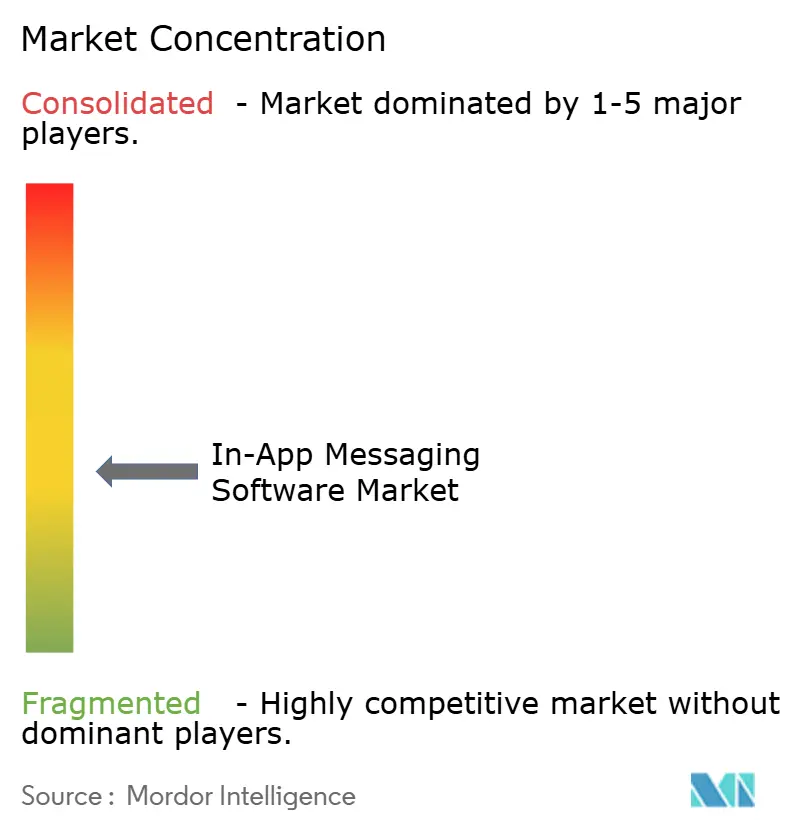
The in-app messaging software market is moderately fragmented. Full-suite customer engagement platforms compete with specialists in mobile engagement, product adoption, and decisioning. Braze, Intercom, OneSignal, Airship, MoEngage, CleverTap, Sendbird, Customer.io, Iterable, Swrve, Pushwoosh, WebEngage, Xtremepush, MessageGears, Optimove, Cordial, Pendo, Appcues, Userpilot, and Chameleon address either in-app messaging directly or adjacent use cases. This broad vendor base gives buyers options across application sizes and deployment needs. However, larger vendors can combine messaging with data management, analytics, and other customer channels. This places pressure on narrow providers that lack integration breadth or focused domain expertise. Some customers will prefer a full platform that reduces the number of suppliers they manage. Others may select a specialist where product onboarding, developer experience, or a specific communication workflow is central to their needs. The competitive result is a wide range of offerings rather than a single standardized solution. A customer engagement suite may appeal to organizations seeking to share data and coordinate across channels. A specialist may appeal where a particular application workflow needs more detailed functionality. This difference supports continued competition across both broad platforms and focused providers.
AI-based campaign automation is becoming a central battleground in the in-app messaging software market. MoEngage acquired Aampe in June 2026 to integrate per-user agentic decisioning with its Merlin AI platform. Braze made BrazeAI Operator and BrazeAI Agent Console generally available in April 2026. These moves seek to reduce the manual work involved in campaign design and timing. CleverTap's acquisition of Rehook.ai added promotion automation, including coupon, loyalty, referral, and gamification functions. Product-led vendors such as Pendo, Appcues, and Userpilot remain differentiated by onboarding and feature-discovery needs. Their focus is relevant when a software provider needs customers to understand and adopt features inside a digital product. Mobile-focused specialists can also compete by offering simpler implementation and close attention to application messaging. Competition will depend on whether a buyer values broad orchestration or a focused workflow. Larger providers may use partnerships, product releases, and acquisitions to add capabilities more quickly. Smaller providers can respond by concentrating on an application area where they have established customer knowledge. This keeps the competitive field active even when larger platforms broaden their product portfolios.
Compliance and the quality of real-time decisioning are other important competitive factors in the in-app messaging software market. Healthcare and financial services customers may prefer platforms that support HIPAA, SOC 2 Type II, ISO 27001, and data processing requirements. These capabilities can reduce friction during security and procurement reviews. Vendors also compete on the accuracy, timing, and auditability of behavioral triggers. Excessive or irrelevant notifications can weaken user engagement, so message precision is more useful than volume alone. Buyers may look for controls that explain why a message was selected and allow teams to revise automated workflows. They may also favor platforms that connect privacy settings with messaging decisions. These requirements make trust, operational control, and delivery relevance important parts of vendor differentiation. Organizations must be able to set limits on message frequency and prevent messaging when a customer has withdrawn consent. They may also need reporting that helps teams identify whether messages support a useful action. Providers that make these controls easier to manage can differentiate without relying solely on a larger feature set. Procurement teams may compare the quality of documentation, technical support, and training when platforms have similar core capabilities. These factors can affect whether a customer can use advanced functions after an initial rollout. Vendors with clear implementation methods may reduce uncertainty for buyers operating critical customer applications. Platform breadth is valuable when it reduces duplicate data work across marketing, support, and product teams. It can be less valuable when the added functions are difficult to use or do not connect with existing systems. Focused providers can remain relevant by offering a simpler experience for a defined set of customer tasks. The in-app messaging software market will continue to reward providers that connect product capability with reliable daily operations. Buyers are also likely to examine how a vendor supports account growth from a single application to several customer touchpoints. This may favor flexible platforms that can serve a basic use case before supporting more complex programs. The range of buyer needs will keep product fit, integration quality, and responsible data use central to competitive selection. Customers will continue to weigh these practical factors alongside AI functions when choosing a provider. A platform must support useful communications without adding avoidable complexity for the teams that manage it. The wide range of full-suite and specialist providers indicates a fragmented competitive structure.
In-App Messaging Software Industry Leaders
Braze, Inc.
Intercom, Inc.
OneSignal, Inc.
Airship Group, Inc.
MoEngage, Inc.
- *Disclaimer: Major Players sorted in no particular order
In-App Messaging Software Market Companies Covered in this Report
- Braze, Inc.
- Intercom, Inc.
- OneSignal, Inc.
- Airship Group, Inc.
- MoEngage, Inc.
- CleverTap Private Limited
- Sendbird, Inc.
- Peaberry Software, Inc.
- Iterable, Inc.
- Swrve, Inc.
- Pushwoosh, Inc.
- WebEngage Inc.
- Xtremepush Limited
- MessageGears, Inc.
- Optimove, Inc.
- Cordial Experience, Inc.
- Pendo.io, Inc.
- Appcues, Inc.
- Userpilot, Inc.
- Chameleon Technologies, Inc.

Recent Industry Developments in In-App Messaging Software Market
- July 2026: Intercom released a comprehensive update to its Fin AI Procedures and Simulations capabilities, introducing 12 functional enhancements that enable Fin to autonomously handle complex multi-step customer queries. The update includes AI-generated simulation suggestions, image-based testing inputs, and improved reasoning transparency, materially advancing Intercom's competitive position in AI-native in-app customer support automation.
- June 2026: MoEngage acquired San Francisco-based Aampe in an all-cash deal valued at tens of millions of USD. Aampe's per-user agentic AI system processes more than 200 billion individualized decisions weekly, deploying a dedicated AI agent for each end-user. MoEngage is integrating Aampe's technology with its Merlin AI platform to build what it describes as the first fully agentic customer engagement platform, with the acquisition designed to capture enterprise migration from incumbent marketing cloud vendors.
- June 2026: MoEngage launched Merlin AI Custom Agents, enabling lifecycle marketers to build proprietary workflow agents on MoEngage's data and tools with full auditability, marketer-defined operational guardrails, and an open Model Context Protocol server connector allowing external AI systems, including Claude and ChatGPT, to access MoEngage data and take cross-stack actions without custom integration work.
- March 2026: MoEngage extended its Portfolio orchestration engine to include in-app messaging and on-site messaging, enabling real-time campaign eligibility reevaluation based on live session data. The update also introduced no-code gamification templates, including spin-the-wheel and scratch-card formats, for on-site messaging deployments, expanding accessible engagement formats for non-technical marketing teams.


Global In-App Messaging Software Market Report Scope
The In-App Messaging Software Market comprises the ecosystem of software solutions and services that enable businesses to send real-time, contextual, and interactive messages directly to users within their mobile or web applications. Unlike traditional external channels like email or SMS, in-app messaging enables highly targeted, behavior-triggered communications, such as chatbots, pop-ups, modals, and in-app banners that appear while the user is actively using the application. Deployed across cloud-based, on-premise, or hybrid environments, these solutions cater to organizations of all sizes across diverse industries, including retail, BFSI, healthcare, and travel. By leveraging these platforms for applications ranging from product onboarding and customer support to marketing promotions and voice-of-customer analytics, businesses can significantly enhance the user experience, drive product adoption, increase customer retention, and boost overall conversion rates through personalized, non-intrusive engagement.
The In-App Messaging Software Market Report is Segmented by Component (Software, and Services), Deployment Mode (Cloud, On-Premise, and Hybrid), Enterprise Size (Large Enterprises, and Small and Medium Enterprises), Application (Marketing and Promotions, User Engagement and Retention, Customer Support, Product Adoption and Onboarding, and Feedback and Voice of Customer Analytics), End User (IT and Telecommunication, BFSI, Healthcare and Life Sciences, Retail and E-Commerce, Industrial Manufacturing, Education and Research Institutions, Media and Entertainment, Government and Administration, Travel and Hospitality, and Other End-User Industries), and Geography (North America, South America, Europe, Asia-Pacific, and Middle East and Africa). The Market Forecasts are Provided in Terms of Value (USD).
| Software |
| Services |
| Cloud |
| On-Premise |
| Hybrid |
| Large Enterprises |
| Small and Medium Enterprises |
| Marketing and Promotions |
| User Engagement and Retention |
| Customer Support |
| Product Adoption and Onboarding |
| Feedback and Voice of Customer Analytics |
| IT and Telecommunication |
| BFSI |
| Healthcare and Life Sciences |
| Retail and E-Commerce |
| Industrial Manufacturing |
| Education and Research Institutions |
| Media and Entertainment |
| Government and Administration |
| Travel and Hospitality |
| Other End User industries |
| North America | United States | |
| Canada | ||
| Mexico | ||
| South America | Brazil | |
| Argentina | ||
| Rest of South America | ||
| Europe | Germany | |
| United Kingdom | ||
| France | ||
| Russia | ||
| Spain | ||
| Rest of Europe | ||
| Asia-Pacific | China | |
| Japan | ||
| India | ||
| South Korea | ||
| Southeast Asia | ||
| Rest of Asia-Pacific | ||
| Middle East and Africa | Middle East | Saudi Arabia |
| United Arab Emirates | ||
| Rest of Middle East | ||
| Africa | South Africa | |
| Nigeria | ||
| Rest of Africa | ||
| By Component | Software | ||
| Services | |||
| By Deployment Mode | Cloud | ||
| On-Premise | |||
| Hybrid | |||
| By Enterprise Size | Large Enterprises | ||
| Small and Medium Enterprises | |||
| By Application | Marketing and Promotions | ||
| User Engagement and Retention | |||
| Customer Support | |||
| Product Adoption and Onboarding | |||
| Feedback and Voice of Customer Analytics | |||
| By End User Industry | IT and Telecommunication | ||
| BFSI | |||
| Healthcare and Life Sciences | |||
| Retail and E-Commerce | |||
| Industrial Manufacturing | |||
| Education and Research Institutions | |||
| Media and Entertainment | |||
| Government and Administration | |||
| Travel and Hospitality | |||
| Other End User industries | |||
| By Geography | North America | United States | |
| Canada | |||
| Mexico | |||
| South America | Brazil | ||
| Argentina | |||
| Rest of South America | |||
| Europe | Germany | ||
| United Kingdom | |||
| France | |||
| Russia | |||
| Spain | |||
| Rest of Europe | |||
| Asia-Pacific | China | ||
| Japan | |||
| India | |||
| South Korea | |||
| Southeast Asia | |||
| Rest of Asia-Pacific | |||
| Middle East and Africa | Middle East | Saudi Arabia | |
| United Arab Emirates | |||
| Rest of Middle East | |||
| Africa | South Africa | ||
| Nigeria | |||
| Rest of Africa | |||


Key Questions Answered in the Report
What is the size of the in-app messaging software market?
The in-app messaging software market size is USD 2.23 billion in 2026 and is forecast to reach USD 4.65 billion by 2031 at a CAGR of 15.83%.
What is driving demand for in-app messaging software?
First-party data use, mobile-first customer engagement, AI personalization, and real-time responses to user behavior are supporting demand.
Which component has the largest share?
Software held 71.24% share in 2025 because embedded platforms create recurring revenue and switching can require extensive application and data work.
Which deployment model is growing fastest?
Hybrid deployment is projected to grow at a 17.69% CAGR through 2031 as regulated users combine data control with cloud-based AI capabilities.
Which end-user sector leads adoption?
Retail and e-commerce held 24.36% share in 2025, supported by high-intent shopping interactions and behavioral offer delivery.
Which region is growing fastest?
Asia-Pacific is projected to grow at a 19.18% CAGR through 2031, supported by mobile application growth and digital-native business models.
Page last updated on:


 Your data is secure and never sold or shared.


